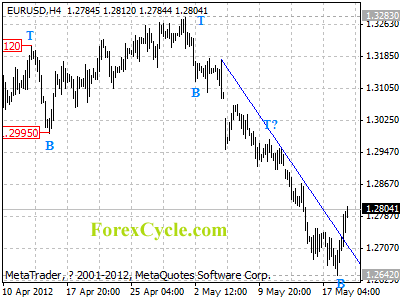
EURUSD rebounds from 1.2642

Being contained by 1.2624 (Jan 13 low) support, EURUSD rebounds from 1.2642 and breaks above the downward trend line on 4-hour chart, suggesting that a cycle bottom has been formed at 1.2642. Range trading between 1.2642 and 1.2900 would likely be seen in a couple of days. Another fall to re-test 1.2624 previous low support could be expected, a breakdown below this level will signal resumption of the long term downtrend from 1.4938 (May 4, 2011 high).

eurusd

Provided by ForexCycle.com

Currency Speculators pile into US Dollar long bets as Euro, Aussie bets falter

By CountingPips.com

The latest Commitments of Traders (COT) report, released on Friday by the Commodity Futures Trading Commission (CFTC), showed that large futures speculators increased their overall US dollar long positions last week for the second consecutive week as speculators added to their euro short positions to the highest level on record.

Non-commercial futures traders, including hedge funds and large speculators, increased their total US dollar long positions to $28.52 billion on May 15th from a total long position of $20.95 billion on May 8th, according to the CFTC COT data and calculations by Reuters which calculates the dollar positions against the euro, British pound, Japanese yen, Australian dollar, Canadian dollar and the Swiss franc.

Individual Currencies:

EuroFX: Currency speculator sentiment plummeted for the euro currency last week as euro net short positions or bets against the currency increased to 173,869 contracts on May 15th from the previous week’s total of 106,990 net short contracts on May 8th. This is the highest level for euro short positions on record surpassing the January 23rd level when short contracts totaled 171,347.


The COT report is published every Friday by the Commodity Futures Trading Commission (CFTC) and shows futures positions as of the previous Tuesday. It can be a useful tool for traders to gauge investor sentiment and to look for potential changes in the direction of a currency or commodity. Each currency contract is a quote for that currency directly against the U.S. dollar, where as a net short amount of contracts means that more speculators are betting that currency to fall against the dollar and net long position expect that currency to rise versus the dollar. The graphs overlay the forex spot closing price of each Tuesday when COT trader positions are reported for each corresponding spot currency pair.

GBP: British pound sterling positions dipped slightly last week after rising for a four consecutive weeks and ascending to their highest level in over a year. British pound positions saw a total of 25,021 net long contracts on May 15th following a total of 25,339 net long contracts registered on May 8th. Before last week’s pullback, Pound positions were at the highest level since May 3rd 2011 when long contracts equaled 30,807.

JPY: Japanese yen speculative contracts improved last week for a fifth consecutive week as Yen positions totaled 34,315 net short contracts reported on May 15th following a total of 41,093 net short contracts on May 8th. The improvement in the Japanese positions has coincided with the US Dollar falling against the yen in the spot price forex market as the pair currently trades under the 80.00 level.

CHF: Swiss franc speculator positions decreased sharply last week and fell for the second straight week. Speculator positions for the Swiss currency futures registered a total of 26,694 net short contracts on May 15th following a total of 16,494 net short contracts as of May 8th.

CAD: Canadian dollar positions declined last week for a second straight week after reaching the highest level of the year on May 1st. Canadian dollar positions fell to a total of 51,005 net long contracts as of May 15th following a total of 60,095 long contracts that were reported for May 8th. CAD positions had recently surpassed their previous highest level of the year and reached their best level since March of 2011 on May 1st at positive 70,223 contracts.

AUD: The Australian dollar long positions dropped sharply for a second consecutive week. Aussie positions declined to a total net amount of 4,734 long contracts on May 15th after falling to 25,104 net long contracts as of May 8th. AUD speculative positions are now at the lowest level since at least 2009 and surpassed the previous low level of the last 12 months that was a total of 5,167 contracts on September 26th of 2011.

NZD: New Zealand dollar futures speculator positions declined for a fourth straight week as NZD contracts decreased to a total of 2,597 net long contracts as of May 15th following a total of 6,224 net long contracts on May 8th. This is the lowest level for New Zealand Kiwi contracts since January 2nd 2012.

MXN: Mexican peso speculative contracts continued lower after edging down the previous week. Peso long positions decreased to a total of 14,445 net long speculative positions as of May 15th following a total of 36,928 long contracts that were reported for May 8th.

COT Currency Data Summary as of May 15, 2012
Large Speculators Net Positions vs. the US Dollar

EUR -173869
GBP +25021
JPY -34315
CHF -26694
CAD +51005
AUD +4734
NZD +2597
MXN +14445


Why Price Fixing Will Be the End of the Retail Industry

By MoneyMorning.com.au

According to a National Australia Bank survey, Australia’s retailers raked in $216 billion last year.

Online shopping made up just $10 billion of that amount.

And only $2.5 billion, or just 1.2%, of all retail spending by Australians went to international websites.

But importantly, overseas buying accounts for 25% of all online retail sales.

If you’re the one who opens the Visa bill at home, then you know online shopping is growing.

NAB estimates web shopping is growing at 30% a year…compared to 3% for traditional “bricks-and-mortar” retailers.

The thing is, retailers are spooked.

They liked the industry as it was.

And they don’t want to change.

Online shopping has been common in the US for over a decade. Yet hardly any Australian company comes close to developing a way for Aussie’s to web shop at their favourite stores.

In 2000, one of the few companies to set up a web site for shopping was David Jones [ASX: DJS], but they shut it down not long after the dotcom crash. The site had cost the company $28 million, and management couldn’t see any future in online retailing anyway!

And now our fashion shops are playing catch up. But instead of setting the trend like American retailers, Aussie retailers are following. Not because they wanted to, but because Aussie customers forced them to.

But it’s not just the retailers whinging about online shopping ‘ruining’ the retail sector. Local distributors are bleating too. Generally, a distributor – also known as a middleman – secures the rights to a certain brand, and sells the brand to retailers. The retailers then sell the goods to customers like you.

So you can see why these ‘distributors’ don’t like it when you buy from an overseas retailer. Like the Aussie retailers, the distributors miss out too.

Why Price Fixing is the Wrong Solution

Yet one distributor is fighting back.

Their solution? Price fixing!

Last week The Age wrote:

‘Australian consumers will be forced to pay substantially more for their favourite fashion brands as a growing number of local importers reach agreement with international brands to stop selling their clothes to Australians on overseas websites or to lift their web price.’

There, that’ll fit it!

The distributor, International Fashion Group, says, ‘It’s the only way we can compete on price with these overseas websites and try to prevent more and more retailers from closing their doors.’

Actually, price fixing will do the exact opposite.

If anything the distributor has just guaranteed fewer sales in the future. And it could mean the end of the traditional retail industry.

First, what is price fixing?

Wikipedia says it best:

‘Price fixing is an agreement between participants on the same side in a market to buy or sell a product, service or commodity only at a fixed price, or maintain the market conditions. The defining characteristic of price fixing is any agreement regarding price, whether expressed or implied.’

The impact on consumers?

No longer can you choose to shop online and pay $100 for a pair of True Religion designer jeans (a US brand). Because of our location, the brand won’t ship the cheaper jeans to you. You can only buy these jeans from an Australian retailer, at the Australian price. In this case, AU$250….for one pair of jeans.

You see, price fixing isn’t the solution to ‘saving’ Australia’s retail industry.

The set price assumes the consumer will gladly pay $250 for the goods. But just because they were willing to fork out $100 for one pair of jeans, doesn’t mean they’ll pay more than twice the price. The middleman is trying force the consumer to pay the requested price.

Think about it this way…when bananas went from $2 per kilo to $14 per kilo did you buy the same amount of bananas? No. You either bought less, or you bought something else…apples, watermelon or grapefruit.

The same goes for jeans. Instead of buying True Religion jeans, consumers will buy jeans not effected by the price fixing – like Pepe Jeans London, for example. And they’ll buy them from overseas.

However, by setting a price for the jeans, the distributor also hurts the retailers who actually flog the stuff.

Think David Jones, Myer, plus other chain stores and small independent boutiques. These shops will feel the pain of price fixing first.

And these stores can do absolutely nothing to effect the price. Nothing.

Rather than come up with a new way to attract customers, the middleman is desperately trying to remove the competition.

Think about it. By setting a price for these jeans in Australia, the distributor doesn’t have to worry about other businesses offering the same product for a lower price.

But more importantly, there’s nothing to force the price down. To make a profit, all retailers must charge roughly the same for the product. And the middleman doesn’t have to worry about internet sales threatening company profits anymore.

Well, for a little while. Because the price fixing will only work for a short time.

Remember, when America banned alcohol in the 1920′s under Prohibition, it didn’t stop people drinking!

Consumers are smart. It doesn’t take them long to find a way to buy what they want.

And so local retail sales will continue to slow. That means more bad news for local retailers and the distributors…even with price fixing. After all, why would consumers pay more for a product than they have to?

As shops find they can’t move the stock, they’re less likely to order more.

No retailer buys goods it can’t sell.

Consumers have moved to international websites for a reason – they’re simply not willing to pay the price demanded by retailers.

Claiming a set price will save the retail industry is wrong. Removing competition for their product will encourage consumers to look for other products.

Forcing consumers to pay more for goods is a quick way for a retailer to put itself out of business.

Rather than being innovative and trying to complete with the web, local retailers and distributors are being lazy.

If retailers and distributors resort to price fixing to ‘protect’ the industry, they have no one but themselves to blame when their shop doors close for good.

Shae Smith
Editor, Money Weekend

The Most Important Story This Week…

The Australian Petroleum Production and Exploration Association (APPEA) annual conference was on this week. Many key players in oil and gas were there, such as the Saudi Arabian oil minister plus industry chiefs. Our own regular Money Morning editor Dr. Alex Cowie travelled to Adelaide to hear them speak. One of the strongest themes at the conference was the potential of natural gas to turn Australia into a global energy powerhouse as the world shifts from oil and coal to this key fuel.

This is something regular Money Morning editors have emphasised in recent months. “Shale gas” is one new source of supply. This has been inaccessible until now. New technology has made it feasible. Today, shale gas stocks are one sector of the market that might be able to defy the global debt crisis and return investors massive gains. Of course, it all depends when you get in – better sooner, rather than later, as Alex makes clear in Get in Early on Shale Gas.

Other Recent Highlights…

Kris Sayce on Why This is the Best Time to Buy Small-Cap Stocks Since March 2009: “We’ll be honest. This falling stock market has us licking our lips. The S&P/ASX 200 has dropped 6.2% in two weeks. And yesterday the index had its first 100-point fall since 3 October last year. The ASX Emerging Companies index has done even worse. It has dropped 17.1% in seven weeks. That’s bad news if you hold small-cap shares, but great news if you want to buy beaten-down stocks on the cheap.”

Dr. Alex Cowie on APPEA – Day One at the Oil & Gas Show: Sand Dunes, Scuba Diving and Camels: “Today it’s Asia that’s ‘gotta have gas’. 17 LNG receiving terminals are being built across Asia, and 18 more are planned for construction before 2020. Asia is the greatest source of LNG demand, though globally demand is expected to increase around 5% a year for the rest of this decade. Where’s it all going to come from?”

Tim Price on How Central Banks Are Delivering A Financial Repression: “Imagine you are one of two people playing Monopoly. While you follow the rules religiously, the other player, who also happens to be the banker, does not… Oh, and he hates to lose. Rather than concede defeat, he is perfectly willing to set fire to the table. Imagine no longer. This is the state of the financial markets. You are playing against the world’s central banks.”

Dr. Kent Moors on Oil and the Death of Greece : “The only way oil prices are coming down is by the advance of pressures outside (exogenous to, as the analysts say) the oil market itself. This is what happened in 2008. The rise in crude and the corresponding spike in the cost of oil products like gasoline, diesel, and heating oil retreated only when the full weight of the subprime mortgage-induced credit freeze hit… Yet this time there are three important differences.”


Why Price Fixing Will Be the End of the Retail Industry
Capitalism and the Five Pillars of Economic Freedom

By MoneyMorning.com.au

The great debate between capitalism and socialism suffers from a lack of clarity about definitions.

Every day, for example, we read how the European economic mess is a “crisis of capitalism.” Huh? It’s been more than a century since governments let these economies grow on their own without bludgeoning them with regulations, taxing and looting the public, littering financial systems with fake money, cartelizing producers, shovelling welfare benefits, funding gigantic public works and the like.


Some advocates of market liberty believe that the term “capitalism” should be jettisoned permanently because it causes confusion. People might think that you favour using the state to back capital against labour, using public policy in a way that supports prominent producers over consumers or pushing political priorities that advance business over labour.

If a term elucidates an idea with accuracy, great. If it causes confusion, change it. Language is constantly evolving.. And what is at stake in this debate about market freedom (or capitalism or laissez faire or the free market) is of profound importance.

It’s the substance, not the words, we should care about. Civilization really does hang in the balance.

Here are five core elements to this idea of market freedom, or whatever you want to call it. It is my short summary of the classical liberal vision of the free society and its functioning, which isn’t just about economics, but the whole of life itself.

Volition

Markets are about human choice at every level of society. These choices extend to every sector and every individual. You can choose your work. No one can force you. At the same time, you can’t force yourself on any employer. No one can force you to buy anything, either, but neither can you force someone to sell to you.

This right of choice recognizes the infinite diversity within the human family (whereas state policy has to assume people are interchangeable units). Some people feel a calling to live lives of prayer and contemplation in a community of religious believers. Others have a talent for managing high-risk hedge funds. Others favour the arts or accounting, or any profession or calling that you can imagine. Whatever it is, you can do it, provided it is pursued peacefully.

You are the chooser, but in your relations with others, “agreement” is the watchword. This implies maximum freedom for everyone in society. It also implies a maximum role for what are called “civil liberties.” It means freedom of speech, freedom to consume, freedom to buy and sell, freedom to advertise and so on. No one set of choices is legally privileged over others.

Ownership

In a world of infinite abundance, there would be no need for ownership. But as long as we live in the material world, there will be potential conflicts over scarce resources. These conflicts can be resolved through fighting over things or through the recognition of property rights. If we prefer peace over war, volition over violence, productivity over poverty, all scarce resources — without exception — need private owners.

Everyone can use his or her property in any peaceful way. There are no accumulation mandates or limits on accumulation. Society cannot declare anyone too rich, nor prohibit voluntary aestheticism by declaring anyone too poor. At no point can anyone take what is yours without your permission. You can reassign ownership rights to heirs after you die.

Socialism is not really an option in the material world. There can be no collective ownership of anything materially scarce. One or another faction will assert control in the name of society. Inevitably, the faction will be the most powerful in society — that is, the state. This is why all attempts to create socialism in scarce goods or services devolve into totalitarian systems.

Cooperation

Volition and ownership grant the right to anyone to live in a state of pure autarky. On the other hand, that won’t get you very far. You will be poor, and your life will be short. People need people to obtain a better life. We trade to our mutual betterment. We cooperate in work. We develop every form of association with each other: commercial, familial and religious. The lives of all of us are improved by our capacity to cooperate in some form with other people.

In a society based on volition, ownership and cooperation, networks of human association develop across time and space to create the complexities of the social and economic order. No one is the master of anyone else. If we want to succeed in life, we come to value serving each other in the best ways we can. Businesses serve consumers. Managers serve employees, just as employees serve businesses.

A free society is a society of extended friendship. It is a society of service and benevolence.

Learning

No one is born into this world knowing much of anything. We learn from our parents and teachers, but more importantly, we learn from the infinite bits of information that come to us every instant of the day all throughout our lives. We observe success and failure in others, and we are free to accept or reject these lessons as we see fit. In a free society, we are free to emulate others, accumulate and apply wisdom, read and absorb ideas and extract information from any source and adapt it to our own uses.

All of the information we come across in our lives, provided it is obtained non-coercively, is a free good, not subject to the limits of scarcity, because it is infinitely copy-able. You can own it and I can own it and everyone can own it without limit.

Here we find the “socialist” side of the capitalist system. The recipes for success and failure are everywhere and available for the taking. This is why the very notion of “intellectual property” is inimical to freedom: It always implies coercing people and thereby violating the principles of volition, authentic ownership and cooperation.

Competition

When people think of capitalism, competition is perhaps that first idea that comes to mind. But the idea is widely misunderstood. It doesn’t mean that there must be several suppliers of every good or service, or that there must be a set number of producers of anything. It means only that there should be no legal (coercive) limits on the ways in which we are permitted to serve each other. And there really are infinite ways in which this can take place.

In sports, competition has a goal: to win. Competition has a goal in the market economy, too: service to the consumer through ever increasing degrees of excellence. This excellence can come from providing better and cheaper products or services or providing new innovations that meet people’s needs better than existing products or services. It doesn’t mean “killing” the competition; it means striving to do a better job than anyone else.

Every competitive act is a risk, a leap into an unknown future. Whether the judgment was right or wrong is ratified by the system of profit and loss, signals that serve as objective measures of whether resources are being used wisely or not. These signals are derived from prices established freely on the market — which is to say that they reflect prior agreements among choosing individuals.

Unlike in sports, there is no endpoint to the competition. It is a process that never ends. There is no final winner; there is an ongoing rotation of excellence among the players. And anyone can join the game, provided they go about it peacefully.

Summary

There we have it: volition, ownership, cooperation, learning and competition. That’s capitalism as I understand it, as described in the classical liberal tradition improved by the Austrian social theorists of the 20th century. It is not a system so much as a social setting for all times and places that favour human flourishing.

Jeffrey Tucker
Contributing Writer, Money Morning

Publisher’s Note: This is an edited version of an article that originally appeared in Laissez Faire Books.

From the Archives…

What Newton Knew About House Prices …That the IMF Should
2012-05-11 – Kris Sayce

Why a Greek Exit From the Eurozone Could Be Great News For Markets
2012-05-10 – John Stepek

Why Europe Will Ditch Green Energy
2012-05-09 – Kris Sayce

Why It’s Time to Buy Gold
2012-05-08 – Dr. Alex Cowie

Why You Should Be Watching Japan’s Economy
2012-04-07 – Dan Denning


Capitalism and the Five Pillars of Economic Freedom

Monetary Policy Week in Review – 19 May 2012

By Central Bank News
The past week in monetary policy was relatively quiet on the interest rate front, with just Iceland changing rates; adding 50 basis points to 5.50%, and Chile’s central bank holding its interest rate unchanged at 5.00%.  Outside of monetary policy decisions there was monetary policy committee meeting minutes out from Australia and the US.  The Reserve Bank of Australia explained some points about it’s recent 50bp rate cut, meanwhile the US Federal Reserve FOMC voiced doubts on the strength of the recovery.  The Bank of England also released its regular inflation report.


Looking at the central bank calendar, the week ahead is also scheduled to be a relatively quiet week with just the Bank of Japan and South African Reserve Banks set to meet.  Both will surely keep rates unchanged, but the question mark would hang over the Bank of Japan’s asset purchase program.  Outside of that, the Bank of England is set to release its Monetary Policy Committee meeting minutes.  Europe and China have the much watched flash PMI economic indicators due out later in the week, and New Zealand has inflation expectations data and the annual Government budget due out in the week ahead.

May-23
JPY
Japan
Bank of Japan
May-24
ZAR
South Africa
South African Reserve Bank


Source: www.CentralBankNews.info

Article source: http://www.centralbanknews.info/2012/05/monetary-policy-week-in-review-19-may.html

Central Bank News Link List – 18 May 2012

By Central Bank News
Here's today's Central Bank News link list, click through if you missed the previous central bank news link list.  Remember, if you want to submit links for inclusion in the daily link list, just email them through to us or post them in the comments section below.

A Different Approach to Apple Using Options

By JW Jones – www.OptionsTradingSignals.com

Apple (AAPL) is one of the most actively traded stocks currently. For the trader who trades only stock, there are two major difficulties in executing trades in this stock:

1. It is breathtakingly expensive.

2. It exhibits periods of neck snapping volatility exposing the trader to substantial losses if he gauges the direction wrong and does not act quickly.

For the investor who is willing to learn an option based approach, both these problems can be easily dealt with by using structured option trades to control risk crisply and make efficient use of capital.

Because this underlying is such an actively traded stock, the options are extremely liquid and trade with very tight bid / ask spreads. These are the two essential characteristics for selecting an appropriate vehicle in which to trade options.

I thought it would be interesting to look at a high probability trade that does not depend on accurately predicting the price direction of AAPL.  Let us first consider the price chart below:

The horizontal orange lines represent the price boundaries of the option trade we will consider. The lines have been placed to coincide with areas of recent support and resistance. The lines are obviously placed somewhat subjectively and can be modified to reflect the nuances of the reader’s technical analysis biases.

The point of the thought process I want to lay out here is not to debate the exact placement of these lines, but to demonstrate how a high probability trade can be constructed using whatever technical methods you wish to use to determine areas of support and resistance.

The next point we need to discuss is the concept of a “vertical credit spread”. This is, as implied by the name, an options spread in which a credit is received into the trader’s account. The spread is constructed in either calls or puts, and represents a bearish or bullish trade respectively.

An example of a bullish trade, a vertical put credit spread, would be to sell the AAPL 490 strike put in June and buy the 485 strike. The result of entering this trade would currently be a credit of $60 for each contract and the full value of this contract would be realized if AAPL closed at 490 or above at June expiration. No additional profit is possible for this trade. The position has a maximum potential loss of $440 because we own the long put.

A similar bearish trade can be established using a vertical call spread.  In this example, the June 595 call could be sold and the June 600 call bought for a net credit of $45 per contract. This is the absolute maximum profit that can be made from the position.

The full value of the position would be realized if AAPL closed at 595 or below at June expiration. The position has a maximum defined risk of $455 because we own the long call.

The astute reader will now undoubtedly ask the question:  Why would anyone take a trade where he could make $45 and lose $455?  The answer lies in the probability of realizing the profit. At current prices, each of these credit spreads has an 88% probability of achieving its maximum profitability.

The position I would like to call to the reader’s attention is to do both trades simultaneously. The combination of a bearish call spread and a bullish put spread is termed an “iron condor”. The characteristic P&L curve is presented below:


The illustrated trade has a return of 31% on margin requirements and a probability of being profitable of 72%. Because it is a credit spread, the trade has no direct cost, but does have margin encumbrance requirements to secure the ability to enter the trade.

An important point is that only one side of the trade requires margin since it is clearly not possible to lose on both sides of the position. It is critical to confirm that your broker only requires margin on one side; a few “option unfriendly” brokers require margin on both sides.

If you find your broker is one of these dinosaurs- run, don’t walk away since that illogical requirement halves the potential return on the position.

This is but one example of using options to construct a high probability trade that is profitable over a wide range of price and uses capital efficiently. In addition, risk is crisply defined and accounts cannot be “blown up” by Black Swan events.

The use of options opens a host of potential profit opportunities beyond the simple “going long” or “going short” available to the stock trader. In missives to come we will explore more of these unique opportunities.

Looking for a Simple ONE Trade Per Week Trading Strategy?
www.OptionsTradingSignals.com

Jw Jones

This material should not be considered investment advice. J.W. Jones is not a registered investment advisor. Under no circumstances should any content from this article or the OptionsTradingSignals.com website be used or interpreted as a recommendation to buy or sell any type of security or commodity contract. This material is not a solicitation for a trading approach to financial markets. Any investment decisions must in all cases be made by the reader or by his or her registered investment advisor. This information is for educational purposes only.


Money-Losing Companies That Beat the Market By 46% Each Year

Article by Investment U

Money-Losing Companies That Beat the Market By 46% Each Year

Over the past 10 years, if you bought all of the stocks that lost money but had positive cash flow, you’d beat the market by an average of 46% per year.

When I was young, stupid and chasing girls, good looks were the most important attribute a female could have as far as I was concerned.

A disastrous relationship with an insane model changed my thinking pretty quickly. After splitting up with “Crazy Christine,” as my friends used to call her, I became much more interested in what was beneath the surface.

The same can be said about my approach to stocks.

Most investors look at earnings when evaluating a company. And that’s a great place to start. Typically, a company that’s consistently increasing its earnings has a healthy business, and the stock should emulate that success.

But I like to dig deeper and really get to know the company. To do that, I look at cash flow.

Cash flow is how much actual cash came into the company versus how much went out. At the end of the year (or quarter) if more cash came in than went out, the company is cash flow positive.

Now, you may be asking, if the company is profitable, shouldn’t it be cash flow positive?

Not always.

Due to complex accounting rules, earnings can be doctored to tell pretty much any story an executive wants.

Here’s an example of how a company can be profitable, but not cash flow positive.

In 2011, InterDigital (Nasdaq: IDCC) made $89 million in earnings. However, its cash flow from operations was negative $34 million. How is it possible the company was profitable, yet saw more money go out the door than came in?

When we look at InterDigital’s statement of cash flows, we see that the company recognized $235 million in deferred revenue, which is subtracted from cash flow. Here’s why…

Deferred revenue is when a company gets money up front, but doesn’t recognize the revenue right away. This is very common among software, technology and services companies. For example, a company will sell a software package that has a $1-million service agreement that’s valid for four years. The company might get paid that $1 million up front, but will only recognize $250,000 per year for four years.

On the cash flow statement, however, that money has to be accounted for, because cash flow represents how much money flowed into or out of the company.

So in InterDigital’s case, the negative $235 million means the company recognized the revenue in calculating net income; however, it doesn’t represent any actual cash that flowed into the company in 2011. That money came into InterDigital in previous years, but is only now being recognized as revenue and contributing to earnings.

To sum up, InterDigital made a profit in 2011 because it recognized revenue on cash that it received prior to 2011. But it didn’t bring in more cash than it spent. Keep in mind, this is actually a conservative strategy, because if the company recognized all of the revenue at once, when it still owes a client four years of service, that could cause problems down the road if its obligations aren’t met.

And it goes both ways…

This earnings and cash flow discrepancy can work the other way, too, where a company is unprofitable. but takes in more cash than it spent.

For example, in 2011 Zynga (Nasdaq: ZNGA) lost $404 million. But when we look at its statement of cash flow, we see that $600 million in expenses was stock-based compensation expense – which is a non-cash item. It still needs to be accounted for on to determine profitability, but it doesn’t represent cash going out the door in the same way paying employees’ salaries does. So that $600 million gets added back to cash flow. After a few other small adjustments, the company’s cash flow from operations was $389 million.

So even though it lost $404 million according to the income statement, the business actually generated $389 million in cash.

I ran a screen to see which companies were unprofitable and cash flow positive and profitable but cash flow negative. Here are some of the largest in terms of market cap. Results are for the full year 2011.

Unprofitable/Cash Flow Positive Profitable/Cash Flow Negative
Anadarko Petroleum (NYSE: APC)Archer Daniels Mid (NYSE: ADM)
Level 3 Communications (NYSE: LVLT)CarMax (NYSE: KMX)
Nokia (NYSE: NOK)Elan Corp. (NYSE: ELN)
Salesforce.com (NYSE: CRM)Lennar Corp. (NYSE: LEN)
Transocean (NYSE: RIG)Spirit Aerosystems (NYSE: SPR)

Knowing which companies are getting too much credit for their earnings, or too little for their cash flow, is a good starting point for your investment research.

In fact, over the past 10 years, if you bought all of the stocks that lost money but had positive cash flow, you’d beat the market by an average of 46% per year.

So whether you’re checking out potential dates on Match.com or looking at the fundamentals of a stock, it pays to look beyond what you see on the surface and dig a little deeper. The rewards for doing so are significant.

Fortunately, I realized that a long time ago. I’ve been happily married to my wife, who was previously not my “type,” for 16 years.

Good Investing,

Marc Lichtenfeld

Article by Investment U

“Counterattack by Bulls” Sets Up Gold for Weekly Gain, Greek “Can of Worms” Could Be “Messy” for Investors

London Gold Market Report
from Ben Traynor
BullionVault
Friday 18 May 2012, 09:00 EDT

WHOLESALE MARKET gold prices climbed as high as $1594 an ounce during Monday morning’s London trading, jumping 1.5% in the first two hours, while Eurozone stocks looked to have stemmed four days of losses despite Greece and Spain seeing negative ratings decisions.

A day earlier, Dollar prices to buy gold jumped 2% in two hours during Thursday’s US trading.

“The bulls staged a big counterattack,” says the latest technical analysis note from Scotia Mocatta, a bullion bank.

“In terms of the longer-term technical [though], the picture is still bearish so long as we remain below last week’s high at $1642.”

On the currency markets, the Euro recovered some ground against the Dollar this morning, after sinking to a four-month low in Friday’s Asian session, during which time gold prices held most of the previous day’s gains.

Heading into the weekend, gold prices looked set for a slight weekly gain by Friday lunchtime in London – having risen 4% from Wednesday’s low.

“We’d like the market to hold at $1,550-$1,560,” says Nick Trenethan, Singapore-based senior metals strategist at ANZ .

“If it does that, then I think there’s a fair chance we could continue higher towards the $1,600 level, perhaps re-establishing the range there…but if the headlines out of Europe continue poorly, we may retest the lows.”

Over in India, the world’s largest source of gold demand in 2011, “demand has come down [from Thursday]” said Ketan Shroff, director at Mumbai-based wholesaler Pushpak Bullion, speaking this morning.

“People were waiting for a correction and all of a sudden prices went up yesterday. If prices go up further then we may see more fall in demand.”

By contrast, the world’s largest gold ETF, the SPDR Gold Trust (GLD), added 2.1 tonnes to its gold bullion holdings Thursday, taking them to their highest level this month at 1278.7 tonnes.

Silver prices meantime rallied as high as $28.66 an ounce this morning – though they remained 2% down on the week by Friday lunchtime.

Here in Europe meantime, the European Commission and European Central Bank are planning for scenarios whereby Greece leaves the Euro, according to European Union trade commissioner Karel De Gucht.

“A year and a half ago there maybe was a risk of a domino effect,” De Gucht tells Belgian Dutch-language newspaper De Standaard.

“[But] a Greek exit [now] does not mean the end of the Euro, as some claim.”

Ratings agency Fitch however cut Greece’s credit rating by a further two notches Thursday evening, reflecting “the heightened risk that Greece may not be able to sustain its membership of Economic and Monetary Union.”

Fellow ratings agency Moody’s last night downgraded 16 Spanish banks, including the Eurozone’s biggest bank Santander, following its downgrade of 26 Italian banks on Monday.

“Amidst the ongoing Euro area debt crisis, the Spanish government’s rising budget deficit and the renewed recession, sovereign creditworthiness has declined,” said a Moody’s statement.

Despite the downgrades, shares in Spanish banks were among the biggest gainers in Friday morning’s trading, with Bankia – which was partly nationalized last week – seeing its shares bounce by over 30% at one point following losses in recent days.

Spain’s government has hired Goldman Sachs to undertake an independent valuation of Bankia, according to Spanish newspaper Expansion. Spain is also expected to name independent auditors later today to determine how big a bailout the banking sector needs.

Yields on 10-Year Spanish bonds meantime eased slightly this morning, though remained above 6%.

“Volumes are light,” reports one trader, “just bits and pieces on the screens…there’s a [potential] can of worms to be opened [if Greece leaves the Euro]and it can become very messy and people don’t want to be too involved.”

As gold spiked this morning, yields on German 10-year bunds fell to fresh all-time lows below 1.4% at one point, as investors pushed up the price of German government debt.

“To see a return of gold reacting positively to macro stresses is indeed refreshing,” says a note from Swiss investment bank UBS.

“But it is still far too early to make any firm conclusions from here that gold has indeed turned the corner…[gold] will have to consistently exhibit its safe haven properties, and do so for some time to attract strategic buying.”

Gold prices by Friday lunchtime remained 3.3% down from their levels on May 6, when Greek elections failed to produce a government.

European stock markets managed to pare early losses on Friday, with the Euro Stoxx 50 Index – which tracks blue-chip Eurozone stocks – showing a gain on the day by lunchtime following four straight days of losses. Here in London however the FTSE was still showing a 0.8% daily fall as we headed towards US open.

Across the Atlantic, stock market futures trading suggested the S&P 500 would open higher Friday, with Facebook set for its first day’s trading.

Ben Traynor
BullionVault

Gold value calculator   |   Buy gold online at live prices

Editor of Gold News, the analysis and investment research site from world-leading gold ownership service BullionVault, Ben Traynor was formerly editor of the Fleet Street Letter, the UK’s longest-running investment letter. A Cambridge economics graduate, he is a professional writer and editor with a specialist interest in monetary economics.

(c) BullionVault 2011

Please Note: This article is to inform your thinking, not lead it. Only you can decide the best place for your money, and any decision you make will put your money at risk. Information or data included here may have already been overtaken by events – and must be verified elsewhere – should you choose to act on it.


Downgrades in Europe

By TraderVox.com

Tradervox (Dublin) – The EUR/USD opened the day negative pushing the currency pair to four month lows of 1.2656. The pair opened the day around the 1.269 level but was hammered further into the day as the risk aversion began to grapple the market .This risk aversion saw huge dollar inflows driving the Dollar Index to monthly highs of 81.7.

The political situation in Greece and the fears of financial stability of Italy and Spain were the major drivers of risk aversion. The political picture in Greece has become once again uncertain with fresh elections likely to be around early next month after talks between parties failed early this week. A care taker government has been appointed to take care of Greece for the time being.  Speculations are running wild with Greek exit on the top of the agenda. In the wake of this uncertainty the Fitch rating agency has downgraded Greece to one notch below investment grade.

Europe saw further downgrades in Italy and Spain. Moody's Investor Service downgraded 26 Italian banks and 16 Spanish banks. This has led to a sharp rise in the bond yields of both the countries and is detrimental to the Spanish Prime Minister, Mariano Rajoy’s efforts of to cut the budget deficit and bring it down to the European Union acceptable levels.

The Euro is seeing a relief rally towards the close of the European session. The currency is currently on a corrective bullish move with the EUR/USD pair lurking around the 1.270 level. The slight bullish revival in the EUR/USD can be attributed to two reasons. First is the presence of a large number EUR/USD barrier options around the 1.26 level.

Another is the G8 summit this weekend in the US. This is a high risk event and is likely to cause major fluctuation when the markets open next week. So traders are closing out their positions before the weekend to account for this risk event.

The Euro bullish trend is weak and flat. However, the volatility is in favor of the bulls and this could drive the pair to 1.273 levels where it is likely to meet a strong resistance.

Disclaimer
Tradervox.com is not giving advice nor is qualified or licensed to provide financial advice. You must seek guidance from your personal advisors before acting on this information. While we try to ensure that all of the information provided on this website is kept up-to-date and accurate we accept no responsibility for any use made of the information provided. Opinions expressed at Tradervox.com are those of the individual authors and do not necessarily represent the opinion of Tradervox.com or its management. 

Article provided by TraderVox.com
Tradervox.com is a Forex News Portal that provides real-time news and analysis relating to the Currency Markets.
News and analysis are produced throughout the day by our in-house staff.
Follow us on twitter: www.twitter.com/tradervox