A “Turning Point” for the Chinese Economy …and Australia

By MoneyMorning.com.au

Last week I went to hear fund manager Michael Riddell of M&G Investments talk about his views on emerging markets.

When it comes to the biggest of them all – the Chinese economy – his take is that “the question is not if, but when China’s bubble will burst”.

We don’t disagree with Riddell. In fact, we’d argue that the Chinese bubble has probably already burst. It’s now in the process of deflating.

One country that’s already feeling the pain is Australia.

China’s Economy Has Passed the ‘Lewis Turning Point’

M&G’s Michael Riddell is a big fan of the work of the economist Arthur Lewis. Lewis’s idea was that most growth occurs during the change from a rural subsistence economy to a modern urban one. During this period returns to capital are high, encouraging investment.

However, once all rural labour has been absorbed, growth quickly slows. Attempts to continue the pace of growth via ever-increasing levels of investment, simply lead to poor returns. It also risks creating a credit bubble.

This is the ‘Lewis Turning Point’. And Riddell believes that the Chinese economy has passed it. He also believes that the increase in private credit, which grew by more than 50% each year from 2009 to 2011, shows that there is a bubble.

Rising debt isn’t necessarily a bad sign in itself. Leverage usually increases as a country gets richer. However, Riddell points out that, despite its low per capita GDP, Chinese leverage is already on a par with much wealthier countries such as Hong Kong and Japan.

We’d be inclined to agree with Riddell’s take. Even if you’re not convinced, it’s certainly becoming clear that the Chinese economy has passed some sort of turning point.

As well as facing a fall in its long-term rate of growth, China’s economic short-term woes are mounting. April’s industrial production growth slowed down to 9.2% year on year, the lowest figure since mid-2009. GDP growth fell to 8.1%.

Although these figures both still sound impressive, you have to remember that – like every other government – China’s leaders aren’t above fiddling the data for propaganda purposes. This means that the trend, not the actual figures are key.

An even bigger hint of major problems is the latest trade data. Exports grew by 4.9%, compared with a year ago. This was much lower than the 8.5% expected. Imports effectively stayed the same, going up by only 0.3%. This suggests that China can neither export its way out of trouble nor rely on domestic demand.

The Impact of a China Slowdown on Australia

A slowdown in China should have a big impact on its ’51st state’ – Australia. While China’s massive demand for resources has shielded Australia from the global financial crash to a great extent, this is now set to go into reverse.

This would be bad enough even if Australia was in a hugely sound economic state. But it’s not. It has suffered a rampant housing bubble that has made it one of the most expensive places to live in the world. That bubble is already collapsing. According to the Australian Bureau of Statistics, average Australian house prices have now fallen for five straight quarters.

Meanwhile, the latest economic surveys show that both the manufacturing and service sectors are in deep trouble, with activity in both shrinking rapidly. No wonder the Aussie dollar has toppled back through parity with the US dollar.

Matthew Partridge

Contributing Editor, Money Morning

Publisher’s Note: This is an edited version of an article that originally appeared in MoneyWeek (UK)

From the Archives…

How the Ukraine Could Be Europe’s Biggest Shale Gas Play
2012-05-18 – Kris Sayce

Why Greece Can’t Afford to Stay in the Euro
2012-05-17 – Dan Denning

Get in Early on Shale Gas
2012-05-16 – Dr. Alex Cowie

APPEA – Day One at the Oil & Gas Show: Sand Dunes, Scuba Diving and Camels
2012-05-15 – Dr. Alex Cowie

The Case for Higher Gold Prices
2012-04-14 – Diane Alter

A “Turning Point” for the Chinese Economy …and Australia

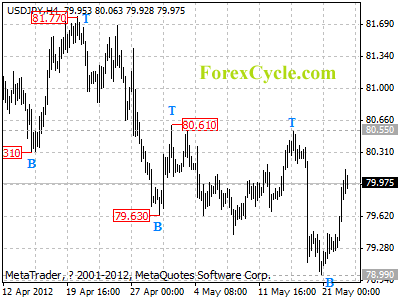
USDJPY breaks above 79.70 resistance

USDJPY breaks above 79.70 resistance, suggesting that lengthier consolidation of the downtrend from 84.17 (Mar 15 high) is underway. Range trading between 78.99 and 80.61 is expected in a couple o fays. Key resistance is located at 80.61, as long as this level holds, one more fall to 78.00 is still possible. On the upside, a break above 80.61 will indicate that the fall from 84.17 has completed at 78.99 already, then the following upward movement could bring price back to 83.00 zone.

usdjpy

Daily Forex Analysis

Central Bank News Link List – 22 May 2012

By Central Bank News
Here's today's Central Bank News link list, click through if you missed the previous central bank news link list.  Remember, if you want to submit links for inclusion in the daily link list, just email them through to us or post them in the comments section below.

Dollar: Surviving Safe Haven

By TraderVox.com

Tradervox (Dublin) – The Forex markets were quiet in the Asian session with the Euro, Pound, Yen and the Franc trading flat. However bullish momentum was visible in the commodity currencies, Canadian Dollar and the Australian Dollar, supported by Chinese government comments to take on measures to boost growth, thereby driving up demand for commodities.

However the gains in the commodity currencies did not spill into the European session. In fact the Canadian Dollar and Australian Dollar reversed gains and turned bearish. Gold and silver which were in tight bounds saw bearish sentiments into the European session. The reason for this was huge dollar inflows on the back of risk aversion driving up the dollar index to 81.3 levels.

Risk aversion already supported by Europeans saw further support coming in from the Japanese. The Fitch rating agency has downgraded Japan by one notch to negative on rising debt concerns in the country. This has led to strong outflows from the safe haven Japanese Yen to the US Dollar.

US dollar remains as the sole safe haven which is enjoying strong inflows backed by the strong revival in the US economy and the recovery in housing market.

The major releases today were the UK CPI and UK Core CPI. Consumer prices in the UK rose from the previous 0.3% to 0.6% as expected while the Core CPI fell from the previous 2.5% to 2.1% beating expectations of a fall to 2.0%. After the CPI data there was a huge selling in the GBP/USD pair driving the pair to 1.57648 levels where the pair found support.

Moving into the US session, the US economy posted the home sales data which showed a huge improvement, beating expectations to rise to 3.4% from the previous -2.8%.

This has resulted in outflows from traditional safe havens Gold and Yen into the Dollar.

Tomorrow the European leaders meet in Brussels for talks regarding the European Debt crisis. Greek Exit and Euro bonds are likely to be on top of the agenda. Markets do not however expect any meaningful output, as had happened with previous summits.

Disclaimer
Tradervox.com is not giving advice nor is qualified or licensed to provide financial advice. You must seek guidance from your personal advisors before acting on this information. While we try to ensure that all of the information provided on this website is kept up-to-date and accurate we accept no responsibility for any use made of the information provided. Opinions expressed at Tradervox.com are those of the individual authors and do not necessarily represent the opinion of Tradervox.com or its management. 

Article provided by TraderVox.com
Tradervox.com is a Forex News Portal that provides real-time news and analysis relating to the Currency Markets.
News and analysis are produced throughout the day by our in-house staff.
Follow us on twitter: www.twitter.com/tradervox

NZD/USD Cross Remains Bearish on Eurozone Crisis

By TraderVox.com

Tradervox (Dublin) – Commodity sensitive currencies have taken a hit in the recent weeks following the resurgence of debt crisis and political uncertainty in euro area. The New Zealand currency has taken a beating against the US dollar as risk aversion takes center stage in the bourse. The pair is expected to continue on the downward trend during this week as weak financial data is expected from New Zealand this week.

Today, the inflation expectation data will be released. The report is expected to show that the CPI for the first quarter has dropped to 2.5 percent as compared to last year’s first quarter CPI of 2.8 percent. Despite the inflation moderating in March, the advance of the New Zealand dollar is expected to limited due to risk aversion.

Another report that is expected to affect the cross is the trade balance report to be released on Wednesday at 2245hrs GMT. There is expectation that trade balance decline to $134 million in March. This is a continued decline from February when it declined to $220 million. The annual Budget Release on Thursday at 0200hrs GMT is expected to show the tight financial constraints in New Zealand. These reports are deemed as bearing for the NZD/USD cross hence it is expected to continue with a decline setting the kiwi up for another weekly decline.

Some of the technical lines worth watching out for are the 0.7620 which has provided support in May 2012 and its resistance. The 0.7550 has gained a stronger role of separating ranges just like it did in January. On the lower side, the 0.7470 line is a crucial support and it had a similar role at the beginning of 2011. If this line is crossed, then it would open the door for December low support of 0.7370, which is crucial line.

Disclaimer
Tradervox.com is not giving advice nor is qualified or licensed to provide financial advice. You must seek guidance from your personal advisors before acting on this information. While we try to ensure that all of the information provided on this website is kept up-to-date and accurate we accept no responsibility for any use made of the information provided. Opinions expressed at Tradervox.com are those of the individual authors and do not necessarily represent the opinion of Tradervox.com or its management. 

Article provided by TraderVox.com
Tradervox.com is a Forex News Portal that provides real-time news and analysis relating to the Currency Markets.
News and analysis are produced throughout the day by our in-house staff.
Follow us on twitter: www.twitter.com/tradervox

How a Simple Line Can Improve Your Trading Success

Elliott Wave International’s Jeffrey Kennedy explains many ways to use this basic tool

By Elliott Wave International

The following trading lesson has been adapted from Jeffrey Kennedy’s eBook, Trading the Line — 5 Ways You Can Use Trendlines to Improve Your Trading Decisions. You can download the 14-page eBook here.

“How to draw a trendline” is one of the first things people learn when they study technical analysis. Typically, they quickly move on to more advanced topics and too often discard this simplest of all technical tools.

Yet you’d be amazed at the value a simple line can offer when you analyze a market. As Jeffrey Kennedy, editor of the new Elliott Wave Junctures service, puts it:

“A trendline represents the psychology of the market, specifically, the psychology between the bulls and the bears. If the trendline slopes upward, the bulls are in control. If the trendline slopes downward, the bears are in control. Moreover, the actual angle or slope of a trendline can determine whether or not the market is extremely optimistic or extremely pessimistic.”

In other words, a trendline can help you identify the market’s trend. Consider this example in the price chart of Google.

That one trendline — drawn between the lows in 2004 and the lows in 2005 — provided support for a number of retracements over the next two years.

That’s pretty basic. But there are many more ways to draw trendlines. When a market is in a correction, you can draw a trendline and then draw a parallel line: in turn, these two parallel lines can create a channel that often “contains” the corrective price action. When price breaks out of this channel, there’s a good chance the correction is over and the main trend has resumed. Here’s an example in a chart of Soybeans. Notice how the upper trendline provided support for the subsequent move.


For more free trading lessons on trendlines, download Jeffrey Kennedy’s free 14-page eBook, Trading the Line — 5 Ways You Can Use Trendlines to Improve Your Trading Decisions. It explains the power of simple trendlines, how to draw them, and how to determine when the trend has actually changed.Download your free eBook >>

This article was syndicated by Elliott Wave International and was originally published under the headline How a Simple Line Can Improve Your Trading Success. EWI is the world’s largest market forecasting firm. Its staff of full-time analysts led by Chartered Market Technician Robert Prechter provides 24-hour-a-day market analysis to institutional and private investors around the world.


BOE’s Crisis Response Strategy under Pressure from Law Makers

By TraderVox.com

Tradervox (Dublin) – Lawmakers in UK have pushed for an inquiry into the crisis response strategies taken by the Bank of England Governor Mervyn King. This has come at a time when the BOE is preparing to take over financial regulation in the country. The court has been pushed to order and investigation on some of the BOE’s actions which include the bank’s conduct after Lehman Brothers Holdings Inc. collapsed. Lawmakers want the investigation to cover Emergency Liquidity Assistance program which was undertaken in 2008 and 2009; they also want an investigation on the framework for providing liquidity to banks, and capability of the monetary policy committee to forecast economic parameters.

The decision by the bank to have the BOE’s investigated came after lawmakers who are debating a bill to give the BOE more power pushed for it. The bank of England had earlier been investigated in January, but the governor said that he would welcome any investigation if it were deemed necessary by the cross-party committee of lawmakers.

According to Andrew Tyrie, the investigation into the handling of financial crisis is necessary as lawmakers have not yet come up with conclusive solutions to the issues they are supposed to address. Andrew Tyrie chairs the Treasury Select Committee which oversees the Bank of England. Mr. Tyrie have also criticized The Court, which is the BOE’s governing body, saying that it refused to disclose discussions it held during the financial crisis which he claims prevented the parliament from holding the Bank of England accountable for the mistakes made in dealing with financial crisis.

The investigation into the BOE’s conduct during the crisis will be carried out by the former BOE policy maker Ian Plenderleith, former head of US research and forecasting at the Fed David Stockton, chief executive officer of Renshaw Bay LLP Bill Winters who is also a member of the UK Independent Commission on Banking.

Disclaimer
Tradervox.com is not giving advice nor is qualified or licensed to provide financial advice. You must seek guidance from your personal advisors before acting on this information. While we try to ensure that all of the information provided on this website is kept up-to-date and accurate we accept no responsibility for any use made of the information provided. Opinions expressed at Tradervox.com are those of the individual authors and do not necessarily represent the opinion of Tradervox.com or its management. 

Article provided by TraderVox.com
Tradervox.com is a Forex News Portal that provides real-time news and analysis relating to the Currency Markets.
News and analysis are produced throughout the day by our in-house staff.
Follow us on twitter: www.twitter.com/tradervox

EUR Resumes Bearish Trend

Source: ForexYard

After steadily gaining on the dollar and yen yesterday in overnight trading, the euro once again turned bearish during the European session. Renewed concerns regarding the political situation in Greece triggered the bearish correction. Still, the common currency was able to avoid dropping to the four-month low hit last week. Turning to today, traders will want to pay attention to a batch of British and US economic indicators. Both the British CPI and Public Sector Net Borrowing figures are forecasted to come in well below last month’s figures. If true, the GBP could take losses during mid-day trading. Later in the day, analysts are predicting that the US Existing Home Sales figure will show improvements in the American Real Estate sector. If true, the dollar could move up as a result.

Economic News

USD – Risk Aversion Boosts USD

Investors once again returned to safe-haven assets during European trading yesterday, resulting in gains for the US dollar against many of its main currency rivals. A pledge by world leaders over the weekend to help support the euro in the event that Greece is forced to exit the euro-zone did little to convince investors that the euro-zone debt crisis is anywhere close to being over. As a result, the EUR/USD, which had peaked at 1.2811 during overnight trading, tumbled over 80 pips throughout the day, eventually reaching as low as 1.2724.

Turning to today, dollar traders will want to pay attention to the US Existing Home Sales figure, scheduled to be released at 14:00 GMT. Analysts are predicting the figure to come in at 4.62M, which if true, would represent a significant increase over last month’s result and could lead to dollar gains against its safe-haven rival, the Japanese yen. That being said, should today’s news disappoint and come in below expectations, the dollar may give up some of yesterday’s gains against currencies like the euro and AUD.

EUR – Euro-Zone Uncertainties Lead to EUR Losses

After seeing gains against several of its main currency rivals during trading late last week, the euro resumed its bearish trend yesterday against its safe-haven currency rivals. Analysts attributed the downward correction to ongoing fears about the potential outcome of elections in Greece, scheduled for next month. In addition dropping more than 80 pips against the US dollar, the euro was also down approximately 65 pips against the Japanese yen. The EUR/JPY fell as low as 100.92 before staging a slight correction during the afternoon session and stabilizing around the 101.25 level.

Today, any announcements out of the euro-zone have the potential to generate volatility for the common currency. Conflicting solutions to the euro-zone debt crisis between France’s new President and the German government have led to investor worries about the prospects for economic recovery in the region. Any additional news today which indicates that euro-zone leaders are still failing to come to a unified position could result in the EUR extending yesterday’s losses further.

Gold – Gold Sees Mild Bearish Movement

Following last week’s significant bullish movement, gold once again turned downward during yesterday’s trading session as risk aversion returned to the marketplace. The precious metal fell well over $10 an ounce during the European session, dropping as low as $1584.57 before staging a slight upward correction.

Turning to today, traders will want to pay attention to euro-zone news which has the potential to impact the price of commodities and precious metals. Any risk aversion due to concerns about the upcoming elections in Greece and their potential impact on other countries in the euro-zone could cause gold to extend yesterday’s losses.

Crude Oil – Crude Oil Advances above $92

Upcoming talks between Iran and world leaders this week regarding that country’s disputed nuclear program resulted in mild supply side fears among investors, which brought the price of crude oil above the $92 a barrel level. Additionally, euro gains last week led to moderate risk taking in the marketplace, giving crude a slight boost. Overall the commodity was up close to $1 during European trading, peaking at $92.63.

Turning to today, crude traders will want to pay attention to any announcements out of the euro-zone which have the potential to generate significant market volatility. Any signs that the current crisis in Greece could spread to other euro-zone countries, in particular Spain, could result in oil reversing yesterday’s gains.

Technical News

EUR/USD

The MACD/OsMA on the weekly chart has formed a bullish cross, indicating that this pair could see an upward correction in the coming days. This theory is supported by the Williams Percent Range on the same chart, which has dropped into oversold territory. Going long may be the wise choice for this pair.

GBP/USD

Most long term technical indicators show this pair range-trading, meaning a definitive trend is difficult to determine at this time. Traders will want to keep an eye on the Relative Strength Index on the daily chart, as it is close to dropping into oversold territory. Should the indicator drop below the 30 line, it may be a sign of an impending upward correction.

USD/JPY

The weekly chart’s Williams Percent Range has crossed over into oversold territory, indicating that this pair could see upward movement in the coming days. Additionally, the MACD/OsMA on the daily chart has formed a bullish cross. Opening long positions may be the wise choice for this pair.

USD/CHF

The weekly chart’s MACD/OsMA has formed a bearish cross, indicating that a downward correction could occur in the near future. Furthermore, the same chart’s Williams Percent Range has drifted into overbought territory. Traders may want to open short positions ahead of possible downward movement.

The Wild Card

Dow Jones Industrials

The daily chart’s Williams Percent Range has dropped into oversold territory, indicating that upward movement could occur in the near future. Furthermore, the same chart’s Slow Stochastic has formed a bullish cross. Forex traders may want to go long in their positions ahead of a possible upward breach.

Forex Market Analysis provided by ForexYard.

© 2006 by FxYard Ltd

Disclaimer: Trading Foreign Exchange carries a high level of risk and may not be suitable for all investors. There is a possibility that you could sustain a loss of all of your investment and therefore you should not invest money that you cannot afford to lose. You should be aware of all the risks associated with Foreign Exchange trading.


What Falling Iron Ore Means for Gold

By MoneyMorning.com.au

In yesterday’s Money Morning I sounded the alarm on China.

Some of the data coming out from China right now, like bank lending, has just fallen off a cliff.

Between them, China’s big four banks have reportedly made ZERO new loans in the first half of May.

That’s a big deal because Chinese property developers need these bank loans to finance construction. According to Morgan Stanley, even large developers are waiting five months to get financing.


The smaller developers, if they can even get financing, are looking at an interest rate of 15-18%, probably from fringe-lenders.

At those rates they’d be better off putting it on a credit card!

Without a source of credit, developers are finding it very hard to build anything new, or even to finish projects off.

This is what the Chinese government wanted – to cool the property bubble down.

It looks like it is working a bit too well! And it could have a major impact on the Aussie economy…

With bank lending drying up, Chinese construction will soon STOP.

This has loads of follow-on effects.

For instance, the Chinese property market accounts for 40% of Chinese steel consumption.

So if Chinese property building grinds to a halt, there could up to a 40% drop in steel demand on the horizon. And that’s not even looking at the potential falls in steel demand for car production, infrastructure and the other industries that take the remaining 60%.

The Impact on Australian Iron Ore

This is where Australia comes in.

The Chinese steel industry is the biggest buyer of Australian iron ore, and it looks like demand for Australia’s most famous export (after Kylie) is about to fall in a hole.

The quotes from the Financial Times I used yesterday describing China’s economy have gone viral on the net. These suggested that major commodity trading houses are finding that Chinese commodity buyers have gone cold. And some big players have apparently defaulted on contracts in iron ore.

This is terrible news for anyone who is long on iron ore. You only have to look back to last September when it lost 35% in two months as a reminder of how volatile the price can be. This time around it has fallen by 12% in a month.

The fundamentals look pretty ropey. For the technical view of iron ore’s latest move, I spoke to our in-house technical guru, Murray Dawes of Slipstream Trader. He’s been making good money for his readers in this falling market, and reckons:

‘…Iron Ore prices are looking very sick indeed. $130 is the last line of support before a fall to $116. The impulsive decline from September to November last year (I.e. $181 down to $117) saw a perfect 50% retracement. The downtrend has now reasserted itself so I’d expect to see this $130 support fail in the short term and a sharp decline to $116. From there we can’t discount the possibility of a fall towards $100.’

Iron Ore – on its way to $110 / tonne?

Iron Ore - on its way to $110 / tonne?

Source: ANZ commodity research

This would have many institutional players howling, as so many of them are heavily invested in iron ore stocks. As a big player in Australia, It’s a bit hard not to be.

There is talk from big players that the Financial Times quotes about Chinese commodity buyers defaulting on contracts are ‘rumours’ designed to give traders the opportunity to short sell the iron ore market.

And I thought the gold bugs were supposed to be the conspiracy theorists!

What Happens Next For Iron Ore?

Well the next data we get on China will be Thursday lunchtime when the ‘Flash China Purchase Managers Index (PMI)’ is released. If it confirms all the recent news pointing at China stalling, then it could be an ugly day for iron ore, the rest of the resources sector, and the Australian dollar to boot.

Iron ore needs Chinese property construction, so the best hope iron ore has of a recovery is a stimulus program from China. I can’t see any hope of China’s property sector getting CPR from the government until next year, after the baton is passed from the current Chinese leadership to the next.

Iron ore is a commodity I’ve not tipped to Diggers and Drillers readers for a long time, because I prefer commodities that have supply squeezes and/or sustainable increases in demand. Iron ore didn’t fit the bill. Supply is on the up, and demand depended heavily on China.

Will Gold Face a Similar Fate to Iron Ore?


Gold fits the bill better, with supply that increases very slowly, and steadily rising demand.

But the latest developments in China may cast a shadow over gold too.

If China’s economy has dropped anchor – then will it keep importing gold in huge quantities?

In the last year, Chinese gold demand has become a big player in the market. It has imported an average of around 40 tonnes a month – around 18% of global gold mine output. These are just the official figures, and I’ll bet the real amount is far higher.

Will China keep importing if things are hitting the skids? My feeling is that most of the gold going into China is for China’s Central Bank – which should continue even if things slow down.

Some Chinese gold imports are for retail investors of course, and they are now buying around 0.25 grams per tonne per year. It’s possible this may actually increase if Chinese property investors decide to reallocate from property to gold. Other than the dodgy Chinese equity markets, they don’t have many other choices!

To be honest I’m not sure which way Chinese gold demand would turn in a slowdown. It’s something to think about, and we’ll have to watch the numbers for a while yet.

What’s in store in the meantime?

The reports I’m reading suggest the current leadership in China is brewing some stimulus up for this year.

However it won’t target property.

Rather it will point at the agricultural sector to reduce food price inflation, which has been a big problem.

If that’s the case, then in addition to hanging onto your gold…go short iron ore, and go long tractors!

Dr. Alex Cowie
Editor, Diggers & Drillers

Related Articles

The Conference of the Year “After America” DVD

APPEA – Day One at the Oil & Gas Show: Sand Dunes, Scuba Diving and Camels

Get in Early to Shale Gas


What Falling Iron Ore Means for Gold