Just How Green is Google

Google may have a bad track record on privacy practices, but when it comes to green, the internet giant is clean, racking up over $850 million in investments to develop and deploy clean energy and earning the top spot on Greenpeace’s list of IT giants who are using and advocating for clean energy.

In February, Greenpeace ranked Google the best on its “Cool IT Leaderboard”, although it only scored 53 out of 100 points on the ranking system, still putting it ahead of Cisco, with 49 points. But it was a reluctant gift from Greenpeace, which has been hounding the IT giant for some time over its long overdue moves to shift to green and to use its influence and outreach to advocate for renewable energy.

Google may have gotten off to a slow green start, but in the long term, the IT giant should benefit from the move. It is now sourcing more than 20% of its global energy use from green sources such as solar and wind. As a major consumer of energy, reducing consumption will help its profit margins and its clean energy efforts should boost its public image at a time when Google is mired in litigation over privacy practices.

And Google’s influence should not be underestimated, which is something Greenpeace understands well. Not only is Google going green, it’s also dabbling in policy initiatives, offering up its own clean energy proposals for government consideration (such as a plan to remove US dependency on fossil fuels entirely within 22 years).

So far, Google has invested $10 million in two solar companies, eSolar and Brightsource, and has created a $280 million fund with SolarCity in California to install solar panels in 9,000 homes on a lease option. The IT giant has invested another $15 million in wind energy, and $10 million in enhanced geothermal systems. Most significantly, Google Ventures has launched a $100 million venture capital fund for innovative clean technology start-ups. Beyond that, the IT giant is seeking to foray into the utility sector by applying for a license to sell bulk electricity. Smart grids and plug-in cars are also on its list of green projects, as are a number of riskier ventures, including work on a heliostat – a mirrored device that directs the sun’s rays to create thermal energy – and high-altitude flying wind turbines.

While Google and other IT giants such as Cisco, Ericsson and Dell top Greenpeace’s clean energy use and advocacy list, the environmental groups says that there is still an insufficient amount of movement in terms of addressing pollution. “Google tops the table because it’s putting its money where its mouth is by pumping investment into renewable energy,” Greenpeace International analyst Gary Cook told reporters upon the release of the “Cool IT Leaderboard.” However, he said, while the IT industry is driving significant energy demand with its data centers and global infrastructure, when it comes to addressing pollution, action has been slow.

Certainly, Google’s original plans for energy have been scaled down, and many of the more eclectic projects the company once envisioned have been cancelled as results were not forthcoming as predicted. Still, the company is now investing more in clean energy than ever – in fact, ten times more than in 2010. This is a remarkable sum for an IT company when you compare it to renewable energy investments in energy giants such as BP, for instance, which invested around $1.6 billion in 2010. Google’s focus has shifted from the eclectic to the practical, a shift most clearly seen in its drive to deploy commercial solar panels and wind turbines – investments that promise a return.

In the realm of clean energy and the US drive to reduce dependency on foreign fuel imports, Google and other IT giants could wield a significant amount of influence, both on the public and on policy. Now that that IT giants are largely on board with the clean energy initiative – though the jury is still out on Apple and Oracle – this momentum should pick up pace.

Source: http://oilprice.com/Alternative-Energy/Renewable-Energy/Google-The-Power-to-Influence-Clean-Energy.html

By Jen Alic of Oilprice.com


Pound Drops against Dollar on Inflation Data

By TraderVox.com

Tradervox (Dublin) -The sterling pound has been the best performer in the last three months increasing by 4.8 percent over the period. However, the current upward trend has changed today after government data showed that the inflation dropped in April more than the market was expecting. The pound fell against the greenback after extending gains for the last three days. Further, the sterling weakened after the International Monetary Fund recommended that Bank of England should resume its quantitative easing program to spur economic growth in the country.

The current European crisis is seen as a hindrance to economic growth and the strengthening pound was bound to hurt exports into the 17-nation trading bloc which takes 40 percent of UK’s exports. However, today’s inflation data will ease the pound’s surge which is good for the UK economy. According to Lee McDarby of Investec Bank Plc in London, the recent run has made the market long for an opportunity to sell and the inflation data provides that opportunity.

According to a report from the IMF, the Bank of England should embark on a program to inject more stimulus into the economy as the recent European crisis will derail the recovery. The IMF suggested quantitative easing or cutting interest rates as the possible ways the bank might take to ensure economic growth. However, BOE policy makers stopped the quantitative easing program this month after injecting 325 billion pounds into the economy. The minutes of their meeting of May 9-10 will be released tomorrow where investors will try to establish the bank’s stand on monetary easing program.

After the release of the inflation data, the sterling pound dropped by 0.2 percent against the dollar to exchange at $1.5789; the pound had fallen to $1.5733 on May 18 which is the lowest it had been since March 16. However, the Great Britain Pound gained by 0.2 percent against the euro to trade at 80.75 pence per euro.

Disclaimer
Tradervox.com is not giving advice nor is qualified or licensed to provide financial advice. You must seek guidance from your personal advisors before acting on this information. While we try to ensure that all of the information provided on this website is kept up-to-date and accurate we accept no responsibility for any use made of the information provided. Opinions expressed at Tradervox.com are those of the individual authors and do not necessarily represent the opinion of Tradervox.com or its management. 

Article provided by TraderVox.com
Tradervox.com is a Forex News Portal that provides real-time news and analysis relating to the Currency Markets.
News and analysis are produced throughout the day by our in-house staff.
Follow us on twitter: www.twitter.com/tradervox

Gold & Silver Long-Term Signal

By JW Jones – Traders Video Playbook

“The selfish they’re all standing in line

Faithing and hoping to buy themselves time

Me, I figure as each breath goes by

I only own my mind.”

~ Pearl Jam, I Am Mine ~

Long time readers know that I have been and remain bullish on gold and gold stocks in the longer-term. However, the reasons why I believe gold and silver will perform well in the longer-term are a bit different than what many economists and pundits are expecting.

I am a contrarian by nature. I generally try to do the opposite of the crowd in every situation I find myself regardless of whether I am in a movie theater or trading options. Before getting into the gold and gold miners analysis, I thought I would explain my position publicly to readers. I do not consider myself an expert economist, but I try to read those who many consider to be experts looking for similarities in their viewpoints and expectations.

The herd mentality exists in financial markets and a similar behavior exists among economists. Most economists in the mainstream media today tend to be Keynesians or neo-classical economists. Both viewpoints are generally accepted as the correct interpretation of economic and monetary policies by academia.

However, the academic world can actually reduce open thought through ridicule and persecution. In the world of academia the herd is right, until someone proves that they are wrong using logic based reasoning.

Very similar to political ideologies, economic ideologies are deeply rooted. Paul Krugman is a great example of Keynesian economist. Like it or not, the majority of economists believe his views are correct regardless of whether they are based on fact, history, or dare I say “common sense.”

This leads me to the reason why precious metals and commodities in general may be approaching a major bottom and the potential for a monster rally. The reasoning stems from the fact that across the world central bankers generally share the same views as Paul Krugman. They believe that the modern finance system does not need gold and that fiat currency is the answer even though history argues in their face across multiple millennia.

Most economists and financial pundits believe that sovereign debt is going to bring down the economy and they may be correct. Many believe that the debt will unleash a massive deflationary spiral that will consume fiat valuations, specifically on risk assets and debt obligations.

I do not necessarily disagree that this is a likely outcome, but what concerns me is the number of people that believe this is true. This is the herd’s idea and as I have said many times before the herd is rarely right. This time may be different, although it rarely is. For inquiring minds I offer a rather different potentiality.

What if the debt crisis causes a totally different outcome that very few economists envision? What if they follow Dr. Krugman’s ideas and create massive amounts of debt to stimulate the economy while printing vast quantities of fiat money to prop up failing financial institutions? Clearly increasing debt levels and debasing the currency do not imply a long term positive scenario.

Central banks do not have a strong track record when it comes to reducing liquidity or increasing liquidity at the appropriate times. Thus these actions are likely to facilitate some sort of crisis in the future whether it is a result of runaway deflation or inflation.

I believe that should a deflationary crisis caused by massive debt levels and diminishing economic strength present itself, central bankers around the world will behave exactly the same way. They will act simultaneously and through dovish monetary policy central bankers will flood the world with massive sums of freshly printed fiat currency with the intent to print away issues with a liquidity induced risk-on orgy.

Should that be their ultimate choice, risk assets will rally sharply higher initially. Paper assets like stocks will produce huge gains in a short period of time while supposedly safe assets such as Treasuries would likely arrive at negative interest rates across the yield curve in nominal terms. The next phase is the scary part and why I am bullish long term of precious metals specifically.

The devaluation of fiat currencies simultaneously around the world will result in a monster economic crash when the masses realize that the majority of the major worldwide currencies are becoming worth less and less. The resulting crash would be caused by the opposite force of runaway inflation while the herd mentality that anticipates a deflationary debt spiral espoused by most experts and pundits would be proven materially false.

Under those circumstances, precious metals will be the true safe haven. Gold and silver will prove to be a true store of wealth that they have been for centuries. So many so-called experts fail to recognize that gold and silver are currencies. Yes they have industrial uses, but gold and silver represent the last unequivocal bastion of wealth preservation against the constant debasement procured by central bankers and their minions.

Under the scenario whereby central bankers flood financial markets with cheap, freshly printed fiat currency one would expect other essential commodities such as oil to also perform well. Furthermore agricultural based commodities would also flourish under those economic conditions. Investors would be in much better fiscal condition owning things that they could hold in their hands versus stocks or bonds.

I posit this potentiality not to say that this is exactly what is going to happen, but to challenge readers to open their minds. The crowd is usually wrong. The central bankers and most economists generally share the same viewpoints and their behavior is literally a giant group-think.

Is it possible that they are a herd which ultimately will be proven wrong? Will the herd mentality of economists and central bankers cause a massive currency crisis as they attempt to stem the tide of a deflationary debt crisis?

The two possible outcomes go hand in hand. I do not know what is going to happen, but neither outcome in the longer-term is especially optimistic. Should either scenario come to pass, the human condition will likely be threatened by a decrease in the standard of living across multiple developed countries and ultimately the threat of revolution and military action on a scale not seen in several decades could eventuate.

Clearly I have simplified the issues at hand presently for ease of reading, but the ultimate endgame will likely be one or a combination of both a debt crisis and a currency crisis. They will likely occur in close proximity to one other in terms of time, but the precise outcome will likely be different than what is commonly expected.

Regardless of which scenario occurs, precious metals will eventually be sought for their protection against the constant devaluation of fiat currencies by central banks around the world. For this reason, I remain a long term precious metals bull. With that said, why don’t we take a look at the recent price action in gold, silver, and gold mining stocks shown below.

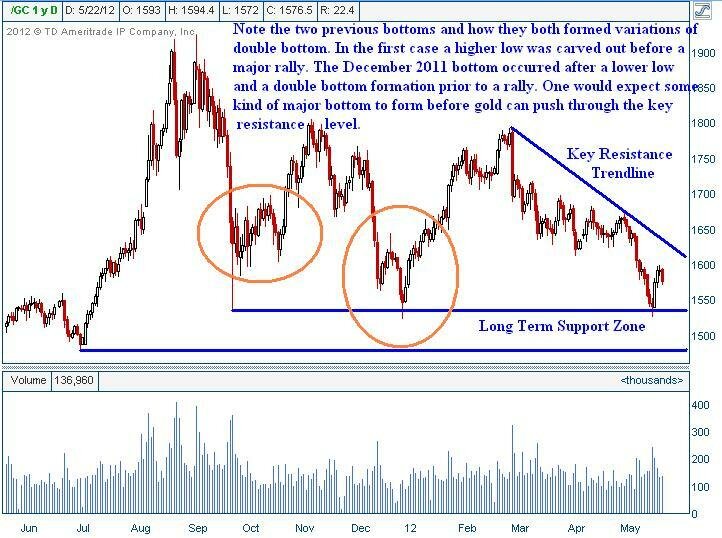
A lot of writers have stated that gold has bottomed. I am not totally convinced, however I do believe that gold is in a bottoming process. For me to get completely in my gold bull suit I would need to see price action exceed the key resistance trend line shown below.

Gold Futures Contract Daily Chart
trading videos

As can be seen above, until we see price push through resistance I will remain cautious. I would also point out that the last two times gold found bottoms near current prices the bottom forming process took several weeks to complete.

I do not expect for gold to form a V shaped reversal. In fact, lower prices in the short term would help drive the bullish case for the longer term. Bottoms take weeks to form and can be very dangerous trading environments where active traders get chopped around.

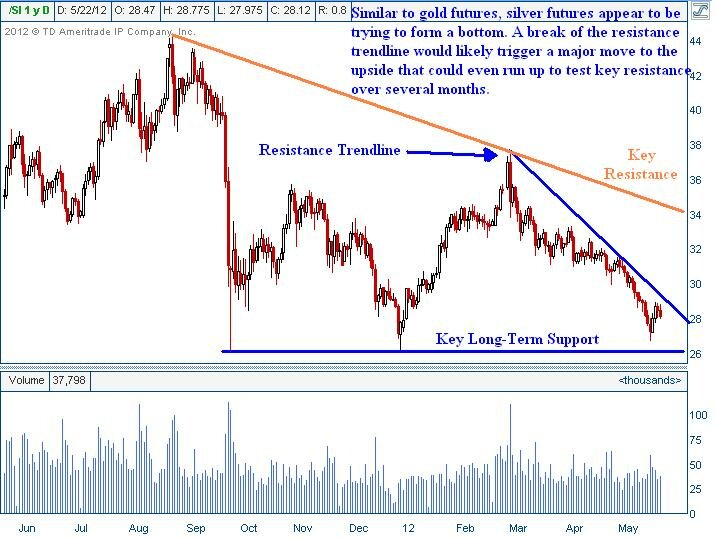
Silver is very similar to gold in that it appears to have formed the beginning of a possible bottom. Bottoms are generally not formed in one day. During the recent selloff, silver showed relative strength against gold. It is important to acknowledge that silver has yet to test the key lows that should offer support.

Because of this divergence in these two precious metals, I continue to believe that gold may see more downside again before a much stronger rally begins to take hold. Similar to gold, the descending trend line offers a great resistance level where traders can flip from being short-term bearish to longer-term bullish if the resistance line is penetrated. If we see silver carve out multiple daily closes above the resistance trend line paired with strong volume, I would anticipate that a bottom has formed and silver prices will have an upward bias. The daily chart of silver is shown below.

Silver Futures Contract Daily Chart
silver trading videos

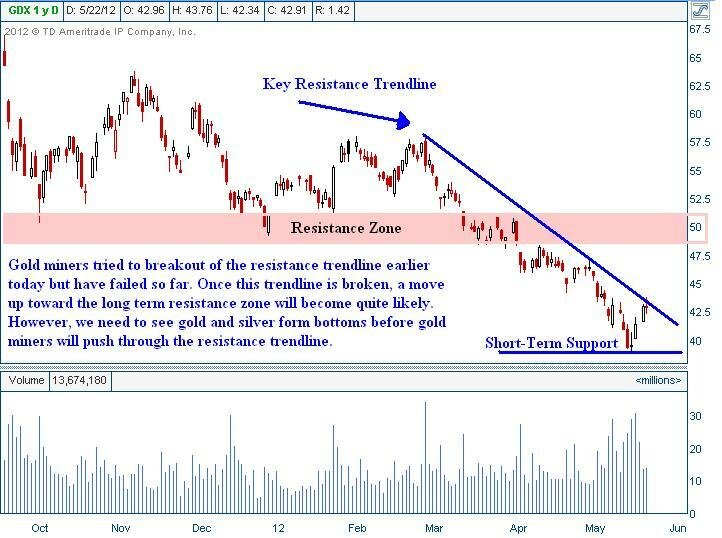
As expected, the gold miners have shown relative strength recently. The miners were just absolutely massacred during the recent selloff in equities and precious metals. However, gold miners similar to precious metals have a major descending trend line which they have already tested today. If the gold miners can push through resistance a large scale rally could play out. The daily chart of gold miners is shown below.

Gold Miners (GDX) Daily Chart
gold miners trading videos

In addition, if readers look at a long term GDX price range that dates back to the 2009 lows the recent pullback is almost precisely a 0.50% Fibonacci Retracement. Similar to gold and silver, I would expect to see the gold miners pull back a bit here before pushing through major resistance. We may be setting up for a possible major bottom in precious metals and gold miners in the near future. Only time will tell.

In closing, remember to keep an open mind with regards to the future. The more often you hear the same message coming from financial pundits and experts, the more cynical you should become. Both potential scenarios will likely not end well. The question is whether the reason for the crash is deflation, inflation, or a combination of both scenarios. Regardless of the outcome, the long-term future for precious metals remains quite bright.

If you enjoyed this article and analysis, you can get our detailed trading analysis videos every Sunday, Monday, Wednesday and Thursday.

Happy Trading and Investing!

By JW Jones –Traders Video Playbook


This material should not be considered investment advice. J.W. Jones is not a registered investment advisor. Under no circumstances should any content from this article, TradersVideoPlaybook.com, or OptionsTradingSignals.com websites be used or interpreted as a recommendation to buy or sell any type of security or commodity contract. This material is not a solicitation for a trading approach to financial markets. Any investment decisions must in all cases be made by the reader or by his or her registered investment advisor. This information is for educational purposes only.


USD Moves Up vs. JPY Following Japanese Credit Downgrade

Source: ForexYard

The JPY took losses against the US dollar during European trading yesterday, following a downgrade of Japan’s credit rating. The USD/JPY advanced close to 60 pips over the course of the day, eventually peaking at 79.93. Today, dollar traders will want to pay attention to US New Home Sales figure, set to be released at 14:00 GMT. Analysts are forecasting the figure to show improvements in the US real estate sector, which if true, could help the greenback extend yesterday’s gains. In addition to the news out of the US, traders will want to pay attention to any announcements out of the euro-zone. An informal meeting of euro-zone leaders is set to conclude today. Any signs of a new strategy to combat the region’s debt crisis could lead to market volatility.

Economic News

USD – Dollar Sees Gains across the Board

The US dollar moved up vs. virtually all of its main currency rivals yesterday, following negative data out of the UK and Japan which caused investors to shift their funds to the greenback. A worse than expected UK CPI figure resulted in the GBP/USD tumbling close to 85 pips during the European session. The pair reached as low as 1.5762 before staging a slight upward correction during afternoon trading. Against the JPY, the dollar was able to benefit after Fitch Ratings downgraded Japan’s credit score. The USD/JPY shot up over 60 pips following the news to come within reach of the psychologically significant 80.00 level.

Turning to today, dollar traders will want to pay attention to the US New Home Sales figure, scheduled for 14:00 GMT. Analysts are forecasting the figure to come in at 335K, which if true, would represent the second consecutive month of growth in the US Real Estate sector. Should the news come in as expected, the dollar may be able to extend yesterday’s gains against the yen and UK pound. That being said, if today’s indicator comes in below the predicted level, the greenback could reverse its recent bullish trend.

EUR – Meeting of Euro-Zone Leaders Set to Generate Market Volatility

The euro fell against the US dollar during mid-day trading yesterday, as investor worries about the euro-zone’s prospects for economic recovery continue to dominate market sentiment. The EUR/USD dropped close to 70 pips, reaching as low as 1.2737 before staging a mild upward correction. Against the Japanese yen, the common-currency was able to benefit from a Japanese credit rating downgrade. The EUR/JPY was up around 55 pips during European trading, reaching as high as 102.00 before dropping to the 101.85 level.

Turning to today, euro traders will want to pay attention to any announcements following a meeting of euro-zone leaders regarding any new ways to combat the region’s debt crisis. Significant differences between Germany and France on the best way to promote economic recovery in the euro-zone have led to risk aversion in the marketplace in recent weeks. Unless a more unified policy is unveiled today, the euro could see further losses against the US dollar during afternoon trading.

AUD – Aussie Falls amid Increased Risk Aversion

Risk aversion in the marketplace led to significant losses for the Australian dollar vs. its US counterpart throughout yesterday’s trading session. After reaching as high as 0.9933 during early morning trading, the AUD/USD began to tumble eventually reaching 0.9864. The AUD had slightly better luck against the Japanese yen. The AUD/JPY shot up close to 40 pips during the morning session, but eventually staged a correction to erase its earlier gains.

Today, the direction the aussie takes will likely be determined by news out of the euro-zone. Should a meeting of euro-zone leaders produce any positive ideas regarding how to best stimulate growth in struggling euro-zone economies, investors may shift their funds to riskier assets which could help the AUD during afternoon trading.

Crude Oil – US Crude Inventories may Impact Price of Oil

The price of crude oil fell just over $1 a barrel during European trading yesterday, following an increase in risk aversion due to concerns about the euro-zone economic recovery. The commodity dropped as low as $92.18 during the morning session before bouncing back to the $92.41 level.

Turning to today, oil traders will want to pay attention to the US Crude Oil Inventories figure, set to be released at 14:30 GMT. US crude stockpiles have reached record highs in recent weeks, signaling decreased demand in the world’s largest oil consuming country. Should today’s figure show that US inventories increased again, the price of oil could drop further during the afternoon session.

Technical News

EUR/USD

The MACD/OsMA on the weekly chart has formed a bullish cross, indicating that this pair could see an upward correction in the coming days. This theory is supported by the Williams Percent Range on the same chart, which has dropped into oversold territory. Going long may be the wise choice for this pair.

GBP/USD

Most long term technical indicators show this pair range-trading, meaning a definitive trend is difficult to determine at this time. Traders will want to keep an eye on the Relative Strength Index on the daily chart, as it is close to dropping into oversold territory. Should the indicator drop below the 30 line, it may be a sign of an impending upward correction.

USD/JPY

The weekly chart’s Williams Percent Range has crossed over into oversold territory, indicating that this pair could see upward movement in the coming days. Additionally, the MACD/OsMA on the daily chart has formed a bullish cross. Opening long positions may be the wise choice for this pair.

USD/CHF

The weekly chart’s MACD/OsMA has formed a bearish cross, indicating that a downward correction could occur in the near future. Furthermore, the same chart’s Williams Percent Range has drifted into overbought territory. Traders may want to open short positions ahead of possible downward movement.

The Wild Card

Hang Seng Index

The daily chart’s Relative Strength Index has dropped into oversold territory, indicating that upward movement could be seen in the near future. This theory is supported by the Williams Percent Range on the same chart, which has crossed below the -80 level. Forex traders may want to go long in their positions ahead of a possible upward correction.

Forex Market Analysis provided by ForexYard.

© 2006 by FxYard Ltd

Disclaimer: Trading Foreign Exchange carries a high level of risk and may not be suitable for all investors. There is a possibility that you could sustain a loss of all of your investment and therefore you should not invest money that you cannot afford to lose. You should be aware of all the risks associated with Foreign Exchange trading.


You Choose to Outlive Your Retirement Income

Article by Investment U

You Choose to Outlive Your Retirement Income

No Social Security. No Medicare. No pensions. Higher life expectancy. Retirement income is harder to attain than ever, but it can be done.

A generation ago, it was easy. Case in point: My Dad spent 35 years working for Bethlehem Steel. He was a union man that knew his pension and retired health benefits were coming after he called it quits. On top of that, he would also file for social security to give him an added boost in retirement income. And that’s how it would be for the rest of his years.

Then that reality changed. For the most part, the private sector realized that pensions – and the actuaries that ran them – put a hurting on their bottom line. Workers would be OK because those 401(k) plans that Congress created finally started to really catch on in the 1990s. Thirteen or 14 years ago a 401(k) would burst off the charts with tech funds and when you wanted to play it safe a money market fund would give you 5%. This saving for retirement stuff wasn’t so hard. Can you say, “The good old days?’’

Let’s fast forward to 2012. We just saw the greatest economic downturn since the Great Depression four years ago. The ball game has changed. Gone are the days when retirement was just simple math. You knew exactly how much retirement income Social Security, savings and your pension would deliver. Then, you would cut back any unaffordable expenses when you hit 65.

With Social Security and Medicare’s future uncertain due to our budget crisis and a market that makes your employer benefit retirement plans remind you of a rollercoaster, the retirement planning process went from pretty simple to very complicated.

The current landscape has caused a great deal of pessimism concerning the retirement years. This new retirement reality is reflected in the fact that only 14% of Americans polled in the 2012 Retirement Confidence Survey conducted by the Employee Benefit Research Institute said they were “very confident they will have enough money to live comfortably in retirement.”

“Will I or we have enough money to maintain a comfortable lifestyle and make adjustments that may be necessary once I stop working?” This question is a burden weighing on the hearts of many. More than half of those surveyed said they had not even tried to calculate how much retirement income they will need.

Sit Down And Write Up A Plan

As you enter that stage where you’re really thinking about how to use retirement money for living expenses, you probably need to come up with a spending plan. Figure out the income you will have and what costs you will be paying out to help make your retirement income last over the long haul. This plan cannot be based on wishful thinking. Let’s be brutally honest. Let’s take into account the following:

  • Future inflation
  • Life expectancy
  • Health care costs.

There is a risk these days of your nest egg running out while you are still alive and kicking.
Technology and the knowledge of how to live better have us living longer. According to the Society of Actuaries, at age 65:

  • The average life expectancy is 17 years for men and 20 years for women.
  • Men have a 41% chance of living to age 85 and a 20% chance of living to age 90.
  • Woman have a 53% chance of living to age 85 and a 32% chance of living to age 90.
  • For married couples, there is a 72% chance that at least one of them will live to age 85 and a 45% chance that one will live to age 90.

To sum it up, this money better last cause chances are that you will.

You’ll Most Likely Have a Funding Gap

Given your investments, rates of return, life expectancy and amount of risk you’re taking in your 401(k) portfolio, how much money will you need? The run-of-the-mill retirement model will tell you to assume you’ll need to replace 80% of your pre-retirement income. For most people going through this process, many find that there is a gap between projected income and expenses during retirement.

Your plan’s possible “funding gap” will show that some changes in behavior may be necessary to meet objectives. This could be accomplished by increased contributions to retirement plans, a larger allocation to stocks or greater outside savings. It is essential that you determine how you will fill the gap through creating your retirement spending plan.

How to Attack the Gap

You need to determine a strategy for using all of your investment accounts and IRAs to bridge the gap. You might want to start by taking the following steps:

  • Determine the current market value of all your investments and estimate expected rates of return. You need this information so you can see how to go about withdrawing money in your retirement to meet all your known expenses.
  • Rather than drawing down with specific monthly dollar amounts, you may want to take out a periodic percentage of the sum. Using a percentage can be your best bet against outliving your retirement income.
  • Take note: A method popularized by William P. Bergen, a certified financial planner practicing in California, uses an annual withdrawal rate from retirement assets of 4% plus annual increases of about 3% to compensate for inflation.

For the moment, all of this is preliminary planning because Social Security and Medicare are wild cards.

If your gap really scares you, you also can take these additional steps now:

  • Tell your employer to raise your pretax contribution to your employer-sponsored retirement plan.
  • If you are self-employed in any manner, you can set up your own small business plan such as Simple or SEP-IRAs or a Profit Sharing or Money Purchase Pension Plan.
  • Also, contribute as much as you can to your traditional IRA and/or Roth IRA.
  • Then there’s the obvious. Save more in your traditional accounts!

Allocate and Make Decisions

Allocate your retirement assets to accomplish the complementary strategies of asset preservation and growth. You’ve heard this from Investment U before. Because different asset classes are imperfectly correlated – some zig, while others zag – our approach allows you to boost returns while reducing your portfolio’s volatility. True Asset Allocation should be the foundation stone of your whole investment strategy. It’s critical to your long-term financial health.

To do this, you use a special asset allocation percentage among large and small stocks, foreign shares, real estate investment trusts (REITs), gold stocks and three different types of bonds (high grade corporates, junk bonds and inflation-adjusted treasuries). The actual percentages run as follows:

  • 15% – US Large Caps,
  • 15% – US Small Caps,
  • 10% – European Stocks,
  • 10% – Pacific Rim stocks,
  • 10% – Emerging Market Stocks,
  • 10% – High Grade Bonds,
  • 10% – High Yield Bonds,
  • 10% – TIPS,
  • 5% – Gold mining stocks,
  • 5% – REITS

Remember that just sticking your money in money market accounts and Treasuries doesn’t cut it anymore. According to the Society of Actuaries, from 1980 to 2007, annual inflation in the United States has averaged 3.5%, so keeping some of your money in equities is vital if you expect your retirement funds to last by keeping pace with inflation.

Finally, a good idea would be to keep your retirement funds in separate “buckets.”

  • Money that you will need in the 12 months or less to meet monthly expenses in cash or cash equivalents.
  • Money that you expect to need in 2-5 years in fixed investments, which entail less risk and are likely to preserve your retirement capital.
  • Finally, keep any money that you don’t expect to need for five to 10 years in equity investments where you will get the growth needed to keep pace with inflation.

Choose the retirement assets that you will draw down first with consideration for tax advantages. Consider withdrawals from taxable accounts first and then tax-deferred accounts such as traditional IRAs, 401(k) plans, 457 plans and the like. Roth IRAs should be drawn down last to allow the tax-free earnings to continue growing as long as possible.

I hope this is a start and gets rid of some of that pessimism.

Good Investing,

Jason Jenkins

Article by Investment U

Canadian Dollar Up against Major Peers Ahead of EU Leader’s Meeting

By TraderVox.com

Tradervox (Dublin) – The EU leaders are expected to meet today in a meeting to discuss the prospects of the monetary union. The discussions at the meeting are expected to heat up as Angela Merkel, the German Chancellor, and the new French President Francoise Hollande seek to present their ideas on how the debt crisis should be handled. Hollande is opposed to Merkel’s led austerity drive and proposes the introduction of euro bond to curb the debt crisis in the region. Discussions about the Greece are also expected to take center stage during the meeting.

As the leaders prepares to meet, the Canadian dollar has improved against most peers as risk appetite returned in the market, even though is for a short time. Investors are waiting to see what the leaders will decide concerning the status of Greece in the euro zone. EU leaders seem united in doing everything possible to keep Greece in the single currency bloc and that is what is raising the risk appetite in the market. After meeting with new French Finance Ministers, Germany’s Finance Minister Wolfgang Schaeuble reiterated that European officials will do everything possible to keep Greece in the 17-nation trading bloc.

As the EU leaders meet, Dean Popplewell who is a chief currency strategist at Oanda Corp indicated that the market is playing it very tight prior to announcement of the leaders’ decision. Investors will also keep a close eye on what leaders will say during the meeting and they are particularly concerned about positions taken by French president and German Chancellor who are seen as key players in ensuring the success of austerity measures.

Any sign of consensus will spur risk appetite that will lead to higher demand for higher yielding currencies. The Canadian dollar has already started showing some improvement as it improved by 0.6 percent against the euro to trade at C$1.2963 per euro as it gained for the second day. However, the current risk appetite was not enough to push the loonie against the greenback where it dropped 0.5 percent to trade at C$1.0224, it had earlier gained by 0.2 percent as it tries to find some footing.

Disclaimer
Tradervox.com is not giving advice nor is qualified or licensed to provide financial advice. You must seek guidance from your personal advisors before acting on this information. While we try to ensure that all of the information provided on this website is kept up-to-date and accurate we accept no responsibility for any use made of the information provided. Opinions expressed at Tradervox.com are those of the individual authors and do not necessarily represent the opinion of Tradervox.com or its management. 

Article provided by TraderVox.com
Tradervox.com is a Forex News Portal that provides real-time news and analysis relating to the Currency Markets.
News and analysis are produced throughout the day by our in-house staff.
Follow us on twitter: www.twitter.com/tradervox

Market Review 23.5.12

Source: ForexYard

printprofile

Fears of a Greek exit from the euro-zone brought the EUR/USD within range of a four-month low yesterday. Facebook dropped another $2 a share during overnight trading while crude oil is trading below $91 a barrel.

Main News for Today

EU Economic Summit-All Day
• Traders will want to pay attention to any announcements following the summit
• Investors will be waiting to see if France and Germany can come to an agreement over how best to stimulate economic growth in the euro-zone
• Positive developments could lead to short term euro gains
US New Home Sales-14:00 GMT
• The dollar saw gains against the yen yesterday following a better than expected US Existing Home Sales figure
• If today’s news come in as expected, the USD could extend yesterday’s gains

Read more forex news on our forex blog

Forex Market Analysis provided by ForexYard.

© 2006 by FxYard Ltd

Disclaimer: Trading Foreign Exchange carries a high level of risk and may not be suitable for all investors. There is a possibility that you could sustain a loss of all of your investment and therefore you should not invest money that you cannot afford to lose. You should be aware of all the risks associated with Foreign Exchange trading.

Dollar Sees Gains across the Board

Source: ForexYard

printprofile

The US dollar moved up vs. virtually all of its main currency rivals yesterday, following negative data out of the UK and Japan which caused investors to shift their funds to the greenback. A worse than expected UK CPI figure resulted in the GBP/USD tumbling close to 85 pips during the European session. The pair reached as low as 1.5762 before staging a slight upward correction during afternoon trading. Against the JPY, the dollar was able to benefit after Fitch Ratings downgraded Japan’s credit score. The USD/JPY shot up over 60 pips following the news to come within reach of the psychologically significant 80.00 level.

Turning to today, dollar traders will want to pay attention to the US New Home Sales figure, scheduled for 14:00 GMT. Analysts are forecasting the figure to come in at 335K, which if true, would represent the second consecutive month of growth in the US Real Estate sector. Should the news come in as expected, the dollar may be able to extend yesterday’s gains against the yen and UK pound. That being said, if today’s indicator comes in below the predicted level, the greenback could reverse its recent bullish trend.

Read more forex news on our forex blog

Forex Market Analysis provided by ForexYard.

© 2006 by FxYard Ltd

Disclaimer: Trading Foreign Exchange carries a high level of risk and may not be suitable for all investors. There is a possibility that you could sustain a loss of all of your investment and therefore you should not invest money that you cannot afford to lose. You should be aware of all the risks associated with Foreign Exchange trading.

The Commodity to Prepare Your Portfolio for in a Post-China World

By MoneyMorning.com.au

If we learnt one thing from the 2008 stock market crash it’s that all asset prices can fall, regardless of the market fundamentals.

Leading up to 2008, many thought companies that dealt in hard assets (commodities such as iron ore, gold and copper) would be immune from price falls.

Why?

Because they owned the rights to tangible assets. The copper would still be in the ground…it wouldn’t suddenly disappear, and therefore these stocks would be safe.

What they forgot is that iron ore, gold and copper in the ground isn’t the same as iron ore, gold and copper in your hand.


To dig up those resources, a mining firm needs another kind of resource – money. And when markets crash (especially in a credit crunch where it’s harder to borrow money), money is harder to come by.

So, with the market hitting the skids and some analysts (including our own Slipstream Trader, Murray Dawes) predicting further big falls for the Aussie market, is there a resources ‘safe haven’ investors can rely on?

We think there is, and we’ll explain why now…

Now, before we go on, let’s make one thing clear. The resource investment we’ll mention isn’t immune from price falls either.

In fact, some of the stocks we’ve looked at have already fallen by double-digit percentages in recent weeks. And they could fall further.

No. When we talk about a ‘safe haven’ we’re talking about the fundamentals of the commodity rather than the price action of the commodity.

It’s a commodity that we believe will still be in demand even when the Chinese economy comes to a grinding halt. And even if another major economy doesn’t replace China’s huge demand for resources.

So, does such a resource even exist?

After all, you’ve probably read the stories about how China consumes 70% of the world’s concrete, 60% of the world’s coal and iron ore, and 40% of the world’s copper.

Yet, such a resource does exist. In fact, there are two of them.

A Commodity That Doesn’t Rely on China

As the following chart shows:

A Commodity That Doesn't Rely on China

Source: Thomas White Global Investing

You’ll notice the two bars on the right of the chart – oil and natural gas. As of 2009, China’s share of world demand was 10% and 4% respectively.

Yes, the figures have grown since 2002. But they’re still small compared to total world consumption.

So where a collapse in demand for iron ore and metallurgical coal will see prices slump and funding for coal and iron ore explorers dry up, a collapse in China’s demand for oil and gas should have a much lesser impact on oil and gas prices and demand.

Again, we’re not saying there won’t be an impact. What we’re saying is, even after a Chinese economic collapse there will still be a big demand for oil and gas. That’s not something you can say about commodities like iron ore and copper.

We mean, who will take up the slack when China stops buying iron ore? Who will take up the slack when China stops buying copper…or aluminium?

If China’s iron ore demand slips back to 2002 levels, you can say goodbye to the iron ore explorers and producers. Especially firms that have borrowed big, like Fortescue Metals [ASX: FMG].

So your guess is as good as ours on who will replace China as the dominant market for bulk metals. What about India? We’re not convinced, but we guess it’s possible.

The way we look at it, the problem with bulk metals is the lack of innovation. Maybe if we saw a change like in the late 19th century when steel pushed aside iron in the building industry, then we may see a good future for bulk metals.

But we don’t.

An Innovative Commodity Resource

Compare that to the innovation you see in the energy markets. Take this story from Bloomberg News as an example:

‘Shell’s plan to spend $250 million on an LNG plant and a string of filling stations is the biggest single investment yet in making frozen gas a transport fuel, a shift advocated by proponents of energy independence including billionaire investor T. Boone Pickens. Switching engines to run on LNG is becoming economic because a glut of fuel from North America’s shale rocks has made the U.S. the world’s largest natural-gas producer and forced prices to record discounts versus crude oil.’

The outlook for natural gas is even stronger thanks to new technology in the energy industry.

The US shale gas revolution has set the US on the path to energy independence. Now that there’s proof the technology and recovery methods work, the pattern of energy independence is set to spread world-wide.

When the Chinese economy finally implodes (it’s on the way), the last place you’ll want to have your money is in bulk metals.

As we say, energy stocks will take a hit too. But if you want a resource that has the best chance of recovering early and marking up big gains as the world adjusts to a post-China global economy, the best place to bet is the energy market

And especially natural gas.

Cheers,

Kris.
Related Articles

The Conference of the Year “After America” DVD

APPEA – Day One at the Oil & Gas Show: Sand Dunes, Scuba Diving and Camels

Get in Early to Shale Gas


The Commodity to Prepare Your Portfolio for in a Post-China World

How Chinese Stocks Are Fading Fast

By MoneyMorning.com.au

Last week, China reported weak economic numbers, prompting the government to cut the reserve required ratio for banks resulting in looser monetary policy.

A lot of people are urging investors to invest in the Chinese stock market. I think that would be a terrible mistake. China is in the midst of a very painful episode in its history. China’s economy has recently slowed to its slowest pace in two and a half years. And that is likely to continue.


China suffers from serious bottlenecks, including lofty property prices, rising wages and higher logistics costs due to manufacturing’s move to the hinterland (the ‘Go West Policy’). The results are higher inflation (3.4% at the latest count) and slowdown in foreign direct investments (which in fact peaked in August 2011).

China’s economy typically generates top-line nominal growth of 14% on average, but the split between growth and inflation has fallen to the lowest in over a decade in the last two years. Meanwhile earnings are tumbling.

The profitability for Chinese non-financial state-owned enterprises (SOEs) is at the lowest level since 2001 (excluding 2008). And the latest reporting season for Chinese stocks was the worst since 2008.

While MSCI China trades on a prospective price/earnings (PE) ratio of 9.7 times and an estimated 11.6% earnings per share (EPS) growth, analysts have been busy downgrading their numbers since September 2011.

I see the fundamental problem being that profitability appears to be on a secular decline. This is evident by proposed reforms such as reducing the cartel power of state-owned enterprises (the majority of listed Chinese stocks), market pricing of key inputs such as capital and energy and higher taxation (to pay for social reforms).

Last time reforms took place was in the late 1990s, focused on SOEs and banking reforms, which helped unlock huge productivity gains and fuel China’s high octane growth rate for a decade. The snag was it took China’s stock market more than five years before it moved sharply higher. The same could happen again, further aggravated by a West that is de-leveraging.

Investors Back Away from the Chinese Stock Market

Not that investing in China’s stock market is a good idea anyway.
The Shanghai market, the leading local exchange, is a very peculiar beast. Following WTO-membership it started with total inaction for almost five years. Then, in a short period, spanning from March 2006 to October 2007, the marked surged 2.5 times. The gain was short-lived and it hit a trough in November 2008.

The market yielded 52% over 11 years – equivalent to a 4% compound annual growth rate – compared to an average real GDP growth of 10%. That translates into a real return of 1.5% pa, meaning in plain language that 85% of the GDP growth was not captured by the Chinese stock market.

Investors sense something is not right. They recognise a corporate culture that has become renowned for accounting scandals. Short-sellers, aided by independent research houses, have been investigating Chinese companies listed in the US and Hong Kong for years. Last week, rumours in Hong Kong suggested a well-known research house has a list of 36 names under negative review.

Local investors are also less enthusiastic as the number of newly opened accounts in Shanghai has dropped to the lowest level since 2001. Instead investors have aggressively bought wealth management products, which are investment products that can avoid regulatory caps on deposit rates. Companies and people have moved their deposits to areas that can give higher returns.

This has three major implications:

  • it puts strain on banks’ balance sheets and ability to lend, which may help to explain the disappointing loan growth;
  • it forces entrepreneurs to pay high interest rates for loans: the percentage of loans charged above benchmark lending rates has increased from 30-40% to a record high of over 60%;
  • perhaps most worrisome, it makes it more difficult for the government to control the economy; the shadow banking system is estimated to account for one quarter of the total outstanding credit in China, up from 18% in 2009.

A survey shows that 60% of Chinese millionaires are thinking about emigrating to the U.S., Canada or another country, the Wall Street Journal reported. The main reasons cited in the survey were their children’s education, fear of sudden changes in China’s political situation and concern about worsening business conditions.

China’s Slow-Motion Stock Market Crash

My personal experience from investing in China over many years is that is a policy-driven market: good news fuels spurts of robust stock market performance. And given the political handover within the Communist Party in November – where seven out of the nine politburo members are to be replaced – I think that looks less likely.

China operates a closed capital account and non-convertible currency meaning that liquidity cannot be pulled by investors on short notice, as was the case in the Asian financial crisis. Instead of a short and sharp crisis like in 1997, I envisage a prolonged downtrend – like Japan’s economy – as the financial system slowly digests poor loans and misallocation of capital.

China’s stock market as the best long-term way to invest in Asia is probably wrong. At least that is the experience from Europe, according to a recent study by Credit Suisse. While the biggest economies – Germany and France – offered a paltry 2.9% annual return over the last 112 years, the smaller peers yielded far higher: Sweden (6.1%), Finland (4.8%), Netherlands (4.8%) and Switzerland (4.1%).

I see no reason why Asia should be much different. That’s why I’ve been talking about an Asia that is no longer dominated by China. As China gets sucked into a slow-motion crash, the likes of Malaysia, Indonesia and Singapore will do everything they can to boost bilateral trade. And that is going to produce some formidable opportunities.

Lars Henriksson
Contributing Editor, Money Morning

Publisher’s Note: This is an edited version of an article that first appeared in MoneyWeek (UK)

From the Archives…

How the Ukraine Could Be Europe’s Biggest Shale Gas Play
2012-05-18 – Kris Sayce

Why Greece Can’t Afford to Stay in the Euro
2012-05-17 – Dan Denning

Get in Early on Shale Gas
2012-05-16 – Dr. Alex Cowie

APPEA – Day One at the Oil & Gas Show: Sand Dunes, Scuba Diving and Camels
2012-05-15 – Dr. Alex Cowie

The Case for Higher Gold Prices
2012-04-14 – Diane Alter


How Chinese Stocks Are Fading Fast