Video courtesy of ForexCT – A leading Australian forex broker, liscensed by the Australian Securities & Investments Commission, offers the MetaTrader4 and PROfit Platform to retail traders. Other services include Segregated Accounts, Trading workshops, Tutorials, and Commodities trading.
EUR/USD Falls to 21-Month Low
Source: ForexYard
The EUR/USD fell as low as 1.2614 yesterday, a 21-month low, after investors grew increasingly concerned regarding Greece’s fate in the euro-zone and shifted their funds to safe-haven assets. The currency pair staged a mild upward correction later in the day, eventually stabilizing around the 1.2655 level. Turning to today, euro traders will want to pay attention to several potentially significant news events. Specifically, the German Manufacturing PMI and Ifo Business Climate may help the euro recoup some of yesterday’s losses if they come in above expectations.
Economic News
USD – Dollar Sees Significant Gains amid Risk Aversion
The US dollar moved up against several of its main currency rivals yesterday, as ongoing fears regarding Greece’s future in the euro-zone have led to risk aversion in the marketplace. Against the euro, the dollar gained over 60 pips, eventually hitting a 21-month high. The USD/CHF advanced some 50 pips during the European session, eventually peaking at 0.9518, a four-month high. That being said, the news was not all positive for the greenback. Against its safe-haven rival the JPY, the USD fell close to 60 pips, eventually reaching 79.32 during mid-day trading.
Today, dollar traders will want to pay attention to several US indicators which may generate market volatility. At 12:30 GMT, the Core Durable Goods Orders and Unemployment Claims figures are set to be released. Both are forecasted to show growth in the US economy, which if true, may help the dollar against currencies like the yen, GBP and euro. Traders will also want to pay attention to any news out of the euro-zone which could impact the dollar. Specifically, any negative announcements out of Greece are likely to cause safe-haven currencies like the dollar to extend their bullish trends.
EUR – Greece Worries Send Euro to Fresh Lows
The inability of euro-zone leaders to come up with fresh ideas to combat the debt crisis in the region caused higher-yielding assets like the euro to tumble vs. the safe-haven currencies during yesterday’s trading session. Differences in opinion between France’s anti-austerity new government and German officials have led to serious concerns among investors regarding the future prospects for the euro-zone. In addition to falling to a 21-month low against the US dollar, the EUR/JPY dropped over 100 pips over the course of the day, eventually reaching as low as 100.15.
Turning to today, euro-traders will want to pay attention to several indicators that may generate market volatility. The German Flash Manufacturing PMI and Ifo Business Climate, set to be released at 7:30 and 8:00 GMT, may help the euro during the morning trading session if they come in above expectations. At the same time, traders should be warned that the overall trend for the euro is still bearish. Any positive euro-zone news may be overshadowed by the political and economic crisis in Greece, which could limit any gains.
Gold – Gold Tumbles as Investors Move to Safe-Haven’s
Gains by the safe-haven US dollar yesterday resulted in gold tumbling over $20 an ounce during mid-day trading. Typically, a bullish dollar negatively impacts commodities and precious metals, as it makes them more expensive for buyers outside of the US. The price of gold dropped below $1540.00 by the afternoon session.
Turning to today, gold traders will want to pay attention to US news set to be released toward the end of European trading. Should any of the news result in additional dollar gains, gold may fall during the afternoon session.
Crude Oil – Oil Drops to 7-Month low
The price of crude oil fell as low as $90.68 a barrel during European trading yesterday, a seven-month low. Oil, along with most other commodities, has turned bearish due to fears that Greece may have to exit the euro-zone due to its unwillingness to commit to austerity measures. In addition, record high stockpiles of crude oil in the US have led to an additional drop in prices.
Turning to today, the direction oil takes will once again likely be determined by euro-zone news. Any additional negative developments could result in the commodity extending yesterday’s losses. At the same time, should any of the US news set to be released come in above expectations, it may be taken as a sign of increased demand which could lead to a modest increase in the price of crude.
Technical News
EUR/USD
The Relative Strength Index on the daily chart indicates that this pair is in oversold territory, meaning an upward correction could occur in the near future. This theory is supported by the MACD/OsMA on the weekly chart, which has formed a bullish cross. Going long may be the wise choice.
GBP/USD
The weekly chart’s Williams Percent Range has dropped below the -80 level, indicating that an upward reversal could take place. Furthermore, the Slow Stochastic on the daily chart has formed a bullish cross. Traders may want to go long in their positions.
USD/JPY
Long term technical indicators for this pair are providing conflicting signals at this time. On the one hand, the weekly chart’s MACD/OsMA has formed a bearish cross. At the same time, the Williams Percent Range on the same chart is in oversold territory. Taking a wait and see approach may be the wise choice for this pair.
USD/CHF
The weekly chart’s MACD/OsMA has formed a bearish cross, indicating that this pair could see downward movement in the near future. This theory is supported by the Willaims Percent Range on the same chart, which has crossed above the -20 line. Opening short positions may be the wise choice for this pair.
The Wild Card
USD/NOK
The daily chart’s Williams Percent Range is currently in overbought territory, indicating that downward movement could occur in the near future. This theory is supported by the Relative Strength Index on the same chart, which is currently at the 70 level. Forex traders may want to open short positions ahead of a possible downward breach.
Forex Market Analysis provided by ForexYard.
© 2006 by FxYard Ltd
Disclaimer: Trading Foreign Exchange carries a high level of risk and may not be suitable for all investors. There is a possibility that you could sustain a loss of all of your investment and therefore you should not invest money that you cannot afford to lose. You should be aware of all the risks associated with Foreign Exchange trading.
The Divergence of Oil and Natural Gas
This morning we’re writing from the Platts LNG Forum in Sydney.
It’s only a small affair, but we wanted to get a feel for the latest vibe in the LNG (liquefied natural gas) market.
Our aim?
To bolster our case that we’re on the right track…that natural gas is set to be the number one growth commodity (perhaps the only growth commodity) over the next 20 years.
Of course, there’s a chance we’re wrong about natural gas.
But that’s OK.
Because we’ve prepared for that too…
So, let’s say we’re wrong.
Let’s say natural gas isn’t the energy of the future.
But if that turns out to be true, we have to figure out what will be the energy of the future.
Wind energy?
Solar energy?
Wave energy?
You know our position on those. We just don’t see how they’ll ever generate the same level of on-demand power supply as natural gas, oil or coal.
By 2010, wind power accounted for just 2.5% of the entire world’s electricity generation.
And a quarter of that capacity is in China, so when the Chinese economy does implode it’ll set the fledgling wind energy industry almost back to square one.
And with nuclear energy seemingly on the nose, the only other viable alternatives to natural gas are coal for electricity generation and oil products for transportation.
We don’t know much about the coal industry, so we’ll leave that to one side. Oil is something we do know a thing or two about.
For a start, we know that with the devaluation of the US dollar, oil has become a key currency in some parts of the world. As this report from El Universal notes:
‘The financial agreement between Venezuela and China was amended. Now, the instrument provides that, in order to pay back the three-year loans agreed with the Asian country, Venezuelan shipments of oil cannot be less than 230,000 bpd [barrels per day].’
China would rather have a set quantity of oil than a stack of devalued dollar bills.
So that’s it then.
Oil it is.
Or is it?
Oil and Gas – A Tale of Two Fuels
Marin Katusa over at Casey Research had some pretty interesting things to say about the oil market yesterday. Here’s a sample of what he wrote:
‘A decade ago it was standard for oil companies to assess a new project’s profitability using an oil price of US$17 to $20 per barrel. Prices had been at that level for many years, and most reservoirs were near surface and easy to access, which meant it often cost less than $10 to produce a barrel of oil.
‘Then we started to deplete the easy oil. The days when a company could simply prick the Earth’s crust in Texas or the Middle East and let the black gold gush became a fond memory. Instead, companies had to drill deeper to find oil, fracture tight rocks to enable oil to flow, figure out how to produce oil from reservoirs underneath several miles of water, or develop methods to separate sticky oil from sand. And production costs soared.
‘By 2008 the cost to produce a barrel of oil from a new project had climbed to between $50 and $75 per barrel. Today, it’s even worse.
‘New production from the Canadian oil sands and from Venezuela’s heavy oil deposits costs roughly $70 to $90 a barrel, all in. Deepwater oil production costs $70 to $85 per barrel. To produce oil from tight oil formations in the United States such as the Bakken shale costs at least $80 a barrel. And production from Arctic oil reservoirs, coal-to-liquids and gas-to-liquids projects, and biofuels are even more expensive.’
The high oil price had a dual function. It made previously uneconomical oil reserves viable, and it forced energy companies and energy users to look for other energy sources as an alternative to oil.
But here’s the interesting comparison. And it’s why we’ve put natural gas in the box seat.
Where new technologies and reserves have seen the cost of oil production rise and therefore kept the oil price high, the opposite has happened with natural gas.
New technologies and methods of exploiting gas, plus an increase in new reserves, have seen the North American natural gas price slump. It’s down more than 50% over the past 12 months.
So, while we like the oil story (we’ve backed a couple of oil stocks in Australian Small-Cap Investigator), we still take the view that the big advance will be in natural gas.
Oil will continue to be an important fuel for the rest of our lifetime. But with the development of shale gas reserves and the investment going into the LNG industry, our bet is natural gas is the only viable and cost-effective energy source for the 21st century.
But as we say, we could be wrong. We’ll see what the presenters at the Platts LNG Forum have to say and report back tomorrow.
Cheers,
Kris.
Related Articles
The Conference of the Year “After America” DVD
The Commodity to Prepare Your Portfolio for in a Post-China World
China Stirs Up Troubled Waters in the South China Sea
With all the focus on European financial markets, let’s not forget geopolitics. Just as financial panics evolve into social and political crises, so too do political crises have the potential to become military crises. Nowhere is this more true right now than the South China Sea.
If you asked the average person on the street what simmering political conflict is most likely to turn into a shooting war, most of them would probably tell you Israel and Iran or North Korea and South Korea. Hardly anyone would mention China and the Philippines. But don’t count that possibility out.
In early May the China National Offshore Oil Corporation (CNOOC) deployed CNOOC 981 in the South China Sea. 981 is China’s first self-developed deep sea drilling platform, according to the Financial Times. The platform is located in disputed waters – an area between the Paracel Islands which is claimed by China and Vietnam and the Macclesfield Bank, which is claimed by China and Taiwan.
A Five Nation Dispute in the Making…Make that Eight!

Source: www.nationmaster.com
What’s So Special About the South China Sea?
The South China Sea is lucrative for its fishing grounds and its potential oil and gas assets. That’s why China, Malaysia, the Philippines, Vietnam, and Taiwan all lay claim to parts of it. You can probably throw in Japan, the United States, and Australia, as all three Pacific powers are bound to be drawn into any serious dispute between the five countries whose land borders the Sea.
In fact the skirmishing has already started. A Philippine naval vessel made an attempt to detail Chinese vessels it said were illegally fishing near the Scarborough Shoal. The Chinese call the Scarborough Shoal Huangyan Island. And that’s the problem. Ownership is disputed.
The result has been a tense one-month standoff. The Philippines can’t really do anything to enforce their claim. And China is flexing its new regional muscle by pushing the Philippines around. The US Navy is nowhere to be seen, or at least heard.
I’m not predicting any kind of imminent conflict. But I am saying you can expect to see more of this. America’s willingness to clash with China in the Pacific is in doubt. Its ability to project force in the middle of a long-term fiscal crisis is also in doubt. China certainly doesn’t have a Blue Water navy that can compete with the US yet. But you’re getting a taste of things to come.
And of course there’s the possibility that financial crises actually accelerate military conflicts. To the extent that a financial crisis radicalises politics, it puts fringe parties in power. The whole political dialogue becomes more bellicose. And as always, blaming an external enemy is a great way to distract angry people from poor economic times.
We knew the popping of the credit bubble would involve deleveraging, first at the household and then the public level. What we didn’t expect so soon is that the bear market in globalisation could quickly lead to State on State conflict. Everyone thought that era was over forever. That’s what they thought in 1914 too.
Dan Denning
Editor, Australian Wealth Gameplan
From the Archives…
How the Ukraine Could Be Europe’s Biggest Shale Gas Play
2012-05-18 – Kris Sayce
Why Greece Can’t Afford to Stay in the Euro
2012-05-17 – Dan Denning
Get in Early on Shale Gas
2012-05-16 – Dr. Alex Cowie
APPEA – Day One at the Oil & Gas Show: Sand Dunes, Scuba Diving and Camels
2012-05-15 – Dr. Alex Cowie
The Case for Higher Gold Prices
2012-04-14 – Diane Alter
What to Expect if Greece Exits the Eurozone and Dumps the Euro
The only certain thing if Greece leaves the Eurozone is the uncertainty that will certainly follow.
Unable to form a coalition government during May elections, Greece has been forced to hold a second vote on June 17.
In the balance is the future of the Eurozone itself as a “Grexit” looms large.
So much is riding on the outcome that U.S. President Barack Obama and other leaders of the G-8 have conveyed their optimism that Greece will remain in the Eurozone when they convened for a summit on Saturday aimed at keeping Europe’s economic woes from stretching around the globe.
“All of us are absolutely committed to making sure that growth and stability and social consolidation are part of an overall package,” President Obama said.
But many other principals and economic experts are not as committed and believe a Greek exit would be the best move in the long run.
The question is what impact its departure will have beyond its own ailing borders if Greece renounces its debt and leaves the Eurozone.
What a “Grexit” From the Eurozone Means for Greece
What would most likely happen over the next two years is that the Greek economy would no doubt fall more steeply and more swiftly than it currently is.
But after a turbulent period, the Greek economy would grow much more rapidly than it would otherwise, according to Money Morning (USA) Global Investing Strategist Martin Hutchinson.
“To recover,” Hutchinson says, “Greece needs to leave the euro, devalue its new drachma by about two-thirds, and recover an export and tourism sector that would quickly re-employ its people.”
However, if Greece does stop using the euro and issues its own currency its drachmas will at once be significantly less than the euro.
That means banks and companies with foreign debts denominated in euros would be unable to pay their obligations, forcing them into bankruptcy, leading to an even steeper Greek recession.
In fact, the International Monetary Fund (IMF) forecasts the debt ridden Mediterranean nation’s GDP would shrivel by more than 10% in the first year. But after a year, maybe two, the picture for Greece would improve and the economy would grow even faster than it would without the devaluation.
The reason, economists say, it that the devalued currency will make imported goods more expensive, forcing Greeks to purchase more domestic products. It will also make the country exports cheaper and more enticing to foreign buyers.
Analysts cite Iceland, which defaulted on its debt and now enjoys a fast growing economy, as an example.
Merrill Lynch also sees a silver lining amid the emerging chaos, noting beaten down European banks may rally following the default if total Armageddon doesn’t occur as a result. Silver linings are usually an indication that the tempest won’t last forever.
Another Eurozone Debt Crisis in the Making?
The nagging concern is the impact that a Greece bankruptcy would have on other nations.
The good news is those risks have actually diminished sharply in the last year and a half since much of the debt has been cleared off private sector ledgers and governments have taken over the arrears.
The EU and the IMF bailed out Greece for the first time in May 2010.
At the time, lenders in other EU nations held $68 billion worth of Greek sovereign debt, according to the Bank for International Settlements. If Greece had defaulted, lenders would have been out some $51 billion at a 25% recovery rate.
But over the next 15 months, those same holdings of Greek bonds dropped by $31 billion. This has dramatically curbed the possibility of a private sector contagion.
The sting would be felt most prominently amid governments. Fitch Ratings reports that public sector claims against Greece will top $450 billion in 2012. Germany’s exposure is some tens of billions of dollars – nearly the German government’s net borrowing for all of the current year, according to MarketWatch.
The Possible Ramifications on the EU of a Greek Exit
But how ever offhandedly some European officials talk of managing a Greek exit, the political and financial costs would embody an essential challenge to the EU and its integrity.
According to Simon Tilford, the chief economist at the Center for European Reform, “Anyone who thinks a Greek departure would be cleansing and not cause systematic contagion is deluding themselves. Already we’ve seen a sharp increase in spreads and the beginning of capital flight in other struggling euro zone economies, with the risks of a full blown banking crisis in Spain, where Moody’s Investor Service has just downgraded 16 banks and four regions.”
In short, it could turn into a crisis. In fact, BBC Business News says we can expect the following if Greece leaves the euro:
- Greek defaults
- Greek meltdown
- Bank runs
- Business bankruptcies
- Sovereign debt crisis
- Political backlash
- Recession
- Market turmoil
Holders of Greek debt would also take an immediate haircut and investors will speculate and be fearful of who is next in the current fragile financial environment. A Greek default would also reduce investor appetite for risk simply by depressing sentiment. It could also depress business confidence and capital spending in bigger Eurozone countries.
Above all, a Greek default would create uncertainty, because the scope and the duration of the contagion in the Eurozone would be largely unpredictable.
And we all know that markets hate uncertainty.
Diane Alter
Contributing Writer, Money Morning (USA)
Publisher’s Note: This article originally appeared in Money Morning USA
From the Archives…
How the Ukraine Could Be Europe’s Biggest Shale Gas Play
2012-05-18 – Kris Sayce
Why Greece Can’t Afford to Stay in the Euro
2012-05-17 – Dan Denning
Get in Early on Shale Gas
2012-05-16 – Dr. Alex Cowie
APPEA – Day One at the Oil & Gas Show: Sand Dunes, Scuba Diving and Camels
2012-05-15 – Dr. Alex Cowie
The Case for Higher Gold Prices
2012-04-14 – Diane Alter
What to Expect if Greece Exits the Eurozone and Dumps the Euro
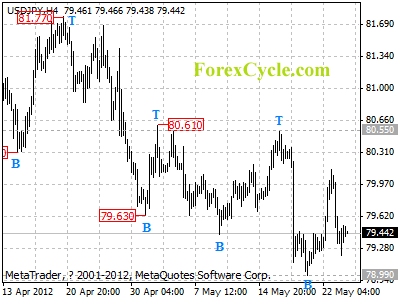
USDJPY moves sideways in a rang
USDJPY moves sideways in a rang between 78.99 and 80.61. As long as 80.61 key resistance holds, the price action in the range is treated as consolidation of the downtrend from 84.17 (Mar 15 high), and one more fall towards 78.00 is still possible after consolidation. However, a break above 80.61 will indicate that the downward movement from 84.17 has completed at 78.99 already, and the target for the following upward movement would be at 83.00 area.
Christmas May Come Early This Year
It’s a little early for Christmas in July, but now is the time for investors to be putting together their “Christmas lists” of sorts.
Recently, I wrote a piece that described an old investment strategy of Sir John Templeton (see “An Anniversary We’d Prefer to Forget”). Sir John would make a list of companies he’d love to own “if only” they fell to a more attractive price. He would then place limit orders to buy those companies at prices substantially below the current market price. In the event of a sharp selloff, the limit ordered would be executed, and Sir John would have his shares at the prices he always wanted.
His rationale for the strategy was simple enough: we humans are instinctively herd animals, and we tend to panic when we see others around us panicking. We lose our independent judgment and we freeze in fear at exactly the moment we should be buying aggressively. Templeton’s move was designed to take his own emotions out of the equation; Sir John understood his own human shortcomings, and essentially gamed himself.
Today, with Europe teetering on the edge of a potential meltdown, I’m going to recommend that investors take a similar approach, though mine has the added bonus of adding a little extra income.
I recommend that you make a list of strong multinational companies based in Europe that you are confident can survive Armageddon with their businesses intact. Ideally, these companies would have significant percentages of their revenues coming from outside of the Eurozone.
Once you have your list of stocks, consider selling deep out-of-the-money puts on them. If prices remain relatively stable or rise, the options expire worthless and you pocket the premium. And if the share prices take a nosedive, the options will be exercised and you will be obligated to buy the shares at the prevailing market price—which was your objective all along. And you still get to pocket the premium.
Here a little explanation is needed. When you buy an option, whether it be a call or put, your risk is limited to the price you paid for the options. You are buying the right to buy or sell shares at a given price, not the obligation.
Selling, however, is a much trickier business. Your upside is limited to the premium at the time you sell the option. But your downside is much, much bigger. In fact, when selling a naked call option, your risk is theoretically infinite. For example, if you sell the right to buy Facebook (Nasdaq:$FB) at $38 to another investor and the stock rises to $100 the next day, you’re on the hook to buy at the prevailing market rate of $100 and sell at $38. Not an appealing prospect.
Likewise, when you sell a put, you are giving an investor the right to sell you shares at a price that might be far higher than the prevailing market price. So, when selling put options on your list of European stocks you’d like to own, make sure that you have the cash on hand to handle the trade if it is exercised. Don’t get greedy and sell contracts for more shares than you can afford to buy or that you would ideally like to own.
I’m not going to recommend specific put option contracts for you to sell because the entire point of this article was for you to create a list of stocks you like at prices you want to pay. I also want the advice in this article to be general and something that you can use months or years from now; recommending a specific contract would make this article too short-term for my liking.
I will, however, toss out a few company names for you to consider. Last week, I recommended Spanish bluechips Telefonica (NYSE: $TEF), Iberdrola (Pink:$IBDRY)and Banco Santander (NYSE:$STD) (see “Bargain Hunting in Spain”).
I continue to like all three, and to this list I would add French oil major Total (NYSE:$TOT) and British telecom giant Vodafone (NYSE:$VOD). While Vodafone is not a Eurozone stock, it has significant operations in the Eurozone and I would expect its share price to take a tumble in a general market rout.
If you’re not comfortable with options, that’s ok. You can accomplish essentially the same thing by placing limit orders like Templeton.
Disclosures: Sizemore Capital has positions in TEF.
This article first appeared on MarketWatch.
Position Yourself for the Rest of “Conquer the Crash”
The earlier you prepare, the better
By Elliott Wave International
To this day, I wonder why Robert Prechter’s book Conquer the Crash has not been more widely recognized. It described in advance much of what happened in the 2008 financial crisis.
Published in 2002, the book provided detailed descriptions of then-future economic scenarios. They were detailed vs. general. Prechter was specific in a way that would prove right or wrong; there was no gray.
This is from the book:
There are five major conditions in place at many banks that pose a danger: (1) low liquidity levels, (2) dangerous exposure to leveraged derivatives, (3) the optimistic safety ratings of banks’ debt investments, (4) the inflated values of the property that borrowers have put up as collateral on loans and (5) the substantial size of the mortgages that their clients hold compared both to those property values and to the clients’ potential inability to pay under adverse circumstances. All of these conditions compound the risk to the banking system of deflation and depression.
Conquer the Crash, second edition, (p. 179)
That’s just one excerpt about one topic in a 456-page text. Perhaps you see why I believe the book deserves more credit. Yet even that one paragraph from the book turned out to be a virtual mirror of what came to pass. And much of what he predicted is unfolding today: the JPMorgan trading fiasco, massive withdrawals at Greek banks, downgrades of Italian and Spanish banks and much more. Those are just a few headlines.
The broader point is that Conquer the Crash prepared its readers. Around the time the book’s second edition published in 2009, the Chicago Sun-Times remarked
And the credit implosion is still not over. Please take a look at the chart:

In the Conquer the Crash quote in the first part of this article, you’ll notice the last three words are “deflation and depression.”
The world has yet to completely pass through these economic valleys.
 | It’s not too late to prepare yourself for what’s aheadElliott Wave International is offering a special free report with 8 lessons from Conquer the Crash to help you prepare for your financial future. In this 42-page report, you’ll get valuable lessons on what to do with your pension plan, what to do if you run a business, how to handle calling in loans and paying off debt, a list of imperative do’s and don’ts, plus much more. |
This article was syndicated by Elliott Wave International and was originally published under the headline Position Yourself for the Rest of “Conquer the Crash”. EWI is the world’s largest market forecasting firm. Its staff of full-time analysts led by Chartered Market Technician Robert Prechter provides 24-hour-a-day market analysis to institutional and private investors around the world.
Have the Small Cap Stocks Bottomed Yet?
David A. Banister- Chief Strategist- Markettrendforecast.com and ActiveTradingPartners.com
The IWM ETF represents the Russell 2000 small cap growth index. This ETF peaked at 84.66 this spring and has fallen in the the 74′s before the recent two day bounce. What we are looking at is a possible 5 wave rally from October into March, and now a possible 3 wave correction (Wave 2) of 38-50% of that entire 5 wave rally. Elliott Wave theory is broken down into 5 wave and 3 wave movements in the markets and individual stocks, where a full 5 wave pattern in a Bull market is obviously bullish and a 3 wave pattern corrective of the prior 5 wave rally.
The small cap index peaked with the reset of the market in March of this year, interestingly about 3 years into the Bull Market. The first low so far was a typical 38% fibonacci retracement of the rally from October through early March. The next low pivot would be a 50% pullback. This would place the IWM target around 72.10 plus minus some pennies.
In the 72′s that would represent a C wave decline that is equivalent to 161% of the A wave decline in the chart below from the 84.66 highs. ABC declines are common in a Bull cycle and are designed to throw investors off the back of the Bull. Normally the C wave is where investors finally throw in the towel near the bottom, as we saw in early October of 2011. I wrote an article on October 3rd last year, one day before the bottom outlining why a massive rally was about to ensue. Will we see the same thing now?
Well, this correction could indicate one more possible decline of 4-5% worst case should this projection in the chart below fulfill.
That said, the 38% retracement we have had so far would also qualify as a Wave 2 low last Friday. Therefore, this outline is to give you some indications of what to watch in case we drop further and pierce those lows. If we can hold this rally and rebound smartly again, then the C wave of the ABC is likely over and we can get an all clear to be more aggressive.
Join us at www.markettrendforecast.com for weekly reports and or a subscription and a 33% discount!

The Ins and Outs of International Investing
What do BMW, Burberry and Prada have in common?
Well, yes, all three are European companies with an old pedigree that produce highly-sought-after luxury goods, but besides that?
Unlike some of their peers—such as Daimler AG ($DDAIF) or Moet Hennessey Louis Vuitton ($LVMUY), none trade in the United States as a liquid ADR.
In addition to trading on German and French exchanges, respectively, both DDAIF and LVMH trade in the American over-the-counter pink sheets. Plenty of other European firms trade on the New York Stock Exchange or Nasdaq—including household names like Britain’s Vodafone ($VOD) and Spain’s Telefonica ($TEF) and Banco Santander ($STD), to name a few.
The world of ADRs is not limited to European companies, of course. China Mobile ($CHL), Turkcell ($TKC), and AmBev ($ABV) all trade as U.S. ADRs and hail from China, Turkey and Brazil, respectively. And there are hundreds more.
In contrast, BMW trades on the Xetra in Germany, Burberry trades on the London Stock Exchange, and Prada trades in Hong Kong of all places. Buying shares requires having a broker with access to these markets; a seat at the New York Stock Exchange will not suffice.
For the uninitiated in international investing, this requires a little explanation. An American Depository Receipt (“ADR”) is a security trading in the U.S. markets that represents shares of a non-U.S. company. The shares trade in U.S. dollars and pay any dividends in U.S. dollars. Aside from the occasional withholding of foreign dividends for tax purposes, a U.S. investor will generally notice no difference between holding an ADR and holding a regular U.S. stock.
Companies have their own assorted reasons for going the ADR route, but for most it is a matter of prestige and access to capital. As the largest and most liquid market in the world, the United States has been a favored place for multinational giants to raise capital for decades. In fact, the first ADR was issued as far back as 1927, for the British retailer Selfridges.
For investors, the rationale is much the same. Historically, it has been difficult for Americans to buy shares of locally-traded foreign firms. You would either need a broker in that country or a full-service U.S. broker with access to those markets, and in either event you are dealing with time zone differences, currency differences, higher trading costs and often times a serious lack of information about the stock you’re wanting to trade.
Buying the stock as an ADR alleviates these concerns and also potentially gives you better corporate governance. Sponsored ADRs trading on the NYSE (as opposed to those trading over the counter on the pink sheets) have essentially the same reporting requirements as listed U.S. firms.
For all of these reasons, ADRs are usually the best option for U.S. investors when given the choice. All else equal, I’d prefer to buy the Daimler ADR than to buy the German-traded shares.
But you shouldn’t limit yourself to the world of ADRs. Doing so may eliminate some otherwise great investment opportunities.
Consider BMW, which I mentioned above. I love BMW for precisely the same reasons I like Daimler. Luxury German cars are an aspirational status symbol around the world, but particularly in emerging markets. I consider BMW a fine “backdoor” way to profit from the rise of China’s nouveau riche, and the company’s operating results have been nothing short of stellar even in the midst of a European debt crisis. BMW had record profits in 2011 and raised its dividend to a new record level. More rises are likely. I’d prefer the ease of buying BMW as an ADR, but I would be perfectly comfortable buying it on the German exchange as well.
Much the same could be said for the two fashion brands I mentioned above. I love ADR-traded LVMH as an indirect bet on emerging market growth. But if I love LVMH, why would I also not love Burberry or Prada? All three companies are wildly profitable, have incredible brand equity and cater to the taste of high-income earners in Asia and elsewhere.
As capital markets become more globally integrated and information more dispersed, the barriers to buying and selling locally-traded shares are getting smaller. Most large, foreign blue chip companies publish their annual reports in an English version, and even for those that do not there is usually ample data available to help you in your decision making. Reporting standards do vary from country to country, but this should be no impediment to a motivated investor willing to roll up his sleeves and do a little research.
The logistics of trading have also gotten easier. These days, even many discount brokers offer some level of access to foreign-traded shares. To give two examples, Sizemore Capital primarily uses Interactive Brokers and Scottrade for trading and custody. Interactive Brokers allows me to buy or sell on virtually any major exchange in the world and to hold my cash balances in any major world currency. Scottrade’s international options are a little more limited, but Scottrade too allows for trading in a handful of foreign markets. Depending on the market in question, the trading commissions at both brokers are often about the same as they would be for regular domestic stocks.
Sure, it can be a little confusing at times when you look at your account statement and see that you just received a dividend denominated in, say, Norwegian kroner. But this is nothing to be afraid of and your broker will usually exchange it into dollars for you automatically.
Bottom line: In a world in which companies and their customers know no national boundaries, investors too should be willing to invest globally.
As a side note about over-the-counter ADRs, a lot of investors are put off by buying something on the pink sheets. I understand completely.
The pink sheets are notorious for being the home of micro-cap pump-and-dump scams, and I would never recommend that investors walk into that minefield. But it is important to view ADRs on a case-by-case basis. Daimler and LVMH have more than ample size and liquidity to trade on the New York Stock Exchange, as would Swiss confectionary giant Nestle ($NSRGY). They instead choose to go the pink sheet route because they don’t want to deal with the expensive headaches of dealing with Sarbanes-Oxley and other recent U.S. legislation. They trade on well-regulated exchanges in Europe, so their lack of regulation here is nothing I would consider a red flag. But in the case of, say, Russian gas giant Gazprom ($OGZPY), the lack of governance would be something I’d have to take into consideration.
Disclosures: Sizemore Capital currently holds long positions in CHL, DDAIF, LVMUY , NSRGY,TEF and TKC
