Free of the Dragon: Why the Energy Market Doesn’t Need China

By MoneyMorning.com.au

Your editor spent yesterday morning at the Platts LNG Forum in Sydney.

The audience contained a mixture of industry professionals and investment analysts.

Anyone who turned up hoping for a healthy dose of ‘China will spur growth in the Asian energy market for years to come’ was sorely disappointed.

In fact, we walked away even more convinced of what we had already started to think – that China (and India) won’t have the same influence over the global energy market as they’ve had over the metal markets.

But if that’s so, what does it mean for natural gas, oil, and Aussie energy stocks?

Despite what you may think, we’d say it means a very bright future indeed. And with the recent hammering taken by energy stocks, we’d say now could be the best chance you’ll ever get to buy energy stocks on the cheap. Here’s why…

China’s Energy Demands

Yesterday I showed you a chart of China’s share of global natural gas demand. As of 2009 it was about 4%. But what we didn’t have were the numbers for the last two years.

Had China’s demand for natural gas taken off like a gas-fired rocket? Was it in control of 50%, 60% or even 70% of global demand?

Not quite.

Hong Chou Hui, managing editor of Platts’ Asia LNG gave us just the info we were after.

In 2010, China’s natural gas demand was 4.8% of global demand. And in 2011 it was 5% of global natural gas demand.

In growth terms, China’s share has increased 25% in two years. But so what? It was starting at a low base. And when you think about it, given that the Chinese economy has grown so quickly, and the fact it’s consuming more raw materials than you can possibly imagine…it still only accounts for 5% of the world’s energy demand.

Again, compare those numbers to the chart we showed you yesterday, where China is by far the biggest consumer of iron ore, coal and copper.

When Chinese demand for iron ore, coal and copper drops, related commodities and stocks will drop too. In the case of BHP Billiton [ASX: BHP], Rio Tinto [ASX: RIO], and Fortescue Metals [ASX: FMG], they already have.

Inelasticity of Energy Demand

So what does this tell us?

It tells us that the energy market isn’t a China-driven market.

For that matter, it’s not necessarily an American, European or Australian market either. The energy market right now is probably the closest you’ll get to a fully diversified commodity.

But, what’s happened?

China’s economy has slowed, the Europeans look as though they’re heading for recession, the oil price has tanked and Aussie oil and gas stocks have taken a bath.

It doesn’t make sense. And we’ll show you two charts to explain why. The first is a chart of world oil consumption from 1980 to 2010:

world oil consumption from 1980 to 2010
Click here to enlarge

Source: Indexmundi.com

The second chart is world dry natural gas consumption between the same dates:

world dry natural gas consumption from 1980 to 2010
Click here to enlarge

Source: Indexmundi.com

You see the same pattern on both charts. A steady increase. Yes, there are some peaks and troughs, but even during 2008-2009 (the biggest global recession since the Great Depression), oil and gas consumption barely dropped.

That’s because there’s an ‘inelastic demand’ for energy. In other words, the demand is reasonably stable regardless of economic conditions.

Power stations need oil, gas and coal to produce electricity (even with the advent of alternative energy supplies).

Industry and individuals need to drive to work, or use public transport that relies on an electricity supply powered by oil, gas and coal.

And people and businesses need to warm or cool their premises…and cook meals…and do all sorts of other things that require fuel.

Yet when China shows signs of slowing down, energy prices and energy stocks take a hit along with every other resources stock.

(Not quite every resources stock. Our old pal, Diggers & Drillers editor, Dr. Alex Cowie was dancing on his desk on Wednesday as his recent stock pick clocked up a huge gain. You can check out the Doc’s investment advisory service and the stock he reckons has further to run by clicking here…)

Why China Doesn’t Matter to the Energy Market

And let’s say China’s economy slows down. What kind of impact will this have on energy markets? Yes, there will be an impact. But it won’t be energy Armageddon.

According to Martin Daniel, editor of Platts Power in Asia, industry accounts for 75% of China’s electricity generation.

This is twice as much as in Japan and most other western economies where less than 35% of electricity demand is for industry.

Based on that, Chinese industry accounts for 3.75% of global natural gas demand. And even we aren’t predicting that Chinese firms will switch off all their machines when the economy crashes.

Firms will carry on making stuff. And sure they may not use quite as much electricity and natural gas, but as the charts above show, the impact of even major economic slowdowns only has a negligible effect on oil and gas demand.

You don’t get many opportunities in your lifetime to buy unfairly beaten-down stocks. This is one of those times.

Cheers,
Kris

Related Articles

The Conference of the Year “After America” DVD

The Commodity to Prepare Your Portfolio for in a Post-China World

Get in Early to Shale Gas


Free of the Dragon: Why the Energy Market Doesn’t Need China

Good For Gold Prices: Commodities are Wounded, But Far From Dead

By MoneyMorning.com.au

Greece is frozen in a political stalemate. Youth unemployment is running at over 50%. And there has been a $1 billion run on Greek banks.

From near and afar, there appears to be no easy way out, especially now that the Eurozone is heading back into a recession.

It’s times like these when investors pour into the U.S. dollar for its “perceived safety.”

With commodities priced in U.S. dollars, this spike in the greenback has sent commodities-including gold prices into a tailspin since early March.

That has many doubters asking: “Has the commodities super-cycle ended?”

It’s a reasonable question considering the Continuous Commodity Index (CCI) is back down to levels it last saw in September 2010.

What’s more, gold prices have backed off to near $1,500/oz., and oil prices have fallen from $110 to $90/barrel.

But as you’ll see, the commodities coin does have another side.

The Other Side of the Commodities Story

In fact, a recent article by Frank Holmes, CEO and chief investment officer at U.S. Global Investors, pointed out how China and other emerging nations are in better fiscal shape than much of the West.

Even if China is slowing somewhat, it is still growing at an enviable 8% per year, with only 42% debt to GDP ratio. So rather than go for more outright stimulus, it’s expected that China will target new loan growth and its M2-money supply growth to around 14%.

Meanwhile, India and Australia have just lowered interest rates while other central banks are basically refusing to raise rates.

It means the world will keep turning, people will keep consuming and annual demand of raw materials is likely to remain elevated.

As for gold prices, let’s cut right to the chase.

Interest Rates and Demand is Pushing Gold Prices Up

Real interest rates [in the US] are running around negative 2% and thanks to ZIRP (Bernanke’s Zero Interest Rate Policy), they’re likely to remain so at least until late 2014.

And debt in the West (U.S., Europe, England, and Japan) has doubled in a little over three years to almost $8 trillion in a veritable monetary flood that’s bullish for gold.

On top of all that, the demand for physical gold is still increasing.

According to the World Gold Council’s (WGC) Q1 2012 trends review, they see record levels of Chinese gold demand, surging 10%, for a new quarterly high of 255.2 tonnes. They also see further growth, as the Chinese remain concerned about high inflation persisting.

The demand is so great that China has surpassed India as the world’s largest gold consumer.

European demand has also held up well, with physical metals in the form of bars and coins selling at higher than historical levels.

And central banks keep doing their part, with net purchases totaling 80.8 tonnes, or about 7% of global demand. WGC believes there’s been a secular shift, with central banks now set to remain net buyers of gold for the foreseeable future.

Prepare Yourself for Gold Price Fluctuations

Yet, gold investors who are dismayed by its recent price action need to be psychologically prepared.

If we were to see a scenario similar to the 1970s bull market, gold could easily drop in half at any time.

That’s exactly what happened when gold reversed from $200 in January 1975, and fell for 18 months to $100 in August 1976.

Certainly, a drop that big would have forced a lot of gold investors to sell. But the truth was that the best was yet to come.

From $100 in August 1976 until its peak in 1980, gold rose 8 times to over $800.

In fact, a chart of the entire current bull market shows that gold prices could easily pull back to $1,300 and still not violate its upward trend line.

A QE Boost to Commodity and Gold Prices

So yes, the markets are in a funk over Europe and less-than-stellar economic news here.

But this is déjà vu all over again. Since the financial crisis began, we’ve been here three times before. In fact, each time since then, the Fed has stepped in following a clear market pullback and opened the monetary spigots.

First came Quantitative Easing 1 (QE1), then QE2, then Operation Twist. Each one of these liquidity injections quickly sent the market soaring.

Fed QE Program

The Fed also promised to keep rates low until the end of 2014. Of course, Ben’s been denying for months that more stimulus is coming. Yet recently released Fed minutes from its April monetary policy meeting showed more openness to another round of quantitative easing to coax the economy along.

But each time one of these injections ends (wears off), the market (junkie) goes into withdrawal, and looks for its next fix.

I’ve been saying for a while that it’s coming. With an election pending this November, odds are good we’ll see QE3 before the end of summer.

With falling stocks, retreating commodity prices, and weak jobs reports, it’ll make the QE3 sales pitch a much easier sell than your average time-share.

And based on the reaction the last three times, I’m pretty confident the commodities markets will smile at this one, too.

Still, it won’t be enough. We’re going to see a lot more central bank easy money. QE4, QE5, and QE-pick-a-number will not be far behind.

Get ready. Commodities and gold are about to come roaring back.

The commodities bull market is far from over.

Peter Krauth

Global Resources Specialist, Money Morning (USA)

From the Archives…

How the Ukraine Could Be Europe’s Biggest Shale Gas Play
2012-05-18 – Kris Sayce

Why Greece Can’t Afford to Stay in the Euro
2012-05-17 – Dan Denning

Get in Early on Shale Gas
2012-05-16 – Dr. Alex Cowie

APPEA – Day One at the Oil & Gas Show: Sand Dunes, Scuba Diving and Camels
2012-05-15 – Dr. Alex Cowie

The Case for Higher Gold Prices
2012-04-14 – Diane Alter


Good For Gold Prices: Commodities are Wounded, But Far From Dead

Where Are Oil Prices Headed?

By MoneyMorning.com.au

The uncertainty looming around worldwide economies sent oil prices sinking below $90 a barrel, a level not seen since October of last year.
The decline came on the heels of several weeks of slipping oil, sparked by a plethora of less than stellar economic reports. The concerning data mostly involved Europe’s ongoing sovereign debt saga.

Oil gained 0.5% in early afternoon New York trading Thursday, but the reasons for the rally were unclear.

“You don’t know if this is just a short-covering rally or the start of a more significant rally,” Andy Lebow, an oil analyst with Jefferies, told The Wall Street Journal. Lebow said that progress in the talks between Iran and Western powers about Tehran’s nuclear ambitions could have spurred Thursday’s price reversal.

If the gain isn’t maintained, however, prices could head closer to $85 a barrel.

Europe and the Oil Prices Slide

Contributing to [the] decline were mounting concerns about the strength of the global economy.

European finance ministers gathered for an ad-hoc meeting in Brussels Wednesday night to discuss measures to prop up stagnant economic growth in the region and to confer about the dire situation in Greece.

Red flags have been raised warning of a “severe recession” in the 17 nations that use the euro, which Greece is threatening to leave.

Also weighing on oil was the latest government report that showed U.S. stores swelled last week by 900,000 barrels to 382.5 million barrels. That was the highest level since 1990 and above forecast of supply growth of 750,000.

In May alone, the oil price has declined more than 15% and currently sits at its lowest level since Oct. 21.

“This is a good thing for consumers, that’s for sure,” oil analyst Andrew Lipow told the Associated Press.

Oil Price Decline Temporary

Don’t get too comfortable, however, with lower oil and gas prices.

[USA] Money Morning’s Global Energy Strategist Dr. Kent Moors sees the slide as temporary.

He wrote just a week ago, “We are seeing a short-term pullback in prices as concerns over falling demand levels parallel the European confusion.”

Moors wrote that the U.S. economy is “largely insulating itself” from what happens overseas, and that oil demand continues to be robust in the areas around the world that actually determine the pricing level.

“The current situation tends to benefit the value of the dollar against the euro,” said Moors about Europe’s debt debacle. “With virtually all international oil trades in dollars, that does mean prices may stabilize for a time. But it also means the concentrated asset wealth in oil transactions will increase.”

“And despite the events in Europe, the ultimate value of oil contracts will increase as well-especially in a market where the essential rise in demand is occurring in those regions of the world not directly impacted by the Eurozone problems,” Dr. Moors continued.

Other variables looming that could trigger an oil prices spike include Iran resuming its standoff with the West, and the possibility that OPEC could cut production if the oil price falls too low. Then there is the U.S. hurricane season which starts June 1; major storms are always a worry to oil rigs in the Gulf.

Diane Alter

Contributing Writer, Money Morning (USA)

Publisher’s Note: This article originally appeared in Money Morning (USA)

From the Archives…

How the Ukraine Could Be Europe’s Biggest Shale Gas Play
2012-05-18 – Kris Sayce

Why Greece Can’t Afford to Stay in the Euro
2012-05-17 – Dan Denning

Get in Early on Shale Gas
2012-05-16 – Dr. Alex Cowie

APPEA – Day One at the Oil & Gas Show: Sand Dunes, Scuba Diving and Camels
2012-05-15 – Dr. Alex Cowie

The Case for Higher Gold Prices
2012-04-14 – Diane Alter


Where Are Oil Prices Headed?

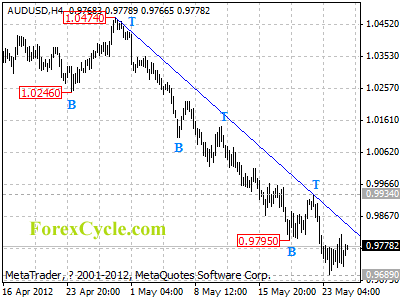
AUDUSD stays below a downward trend line

AUDUSD stays below a downward trend line on 4-hour chart, and remains in downtrend from 1.0474, the rise from 0.9689 is treated as consolidation of the downtrend. As long as the trend line resistance holds, we’d expect downtrend to resume, and next target would be at 0.9600 area. However, a clear break above the trend line resistance will indicate that the downward movement from 1.0474 has completed at 0.9689 already, then the following upward movement could bring price back to 1.0600 zone.

audusd

Daily Forex Forecast

Iran Hopes to Export Electricity to Cover for Reduced Oil Demand

Against the backdrop of discussions about pending negotiations over its controversial nuclear program and the upcoming deadline of an European embargo on Iranian oil comes a quiet push by the Islamic republic to become a major electricity exporter. Tehran had said it was expecting to secure electricity deals with Syria and Lebanon and had somehow attracted an estimated $1 billion to help build new power plants in the country. With some of the largest natural gas reserves in the world, Tehran might be able to shrug off international sanctions by embracing an ambitious electricity agenda.

European restrictions on Iranian oil go into force later this summer. Some U.S. allies in the European and Asian community have already started taking steps away from Iranian crude oil purchases in an effort to escape economic pressure from the West. Sanctions are meant to take oil revenue away from Tehran that its adversaries believe is financing a covert nuclear weapons program. But while U.S. Secretary of State Hillary Clinton was praising New Delhi for its coordination with U.S. nuclear concerns, Indian delegates were in the other room landing trade deals with visiting Iranians. This suggests that despite Western pressure, there’s still some interest in working in an Iranian economy.

A week after Clinton left, Tehran started announcing that it was keen to develop a self-sufficient power sector. The Iranian government said it already has electricity export contracts with its neighbours, including Turkey and Iraq, and was now looking further away to Lebanon and Syria. The Energy Ministry said its electricity exports were up more than 38 percent for the calendar year ending in March, so there was plenty to go around. Despite an eight-year military and reconstruction campaign in neighbouring Iraq, Tehran could claim, parts of Baghdad still don’t have a reliable source of electricity so why not take advantage of the opportunity.

Further still come claims that Tehran has set aside roughly $650 million for renewable energy programs. This, the government said, would come from a slush fund set up by Iranian President Mahmoud Ahmadinejad last year, when Iranian crude oil was still flowing freely, that designated 20 percent of the country’s oil and gas revenue for such social investments. On top of that was the announcement that the private sector can now sell Iranian crude in an effort to escape sanctions pressure.

OPEC in its monthly report said oil supplies were greater than oil demand. The IEA, for its part, said that while Iranian crude exports were down sharply, an “apparent” easing of tensions between Iran and the international community was helping to keep crude oil prices down. So much for back-breaking gasoline prices. That being said, with Iran ranking in the Top 5 among world natural gas producers, it might be onto something with its electricity ambitions. And if it’s indeed serious about a renewable energy program, its green revolution may come not from opposition leaders but in the form of renewables and natural gas.

Source: http://oilprice.com/Energy/Natural-Gas/Irans-Green-Revolution-may-come-from-Energy.html

By. Daniel Graeber of Oilprice.com


Indian Economy – A Basket of Business Opportunities

The population of India is estimated at over 1 billion, and continues to grow every year. The Indian economy is the fourth largest economy of the world, when we talk in terms of Purchasing Power Parity (PPP). The economic reforms initiated since 1991, have been providing an investor-friendly environment through a liberalized policy framework spanning the whole economy. These reforms have helped India in becoming more prominent in undertaking importing and exporting activities, and other such forms of overseas businesses.

More than 10 per cent of the employed population works in industrial fields, and these include manufacturing and production of textiles. Process outsourcing is another business in India in which economy has grown drastically over the years. Residents of India are fluent in English, they have good communication skills for doing customer service, they are conversant in tech support, and other similar service industries, so the Business Process Outsourcing (BPO) segment has good scope in India. In fact, out of the top fifteen outsourcing companies across the globe, seven of the large firms are located in India.

India also produces a good amount of agricultural products, along with development in segments such as logging, fishing, and forestry. Investment is increasing as banks have become more stable and secure, which was also part of the economic reform. India’s growth rate is approximately 7% on an average, and has greatly reduced the amount of poverty among its residents over the years. The constant growth of main industries has given more individuals the opportunity to have stable employment.

India is one of the most sought after destination for business and investment opportunities. The reasons behind this are:-

  • Extensive manpower base
  • Diversified natural resources, and
  • Strong macro-economic fundamentals

Over the last ten years, the Indian Economy has seen a paradigm shift and is on a robust growth trajectory. The Indian economy today claims of an increasing annual growth rate, deep capital markets and liberalized foreign direct investment (FDI) regime. India is one of the few economies to have withstood the recent global financial crisis and its gross domestic product (GDP) has been constantly growing in excess of 8 per cent per year. The country’s GDP has been growing at an average rate of 8.6 per cent for the last five years. India’s GDP growth projection is 8.5 per cent for FY11.

India’s economy has strong fundamentals and is host to several prominent global corporate giants that are leaders in their respective fields. According to the Global Competitiveness report 2010-11, India ranks 51st among 139 countries. India ranks higher than many countries in key parameters such as market size (4th) and innovation (39th). It also has a sound financial market (17th).

According to UNCTAD’s World Investment Prospects Survey 2010-2012, India is the second-most lucrative destination for FDI in the world. Indian markets have significant potential and offers prospects of high profitability and a favorable regulatory regime for investors.

About the Author

Harjeet is an Indian – born mass-market novelist, who covers the world internet related topics . He writes columns and articles for various websites and internet journals in the domain of Investments and Investing in India.


Euro Dips after EU Summit Clash

By TraderVox.com

Tradervox (Dublin) – The euro has dropped to its lowest since July 2010 versus the dollar after EU leaders clashed over the joint bond sales which French Hollande is supporting to be introduced in the euro zone as a solution to the current debt crisis in the region. The EU Summit could offer an immediate solution to the problems in Spain attracting investors’ attention in to the problems in the region. This has sparked risk aversion in the market hence forcing the euro further down against the yen and the greenback.

The 17-nation currency dropped against the yen for the third day after euro zone reports indicated that services and manufacturing industries contracted in May as German business confidence dropped. The debt crisis in the region and the contagion fears are other reasons that have forced the pound down against major peers in the market. Safe haven currencies such as the dollar and the yen have increased against most major peers as concerns the debt crisis is worsening increased their demand. This trend is expected to continue as more news from the meeting is expected. The crisis is also expected to spill over to other high-yielding currencies such as south pacific currencies and the Canadian dollar.

After the summit, Angela Merkel, the German Chancellor indicated that a stronger economic cooperation between countries in the region is required before they could introduce joint bonds. The European Council President Herman Van Rompuy, indicated that Euro zone leaders are in no pressure to introduce the euro bonds.

After the meeting, the euro fell by 0.2 percent to 1.2555 during the start of the London session, it had earlier dropped to 1.2516 which is the weakest level it had been since July 2010. Against the yen, the 17-nation currency dropped by 0.4 percent to trade at 99.65 yen. The euro had dropped 1.5 percent yesterday making it the biggest drop this week.

Disclaimer
Tradervox.com is not giving advice nor is qualified or licensed to provide financial advice. You must seek guidance from your personal advisors before acting on this information. While we try to ensure that all of the information provided on this website is kept up-to-date and accurate we accept no responsibility for any use made of the information provided. Opinions expressed at Tradervox.com are those of the individual authors and do not necessarily represent the opinion of Tradervox.com or its management. 

Article provided by TraderVox.com
Tradervox.com is a Forex News Portal that provides real-time news and analysis relating to the Currency Markets.
News and analysis are produced throughout the day by our in-house staff.
Follow us on twitter: www.twitter.com/tradervox

The Psychological Keys of Trading

By Taro Hideyoshi

There are many experts who teach the psychology of trading. Also, there have been many books written trying to teach the discipline needed for trading. Although the psychology is a important key for trading, you do not need to spend your money and your effort attending seminars to learn it.

This article intends to provide you a few simple psychological rules for trading that should greatly enhance your ability to trade effectively

Think about your losses as a cost of doing business

You have to accept your losses as a cost of doing business. Most successful traders said that the most difficult thing about trading is accepting your losses. Everyone has the desire to be right, to be correct all of the time. Therefore novice traders usually think that their losing trades mean that they make some mistakes or something is not working. But for experience traders, losses are just a cost of doing business.

Every great traders cannot win all the times. If you look at the performance results of them, you will see that they all have a large percentage of losing trades. Some of them use to lose money on more than half of their trade.

I guarantee you that you will have the times that you loose. So, learn to accept them and live with them. You will be spending a lot of time with them.

Use historical statistics

Before you trade, You have make sure that your trading strategy will eventually make profits for you. You should know its characteristics. In order to do this, you may have to use historical statistics.

Using historical statistics for your trading strategies, A.K.A. back-testing, gives you great peace of mind, particularly in accepting the losses.

By knowing the historical performance of a trading strategy, you may have psychological comfort during the tough periods of losing trades and drawdown. You will get the ideas about the trading strategy e.g. how many losing trades it has in a row and the largest losing trade the strategy has experienced.

Let the market and strategy determine the profits

Once you make sure that your selected trading strategy will make you profits, do not try to predict the market and do not try to second guess your strategy. You have to let the strategy be the strategy. Let it make money if it can. However if the market does not move in the manner that allow it to make money, it will not make money.

Put the responsibility of making money on the strategy and the market.

About the Author

Taro is an experience trader who trades in stocks, futures, forex. He strongly focuses on technical analysis, trading systems and money management.

If you would like to find more articles on MetaStock Tutorials, MetaStock Formulas, Trading Systems and Money Management. Please go to MetaStock Trading System.

You would also find the list of recommended books for trading & investing at The Investing Books.


Gold & Silver Rally with Stocks, Euro Hits 23-Month Low, as “Grexit” Planning Begins

London Gold Market Report
from Adrian Ash
BullionVault
Thurs 24 May, 08:10 EST

The WHOLESALE PRICE of gold investment bars rose 2.0% from yesterday’s low to reach $1569 per ounce in London Thursday morning, recovering from $1535 for the fourth time since gold hit all-time peaks above $1900 in late-summer 2011.

European stock markets also rose from new 2012 lows, while commodities halted their plunge and the silver price rallied 3.4% to trade back above $28 per ounce.

The Euro currency also bounced after slipping to $1.2520 – a new 23-month low.

Raising the odds of a Greek exit from the Eurozone to 50-75% by 2014, “We assume Grexit occurs on Jan. 1 2013,” says Citigroup economist Michael Saunders in a new report.

Citi’s base scenario sees “Greece staying in the European Union and receiving external loan support” – an idea mooted by German weekly magazine Der Spiegel ahead of Wednesday night’s “informal” summit of EU leaders.

After the meeting Herman Van Rompuy, president of the European Council, said that Greece’s partners want it remain in the Eurozone, but Athens must “respect its commitments.”

The Eurogroup Working Group – which advises Eurozone finance ministers – has “agreed that each [member] should prepare a contingency plan for the potential consequences of a Greek exit,” Reuters today quotes an un-named official.

“The immediate Greece impact is manageable,” reckons Germany’s banking association BdB.

“I think [an exit] has been priced in by markets,” says BdB’s general manager Andreas Schmitz.

US, German, Japanese and UK government bonds all ticked higher Thursday morning, nudging interest rates for their “safe haven” debt down towards new record lows.

Core Eurozone stock markets also rose, but remained more than 6% lower from the start of May.

The Athens stock market shed another 3%, extending its fall to 22-year lows, but Madrid pushed 1.8% higher after the Spanish government injected €11 billion into part-nationalized Bankia lending group.

This morning’s drop in the Euro helped raise the price of wholesale gold investment bars to €40,000 per kilo, unwinding the last of this week’s previous 2.1% drop.

Even so, “The correlation with Euro/Dollar is quite strong at the moment,” notes Credit Suisse analyst Tom Kendall.

“Today we’ve seen the Euro come back off its immediate lows … and that has helped the precious metals get a bid again.”

The 1-month rolling correlation of Dollar gold prices with the Euro/Dollar exchange rate – which would read 1.00 if they moved perfectly in lock-step – rose above 0.94 on Wednesday.

Gold’s correlation with the Euro has only been stronger on 14 trading days in the last 675, since Athens first revealed a “black hole” in its government accounts and raised the 2009 budget deficit forecast to 12%.

“If gold moved entirely in lockstep with EUR/USD movements,” says market-maker HSBC’s precious metals team, “we would expect the bullion market to be much closer to $1100” – the level of gold investment prices when the Euro last traded at $1.25

“That gold now is $460 per ounce higher implies it may have some other underlying supportive factors” beyond a simple Euro connection.

Emerging-market central banks continued their gold investment in April, new data from the International Monetary Fund showed this morning, with Mexico, Kazakhstan and Ukraine all adding metal to their holdings.

The Philippines’ gold reserves rose at the fastest pace since Lehman Bros. collapsed in Sept. 2008, up by 32 tonnes to a total of more than 194.

“[This will] gather much attention from market participants,” says Edel Tully, precious metals strategist at Swiss bank UBS. “[It] should somewhat help sentiment for gold.”

Central bank gold buying in the first 3 months of 2012 totaled 81 tonnes, according to latest data from market-development organization the World Gold Council.

That was equal to nearly four-fifths of all gold ETF and new coin demand from private investors.

“Overall higher global central bank and invest-ment demand almost balanced out the drop in demand from the jewellery and industrial sectors,” notes Oliver Heuschuch at German refiner Heraeus’ headquarters in Hanau, Germany.

Looking at the refiner’s own flows, “Sales of gold investment bars in the last three weeks were significantly up, even though this has so far had no effect on the price of the metal,” Heuschuch says in his latest weekly report.

In Asian trade overnight, “gold prices held fairly steady,” says Standard Bank’s daily note, “with profit-taking balanced by a resurgence in physical demand.”

“Everyone is worried about Greece withdrawing from the Eurozone and [about] the global economy,” says Dick Poon, head of precious metals at Heraeus’ Hong Kong office, “and would rather keep cash on hand than buying anything.”

Flash estimates for China’s manufacturing activity pointed today to a further slowdown in April. Eurozone manufacturing activity quickened its contraction, with Germany’s Ifo business sentiment survey also coming in worse than analysts forecast.

Adrian Ash
BullionVault

Gold price chart, no delay   |   Buy gold online at live prices

Adrian Ash is head of research at BullionVault, the secure, low-cost gold and silver market for private investors online, where you can buy gold today vaulted in Zurich on $3 spreads and 0.8% dealing fees.

(c) BullionVault 2012

Please Note: This article is to inform your thinking, not lead it. Only you can decide the best place for your money, and any decision you make will put your money at risk. Information or data included here may have already been overtaken by events – and must be verified elsewhere – should you choose to act on it.


The Best Investment Opportunities in India

Presently it has been found that most developed countries are increasing their investments in India. The reason behind this is the varied industrial opportunities that this vibrant democratic system of the country offers to investors. The legal framework of the country is highly expansive. The infrastructure of India also is growing rapidly as it has a good network of business institutions, banking facilities and the capital market is highly organized.

The various sectors that are worth investing in India are namely:
Education: The education system of India has been praised by the world educationists from a long time. Along with private investors the government too is taking care to see that the quality of education is of the best quality. Actually the population of India comprises of 50% youth. There are 367 universities and about 18000 colleges. Teaching is a respectable profession and many sought after it. International schools have entered the country too because they have seen great prospects. Biotechnology and aeronautics are very popular courses of today in India.

Software Industry: This is another most promising field where investments are sure to be profitable. India is well known as the IT hub and that is because the intelligent youth of India are providing great services at a very reasonable rate. Moreover, it is continuously growing and the revenue output is very high. The software companies are CMM certified which is an added advantage that attracts investors to this sector. Hence it has been rightly thought that investing in this giant software industry is surely a good decision.

BPO Services: Along with the software industry, the KPO (Knowledge Process Outsourcing) and the BPO (Business Process Outsourcing) services that are linked to it are also growing at a tremendous rate and that is also another reason of investors taking great interest in this field. According to the facts stated by NASSCOM, the BPO industry only is expected to reach a value of $30 billion by the year 2012. It has been predicted that the KPO industry is also supposed to reach the $10 billion by the 2012.

Food processing: India is an agriculture based country. Among the various flourishing industries, food industry has gained great importance as it acts as a connector between industry and agriculture. Hence it is quite obvious that the industry of food processing is bound to be the largest and the best field for investment opportunities in India. It is patronized by not only the government but is supported by cooperatives and private investors also.

Stringent rules have been formulated and government bodies set up to keep control over the functioning of the various units. To ensure safety of the investors government has introduced the National Food Processing Policy also.

If you are interested to invest in India Online you can very well do so as the economy of the country is always developing and therefore it is the appropriate market for investment. India is highly influenced by the global markets and that is seen in her purchasing power.

So if you are planning to invest in Indian Industries, then look straight to the world’s largest super power. Investing in India is surely the right decision.

About the Author

Harjeet is an Indian – born mass-market novelist, who covers the world internet related topics . He writes columns and articles for various websites and internet journals in the domain of Investing in India and Investment options.