LNG: Why Australia Will Be a New Global Gas Leader

By MoneyMorning.com.au

Peter Coleman is 52 years old, but his baby face makes him look years younger.

You should not let that fool you. Among other things, this savvy Aussie oil and gas executive is also a Western Australia Football Commissioner.

You know, that unique sport where you get to run up the score into triple digits while kicking your opponent in the teeth.

These days, Peter is in the middle of a major shift in the global liquefied natural gas (LNG) pecking order. Don’t look now, but the order is about to see a new global leader… Australia!

Prior to this point, market observers had usually considered the country to be a fringe player in the global oil and gas trade.

That’s about to change.

A Major LNG Exporter

Projections now put the country on schedule to displace Qatar as the major LNG exporter worldwide. Rising from nothing at the beginning of this decade, the country will be exporting at least 80 million tons of gas each year by 2020.

I first met Peter three years ago when he was still vice president for Asia and the Pacific at global oil and gas giant ExxonMobil Corp. (NYSE: XOM). At the time, I was consulting on the massive Gorgon offshore natural gas project north of Perth on the Australian west coast.

Gorgon is led by Chevron Corp. (NYSE: CVX) and involves what, at the time, was one of the first subsea gas gathering infrastructure networks ever attempted on a system of fields this size.

(By the way, they are still finding gas in this region).

Gorgon is Chevron’s largest project worldwide, but it is only one of three major projects in that part of Australia. All three are priming up to move LNG into the global market.

Initially, there was significant concern that the combination of projects would end up flooding the Asian market with gas, and end up driving down the price. Chevron has 47% of the Gorgon operation, but the project also includes majors Exxon and Royal Dutch/Shell (NYSE: RDS-A), along with three Japanese end users as minority participants.

And that was the potential downside.

Exxon has its own project in Papua New Guinea also coming on line. The other two main Gorgon partners worried Exxon would lock up long-term Japanese LNG end- user contracts, squeezing out Gorgon along with the other two northwest Australian projects.

Peter played his cards close to chest in those days, and you could never read his face very easily. His words are always measured, leaving you with the distinct impression that the other shoe is about to drop.

You also come away with the feeling he is providing only what he thinks you already know.

A Big LNG Market

Well, all that angst ended when China announced it was building five new coastal LNG receiving facilities simultaneously. The result has been nothing short of staggering. All of the projected volume from all of the Australian and New Guinean projects is now tied up in 15- to 20-year delivery contracts.

One of the central Australian players in all of this is Woodside Petroleum (ASX: WPL).

And that is where Peter comes back in.

For the past year, he has been CEO of Woodside.

Woodside has been paring its stakes somewhat in natural gas production projects, but it has just begun exporting from its huge $14.7 billion Pluto LNG terminal. The first consignment went off to Japan late last month. That facility will be moving at least 4.3 million tons a year with an expansion possible.

The Pluto and Xena projects remain under the control of Woodbine. But the company also believes that other natural gas producers will satisfy additional export capacity beyond Woodbine’s production levels.

Asia remains the single greatest consumer market (until the international boon began a few years ago, more than 70% of all LNG in the world was sold either to Japan or South Korea).

Still the competition will be increasing from Russian and U.S.-based production, and the question is whether the market can sustain the rapidly accelerating volume becoming available.

That just happened to be one of the main topics Peter discussed in an interview with Wall Street Asia’s David Winning.

In the process, another “ringer” was introduced.

It seems that Australia has significantly more shale gas than originally thought. It remains too early to estimate how much of this will find its way onto the market, or the time it will take to construct the necessary infrastructure, develop the field systems, extract, and process the gas.

In the interview, Peter was again quite measured in his responses. While most would turn to the recent history in North America and point toward a similar result in Australia, Peter takes the more cautious approach – awaiting geological determinations of actual basin structures.

Nonetheless, whether the natural gas will be coming from abundance offshore or locked within rock onshore, one thing is becoming quite clear.

Australia is now a leading international force and market maker in the natural gas sector.

Dr. Kent Moors

Contributing Editor, Money Morning

Publisher’s Note: This article originally appeared in Oil & Energy Investor

From the Archives…

How the Ukraine Could Be Europe’s Biggest Shale Gas Play
2012-05-18 – Kris Sayce

Why Greece Can’t Afford to Stay in the Euro
2012-05-17 – Dan Denning

Get in Early on Shale Gas
2012-05-16 – Dr. Alex Cowie

APPEA – Day One at the Oil & Gas Show: Sand Dunes, Scuba Diving and Camels
2012-05-15 – Dr. Alex Cowie

The Case for Higher Gold Prices
2012-04-14 – Diane Alter


LNG: Why Australia Will Be a New Global Gas Leader

John Law: The Gambler Who Broke France

By MoneyMorning.com.au

In 1720, John Law was lucky to escape Paris with his life. His investment scheme had made him one of the richest men in France. But it collapsed – and when it did, it ruined the entire nation. With a mob behind him baying for blood, he stole away to Brussels with one exquisite diamond – the last remnant of his enormous fortune.

It wasn’t the first time that Law had been forced to run for his life. In 1697, aged 26, he had fled London. At the gaming tables of society London, he had flirted with the future Countess of Orkney. Her husband challenged him to a duel. Law won, killing the husband, but earning himself a death sentence. He sprung jail and stole off to the continent. There, his attention was drawn to mathematics, banking and gambling.

Law hit Europe’s gaming tables. He understood the new science of probability and he used it to his advantage – among his tricks, for example, he would offer wealthy gamblers tempting prizes at vanishingly small probabilities.

He was a skilful gambler – but he was still a gambler, and he suffered some drastic losses. Years earlier in London, he had been forced to mortgage his family estate in Scotland to repay his gambling debts. In Europe he made enemies of the sheriffs of Venice, Genoa and Paris, and was expelled from each of those cities. But before he was ejected from Paris, he made one important friendship – with the Duke of Orleans, a young royal who was destined to rule France.

As well as gambling, Law was preoccupied with abstract questions of money and banking. He wrote a series of books and pamphlets to promote his radical ideas on how to organise the nation’s money.

In Essay on a Land Bank and Money and Trade Considered, Law broke new ground in economic theory. Indeed, the books put him in the front rank of the great economists. Among other things, he defined for the first time the functions of money.

He also used supply and demand analysis to explain the ‘paradox of value’ – in other words, why water is cheap and diamonds are expensive. He also advanced understanding of how changes in the money supply could drive real changes in the economy (although he neglected some key aspects of this theory, as we shall see shortly).

When Paper Money Was Better Than Metal Money

In 1715, Louis XIV died. Known as the ‘Sun King’, he built the lavish palace at Versailles, he believed his reign was ordained by God – and he left France on the verge of bankruptcy. His government owed three billion livres, but only took in 142 million in taxes.

The Duke of Orleans assumed the reins of government after Louis died. Remembering his old friend Law’s ambitious ideas for transforming the monetary system, he summoned him to Paris.

First in Scotland, then in Saxony, Law had tried to convince the government to issue new paper money backed by the nation’s land, with no success. But France’s new ruler was desperate, and so more receptive.

Law convinced him that France’s metallic money supply was restrictive, and that expanding the money supply with new paper currency would stimulate trade and employment. The regent allowed Law to try his scheme on a small scale.

He and his brother established the Banque Generale and issued six million livres’ worth of bank notes, partially backed by specie. Because the authorities continually clipped and debased French coinage, Law’s currency was sought after. Soon it traded at a 16% premium over face value.

The bank opened branches throughout France and Law’s paper credit system was extended around the nation. Trade and employment picked up. The ruler was impressed.

Flush with success, Law proposed a more ambitious scheme. At the time, France controlled the Mississippi river territories – which included the present states of Louisiana, Mississippi, Arkansas, Missouri, Illinois, Iowa, Wisconsin and Minnesota. The area was sparsely populated.

Law proposed establishing a company and granting it a monopoly over trade in the new territory. His plan was endorsed by the regent, and in 1717, the Compagnie du Mississippi was born.

Law was growing in power and influence. The Duke of Orleans appointed him Controller General of Finance, making him the second most powerful man in France and its de facto ruler. He consolidated the East India, Canada and China trading corporations into his Mississippi Company, so that the new entity monopolised all French trade outside of Europe.

By 1720, he had assembled and fused together all of the French trading companies, the tobacco farm, the mint, the tax firms, the French national debt and a quasi-central bank under a giant conglomerate known as the Mississippi Company.

The Bubble to End All Bubbles

Remember that France was close to bankruptcy. Using audacious financial engineering, Law swapped all of France’s high-yielding government debt for equity in the Mississippi Company. Nothing similar had ever been attempted on this scale. The seemingly limitless resources of France’s new empire fired demand for shares in the company in France and across Europe.

The first share issue, at 550 livres per share, was oversubscribed, and was soon trading at twice the price. Subsequent shares were issued at 1,000 and then at 5,000 livres.

Trading in Mississippi Company shares led to one of the biggest speculative manias in history. Enormous fortunes were made overnight – the word millionaire originated from Mississippi Company traders. Almost every single member of the French aristocracy was engaged in buying or selling Mississippi stock.

And it wasn’t just wealthy investors who were caught up in the scheme. People from every class of French society rushed to get involved. Coachmen and cooks made millions in days. Trading was centred on the tiny street in Paris where Law lived, the Rue Quincampoix, and crowds gathered every day to shout and scrap for Mississippi shares. It seemed that Law’s paper wealth had obliterated the normal rules of economic life.

But Law’s theory of money was incomplete. He neglected the impact that the issuing of millions of shares would have on the money supply, and on inflation. Notes and coins in circulation went up by 186% after the company floated. By January 1720, prices were rising by 23% per month.

Law was losing control of his scheme. He proposed that shares in the Compagnie be gradually deflated by 50% over a period of months – and this is where the story ends.

The penny was beginning to drop that the Mississippi delta was less a bountiful verdant garden and more a malarial swamp. There was a run on the shares, the banks, and on paper money. Metallic specie was reintroduced. Law was sacked from the ministry.

There were ugly scenes on the streets of Paris where dozens were crushed in the crowds, desperate to withdraw coin from the remaining banks. France would take generations to recover from the collapse.

“My shares which on Monday I bought,
Were worth millions on Tuesday, I thought,
So on Wednesday I chose my abode;
In my carriage on Thursday I rode;
To the ball-room on Friday I went;
To the workhouse next day I was sent.”

An innocent merchant barely escaped alive and his carriage was ripped to pieces when the mob mistook him for Law. France’s former de facto ruler had no choice but to flee. He abandoned his fortune and his adopted country and moved to Venice, where he died in poverty nine years later.

Sean Keyes

Contributing Editor, MoneyWeek (UK)

Publisher’s Note: This article originally appeared in MoneyWeek (UK)

From the Archives…

How the Ukraine Could Be Europe’s Biggest Shale Gas Play

2012-05-18 – Kris Sayce

Why Greece Can’t Afford to Stay in the Euro

2012-05-17 – Dan Denning

Get in Early on Shale Gas

2012-05-16 – Dr. Alex Cowie

APPEA – Day One at the Oil & Gas Show: Sand Dunes, Scuba Diving and Camels2012-05-15 – Dr. Alex Cowie

The Case for Higher Gold Prices

2012-04-14 – Diane Alter


John Law: The Gambler Who Broke France

EURUSD has formed a cycle bottom at 1.2642

EURUSD has formed a cycle bottom at 1.2642 on 4-hour chart. Range trading between 1.2642 and 1.2900 would likely be seen in a couple of days. As long as 1.2900 resistance holds, the bounce is treated as consolidation of the downtrend from 1.3283, and another fall to re-test 1.2624 (Jan 13 low) support could be expected. On the upside, a break above 1.2900 resistance will indicate that the downtrend from 1.3283 has completed at 1.2642 already, then the following upward movement could bring price back to 1.3200-1.3300 area.

eurusd

Forex Technical Analysis

2012 Gold Price Forecast: Where We Are and Where We’re Going

Article by Investment U

Gold Price Forecast for the Remainder of 2012

You'll notice that volatility in equities remains ever-present, particularly as we're in the midst of earnings season. But the volatility in gold prices has calmed down.

In 99.9% of instances, I take a bottom-up approach to investing.

I ignore the macro-economic picture for the most part; I ignore the talking heads on television; and I ignore the crests and troughs of sentiment.

I focus on companies. I focus on their opportunities. I focus on value and growth. And then I prey on the “Chicken Littles,” the panic sellers, the investors who freak out on every market dip. I snag great companies at discounts and watch the returns roll in.

This is why my favorite time of the year is August, September and October – the months of broad market catastrophes.

Now, that’s for the vast, vast majority market sectors. One of the few exceptions though, is gold.

Gold is the exact opposite. It’s a top-down investment, with its value tethered to the macro-economic picture. You add to your position on dips – like we have now – and profit on the run-ups.

In August, gold bounced off $1,900 per ounce. Today, we’re hovering around $1,590. That’s nearly a 16% decline… A 16% discount.

A lot of people think the glitter-filled days of new gold highs are behind us. I’ve heard calls for $1,100 gold and even a claim gold will tumble all the way down to $700… But I’d ignore those extremes. I will tell you, we may see gold dip lower – that isn’t out the question.

But a lot of those talking heads forget that gold is also seasonal, though this seasonality isn’t as profound as other, softer commodities.

So the reality is, we’re in a seasonal bearish period inside what I believe is a larger bull run. We’re in stasis – a holding pattern. A breather. We saw this same stall from April to July last year when gold mainly hovered around $1,500 and dipped in the $1,400s a few times.

In fact, over the last 15 years, gold prices weaken from mid-February into the summer, then again in October. And our biggest gains come in the stretch from November to early February – the annual stampede run fed by ramped up Asian buying.

You’ll notice that volatility in equities remains ever-present, particularly as we’re in the midst of earnings season. But the volatility in gold prices has calmed down. Gone are the days of $150 per ounce moves. Now, a big move is between $30 and $40. And most days the moves have been much smaller than that.

November and December are two of the strongest months for gold. But this year we also have the U.S. presidential election in November. And the macro-economic picture continues to remain tenuous. We’re still concerned about Europe. Greece is small potatoes compared to what’s unraveling in Spain. And Spain is a drop in the bucket compared to Italy.

If the dominoes begin falling, the great euro experiment’s end will move from a fun over-dinner debate to a very real possibility.

I expect it’ll be six months before the next big leg up in gold’s price. And $2,000 gold is far more eminent than triple-digit gold. Pick your spots over the next six months, and look for gold to move higher in the last half of the year. Of course, at the very least, you should have Investment U’s recommended 5% allocation in precious metals like gold.

Good Investing,

Matthew Carr

Article by Investment U

A Few More Reasons to Avoid the Facebook (Nasdaq: FB) IPO

Article by Investment U

A Few More Reasons to Avoid the Facebook (Nasdaq: FB) IPO

Like it or not, Facebook has to prove profitable and sustainable, two issues that are still in question at this time.

On Tuesday, May 15, Investment U research contributor Gary Spivak asked a series of questions about Facebook:

“Can an entire industry or company that has been in existence for less than 10 years continue to grow at its current torrid pace? Will social media continue to stay “hot hot hot” or will it merge into the mainstream? If it takes a company seven years to “rule the world,” how long could it take a competitor to come in and simply be cooler or just plain better?”

Those are questions that many market analysts have been asking ever since Facebook (Nasdaq: FB) first announced its IPO back in February. And they have every right to ask them, too.

The social media site arguably has the most hyped-up IPO of the century and, according to some business writers, of all time. What’s even less disputable is that investors were salivating over the mere prospects of Facebook going public long before any such thing was declared.

But initial publicity and enthusiasm can only go so far. At some point, a company has to stand on its own merit.

Like it or not, Facebook has to prove profitable and sustainable, two issues that are still in question at this time.

General Motors Backs out of Facebook Advertisements

With mere days left until the big IPO, Facebook bulls recently received a piece of unexpected news to pause over. Apparently, General Motors (NYSE: GM) sees some issue with its advertising campaign on the site, and has pulled its $10 million out of the game.

Now, that could be for a large variety of reasons. And none of them are clear considering the car company’s refusal to address speculation and Facebook’s inability to do so, since it’s in its pre-IPO “blackout” period.

But it isn’t the only piece of bad news the social media giant had to deal with in the last few weeks. Back in late April, Facebook reported first quarter financials, which included a decrease in profits amounting to $28 million less than the previous year and a 6% decrease compared to the last quarter.

MarketWatch tech columnist John Shinal explains that “Facebook’s results over the last two years show a consistent pattern: Advertising revenue surges in the second and fourth quarters, respectively, yet slows or even weakens in the first and third calendar periods.”

Yet even so, it doesn’t change the fact that this was the first time profits dropped in at least a two-year time span.

Consumers Ok With Facebook Alternative in the Future

Again, one bad quarter doesn’t a trend make, but it’s slightly worrisome. So too, for that matter, is a recent Associated Press-MSNBC poll.

Apparently, despite the hoopla in the business world and even the obsession among consumers themselves, half of Americans think that Facebook won’t be sticking around for the long haul. About the same number also believe that the social network isn’t worth what CEO Mark Zuckerberg expects it to go for.

That cynicism shouldn’t be shrugged off lightly, either. In the ever-evolving world of technology, trends come and go extremely easily. For one example, take the evolution of musical recordings over the last few decades…

Just 30 years ago, records were still being made and sold. Yet since then, the market has seen cassette tapes come and go, CDs begin their slow but obvious death spiral, and MP3 take over the market.

Few people can say exactly what’s going to come next, only that something undoubtedly will… and probably sooner than later.

The same has been true of social media’s relatively short history. In 2003, the hip crowd was gaga over Xanga, an online journal site where people could share their thoughts and pictures with friends or their larger community. Next up was MySpace, which peaked in 2006.

And while Facebook has reigned king – with Twitter possibly as queen – for the last several years, who’s to say that will last?

Facebook might be able to beat the trend like its predecessors haven’t been able to… but it’s probably wisest to say otherwise all the same.

Good Investing,

Jeanette Di Louie

Article by Investment U

Kings of Trash: The Top Dividend-Paying Waste Management Stocks

Article by Investment U

It’s not a pretty business picking up the trash, but some one has to do it. And at the end of the day, it’s good business.

In the United States alone, we create more than 250 million tons of trash every year. And more than half of our waste ends up in landfills.

With populations continuing to grow and consume more and more every year, we’re producing more trash than ever before.

This is good news for companies involved in the $52-billion waste management industry, as they’re turning more trash into more profits. Profits that many then pass along to stockholders through dividends.

The Kings of Trash

While you might think that big money is made in the service side (literally picking up trash), it’s actually found on the ownership side. Not ownership of the trash itself, but of the land used to store it.

Owners of landfills that have a large amount of space left for trash (also known as airspace), have an advantage in the waste disposal business. An advantage that lets them collect big returns on what people throw out everyday.

The top tickers involved in the landfill business, or what I call the “Three Kings of Trash,” are Waste Connections (NYSE: WCN), Republic Services (NYSE: RSG) and Waste Management (NYSE: WM).

I tend to like sectors that have a strong advantage in down markets, and waste management is one of them. You can still collect quality dividends while everything else is tanking.

The landfill industry was very resilient through the recent financial crises. While revenue growth stalled during the downturn, companies were still able to create strong cash flow and defend their dividends.

Many dividend payers in other industries were freezing or cutting their dividends through the financial crises, while Republic Services and Waste Management continued to grow theirs. (Waste Connections, the youngest company of the three, didn’t start paying a dividend until 2010.)

And the “Three Kings of Trash” truly have an advantage over competitors (or would be competitors). They have extensive experience in working regulatory hurdles.

Squeezing Out the Competition

I’m sure any CEO in the waste management business would be able to list countless unnecessary regulations that hurt their business. But extensive regulations also give the established players a big advantage.

The landfill industry is highly regulated. It entails constant investment to remain compliant.

Growing environmental regulations have made it more and more costly to operate and own landfills. It requires large amounts of capital to construct, organize and monitor sites.

And permits today require 30 years of environmental monitoring after a landfill closes. This is a major financial commitment that has to be planned well in advance.

The final price tag on a landfill… about $1 million per acre to construct, operate and finally close in ordinance with regulations.

With the amount of capital required to operate landfills coupled with a dumpster of regulations, new players in the game have a tough time breaking into the market and finding their feet.

That’s why industry revenue is driven to the established kings of the industry, while smaller competitors sit on the sidelines.

Taking Out the Trash

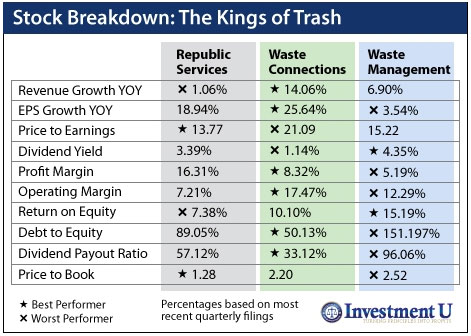
Let’s take a look at the chart below to help decide which of the Three Kings of Trash stand to benefit investors the most:

Dividend-Paying Waste Management Stocks

Based on the chart above, I’d be more inclined to pick up shares of Waste Connections first and then Republic Services – leaving Waste Management out on the curb.

While Waste Management does have the highest dividend yield and return on equity (something all investors should consider when researching a stock) it clearly has some other issues that raise a red flag.

First, it has a high debt-to-equity ratio of 151.97%. This means that creditors currently have more money in the company than stockholders have. Not a good sign.

Second it has a high dividend payout ratio of 96.06%. And yes, some can argue that they prefer companies with a higher dividend payout ratio since it means investors are receiving a higher amount of earnings.

But I tend to agree with Investment U income expert Marc Lichtenfeld. A payout ratio (preferably based on cash flow rather than earnings) of 75% or less means a company can reinvest its cash back into the business to fuel future growth. Not to mention as the payout ratio approaches 100%, it signals that the dividend payments are in jeopardy of being cut.

Waste Management also has the lowest operating and profit margins of the three kings. And it has the highest price-to-book ratio of 2.52. The other kings sit at much more attractive levels of 1.28 and 2.20.

And Waste Management only grew earnings 3.54% year-over-year in its latest quarter, while Republic Services and Waste Connections both had earnings growth in the double digits.

Of course those who are interested in the best yielding stock can still consider Waste Management. Over the past five years it has grown its dividend 8.85%. But once again, it placed below its competitor Republic Services, which grew its dividend 15.78% over the same period of time.

Our stock breakdown winner, Waste Connections, has only been paying its dividend since 2010, so we can’t calculate a five-year dividend growth rate. And it does have the lowest yield of 1.14%. But it has a one-year dividend growth rate of 53.33% and will likely continue to grow its dividend in the future.

Get Your Fill of Landfills

Investors should consider exposing themselves to the landfill market. It’s one that should continue to offer steady cash flow and dividends as our trash piles up, even in a down market.

And as I mentioned above, the three kings have established operations and hold higher ground over smaller players.

I would just be more inclined to pick up share of Waste Connections or Republic Services over Waste Management. I believe they have more room to grow their bottom lines and their dividends in the future.

Good Investing,

Ryan Fitzwater

Article by Investment U

Chinese Oil Companies: How to Play the Inevitable Shift

Article by Investment U

Chinese Oil Companies

In March, PetroChina announced that it pumped 2.4 million barrels of oil per day. That’s 100,000 more than Exxon.

It’s crazy to think that in just the last three years, China has become the world’s second largest economy, the world’s largest energy consumer, and the world’s second largest oil consumer.

A recent PriceWaterhouseCoopers report even estimates, “China could be the largest economy in the world as early as 2020…”

Whether it happens by then, I honestly don’t know. But neither does anyone else. In fact, long-term estimates like these are almost never right.

There’s one thing you can count on, though. No matter when (or even if) China takes the number one spot in the global economy, it’s going to require a great deal of energy either way.

And it’s more important than ever investors take a close look at what’s going on. Because, when it comes to energy, China is shaking up some very critical sectors like no one has seen before.

China’s Big Advance on Western Oil

Last year, Exxon Mobil (NYSE: XOM) saw its total oil output drop 5%.

For China’s government-owned PetroChina (NYSE: PTR), this decline was all it needed to knock Exxon out of its top spot as the world’s largest publicly traded oil producer.

In March, PetroChina announced that it pumped 2.4 million barrels of oil per day. That’s 100,000 more than Exxon. And unbelievably, it’s just a 13-year-old company.

For investors, this may be just the beginning of a new trend, too.

For example, China National Offshore Oil Corp. (NYSE: CEO), or CNOOC, said it expects to be one of the biggest oil companies in the world by 2030. The firm is currently the thirty-fourth largest oil company by reserves. To help bolster growth, last week the company opened up China’s first deep-sea drilling project in the South China Sea for business.

Then there’s Sinopec Group (NYSE: SNP), China’s second largest oil and gas producer. It just launched its first ever shale gas project and expects to churn out 6.5 billion cubic meters of shale gas for China by 2015. The Chinese oil company’s production also continued to nudge up in 2011 by 0.4%.

On the other hand, like Exxon, other Western oil and gas giants have struggled, as well. ConocoPhillips (NYSE: COP) divested more than $20 billion in assets and investments since 2010 and further expects oil production to dip 4.3% in 2012. Chevron (NYSE: CVX) saw its oil production drop 4.7% so far this year. The list goes on.

So what is China doing differently that’s allowing Chinese oil companies to gain the upper hand over its Western rivals?

The answer: They’re aggressively buying up foreign oil and gas companies and fields.

China Foreign M&A… Good or Bad for Investors?

According to MarketWatch, “In 2011, the total mergers and acquisition value of China’s three biggest oil companies – CNPC [a.k.a. PetroChina], China Petrochemical Corp. or Sinopec, and China National Offshore Oil Corp. – reached about $20 billion.”

Just a few years ago, the three top Chinese oil companies accounted for only a fraction of this number. However, investors should still be very cautious as they try to take advantage of China’s increasing energy presence abroad.

The main reason is companies like Sinopec and PetroChina operate for the sole purpose of fulfilling the needs of China’s government. Therefore, they’re notorious for spending more than they need to for exploration, development, and buying up other companies.

And this combination hardly ever translates well to making a profit.

For instance, over the past five years PetroChina’s shares have jumped a measly 1%. Meanwhile, Sinopec’s shares tanked 53%. That’s not the kind of investment I like to make.

Instead, think about Chinese oil companies that operate more independently, like CNOOC. In fact, it’s often considered the most “western” of oil majors in China because it has a long history of working alongside with foreign competitors.

Not surprisingly, CNOOC’s shares have performed much better than its peers. Instead of falling or trading flat over the past five years, its shares have more than doubled in price.

Not to mention, the Chinese oil company still has a solid divided yield of 3.4% and trades for merely seven times earnings. Just something to think about.

Good Investing,

Mike Kapsch

Article by Investment U

How to Invest in Gold Without Breaking the Bank

Article by Investment U

No question, having a small amount of precious metals in your global portfolio serves as sort of a “shock absorber” in times of crisis and uncertainty.

Obviously, the most logical strategy is to be a buyer of gold when prices dip and the opposite when prices are surging.

And with gold prices in a slump, I was thinking about adding a slug to my portfolio. But after doing some research, I’ve decided that there may be some better options right now…

Mine the Gap

First, take a look at the spread between gold miner shares and spot gold prices – near a 30-year low.

Spread between NYSE Arca Gold Miners Index and Spot Gold

Gold exchange-traded funds (ETFs) have fueled gold price gains over the past few years. Assets in bullion-backed ETFs have more than tripled during the last five years, reaching a record 2,410 metric tons on March 13, valued at about $140 billion, according to Bloomberg.

At some point, probably soon, this spread will narrow as investors look beyond the obvious risks in mining stocks and appreciate their substantial upside potential.

Gold stocks are trading at the cheapest valuations in about a decade. In addition, gold miners, especially small caps, are raising dividends to better attract capital flows from the ETFs and big-cap miners.

Market Vectors Gold Miners ETF (NYSE: GDX), which tracks larger gold miners, offers only a 0.7% yield. But my recommendation, Market Vectors Junior Gold Miners ETF (NYSE: GDXJ), which leans toward small- and mid-cap junior miners, offers about a 5% composite dividend yield.

It seems to me that these mining companies are dirt-cheap, with the large miners trading at around five times cash flows, and the juniors even less. GDXJ offers you a basket of these stocks, which is a better strategy than trying to pick and monitor one or two junior mining stocks.

Next, looking beyond gold, platinum and palladium have also suffered a sharp pullback, down about 18% since early March. Relative to gold, these metals are hybrids with precious and industrial value. Platinum is 30 times rarer than gold, used up in industrial uses rather than stored in vaults, plus it’s more difficult to mine.

The industrial uses of these two precious metals are largely in the auto business, so rising demand from auto companies is a key driver of prices. There are other uses as well, such a jewelry, glassmaking and the chemical industries.

ETFs for both of these metals increasingly play a key role in determining their spot prices. The Palladium (NYSE: PALL) and Platinum (NYSE: PPLT) ETFs are your best ways to add some exposure to your portfolio.

Take advantage of market weakness – but rather than adding some gold, why not diversify with some junior gold miners, blended in with a dash of palladium and platinum?

Good Investing,

Carl Delfeld

Editor’s Note: In today’s Investment U Plus edition, Carl recommends a specific mining company he thinks is way oversold and ready to jump. Its shares have fallen 52% over the past year and is only trading eight times earnings.

To find out today’s recommendation, along with our experts’ specific recommendations with every issue of Investment U, click here.

Article by Investment U

Europe takes a breather on G8

By TraderVox.com

Tradervox (Dublin) – The EUR/USD pair continued to ride higher on the bullish wave that was generated during the closing hours of the Friday’s trade. The pair opened the week at 1.2778 levels. The bullish bias from Friday’s close drove the pair up to the 1.28098 where the reality began to set into the Euro bulls.

The Friday bullishness in the EUR/USD was due to the positive market sentiments ahead of the weekend G8 summit at Camp David. In fact the summit lived up to its bullishness with the G8 leaders agreeing on popular “growth & jobs” plan instead of the “ forced austerity” measures which had led to toppling of previous governments in France and Greece.  This is a positive sign of greater understanding among Euro zone members. In addition the French President has called for a Euro zone bonds which will be put to the table at the Euro zone meeting this week in Brussels. The Euro zone members have unanimously expressed support to keep the Greece within the euro zone. This was a relief to the Euro bulls who were struggling to get out of the Greek Exit Dilemma which was making the rounds last week.

But the Euro could not sustain the bullish bias for long. The Euro revered the course and turned bearish at 1.2808 levels, which served as a strong resistance. Following this was a huge selling rally in the EUR/USD driving the pair to find support at 1.2738.

The reasons for the sell off can be attributed to the fact that markets have not yet left behind the Greek saga which drags into more uncertainty as the elections come closer. Another supporter of the Euro bears was Spain. The Spanish Finance Minister said that the economy had continued to contract in the second quarter. This comes after Friday’s news where the government suggested the country would miss its budget deficit targets this year.

However the effect of the news was not reflected much in the European Bourses with all of them, with the exception of Greece and Spain, closing in the Green.

The EUR/USD has entered a tight trading range and will likely remain flat for the Asian session.

Disclaimer
Tradervox.com is not giving advice nor is qualified or licensed to provide financial advice. You must seek guidance from your personal advisors before acting on this information. While we try to ensure that all of the information provided on this website is kept up-to-date and accurate we accept no responsibility for any use made of the information provided. Opinions expressed at Tradervox.com are those of the individual authors and do not necessarily represent the opinion of Tradervox.com or its management. 

Article provided by TraderVox.com
Tradervox.com is a Forex News Portal that provides real-time news and analysis relating to the Currency Markets.
News and analysis are produced throughout the day by our in-house staff.
Follow us on twitter: www.twitter.com/tradervox

Loonie Falls Despite Government Data Surpassing Expectations

By TraderVox.com

Tradervox (Dublin) – The Canadian dollar has registered its greatest decline since November after dropping for the third straight week due to concerns in Europe. Greece political uncertainties and the risk of debt crisis contagion have overshadowed positive government report showing that inflation and factory sales increased more than expected. The pressure on commodity currencies continued for the third week; the trouble for the loonie started after election results in France and Greece.

The Canadian dollar has touched a four-month low against the greenback which has continued to rise. The greenback rose against all the major traded peers as the market seeks safe haven currencies. The market is expecting a report to be released next week to show that retail sales rose in March. According to Chief Strategist Dean Popplewell of Oanda Corp, an online currency trading firm in Toronto, despite the very positive Canadian metrics, the external headwinds are too great that commodity sensitive currencies are unable to shake off.

The positive data came after a last week report showed that Canadian payroll had  the largest two-month gain in thirty years. Report released today showed that the Retail Sales rose 0.3 percent in March after registering an unexpected drop in February. Jeremy Stretch who is the head of currency strategy in Canadian Imperial Bank of Commerce in London said that the USD/CAD pair will remained biased until the risk aversion in the market subsides. Analysts are still optimistic that Canada will be the first of the Group of Eight countries that will increase interest rates.

The Canadian dollar slid by 2.1 percent against the US dollar to trade at C$1.0222 from a May 11 high of C$1.0005 making it the largest decline since November 4. The turmoil in Europe has caused major risk aversion in the market forcing risk sensitive currencies to drop.

Disclaimer
Tradervox.com is not giving advice nor is qualified or licensed to provide financial advice. You must seek guidance from your personal advisors before acting on this information. While we try to ensure that all of the information provided on this website is kept up-to-date and accurate we accept no responsibility for any use made of the information provided. Opinions expressed at Tradervox.com are those of the individual authors and do not necessarily represent the opinion of Tradervox.com or its management. 

Article provided by TraderVox.com
Tradervox.com is a Forex News Portal that provides real-time news and analysis relating to the Currency Markets.
News and analysis are produced throughout the day by our in-house staff.
Follow us on twitter: www.twitter.com/tradervox