Next Month “Key for Gold” as US Futures Positions Steady, Euro “Loses Support” from Central-Bank Demand

London Gold Market Report

from Adrian Ash

BullionVault

Mon 28 May, 08:35 EST

LONDON’s benchmark wholesale gold price rose 0.8% in Asian and London trade Monday, touching $1584 per ounce before easing back as silver also retraced early gains and European stock markets halved their initial rise.

Press reports said Madrid may move to support both the failed Bankia lender and Spain’s cash-strapped regional governments with new public debt.

Spanish 10-year bond yields today rose back above 6.4% –  a level last seen before the European Central Bank’s €1 trillion LTRO loans began in December 2011.
Italy’s unelected caretaker government was accused of taking “no significant measure” to tackle untaxed employment.

The caretaker government in Greece – which is on track to back pro-Euro, pro-bailout parties in next month’s election re-run, according to weekend polls – may divert €3 billion from propping up Athens’ banking sector to help pay public sector salaries in June, the press quote an un-named finance official.

New York markets remained closed after the weekend for Memorial Day


“June will be a key month as investors await the Greek election,” reckons Phillip Futures analyst Lynette Tan in Singapore.

“[The gold price] will probably be rangebound between $1530 and $1600 per ounce if there’s no major news before the election” on Sunday 17 June.

“People are just waiting for the verdict on Greece,” agrees a Hong Kong gold dealer also quoted by Reuters.

Last Friday the gold price “closed down slightly on the week at 1570,” says the latest technical analysis from bullion-bank Scotia Mocatta, “negating [the previous] week’s bullish hammer in the candlestick charts.

“[That was] gold’s 2nd week below the previous long-term uptrend and thus the outlook remains bearish.”

Latest data from US regulator the Commodity Futures Trading Commission show hedge funds and other professional speculative, non-industry traders stemming the slide in their “net long” exposure to gold futures and options.

Private individuals playing the gold futures market continued however to grow their bearish bets in the week-ending last Tuesday.

That took the total “net long” position of non-industry gold traders to its smallest level since December 2008 – when the Dollar gold price was trading at $767 per ounce and down more than 60% from the record high of August 2011.

Credit-investors meantime pulled more than $3 billion from low-grade bond funds worldwide last week – the fastest pace since August last year – according to EPFR Global in Cambridge, Massachusetts.

International money market data now show speculators holding their heaviest pro-Dollar bets since May 2008, and a new record “short” position against the Euro for the third week running.

“For much of this year the Euro would not move,” says Standard Bank’s currency strategist Steve Barrow.

“But now it won’t stop falling and we do not see this changing,” he says, restating Standard’s new 3 to 6-month targets of $1.15, £0.75 and ¥85.0, and citing “a number of factors that seem to have propped up the Euro in the past [but] may no longer prove such a force.”

Barrow points to “severe currency weakness” amongst big foreign-reserve accumulators led by China, Russia and Brazil, plus a sharp slowdown in their pace of diversification away from the US Dollar. The Eurozone’s balance of payments has worsened, “suggesting [both] international fear about the crisis, and greater fears internally” as Eurozone investors move capital outside the currency union.

“Finally, we also wonder whether EU directives to banks, to lift their capital ratios by June of this year, could have led to an acceleration of Dollar-asset disposals,” says Barrow. “It could have served to support the Euro [but] should wane now that June is nearly upon us.”

Meantime in India – the world’s #1 gold consumer market until overtaken by China last October – lower demand to buy gold could dent imports by 50% this month, says Prithviraj Kothari, president of the Bombay Bullion Association, despite the government reversing an earlier, highly unpopular move to raise more tax from jewelry sales.

The Rupee gold price has remained near all-time record highs thanks to sharp falls in the Indian currency’s forex value.

“We are heading towards seasonally weak demand period,” says one Kerala retail manager to Reuters.

“The wedding season is coming to an end and the monsoon is approaching.”

India’s peak season for buying gold typically coincides with the post-harvest wedding season and festivals culminating with Diwali in November.
Adrian Ash

BullionVault

Gold price chart, no delay   |   Buy gold online at live prices

Adrian Ash is head of research at BullionVault, the secure, low-cost gold and silver market for private investors online, where you can buy gold today vaulted in Zurich on $3 spreads and 0.8% dealing fees.

(c) BullionVault 2012

Please Note: This article is to inform your thinking, not lead it. Only you can decide the best place for your money, and any decision you make will put your money at risk. Information or data included here may have already been overtaken by events – and must be verified elsewhere – should you choose to act on it.


 

Lots, Leverage, and Profits in Forex Trading

The world of currency trading is full of its own distinctive terms and concepts. Understanding these terminologies is very essential in avoiding some pitfalls faced by newbie traders.

In Forex trading, lot is the standard transaction size of all transactions. The standard size for a lot is 100,000 units. And, there is
also sizes for mini lot (10,000 units), micro lot (1,000 units), and nano lot (100 units). Because trading using these units can make trading to be exorbitant for the average trader, Forex brokers have come up with a concept referred to as leverage.

Leverage enables you to execute large trades in your trading platform with a limited capital in your account. Leverage is a great moneymaking tool that many people have used to harvest huge profits in Forex trading. However, you should use it carefully because it can either work against you or for you. In other words, it is a double-edged sword.

If your broker provides 100:1 leverage, then you require 1 unit of currency to take charge of 100 units in the market. Therefore, it would only require 100 units to take charge of 1 mini lot (10,000 units) in the market, or 1,000 units to take charge of 1 standard lot (100,000 units). If your broker provides a 200:1 leverage, then you require 50 units to take charge of 1 mini lot, and 500 units to take charge of 1 standard lot.

Thus, profits in the business of currency trading is a factor of leverage x the type of lot being traded x the smallest price movement in the value of a currency pair (pip). On the other hand, loss is determined using the same method when price goes against you. Pip is normally the right-most digit of any quote of a currency pair, and it is what either increases or decreases when you enter a trade.

For example, if you buy EUR/USD at 1.2800 and the price moves to 1.2805, your profit will be:

$50 (for standard lot) = 100,000 x 0.0005

$5 (for mini lot) = 10,000 x 0.0005

$0.50 (for micro lot) = 1,000 x 0.0005

$0.05 (for nano lot) = 100 x 0.0005

Therefore, proper understanding of lots, leverage, and profits is important if you want to succeed in the business of Forex trading. Otherwise, if you don’t have a
solid grasp of these terminologies, you may lose a lot of money when trading Forex.


Heavy News Week Set to Cause Market Volatility

Source: ForexYard

The EUR/USD fell to an almost two-year low on Friday, as concerns regarding Spanish debt sent investors to safe-haven assets. The currency pair dropped to 1.2495 during mid-day trading before staging a slight recovery to close out the week at 1.2514. This week, traders can anticipate volatility in the marketplace, as a batch of significant US data is set to be released. In addition to the all-important Non Farm Payrolls figure on Friday, attention should also be given to Tuesday’s CB Consumer Confidence and Thursday’s Prelim GDP figures. Any better than expected news could help the dollar extend its recent bullish run.

Economic News

USD – Risk Aversion Helps USD Extend Gains

The US dollar was able to extend its bullish momentum on Friday, as concerns regarding Spain’s debt situation caused investors to continue selling off riskier assets. In addition, investors are still concerned about the affects of a possible Greek exit from the euro-zone. As a result, the EUR/USD dropped over 100 pips during the European session, eventually reaching an almost two-year low at 1.2495. The GBP/USD fell close to 70 pips over the course of the day, reaching as low as 1.5629 before staging a slight upward correction to finish the week at 1.5659.

Turning to today, dollar traders will want to note that US markets are closed due to the Memorial Day holiday. That being said, significant US news scheduled to be released throughout the week is almost guaranteed to generate activity in the markets. The CB Consumer Confidence figure on Tuesday, followed by Wednesday’s Pending Home Sales and Thursday’s Prelim GDP indicators could all help the dollar should they come in above expectations. Finally, Friday’s Non-Farm Employment Change figure is considered the most important economic indicator on the forex calendar, and has the potential to create volatility throughout the marketplace.

EUR – Euro-Zone Instability Leads to Heavy EUR Losses

The euro continued to fall against several of its main currency rivals on Friday, as fresh concerns regarding Spain’s ability to manage its debt caused investors to abandon riskier assets. In addition to the almost two-year low hit against the US dollar, the common currency also took heavy losses against the British pound and Japanese yen. The EUR/GBP fell 65 pips during mid-day trading before closing out the week at 0.7989. The EUR/JPY fell 85 pips over the course of the day, reaching as low as 99.46 before correcting itself to finish the week at 99.70.

This week, euro traders will want to pay attention to any announcements out of the euro-zone regarding the upcoming Greek elections. Any signs that anti-austerity political parties could win in the elections may drive the euro lower. In addition, an Italian bond auction on Wednesday could be an important indicator of whether the crisis in Greece is spreading to other euro-zone countries. Finally, the US Non-Farm Payrolls figure on Friday typically leads to volatility throughout the marketplace. Should the figure show improvements in the US labor sector, the euro may take additional losses as a result.

Gold – Gold Closes the Week on a High Note

The price of gold increased significantly on Friday, eventually finishing out the week at $1572.94 an ounce, up over $20 for the day. Analysts attributed the gains to investor reluctance to open too many short positions for the precious metal ahead of the holiday weekend in the US. Despite Friday’s gains, the precious metal was still down overall for the week due to euro-zone debt worries.

This week, gold traders will want to pay attention to any news out of the euro-zone. Wednesday’s Italian bond auction will provide investors with important clues as to whether the debt crisis in Greece is spreading to other countries in the region. Poor results for the debt auction could lead to an increase in risk aversion which may weigh down on the price of gold.

Crude Oil – Oil Sees Modest Gains to Finish Week

Inconclusive talks regarding Iran’s disputed nuclear program generated some supply side fears which led to a modest increase in the price of crude oil on Friday. Any sign that Iran could scale back its oil exports generally cause the price of crude to turn bullish. Oil increased by over $1 a barrel during morning trading, eventually peaking at $91.29, before moving downward to close out the week at $90.68.

This week, the price of oil may be influenced by a batch of highly significant US news. As the world’s biggest oil consuming country, high demand in the US typically leads to gains for oil. Traders will want to pay attention to Tuesday’s CB Consumer Confidence figure, Thursday’s Prelim GDP and Friday’s Non-Farm Employment Change. Any better than expected news could help oil extend Friday’s bullish movement.

Technical News

EUR/USD

A bullish cross on the weekly chart’s Slow Stochastic indicates that this pair could see upward movement in the coming days. This theory is supported by the Williams Percent Range on the same chart, which has crossed into oversold territory. Going long may be the preferred strategy for this pair.

GBP/USD

Technical indicators on the daily chart, including the Relative Strength Index and the Slow Stochastic, indicate that this pair could see an upward correction in the near future. In addition, the weekly chart’s Williams Percent Range has crossed into oversold territory. Opening long positions may be the wise choice for this pair.

USD/JPY

While the Williams Percent Range on the weekly chart is in oversold territory, most other long term technical indicators show this pair range trading. Traders may want to take a wait and see approach, as a clearer picture is likely to present itself in the near future.

USD/CHF

The weekly chart’s MACD/OsMA has formed a bearish cross, indicating that downward movement could occur in the coming days. This theory is supported by the Williams Percent Range on the same chart, which has crossed into overbought territory. Going short may be the wise choice for this pair.

The Wild Card

USD/CAD

The daily chart’s Slow Stochastic has formed a bearish cross, indicating that this pair could see downward movement in the near future. In addition, the Williams Percent Range on the same chart has crossed over into the overbought zone. This may be a good time for forex traders to open short positions ahead of a possible downward correction.

Forex Market Analysis provided by ForexYard.

© 2006 by FxYard Ltd

Disclaimer: Trading Foreign Exchange carries a high level of risk and may not be suitable for all investors. There is a possibility that you could sustain a loss of all of your investment and therefore you should not invest money that you cannot afford to lose. You should be aware of all the risks associated with Foreign Exchange trading.


J.P. Morgan Chase: A Screaming Buy for Value Stock Investors

Article by Investment U

J.P. Morgan Chase: A Screaming Buy for Value Stock Investors

J.P. Morgan Chase (NYSE: JPM) isn't going anywhere. Don't miss out on this rare value stock investing opportunity.

Unless you’ve been on a deserted island for the last two weeks and haven’t heard:

J.P. Morgan Chase (NYSE: JPM), our country’s biggest bank, admitted on May 10 to an unexpected trading loss in its chief investment office (CIO) unit.

And to make it more of a public relations nightmare, it’s a bad hedge on credit derivatives. At that time, the loss was reported at more than $2 billion. According to Morgan’s chief executive, Jamie Dimon, who called the actions “flawed” and “poorly reviewed,” it’s going to take some time before they know the total damage. Its shares have tumbled in response falling 2.9% to close at $32.51 on Monday of this week, bringing their monthly losses to 24%. So far this year, the shares have lost 2.2%.

This, my friends – believe it or not – is what’s called a buying opportunity.

The Star Pupil of the Bank

So how did this happen?

Up to this point, the chief investment office had been the star pupil of the bank. The unit was bringing in some big profits for J.P. Morgan even as other businesses at the bank, like home loans, began to hemorrhage. What no one addressed however, were the unit’s increasing risk. Or since they were making money – no one really cared.

As early as 2010, the senior banker who has taken the blame, Ina Drew, began to lose her grip on the bank’s chief investment office, according to current and former traders. She had guided the bank through some of the really tough times of the 2008 financial crisis, earning the trust of Dimon.

But after contracting Lyme disease that same year, she was frequently out of the office for a critical period, when her unit was taking riskier positions, and her absences allowed the inmates to run the asylum.

Dimon has described the trades as “sloppy” and “stupid,” and believe me he will not be embarrassed again.

Profiting Despite the Loss

J.P. Morgan Chase is the biggest U.S. bank by assets and it’s still expected to make a profit in the second quarter despite the losses in the CIO unit.

When everyday citizens start hearing about the loss of billions of dollars, we think the world is about to go bankrupt. But, in the world of government and high finance, the word billion isn’t that special. Remember, we have a deficit in the trillions.

So to J.P. Morgan, a $2-billion loss is not a huge amount. The loss represented about 0.5% of J.P. Morgan’s Cash and Cash Equivalents. Even with the loss, J.P. Morgan remains within the required Basel III Capital Requirement of 8% at 8.2% to be exact.

To relate it to the common man, you just lost your buy-in on poker night.

Media Versus Fundamentals

A $1-billion net trading loss during the second quarter would bring down earnings by around $0.17 per share. Analysts over the past week have already lowered their full-year estimate by $0.27. Even when you take all this into consideration, J.P. Morgan’s earnings are expected to go up to $4.71 per share this year from $4.48 last year. Early forecasts for next year call for earnings of $5.55 a share.

In March, I wrote an article about banks that passed the Fed’s stress tests and how they were then given permission to raise dividends. J.P. Morgan decided to increase its dividend to $0.30 a share and set in motion a $15-billion equity repurchase program.

Speaking at a financial-services conference organized by Deutsche Bank in New York, Dimon, stated that the bank will maintain its dividend.

“I’ve been asked a lot of questions about capital distribution,” Dimon said. “I made the mistake at the shareholder meeting, saying I hoped to continue dividends. No, we intend to maintain the dividend.”

He reiterated that the bank still has a “fortress balance sheet” that is “barely nicked by this thing.”

The repurchase program has been put on hold. Now there’s been dialogue out there that the repurchase program was suspended because of the loss. However, as the numbers show, that doesn’t wash. But here is what does:

  • The bank decided to suspend share buybacks in order to meet global regulatory requirements on higher capital levels, and not because of the size of trading losses in the CIO. “We intend to restart it [share buyback program], but we’re not going to tell people when we do that,” he said.
  • Jaret Seiberg, senior policy analyst at Guggenheim Securities LLC, said that J.P. Morgan’s decision to suspend share buybacks reduces the risk that regulators would force the bank to reduce or suspend its dividend.
  • The move also improves the bank’s image in Washington, just as key financial regulations are being finalized. “By taking the initiative itself to suspend repurchases, J.P. Morgan appears to be acting like a responsible adult,” Seiberg wrote in a note. “That will buy it credibility in the coming weeks when Jamie Dimon appears on Capitol Hill.”

Still Rated a “Buy”

Over 20 analysts still rate the stock a “Buy,” according to FactSet Research Systems Inc. Of the 26 analysts whose price targets and recommendations are tracked by FactSet, 17 have price targets for J.P. Morgan stock of $50 or above.

For analysts who follow J.P. Morgan, here’s the million-dollar question: Will the bank’s strong financial position trump the “occupy Wall Street” momentum in the media? Is Wall Street running amuck again in those markets we don’t understand… or was this just a bad play that’s already been corrected?

Rather than indict the whole bank, I’ll place the blame over there in London on some over- zealous traders. In the end, I personally see all this as an opportunity to buy a stock that was headed for a good year before. Dimon pulled the curtain. Despite the negative publicity brought by this, J.P. Morgan has strong fundamentals that should balance weaknesses that occurred in one business unit.

Good Investing,

Jason Jenkins

P.S. J.P. Morgan Chase is not the only screaming buy at the moment. Each day, our Investment U Plus subscribers have access to top stock recommendations from our team of contrarian investing experts.

For more information on accessing these exclusive stock picks, click here.

Article by Investment U

Finding Growth in Low Volatility Stocks and ETFs

Article by Investment U

Investing in Low Volatility Stocks and ETFs

Historically, low volatility stocks have performed as well as the broad market with far less risk.

As a financial writer, I am regularly inundated with friends and family members who ask two familiar questions.

The first is, “Where can I park my money these days to earn a decent yield without any downside risk?”

They don’t want to hear it, but I tell them the truth anyway. “Nowhere. If you want yield, you have to take risk. And if you want a high yield, you have to take considerable risk.”

The second most frequently asked question is, “Is there a way I can invest in stocks without having to endure all that neck-snapping volatility?”

Here the answer is a bit more nuanced. There are things you can do to soften the curves in your equity portfolio, from running trailing stops to selling covered calls, ideas we’ve talked about here before.

But there is another alternative, one that even widows and orphans can embrace: low volatility stocks – and the ETFs that invest in them.

Four Low Volatility Stock Funds to Consider

Take the PowerShares S&P 500 Low Volatility Portfolio (Nasdaq: SPLV), for example. Since its inception a year ago, investors have plunked more than $1.6 billion into the fund. And they have been amply rewarded. Despite its somewhat stodgy portfolio – filled with names like Coca-Cola (NYSE: KO), Kellogg (NYSE: K) and Procter & Gamble (NYSE: PG) – the fund is up 9% year-to-date.

(I should warn here that funds like these do go down from time to time, just less than the broad market ordinarily.)

There are plenty of reasons to believe this will continue to be a good investment going forward. Plenty of academic and industry research confirms that safe, well-established companies provide generous returns to investors over the long term, without the sleepless nights. It seems counterintuitive, but low-risk, low-valuation, higher-yielding stocks have fared as well or better than go-go growth stocks over the long haul.

And today there are 14 different funds that bill themselves as low-beta investments. For example, the iShares MSCI Emerging Markets Minimum Volatility Index Fund (Nasdaq: EEMV) holds more conservative blue-chips in Latin America, Eastern Europe and Asia. It would be a good choice for a retirement account or a college fund for a child or grandchild with five or more years until matriculation.

If you are too conservative to invest in emerging markets – a mistake, in my view, given their attractive prospects – you might consider the Russell Developed ex-U.S. Low Volatility ETF (Nasdaq: XLVO). Or, if you want to invest globally but without a particular emphasis on emerging markets, consider the iShares MSCI All Country World Minimum Volatility Index (Nasdaq: ACWV).

Low Risk, High Return

You’ve heard the old investors’ saw that risk and return go hand in hand, that you have to take more risk to get better returns. But there are exceptions. Low volatility stocks are one of them. Historically, they have performed as well as the broad market with far less risk.

If you know someone who has a low stock allocation – or no stock allocation – because they were burned during the market meltdown of 2008 or during the sudden downdraft of last year’s third quarter, low-volatility ETFs are a good solution.

And when I find that special investment with a decent yield and no downside risk, I’ll let you know that, too.

But don’t hold your breath…

Good Investing,

Alexander Green

Article by Investment U

The Basics of Oil Investing: The WTI-Brent Spread

Article by Investment U

The Basics of Oil Investing: The WTI-Brent Spread

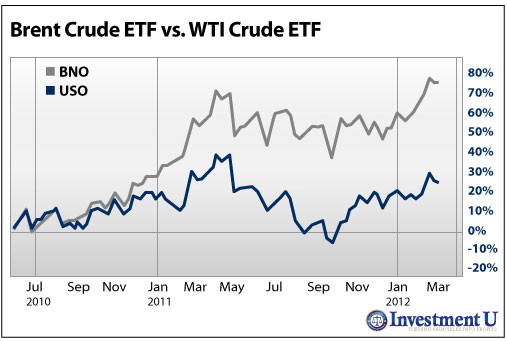
USO, which tracks WTI futures, and BNO, which offers exposure to Brent crude, show the WTI-Brent spread (or WTI vs. Brent) over the past few years.

I think it’s safe to say crude oil may be the most essential commodity around the globe.

It’s a new world out there. The United States is just one of the super economies around and many of the others are new to the game and are growing at a rate much larger than ours.

We use crude oil for everything from running our cars to making plastic. The need for oil causes conflicts and gives power to those countries that have an abundance of it. Taking all this into account, not too many of us actually know how it’s priced. A lot of us hear how much it costs per barrel or get mad when prices go up at the pump. But what’s the method behind the madness?

Hopefully, I can shed a little light on the process…

All Oil is Not Equal

If you drill for oil in different parts of the world, you may get oil, but it might not be all the same oil. Excuse me for getting all scientific, but there are varying degrees of oil based on a number of metrics such as the oil’s American Petroleum Institute (API) gravity. This API gravity is used to compare a petroleum liquid’s density to water. The scale ranges from 10 to 70. “Light” crude oil usually has an API on the higher side of the scale, while heavy oil falls on the lower end of the range.

After you find the API gravity, investors will then look at how sweet or sour petroleum is. This “flavor” depends on the oil’s sulfur content – 0.5% is a key benchmark. When oil has a total sulfur level greater than half a percent, then it’s considered sour. Content less than 0.5% indicates that oil is sweet.

You can find sour oil in a lot more places around the world – like Canada, the Gulf of Mexico, some South American nations, as well as most of the Middle East – than its sweet counterpart. Sweet crude comes from the good old USA, the North Sea region of Europe, and parts of Africa and Asia.

The industry uses both types, but the sweet crude is the prize pony because it requires less processing in order to get out all of the bad stuff. What to take away? Light and sweet forms of crude oil are strongly desired. The heavier form usually trade at a discount in comparison.

WTI vs. Brent

Now we have a foundation so we can begin to price these different types of oil on the world market. Right now, there are two major benchmarks for world oil prices, West Texas Intermediate (WTI for short) crude oil and Brent crude oil. Both are light sweet crude oils, but WTI is generally sweeter and lighter.

Benchmarks are needed so traders can determine transactional settlement prices. Crude oil can be found all over the world, so the types vary. With so many different variances, benchmarks are used to give a reference point that can be globally quoted and traded. There are actually over 160 different types of crude produced in the world. And as we just discussed, each type of crude is priced differently based on its quality.

Understanding the WTI-Brent Spread

WTI is a regional benchmark reflective of supply/demand issues in the American Midwest, while Brent is a European benchmark reflective of specific European issues (with slightly higher exposure to regions such as Africa and the Mideast).

WTI is a crude oil specific to the Midwest region of the United States. Where you find it that explains its large discount to Brent. There is a glut in the amount of crude oil going to refineries in the Midwest due to an increased supply from Canada and North Dakota’s Bakken Shale. The excess supply pushes prices of WTI at the refineries in Cushing, Oklahoma.

Brent reflects the supply/demand balance in Europe. Because of this, many industry analysts believe that Brent is a more global benchmark and reacts more to global events. Think of how the issues in Libya last year and now Syria and Iran pushed Brent prices higher.

Two ETFs, the United States Oil Fund (NYSE: USO), which tracks WTI futures, and the United States Brent Oil Fund (NYSE: BNO), which offers exposure to Brent crude, show the performance difference of the major benchmarks over the last few years. Since its inception in mid 2010, BNO and Brent oil alike have put a beating on WTI with a return around 75% for the fund. In comparison, USO has gained 25% – which isn’t bad.

The graph below gives us a visual of the difference:

Brent Crude ETF (BNO) vs. WTI Crude ETF (USO)

It’s my belief that volatility in Middle East can account for the difference we’ve seen lately.

Take the following into consideration going forward…

  1. How long can this vast gap in returns last? If the issues in the Middle East stabilize, we might see the premiums come back together. I’m referring to stability as no immediate signs of war or revolution. You could possibly get trapped into buying a commodity that is set to fall based on overarching macroeconomic factors.
  2. On the flip side, the region has a history of instability so it might be a while before we see the region calm down and Brent fall. If you play the chaos card, take Brent as the best crude option.
  3. WTI and Brent are still the two prominent benchmarks used to set global oil prices, but this could change in the next few years. Major producers are shifting allegiance or going in a different direction all together. Brazil’s Petrobras (NYSE: PBR) – which Investment U has written about on several occasions recently switched its benchmark pricing from WTI to Brent. Saudi Arabia, Iraq and Kuwait all shifted their benchmark pricing for U.S. exports from WTI to the Argus Sour Crude Index.
  4. These two benchmarks will become less important as markets will probably seek one global benchmark. The widening WTI-Brent spread is accelerating this trend. However, that’s probably years away from becoming a reality.

Hope this helps.

Good Investing,

Jason Jenkins

Article by Investment U

How to Be Rich: 6 Investing Lessons From J. Paul Getty

Article by Investment U

How to Be Rich: 6 Investing Lessons From J. Paul Getty

J. Paul Getty’s book, How to Be Rich, was recommended by Mark Ford in a recent column. In fact, he advised that even if you've already read it, read it again.

Upon seeing the first chapter entitled How I Made My First Billion, I knew I had a winning book in my hands…

J. Paul Getty’s book, How to Be Rich, was recommended by Mark Ford in a recent column. In fact, he advised that even if you’ve already read it, read it again.

So I promptly ordered it and read it twice in one week.

What a fantastic book. Getty’s life story alone is inspiring, but what makes it special is his blunt and personal advice.

Getty was fortunate to have oil and common sense in his blood in equal proportions.

His father was a successful businessman who moved west to become a wildcatter in the rough and tumble Oklahoma oil boom. J. Paul grew up around the business doing the tough and gritty work at the wellhead before striking out on his own.

With no capital at all, the first deal for this independent wildcatter gave him a 15% share of the profits. Then his father grubstaked him, taking 70% of the profits while the Oxford-educated son worked right next to the roustabouts with his battered car serving as his office.

By the age 24, he became a millionaire. His next move was to explore for oil in California where his success expanded into property and stocks.

What makes this book different is that it isn’t just about how to get rich, but how to live a full and rich life. In Getty’s view, the key is to be a non-conformist, to be independent and willing to challenge conventional wisdom.

After reading the first chapter, I had a tremendous urge to jump out of my chair and dig for oil in my backyard. (I settled on just planting a tree.)

Taking on Getty’s Life Lessons

The Getty story pulsates with activity, nerve and initiative. Here’s my take on Getty’s life lessons and how they can be applied to become a more successful investor and businessperson.

Be stealthyGetty won his first oil property in a competitive bid for only $500 by using a bank as his proxy, thereby scaring away independent competitors.

Separate fact from opinionGetty always tried to dig deep for facts and challenge “expert” opinions. He was one of the few wildcatters who studied and used geological data to help him make decisions.

Be independentGetty loved being an independent wildcatter outwitting the big boys. It’s hard to imagine him sitting in a cubicle, or any office, for that matter.

Look ahead and learn from mistakesGetty was way ahead of his time in seeing great growth opportunities in international markets. Half a dozen times in his book, he literally kicks the reader to look beyond America’s borders. And Getty doesn’t pass the buck, but admits his blunders. One beauty was to pass on a bargain-basement opportunity to gain a foothold in the oil-rich Middle East in the 1930s only to pay $12 million for a Saudi concession in 1946. (Still a great move.)

Be patient, but take risks in down markets by finding quality valuesGetty was a master in taking advantage of great stock values in depressed and crisis markets. Much of his great fortune can be traced back to the 1930s when he scooped up resource stocks and properties at bargain prices.

Finally, Getty chose his targets carefully and had the courage of conviction to jump in when others were scared to death. He put it this way:

 ”The big profits go to the intelligent, careful and patient investor, not to the restless and overeager speculator… The seasoned investor buys stocks when they are low, holds them for the long-pull rise and takes in between dips and slumps in his stride.”

All great lessons and reminders to investors and businessmen of any skill level…

Good Investing,

Carl Delfeld

Article by Investment U

MLPs: Better Than Dividend Stocks for Income Investors?

Article by Investment U

MLPs: Better Than Dividend Stocks for Income Investors?

As income investors scour the market for higher yields, a number of them are (in fact) shifting their attention from dividend stocks to MLPs like EPD and ETP.

Last December, Investment U Senior Analyst Marc Lichtenfeld made some bold predictions for income investors in 2012.

Perhaps his biggest was that Apple (Nasdaq: AAPL) would declare a dividend. Of course, in March, Apple did just that.

Another prediction was that master limited partnerships (MLPs) would be one the hottest investments this year.

Marc pointed out, as dividend stocks become more popular, their overall yields will go down. As a direct result, investors will widen their search for income and end up in MLPs.

MartketWatch reported just a few days ago, “In 2012, S&P 500 companies are on pace to pay out a record amount in dividends — $277 million or about $29.02 per index share.”

What does this tell us?

It’s that dividend paying stocks are more popular than they’ve been in a very long time, if ever.

And as investors scour the market for higher yields, a number of them are (in fact) shifting their attention to MLPs.

The Good… the Bad… and the Easy Way

It’s doesn’t take much to see why MLPs are gaining in popularity today…

  • The average dividend from the S&P 500 yields just about 2%.
  • 10-year Treasuries pay less than 2%.
  • And money market accounts return next to nothing.

Meanwhile, MLPs like Enterprise Product Partners (NYSE: EPD), Energy Transfer Partners (NYSE: ETP), and Regency Energy Partners (NYSE: RGP) yield 5%, 7%, and 9% respectively. Returns from other MLPs can be even higher.

Because MLPs redistribute at least 90% of their income back to investors (known as unit holders), they typically have higher yields than regular dividend paying stocks.

But there’s a second reason more investors are looking into them as well… taxes.

You see, distributions from MLPs offer a unique tax advantage because a portion of their payouts is considered a “return of capital,” not a dividend.

Therefore, unit holders are not taxed on their return of capital until they go to sell their holdings.

Now if this sounds enticing and complicated all at the same time, you’re absolutely right.

And this is exactly what makes MLPs good for some and bad for others. I’d say, unless you know what you’re doing, you should consult a tax advisor before investing a dime in any MLP.

But is there any way to enjoy higher yields from MLPs without the tax headaches?

Yes. And the answer for you may be in ETFs.

MLP ETFs

Something you’ll quickly notice about MLPs is that nearly all of them are companies involved with the storage and transportation of commodities such as oil or natural gas.

Not surprisingly, MLP ETFs are also comprised the same way.

For instance, Alerian MLP Infrastructure Index ETF (NYSE: AMLP) contains 50 prominent energy-related MLPs in its fund.

Typical of individual MLPs, Alerian also has a juicy yield of 6%. But unlike regular MLPs, it’s structured like a C-corp and is required to pay state and federal income taxes.

In other words, while you’ll have higher income and less headache to deal with at tax time by investing in an MLP ETF, you will also pay taxes and fees on the fund just like you would investing in any other dividend generating ETF.

Alerian has an expense ratio of 0.85%. Among MLP ETFs, the average expense ratio is 0.88%. But this number was just slashed by a new ETF, Global X MLP ETF (NYSE: MLPA), which just launched a little over a month ago. Its expense ratio is just 0.45%.

Looking Forward

No matter how you look at it, MLPs are increasingly becoming a popular way to invest among savvy investors. But if you’re not one for getting involved in their complicated tax structures, you may want to consider an MLP ETF as an alternative. With interest rates to remain low at least until 2014, you’re going to be hard pressed to find a more solid yield for your investments.

Good Investing,

Mike Kapsch

Article by Investment U

Monetary Policy Week in Review – 26 May 2012

By Central Bank News
The past week in monetary policy saw 9 central banks reviewing interest rate settings.  Three central banks reduced their monetary policy interest rates: Vietnam cut another -100 basis points to 12.00%, Denmark trimmed -10 basis points to 0.60%, and Georgia cut -25bps to 6.00%.  Meanwhile those that held interest rates unchanged were: Nigeria 12.00%, the Czech Republic 0.75%, South Africa 5.50%, Angola 10.25%, Latvia 3.50%, and Japan at 0.10%; the Bank of Japan also made no changes to its quantitative easing program (also sometimes referred to as an LSAP i.e. Large Scale Asset Purchase).


Looking at the central bank calendar, the week ahead sees the far east of Europe reviewing interest rates, with Israel up first, then Hungary and Turkey.  But most eyes will be on Brazil’s central bank, where the BRIC economy is expected to cut the Selic rate by 50 basis points to a low of 8.50%.  Elsewhere the Bank of Japan will release monetary policy meeting minutes.  On the economic front, the week ahead sees the release of some key monthly indicators like US nonfarm payrolls and the much watched purchasing managers index (PMI) readings.

May-28
ILS
Israel
Bank of Israel
May-29
HUF
Hungary
The Magyar Nemzeti Bank
May-29
TRY
Turkey
Central Bank of Turkey
May-30
BRL
Brazil
Banco Central do Brasil

Source: www.CentralBankNews.info

Article source: http://www.centralbanknews.info/2012/05/monetary-policy-week-in-review-26-may.html

Central Bank News Link List – 25 May 2012

By Central Bank News
Here's today's Central Bank News link list, click through if you missed the previous central bank news link list.  Remember, if you want to submit links for inclusion in the daily link list, just email them through to us or post them in the comments section below.