Pound Drops as GDP Data Raises QE Bets

By TraderVox.com

Tradervox (Dublin) – The Office of National Statistics reported last week that the Gross domestic product for UK had fallen 0.3 percent dropping more than the market estimate of 0.2 percent drop. This led the pound to fall for the fourth week in a row against the dollar as investors choose the greenback over the pound as the best safe haven option. Safe haven demand has increased in the market due to the continued crisis in euro zone. The nation’s ten-year gilts also dropped two basis points after the report was released last week.

The GDP report from the Office of National Statistics have also increased speculations that the Bank of England will embark on its quantitative easing program to take the economy back on the recovery path. The BOE is also facing investigations into its recovery strategies as lawmakers are not convinced that the bank’s president took the right action. Some analysts have taken the first quarter GDP results as an indication of weakness in the UK economy hence pushing many investors into choosing the yen and the US dollar as the best safe haven currencies in the market at the moment. Further weaknesses in the UK economy were also evident from the construction output report, which showed that the construction in the country fell by 4.8 percent, the most in 3 years. The market was expecting a drop of 3 percent.

The Europe’s debt crisis has been established as the biggest threat to the UK’s financial stability. Leaders in UK have urged the euro zone leaders to come up with appropriate measures to curb the current crisis as it is hurting the UK exports –forty percent of the UK’s exports go to the euro zone countries hence any problem in the region is set to disrupt recovery measures in the country. There are fears that the current advance of the pound against the euro will hurt exports. However, the lower-than expected GDP results led the pound to drop to $1.5639 which is the lowest since March.

Disclaimer
Tradervox.com is not giving advice nor is qualified or licensed to provide financial advice. You must seek guidance from your personal advisors before acting on this information. While we try to ensure that all of the information provided on this website is kept up-to-date and accurate we accept no responsibility for any use made of the information provided. Opinions expressed at Tradervox.com are those of the individual authors and do not necessarily represent the opinion of Tradervox.com or its management. 

Article provided by TraderVox.com
Tradervox.com is a Forex News Portal that provides real-time news and analysis relating to the Currency Markets.
News and analysis are produced throughout the day by our in-house staff.
Follow us on twitter: www.twitter.com/tradervox

ECB on the Spot to Help in Spain Debt Crisis

By TraderVox.com

Tradervox (Dublin) – The EU Summit meeting held last week raised more questions than answers as leaders from the region crashed on issues pertaining to the solution of the region’s debt crisis. Angela Merkel, the German Chancellor and the new French President Francoise Hollande raised their different proposition of how the debt crisis should be dealt with. They crashed on whether the region should introduce a new euro bond to help safe guard the region from spiraling into a recession.  Further, the Spanish Prime Minister urged the ECB to act in order to bring down the country’s rising borrowing cost.

Mariano Rajoy, the Spanish Prime Minister, said in a speech after the EU summit on May 24 that the unsustainable public debt is the problem and urged the European Central Bank to take a decision that it had taken before. He was referring to the ECB’s decision to buy Spanish bonds in August which helped to reverse the surge of the country’s bonds. Further, the bank channeled $1.3 trillion of three year loans to the region’s financial institution in December and February. The Spanish Prime Minister also indicated that the measures he was proposing could be taken in 24 hours by the ECB, where he suggested that guaranteeing the sustainability of the public debt was the most important.

Spain has seen 16 of its financial institutions being degraded by moody’s which has increased fears of the region’s economy. Further, the surge of the 10-year bond yield has also raised concerns that the country may require international bailout just like Portugal, Ireland and Greece. The country’s ten-year bonds has risen 150 basis points from March second when the country missed the deficit target. Despite Rajoy’s argument to get ECB involved, the ECB President Mario Draghi indicated that the Rajoy was not calling on ECB to give the country funds to reduce its debt and suggested that liquidity could be provided through other means.

Disclaimer
Tradervox.com is not giving advice nor is qualified or licensed to provide financial advice. You must seek guidance from your personal advisors before acting on this information. While we try to ensure that all of the information provided on this website is kept up-to-date and accurate we accept no responsibility for any use made of the information provided. Opinions expressed at Tradervox.com are those of the individual authors and do not necessarily represent the opinion of Tradervox.com or its management. 

Article provided by TraderVox.com
Tradervox.com is a Forex News Portal that provides real-time news and analysis relating to the Currency Markets.
News and analysis are produced throughout the day by our in-house staff.
Follow us on twitter: www.twitter.com/tradervox

Market Review 28.5.12

Source: ForexYard

printprofile

The euro was able to stage a recovery against several of its main currency rivals during overnight trading due to Greek polls that showed pro-austerity political parties making gains ahead of elections next month.

This week, traders will want to monitor a batch of news out of the US, including the all-important Non-Farm Payrolls figure on Friday. Any better than expected data could help the USD against the euro and Japanese yen.

Main News for the Week

Monday
• Bank holidays in US, France, Germany and Switzerland
Tuesday
• US CB Consumer Confidence-14:00 GMT
Wednesday
• Italian 10-y Bond Auction
• US Pending Home Sales-14:00 GMT
Thursday
• US ADP Non-Farm Employment Change-12:15 GMT
• US Prelim GDP-12:30 GMT
• US Unemployment Claims-12:30 GMT
• EU Irish Stability Treaty Vote
Friday
• UK Manufacturing PMI-08:30 GMT
• US Non-Farm Employment Change-12:30 GMT
• US Unemployment Rate-12:30 GMT
• US ISM Manufacturing PMI-14:00 GMT

Read more forex news on our forex blog

Forex Market Analysis provided by ForexYard.

© 2006 by FxYard Ltd

Disclaimer: Trading Foreign Exchange carries a high level of risk and may not be suitable for all investors. There is a possibility that you could sustain a loss of all of your investment and therefore you should not invest money that you cannot afford to lose. You should be aware of all the risks associated with Foreign Exchange trading.

The Market Has Crashed, But This Graphite Stock Has More Than Doubled

By MoneyMorning.com.au

There’s always an opportunity to make money in the markets.

You just have to do the hard yards to find it.

Even in the current near 10% collapse in the stock market, some savvy investors have just doubled their money.


This didn’t involve short selling, or using any of the sophisticated trading you’d expect from a hedge fund. All they needed to know was which part of the market was about to take off…and buy the right stocks.

Even facing a slowdown in the US, the disintegration of Europe, and the very real prospect of China hitting the skids, there are still some parts of the market soaring.

So, what is this hot sector? And is there still time to get on board? Read on for more…

I’m talking about graphite.

You might have heard me discuss graphite before, as I’ve been following this story for a while now.

In last month’s Diggers and Drillers newsletter, I looked at Aussie graphite stocks and tipped one in particular. Readers that followed the tip are now sitting on gains of 105%, in the same time the market has fallen 7.4%.

This is exactly what I look for: investing opportunities the market has missed. In this case, the mainstream didn’t know anything about graphite. Some of them still don’t. Just this morning I read this drivel in The Age:

‘Consider also that Graphite’s price has quadrupled in the past four years and in your humble columnist’s opinion there is evidence of a bubble. Graphite’s worth as a commodity is not disputed. But from a supply perspective it is not hard to see tonnes of it coming on stream. Graphite is very easy to process, because it is simply pure carbon. You just crush carbon and then purify it using gravity.’

The most important point missed here is that there are different types of graphite.

The Right Type of Graphite to Invest In

The investing opportunity lies in FLAKE graphite. Its counterpart, amorphous graphite, is indeed a dime a dozen. But flake graphite is only found in a few places in the world.

It is rare.

What is even rarer is flake graphite that can be processed easily.

Put simply, graphite is found as a component of other rocks; typically it makes up 1%-20% of the volume. Extracting it can be complex, and in some rock types, it can be too expensive to be viable. So you can forget the fuzzy notion that ‘graphite is very easy to process, because it is simply pure carbon. You just crush carbon and then purify it using gravity.’

As for ‘tonnes of it coming on stream’…well…that’s generally the idea in mining.

However there are no significant new projects that will be ready to meet the rapidly growing demand. Smart operators saw this opportunity, so are out there looking for the stuff now. The number is growing because there is money to be made.

But the fact is the success rate for small-cap miners is around 5%. Most players will fall by the wayside. So an oversupply of flake graphite is very unlikely indeed.

The low success rate is the reason it’s so important to do a great deal of research. You need to filter out the duds at the start to give your investment the best chance of making gains.

The good news is the Aussie market has a few serious contenders. And while some are weighing in with uninformed and sensationalist talk of a bubble, the fact is that smart investors are still buying. It’s not just punters having a crack. Some of the largest resource funds from Australia, and also Canada, are lining up…

Graphite – The ‘Next’ Mineral Sands All Over Again?

The Canadian market has decades more experience with graphite than the Australian market. Its investors have a good appreciation of what to look for, and know the kind of money that could be made so it’s a big vote of confidence to see them weighing in already.

The graphite tip I suggested to readers has already more than doubled in a month. If they felt like it they could have the pleasure of selling a few shares to big name fund managers for a 100% mark-up. However this could mean missing out on much bigger gains. This show has just begun.

In fact, this stock reminds me of Iluka (ASX:ILU).

A few years back no one knew anything about its proposed commodity either – mineral sands. But the company found and developed the world’s dominant supply of the stuff, and grew from a minnow to a $5 BILLION company in the process.

Graphite Sector to Produce the Next Iluka?

Graphite Sector to Produce the Next Iluka?
Click here to enlarge

Source: Slipstream Trader


But as I mentioned, getting from explorer to producer is a difficult process.

Having the right ingredients greatly improves your chances. Having a large, high-grade resource, in a good jurisdiction, and sufficient infrastructure provides a very strong foundation.

And luckily for Aussie investors, one of the graphite stocks right here on our market has exactly that.

Dr. Alex Cowie
Editor, Diggers & Drillers

Related Articles

The Conference of the Year “After America” DVD

The Commodity to Prepare Your Portfolio for in a Post-China World

The Divergence of Oil and Natural Gas


The Market Has Crashed, But This Graphite Stock Has More Than Doubled

Use This Investment Strategy to Avoid ‘Panic Selling’ Your Stocks

By MoneyMorning.com.au

At the start of May, the market reached its highest level since November 2009. It could have been an excuse for stocks to go even higher, but that didn’t happen.

When shares go up, typically small-cap stocks lead the market higher. When shares go down, typically small-cap stocks lead the market lower.

You can see that reflected in the chart below.

ASX200

Source: CMC Markets

Now, we won’t focus on the causes of the falling market. You can put it down to a number of things: US unemployment and employment numbers; European national debt problems; European bank problems; commodities prices; and the Australian federal budget.

Instead, we’ll focus on what you should do when the market falls like this. Should you sell your stocks? Should you leave everything alone? Or should you buy more?

Well, we know it’s a trite saying, but the time to decide what to do when the market crashes is before the market crashes.

Making a decision to sell, hold or buy during a crash likely means you’ll get it wrong.

For instance, in our personal retirement portfolio we haven’t sold a single stock.

Why? Because we’re comfortable with how and where we’ve invested our money.

We have a bunch of cash earning interest (probably less interest thanks to the Reserve Bank of Australia’s interest rate manipulation), we have a few dividend paying stocks that are still paying a dividend, and we own a handful of micro-cap stocks that we know could either halve in value or double overnight.

Oh, and there are the gold and silver investments too.

In short, whatever the market conditions, we’re always looking to be a buyer rather than a seller.

If you find yourself selling a stock you own in this market, it most likely means you were over-invested in it. And it’s never a good idea to be in that position. All we can do is suggest you follow our advice and split your savings into ‘safe money’ and ‘punting money’.

We’ve outlined this idea here in Money Morning several times since the middle of last year. The breakdown looks like this:

Remember, this is just a suggestion. As an example, here’s how we’ve allocated our retirement savings: 35% cash and term deposits, 40% gold and silver, 15% dividend stocks, and 10% punting stocks.

But just because that suits us, doesn’t mean it will suit you. You may prefer to allocate more or less in each of these investments. It comes down to what you’re comfortable with.

The bottom line is to make sure that if you do want to sell a stock it’s always on your terms rather than when the market scares you into selling.

Kris Sayce

Editor, Australian Small-Cap Investigator

From the Archives…

Free of the Dragon: Why the Energy Market Doesn’t Need China
2012-05-25 – Kris Sayce

China Stirs Up Troubled Waters in the South China Sea
2012-05-24 – Dan Denning

How Chinese Stocks Are Fading Fast
2012-05-23 – Lars Henriksson

LNG: Why Australia Will Be a New Global Gas Leader
2012-05-22 – Dr. Kent Moors

A Shocking Week for China’s Economy
2012-04-21 – Dr. Alex Cowie


Use This Investment Strategy to Avoid ‘Panic Selling’ Your Stocks

What Facebook Stock is Worth (At Best)

By MoneyMorning.com.au

Duh on you if you bought the Facebook IPO.

Double duh if you’re thinking of buying Facebook stock now that it’s fallen to $32 a share and lost $17.16 billion off its initial $104 billion valuation.

The company is only worth about $7.50 a share. And, no. That’s not a typo. There is no missing zero or a placeholder.

That’s reality. What is ludicrous is that Morgan Stanley and Facebook executives thought the company merited a $104 billion valuation at 100 times earnings.

As my good friend Barry Ritholtz pointed out recently, both Apple (Nasdaq: AAPL) and Google (Nasdaq: GOOG) debuted at about 15 times earnings. Today they trade at 13.6 and 18.2 times earnings and 3.75 and 4.9 times sales respectively.

As I type, Facebook’s market cap is $86.84 billion and its price to sales is ridiculously high at 21.01. I think that’s way out of line.

So what should the numbers be?

Try this on for size. If we use Google’s price to sales ratio of 4.9 (and I am being generous here for discussion purposes), that equals a total market cap of $20.24 billion or 76.68% lower than where it’s trading today.

With 2.74 billion shares outstanding, that’s equal to only $7.39-$7.50 per share.

No doubt I’ll get the evil eye from the Facebook faithful and Morgan Stanley for saying this, but think about it.

Revenue is already slowing and the company does not and cannot possibly dominate the mobile markets that are becoming the preferred channel for millions of people.

Worse, startups are already cannibalizing Facebook’s user base as concerns over privacy and who likes who mount.

Companies like General Motors (NYSE: GM) are deciding not to renew their advertising. This is going to hit Facebook to the tune of $10 million a year for the loss of GM alone.

More will undoubtedly head out the door for the same reason, since Facebook friends don’t necessarily translate into revenue.

Corporate buyers are beginning to figure out that advertising on Facebook is simply not cost effective versus other media alternatives – gasp – including good old fashioned television and radio advertising, billboards and tradeshows.

Facebook Stock: At the Mercy of the Merely Curious

Many people think this isn’t a big deal. They couldn’t be more wrong.

Facebook serves up its ads while you’re kibitzing about your latest trip or checking out pictures of your family’s newest arrival. This is very different from how Google works, for example.

Google’s adverts appear after a customer has already entered search terms and refined the results they want to see. Facebook’s approach is like pissing in the wind and about as effective.

In practical terms what this means is that Google search advertisers know that those who click on their ads are already hunting. So they’re willing to pay a few hundred dollars to acquire a paying customer.

Facebook advertisers, on the other hand, are at the mercy of the merely curious. That means the acquisition cost can be dramatically higher, perhaps even into the thousands of dollars.

There are very few business models and products where that kind of marketing expense is “worth” it.

Then there’s the whole “like” thing.

That’s badly flawed — the Internet equivalent of signing somebody’s yearbook in high school.

According to the technology savvy wunderkids at Facebook, “likes” are supposed to open up a magnificent relationship between prospective customers and the brands they “like.”

Maybe this worked at Harvard when you were talking about bars, people and local hangouts but I don’t buy that it’s going to translate into real sales. So what if you become a company’s friend?

When you “like” something, you get a stream of information from the “likee” that appears on your personal Facebook wall.

Go on a “like” binge one day and suddenly you’ve got 20 or 30 streams of information coming in right next to pictures of your hot rod buddies or school chums.

Over time, what happens is users tend to block out these streams in yet another never ending battle to screen out visual vomit, thereby robbing companies of the very connection they crave.

Your initial “like” never goes away, but depending on the barrage of information you receive I submit that brand negativity actually builds up.

If I “like” a genre-specific museum that’s just opened up in town, I don’t want to see totally unrelated posts about nearby milkshake parlors issued by the museum in a pathetic attempt to keep their brand front and center on my “wall.”

The real measure of any business is how it handles the “dislike” button – but Facebook doesn’t offer that.

According to the marketing cognoscenti and my own personal experience, most of the companies that advertise on Facebook are far below the 3-4 interactions a week needed to prompt a customer response. That is, unless you count the four-letter words every time I get an irrelevant “story” posted to my wall.

It’s no wonder to me that very “unsocial” networks are already wiping the shine from Facebook’s apple.

The assumption that Facebook can maintain the 100% growth it reported Q2 2011 is no more plausible than the 45% growth it reported most recently. Google couldn’t. Apple couldn’t. And both of them are real businesses.

So Now What For Facebook Stock?

I think Facebook’s valuation is the least of its worries. The blame game now underway is only the tip of the iceberg.

Morgan Stanley, Goldman Sachs (NYSE: GS) , Facebook and the Zuck himself are being sued over the IPO, according to a slew of papers filed in the U.S. District Court in Manhattan.

At issue are material reductions in the company’s revenue forecasts that were selectively disclosed to preferred investors as opposed to the investment community at large, as required by securities law.

Also at issue is the fact that a single Facebook executive may have communicated this information verbally to institutional investors but, again, not to every investor. That’s a big no-no.

Talk about irony, though.

Facebook represents itself as ushering in a new era of transparency, openness and connectivity. If these allegations are true, the company could not have been more two-faced.

I’ve been involved in Wall Street and its IPOs for more than two decades and I have never seen something like this. It’s unprecedented, especially when it comes to material revenue projection reductions during the company’s pre-IPO roadshow.

So far individual investors are just getting warmed up.

Phillip Goldberg, for example, filed a complaint in Manhattan federal court against NASDAQ OMX Group, Inc. saying the exchange acted negligently in its widely publicized mishandling of the Facebook IPO.

Goldberg, who is based in Maryland, apparently wants to represent a class action lawsuit on behalf of investors who lost money because their orders were not properly handled.

The bottom line?

I’d love to buy Facebook put options. But I can’t. There aren’t any.
I’d also love to short Facebook stock. But I can’t do that, either.

My broker tells me the stock is on the restricted list, meaning the security cannot be borrowed nor delivered in such a way to consummate the transaction.

So, I’ll just sit back and watch the fireworks for a while.

Come to think of it, $7.50 a share is still rich for a company that doesn’t know what it wants to be when it grows up.

Keith Fitz-Gerald

Chief Investment Strategist, Money Morning (USA)

Publisher’s Note: This article originally appeared in Money Morning (USA)

From the Archives…

Free of the Dragon: Why the Energy Market Doesn’t Need China
2012-05-25 – Kris Sayce

China Stirs Up Troubled Waters in the South China Sea
2012-05-24 – Dan Denning

How Chinese Stocks Are Fading Fast
2012-05-23 – Lars Henriksson

LNG: Why Australia Will Be a New Global Gas Leader
2012-05-22 – Dr. Kent Moors

A Shocking Week for China’s Economy
2012-04-21 – Dr. Alex Cowie


What Facebook Stock is Worth (At Best)

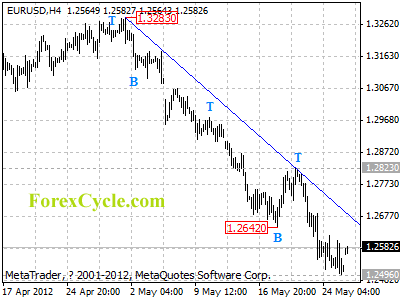
EURUSD stays below a downward trend line

EURUSD stays below a downward trend line on 4-hour chart, and remains in downtrend from 1.3283, and the fall extends to as low as 1.2496. Another fall would likely be seen after a minor consolidation, and next target would be at 1.2400 area. On the upside, a clear break above the trend line will indicate that the downtrend from 1.3283 has completed at 1.2496 already, then the following upward movement could bring price back to 1.3400 zone.

eurusd

Daily Forex Forecast

Facebook: A Replay of Another Bad Deal?

By MoneyMorning.com.au

I hope you didn’t buy shares of Facebook (Nasdaq: FB). The valuation was always too aggressive.

And increasing both the price and amount of Facebook stock at the last moment ensured that both underwriters and retail investors ended up with far more shares than they bargained for.

In fact, the Facebook fiasco reminds me of another deal that marked the peak of the dot-com boom.

No, not the ineffable and rather sweet Pets.com – their IPO was far too small a deal to have genuine market significance.

Instead I’m talking about the AOL and Time Warner merger announced on January 10, 2000.

Like Facebook, the deal was sold as a big success. It was only later that it quickly became clear that AOL had sold itself at the absolute peak of the market.

From there on out it was all downhill as the storied merger practically top-ticked the market.

Before Facebook There Was AOL

AOL had built up a nice business from “dial-up” Internet access, but it was already obvious by January 2000 that the arrival of broadband Internet would make for a difficult transition.

As such, AOL’s market capitalization of around $200 billion was purely the result of the frothy market of 1999.

Nevertheless, that rich valuation enabled AOL to become the senior partner in an acquisition of the Time Warner media conglomerate, getting 55% of the merged company in a deal valued at $350 billion. It was the largest merger in U.S. history.

At the time there was a great deal of talk about how the Internet had revolutionized life to such an extent that AOL’s Internet access and modest content businesses would provide immense synergy to Time Warner’s magazine, cable TV, film and broadcasting assets.

In reality, the deal was a disaster for Time Warner.

In the aftermath, Time Warner reported a loss of $99 billion in 2002 because of AOL-related write-offs, Steve Case resigned as chairman in January 2003, and AOL was spun off again in 2009.

Time Warner’s market capitalization fell from $350 billion to below $20 billion in the ensuing downturn. It is only $33 billion today.

In short, the AOL/Time Warner merger marked the peak of the dot-com bubble. The Nasdaq Composite index peaked at 5,048.62 two months later and has only recently risen above half that value.

The ability of AOL to be valued at more than the giant Time Warner came to be seen as an anomaly, and the difficulties experienced by the deal helped to puncture market euphoria.

Subsequent deals valuing Internet companies at bubble prices proved difficult or impossible to get done. The market began to slide from the spring on, with confidence finally ebbing away in the contentious 2000 election aftermath.

Facebook is AOL Revisited

To me, the Facebook IPO looks very much like the AOL of 2000.

Its growth is already slowing, with first-quarter revenue down on the fourth quarter. Unlike Google (Nasdaq: GOOG) or Apple (Nasdaq: AAPL), it does not seem an essential part of the Internet scene.

Indeed even in Facebook’s business sector, LinkedIn (NYSE: LNKD), the business connections social network with a market capitalization of $10 billion, has a more well-defined economic purpose.

Like AOL, Facebook’s valuation was pushed beyond its natural limit, partly because the company had large numbers of well-connected shareholders who wished to exit at the maximum possible price.

The issue was too large, the issue price was set too high, and the Nasdaq trading glitch prevented the stock from getting the initial “pop” that might have convinced foolish retail investors that it was too good to miss.

The company has around $10 billion in cash, so it isn’t worthless, but I would have a hard time assigning it a value of much above $15 billion-say $5 or $6.

Falling to $31 in its first trading days, Facebook is making good progress towards that modest goal.

If it falls below $19 or so before Goldman Sachs’ private equity clients can get out, I shall smile with relief. There was altogether too much of an insider ramp by the well-connected at $19/share followed by a sale to suckers at $38 within a year or so.

Like the AOL/Time Warner merger, the Facebook IPO has messed up the market for the rest of the tech sector as a whole and social network companies in particular.

The underwriters were left with a lot of stock, and were chiseled down on commissions, so they won’t be anxious to repeat the process.

Companies with massive private equity followings will find an unenthusiastic reception in the public markets, as investors will suspect that, like Facebook, they were gigantic “pump and dump” operations.

If Goldman’s buddies lose money on Facebook, the appetite for late-stage private equity investment will be curtailedno bad thing as it is too often used as a substitute for a proper IPO to the general public.

Valuations, in any case, look likely to decline. To that extent the “social network” bubble will have burst, and probably the second Internet bubble also.

In the long run, the economy will benefit from this as resources are reallocated to more useful sectors; in the short run the process will inevitably be painful.

As investors, we might want to look at weeding our tech portfolio, however good our investments’ long-term prospects may appear.

Martin Hutchinson
Global Investing Strategist, Money Morning (USA)

Publisher’s Note: This article originally appeared in Money Morning (USA)

From the Archives…

How the Ukraine Could Be Europe’s Biggest Shale Gas Play
2012-05-18 – Kris Sayce

Why Greece Can’t Afford to Stay in the Euro
2012-05-17 – Dan Denning

Get in Early on Shale Gas
2012-05-16 – Dr. Alex Cowie

APPEA – Day One at the Oil & Gas Show: Sand Dunes, Scuba Diving and Camels
2012-05-15 – Dr. Alex Cowie

The Case for Higher Gold Prices
2012-04-14 – Diane Alter


Facebook: A Replay of Another Bad Deal?

Why Myer is the One Retail Stock You Don’t Want in Your Portfolio

By MoneyMorning.com.au

Was anyone really surprised at Myer’s [ASX:MYR] recent profit downgrade?

Instead of losing $16 million in the second half of the financial year, CEO Bernie Brooks reckons the firm will lose $24 million.


As the share price tanked on this news, The Australian wrote:

‘That is an effective 13 per cent cut in forecast second-half earnings and, if it is as bad as Brookes fears, will push down earnings before interest and tax to about $225m this year, about 17 per cent below 2010 year levels.’

Importantly, the article also notes ‘Myer has not grown sales per square metre for more than a decade and in the past two years these have fallen so the latest blip is not exactly a surprise.’

Clearly, this was something shareholders forgot when they forked out $4.10 a share when Myer floated back in 2009.

Source: CMC Markets

As of Friday, the stock was trading at half its initial listing price.

However, the department store chief keeps blaming everyone but the management team. It’s the middleman. It’s the internet. It’s the carbon tax. It’s consumer sentiment…

That old one. The fact that people just aren’t shopping has become a reason for many retailers reporting lower profit numbers, if not outright losses. Look at the chart below of Aussie consumer confidence.

Australia Consumer Confidence

It’s just hovering below zero in Australia. This, if you consider that it dipped below minus 5 last year, is starting to look like an acceptable number.

It’s a simple concept to understand. A positive score, something above zero, means people feel confident about their income and financial situation. Like their job security and asset position. However a negative score suggests people aren’t so sure what their financial future holds.

So here’s why this is important: the more positive the number, the more likely people are to spend money.

But is this really the reason people aren’t flooding Myer stores around the country? No, it’s not.

Let’s compare Australia’s consumer confidence index to the UK’s just for a moment.

United Kingdom Consumer Confidence

The UK consumer confidence index is at minus 30! And has been negative for almost a decade. So things must really bad for UK department stores.

And yet, the big department stores there are still turning a profit. What’s more refreshing is they’re not blaming anyone. Most are just getting on with business.

For example, take a look at two of the biggest department stores listed on the London Stock Exchange, Debenhams [LON: DEB] and Marks and Spencer [LON: MKS].

Myer reported a 3% drop in net profits for the 2011 financial year. And based on this week’s announcement, you know a loss is coming for this financial year. Yet compare that to Marks and Spencer. It increased net profit by 12% in the same period, and has managed a healthy 2% increase in turnover.

Debenhams isn’t far behind. After-tax profit for the company increased £20 million in 2011. Already half-year results for the company show turnover is up 1.4%.

How is it possible that these companies are profitable? Britain has seen two quarters of negative gross domestic product growth, putting the country back into a technical recession.

And, back in 2008 when the UK first entered a recession, both businesses still made a profit. Yes, profits shrank from their 2007 level. But in a recession, both still ran profitable companies.

Even though the Aussie economy is ‘only’ slowing, our largest department store can’t get the books into the black. And Mr Brookes won’t even offer a projection on what 2013 might hold.

In fact, in the time Myer’s share price halved, M&S is up 50%. And Debenhams? Its stock price is up 139%…


Click here to enlarge

Source: Google Finance

These two companies have increased profits during a time when consumer confidence is 10 points away from the low.

Ditching A Dud Stock

So despite the UK economy’s problems, both companies have delivered profits and capital growth, unlike the 100-year-old Myer store.

So, what’s Myer’s problem?

It’s simple. There’s no foot traffic. If people aren’t going into the stores, they can’t buy anything. And they certainly can’t buy much from the lame Myer online store.

Considering Myer’s been around for over a century, the company must have faced tougher retail periods (the Great Depression and two world wars spring to mind). Yet the management team still can’t deliver goods a shopper wants, or financial results an investor needs to keep holding shares.

Overseas retailers can provide profits for investors, in much tougher economic situations.

Things aren’t looking good for investors in Myer right now. Do you really still want to have this retail stock in your portfolio when the end of financial year results are due? Probably not.

Shae Smith
Editor, Money Weekend

The Most Important Story This Week…

Investors have tagged Australia the “great southern province of China” in recent years. This is due to the huge boom in Chinese demand for resources like iron ore and coal. But it also gives a clue to how hedge funds and global fund managers see the Australian economy and the Aussie dollar. They see it as nothing more than a proxy for Chinese growth. If China falls, Australia goes with it.

There is a lot of evidence that the Chinese economy has many problems. Bad news out of Beijing will see lower Aussie stock prices and a lower Aussie dollar. One way to hedge this scenario is to find an investment with as little connection to Chinese growth as possible. But are there any resources like this? Yes. Which one? Kris Sayce identified it this week in: Free of the Dragon: Why the Energy Market Doesn’t Need China

Other Recent Highlights…

Dr. Alex Cowie on A Shocking Week for China’s Economy: “There have been some ominous creaks and groans coming out of the good ship China recently. We know that China’s economy grew at 8.1% in the first three months of the year – that’s if you believe the numbers – but what about right now? There are a few things we can look at here and now…And they don’t look good.”

Lars Henriksson on How Chinese Stocks Are Fading Fast: “China operates a closed capital account and non-convertible currency meaning that liquidity cannot be pulled by investors on short notice, as was the case in the Asian financial crisis. Instead of a short and sharp crisis like in 1997, I envisage a prolonged downtrend – like Japan’s economy – as the financial system slowly digests poor loans and misallocation of capital.”

Dr. Kent Moors on LNG: Why Australia Will Be a New Global Gas Leader: “It seems that Australia has significantly more shale gas than originally thought. It remains too early to estimate how much of this will find its way onto the market, or the time it will take to construct the necessary infrastructure, develop the field systems, extract, and process the gas.”

Matthew Partridge on A “Turning Point” for the Chinese Economy …and Australia: “A slowdown in China should have a big impact on its ’51st state’ – Australia. While China’s massive demand for resources has shielded Australia from the global financial crash to a great extent, this is now set to go into reverse. This would be bad enough even if Australia was in a hugely sound economic state. But it’s not.”

Kris Sayce on Why a Stock Market Crash is Great News For Shale Gas Investors: “The stock market has crashed. This makes it an excellent time to find the best stocks for the next twelve months. A crashing market creates a great opportunity to buy some truly disruptive energy companies… We’re talking about investments in natural gas. And more specifically shale gas. But why are we so sure now is the time to buy?”


Why Myer is the One Retail Stock You Don’t Want in Your Portfolio

Don’t Invest Another Dime Before Reading This Free Report at Least 3 Times

You shouldn’t invest another dime in the U.S. or in Europe without reading this report. Learn more about the new free report here.

Free report by Elliott Wave International

Elliott Wave International, a leading provider of technical analysis to individual investors and institutions worldwide, has just made its May 2012 Elliott Wave Financial Forecast available — for free. This is rare: one of its flagship publications with paying subscribers around the globe, EWI almost never gives away the Financial Forecast at no charge.

With Europe in turmoil, U.S. stocks retreating and the mainstream financial press totally on the wrong side of the trend (as usual), EWI’s big-picture forecast — though dire — is actually quite refreshing to read. In trademark fashion, EWI tackles the issues that everyone else ignores, and they explain the future using straight-talking language.

EWI has put together a webpage to allow you to download this special issue for free, but fair warning: It’s only available until Thursday, May 31.

Follow the link below to go there, read about the report and then download it for free.

Learn more and download EWI’s new 10-page May 2012 Elliott Wave Financial Forecast here — it’s free.


About the Publisher, Elliott Wave International
Founded in 1979 by Robert R. Prechter Jr., Elliott Wave International (EWI) is the world’s largest market forecasting firm. Its staff of full-time analysts provides 24-hour-a-day market analysis to institutional and private investors around the world.