Stupid Crisis Acronyms

By The Sizemore Letter

The financial press is not particularly good at forecasting market moves or giving reliable investment advice.  In fact, it’s generally awful at both.  (It’s a structural flaw; markets are forward looking, anticipating what will happen, while journalism is backward looking, explaining after the fact what already has happend).

But if the financial press is truly good at anything, it would be coming up with pithy (yet meaningless) acronyms and abbreviations.

First, we had the “BRIC,” which was shorthand for Brazil, Russia, India and China. These were supposed to be the four emerging market growth dynamos that would power the world economy for the next decade and beyond.

Why not include, say, Mexico, Indonesia or Turkey? Mostly because the “BRICMIT” doesn’t sound as cool in marketing literature.

Lest you think I’m joking, I am completely serious. The only thing these four countries had in common when the term “BRIC” was coined was that their abbreviations made a word with a nice ring to it. (Of course, today they have disappointing rates of growth in common, but that is a topic best saved for another day.

Next, we had the “PIIGS,” consisting of Portugal, Ireland, Italy, Greece and Spain. These were the European countries hardest hit by the 2008 meltdown and subsequent sovereign debt crisis.

Unlike the BRICs, the PIIGS actually had quite a bit in common. They were all viewed as being sovereign risks due to high deficits, high debts, an insolvent banking sector, or some combination of the three.  Still, we are left to wonder whether the investor preoccupation with Eurozone contagion was exacerbated by handiness of the “PIIGS” acronym.  (Then again, Malta is quietly blowing up as well, dispite not having an “M” in “PIIGS.”)

And now we have the “Grexit,” or Greek exit from the Eurozone. It’s difficult to handicap the odds on whether or when Greece might be kicked out of the Eurozone, but I would not at all be surprised to pick up a copy of tomorrow’s Wall Street Journal and find out that it happened overnight.

Following on the heels of the Grexit is the “Squit,” courtesy of the Financial Times’ James Mackintosh.  Squit, naturally, is short for “Spain quitting the euro.”  Mr. Mackintosh might have been stretching a little on this one. 

“Spanic” is another lovely recent addition, short for “Spain panic.”

If you are still reading this, shame on you.  You really ought to make better use of your time. 

The best advice I can give you is to ignore stupid, trendy acronyms, or perhaps to use them as a contrarian indicator.  Focus on the opportunities (or risks) that are not covered in a cheesy catchphrase.  While Wall Street was busily rolling out BRIC ETFs and mutual funds for the investing masses, more nimble investors had already found more promising opportunities in the likes of Peru, Colombia, and Indonesia. 

The BRICs, thankfully, appear to be dead as an investment theme, and I suspect that by mid-summer most of the “PIIGS” hysteria will have passed as well.  We may or may not have a “Grexit,” and I really couldn’t care less either way. None of really matters. A year from now, there will be some new trendy acronym that no one has thought of yet.

Whatever it turns out to be, ignore it.  Your time is better spent rolling up your sleeves and researching promising companies. 
 

Inventory Turnover: The Metric That Predicted Qualcomm’s Earnings Warning

Article by Investment U

Someone in my office recently called me a finance geek. I was actually a little bit insulted. But then, as I started to write this column, I realized she spoke the truth.

You see, I enjoy looking over financial statements and seeing how the numbers interact with each other. I like to look for clues about what the future might hold.

And if there’s a surprise in earnings, I go back to previous quarters to figure out if I could have detected it earlier. It’s kind of like a big puzzle with lots of interconnecting parts that, once you understand them, give you a clear picture of the company and its prospects.

Today, I’m going to use one of the metrics we’ve discussed before to see if we could have predicted an earnings warning by Qualcomm (Nasdaq: QCOM).

That metric is inventory turnover – an often-overlooked measure that can tell you a lot about a company’s operations.

Inventory turnover is essentially how many times a company turns over its inventory in a quarter or a year, or how many times it sells through the products on it shelves.

I decided to look at Qualcomm’s inventory turnover because, although the company reported stellar quarterly results a number of weeks ago, it issued an earnings warning because it couldn’t keep up with demand due to a shortage from one of its vendors. Therefore, I assumed inventory turnover should have spiked.

Let’s see if it did…

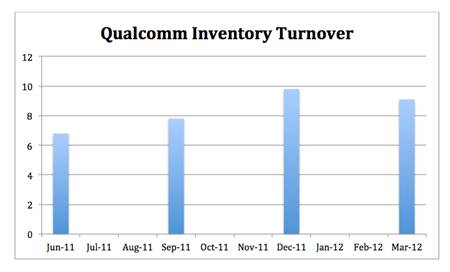
Over the last four quarters, Qualcomm’s inventory turnover climbed from 6.8 to 9.7. In other words, a year ago it was selling through its inventory 6.8 times per year. In December, it spiked to over nine, and in the most recent quarter the company was turning over its inventory 9.7 times per year.

Inventory Turnover: The Metric That Predicted Qualcomm's Earnings Warning

In fact, the inventory turnover is higher than it’s been since 2006.

Now, an earnings warning isn’t a positive, but not being able to keep up with demand is a good problem to have. I expect that Qualcomm’s earnings will be excellent once it gets its distribution issues straightened out.

Earnings per share popped in December and March, as well. Qualcomm earned $0.83 per share in December versus $0.61 in the previous quarter. More importantly, the higher inventory turnover may signify what’s going to happen in the next quarter.

In the September quarter, inventory turnover began to rise and we saw a pop in earnings in December. December’s inventory turnover rose sharply, and earnings in March were also strong.

With another quarter of high inventory turnover in March, I would expect a stronger June quarter in terms of earnings than Qualcomm is letting on.

Keep in mind – most companies give very conservative guidance. But even if June isn’t especially strong, I’d expect earnings to pick back up in the September quarter, as it’s clear that Qualcomm is moving product off its shelves at a rapid pace.

Like I always say, earnings can be and are manipulated to tell the story that management wants to tell.

Looking at inventory turnover can give you a strong idea as to how well a company is operating and what the future may be bring.

Good Investing,

Marc Lichtenfeld

Article by Investment U

Gold Jumps, Wipes Out Week’s Loss After Disappointing Nonfarms Report, But “Strong Dollar a Problem” as Trend “Remains Bearish”

London Gold Market Report
from Ben Traynor
BullionVault
Friday 1 June 2012, 09:00 EDT

U.S. DOLLAR prices to buy gold climbed back above $1600 an ounce on Friday, after disappointing US jobs data was then followed by news of a slowdown in American manufacturing activity.

The ISM Manufacturing Index fell to 53.5 in May, down from 54.8 a month earlier (a figure above 50 indicates an expansion in manufacturing activity).

The ISM release followed several examples of disappointing manufacturing data from around the world, with signs of slowdown in China and ongoing contraction in the UK and the Eurozone.

Friday afternoon’s London gold Fix was $1606 per ounce, the first Fix above $1600 since May 8.

Earlier in the day, gold spiked immediately after the release of worse-than-expected US nonfarm jobs data.

The US economy added 69,000 nonagricultural private sector jobs in May, according to official data published Friday, compared with analysts’ forecasts for 150,000.

The US unemployment rate meantime ticked higher to 8.2% – up from 8.1% in April.

Gold’s jump wiped out its losses for the week. By Friday afternoon in London, prices to buy gold looked set for a 0.6% gain on where they started the week.

Silver also spiked higher following the US jobs news, climbing to $28.63 per ounce, and headed for a slight gain on the week by Friday afternoon in London.

“The larger trend [however] remains bearish,” says technical analyst Russell Browne at bullion bank Scotia Mocatta.

A day earlier, gold’s final London Fix of May 2012 was down 5.6% on April’s last Fix – the third monthly fall in a row by gold Fix prices. Spot gold meantime – which back on February 29 fell by $100 an ounce after the PM Fix – ended May by making fourth straight monthly loss in Dollar terms.

By London Fix prices, gold has not fallen four months in a row since summer 1999.

In contrast with gold, European stock markets fell following the nonfarms release, extending their losses from Friday morning’s trading.

Earlier in the day, German 10-year Bund yields fell to a fresh all-time low below 1.15%, while on the currency markets the Euro sank to its lowest level against the Dollar since June 2010.

Spain’s banking system meantime saw €97 billion of capital leave the country in the first three months of 2012, according to figures published Thursday evening by the Spanish central bank. The Spanish government, which this week saw its implied 10-Year borrowing costs breach 6.7% for the first time since November, is trying to raise €19 billion to rescue nationalized lender Bankia.

The International Monetary Fund yesterday denied rumors that Spain’s government has approached it for a bailout.

Over in Ireland, votes were being counted Friday following yesterday’s referendum on whether or not to ratify the European Union’s new fiscal treaty, which would impose limits of government borrowing.

“We are very, very confident [of a ‘Yes’ vote],” said Lucinda Creighton, Ireland’s European affairs minister.

Press reports suggest around half of those eligible to vote in the referendum actually did so.

In Greece meantime, the biggest pro-bailout party New Democracy leads second place Syriza in the opinion polls, with just over a fortnight to go until the June 17 elections, news agency Bloomberg reports.

Syriza’s leader Alexis Tsipras said Friday that the bailout agreement is a failure, reiterating that Syriza would reverse some of the Greek government reforms if elected, including privatizations and cuts to public sector wages.

“The [bailout] memorandum equals a return to the Drachma,” Tsipras added.

The Eurozone’s purchasing manager’s index for manufacturing, a survey indicator of whether the sector is expanding or contracting, fell from 45.9 in April to 45.1 last month, figures published Friday show. A PMI above 50 indicates sector expansion.

Germany’s PMI meantime fell to 45.2 in May – down from 46.2 a month earlier.

The Eurozone’s unemployment rate meantime remained at 11.0%.

On the currency markets, the Euro fell to a two-year low against the Dollar Friday morning, remaining below $1.24.

European Central Bank president Mario Draghi warned Thursday that the current Eurozone structure is “unsustainable”.

“At the moment, Europe and downside risks to the Euro are the problem for gold,” says Michael Lewis, head of commodities research at Deutsche Bank.

“Dollar strength is going to be the big problem over the next few weeks.”

The US Dollar Index, which measures the currency’s strength against a basket of other currencies, hit its highest level since August 2010 this morning.

Here in the UK, manufacturing activity fell into contraction last month. May’s manufacturing PMI was 45.9, compared to 50.2 in April. The consensus forecast among analysts ahead of Friday’s PMI publication was for a figure just below 50.

The disappointing UK PMI figure “has increased dramatically the likelihood of the [Bank of England] announcing more quantitative easing next Thursday,” reckons Deutsche Bank’s chief UK economist George Buckley.

Manufacturing activity also slowed in China, the world’s largest source of demand to buy gold in the first three months of 2012.

May’s official PMI figure was 50.4, down from 53.3 in April. HSBC’s PMI meantime, which looks at smaller Chinese firms, showed ongoing manufacturing contraction, falling to 48.4 from 48.7.

In India meantime, traditionally the world’s biggest gold buying nation, gold demand for 2012 will fall by 4% by volume compared to last year – but will be 4% up in value terms – according to a report published by researchers at Morgan Stanley.

Ben Traynor
BullionVault

Gold value calculator   |   Buy gold online at live prices

Editor of Gold News, the analysis and investment research site from world-leading gold ownership service BullionVault, Ben Traynor was formerly editor of the Fleet Street Letter, the UK’s longest-running investment letter. A Cambridge economics graduate, he is a professional writer and editor with a specialist interest in monetary economics.

(c) BullionVault 2011

Please Note: This article is to inform your thinking, not lead it. Only you can decide the best place for your money, and any decision you make will put your money at risk. Information or data included here may have already been overtaken by events – and must be verified elsewhere – should you choose to act on it.


Markets Eagerly Awaiting US Non-Farm Payrolls

Source: ForexYard

The euro saw a mild upward correction during mid-day trading yesterday amid hopes that Ireland would ratify a euro-zone fiscal pact. That being said, the rally was short-lived and the EUR/USD was once again trading below 1.2400 by the afternoon session. Today, the US Non-Farm Payrolls figure is likely to be the highlight of the trading day. The all-important employment statistic has come in below expectations two-months in a row. Should today’s news again disappoint, the USD could extend its recent bearish trend against the safe-haven Japanese yen to close out the week.

Economic News

USD – Disappointing US News Turns USD/JPY Bearish

While the US dollar was able to maintain its recent gains against riskier currencies like the EUR and AUD during European trading yesterday, it was not as fortunate vs. the Japanese yen. A disappointing ADP Non-Farm Employment Change figure caused the USD/JPY to drop as low as 78.54 during the afternoon session. Overall, the pair fell more than 35 pips for the day. Against the AUD, the dollar fell some 70 pips during morning trading. That being said, the AUD/USD reversed its upward trend later in the day, and was once again trading around the 0.9740 level by the afternoon session.

Today, traders will want to pay close attention to the US Non-Farm Payrolls figure, set to be released at 12:30 GMT. While analysts are predicting that the figure increased over last month’s result, traders should be warned that the employment statistic is notoriously difficult to predict. The dollar could see additional losses against the JPY to close out the week if the Non-Farm figure comes in below the forecasted 151K. At the same time, should today’s news come in higher than predicted, the dollar could see substantial gains throughout the rest of the day.

EUR – Positive Euro-Zone News Gives EUR Temporary Boost

The euro saw temporary gains during the first half of yesterday’s trading session following the release of Greek polls that indicated gains for pro-austerity political parties ahead of elections later this month. That being said, concerns regarding the Spanish banking sector caused the common-currency to reverse its upward trend later in the day. Against the JPY, the euro advanced over 60 pips, reaching as high as 98.00, before turning downward and dropping to 97.15 by the afternoon session. Against the USD, the euro was up close to 70 pips before dropping within reach of a recent two-year low.

Today, any new announcements regarding the economic turmoil in Spain are likely to generate market volatility for euro pairs. Analysts are warning that the markets are still overwhelmingly bearish toward the euro, meaning that the currency is unlikely to see meaningful gains in the near future. Additionally, traders will also want to pay attention to the US Non-Farm Payrolls figure. Should the figure come in below expectations, investors may choose to place their funds with safe-haven assets which could lead to additional losses for the euro before markets close for the week.

AUD – Aussie Resumes Bearish Trend

The aussie was unable to sustain early morning gains against the US dollar and Japanese yen yesterday, and was once again moving downward by the afternoon session. The AUD/USD was up close to 70 pips during the first part of the day, reaching as high as 0.9759 before staging a bearish correction which brought it down to 0.9700. The AUD/JPY staged a downward correction after peaking at 76.95 and eventually fell as low as 76.10.

Today, any negative news out of the euro-zone is likely to weigh down on the AUD before markets close for the week. Furthermore, the US Non-Farm Payrolls figure has the potential to create additional risk aversion in the market place if it comes in below the expected 151K. Should the US news disappoint, the aussie could fall further against its safe-haven rivals.

Crude Oil – Risk Aversion Sends Crude Oil Tumbling

The price of crude oil fell during afternoon trading yesterday, as euro-zone worries combined with disappointing US indicators caused investors to shift their funds to safe-haven assets. In addition, decreased demand for oil was highlighted by US stockpiles, which are currently near a 22-year high. The price of crude fell as low as $86.50 a barrel, down almost $1.70 for the day.

Turning to today, the price of oil could see additional losses if the US Non-Farm Payrolls figure comes in below expectations and investors continue to shift their funds to safe-haven assets. Traders will want to pay attention to the EUR/USD. Should the pair continue its bearish trend, it may be a sign that the price of oil will go down as well.

Technical News

EUR/USD

A bullish cross on the daily chart’s Slow Stochastic indicates that this pair could see an upward correction in the near future. This theory is supported by the weekly chart’s Williams Percent Range, which has dropped into oversold territory. Opening long positions may be the wise choice for this pair.

GBP/USD

Long-term technical indicators are providing mixed signals for this pair. On the one hand, the weekly chart’s MACD/OsMA has formed a bearish cross, meaning downward movement could occur in the coming days. That being said, the same chart’s Williams Percent Range has dropped into oversold territory. Taking a wait-and-see approach may be the wise choice for this pair.

USD/JPY

While the Williams Percent Range on the weekly chart has dropped into oversold territory, most other technical indicators show this pair trading in neutral territory. Traders may want to take a wait-and-see approach, as a clearer picture is likely to present itself in the coming days.

USD/CHF

The Relative Strength Index on the daily chart has crossed over into the overbought zone, indicating that this pair could see downward movement in the near future. Furthermore, the weekly chart’s MACD/OsMA has formed a bearish cross. Opening short positions may be the right move for this pair.

The Wild Card

NZD/CHF

A bearish cross on the daily chart’s Slow Stochastic indicates that a downward correction could occur in the near future. This theory is supported by Williams Percent Range on the same chart, which has crossed into overbought territory. Forex traders may want to go short in their positions ahead of a possible bearish reversal.

Forex Market Analysis provided by ForexYard.

© 2006 by FxYard Ltd

Disclaimer: Trading Foreign Exchange carries a high level of risk and may not be suitable for all investors. There is a possibility that you could sustain a loss of all of your investment and therefore you should not invest money that you cannot afford to lose. You should be aware of all the risks associated with Foreign Exchange trading.


Market Review 1.6.12

Source: ForexYard

printprofile

The EUR/USD dropped to its lowest level since July of 2010 at 1.2323 in overnight trading. Investor concerns that the Bank of Japan will intervene in the markets to weaken the yen caused the USD/JPY to come off a recent 3 ½ month low. The pair is currently trading at 78.42.

Main News for Today

UK Manufacturing PMI- 08:30 GMT
• The pound has taken heavy losses against the dollar, yen and euro lately
• Analysts are predicting today’s news to come in at 49.7, which would mean that the British manufacturing industry contracted last month
• If the news comes in as expected, the pound could see additional losses to close out the week

US Non-Farm Employment Change- 12:30 GMT
• Considered the most important economic indicator on the forex calendar
• The last two months have both come in below expectations and have led to dollar losses
• Should today’s news again disappoint, the dollar could drop against the yen

Forex Market Analysis provided by ForexYard.

© 2006 by FxYard Ltd

Disclaimer: Trading Foreign Exchange carries a high level of risk and may not be suitable for all investors. There is a possibility that you could sustain a loss of all of your investment and therefore you should not invest money that you cannot afford to lose. You should be aware of all the risks associated with Foreign Exchange trading.

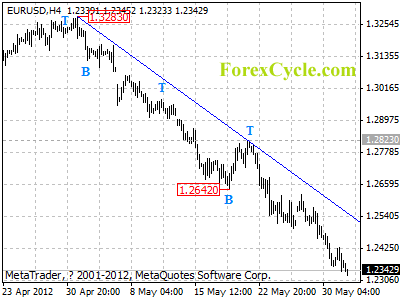
EURUSD’s downward movement extends to 1.2323

EURUSD’s downward movement from 1.3283 extends to as low as 1.2323. Further decline could be seen after a minor consolidation, and next target would be at 1.2200 area. Initial resistance is at 1.2430, a break above this level could indicate that a cycle bottom is being formed on 4-hour chart, then, consolidation of the downtrend could be seen. Key resistance is at the downward trend line, only a clear break above the trend line could signal completion of the downtrend.

eurusd

Daily Forex Forecast

Three Handy Hints to Cut Your Tax Bill in 2012

By MoneyMorning.com.au

‘And here’s the rub. You don’t own the minerals. I don’t own the minerals. Governments only sell you the right to mine the resource, a resource we hold in trust for a sovereign people.’ – Prime Minister, Julia Gillard

At least the PM is consistent.

When you think about it, the way the pollies treat mining royalties is the same way that they treat your income.

You don’t own it. It’s everyone’s. Your income is just held in trust until you earn it.

Then the government takes a slab, leaving you what’s left over.

Yes, dear reader, it’s almost tax time again.

It’s time to see just how much of your income the government has stolen from you in the past 12 months.

But just as important, it’s time to plan ahead to make sure you’re able to legally cut your tax bill next year.

Here’s three handy and practical hints…

Money Saving Tax Tip #1
Prepay next year’s compulsory health insurance

OK. Strictly speaking, health insurance isn’t compulsory.

But penalising taxpayers for not having private health insurance makes it compulsory. For instance, any single person earning over $84,001 or a family earning over $168,001 has to pay the Medicare Levy Surcharge (MLS) of at least 1%.

That’s on top of the 1.5% Medicare Levy.

But if you have private health cover, you don’t pay the surcharge. And seeing as the cost of private health is usually less than the surcharge it makes sense to buy insurance…hence making it effectively compulsory.

But there’s a sting for health insurance buyers next tax year. The 30% rebate (or discount) on your health insurance will drop depending on your income. As the following table shows:

health insurance

Source: Australian Taxation Office

For example, a single person earning $100,000 per year will only get a 10% rebate rather than the current 30% rebate. So if their insurance policy is $1,000, they’ll only get a $100 discount (net cost $900).

But if they ditch private insurance, they’ll have to pay $1,250 for the Medicare Levy Surcharge…making them $350 worse off.

That’s the cruel nature of government and the State. Forcing ‘sovereign people’ to buy something they don’t need and won’t use.

But there is a small silver lining. You can dodge the reduced rebate bullet for one year. According to the experts, if you pre-pay next financial year’s health insurance before June 30 you’ll still qualify for the old 30% rebate.

For the single person on $100,000 that’s a $200 saving…it’s not much, but it’s better in your pocket than in your health insurer’s.

Before you do anything, check with your accountant and private health insurance firm to make sure that this is the best option for you.

Money Saving Tax Tip #2
Lock in gains and losses before June 30

This strategy is as old as the hills, but it’s worth reminding you about it.

If you have any investment gains during a tax year you have to pay tax at your marginal tax rate during that year.

But, if you have any losses from investments you can use those losses to offset any realised gains.

For instance, if you made a profit of $1,000 buying shares in Company A, you’ll need to pay tax on that profit of say 30% (depending on your tax rate).

But if you made a loss of $1,000 on Company B, you can use that loss to offset the gain…providing you sell the shares of Company B to realise the loss. You can’t claim the loss if you continue to hold the losing shares.

Hopefully you haven’t made any losses this year. But if you have, and you don’t think the stock has a chance of making a comeback, then you should think about selling out.

Just beware of one thing. Tax busy-bodies take a dim view of investors who sell a stock to claim the tax loss and then buy the stock back again.

If you think there’s a chance the stock could recover and you don’t want to miss out if it does, then maybe think about just selling half your position…at least it’ll give you a partial tax break while still keeping some skin in the game if the stock goes up.

Money Saving Tax Tip #3
Invest for tax effective income

A simple way to take advantage of the tax system is to buy income-friendly shares.

Those are shares that have what’s called a ‘fully franked’ or ’100% franked’ dividend.

Now, we won’t go into all the details about franking credits, because to be honest, it’s not very interesting.

But to put it simply, if a company pays a 70-cent fully franked dividend, it means the company has already paid tax on that dividend at the company tax rate of 30%.

So you get that tax benefit, allowing you to ‘gross up’ the dividend to $1. You then pay tax on the $1 dividend at your marginal tax rate.

If your tax rate is below 30% then you’ll receive a credit. If your tax rate is above 30% then you’ll have to pay a bit more tax.

But either way, it shows you the benefit of investing in income stocks that pay franked dividends compared to stocks that don’t.

We asked our in-house income investing expert, Nick Hubble to give us a worked example comparing two Aussie stocks – one with a fully franked dividend and one with an unfranked dividend…

dividend

Nick told us:

‘Notice how the after tax dividend yield on the fully franked share fell far less (1.31% to 1.04%) from the pre-tax dividend yield as a result of the franking credit offset. You should always double check dividend yields for this change.

‘Just to be clear, there is nothing inherently better about a franked or unfranked dividend. After all, every company is different. What is important is that the true dividend yield is different to the quoted yield. So you should always look beyond the quoted yield to work out the true yield based on your personal tax rate.’

Of course, this is only general advice. But with Australian taxes rising and the ability to reduce taxes being made harder all the time, it’s important you make the most of any tax breaks available.

Cheers,
Kris.

Related Articles

Market Pullback Exposes Five Stocks to Buy

APPEA – Day One at the Oil & Gas Show: Sand Dunes, Scuba Diving and Camels

Get in Early to Shale Gas


Three Handy Hints to Cut Your Tax Bill in 2012

How Bad Monetary Policy Will End the Welfare State

By MoneyMorning.com.au

It’s a presidential election year in the US. There are millions of Americans still underwater on their mortgages. US house prices have neither bottomed nor recovered. And the Fed is doing all it can to prevent another great wave of foreclosures in an election year.

The past two months of action in the markets isn’t helping anyone in government.

In April, after five days in a row of falling stock prices in the US, you’d expect the powers that be to do something.

And they did. Federal Reserve Vice Chairman Janet Yellen told investors that the Fed would leave interest rates low until 2014 and maybe even until 2015. ‘Further easing actions could be warranted,’ she added.

Now that the first few weeks of May have seen the Dow wipe off 5.6%, Boston Federal Reserve President Eric Rosengren has called for further easing.

Adding to the easing talk is China. Recently the International Business Times wrote, China’s interest-rate swaps market has priced in three to four benchmark interest rate cuts over the next year, reflecting growing pessimism over the world’s second-largest economy and expectations of more aggressive monetary easing.

Investors love this kind of talk. It means free money will be around for another few years. And not just in America. Chinese money supply grew by 13.4% in the last year, according to the People’s Bank of China. Yuan-denominated loans grew by 1 trillion yen in March, or $160 billion. Reserve requirements at local banks were cut in April.

I’d suggest to you that officials in China and America are encouraging credit growth through monetary policy for the same reasons: to prevent rising political and social instability.

In China, the government of Wen Jiabao balances inflation concerns with growth concerns. If bank loans grow too fast, you get inflation and soaring prices (bad for stability). On the other hand, if credit growth contracts too quickly you get fallen house and stock prices and rising unemployment (also bad for stability).

If you know someone who believes that central bank easing is the key to sparking a real economic recovery, tell him he’s dreaming. Any short-term rallies in stocks due to news flow like this are a complete distraction from more serious issues. It should be ignored, or at least heavily discounted.

This is the point I want to make: the failure of monetary policy worldwide has begun to have political consequences.

For the past couple of years I’ve showed readers of Australian Wealth Gameplan how unsound money has brought us to the end of the Western Welfare State. Bad monetary policy results in the steady debasement of the currency. The less stable and reliable the currency is, the less trust ordinary people have in the political system (the people who defend and use the currency as a weapon and instrument of power).

In China, the political system is losing the trust of the people for many reasons; financial, political, ethical, and economic. There’s a tendency to look at the Chinese political system from the outside and view it as monolithic, where there is unanimity on all decisions. That’s not the case, of course.

Many people might find it inconceivable that the Chinese Communist Party could be yet another indirect victim of the Global Financial Crisis. But the Party is not so different from the European Central Bank or the Federal Reserve. They are institutions trying to manage and control complex systems. That’s a losing proposition in a complex world.

Prepare for the inconceivable.

Dan Denning
Editor, Australian Wealth Gameplan

From the Archives…

Free of the Dragon: Why the Energy Market Doesn’t Need China
2012-05-25 – Kris Sayce

China Stirs Up Troubled Waters in the South China Sea
2012-05-24 – Dan Denning

How Chinese Stocks Are Fading Fast
2012-05-23 – Lars Henriksson

LNG: Why Australia Will Be a New Global Gas Leader
2012-05-22 – Dr. Kent Moors

A Shocking Week for China’s Economy
2012-04-21 – Dr. Alex Cowie


How Bad Monetary Policy Will End the Welfare State

Investing in Rising Corn Prices, Gold Miners, and More (CORN, NEM, GDX)

Article by Investment U

View the Investment U Video Archive

In focus this week: why corn prices are set to rise, where gold miners are going, how Vanguard’s index mutual funds are raking in the dough and the SITFA.

There’s a ton of money to be made in corn this year. The current production estimates and demand trends can drive it back from its recent sell-off, and then some.

Corn prices jumped 9.5% recently following an 11% drop in early May that was driven by news of a huge U.S. crop this year.

Dave Marshall, an independent grain-marketing consultant, was quoted in the Journal this past week saying exporters and users are literally fighting over tight available supplies.

Wheat recently saw a 17% price increase, and corn should follow suit. Both can be used as animal feed, so corn and wheat prices are usually tied together.

And a recent comment by the Department of Agriculture has been adding to the surge in prices. It seems there were several very large corn export sales listed as going to unknown destinations, that were in fact headed for China. The International Grains Council said this past week that China’s demand could rise 50% in the year that starts this July.

I know I don’t have to tell you what increasing demand from China can mean to corn prices.

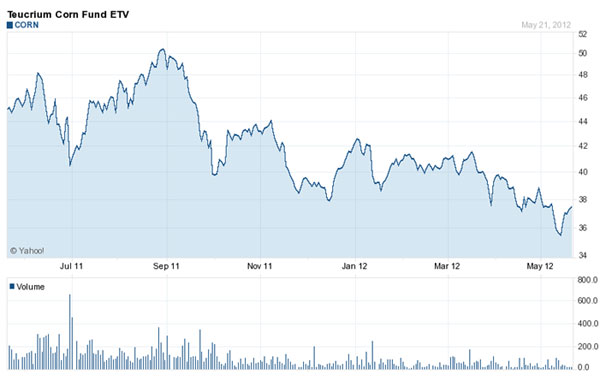
The best news: You can invest in corn without all the mechanics of the commodities exchange, via an ETF called the Teucrium Corn Fund (NYSE: CORN). Its chart is on your screen now.

Investing in Rising Corn Prices, Gold Miners, and More (CORN, NEM, GDX)

Trending upward, rising demand and less of a crop than previously expected all add up to higher corn prices. Take a look at CORN.

Gold Miners

Barron’s says gold mining stocks could jump 50% if the price gap between gold and the miners narrows to historical levels.

Despite the recent sell-off in gold, it’s still up 80% since 2009, but gold miners are only up about 20% in the same period. The ratio between the two is at an all-time high.

The name Barron’s is throwing around, Newmont Mining (NYSE: NEM). It’s at or near its 52-week low and has a 3.1% dividend. Earnings are expected to hit an all-time high this year at $4.85 per share on a 6% increase in revenues. The P/E is a screaming 8!

Morgan Stanley said in a Barron’s article last week that all of the fundamentals that drove gold to the $1,900 level are still in place and they are expecting a further run-up, which can only add to the case for miners.

Newmont currently produces gold at $650 an ounce, but announced it is working to reduce that cost. Produce at $650, sell at $1,600 and higher, very nice!

The alternative play on the disparity between gold and the miners is the Market Vectors Gold Miners ETF (NYSE: GDX). It’s just a few dollars above its 52-week low and sports a diverse portfolio of mining stocks.

Spreads like this one between gold and the miners don’t last forever. Bet on it running back to its historic norm. NEM or GDX, take a look.

Mutual Funds That Have Tons of Cash Rolling In!

The top 1% of mutual funds last year brought in a net of $290 billion. The other 99% of funds had a net loss of $91 billion. That’s what I call a signal!

Which stock funds are investors pouring money into? Boring, vanilla, big-cap, dividend-paying mutual funds!

The chairman of thee top asset gathering funds, the Vanguard Group, described his funds as “not Wall Street and representative of Main Street.” The Vanguard Total Stock Market Index Fund (MUTF: VITSX) and the Vanguard Total International Stock Index Fund (MUTF: VGTSX) were the top dogs! In fact, Vanguard had seven of the top 20 asset gatherers from last year.

Bill McNabb, the Chairman of Vanguard, said they serve over 10 million families with low cost, high performance index funds. It’s hard to argue with that combination.

Boring and stable definitely appears to be the current investing trend.

The Ultimate SITFA

Usually I try to find something for this segment that hasn’t hit the big news sources, something off the beaten track. But this week I have to get my digs in on the Facebook (Nasdaq: FB) IPO.

IPOs, good ones anyway, are the ultimate insider’s territory. No one, and I mean no one who wasn’t one of the inner circle got any of this stock. The hype was so over the top I had to stop listening days before the offering. I still can’t believe how the so called intelligentsia got sucked into this one.

I wasn’t certain it was going to tank, but with a PE of 75 what did they expect?

Now we know the revenue numbers were secretly cut during the road show. A road show is when the lead underwriter travels around to talk to all the other ultimate insiders to assure them this is the one they have to own.

Having spent 10 years in the brokerage business watching the insiders scoop up all the stock in any IPO worth the paper they were printed on, I have to say it was somewhat satisfying to watch this one do the rock imitation.

FB ran the perfect scam on the wolves of the street and the insiders finally got the slap in the face they so richly deserved. FB priced this thing at the top of even the hype, not just the top of the numbers. Anyone who got caught at the top got exactly what he paid for. Hype.

This could very well turn out to be a good investment, but not until it finds its bottom. Which is where I’m sure most of the inner circle are quite sore after the good kick they just got.

Be careful, everything comes around!

Article by Investment U

Mark Skousen’s Investment Conference Round-Up

Article by Investment U

Mark Skousen’s Investment Conference Round-Up

Today's contributor is the famed economist, investment analyst, author, Ben Franklin impersonator and investment conference attendee, Mark Skousen.

“On Dec. 31, trillions of dollars in tax cuts will expire, trillions more in new tax hikes under ObamaCare will kick in, and a trillion in automatic spending cuts will begin.”

– Don Luskin, “Fiscal Cliff Could Crush Stocks,” Wall Street Journal, May 4, 2012

As an investment writer, I probably lead all other writers (including Alex Green!) in one category: attending investment conferences! My subscribers are constantly amazed at how often I am away from home attending a conference or visiting a new country.

I probably attend two dozen economic and financial seminars each year, including the Milken, SALT, Money Shows, New Orleans, Investment U, and of course my own big show FreedomFest. I’m constantly on the road. I’ve been to 72 countries and this week will travel to Warsaw, Poland and London, England to deliver several addresses on economics and finance.

Why do I do it? I firmly believe I’m a better economist and financial advisor by attending conferences and hearing what others have to say. In fact, I would argue that YOU will be a better investor by attending financial conferences too.

The Buzz at the Milken Conference

May has been especially busy with conferences. I attended in Beverly Hills the famous Milken Institute Global Conference, hosted by Michael Milken. The watch word I heard repeatedly about the U.S. economy was “fiscal cliff.” The huge debt load the United States is facing on top of the trillions in unfunded liabilities is indeed cause for alarm. A crisis is coming, and nobody is doing anything about it. It may hit as early as December, as Don Luskin warned in the Wall Street Journal (see quote above).

All kinds of big wigs were at the Milken event: former President Bill Clinton, California Gov. Jerry Brown, alternative energy promoter T. Boone Pickens, doom-and-gloomer Nouriel Roubini, Walter Isaacson (author of Steve Jobs’ biography), Harvard historian Niall Ferguson, and hundreds of CEOs from around the world.

I thought Niall Ferguson, the Harvard historian, stole the show. When a Keynesian economist said that state capitalism (e.g., China) seems to work better than free-market capitalism (e.g., the United States), Ferguson jumped in to show a dramatic chart that proved otherwise. Looking at government as a percentage of gross domestic product (GDP), the size of government in China is far smaller than in the United States! “China is moving away from state capitalism toward freer markets,” he said. “The United States is moving away from free markets toward state capitalism.” China is growing faster because they are adopting free market policies – a brilliant response!

Meanwhile, I also ran into Steve Forbes, who spoke on a panel about tax reform. He railed against the millionaires’ tax (The Buffett Rule) being proposed by President Obama (and supported by Jared Bernstein on the panel), contending, “You don’t raise taxes on the successful, especially during a weak recovery.” Amen!

Afterwards, Steve asked about my own conference FreedomFest, and I told him about all of the great debates and panels we have scheduled this year. “I can’t wait,” he said. Steve Forbes and Whole Foods CEO John Mackey are our official FreedomFest co-ambassadors. Hope you’ll join us.  See more below…

SALT Conference: It’s All about Jobs!

Another conference I attended was the SALT conference, run by hedge fund manager Anthony Scaramucci, who just wrote an excellent primer, “The Little Book of Hedge Funds: What You Need to Know about Hedge Funds but the Managers Won’t Tell You.” Highly recommended.

Like Milken, Scaramucci invites a lot of big names to his conference, including Al Gore and Sarah Palin. I was able to attend only one day due to other commitments, but I was on a panel with Adam Lashinsky, senior editor at Fortune magazine, about his new book, “Inside Apple: How America’s Most Admired — And Secretive — Company Really Works.”

Steve Jobs’ last name symbolizes the challenges facing America today. The future of America is all about the job participation rate and the unemployment rate. The official unemployment rate is down to 8.1%, but that’s largely because millions of people have simply stopped looking for work.

According to a recent report, approximately 86 million people are invisibly unemployed in the United States. After peaking at 67.3% in early 2000, the labor force participation rate has been falling ever since.

In our panel discussion, Lashinsky denied the popular view that technology companies like Apple don’t create many jobs. Apple may not hire a lot of workers, but the products they produce (iphones, ipads, MAC computers, etc.) sharply increase productivity and create a higher standard of living and millions of jobs indirectly – I agree.

My “Surprise” Prediction at the Money Show

I also made numerous appearances at the Las Vegas Money Show, including a SRO private meeting with subscribers (thanks for coming). Investors were worried about the bear market on Wall Street and the never-ending debt crisis in Europe.

But I offered good news to attendees. I made the “surprise” prediction that Mitt Romney would win the Presidency in November and the stock market would roar on the news. This forecast goes counter to the odds makers at www.intrade.com, the political futures market, which currently shows Obama ahead of Romney, 58% to 42%. But over the past two months Obama has been gradually losing support and Romney has been gaining. Moreover, Romney could win if the economy continues to struggle (as I expect it will) and if Romney wins the presidential debates (iffy). Remember, Reagan was way behind Jimmy Carter in early 1980 and ended up winning by a landslide, largely due to economic worries.

Don’t get me wrong: I am not rooting for a downturn just to elect a Republican. But I want someone in office who understands business, and can turn things around.

Watch Intrade carefully. The political futures market is more accurate over the past election cycles than the national polls. The pollsters survey voters with the question, “If the election were held today, who would you vote for?” There’s no skin in the game and voters can lie. But in Intrade, voters are putting up their own money and betting on the question, “Who will win the election in November?”

Update on FreedomFest, “The World’s Best Conference”

Recently I attended one of those big corporate conferences out West and a well-dressed businessman came up to me from out of the blue and introduced himself. He said, “You don’t know me but my name is Tony and I’m from Phoenix. I just want you to know that FreedomFest in Vegas is by far THE best conference I’ve ever attended, and I’ve attended all of them.”

While Tony and I were talking, a young executive came up and introduced herself as Lenore Hawkins from San Diego. “He’s right,” she said. “I always come away inspired and looking to take on the world after attending FreedomFest. This year I’m bringing five friends!”

I know this story sounds like promotional hype, but it really happened.

In fact, it happens all the time. This year the Oxford Club (Alexander Green, Karim Rahemtulla, Marc Lichtenfeld and Steve McDonald) is hosting a one-day conference at FreedomFest. Other speakers include Peter Schiff, Rick Rule, and of course, Steve Forbes and John Mackey. They attend all three days! As Keith Fitz-Gerald says, “FreedomFest is the conference even speakers like to attend.” (Yes, he’s coming.) To see what all the excitement is all about, go here, or give Tami Holland a call toll-free 1-866-266-5101.

Good Investing,

Mark Skousen

P.S. We’ve just signed on two more high-profile speakers for FreedomFest – Robert Kiyosaki, author of “Rich Dad, Poor Dad” and G. Edward Griffin, author of “The Creature from Jekyll Island.”

Article by Investment U