Central Bank News Link List – 31 May 2012

By Central Bank News
Here's today's Central Bank News link list, click through if you missed the previous central bank news link list.  Remember, if you want to submit links for inclusion in the daily link list, just email them through to us or post them in the comments section below.

Using Linear Regression in Forex Trading

In forex trading, there are many different ways to analyse the data in a bid to try and accurately predict what the market is likely to do next.

Linear regression is a tool used by many traders, which sounds more complicated than it is, which offers advantages very similar to that of moving averages.

Put simply, linear regression is a statistical analysis tool which looks at both price and time. Both resistance and support levels are shown on the graph, with the slope direction depicting the overall trend of the market.

Regression is a much-used type of statistical analysis and is very commonly seen in trading. In forex, linear regression creates a channel after support and resistance levels are identified which trading will normally stick within. Any burst outside the channel is normally expected to be brief – a prolonged break-through is a sign that the market is about to reverse.

After a midway point is identified, two further lines are created both above and below – a couple of points each way – to create the channel for the range.

As well as helping to identify trends about to develop, linear regression can also help a trader to set both entry and exit points by looking at the boundaries of the channel created. This can give an indication of when the market is reaching the top of its range and the position should be closed.

However, linear regression can be used to create a simple line, rather than a channel if preferred. A linear regression line is created by joining the starting price with an end price, picking the points which create the least deviation throughout the length.

The linear regression line is viewed as the midway point or the `fair price` and is the point which the market is expect to keep moving through. If the current price is above the line, it would suggest a sell strategy and if below the line, a buy strategy.

Linear regression can be used on different time frames, depending on the trades being executed and can help to remove the psychological element from trading. The power of human emotions can be one of the hardest things for traders to overcome and much discipline and self control is required at times.

Because linear regression is based on facts, there is no need to interpret the results – they speak for themselves. This can help to make it easier – when used alongside other technical indicators – to set up entry and exit points, as well as detect trends very soon after they begin.

Linear regression is just one of the tools used by traders to help become more effective and despite its statistical strength, should never be used in isolation to determine a strategy. In order to trade forex profitably it is necessary to select the right mix of charts, tool and indicators; enough to provide sufficient detail for analysis but not too many for the picture to become clouded.


Gold and Silver “Finally Decouple” from Euro, Stocks & Commodities But Still End May Sharply Down

London Gold Market Report
from Adrian Ash
BullionVault
Thurs 31 May, 08:45 EST

WHOLESALE BULLION gold prices rose Thursday lunchtime in London, extending yesterday’s sharp jump and cutting this week’s 2.5% drop by more than two thirds even as the Euro currency again slipped through $1.24 for the second day running.

Trading near $1564 per ounce, however, Dollar gold prices headed towards their fourth monthly drop in succession, losing some 5.3% in May.

Silver bullion neared the end of May more than 10% lower from end-April, despite rallying above $28 per ounce Wednesday afternoon in London when the Euro first slipped to those fresh two-year lows.

US crude oil was on track for a monthly drop of 16% says Bloomberg, its worst fall since December 2008.

The MSCI index of global stock markets has shed nearly 9% in May.

“Gold and to a lesser extent silver decoupled from the rest of the [commodities] group on Wednesday and started to head higher,” says a US analyst.

“Finally gold is behaving ‘normally’ and is ‘profiting’ from the fears surrounding the Euro,” agreess Commerzbank analyst Eugen Weinberg, “[resisting] the general downswing experienced by commodities and equities.

“Gold is proving to be good ‘risk insurance’ [but] we believe there may still be downside risks if the US Dollar continues to remain strong.”

Standard Chartered also “see downside risks for the short term but remain long-term bulls,” they said in a note.

May has “definitely seen a flight to the Dollar rather than gold,” says Chinese brokerage CITIC Futures’ chief investment strategist Wang Xiaoli, adding that “the crisis in Europe doesn’t look like it will abate soon.”

So-called “safe haven” US Treasury bonds rose sharply again on Thursday, driving 10-year yields down to new all-time lows beneath 1.60%, following weaker-than-expected US payroll data from the private ADP group.

Ten-year Spanish bond yields meantime held near 6%, the level which Portuguese yields reached just before its ECB, IMF and European Union bailout.

Speaking to the European Parliament Thursday morning, the 17-nation Eurozone’s chief central banker Mario Draghi accused Spain and other member states of trying to deal with their domestic banking crises in “the worst possible way.”

Spain last week announced a fresh €19 billion injection of state funds into the part-nationalized Bankia lender.

“There is a first assessment, then a second, a third, a fourth,” said Draghi. “Everyone ends up doing the right thing, but at the highest cost.”

Across in Ankara, the Turkish Central Bank today said it may “gradually” raise the percentage of required reserves which commercial banks can hold in physical Gold Bullion to 30%.

The news comes only 1 months after the limit was raised to 20%, and only 2 months after Turkish banks were first allowed to hold a portion of their required reserves in gold. (Read about Turkey’s new gold policies here…)

The world’s biggest trade credit insurer, Euler Hermes, meantime suspended cover for goods being shipped to Greece, saying that until there’s “clarity” after 17 June’s Greek election, it cannot be sure debts will be paid in the event of Athens quitting the Euro.

Over in Hong Kong today, London-based luxury jeweler Graff abandoned its $1 billion stock-market IPO scheduled for tomorrow, blaming “consistently declining stock markets.”

India’s Rajesh Exports – which forecast in Sept. 2009 that rising Gold Prices could dent Indian demand, only to see the world’s #1 buyer grow its private consumption for the next two years running – today warned that Indian gold demand could fall hard in 2012 due to the weak Rupee.

In Dollar terms, “Gold Prices remain within a sideways consolidation,” says Mumbai-based RiddiSiddhi Bullions, pointing to support at $1526 and resistance at $1600.

“We are neutral gold until it makes a larger directional move outside of those levels. The trend remains bearish.”

Adrian Ash
BullionVault

Gold price chart, no delay   |   Buy gold online at live prices

Adrian Ash is head of research at BullionVault, the secure, low-cost gold and silver market for private investors online, where you can buy gold today vaulted in Zurich on $3 spreads and 0.8% dealing fees.

(c) BullionVault 2012

Please Note: This article is to inform your thinking, not lead it. Only you can decide the best place for your money, and any decision you make will put your money at risk. Information or data included here may have already been overtaken by events – and must be verified elsewhere – should you choose to act on it.


Italian Bond Auction Leads to Further EUR Losses

Source: ForexYard

The euro dropped to a fresh two-year low against the US dollar yesterday, following a disappointing Italian bond auction which led to fears that the euro-zone debt crisis is spreading to other countries in the region. In addition, fears regarding the health of the Spanish banking sector caused other higher yielding currencies and commodities to extend their bearish trends throughout the day. Today, traders will want to pay attention to a batch of US data, including the ADP Non-Farm Employment Change and Prelim GDP figures. Any better than expected news could help the dollar add onto its recent gains.

Economic News

USD – ADP Non-Farm Figure Set to Create Dollar Volatility

The US dollar saw additional gains against riskier currencies like the euro and AUD yesterday, as investors continued to shift their funds to safe-haven assets amid concerns regarding the Spanish banking sector. The EUR/USD fell close to 80 pips during European trading, reaching as low as 1.2406 before staging a very slight upward correction. A worse than expected Australian Retail Sales figure caused the AUD/USD to fall well over 100 pips over the course of the day. After reaching as low as 0.9724, the pair was able to reverse upwards and stabilize around the 0.9740 level.

Turning to today, traders will want to pay attention to a batch of US data, including the ADP Non-Farm Employment Change and Prelim GDP figures. The ADP statistic is considered an accurate predictor of Friday’s all-important Non-Farm Payrolls figure, and consistently leads to market volatility. A better than expected figure could help the dollar recover some of its recent losses against the JPY. With regards to the Prelim GDP, analysts are forecasting that the figure dropped from last quarter. If true, investors may take it as a sign that the US economic recovery is weakening, which could cause the dollar to fall against its safe-haven currency rivals.

EUR – Spanish, Italian News Send EUR to Fresh Lows

Ongoing fears regarding Spain’s banking sector combined with a disappointing Italian bond auction, caused the euro to tumble against several of its main currency rivals yesterday. In addition to the 80 pip drop the common currency took against the US dollar, the EUR/JPY also fell around 125 pips during European trading. The pair dropped as low as 97.91, a four-month low. That being said, the news was not all bad for the euro, which was able to move up against the AUD, following a disappointing Australian retail sales figure. The EUR/AUD reached as high as 1.2761, up over 60 pips for the day.

Turning to today, euro traders will want to monitor the results of the Irish Stability Treaty Vote. Ireland is holding a referendum on whether to accept or reject the EU Stability Treaty. Most analysts are forecasting that the referendum will pass, which if true, may give the euro a boost during mid-day trading. That being said, should Ireland vote no on the treaty, it will likely lead to additional euro-zone fears, which could result in the common-currency dropping to new lows against the USD and JPY.

JPY – Yen Continues to Benefit from Risk Aversion

Risk aversion due to euro-zone worries and worse than expected US data led to significant gains for the safe-haven Japanese yen yesterday. The USD/JPY fell as low as 78.86, down over 60 pips for the day, amid fears that the US economic recovery is slowing down. Against the AUD, the yen was able to benefit from poor Australian retail sales data. The AUD/JPY fell over 100 pips, reaching as low as $76.70.

Turning to today, traders will want to pay attention to US news, specifically the ADP Non-Farm Payrolls figure at 12:15 GMT. Should the figure come in above the forecasted 145K, the yen could reverse some of its recent gains during the afternoon session. That being said, if the figure comes in below expectations, the JPY could extend its recent bullish trend.

Crude Oil – Risk Aversion Sends Crude Oil Tumbling

The combination of euro-zone debt worries and disappointing US data sent the price of crude oil tumbling during the European session yesterday. Investor fears regarding declining demand for oil in the US was reinforced following a significantly worse than expected Pending Home Sales figure. Overall, the price of crude dropped over $2 a barrel, eventually reaching as low as $88.16.

Turning to today, oil traders will want to pay attention to the US Crude Oil Inventories figure, scheduled for 15:00 GMT. Record high crude inventories in the US have been taken as a sign of decreased demand in the world’s largest oil consuming country. Should today’s figure come in the above expected level of 0.2M, oil could drop further as a result.

Technical News

EUR/USD

A bullish cross on the daily chart’s Slow Stochastic indicates that this pair could see an upward correction in the near future. This theory is supported by the weekly chart’s Williams Percent Range, which has dropped into oversold territory. Opening long positions may be the wise choice for this pair.

GBP/USD

Long-term technical indicators are providing mixed signals for this pair. On the one hand, the weekly chart’s MACD/OsMA has formed a bearish cross, meaning downward movement could occur in the coming days. That being said, the same chart’s Williams Percent Range has dropped into oversold territory. Taking a wait-and-see approach may be the wise choice for this pair.

USD/JPY

While the Williams Percent Range on the weekly chart has dropped into oversold territory, most other technical indicators show this pair trading in neutral territory. Traders may want to take a wait-and-see approach, as a clearer picture is likely to present itself in the coming days.

USD/CHF

The Relative Strength Index on the daily chart has crossed over into the overbought zone, indicating that this pair could see downward movement in the near future. Furthermore, the weekly chart’s MACD/OsMA has formed a bearish cross. Opening short positions may be the right move for this pair.

The Wild Card

USD/HUF

Both the Slow Stochastic and the MACD/OsMA on the daily chart have formed bearish crosses, indicating that this pair could see downward movement in the near future. This theory is supported by the Relative Strength Index on the same chart, which is currently in overbought territory. This may be a good opportunity for forex traders to open short positions ahead of a possible downward correction.

Forex Market Analysis provided by ForexYard.

© 2006 by FxYard Ltd

Disclaimer: Trading Foreign Exchange carries a high level of risk and may not be suitable for all investors. There is a possibility that you could sustain a loss of all of your investment and therefore you should not invest money that you cannot afford to lose. You should be aware of all the risks associated with Foreign Exchange trading.


Aussie and Kiwi Fall on Spain’s Concerns

By TraderVox.com

Tradervox (Dublin) – The south pacific dollars have continued to lose against most currencies as concerns over Europe took a new twist with Greece now taking a back seat and Spain getting into the limelight as it struggles to rescue its banks. The turmoil in Europe has led to the decline in demand for currencies associated with growth which has caused the Aussie to drop to six-month low.
The Australian dollar also declined as reports showed that Home Approval declined against the market expectation. Some analysts speculate that the Reserve Bank of Australia may cut its interest rate further. The New Zealand dollar is set for its worst monthly decline against the US dollar since September. The recent declines by the south pacific dollars are limited by technical indicators that show the recent drop is excessive.

With focus now turning to Spain, analysts have indicated that it is becoming a huge problem with its bonds surging to almost levels that sent Portugal, Ireland and Greece to seek international bailout. The country is also faced with a banking problem that may prove difficult to tackle. Rochford Capital director, Derek Mumford indicated that Spain will require a lot of money to bail them out despite ECB showing some reluctance to come to its aid. The trouble in Europe will tie down the south pacific currencies as fear takes charge of the market.

There is a tussle between the ECB and the Spanish government as report from Spain indicates that ECB has refused to accept a plane to recapitalize one of its largest lenders. The ECB later denied having been contacted by the Spanish government to discuss such terms. As this turmoil continues, the Australian dollar was trading at 97.21 US cents after it had declined to as low as 96.74 US cents, the weakest it has been since November 25. The New Zealand currency was trading at 75.48 US cents.

Disclaimer
Tradervox.com is not giving advice nor is qualified or licensed to provide financial advice. You must seek guidance from your personal advisors before acting on this information. While we try to ensure that all of the information provided on this website is kept up-to-date and accurate we accept no responsibility for any use made of the information provided. Opinions expressed at Tradervox.com are those of the individual authors and do not necessarily represent the opinion of Tradervox.com or its management. 

Article provided by TraderVox.com
Tradervox.com is a Forex News Portal that provides real-time news and analysis relating to the Currency Markets.
News and analysis are produced throughout the day by our in-house staff.
Follow us on twitter: www.twitter.com/tradervox

Market Review 31.5.12

Source: ForexYard

printprofile

The euro fell as low as 1.2357 against the US dollar in overnight trading, as fears that Spain will soon require a bailout package continue to drive the common-currency lower. Crude oil continued its downward trend as well, reaching $87.25 a barrel last night.

Main News for Today

US ADP Non-Farm Employment Change-12:15 GMT

• Considered an accurate predictor of tomorrow’s Non-Farm Payrolls Claim
• Analysts are forecasting the figure to come in at 145K, slightly above last month’s
• Any better than expected news could help the USD move up against JPY

US Prelim GDP-12:30 GMT

• Analysts are predicting the figure to come in at 1.9%, which would represent a decrease from last month
• If the figure comes in as predicted, investors may continue shifting their funds to the safe-haven JPY as a result

Irish Stability Treaty Vote- All day

• Ireland is voting on whether to ratify a new EU fiscal treaty
• Analysts expect that Ireland will vote in favor of the treaty, but if it does not, the euro could see heavy losses as a result

Forex Market Analysis provided by ForexYard.

© 2006 by FxYard Ltd

Disclaimer: Trading Foreign Exchange carries a high level of risk and may not be suitable for all investors. There is a possibility that you could sustain a loss of all of your investment and therefore you should not invest money that you cannot afford to lose. You should be aware of all the risks associated with Foreign Exchange trading.

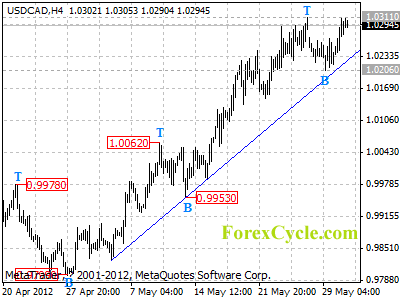
USDCAD rebounds from 1.0206

Being supported by the upward trend line on 4-hour chart, USDCAD rebounds from 1.0206, suggesting that a cycle bottom has been formed, and the uptrend from 0.9799 has resumed. Further rise could be seen over the next several days, and next target would be at 1.0400 area. Initial support remains at the upward trend line, only a clear break below the trend line support could signal completion of the uptrend.

usdcad

Forex Signals

This ‘Strategic’ Minerals Stock Has Just Doubled: What to Do Next

By MoneyMorning.com.au

Air.

Water.

Berries.

Beans.

Nuts.

Without the first, most people will die within a couple of minutes.

Without the second, you could survive for a few days, but that’s all.

And according to Forbes magazine, the third, fourth and fifth items are the most important and healthiest food items you can eat.

Bottom line: if you’ve got access to air, water, berries, beans and nuts, you should be able to at least survive at a subsistence level.

It’s something worth remembering for when economic Armageddon hits the world and you need to stock up your bunker.

Those elements and foods are the necessities of human life. But as an investor it’s pretty hard to make a profit from any of those five items.

But what if there was a crucial element that you could profit from? An element that’s set to become a necessity of industrial life?

As it happens, such an element does exist, and you can profit from it right here on the Australian Securities Exchange…

It’s a story our old pal, Diggers & Drillers editor, Dr. Alex Cowie has followed for some months.

He finally took the plunge by tipping a particular stock to his readers five weeks ago.

Today, those readers who followed the Doc’s advice are up over 150%. That’s pretty good when the broader market has fallen almost 10% over the same time.

The element the Doc plumped for is graphite.

When you ask most people to name the uses for graphite, they’ll say pencil leads…and that’s all.

But for anyone who’s read Dr. Cowie’s latest research report, titled Welcome to the World of “Strategic Mineral” Investing, they’ll know there’s more to graphite than pencils.

The importance of graphite is highlighted by the fact that it’s high on the Royal Geological Society’s list of strategic minerals. Strategic minerals include those minerals that meet specific criteria – such as a concentration of production in one country.

In the case of graphite, China dominates world production. It accounts for three-fourths of the world’s graphite supply.

You can see how limited and concentrated the graphite supply is on the map below:

graphite supply

Source: Wikipedia

As the map shows, China is the single largest producer. For now anyway. But that may be about to change…

World’s Largest Graphite Deposit?

Before we go on, just what is so special about graphite?

To be precise, it’s not graphite Dr. Cowie is interested in, it’s graphene. In his latest report, the Doc explained graphene’s unique qualities:

‘Graphene is a one-molecule-thick sheet of graphite.

‘The carbon molecules line up in hexagons. Close up it would look like chicken wire. It is stronger than diamond, is more elastic than silk, and conforms to any shape. It conducts electricity at the speed of light, and can transmit 1000 times more electric current than copper…

‘IBM has already used graphene to produce the fastest computer chip in history.’

That’s some mineral.

So you can see why Dr. Cowie got so excited when he came across a stock that could own the world’s largest graphite deposit.

If everything goes to plan, the stock he’s backed could end up with a multi-billion-dollar valuation…many times the stock’s current value.

Of course, as with any speculative small-cap resources punt, nothing is certain. The Doc knows there’s still a long way to go before the company gets near production.

But that hasn’t stopped the share price from putting in a tremendous run.

So, is the stock still worth buying even though it has more than doubled in five weeks? Or should investors wait for the price to fall back first?

To find out Dr. Cowie’s latest advice on this high-tech strategic minerals play, click here.

Cheers,
Kris.

Related Articles

Market Pullback Exposes Five Stocks to Buy

APPEA – Day One at the Oil & Gas Show: Sand Dunes, Scuba Diving and Camels

Get in Early to Shale Gas


This ‘Strategic’ Minerals Stock Has Just Doubled: What to Do Next

The Setting Sun of the Japanese Economy

By MoneyMorning.com.au

Europe is the focus for bureaucratic bungling at the moment. It will probably remain in the spotlight for some time. But Japan… Japan is in a class all of its own.


For more than 20 years now, the Japanese economy has been in and out of recession. The bureaucrats have met every ‘challenge’ with a remedy that would have even Keynes turning in his grave – more government spending. Public debt in Japan is expected to reach an incredible 237% of GDP in 2012. No wonder Fitch Ratings downgraded Japan’s debt by two notches to A+.

And the debt continues to grow. Japan’s budget deficit hovers around 10% of GDP. This continual government largesse is tolerated by the markets because of Japan’s ability to fund the expenditure internally. The country’s trade surpluses are legendary. That is, Japan’s private sector produces more than it consumes, meaning it diverts savings into the government sector…that the government then spends wastefully.

Japan balance of trade

Source: tradingeconomics.com

But the flow of private sector savings is now drying up. Japan’s balance of trade (see chart) dipped into deficit in 2011…and it hasn’t bounced back. While Japan’s stock of savings remains huge, its flow of savings – previously a torrent – is turning into a trickle. Without adequate flow, Japan’s economy will find it increasingly difficult to fund its deficits at such low rates.

Making matters worse, Japan’s population is aging rapidly. It’s the world’s oldest nation. Official forecasts have the population falling from 128 million (2010) to 87 million by 2060. In the meantime, the household sector will draw down on savings to fund its retirement. This means less for the government.

Despite all these headwinds, Japan’s funding rates (or the return on Japan’s private sector savings) are incredibly low. The other week, the yield on 10-year government bonds dipped to 0.83%, the lowest level since 2003. Yields haven’t traded sustainably above 2% since 1997.

Japan’s bond market is approaching light speed. And things are certainly getting weird. People, blinded and numbed by a 20 year bull market (when yields fall, prices rise) can only see more of the same.

But simple common sense tells you this can’t continue. Not with a terrible demographic profile and a deteriorating balance of trade. In the next few years something will have to give. In my view bond yields will most certainly rise.

Greg Canavan
Editor, Sound Money. Sound Investments.

From the Archives…

Free of the Dragon: Why the Energy Market Doesn’t Need China
2012-05-25 – Kris Sayce

China Stirs Up Troubled Waters in the South China Sea
2012-05-24 – Dan Denning

How Chinese Stocks Are Fading Fast
2012-05-23 – Lars Henriksson

LNG: Why Australia Will Be a New Global Gas Leader
2012-05-22 – Dr. Kent Moors

A Shocking Week for China’s Economy
2012-04-21 – Dr. Alex Cowie


The Setting Sun of the Japanese Economy