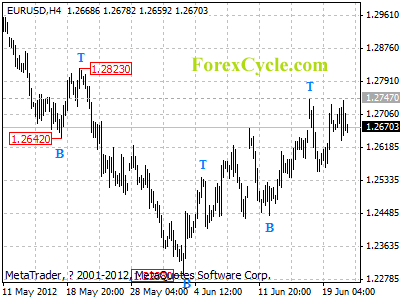
EURUSD fails to break above 1.2747 resistance

EURUSD fails to break above 1.2747 resistance. Range trading between 1.2500 and 1.2747 would likely be seen in a couple of days. As long as 1.2500 support holds, the price action from 1.2747 is treated as consolidation of the uptrend from 1.2288, and another rise to 1.2800-1.2900 area is possible. On the downside, a breakdown below 1.2500 will indicate that the uptrend from 1.2288 has completed, then further decline towards 1.2000 could be seen.

eurusd

Daily Forex Forecast

Why You Shouldn’t Be Afraid to Buy Stocks Now, Part II

Article by Investment U

On Friday I made the case that everyone who is interested in achieving great wealth or protecting what they have should invest in stocks.

Not because stocks have generated a certain return over a certain period of time. Not because the outlook for the economy is fabulous. (It’s not.) And not because I have any inkling what the stock market is going to do next. (I don’t … and neither does anyone else.)

You should own stocks because great fortunes are usually the result of business ownership. (And the fortunes generated in real estate often involved massive amounts of leverage that seemed safe only when investors believed real estate appreciation is a one-way street. Not many do anymore.)

The simplest way to gain a piece of a great business is not to found one but to take an ownership stake through the stock market.

It’s not only easy… it’s fair. If I buy shares of Microsoft (Nasdaq: MSFT), for example, my return will be the same as the world’s richest man, Bill Gates. Sure, he may own a few more shares than I do, but our annual percentage gains will be the same.

Every stock market investor needs to be smart about it, however. In particular, you need to follow three proven principles that form the foundation of Investment U and The Oxford Club’s investment strategies:

  1. Asset Allocation
  2. Trailing Stops
  3. Position-Sizing

Let’s take a quick look at each.

Asset Allocation is a phrase that makes the average investor’s eyes glaze over. Yet it is your single most important investment decision. It refers to how you divide your portfolio up among non-correlated assets: stocks, bonds, cash, metals, inflation-adjusted Treasuries and so on. Diversifying a portion of your risk capital outside of equities reduces your portfolio risk and volatility. History shows that businesses (stocks) outperform everything else over the long haul, but few people have the stomach to stay fully invested in prolonged bear markets. Benjamin Graham, Warren Buffett’s mentor, said no one should ever have more than 75% of his portfolio or less than 25% in stocks. It’s a good rule of thumb.

Trailing Stops. Anyone can plunk for a few shares. But the secret of investing is knowing when to get out. Unfortunately, no one rings a bell at the stop. But running a 25% trailing stop behind your individual stock positions allows you to both protect your principal and your profits. We’ve written on this topic frequently. For more information, click here.

Position-Sizing. You should not invest more than 4% of your stock portfolio in any one stock, at least initially. If it climbs, it may eventually become a much bigger portion of your portfolio but that’s ok. After all, you’re going to be running a 25% trailing stop to protect your profits, too. But look at the other side. If a stock goes against you and you take the maximum loss (25%) in the maximum position size (4%), your stock portfolio is going to be worth just one percent less. And if stocks are only, say, 60% of your asset allocation (as The Oxford Club recommends), the maximum loss in your maximum position size in your maximum stock allocation means your portfolio is only down six-tenths of one percent.

Many investors need the high returns that only stock can provide but can’t handle the risk. The solution? Asset allocate properly, run trailing stops and watch your position sizes.

It sure beats the heck out of sitting on the sidelines… and wishing you were earning higher returns.

Good Investing,

Alexander Green

Editor’s Note: This article is the finale in a two-part essay from Alex. To read the first part of his essay and find out why you should look at stocks more as ownership and investment in quality businesses, click here.

Article by Investment U

GURU: Investing With the Best Minds in the Business

By The Sizemore Letter

Last week, I took a look at how the “Investing All-Stars” were positioning themselves for the remainder of 2012.

Then—as now—the Eurozone crisis hung over the capital markets like the proverbial Sword of Damocles.  Given the difficulty of investing under this kind of uncertainty, I thought it would be beneficial to peek over the shoulders of some of the brightest minds in the business.   If anyone could navigate the storm, it would presumably be them.

Lucky for us, there are quite a few good shoulders over which we can peek.  All large institutional investors are required to disclose their security holdings to the SEC by reporting via Form 13-F, and this information is made publicly available.  You can dig through the filings yourself if you enjoy reading financial legalese, but you certainly don’t need to. There is an entire niche industry dedicated to “13-F mining,” and several very good online services that do this legwork for you.  A site I’ve used over the years to check up on some of my favorite investors is GuruFocus, and several new entrants are worth noting as well, including InsiderEdge and  AlphaClone.

For anyone looking for an investment theme to follow, using one of these sites is a great place to start.

For those investors not particularly interested in doing their own research, Global X Funds has created a passive ETF that tracks the trades of major hedge fund managers: the Top Guru Holdings Index ETF ($GURU).

GURU’s portfolio is an equally-weighted mix of the “high conviction” picks of the hedge fund managers that Global X follows.  These would include household names like David Einhorn’s Greenlight Capital, John Paulson’s Paulson & Company, and Seth Klarman’s Baupost Capital, among many, many others.

It’s not hard to understand the appeal of the GURU ETF.  You’re getting some of the top investment ideas of the world’s most talented hedge fund gurus but without the high fees that come with investing in the hedge funds themselves.  Rather than pay the standard 2% of assets and 20% of profits, investors pay a modest 0.75% in expenses.   Not bad.

There are a few shortcomings to note, however:

  1. The ETF only buys listed stocks, and many major guru investments are not publicly traded.  Consider Warren Buffett’s Berkshire Hathaway (which is currently not tracked by GURU).  Many of Berkshire’s major positions are in private companies.
  2. GURU’s positions are equally-weighted.  Higher-conviction stocks within the portfolio are given no greater weight, nor are the risk management aspects of position sizing considered.
  3. The ETF only tracks long positions.  If a given “high conviction” pick is really just one half of a pair trade, the ETF managers would have no way of knowing this.
  4. As with all guru-following strategies, there is a time lag.  It is entirely possible that the conditions that lead a guru to buy a stock no longer exist by the time that the GURU ETF picks it up.
  5. As a new ETF, GURU has very little in assets under management and very thin trading volume.  You have to be careful getting in or out of a position in GURU.

For investors building a long-term “buy and forgot” portfolio, GURU is an ETF I would consider, along with the Vanguard Dividend Appreciation ETF ($VIG) and the PowerShares International Dividend Achievers ETF ($PID) (to see my rationale for VIG and PID, see “Sizemore Capital Allocation Change: Dividend Appreciation” and “European Dividend Stocks”) .

But while the ETF has its merits and a long-term holding, I see more value in using it as a fishing pond for investment ideas.  Rather than buy the portfolio as is it, with all of the faults I described above, why not instead cherry pick the best ideas from the ETF?

With that said, let’s take a look at what GURU holds: GURU fund holdings.

There are some familiar names, such as Microsoft ($MSFT) and Apple ($AAPL).  There are also a few names that, for all the enthusiasm of the gurus who own them, haven’t quite panned out.  Tempur-Pedic International ($TPX) is a glaring example; the former Wall Street darling is down by 50% in the past month alone.

Carlos Slim’s America Movil ($AMX) also made the list, which I find particularly interesting.  It would appear that the gurus are investing in the chief competitor of my favorite Latin American telecom play Telefonica ($TEF).

Next quarter, when the ETF is rebalanced, GURU’s holdings will no doubt be substantially different than they are today.  So, if you are following my suggestion to use GURU as a fishing pond, make sure that you review your holdings on at least a quarterly basis.

I’m betting that Tempur-Pedic doesn’t make the cut.

Disclosures: Charles Sizemore contributes articles to GuruFocus and InsiderEdge on occasion.  MSFT, PID, TEF and VIG are currently held by Sizemore Capital clients. This article first appeared on MarketWatch.

Related posts:

Fed holds rate, extends ‘Operation Twist’ until end-2012

By Central Bank News
    The U.S. Federal Reserve maintained the target for its key policy rate, the federal funds rate, at 0-0.25 percent and said it expected to maintain rates at these “exceptionally low levels” at least through late 2014.
    As expected, the Federal Reserve extended its policy of increasing the average maturity of its securities — known as Operation Twist — by purchasing U.S. Treasuries worth $267 billion by the end of the year. Operation Twist was due to expire at the end of June. 
    The Federal Reserve has been extending the maturity of its holdings of U.S. Treasury bonds by purchasing bonds with maturities of six to 30 years, and selling or redeeming the corresponding amount of bonds with maturities of 3 years or less.
    “This continuation of the maturity extension program should put downward pressure on longer-term interest rates and help to make broader financial conditions more accommodative,” the Federal Open Market Committee (FOMC) said. The FOMC is the Federal Reserve’s main policy making body.

     In a statement released after a two-day meeting of the FOMC, the Federal Reserve said low interest rates would be maintained due to moderate economic growth, including low rates of utilization, and a subdued outlook for inflation over the medium term.
    The Federal Reserve said employment growth in the U.S. economy had slowed in recent months, household spending appeared to be rising at a slower pace than earlier in the year and the housing sector remains depressed, despite some signs of improvement. Inflation had also eased and long-term inflation expectations were stable.
    The FOMC also cut its forecast for U.S. gross domestic product (GDP) growth this year to 1.9-2.4 percent, down from an April projection of 2.4-2.9 percent. Forecasts for 2013 and 2014 were also cut.
    “To support a stronger economic recovery and to help ensure that inflation, over time, is at the rate most consistent with its dual mandate, the Committee expects to maintain a highly accommodative stance for monetary policy,” the Federal Reserve said, adding:
    “The Committee is prepared to take further action as appropriate to promote a stronger economic recovery and sustained improvement in labor market conditions in a context of price stability.”


    Click to read the Federal Reserve’s monetary policy statement.
    Click to read the Federal Reserve’s economic forecast.
    Click to read the Federal Reserve’s Treasury purchasing program


    www.CentralBankNews.info


Carl Icahn Strikes Again at Navistar (NYSE: NAV)

Article by Investment U

View the Investment U Video Archive

In focus today: Ichan strikes again at Navistar (NYSE: NAV), pipeline MLPs are pumping cash, and a political SITFA – maybe the most maddening I have ever done.

Carl Icahn Strikes Again

Carl Ichan is at it again, the second time in many months. This time his target is Navistar. Shares moved up 15% on the news of his increased position and the stock bounced off a 52-week low that was the result of previously reported disappointing earnings news.

Ichan boosted his share in the company from 10% to 12%.

Other news on Navistar has Volkswagen (OTC: VLKAY) looking at its truck line as a way of increasing its share of  the U.S. truck market which is dominated by its competitor Daimler (OTC: DDAIF).

Chesapeake (NYSE: CHK) was the most recent company Ichan took a larger stake in and it had very positive effects on its stock. Despite the recent sell off in the markets, CHK ran from $13 and change to around $18 and change after Ichan announced his intention to take a greater role in the activities of the company.

Navistar, which has been struggling for years, may benefit as well from the activist investor. Many analysts have been calling for the company to take a serious look at its direction especially in its engine and truck lines. Ichan may be the guy to make them do it.

Between Volkswagen and Ichan I think we should see some action from this one.

Put Navistar on your bogie board.

“Robust profits, Tax Breaks and a Booming U.S. Energy Sector”

Barron’s described pipeline MLPs as having robust profits, tax breaks and a booming U.S. energy sector. It doesn’t get any more positive than that.

Pipeline MLPs have enjoyed great returns for some time and Credit Suisse analyst John Edwards said in a Barrons article that he sees this continuing with yields in the 6% to 7% range and growth in the high single digits. He sees total return exceeding 15% for the next year.

Edwards likes the large well capitalized MLPs; Including current Oxford Club recommendation Plains All-American Pipeline (NYSE: PAA) and former Oxford Systems Trader pick Enterprise Product Partners (NYSE: EPD).

On the tax side, 80% of an MLPs distributions are tax deferred. The remaining 20% is treated as regular income.

Many MLP owners are able to avoid the deferred portion of the taxes entirely by holding them to their deaths and coming in under the $5 million dollar inheritance threshold.

Kyri Loupis, an MLP manager for Goldman Sachs said in the Barron’s article that he sees distributions rising at 8% a year for the next three years and many MLPs benefiting from exposure to rising crude production in the US.

Loupis likes MarkWest Energy Partners (NYSE: MWE) with a 6.3% yield and its exposure to the fast growing energy production in the Marcellus shale.

Anyway you look at them, pipeline MLPs are growing cash cows in an otherwise dead income market in the U.S.

A total return of 15% per year is rare anywhere right now. Add the tax advantage and it’s almost a giveaway.

SITFA: Huge Oil & Gas Prices Following Election?

This week it goes to all the American people who according to Donald Trump on a CNBC interview are being set up by their president to pay huge gasoline and oil prices after the election this fall.

According to Trump, Obama has cut a deal with the Saudis to ramp up production, what other OPEC member’s are calling over production, to force the price of oil lower before the election.

When I first heard this I was hoping it was just politics, but I can’t find anyone who doesn’t believe the accusation – including a good friend who is an oil analyst.

The Saudi’s oil production is at a 30-year high and in stark contrast to other OPEC members; Argentina and Venezuela are at 20-year lows in their production. Most OPEC members are calling for the Saudis to reduce their output. The Saudi’s have stood firm against all efforts.

The kicker, according to Trump, is the deal with the Saudis allows them to make up for the loss revenues with higher prices after the election. Trump says oil prices will go through the roof.

Lower prices on oil now to help his re-election, higher prices later to pay off the Saudis’.

I wonder if the tax-paying portion of the American people can deduct the coming increase in oil prices Trump is predicting as campaign contributions to re-elect Obama.

If you live long enough…

Article by Investment U

Gold Down Ahead of FOMC Decision, “Policy Gesture” Expected But No Fresh QE, France and Italy Call for Bond Buying with Bailout Fund Money

London Gold Market Report
from Ben Traynor
BullionVault
Wednesday 20 June 2012, 09:00 EDT

SPOT MARKET gold prices dropped back towards $1600 an ounce ahead of Wednesday’s US trading – 1.5% down on last week’s close – while stocks and commodities were broadly flat and US Treasuries fell ahead of the Federal Reserve policy decision due later today.

Silver prices dropped to $28.08 an ounce – 2.2% down on the week so far.

As well as announcing its latest decisions on interest rate and asset purchases, the Fed will also publish policymakers’ economic projections, while Fed chairman Ben Bernanke will give a press conference.

“We think Bernanke will talk up the Fed’s readiness to act if required and there is a chance of a policy gesture – an extension to Operation Twist perhaps,” reckons Nick Trevethan, Singapore-based senior metals strategist at Australian bank ANZ, referring to the Fed’s program aimed at lowering longer-term interest rates.

“But anybody looking for some sort of grand [quantitative easing] scheme risks disappointment,” says Trevethan, adding that gold prices could fall as low as $1530 an ounce “if investors are really disappointed”.

“Extending Operation Twist is the path of least resistance,” agrees Josh Feinman, global chief economist at Deutsche Bank’s asset management arm DB Advisors in New York.

“It would be an extension of something we have in place, so it would be more seamless, and it doesn’t complicate exit strategies as much because it’s not expanding the balance sheet.”

European leaders meantime “will take all necessary measures to safeguard the integrity and stability of the [Euro] area,” according to the official communiqué issued at the end of the G20 meeting Tuesday.

“The adoption of the Fiscal Compact [on government budget reforms],” the communiqué adds, “and its ongoing implementation, together with growth-enhancing policies and structural reform and financial stability measures, are important steps towards greater fiscal and economic integration that lead to sustainable borrowing costs.”

The communiqué was issued hours after Spain auctioned 12-month bills at an average yield of more than 5%. Yield’ on 10-Year debt eased slightly on Wednesday morning, dipping back below 7%.

Europe’s major clearing house LCH.Clearnet  meantime has raised the margin clients must post against positions in Spanish sovereign debt. The margin on bonds with maturities of between 10 and 15 years, for example, will rise from 13.6% to 14.7%. The clearing house made a similar hike for Italian bond positions last November after yields on those bonds rose above 7%.

Eurozone bailout funds the European Financial Stability Facility and the soon-to-be-activated European Stability Mechanism could be used to buy sovereign bonds directly on the open market, according to a proposal made by Italian prime minister Mario Monti at the G20 summit.

“The idea is to stabilize borrowing costs,” said Monti, “especially for countries who are complying with their reform agendas, and this should be sharply distinguished from the idea of a bailout.”

French president Francois Hollande, who described yields of 7% on Spanish bonds as “not acceptable”, expressed support for Monti’s proposal.

“The EFSF already exists,” said Hollande, who also repeated calls for joint debt issuance, a financial transaction tax, and for the European Central Bank to play a greater role in fighting the crisis.

“The ESM will soon exist…let’s use them at the right moment and with the right dose.”
German chancellor Angela Merkel is due to meet with Hollande and Monti, as well as Spanish prime minister Mariano Rajoy, in Rome on Friday.

European leaders “need to deliver something” at next week’s European Union summit, one of Merkel’s aides told newswire Reuters Tuesday.

“We know the expectations for the EU summit are high,” the aide said, “But in reality many countries have still not come to grips with the idea of moving towards greater fiscal integration. It’s going to be very hard to deliver the big announcement.”

Germany’s Constitutional Court meantime has ruled that the German government gave insufficient notice to parliament of plans to set up the ESM, the permanent Eurozone bailout fund due to become active at the start of July. The Bundestag is due to vote on whether to ratify the ESM’s creation next week.

Over in Athens, Greek politicians have agreed on the formation of a government, according to Evangelos Venizelos, the leader of Socialist party Pasok.

Pasok, which came third in Sunday’s election, will form a government with other so-called pro-bailout parties, first-placed New Democracy and the Democratic Left, Venizelos said Wednesday.

Here in the UK, members of the Bank of England’s Monetary Policy Committee “judged that some further economic stimulus was either warranted immediately or would probably become warranted”, according to the minutes of the MPC’s June meeting published Wednesday.

The minutes add that the MPC is “waiting to see how matters evolve” in the Eurozone before undertaking any action.

The number of unemployed in Britain meantime fell nearly 2% to 2.61 million between February and April, according to official data published Wednesday. In May, however, the claimant count – which measures the number of people claiming jobseeker’s allowance – rose by 8100 to 1.6 million.

Gold bullion dealers in India, traditionally the world’s biggest gold market, continued to report quiet demand Wednesday.

“Customers are coming to the jewelry shops,” says Bachhraj Bamalwa, chairman of the All India Gems & Jewellery Trade Federation.

“But now they’ve turned sellers rather than buyers.”

Rupee gold prices in Mumbai set a fresh record on Tuesday, the Wall Street Journal reports. The Rupee has fallen 25% against the Dollar over the last 12 months.

China looks set to overtake India as the world’s biggest gold buyer this year.

Ben Traynor
BullionVault

Gold value calculator   |   Buy gold online at live prices

Editor of Gold News, the analysis and investment research site from world-leading gold ownership service BullionVault, Ben Traynor was formerly editor of the Fleet Street Letter, the UK’s longest-running investment letter. A Cambridge economics graduate, he is a professional writer and editor with a specialist interest in monetary economics.

(c) BullionVault 2011

Please Note: This article is to inform your thinking, not lead it. Only you can decide the best place for your money, and any decision you make will put your money at risk. Information or data included here may have already been overtaken by events – and must be verified elsewhere – should you choose to act on it.
 

Central Bank News Link List – June 20, 2012

By Central Bank News

      Here’s today’s Central Bank News link list, click through if you missed the previous central bank news link list. The list is updated during the day with the latest news about central banks so readers don’t miss any important developments.
    If you want to submit links for inclusion in the daily link list, just email them through to us or post them in the comments section below.

Norway central bank keeps rate at 1.5%

By Central Bank News
    Norway’s central bank, as expected, kept it key policy rate unchanged at 1.50 percent, citing uncertainty surrounding the euro area but a slightly better-than-expected domestic economy.
    Central Bank Govenor Oystein Olsen said the central bank’s executive board had decided the policy rate should remain in the 1-2 percent range unless the Norwegian economy was exposed to major shocks. It said the key rate should remain around this level towards the end of 2012 and then gradually rise towards a more normal level.
    “The level of uncertainty surrounding developments in Europe is now higher than it has been for some time. Although domestic developments have been slightly stronger than expected, the turbulence and weak growth prospects abroad suggest the key policy rate should be kept on hold,” said Olsen in a statement.

    The Norwegian central bank surprisingly cut its rate in March, citing a weak outlook for the international economy and a strong Norwegian krone.

FOMC Press Conference Set to Create Market Volatility

Source: ForexYard

Riskier currencies like the euro and Australian dollar saw moderate gains during European trading yesterday, despite negative economic data out of Germany which increased fears among investors that the euro-zone debt crisis could continue to spread. Today, traders will want to carefully pay attention to what is said at the FOMC Press Conference, scheduled to take place at 18:15 GMT. Analysts are predicting the Fed will extend its current bond-buying program to help the US economic recovery gain traction. If true, the euro could see additional gains during the evening session.

Economic News

USD – Possible Action by Fed May Impact USD

The US dollar took losses against its main currency rivals yesterday, despite the release of a better than expected US Building Permits figure. Analysts attributed the dollar’s bearish trend to expectations that the Fed will ease monetary policy to stimulate growth in the US economic recovery. Against the Canadian dollar, the greenback fell more than 50 pips during the European session, eventually reaching as low as 1.0180. Furthermore, the USD/CHF fell over 40 pips, reaching as low as 0.9491 before staging a very minor upward correction during afternoon trading.

Today, dollar traders will want to get ready for volatility in the marketplace as a batch of US news is scheduled to be released during afternoon trading. The FOMC Statement, Federal Funds Rage, FOMC Economic Projections and FOMC Press Conference could lead to dollar losses if the Fed decides to extend its current bond-buying program. Additionally, any mention of a new round of quantitative easing today may weigh down on the greenback for the rest of the week.

EUR – Spanish Banking Worries Threaten to Keep Euro Bearish

The euro was able to recoup some of its recent losses in trading yesterday, as expectations that the US Federal Reserve will extend its bond-buying program gave a boost to riskier currencies. The EUR/USD advanced close to 60 pips over the course of the day, eventually reaching as high as 1.2650. Furthermore, the EUR/JPY gained over 60 pips for the day to peak at 99.99 while the EUR/GBP moved up approximately 35 pips to trade as high as 0.8060.

Turning to today, analysts continue to warn that any gains the euro makes could turn out to be short-lived, especially if the economic situation in Spain and Italy deteriorates further. Furthermore, the euro still has the potential to fall due to the political situation in Greece, which has yet to finalize the makeup of its new government. That being said, the common-currency could see gains this afternoon, as it is widely expected that the Fed will announce steps today to help stimulate growth in the US economy. Any move by the Fed could lead to gains for riskier currencies like the euro.

AUD – Aussie Hits 6-Week High vs. USD

Risk taking in the marketplace gave the Australian dollar a boost over the course of the day yesterday. The AUD/USD extended its recent bullish trend to gain over 80 pips for the day. The pair eventually peaked at 1.0183, a six-week high. Against the JPY, the aussie was able to gain over 50 pips during the European session, reaching as high as 80.48.

Turning to today, the aussie may be able to see additional gains if the Fed announces plans to extend its bond-buying program during the FOMC Press Conference, scheduled to take place at 18:15 GMT. That being said, should any news news out of the euro-zone, in particular with regards to Spain and Italy, be announced, riskier currencies like the AUD may quickly turn bearish.

Crude Oil – Crude Oil Sees Gains amid Risk Taking

After dropping as low as $82.58 a barrel during overnight trading yesterday, crude oil was able to stage a moderate recovery during the European session. Expectations among investors that the US Federal Reserve will soon take additional steps to boost the US economic recovery caused oil to increase as high as $84.69 during mid-day trading.

Today, in addition to any announcements by the Fed which could lead to heavy volatility for oil, traders will also want to pay attention to the US Crude Oil Inventories figure, set to be released at 14:30 GMT. Analysts are predicting that US inventories fell by around 1 million barrels last week, which if true, may signal increased demand in the US which could help crude extend yesterday’s bullish trend.

Technical News

EUR/USD

Long term technical indicators are providing mixed signals for this pair. On the one hand, the weekly chart’s MACD/OsMA seems like it is about to form a bullish cross. On the other hand, the daily chart’s Williams Percent Range is in overbought territory, indicating that downward movement could occur. Taking a wait and see approach for this pair may be the best choice.

GBP/USD

The Williams Percent Range on the daily chart is currently in the overbought zone, indicating that downward movement could occur in the near future. In addition, the Slow Stochastic on the same chart seems like it is about to form a bearish cross. Traders will want to pay attention to this indicator. If it forms the cross, it may be a good time to open short positions.

USD/JPY

The Bollinger Bands on the weekly chart are narrowing, indicating that this pair could see a price shift in the coming days. Furthermore, the Williams Percent Range on the same chart is hovering close to the oversold zone. Traders may want to go long in their positions for this pair.

USD/CHF

A bullish cross on the daily chart’s Slow Stochastic indicates that this pair could see an upward correction in the near future. This theory is supported by the Williams Percent Range on the same chart. Going long may be the best choice for this pair.

The Wild Card

NZD/CHF

Both the Relative Strength Index and Williams Percent Range on the daily chart have drifted into the overbought zone, indicating that this pair could see a downward correction in the near future. Furthermore, the Slow Stochastic on the same chart has formed a bearish cross. This may be a good time for forex traders to open short positions ahead of a possible downward breach.

Forex Market Analysis provided by ForexYard.

© 2006 by FxYard Ltd

Disclaimer: Trading Foreign Exchange carries a high level of risk and may not be suitable for all investors. There is a possibility that you could sustain a loss of all of your investment and therefore you should not invest money that you cannot afford to lose. You should be aware of all the risks associated with Foreign Exchange trading.