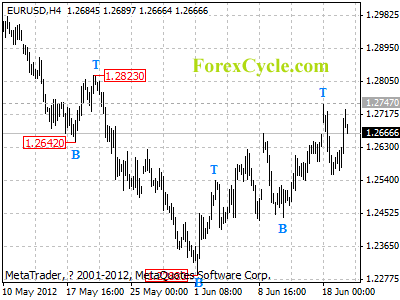
EUR/USD Technical Analysis

EURUSD reversed from 74.6% (1.2563) of 1.2442-1.2746, target
1.2825-1.2932. EURUSD is forming channel on 1hr chart and also above 200EMA,
targeting toward 1.2790-1.2820 in intraday.Break of 1.2710 next taregt will be
1.2750 small resistance and then 1.2790-1.2820.

Break of 1.2660, downside will go toward 1.2640-1.2610 as
trendline pass and possible back from there.In EURUSD buyer will come from
1.2640-1.2610.Break of 1.2610, next target will be 1.2585-1.2540. On the basis
of channel, up move possible on toward 1.2790-1.2820.

Best Forex Signal Provider 2012

Pound Drops Against the Euro on Inflation Data

By TraderVox.com

Tradervox (Dublin) – A report from UK has showed that inflation slowed to its lowest since November 2009, weakening demand for the pound as speculation rose Bank of England will embark on its asset purchases program. The pound has weakened against the euro for the first time in three days after it increased to the strongest in a week yesterday. The drop has come prior to the release of Bank of England meeting minutes which is scheduled for tomorrow. Investors will be looking at these minutes keenly as they look for any indication on the banks stand on quantitative easing. Further, the announcement that the bank will use the Extended Collateral Term Repo Facility to sell $7.87 billion worth of debt tomorrow in a bid to reduce risk to financial stability has not done enough to push the pound up against the euro.

In a report released today, the consumer price Index has increased by 2.8 percent compared to an increase of 3 percent in April. Releasing the report, the Office of National Statistics highlighted that this is the weakest level since September 2009. The market was expecting an increase of 3 percent.  However, the pound decline against the euro has been limited by speculation Federal Reserve and European Central Bank will increase stimulus in the respective economies.

The G20 meeting started yesterday and will continue today as they discuss Europe crisis. The Spanish benchmark yield surged to euro era record touching the level that sent Greece, Portugal, and Ireland asking for international bailout. Concerns about the deepening crisis in Europe has led to some safe haven demand which has limited the pound decline.

The sterling pound declined by 0.5 percent against the euro to trade at 80.68 pence per euro at the close of trading in London yesterday. It had earlier advanced to 80.23 pence which is the strongest it has been since June 12.

Disclaimer
Tradervox.com is not giving advice nor is qualified or licensed to provide financial advice. You must seek guidance from your personal advisors before acting on this information. While we try to ensure that all of the information provided on this website is kept up-to-date and accurate we accept no responsibility for any use made of the information provided. Opinions expressed at Tradervox.com are those of the individual authors and do not necessarily represent the opinion of Tradervox.com or its management. 

Article provided by TraderVox.com
Tradervox.com is a Forex News Portal that provides real-time news and analysis relating to the Currency Markets.
News and analysis are produced throughout the day by our in-house staff.
Follow us on twitter: www.twitter.com/tradervox

Market Review 20.6.12

Source: ForexYard

printprofile

The euro largely held onto gains from yesterday during the overnight session, as investors eagerly await a batch of US news today. Crude oil also largely remained bullish last night and is currently trading just above the $84.00 a barrel level.

Main News for Today

US FOMC Statement 16:30 GMT
US FOMC Economic Projections 18:00 GMT
US FOMC Press Conference 18:15 GMT

• Investors will be closely watching all three of these events for clues as to whether the Fed will initiate a new round of quantitative easing in the near future

• It is also widely expected that the Fed will extend its bond-buying program in order to stimulate growth in the US economy

• Any mention of a new round of quantitative easing is likely to lead to gains for riskier currencies

• If the Fed chooses not to extend its bond-buying program, the dollar could see gains during the evening session

Read more forex news on our forex blog

Forex Market Analysis provided by ForexYard.

© 2006 by FxYard Ltd

Disclaimer: Trading Foreign Exchange carries a high level of risk and may not be suitable for all investors. There is a possibility that you could sustain a loss of all of your investment and therefore you should not invest money that you cannot afford to lose. You should be aware of all the risks associated with Foreign Exchange trading.

An Addicted Stock Market About to Suffer Withdrawals

By MoneyMorning.com.au

I have rarely seen a stock market so beautifully poised for disappointment. Pavlov’s dogs are salivating at the thought of more free money spewing out of the Fed tonight. If the Fed disappoints you are going to wake up to a US market down 2–3% tomorrow morning.

The irony of the situation is that the stock market is shooting itself in the foot by rallying so strongly into the announcement. The S+P 500 is only a little over 4% below the highs reached in April. How can Bernanke justify coming to the rescue of a stock market that is only down 4%? What a farce.

There are of course plenty of options open to Bernanke tonight and I am sure he doesn’t want to completely disappoint, so he will throw a bone or two to the salivating rabid dog that is the market. But I can’t help feeling that if he doesn’t embark on an all-out, unsterilized bout of money printing then the stock market will takes its bat and ball and go home.

The technical picture is truly compelling. I am always fascinated by the way the charts can line up with important announcements and tonight is a perfect example.

Emini S+P 500 futures

Emini S+P 500 futures
Click here to enlarge

Have a look at the above chart and notice how the stock market bounced off the 200 day moving average earlier this month. The rally from that area is causing a short squeeze. Stock market traders who have been shorting the stock market (i.e. betting that the stock market will go down) are now seeing their profits disappear as the stock market rallies.

They are forced to cover their positions more and more the higher the stock market goes. The fear of an announcement of more money printing will be adding to the buying pressure.

Now have another look at the chart and notice how similar the current price action is to the price action from last year, which I have circled. The sell off from the high last year found support at the 200-day moving average, before turning around and having a big short squeeze almost all the way back to the high (in fact it retraced to the 73.4% retracement level).

Once that short squeeze had played itself out the market tread water for a few weeks, before turning back down and plummeting 20% in two weeks. Will the stock market rhyme again this year? I think so.

The Stock Market is Close to a Major Sell Zone

The 73.4% retracement from the lows reached earlier this month is at 1379 in the emini S+P 500. The 61.8% retracement is at 1360 and the high from May last year is at 1373.5. I would expect to see some pretty stiff resistance between 1360 and 1379. In fact, I would be so bold as to say that I expect to see a reversal in the stock market either in or very close to that area. Last night the emini S+P 500 futures closed at 1350 after reaching a high of 1357.

Perhaps we will see another surge higher before the FOMC announces the outcome of their meeting at 2:30pm in the afternoon over there, but the fact is this stock market is very close to a major sell zone and any disappointment could lead to a cascade of selling pressure. I wouldn’t be surprised at all to wake up to the emini S+P 500 futures trading at 1340 or below.

A major daily sell signal will be generated if the S+P 500 futures close below the 10 day moving average in the short term. Currently the 10 day moving average sits at 1327. So if the stock market really gets dumped tonight and it closes below 1327 every stock trader and his dog should be shorting with their ears pinned back.

The next retest of the 200 day moving average will fail and you can see quite clearly how far and how fast the stock market can fall after breaking through the 200 day moving average from last year’s price action.

Spanish and Italian bonds continue to deteriorate and there is no doubt that this will be the elephant in the room at tonight’s meeting. Perhaps the Fed is so scared of the situation over there that they will decide to print huge quantities of money tonight.

If that is the case then we may see the stock market head higher in the short term, but there will be a use-by date attached to any money printing rally, just as there has been in the past. I think that this is a very low probability outcome but like so much in the stock market these days it will be the decision of a few men that will create direction for the world’s markets.

If they do print then all I have to say is buy gold. Lots of it. Buy gold stocks. Even buy silver. If Bernanke is happy to embark on QE3 with the stock market 4% from its highs then you can rest assured he is going to keep printing until the whole rotten edifice comes crashing down on his head. Gold will be trading above $5,000–10,000 by then.

History Repeats

I wrote a piece for The Daily Reckoning last year about the course of events leading to hyperinflation following the French revolution. I quoted a section from a book called Fiat Money Inflation in France by Andrew Dickson. I think that we should revisit that quote now that we may be on the edge of QE3:

The first result of this issue [i.e QE1] was apparently all that the most sanguine could desire: the treasury was at once greatly relieved; a portion of the public debt was paid; creditors were encouraged; credit revived; ordinary expenses were met, and, a considerable part of this paper money having thus been passed from the government into the hands of the people, trade increased and all difficulties seemed to vanish.

The anxieties of Necker, the prophecies of Maury and Cazalès seemed proven utterly futile. And, indeed, it is quite possible that, if the national authorities had stopped with this issue, few of the financial evils which afterwards arose would have been severely felt; the four hundred millions of paper money then issued would have simply discharged the function of a similar amount of specie.

But soon there came another result: times grew less easy; by the end of September, within five months after the issue of the four hundred millions in assignats, the government had spent them and was again in distress.

It progressed according to a law in social physics which we may call the “law of accelerating issue and depreciation.” It was comparatively easy to refrain from the first issue; it was exceedingly difficult to refrain from the second; to refrain from the third and those following was practically impossible.

It brought, as we have seen, commerce and manufactures, the mercantile interest, the agricultural interest, to ruin. It brought on these the same destruction which would come to a Hollander opening the dykes of the sea to irrigate his garden in a dry summer.

It ended in the complete financial, moral and political prostration of France—a prostration from which only a Napoleon could raise it.

I think these words ring very loud on the eve of this FOMC meeting. ‘To refrain from the third and those following was practically impossible.’ Once the addict has filled his veins with the drug there is no turning back. Abstinence leads to sickness while the drug relieves all pain. Who wouldn’t choose the drug?

Bernanke must know that he only has so many rolls of the dice before his game of smoke and mirrors is shown for what it is. Is the situation really so dire right now that he is willing to give up one of those throws? I don’t think so. And if he doesn’t then the stock market is going to spit the dummy.

Murray Dawes

Editor, Slipstream Trader

Related Articles

Market Pullback Exposes Five Stocks to Buy

Small-Cap Stocks – A Thrilling Risk

Why You Should Wish For a Falling Market


An Addicted Stock Market About to Suffer Withdrawals

Five Beaten-Down Aussie Giant Stocks to Add to Your Portfolio

By MoneyMorning.com.au

This week will go down as another where the market is driven by central bankers rather than company fundamentals.

So as a stock picker, we’re stuck between feelings of frustration and opportunism.

Frustration that policy makers and central bankers can’t just get out of the way and let the free market run its course. Opportunism because we see stocks trading at bargain-basement prices.

In fact, for this month’s Australian Small-Cap Investigator, we’ve found four stocks we’d like to tip. But with only limited time to research them before our deadline, we’ll probably have to hold two of those stocks over for next month.

But it’s not just small-cap stocks where we see value. As we glance at the big Aussie blue-chips this morning, there are five beaten-down blue-chip stocks that look ripe for buying…

Most mainstream investment pros will tell you that it’s impossible to time the market. That you should just buy a bunch of shares and hold them for life.

We believe that’s not only wrong, but that, for the most part, it’s irresponsible too.

Sure, there are some cases where that advice works. For instance, if you own a good dividend paying stock and you only expect the market to fall 10-20%.

Or if you own a portfolio of super-high-risk small-cap shares and you’re banking on them either making you huge gains or going bust.

But even with good dividend payers, a time comes when the dividend doesn’t offset big losses. A good example is the market meltdown in 2007 and 2008.

Our view is that you shouldn’t hold an expensive stock just because it pays a good dividend. If it looks expensive and there’s the chance it can’t grow the dividend, then sell…you can always buy back again when the stock is cheaper, and with any luck collect the same dividend.

But what about the argument that you bought a stock for $2 and it’s now $10, paying a 50-cent dividend? (Effectively giving you a 25% yield on your initial investment.)

That argument only stands up if you’re looking at the initial investment. But as good as it sounds, it’s not an effective use of capital…

Because the 50-cent dividend on a $10 stock is only a 5% yield. If the company can no longer grow the dividend each year, maybe you’re better off putting your money to work elsewhere. Perhaps in a stock that can grow its dividend, or even pays a higher yield.

That’s a long way of saying that you should be active with your investments rather than falling into the trap of believing that everything will be fine if you hold on.

Because if you do hold on, hoping for the best, it means you probably won’t be in a position to take advantage of good quality beaten-down stocks like the ones we’ll go through now…

These Stocks Have Already Crashed

Now don’t get us wrong. Each of these stocks has taken a beating for a good reason. But that doesn’t mean you should completely ignore them.

In fact, if you’ve taken our advice and pared back your blue-chip stock holdings in recent years, we’ve got some new advice for you. And that is to dip your toe back in the market and buy one or more of the stocks we list below.

Again, we’re not saying you should load up your portfolio with shares. As Slipstream Trader Murray Dawes explained above, there’s still a risk that the market could fall further.

But if you’ve got more than half of your portfolio in cash, moving part of it (say, dropping your cash position to 45-55%) into a handful of blue-chip stocks makes good sense at current prices.

‘Hang on Kris, the index has only fallen 6.83% from this time last year. I thought you said the market would crash. Have you changed your mind?’

The stocks we’ll suggest you consider buying have already crashed…only the index doesn’t show it yet. And maybe it never will, if the government and central bank continue to prop up the Aussie banks and big resource stocks.

Look at the table below. We’ve included the five beaten-down Aussie blue-chips that have lost between 14.9% and 48.8% in 12 months:

We know what you’re thinking. Yes, we’ve given Harvey Norman, Qantas and Myer a hard time in the past. We even suggested Money Morning readers short-sell Qantas in 2010 when it was trading at $2.53 per share.

Today it’s at $1.15.

The way we see it, none of these stocks and businesses are perfect. And they each have their own problems, either within or outside their control. But they do have something in common…

They’re each a dominant market player in their field. And when we look at blue-chip stocks, whether it’s for growth or income, we like a stock that’s either dominant or has a fair chance of becoming dominant.

Like it or not, it’s hard for Aussie-based firms to crack the corporate ‘glass ceiling’. With so much red-tape that prevents small firms growing (we know all about that as a fan of small-cap stocks), blue-chip companies have an edge over their rivals.

Aside from that, there are individual reasons why these stocks have fallen so much. We’ve highlighted some of them in the table above.

As we say, don’t bet the house on these stocks. But looking for opportunities is what stock investing is all about. And if you want to be a successful investor, the best time to look for opportunities is when most other investors are fleeing the scene.

Kris Sayce
Editor, Australian Small-Cap Investigator

From the Archives…

The Problem With the Spanish Bailout
2012-06-15 – Keith Fitz-Gerald

Australian Housing – How to Avoid This Pauper’s Retirement Trap
2012-06-14 – Kris Sayce

Why Warren Buffett is Loading Up on Tungsten
2012-06-13 – Don Miller

China’s Economic Data Statistics: Just Add Salt
2012-06-12 – Dr. Alex Cowie

Why Graphite is One of the Few Places For Savvy Investors to Make Money
2012-06-11 – Dr. Alex Cowie


Five Beaten-Down Aussie Giant Stocks to Add to Your Portfolio

EURUSD remains in uptrend from 1.2288

EURUSD remains in uptrend from 1.2288, the price action from 1.2747 is treated as consolidation of the uptrend. Key support is at 1.2500, as long as this level holds, another rise to 1.2800-1.2900 area is still possible after consolidation, and a break above 1.2747 could signal resumption of the uptrend. On the other side, a breakdown below 1.2500 will indicate that the rise from 1.2288 has completed at 1.2747 already then the following downward movement could bring price to 1.2000 zone.

eurusd

Forex Signals

FSB: Emerging markets fear for credit under new rules

By Central Bank News

    Developing nations fear that credit and liquidity in their markets will dry up as major international banks struggle to meet tougher global rules, the Financial Stability Board said.
    In a report on the effect on emerging markets from Group of 20-led regulatory reforms, the FSB said some developing economies were worried that higher capital requirements levied on major international banks could have unintended consequences, both on their own financial markets and domestic banks.
    The FSB, which carried out a study with the International Monetary Fund (IMF) and World Bank, also found that emerging economies were concerned over a “home bias” in the design or implementation of the reforms that would have adverse effects on their own financial institutions.

    Click to read: Identifying the Effects of Regulatory Reforms on Emerging Market and Developing Economies: A Review of Potential Unintended Consequences.


FSB: No need for treaty, Swiss law OK for now

By Central Bank News
    The Financial Stability Board, the global financial reform body that was created by Group of 20 leaders without a formal legal status, does not believe it needs the legitimacy of an international treaty to carry out its work right now, the FSB said in a report to the G20.
    Instead, the FSB, whose legitimacy has been questioned, said it could be given a legal form by creating an association under Swiss law and a draft of the articles should be formulated.
    The FSB, which is widening its steering committee to make it more representative, said it would not levy membership fees but continue to rely on the Bank for International Settlements (BIS) for funding.
    And in a move that should appease critics of its lack of transparency, the FSB said it “should adopt a structured mechanism for public consultation on FSB policy proposals; it should also engage in dialogue with market participants and other stakeholders, including through round-tables, hearings and other appropriate events.”


    Click to read “Report to the G20 Los Cabos Summit on Strengthening FSB Capacity, Resources and Governance.”


    www.CentralBankNews.info

Spain and Italy: Different Problems, Same Crisis

By The Sizemore Letter

The Greek election came and went without much in the way of market reaction.  It would appear that “Mr. Market” is tired of hearing about Greece and has now moved across the Mediterranean to Spain.

But for all the wailing and gnashing of teeth over the country’s finances, even Spain is a relatively minor problem if tackled correctly.  At 69%, Spain’s current debt load as a percentage of GDP is actually lower than that of Germany, France or the United Kingdom.  And even if the planned bank bailout from earlier this month adds another $100 billion, total indebtedness will be roughly in line with these Western European peers.  

Should Spain need a full sovereign bailout due to its short-term funding needs—and it is looking increasingly likely that it will—a Spanish bailout would be affordable under the existing bailout mechanisms in place.  Unless Europe’s leaders are even more inept than the most cynical of us could imagine, it won’t be Spain that derails the European project. 

No, the real crisis that will eventually determine the fate of the European Union is not Spain and it’s certainly not Greece.  It’s Italy.

With a GDP of $2.2 trillion, Italy is the 8th largest economy in the world, slightly smaller than Brazil but larger than Russia, Canada or India.  But the Italian government bond market is the 3rd largest in the world, after only the United States and Japan. 

Italy’s outstanding government debt amounts to 120% of GDP, making Italy the most indebted of all industrialized countries save Japan or Greece.  When it comes to spending money they don’t have, it would seem that Italy’s politicians can compete with the best in the world.  And given Italy’s lackluster growth rates of the past two decades, the country’s ability to pay those debts should be called into question.

Spain and Italy are on odd sort of mirror image.  Before the crisis, Spain’s government was considered to be a model of responsibility, and its government debt load was among the lowest in Western Europe.  Spain’s current predicament was not brought on by government spending run amok but by a real estate bubble and bust that wrecked the country’s large banking sector.  In Italy’s case, the private sector is fine.  The country’s banks are, for the most part, in decent health and conservatively financed.  It is wanton government spending that called Italy’s credibility into question.

The issue of timing is also very different.  Spain’s short-term outlook is desperate; the country is struggling to close a yawning budget deficit without killing an economy that is already on life support, but its longer-term outlook is not particularly bad.  In Italy’s case, it is the short-term picture that isn’t particularly bad.  Excluding debt service, the country’s current budget is close to being balanced, and its immediate borrowing needs are modest.  But without growth, Italy’s debts become harder and harder to pay. 

But while we have two very different countries with two very different sets of problem, we have one crisis—a crisis of confidence.

The bond market is indicating a pronounced lack of confidence in Spain and Italy and in the European Union itself, as we can vividly see by the rising bond yields on Spanish and Italian debt.  A couple points should be made about this, however. 

Contrary to popular notion, the “bond market” is not an all-knowing, all-powerful collective intelligence that sifts through the economic data and prices the respective bonds accordingly.  It is a collection of emotional buyers and sellers who react to each other far more than to fundamental data. 

Financial theory would tell you that bond prices change to reflect changes in the underlying fundamentals.  But as any good trader knows, that relationship also goes the other way.  Price movements take on a life of their own and change the fundamentals.  A country that could easily finance its expenses at 4% interest may find it difficult to do so at 6%.  The country thus becomes “riskier” and now requires an even higher interest rate to compensate investors for the risk…which in turn makes the country riskier still.  The predictive power of the market is often no more than self-fulfilling prophecy.

Let’s return to Italy.  Italy was able to amass its gargantuan debts precisely because the bond market priced yields so attractively.    But what the bond market giveth, the bond market taketh away, and now Italian 10-year yields have crept up to crisis levels close to 6%.  In Spain, the yield has crept above 7%.

So, how is this vicious cycle broken?

Frankly, it’s not easy.  You need a “big bazooka” blast to shock the bond market into reverse.  In the case of Europe, you would need either a public commitment from the European Central Bank or one of the bailout facilities to buy as many bonds on the open market as it took to lower yields to a sustainable level. 

Germany has resisted this approach, rightly pointing out that doing so takes away the incentive to cut government spending.  Angela Merkel seems to believe that the only way to convince the problem states of Europe to get their houses in order is to threaten them with bond market oblivion. 

Unfortunately, there are limits to how far this exercise can go, and we are quickly reaching those limits.  Germany needs to commit itself to stabilizing the Eurozone, and it needs to do so quickly.

As bearish as this article might seem, I am actually quite bullish on select European stocks.  The crisis has created some fantastic opportunities to buy Europe’s best multinational blue chips and prices we may never see again. 

I trust that as dense as Europe’s leaders may seem to be at times, they do know better than to cut off their noses to spite their faces.  When faced with the destruction of the Eurozone,  they will do what needs to be done.  Today, this means aggressive bond buying by the ECB and some sort of EU oversight over the national budgets of its member states. 

It will happen…eventually.  In the meantime, we watch and wait.

Related posts:

S&P 500: Did the 13.74-Point Rally Finish the Move?

From an Elliott wave perspective, there was a good reason for the June 15 rally

By Elliott Wave International

There were few “fundamental” reasons to be bullish on U.S. stocks on Friday morning (June 15).

If anything, the news that the U.S. unemployment rose in 18 states in May sounded downright bearish. But stocks rallied anyway — for a seemingly unlikely reason, explained the pundits: Because all the bad news lately makes it likely that the Fed will step in again.

(Just as a side note, how many times did the Fed “step in” in 2007-2009 while the DJIA was dropping from over 14,000 to below 6,500? But hey, that’s ancient history, and besides — “it’s different this time,” right?)

From an Elliott wave perspective, there was another reason for the June 15 rally: the S&P 500 had some unfinished technical business on the upside. Here’s what the editor Tom Prindaville wrote on Friday morning in EWI’s U.S. Intraday Stocks Specialty Service (try it free now, during June 14-21 FreeWeek):

S&P 500 (Intraday)
Posted On: Jun 15 2012 9:30AM ET / Jun 15 2012 1:30PM GMT
Last Price: 1331.33

Trade pushed beyond the 1319.74 level yesterday…[which] is significant because it implies that, minimally, the S&P wants to take a closer, more deliberate look at 1338, and the overall proportionally of the recent Elliott wave action backs that up. For today, persistence atop 1319.74 is needed to see the very near-term trend up with a minimum upside target of 1338.32.

The S&P 500 closed trading on June 15 at 1342.84, exceeding the bullish price target U.S. Intraday Stocks Specialty Service gave on Friday morning by 4 points.


Find out where the S&P, NASDAQ and DJIA are likely headed next — FREE Now thru 12 noon on June 21

Try our U.S. Intraday Stocks Specialty Service forecasts of the S&P 500, DJIA and NASDAQ free for a week. No strings attached, no credit card required.

Get the details and instant, FREE online access now >>

This article was syndicated by Elliott Wave International and was originally published under the headline S&P 500: Did the 13.74-Point Rally Finish the Move?. EWI is the world’s largest market forecasting firm. Its staff of full-time analysts led by Chartered Market Technician Robert Prechter provides 24-hour-a-day market analysis to institutional and private investors around the world.