Fed, BOJ, ECB, and BOE Seen Committing to Easing as Threat of Sluggish Growth Continues

By TraderVox.com

Tradervox (Dublin) – Most central banks around the world have moved to add stimulus to support their economies other than take measures to spur growth leading to speculation that global economic growth will decline. In the recent weeks, the market have experienced a loosely correlated global stimulus that begun with the Federal Reserve extending its “Operation Twist” program and refraining from a bolder step of adding stimulus. Central bankers from Japan to Europe are also considering further monetary easing as supportive measures of their own economies.

According to market analysts, the monetary policy makers are postponing forecasts for economic recoveries which indicate that they expect the measures taken to have little effect. This has raised concerns that world major economies will experience anemic expansion similar to one experienced in Japan since 1990s. According to Peter Dixon who is a Global Equities Economist in London at Commerzbank AG, indicated that Japan’s experience in the 90s show that it is possible for central banks to mitigate effects of the current crisis but they might fall short in stimulating demand which may lead to longer periods of sluggish economic growth and high unemployment.

Jan Loeys, who is the Chief Market Strategist at JPMorgan Chase & Co in New York, have cited economic weakness and policy indecisiveness as some of the major factors that investors are looking at when placing bets on greater quantitative easing. He recommended that investors consider US assets and gold as some of the safe assets and warned against taking peripheral Europe’s bonds. Such sentiments are expected to have great impact on the coming Italian bond auction which is set for later this week.

The major consideration in the central banks action around the world is being determined by the situation in Europe. This has forced them to come together in a coordinated effort to buoy the world economy as they struggle to device a solution for euro zone.

Disclaimer
Tradervox.com is not giving advice nor is qualified or licensed to provide financial advice. You must seek guidance from your personal advisors before acting on this information. While we try to ensure that all of the information provided on this website is kept up-to-date and accurate we accept no responsibility for any use made of the information provided. Opinions expressed at Tradervox.com are those of the individual authors and do not necessarily represent the opinion of Tradervox.com or its management. 

Article provided by TraderVox.com
Tradervox.com is a Forex News Portal that provides real-time news and analysis relating to the Currency Markets.
News and analysis are produced throughout the day by our in-house staff.
Follow us on twitter: www.twitter.com/tradervox

Gold “In Sideways Range” Ahead of European Summit, German Government Announces Joint Debt Sharing, But Only Within Germany

London Gold Market Report
from Ben Traynor
BullionVault
Monday 25 June 2012, 08:30 EDT

WHOLESALE MARKET gold bullion prices dropped below $1570 an ounce during Monday morning’s London session, though they remain broadly in line with where they ended last week, with markets focused on this week’s European leaders’ summit.

Gold bullion is now at levels similar to those seen in the second week in May, when gold fell through $1600 for the first time in 2012.

“Gold has essentially been in a sideways range for the past seven weeks,” says the latest technical analysis note from bullion bank Scotia Mocatta.

“We will need to see a break through the low at $1526 to get a bigger directional move.”

Silver bullion hovered around $26.80 an ounce – a slight dip on last week’s close – while other commodities were also broadly flat, with the exception of oil which ticked lower.

US Treasury bond prices gained meantime, along with other major governments bonds, while the Dollar also strengthened.

By contrast, European stock markets sold off this morning – with Germany’s DAX down 1.8% by lunchtime –as many analysts focused on the European Union summit that takes place this Thursday and Friday in Brussels.

“The stakes are quite high [at this summit],” says Standard Chartered economist Thomas Costerg in London.

“There are very high risks building in the system, borrowing costs are rising, there are stresses in asset classes and growth is falling very rapidly.”

The leaders of Germany, France, Italy and Spain, who met in Rome last Friday, announced they will put forward a growth package worth up to €130 billion at this week’s summit, although no other details were provided. There was also agreement on the creation of a banking union, for which draft proposals are being drawn up ahead of this week’s summit, according to newswire Reuters.

Ahead of the meeting, Italian prime minister Mario Monti proposed that money from Eurozone rescue funds be used to buy the government bonds of distressed Eurozone sovereigns directly on the open market. There was however no sign at Friday’s press conference that German chancellor Angela Merkel favors such a plan.

“Monti’s proposal amounts to state financing via the central bank printing press,” said Bundesbank president Jens Weidmann over the weekend.

“[This] is forbidden by EU treaties…monetary policy should be restrained from limiting the financing costs of member states and from going a long way to shutting down market mechanisms,” added Weidmann, who sits on the European Central Bank’s Governing Council.

In May 2010, the ECB itself announced it would intervene in debt markets, and extended its Securities Markets Programme last year by buying Spanish and Italian government bonds.

“The main problem with bond buying,” says Citigroup strategist Jamie Searle, “is that it gives investors an opportunity to reduce holdings, but it doesn’t convince others to add.”

The German government meantime has agreed to underwrite the debt of German states, which from next year will be able to issue debt for which they and the federal government are jointly liable. The decision is part of a deal with opposition parties in return for support in ratifying the fiscal treaty, on which the Bundestag is still to vote, according to newswire Bloomberg.

European leaders should create a European Fiscal Authority to buy the debt of Eurozone governments in return for fiscal reforms – financing the purchases by issuing debt for which Euro area governments are jointly and severally liable – billionaire investor George Soros argues in today’s Financial Times.

“We have to fight the causes [of the crisis],” countered German finance minister Wolfgang Schaeuble in a television interview Sunday.

“Money alone or bailouts or any other solutions, or monetary policy at the ECB…that will never resolve the problem.”

Schaeuble added that US president Barack Obama “should focus on reducing the American deficit” rather than exhorting European leaders to do more.

“People are always ready to give others advice quickly. Our argument is ‘we’re ready’. We want more Europe.”

On the currency markets, the Euro fell below $1.25 for the first time in two weeks this morning.
“The weaker Euro is keeping a lid on precious metals,” says Monday’s note from commodity strategists at Standard Bank.

“Physical demand out of India is being hampered by a weak Rupee, although Far East buying is still relatively robust.”

Spain meantime has formally requested a bailout to fund restructuring of its banking sector, two weeks after Eurozone leaders announced they would agree a credit line for up to €100 billion.

Over in New York, the difference between bullish and bearish contracts held by noncommercial gold futures and Options traders on the Comex – the so-called speculative net long – rose 3.8% to the equivalent of 429 tonnes of gold bullion in the week ended last Tuesday.

In the same period, the volume of gold held by the world’s largest gold ETF, the SPDR Gold Trust (GLD), rose 0.6% to 1281.6 tonnes, though GLD volumes have been flat since last Tuesday.

Ben Traynor
BullionVault

Gold value calculator   |   Buy gold online at live prices

Editor of Gold News, the analysis and investment research site from world-leading gold ownership service BullionVault, Ben Traynor was formerly editor of the Fleet Street Letter, the UK’s longest-running investment letter. A Cambridge economics graduate, he is a professional writer and editor with a specialist interest in monetary economics.

(c) BullionVault 2011

Please Note: This article is to inform your thinking, not lead it. Only you can decide the best place for your money, and any decision you make will put your money at risk. Information or data included here may have already been overtaken by events – and must be verified elsewhere – should you choose to act on it.


EU Summit May Generate Euro Volatility This Week

Source: ForexYard

The euro was able to close out last week’s session with moderate gains against several of its main currency rivals following an ECB decision to ease rules for funding struggling banks in the euro-zone. That being said, the EUR remained under pressure following the credit rating downgrade of 15 major international banks earlier in the week. Turning to this week, investors will be closely watching a summit of EU leaders, scheduled to take place on Thursday and Friday. Any announcements regarding new ways to help combat the region’s debt crisis may boost the common-currency.

Economic News

USD – Safe-Haven Dollar Benefits From Risk Aversion

The US dollar was able to extend its recent bullish trend against both the British pound and Japanese yen on Friday, as investors remained risk-averse following the release of a batch of data that signaled a slow-down in the global economic recovery. The GPB/USD, which was trading as high as 1.5632 early in the European session, dropped to 1.5556 by the afternoon. Eventually the pair staged a slight recovery to close out the week at 1.5585. The USD/JPY continued moving up throughout the day, eventually gaining some 40 pips to close the week at 80.42.

Turning to today, a slow news day means that the dollar could see further gains if investors decide to keep their funds with safe-haven assets. That being said, traders will want to pay attention to the US New Home Sales figure, set to be released at 14:00 GMT. While analysts are forecasting today’s news to come in slightly above last month’s figure, it should be noted that the housing sector remains one of the biggest obstacles to the US economic recovery. If today’s news comes in below the expected 347K, the dollar could give up its recent gains.

EUR – Negative Global Data Weighs Down on Euro

The euro was able to close out last week’s trading session with gains against the Japanese yen, but remained bearish against other currencies, including the Australian dollar. Analysts attributed the EUR/JPY’s upward trend to renewed focus toward Japan’s trade deficit. The pair advanced close to 50 pips before finish out the day at 101.10. Against the AUD, the euro fell over 50 pips during the European session, reaching as low as 1.2458 before staging a slight upward recovery to finish the week at 1.2486.

Turning to this week, investors will be closely watching a summit of EU leaders scheduled to take place on Thursday and Friday. Data out of Germany released last week signaled that the region’s debt crisis may be affecting the biggest economy in the euro-zone. EU leaders are under intense pressure to announce new plans to combat the debt-crisis when they meet this week. If they fail to reach a consensus about how to best boost the euro-zone’s struggling economies, the EUR could see losses in the coming days.

Gold – Gold Moves Up amid Euro-Zone Economic Worries

After tumbling earlier in the week, gold saw a modest increase in price late in Friday’s trading session. The upward movement was attributed to fears regarding the euro-zone economic recovery, which caused investors to shift their funds to safe-haven assets. Gold finished out the day at $1572.37 an ounce, up from $1557.84 hit during morning trading.

This week, gold could see further gains if news out of the US and euro-zone comes in negative. In addition to the EU summit later in the week, traders will also want to pay attention to the US New Home Sales, CB Consumer Confidence and Core Durable Goods Orders figures, set to be released in the coming days. Any disappointing news could help gold extend its bullish trend.

Crude Oil – Crude Oil Recovers from 8-Month Low

Crude oil saw mild gains during Friday’s trading session after hitting an eight-month low earlier in the week. Potentially severe weather threatened to disturb production in the US, resulting in the bullish movement. Crude finished the week at $80.05 a barrel, up from $77.52 hit earlier in the day.

This week, analysts are warning that any gains made by crude oil could be temporary and the commodity is likely to see volatility due to any news out of the euro-zone. Traders will want to pay attention to the outcome of the EU summit as well as an Italian bond auction, scheduled for Friday. Should demand for Italian bonds come in below predictions, it may result in further risk-aversion in the marketplace, which could result in losses for crude oil.

Technical News

EUR/USD

Both the Relative Strength Index and the Williams Percent Range on the weekly chart are very close to dropping into oversold territory, signaling that an upward correction could take place in the coming days. Traders will want to keep an eye on both of these indicators. Should they drop further, it may be a sign to open long positions.

GBP/USD

Long-term technical indicators show this pair range-trading, meaning that no defined trend can be predicted at this time. Traders may want to take a wait and see approach, as a clearer picture is likely to present itself in the coming days.

USD/JPY

The daily chart’s Slow Stochastic has formed a bearish cross, indicating that downward movement could occur in the near future. Additionally, the Williams Percent Range on the same chart is currently in the overbought zone. Opening short positions may be a wise choice for this pair.

USD/CHF

The weekly chart’s Williams Percent Range is approaching overbought territory, indicating that a downward correction could take place in the near future. This theory is supported by the Relative Strength Index on the same chart, which is currently near 70. Going short may be the wise choice for this pair.

The Wild Card

CAD/CHF

The Bollinger Bands on the daily chart are narrowing, indicating that this pair could see a price shift in the near future. Furthermore, the MACD/OsMA on the same chart has formed a bearish cross, signaling that the price shift could be downward. This may be a good time for forex traders to open short positions ahead of a possible downward breach.

Forex Market Analysis provided by ForexYard.

© 2006 by FxYard Ltd

Disclaimer: Trading Foreign Exchange carries a high level of risk and may not be suitable for all investors. There is a possibility that you could sustain a loss of all of your investment and therefore you should not invest money that you cannot afford to lose. You should be aware of all the risks associated with Foreign Exchange trading.


The Four Keys to Achieving Your Financial Goals

Article by Investment U

Despite the fact that the S&P 500 has doubled since the financial crisis in 2009, a shocking number of people still seem turned off by the stock market.

According to a poll conducted by Prudential, 58% of respondents “have lost faith” in the stock market. Even more stunning, 44% say they will NEVER invest in the stock market again. Never ever!

What that tells me is there’s still a lot of buying power on the sidelines. Call me a cynic, but people often say one thing and do another.

I’m sure there are some investors who got so burned by the collapse in 2008 and 2009, that they really never will put another penny into the market. They’ll cower in fear, with all of their money in gold or bury their cash under the floorboards. And while that might keep their money secure, it’ll never produce wealth.

If you’re a long-time reader of the site or subscribe to Investment U Daily, you know that we don’t try to time the markets. That’s a fool’s game. Sure, a market timer might make a great call now and then, but I don’t know any who are consistently accurate.

So rather than the futile exercise of trying to figure out the exact moment to buy or sell stocks, stick to our “Four Pillars of Wealth” to achieve your financial goals. The results will be better and you’ll be able to sleep at night.

  1. Stick to an Asset Allocation ModelInvestment U follows a formula that won Dr. Harold Markowitz the Nobel Prize in finance in 1990.
  2. Adhere to Safety Switch – Buying a stock is easy. Knowing when to sell is the hard part. This way we let our winners ride and cut our losses before they get too big.
  3. Understand Position Sizing – Invest no more than four percent of your portfolio in any one stock. That way if things go wrong, no one particular holding will sink your entire portfolio.
  4. Cut your Expenses (Including Taxes) – Invest in no load funds with low expense ratios like Vanguard index funds. Also, choose closed-end funds that trade at a discount instead of open-end mutual funds with up-front fees or loads.

You can potentially lower your taxes by not selling your gains for one year, so that they qualify for the long-term capital gains tax rate (rather than the higher short term), avoid actively managed funds in your taxable accounts and keep your high-yield investments in your IRAs or other tax-deferred accounts.

The markets are a little tough right now. The big financials, such as Morgan Stanley (NYSE: MS), were just got downgraded by Moody’s. Typically, it’s difficult for the markets to rally without the help of the financials.

Several other sectors such as networking, transportation and utilities are also weak. One that still looks strong is the drug and biotech sector.

The point is there’s still stocks out there performing well. You just have to look harder for them.

Consider following the Four Pillars of Wealth to achieve your financial goals and leave the panicking to those who have ridiculously sworn off the markets forever.

Good Investing,

Marc Lichtenfeld

Editor’s Note: These “Four Pillars of Wealth” were originally developed by Alexander Green for The Oxford Club. Marc and Alex wanted me to share a more detailed outline of these wealth preservation tips for those interested in learning more.

For a free copy of The Oxford Club’s full report on “The Four Pillars of Wealth,” click here.

Article by Investment U

Former Sell-Side Analyst Reveals Trade Secrets

Article by Investment U

Former Sell-Side Analyst Reveals Trade Secrets

Take a “random walk” in the shoes of the typical sell-side analyst, and see how those shoes could affect what they say and how they say it.

In my last article I told you why you shouldn’t look too far into analysts “Buy,” “Sell,” or “Hold” ratings. Simply put, there’s just not much incentive for analysts to initiate anything but a “Buy” rating.

That’s why you see many more “Buy” ratings than “Sell” ratings.

To understand this phenomenon better, let’s take a look at the four potential results facing the sell-side analyst.

I rate them from best to worst:

  • Bullish and Right – This is the best. You like a stock, you say positive things, you rate it a “Buy” and the stock goes up. You’re a rock star, your clients who agree are making money and everybody thinks you know what you’re doing. You ride the wave of a bull market and you feel like you’re on top of the world, along with everyone else.
  • Bearish and Right – Ok, even if nobody listens, if you’re right you can take credit. Being bearish and right means the stock is going down. People don’t openly celebrate when a stock goes down – it’s like the guy betting “Don’t Pass” at a craps table. If the dice are cold and you bet against the shooter, you just take your chips when they come your way. You don’t jump up and down and celebrate in the face of people who are losing money. So, because of this, bearish and right is only slightly better than….
  • Bullish and Wrong – You say buy a stock, but it keeps going down. At least you’ll find that misery loves company. You’ll hold investors’ hands as the stock descends below the level you said it wouldn’t go below. You’re wrong, but at least you’re still a red-blood American who believes people can get rich owning the right stocks. So, bullish and wrong is still a heck of a lot better than….
  • Bearish and Wrong – You say “Sell,” the stock goes up. You’re lonely. Everyone is having a party but you. You feel like the whole world is a tuxedo, and you are a pair of brown shoes.

Which brings me to the four biggest reasons there are more “Buy” ratings than anything else.

Four Reasons for More Buys Than Sells

The first, as you can see in my points above, is simply that it’s more fun to be bullish!

The second is that when analysts choose the stocks, they’re going to cover stocks you’re more likely to like. This is natural, and in no way misleading. Simply put, analysts choose stocks to cover that they’re more likely to be positive about.

In my last article, I explained that the “Buy” side wants access to management. This means they’ll reward you if you bring a management team into their office to speak to them. This is typically called a “Non-Deal Road Show.” Unlike the recent Facebook road show hoopla, these meetings occur even when there’s no high profile IPO occurring. It’s simply business as usual. And who will these management teams go on the road with? Well, more often than not they would prefer to go on the road with someone who’s positive on the stock. So the third reason why, is it’s easier to get management team access when you rate a company a “Buy.”


Firms still get compensated for investment banking. An analyst can’t be paid directly from particular banking deals, but the analyst also knows that the more positive they are, the more likely an investment banking client may choose them. So, the fourth reason is, investment banking still brings money into the firm.

Basically, the typical analyst wakes up each morning with a pre-disposition to be positive. Not always. But the game is tilted in that direction.

When a firm initiates coverage of a high-profile name like Facebook prior to the IPO, and prior to even knowing the level at which the stock will trade, they’re trying to be interesting…

They’re also trying to fill the information void from the analysts’ firms who are on the IPO, since they’ll be embargoed from publishing research for over a month after the IPO.

And it’s not just the “Buy” ratings you need to be aware of. There’s also pressure to be contrarian and to issue the dreaded “Sell” rating.

Sell Ratings: It’s All in the Semantics..

I know of at lease one sell-side firm that will try to get analysts to go to a “Sell” rating when a company is being acquired. In those cases, the stock essentially goes to the take-out price and the theory is that clients should sell and get into another stock instead.

That’s fine, except when you look at the ratings definition of a “Sell,” which typically state something like “we expect the stock to be at least 15% lower in 12 months” or words to that effect. Downgrading to “Sell” is much more interesting than going to a “Hold.”

Unfortunately, it isn’t consistent with the way the firm defines its ratings. This same firm I’m referring to actually issued a “Sell” rating on a stock after the stock stopped trading.

Sell-side research isn’t inherently evil. It may even be, and frequently is, valuable. I’m merely suggesting you take a “random walk” in the shoes of the typical sell-side analyst, and see how those shoes could affect what they say and how they say it.

Good Investing,

Gary Spivak

Article by Investment U

Loonie Declines to Six Month Low on Growth Reports

By TraderVox.com

Tradervox (Dublin) -Gloomy growth data from Canada resulted to loonie declining to its lowest in six months against the greenback as speculation bank of Canada will delay to increase interest rate gripped the market. Data from the country showed retail sales dropped while mortgage terms were tightened for the third round. The drop also came as US economic reports showed weaker economy while reports from China are expected to show Manufacturing shrank for the eight month. However, the Bank of Canada Governor Mark Carney indicated that he may still increase the interest rate as the economy has improved towards full output.

Speaking in Halifax, Nova Scotia, the BOC governor said that the economic expansion has continued and the current excess supply would be absorbed gradually hence enabling the bank to make modest withdrawal from the current monetary policy. The Canadian economy is the tenth largest in the world and grew by 1.9 percent annualized pace for the first three months of the year. In the same period, the household debt to disposable income ratio rose to the highest. The retail sales dropped in April to 0.5 percent after gaining 0.4 percent in the previous month. In an attempt to avoid household debt crisis, Canadian Finance Minister indicated that he would tighten mortgage terms.

The Canadian dollar also decreased as report from China showed that the country’s manufacturing dropped for the eight month reducing demand for commodity related currencies. Preliminary reading for the Chinese Purchasing Managers’ Index showed 48.1 reading for June which indicates a contraction in the economy. A reading above 50 indicates an expansion in the economy. US data showed a decrease in jobless claims to 387,000 according to labor department figures released today.

The Canadian dollar dropped 1.12 percent against the dollar to trade at C$1.0297, which is the biggest decline since December 12.

Disclaimer
Tradervox.com is not giving advice nor is qualified or licensed to provide financial advice. You must seek guidance from your personal advisors before acting on this information. While we try to ensure that all of the information provided on this website is kept up-to-date and accurate we accept no responsibility for any use made of the information provided. Opinions expressed at Tradervox.com are those of the individual authors and do not necessarily represent the opinion of Tradervox.com or its management. 

Article provided by TraderVox.com
Tradervox.com is a Forex News Portal that provides real-time news and analysis relating to the Currency Markets.
News and analysis are produced throughout the day by our in-house staff.
Follow us on twitter: www.twitter.com/tradervox

Central Bank News Link List – June 25, 2012

By Central Bank News

    Here’s today’s Central Bank News link list, click through if you missed the previous central bank news link list. The list is updated during the day with the latest news about central banks so readers don’t miss any important developments.

    If you want to submit links for inclusion in the daily link list, just email them through to us or post them in the comments section below.


Major Events that Will Influence the EUR/USD Cross This Week

By TraderVox.com

Tradervox (Dublin) – The EUR/USD increased the highest at the beginning of last week following the Greek election result. However, the pair was unable to hold as poor regional data was released and attention shifted to Spain and Italy. Major events that will affect this pair this week are expected to send the pair further down.

The GFK German Consumer Climate report to be released on Tuesday will be one of the main events of the week. The survey takes into account opinions of 2000 consumers and it is expected to remain stable at 5.7 after it dropped from 6 points in the last reading. The German CPI which is expected on Wednesday will probably show that German inflation remained at 0.2 percent for June. German Import Prices is another report that will affect the EUR/USD cross scheduled for release on Wednesday at 0600hrs. This report showed a drop of 0.5 percent last month and a similar fall is expected this month.

A two-day EU Economic Summit scheduled to start on Thursday will be another consideration for investors as they trade the EUR/USD pair this week. There is a lot of pressure on the EU leaders to come up with a solution after the G-20 meeting emphasized on the need for EU leaders to come up with solutions for the crisis. German, French, Spanish and Italian leaders meet in Rome where they came with positive report for the region establishing a 130 billion-euro pact.

Thursday will also be a day when the German Unemployment Change report will be released at 0755hrs GMT. There has been disappointment in Europe’s locomotive employment data which have been declining in the recent months. In May an increase in the number of Unemployed people is expected to rise by 4,000. The Retail PMI will be released at 0810 hrs GMT with the market expecting a further decline in the index. This index has been negative since November last year.

Friday will be another day with major releases for this pair. The Italian 10 year bond auction will be the main event. The Spanish yield has rocketed to new high and the last Italian 10-year bond yield was above 6 percent. This time a more than 6.0 percent yield is expected but a lower yield will calm the market. At 0600hrs GMT, the market will be treated to a German Retail Sales release which is expected to show deterioration with a 0.1 percent increased predicted. The French Consumer Spending will be the last major event to close the week.

This week’s outlook for the EUR/USD is bearish if reports come out as expected.

Disclaimer
Tradervox.com is not giving advice nor is qualified or licensed to provide financial advice. You must seek guidance from your personal advisors before acting on this information. While we try to ensure that all of the information provided on this website is kept up-to-date and accurate we accept no responsibility for any use made of the information provided. Opinions expressed at Tradervox.com are those of the individual authors and do not necessarily represent the opinion of Tradervox.com or its management. 

Article provided by TraderVox.com
Tradervox.com is a Forex News Portal that provides real-time news and analysis relating to the Currency Markets.
News and analysis are produced throughout the day by our in-house staff.
Follow us on twitter: www.twitter.com/tradervox

Major Forex Events This Week

By TraderVox.com

Tradervox (Dublin) – Last week the dollar impressed at the close of the week after it started the week weak after the Greece election results. US Housing Data report is expected to be instrumental for this week while the EU Economic Summit might provide some hope for Eurozone. However, investors are still keen on Spain and Greece as they still pose a threat to the single currency bloc. Here are some major events to look out for this week.
Monday 25

The US New Home Sales will be the first big event, and with impressive Housing Data, the housing sector is providing some hope for the US economy hence easing pressure on quantitative easing prospects. US New Home sales impressed in April, increasing more than expected to 343k; this time around, the market expects this trend to continue with an increase to 347k for May.

Tuesday 26

Another report from the US is expected to be of most interest on Tuesday; the US CB Consumer Confidence report is expected to be released at 1400hrs GMT. This index declined in May from 68.7 in April to 64.9 against market expectation of 70.0. Current economic conditions and short-term forecast for the US economy has led market analysts to consider further decline to 64.0 this time.

Wednesday 27

Still more US data will take centre-stage on this day, with US Core Durable Goods Orders scheduled to be released at 1230hrs GMT. In April, durable goods ex. transportation items plunged unexpectedly by 0.6 percent against a market expectation of 1.1 percent increase. This was a second successive decline after another 0.8 percent decline in March. The market is expecting a change with 1.0 percent increase for May. The US Pending Home Sales is expected to be released at 1400hrs where an increase of 1.3 percent is expected.

Thursday 28

The market focus will shift to the UK where UK Current Account data will be released at 0830hrs GMT. There was an increase in the fourth quarter as trade deficit reduced and income surplus increased. The report is expected to show a widening deficit of 8.9 billion Great Britain pounds from 8.5 billion Great Britain pounds previously registered. Another big event will be the Euro-area Economic Summit which is expected to discuss the future of the Euro. US Unemployment Claims will be read at 1230hrs GMT where the market expects a drop to 385k.

Friday 29

Major event this day will be the Canadian GDP report which will be released at 1229hrs GMT. The report is expected to show an expansion of 0.2 percent.

Disclaimer
Tradervox.com is not giving advice nor is qualified or licensed to provide financial advice. You must seek guidance from your personal advisors before acting on this information. While we try to ensure that all of the information provided on this website is kept up-to-date and accurate we accept no responsibility for any use made of the information provided. Opinions expressed at Tradervox.com are those of the individual authors and do not necessarily represent the opinion of Tradervox.com or its management. 

Article provided by TraderVox.com
Tradervox.com is a Forex News Portal that provides real-time news and analysis relating to the Currency Markets.
News and analysis are produced throughout the day by our in-house staff.
Follow us on twitter: www.twitter.com/tradervox

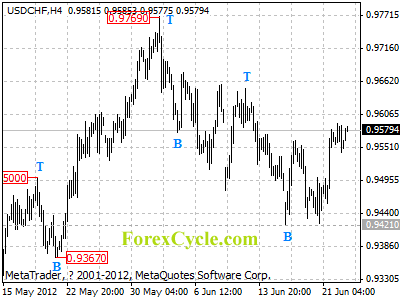
USDCHF is facing 0.9600 resistance

USDCHF is facing 0.9600 resistance, as long as this level holds, the bounce from 0.9421 could be treated as consolidation of the downtrend from 0.9769, and another fall to 0.9300 is still possible after consolidation. However, a break above 0.9600 resistance will indicate that the fall from 0.9769 has completed at 0.9421 already, and the longer term uptrend from 0.8931 (Feb 24 low) has resumed, then another rise towards 1.0000 could be seen.

usdchf

Forex Signals