Market Review 26.6.12

Source: ForexYard

printprofile

The euro fell close to a two-week low against the US dollar during the overnight session, as investors remain doubtful that a summit of EU leaders later this week will produce any meaningful solutions to the euro-zone debt crisis. Furthermore, the EUR/JPY fell close to 40 pips last night, and is currently trading at 99.51. Crude oil also resumed its bearish trend dropping close to 60 cents. The commodity is currently trading at $78.80 a barrel.

Main News for Today

US CB Consumer Confidence Figure-14:00 GMT

• While the dollar has seen substantial gains against currencies like the euro and Swiss franc lately, it has fallen against the Japanese yen
• If today’s news comes in above the forecasted level of 63.8, it may help the dollar recover some of its recent losses against the JPY
• Should today’s news come in below the expected level, the dollar could take additional losses against the JPY

Read more forex news on our forex blog

Forex Market Analysis provided by ForexYard.

© 2006 by FxYard Ltd

Disclaimer: Trading Foreign Exchange carries a high level of risk and may not be suitable for all investors. There is a possibility that you could sustain a loss of all of your investment and therefore you should not invest money that you cannot afford to lose. You should be aware of all the risks associated with Foreign Exchange trading.

Three Reasons Why Silver Could Take Off in 2012

By MoneyMorning.com.au

It’s hard to believe that we’re almost halfway through 2012.

There was one metal that I have expected big things from this year.

But so far…its investors are not sitting on any gains at all.

After soaring nearly 40% in the first few months of the year, silver then steadily gave back all these gains over the following 4 months.

It’s famous for this kind of volatility.

And at the current knocked-down price, it’s the perfect time to look at this metal again…

A quick look at the five-year silver chart shows you the kind of ups and downs the price has endured.

Silver – the ‘rodeo bull’ of precious metals

Silver - the 'rodeo bull' of precious metals
Click here to enlarge

Source: Slipstream Trader

The silver price has come back to the US$27.50 level again in the last few weeks. The good news is that silver has found support around here many times in the last 18 months.

However, our technical guru, Slipstream Trader Murray Dawes, reckons we may see the silver price test this level, with the chance of silver dipping to the low 20′s in the process.

If this were to play out, then the fall in silver would be comparable to the fall in silver during the GFC, when the price more than halved. But don’t forget after that silver then gained 400% over the following 2.5 years.

No Friends for Silver

Silver has fallen out of the spotlight recently. According to Google Trends the volume of media coverage and internet searches are at new lows.

Speculators are out of the market as well. The net non-commercial (trader) silver positions on Comex are nearly as low as they were back in December 2011. When the levels fall this low, it tells you that the speculators have been squeezed out of the market and moved onto other pastures. And last time this happened, it marked the start of that 40% rally we saw in the first few months of this year.

This makes it the perfect time to take another look at silver.

And there are three things to watch for in the second half of the year, which could help silver turn around…

Good News for Silver

The big one is the possibility of more Quantitative Easing (QE) from the US Federal Reserve.

The Fed has hinted that they are still ready to deploy QE3 if the economy needs it. The main indicator Bernanke seems to watch is the flow of new jobs: The ‘non-farm payroll’ (NFP). The pace of new job creation has decelerated so badly that the unemployment rate is creeping back UP again.

We get the next instalment of the NFP numbers next Friday night (July 6th). If it looks like the trend for new job growth is still falling, the chances of the Fed stepping in with QE3 increases.

This matters to silver as it tends to rally strongly on QE – much more so than gold.

During QE1, silver almost doubled in price. Then during QE2 silver rose by around 40%. Should we get a third round, then I would be surprised if silver didn’t rally again.

Industrial Demand for Silver to Increase

Silver isn’t just an investors metal – a lot of it is used by industry too.

The silver institute estimated about 486.5 million ounces of silver is used for industrial applications. That’s out of a total 1,040 million ounces of total supply – so industry uses 46.7% of total supply. That’s nearly half.

Production of photovoltaic cells for solar energy is a big part of this industrial demand.

But very quietly, solar energy has started to take off in a big way.

Solar energy – parabolic increases in power production

Solar energy - parabolic increases in power production

Source: gregor.us

Energy production from solar is still a miniscule amount of the global mix. It’s still less than 1%.

But my point here is that it’s rising fast. By the above estimates, it jumped 92% over the previous year.

CPM Group’s analysts reckon that each Megawatt Hour of solar panel production uses 2,000 ounces of silver. In that case, a jump of this size would generate an additional 57 million ounces of silver.

This kind of significant increase can make the difference between a silver market in surplus…and a silver market in deficit.

The world of solar energy is a complex one. I’m not game enough to say that this strong trend in growing solar power production will keep going exponentially. But seeing as we have seen ten years of consistent growth, it’s a brave man who says that the demands on the silver market from solar will ease any time soon.

Indians Switching from Gold to Silver

Aside from that, there is something happening in the gold market that may give silver demand an unexpected extra boost.

India has long been the biggest importer of gold, as well as silver.

But this year, India’s gold imports have fallen dramatically – as the Indian gold price is just too high for most buyers. The main reason for this is a falling Rupee, and also a new 4% import tax in India.

But silver is still affordable, and so Indian demand for silver is getting stronger. Mineweb reported last week that:

‘The high price of gold, however, has many investors betting on silver. “People’s appetite for investing in the white metal has sky-rocketed lately, with most consumers coming in and picking up silver coins in double digits,” said Sonamull Shah, bullion trader.

‘An official at Nakoda Bullion added, “Coin sales are picking up here. Compared to the last two months, sales are showing good recovery, since all those who cannot afford gold are now buying silver.”’

So silver may be going through the doldrums right now. There is little press, hardly any trading, and the price has come fallen dramatically in the last 15 months.

But all this makes it the perfect time to take another look at it.

And don’t forget over the last 10 years, silver has gained an average of 22% per year. Its best runs have always come after a long slow patch like the one that – if I’m reading it right – is drawing to a close now.

Dr. Alex Cowie
Editor, Diggers & Drillers

Related Articles

Market Pullback Exposes Five Stocks to Buy

Why More QE Is Coming

Bullish Gold Indicator at Five-Year Low Signals Time to Buy


Three Reasons Why Silver Could Take Off in 2012

How a Crude Oil Price Slump Could Bury These Countries

By MoneyMorning.com.au

As crude oil prices fall far below $100 a barrel, the trend is affecting the most oil-dependent economies in the world.

You see, whether we’re talking about a country or a company, having a “competitive advantage” is one of the most important principles involved in succeeding in business.

Just like a company, a country does not want its competitive advantage to diminish as it protects its financial viability and economic future.

But this is exactly what’s happening with Saudi Arabia and other Middle Eastern oil exporting nations.

Let me explain.

Decades of Oil Pricing Power

The competitive advantage for Saudi Arabia has always been its pricing power with crude oil. Plain and simple: Saudi Arabia could always produce oil cheaper than anyone else.

How cheaply can Saudi Arabia produce oil? When asked in December 2008 by “60 Minutes” correspondent Lesley Stahl how much this cost Saudi Arabia, Oil Minister Ali al-Naimi replied, “Probably less than $2 to produce a barrel.”

Pricing power such as this is the most imposing economic moat that exists. It can drive competitors out of business or even deter them from entering the market.

Tremendous power goes along with pricing control, be it a company or a country or a cartel such as OPEC (Organization of Petroleum Exporting Countries).

As demonstrated first in October 1972 in the first Arab oil embargo, and then with the second in 1979, Middle Eastern petroleum exporting nations could send the United States and the world into a deep recession by acting to increase oil prices.

Indeed, just the rumour of conflict in the Middle East can send oil prices skyward, as happened last year with Iran and its threats to close the Strait of Hormuz to oil tankers.

Ironically, it has been regional conflict that has resulted in Saudi Arabia and other Middle Eastern nations abdicating their pricing power and losing their economic moat.

Due to the Arab Spring and revolts in Middle Eastern countries such as Egypt, Libya and now Syria, Saudi Arabia and others have implemented a wide series of expansive domestic spending programs.

These programs are designed to placate their people and prevent an Arab Spring-type uprising.

“The Saudis need to spend more money to keep their citizens quiet and prevent protests,” Carsten Fritsch, oil analyst at Commerzbank, told the Financial Times.

Initiatives such as these are very expensive and explode in cost over time. In fact, in a FT article this year, Saudi Oil Minister Ali al-Naimi stated that to fund these programs, Saudi Arabia would have to keep oil prices around $100 a barrel.

That’s a problem seeing as oil keeps slipping farther away from the triple digits.

According to a June 25 Reuters report, Saudi Arabia has built up a revenue surplus to withstand lower oil prices. The country plans to maintain its oil output numbers despite the lower crude prices.

But Russia and Iran may be in more trouble. Reuters reported both Moscow and Tehran need crude at $115 a barrel to meet budget requirements.

“Russia’s economy is vulnerable to a sharp drop in oil prices,” U.S. oil analyst Phil Verleger told Reuters. “The Saudis may be able to exploit that vulnerability by keeping production at 10 million barrels per day.”

These countries face another threat to high oil prices and pricing power: fracking.

How Fracking Challenges High Crude Oil Prices

As a result of fracking, North America is now the biggest oil producing region in the world. Ironically, if oil prices had not been so high, fracking would not be economically feasible.

Due to fracking, the cost of natural gas has fallen so much that it is now replacing oil in a number of uses.

This is easily seen in the price trajectories for the main exchange-traded funds for oil, United States Oil (NYSE: USO), and natural gas, United States Natural Gas (NYSE: UNG).

Now trading around $29.50, United States Oil is down more than 20% for 2012.

Over the same period, United States Natural Gas has fallen more than 30% to around $18 a share.

The Saudi stock market, the Tadawul All Share Index (SASEIDX), has also declined to year lows in recent trading.

Fracking has opened up both new and existing fields for greater production of oil and natural gas, both in the United States and abroad. This will only increase tremendously as the technology becomes more effective and efficient.

The changing energy environment will limit the control Saudi Arabia and other Middle Eastern countries have over crude oil prices, forever altering the region’s revenue stream.

Jonathan Yates
Contributing Writer, Money Morning

Publisher’s Note: This article originally appeared in Money Morning (USA)

From the Archives…

Fortescue’s Fight Against the State
2012-06-22 – Kris Sayce

Don’t Let the Fed Fool You, This Isn’t the Time to Abandon the Market
2012-06-21 – Kris Sayce

An Addicted Stock Market About to Suffer Withdrawals
2012-06-20 – Murray Dawes

Why Liquefied Natural Gas Makes Australia The Next Energy Hotbed
2012-06-19 – Don Miller

Why Greece is Just a Side-Show to the Economies of Spain and Italy
2012-06-18 – Dr. Alex Cowie


How a Crude Oil Price Slump Could Bury These Countries

How Underwater Mining Could Lead The Next Gold Rush

By MoneyMorning.com.au

The next real gold rush won’t be on a far flung asteroid. It will be under the sea.

In fact, The Wall Street Journal said earlier this month that underwater mining could be a $500 trillion business someday.

That means underwater mining stocks, which are cheap now, could be headed for monster gains.


Scientists now project there are over 10 million tons of gold to be found by sifting through the seas – but don’t go out with your shovel and sifter. Most of the gold is buried under a mile of water.

And that is just the gold.

Underwater mining companies also hope to extract copper, nickel, ore, silver, zinc, and even rare earth metals.

So for those of you who are worried that the earth will run out of these minerals, underwater mining should calm your fears.

“It’s unimaginable to think we’ll need to rely on asteroids from space to supply the Earth with metals,” Scott McLean, chief executive of Ontario-based mining company HTX Minerals Corp., told The Journal. He said the idea is “interesting, it is visionary to think about these things,” but he concludes: “The Earth’s mineral bounty is immense, and it will continue to provide for millennia.”

Underwater Mining: Tapping the Unknown

There is very little that is known about what exactly lies at the bottom of the ocean and how much of it there is. Yet engineers and scientists are coming up with newer ways to find out what is hidden below and how to extract those resources.

Last year scientists from the University of Tokyo discovered an estimated 80 billion to 100 billion metric tons of rare-earth deposits in the Pacific Ocean, or almost a thousand times more than current proven recoverable onshore rare-earth reserves, as estimated by the U.S. Geological Survey.

And the interest in underwater mining is booming on a global scale.

Over the last year, the International Seabed Authority, an independent body set up by the United Nations to control mining in international waters, signed four new contracts with groups interested in exploring the ocean floor, says Adam Cook, an ISA marine biologist.

That is a jump from the eight contracts previously, six of which were signed over 12 years ago, Cook said. The new contracts include agreements with state and private organizations from Japan, Korea, Russia and China.

Previously, underwater mining was too expensive and beyond our technologies to see to fruition. But recent advances in robotics, underwater drilling, computer mapping, and record high commodity prices now make underwater mining an attractive possibility.

Ben Gersten
Associate Editor, Money Morning

Publisher’s Note: This is an edited version of an article that first appeared in Money Morning (USA)

From the Archives…

Fortescue’s Fight Against the State
2012-06-22 – Kris Sayce

Don’t Let the Fed Fool You, This Isn’t the Time to Abandon the Market
2012-06-21 – Kris Sayce

An Addicted Stock Market About to Suffer Withdrawals
2012-06-20 – Murray Dawes

Why Liquefied Natural Gas Makes Australia The Next Energy Hotbed
2012-06-19 – Don Miller

Why Greece is Just a Side-Show to the Economies of Spain and Italy
2012-06-18 – Dr. Alex Cowie


How Underwater Mining Could Lead The Next Gold Rush

Central Bank News Link List – June 26, 2012

By Central Bank News

    Here’s today’s Central Bank News link list, click through if you missed the previous central bank news link list. The list is updated during the day with the latest news about central banks so readers don’t miss any important developments.

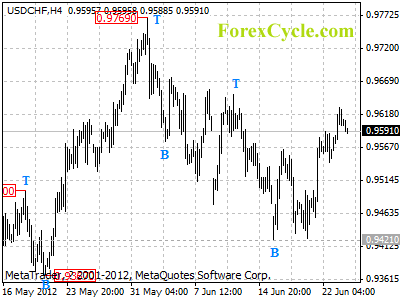
USDCHF breaks above 0.9600 resistance

USDCHF breaks above 0.9600 resistance, and reaches as high as 0.9628, suggesting that the downtrend from 0.9769 has completed at 0.9421 already. The pair is now in uptrend from 0.9421, further rise could be expected, and next target would be at 0.9700 area. Support is at 0.9540, only break below this level will indicate that consolidation of the uptrend is underway, then pullback to 0.9500 level could be seen.

usdchf

Daily Forex Forecast

Too much finance can suffocate a country – BIS economist

By Central Bank News

    Like cancer, a nation’s financial sector can grow so large that it starts to devour its host, according to the chief economist of the respected Bank for International Settlements (BIS).
    “Beyond a certain point, financial development is bad for an economy. Instead of supplying the oxygen that the real economy needs for healthy growth, it sucks the air out of the system and starts to slowly suffocate it,” said Stephen Cecchetti, chief economic adviser to the BIS, known as the central bankers’ bank.
    “Households and firms end up with too much debt. And valuable resources are wasted.”

    In his remarks, which were made to a BIS conference in Switzerland last week, Cecchetti not only questioned the benefit to societies from a large financial sector, but he also questioned financial globalization: the trend of some countries to rely on other countries for financial services.
    Cecchetti’s speech to central bankers at the conference would seem to fly in the face of the widely-accepted beliefs among economists that globalization always benefits societies and a growing financial sector is a sign of progress.
    “Many of us have started to ask if finance has a dark side,” he said, pointing to the ongoing detrimental effects on economies from the global financial crises.
    Evidence suggests, Cecchetti said, that a growing share of the financial system actually slows overall economic growth and countries can become vulnerable by either specializing excessively on finance or relying too much on other countries to provide such services.
    “Has financial globalisation gone too far in some countries?” Cecchetti asked.
    
    Click to read “Is Globalisation Great?” by Stephen Cecchetti

 
    www.CentralBankNews.info

Philip Morris International: A Dividend Stock Best Avoided

By The Sizemore Letter

Nothing is more detrimental to the long-term viability of an investment theme than its own success.  In the often circular logic that defines the market, profitable trades can only remain so as long as they are unpopular.  Once they are embraced by the investing public, prices have generally risen to a point that would make the trade unattractive to its original value-focused adherents.

It is thus with great sadness that I must recommend readers sell their shares of Philip Morris International (NYSE: $PM).  At current prices, this is a dividend stock best avoided.

When Altria (NYSE:$MO) spun off its international tobacco businesses and formed Philip Morris International in 2008, it was about as close as you could get to the perfect stock.  You had all of the standard bullish arguments for tobacco—recession-resistant demand, an addicted customer base, low marketing costs, high cash flows, etc.—but without the threat of crippling lawsuits from the U.S. tort system.

Philip Morris International was also uniquely positioned to take advantage of rising incomes in the developed world.  As consumers in key emerging markets such as China traded up from lower-quality domestic brands, the maker of Marlboro was uniquely positioned to benefit, and still is.

And finally—and perhaps most importantly—Philip Morris International was a dividend-producing powerhouse at a time when decent yields were hard to come by. 

It was the convergence of all of my favorite investment themes in one stock: a high-dividend sin stock with emerging market growth and brand cachet!

But no matter how great an investment looks, your long-term success is ultimately dependent on the price you pay.  And the reason that tobacco stocks have been such great wealth-creation vehicles in recent decades is because they have been perpetually priced as high-dividend value stocks (see “The Price of Sin”).

Let’s face it.  Tobacco is not a growth industry, not even in most emerging markets.  While smoking remains popular in many, market penetration hit the high-water mark a long time ago.  And as health awareness rises with incomes, the best the industry can hope for is gentle decline.

Knowing this, long-term investors tend to by tobacco stocks for one and only reason—the high dividends they offer.

Yet consider how Philip Morris International’s dividend stacks up with other consumer-oriented companies with large footprints in emerging markets.

Company

Ticker

Dividend Yield

Forward P/E

Johnson & Johnson

JNJ

3.7%

12.1

Philip Morris International

PM

3.6%

14.8

Procter & Gamble

PG

3.8%

15.1

Unilever

UL

3.9%

13.7

 At current prices, investors can get a higher dividend yield in Johnson & Johnson (NYSE:$JNJ), Procter & Gamble (NYSE:$PG) and Unilever (NYSE:$UL), and Philip Morris International trades at a higher P/E ratio than all but Procter & Gamble.  And while each of these three examples has had its share of problems in recent years, the longer-term prospects for all are vastly superior to those for Philip Morris International.

Let me put it to you like this: 50 years from now, I suspect that Philip Morris International will still be selling plenty of cigarettes.  But I’m betting that Johnson & Johnson, Procter & Gamble, and Unilever are selling a lot more Band-Aids, razor blades, and shower gel, respectively.  I’m grossly oversimplifying the businesses of all three of these companies, but my point stands: Philip Morris International is only attractive if it is priced at a significant discount to mainstream consumer products companies like the ones mentioned in this article.

This condition does not hold today, which is why I must regrettably make Philip Morris International a “sell.” 

Investors looking for income these days still have plenty of decent options, even if reliable choices from years past are no longer as attractive as they might been.  Many oil and gas master limited partnerships offer attractive yields, as do select specialty REITs.  Telecom and utilities stocks are also attractive.  But at current prices, investors might find Philip Morris International’s stock as dangerous as its products.

Disclosures: Sizemore Capital is long MO, PG, JNJ and UL

If you liked this article, consider getting Sizemore Insights via E-mail.

No related posts.

(VIDEO) Is Natural Gas the Next Big Thing?

By Elliott Wave International

Natural gas rallied 40% in the last two months. Is the cleaner alternative to crude oil braced for another big move to the upside?

EWI’s Senior Analyst Jeffrey Kennedy joins Yahoo! Finance Breakout host Jeff Macke to offer his take on what’s in store for the market that has plagued long-term investors since falling over 80% from its 2005 highs. Kennedy takes viewers through the technicals and offers his long- and short-term forecasts for the market.

Enjoy the interview that was originally recorded on June 19, 2012.


Get 6 Free Lessons to Help You Find Trading Opportunities in Any Market
In this FREE report from Elliott Wave International, Senior Analyst Jeffrey Kennedy presents 6 different lessons that you can apply to your charts immediately. Learn how to spot and act on trading opportunities in the markets you follow.
Get Your Free Trading Lessons Now >>
This article was syndicated by Elliott Wave International and was originally published under the headline (VIDEO) Is Natural Gas the Next Big Thing?. EWI is the world’s largest market forecasting firm. Its staff of full-time analysts led by Chartered Market Technician Robert Prechter provides 24-hour-a-day market analysis to institutional and private investors around the world.

Bank of Israel cuts policy rate 25 bps to 2.25%

By Central Bank News

   The Bank of Israelcut its interest rate by 25 basis points to 2.25 percent to help ward off any negative effects on the economy from developments in Europe. A decline in inflation to below the center of the bank’s target range gave the bank room to cut, the bank said, adding the rate cut was expected by most forecasters.
    “The interest rate reduction will contribute to strengthening the Israeli economy’s ability to deal with the impact of potential negative consequences from the global economy,” the bank said in a statement.

    The bank also said that the future path of interest rates depends on “developments in the inflation environment, growth in Israel, the global economy, monetary policies of major central banks, and developments in the exchange rate of the shekel.”
    “The level of economic risk in the world due to developments in Europe remained high, and with it the concern of negative effects on the domestic economy,” the bank said.
    The Israeli inflation rate was unchanged in May, below forecasts, mainly due to a drop in food prices, and inflation forecast have now been cut. The rate of inflation over the previous 12 months fell to 1.6 percent, below the center of the bank’s target range of 1-3 percent, the bank said.
    The Israeli central bank last changed its rates in February, when it cut by 25 basis points, citing a slowdown in economic activity, both in exports and domestic demand.
    It said then that it expected the slowdown to continue against the backdrop on weakness in the global economy, primarily from Europe, where data showed the euro zone would slip into recession this year.
    Interest rates in Israel have been on a declining path since the fourth quarter of 2011 when the central bank wanted to counter a slowing economy amid growing concern over the financial crises in Europe. Inflation was also moderating, giving the bank room to ease rates.
    Interest rates were cut by 25 basis points in both October and December, 2011, ending at 2.75 percent at year-end. Rates were the cut to their current level in February and have been maintained since then.
  
www.CentralBankNews.info