‘Big Wednesday’ For the Aussie Dollar

By MoneyMorning.com.au

The Aussie dollar isn’t following the script at all.

A ‘risk currency’ like the Aussie should tank when the world is going to hell in a hand-basket.

Australia has the 16th largest economy in the world. Yet the Australian dollar is the 5th most traded currency globally.

A big reason why it punches above its weight on the foreign exchange markets is that traders use it as a proxy for China exposure.

But now that China’s economy is decelerating fast, why hasn’t the Aussie dollar fallen further?

Even stranger is the divergence between the Aussie dollar and commodity prices. The two are normally locked in an embrace – but are now trending in opposite directions.

Where the Aussie Dollar Could Be Heading Next

What’s happening? For the answer, this morning I spoke to our technical trading guru, Slipstream Trader Murray Dawes…

Part of Murray’s trading success is that he looks at all markets, not just stock markets. That means identifying currency trends plays a big part in his analysis.

And because currency markets often set the stage for the stock markets, I asked Murray for his take on the Aussie dollar, and where he sees it going next.

Slipstream Trader’s view of the Aussie Dollar

Slipstream Trader's view of the Aussie Dollar
Click here to enlarge

Source: Slipstream Trader


I asked him to explain the relationship between the Aussie dollar and commodity prices (see chart above):

‘The Aussie dollar has had a good bounce since the start of June 2012, rallying from US$0.96 to US$1.02. I remain sceptical that the rally will continue from here. Look at the chart and you can see the AUDUSD [the Aussie dollar to US dollar] chart with the CCI (Continuous Commodity Index) laid over the top. It’s quite clear that there is a very high correlation between the movements in commodities and the Aussie dollar. The interesting thing to note over the past month is the increasing divergence between the Aussie dollar and commodity prices. i.e. the rally in the Aussie dollar has not been confirmed by a rise in the CCI.

‘My reading of this would be that most of the buying in the Aussie is probably short covering as well as money finding its way here from Europe and into our bond market. Ultimately the correlation to commodities will reassert itself, and I would expect to see the Aussie fall towards the CCI on the chart.

‘Also notice that the rally in the AUDUSD has been rejected from the 50% retracement of the sell-off from early this year. The one bullish sign is that the 10 day moving average has crossed above the 35 day moving average. That is my definition of an intermediate uptrend. Until we see that signal move back into an intermediate downtrend I will be wary of the buying pressure, but once it does turn back down I will be happy to have a target of US$0.94c on the next move down, which is the low from October last year.’

A Big Call On the Aussie Dollar Going Down

The Aussie dollar is trading at $1.004 this morning, so a fall to 94c would mean a fall of just over 6% from this level. A move of that size is huge when you’re talking about a currency.

This is just Murray’s first target of course. He’ll update his readers on what he expects to happen next.

Some analysts reckon there could be much more in store. Andy Xie, who was the chief economist for Asia Pacific for Morgan Stanley, is calling the Aussie dollar to fall by 30%. Xie is no stranger to controversy, and likes to call a spade a spade. In 2006 he became infamous for saying the following:

‘Actually, Singapore’s success came mostly from being the money laundering center for corrupt Indonesian businessmen and government officials … Indonesia has no money. So Singapore isn’t doing well.’

He may be right, but that comment cost him his job. But with regard to the Aussie dollar, Xie now sees it losing 30%, taking it to around 70 cents over the next 12 months or so.

The reasons being that commodity prices will keep sliding, and foreign investors will pull out of the country. Also, Australia’s net foreign debt is around half the GDP. That’s one of the highest levels globally. The result being that the Aussie dollar will need to be devalued.

So What’s Keeping the Aussie dollar from Falling?

For now anyway, it’s the sheer volume of overseas money heading for one of the few remaining ‘safe havens’. By this I mean Australia still has an ‘AAA’ rating.

The Aussie dollar is also one of the few still giving a positive real yield. For example, the Australian 10-year bond yield is 2.96%. The inflation rate is 1.6%.

So the real yield on a 10-year is 1.36%.

That’s hardly the most exciting return in the history of finance…but amazingly, in a world full of negative real yields, 1.36% is all it takes to be the prettiest girl at the dance these days.

This ‘opportunity’ has caught the attention of central bankers who have the job of diversifying their currency holdings. With the euro on the nose, along with most other currencies, the Aussie dollar is the new favourite.

Apparently the Russian and Czech central banks have been piling in, and now Germany is getting in on the act.

They must be very confident on the long term prospects of the Aussie dollar, because it only needs to fall by 1.36% for the capital loss to wipe-out the paltry yield on the bond.

The 10-year Aussie bond yield has fallen from 5% to 2.9% in the last year. With a continuation of this trend, and further interest rate cuts, the positive real yield probably won’t be around forever.

So I’m not sure we can count on this foreign buying support indefinitely. When it dries up, we should see the Aussie dollar come back to earth and catch up with the low commodity prices. Just as Murray predicts.

What will this mean for stock prices? If Murray is right, it could mean more pain. And he’s positioning his traders to take advantage of this kind of move.

He’s calling this his ‘Big Wednesday’. To find out more, click here…

Dr. Alex Cowie
Editor, Diggers & Drillers

Related Articles

Market Pullback Exposes Five Stocks to Buy

Three Reasons Why Silver Could Take Off in 2012

Bullish Gold Indicator at Five-Year Low Signals Time to Buy

‘Big Wednesday’ For the Aussie Dollar

Disruptive Technologies: Accepting Change to Avoid ‘Disruptive Ignorance’

By MoneyMorning.com.au

Ed Note: This article is adapted from an Australian Small-Cap Investigator weekly update from April 2011.

The natural world and the business world are both competitive places. But it’s not just the strong that survive. It’s the most adaptive.

You have to be able to respond to changes in your operating environment – whether it’s a jungle or the software industry – faster and better than your competition.

Those businesses that are most efficient and offer the products and services demanded by consumers, survive, grow, and replicate (think franchises). Businesses that ignore changing consumer demands or simply fail to meet them as well as their competitors will perish.


On another subject, I picked up a copy of MIS magazine this week. MIS stands for Managing Information Strategies. It’s an IT magazine.

I’d flicked through it at the newsstand and noticed an article on cloud computing, so I bought it.

Turns out, the article wasn’t worth the few dollars we’d shelled out for the mag. But another article was.

It’s titled “Disruptive Influence”, and as the subhead states, the writer “looks at new business models and how old business is adapting.”

A better title would have been, “Disruptive Ignorance”. Because judging by the first few paragraphs, some businesses aren’t adapting very well at all:

“Dymocks was among the first bookshops in Australia to begin offering e-book downloads four years ago. He predicted then that by 2015, e-book sales would be about 5 per cent of all books they sell. So far they have only made it to 1 per cent.”

Now compare that to a recent announcement from online book seller, Amazon.com:

“Amazon.com is now selling more Kindle books than paperback books. Since the beginning of the year, for every 100 paperback books Amazon has sold, the Company has sold 115 Kindle books.”

In other words, 53.5% of the books sold by Amazon are e-books… yet Australia’s Dymocks is at 1 per cent.

Dymocks is clearly stuck in the past. Refusing to believe the online revolution is anything to get excited about.

MIS writes:

“[CEO, Don] Grover from Dymocks does not believe buying books online is going to replace physical stores any time soon because people still value the experience of shopping as well as the actual feel of books.”

The article then directly quotes Mr. Grover:

“Stores are a social network. They were the first social network. We all of a sudden say Facebook is social networking – it is not the first.”

I’m sorry, but someone is clutching at straws. Bookshops as a social network? We don’t think so. Although it’s not the first time we’ve heard a bookseller try to claim that. It may be the case for small independent, owner-operated bookshops (even then we’re not convinced), but it’s definitely not the case for chain stores.

Besides, let’s remind ourselves of Amazon’s numbers again… 53.5% of the books it sells are e-books. And Dymocks? That’s right… 1%.

And perhaps Mr. Grover should check out some stories from the US. Such as this report from Daily Campus:

“USA Today reported that Barnes & Noble has already closed all of its 798 B. Dalton mall outlet stores…”

B. Dalton was a US bookstore first opened in 1966 and reached 798 stores at its peak. Today it has none. It doesn’t exist.

Obviously US book retailer Barnes & Noble isn’t convinced about the “social network” of book stores. Or even if they believe it, they clearly didn’t make any money from it.

And has Mr. Grover forgotten about Borders and Angus & Robertson? There’s only so much that can be blamed on bad management for the death of those two retail chains.

The fact is, traditional booksellers are reluctant to change. They’ve invested so much in their way of business – stores, staff, service, etc., they just can’t imagine anyone wanting to buy a book online, least of all an e-book.

It’s got the same ring as the saying attributed to Warner Brothers founder, Harry M. Warner in 1927, just as talking films were hitting the screens:

“Who the hell wants to hear actors talk?”

Millions did. And thankfully for Warner Brothers, Harry M. Warner and his chums figured it out quickly.

But that’s the way disruptive technologies work. The title of the MIS article tips a hat to disruptive technologies – something I mentioned in the March issue of Australian Small-Cap Investigator.

Even in the face of facts and a clear trend, many established businesses refuse to accept change. They just can’t picture it in their mind. I mean, books, everyone likes books. They look great on a bookshelf, and it’s satisfying closing a book shut when you’ve finished it.

“Who the hell wants to read a book on a small computer screen?”

Millions do!

But… let’s be serious. You heard the same story not so long ago when compact discs replaced vinyl records. How’s the vinyl industry doing these days?

Fortunately, record stores didn’t fight the change. They adapted and moved on. If booksellers don’t adapt their business models they won’t be so lucky.

The way I see it, if Dymocks’ goal is to increase e-book sales to just 5% in the next four years, odds are it won’t make it… simply because the receivers and liquidators will have been called in long before then.

Kris Sayce
Editor, Australian Small-Cap Investigator

From the Archives…

Fortescue’s Fight Against the State
2012-06-22 – Kris Sayce

Don’t Let the Fed Fool You, This Isn’t the Time to Abandon the Market
2012-06-21 – Kris Sayce

An Addicted Stock Market About to Suffer Withdrawals
2012-06-20 – Murray Dawes

Why Liquefied Natural Gas Makes Australia The Next Energy Hotbed
2012-06-19 – Don Miller

Why Greece is Just a Side-Show to the Economies of Spain and Italy
2012-06-18 – Dr. Alex Cowie


Disruptive Technologies: Accepting Change to Avoid ‘Disruptive Ignorance’

Why Cyprus Has Put its Hand Up For a Bailout

By MoneyMorning.com.au

Shortly after word came that Spain had formally requested a bailout package for its ailing banks, Cyprus chimed in and also asked for aid.

The Mediterranean country has become the fifth Eurozone nation to hold out its hand for an international rescue. While the smallest of the bunch to seek relief, Cyprus highlights the European Union’s increasingly stressed resources as it wrestles with weakening economic conditions.

The aid request followed Fitch’s downgrade Monday of the island’s stressed banks to “junk” status. The credit cut means the country has lost it investment status with the trio of the largest and most influential rating agencies.

Fitch said in a statement, “Cypriot banks will require substantial injections of capital in order to secure confidence in their financial viability.”

Cyprus, saddled with Greek private sector debt, could need as much as 10 billion euros ($12 billion) in bailout funds.

“Classic contagion, “BBC‘s chief economics correspondent Hugh Pym said of Cyprus’ troubles.

Cyprus – The Latest in Line for a European Debt Bailout

Cyprus is only days away from its deadline to recapitalize Cyprus Popular Bank, the country’s second-largest lender that was largely exposed to Greek debt.

Cyprus had to raise 1.8 billion euros, or 10% of its domestic output, to meet the deadline set by European regulators.

In a statement Monday, the Cyprus government said, “The purpose of the required assistance is to contain the risks to the Cypriot economy, notably those arising from the negative spillover effects through its financial sector, due to its large exposure in the Greek economy.”

Cut off from capital markets for more than a year, Cyprus has been knocking on Russia’s door for additional support. To date, Russia has lent the financially struggling island, with a population of roughly 1 million, about 2.6 billion euros.

While Britain has mulled helping because of its significant military base on Cyprus, it has axed the idea.

“This is long overdue,” Stelios Platis, a well-known Cyprus economist, told the Financial Times. “The delay going to the EFSF (the Eurozone rescue fund) was damaging for Cyprus and the banking sector…We have to contain the spillover effect from Greece.”

The fresh requests from Spain and Cyprus will be highlighted at the June 28-29 summit of European finance ministers.

Reports have hinted that the meeting’s discussions will include a proposal for a sole European banking supervisor, closer fiscal union among the 17-member nations and a common system for guaranteeing bank deposits.

Investors are sceptical that much will be accomplished at the summit. Trading is expected to be volatile in the days ahead as concerns surround the Eurozone debt crisis and increasing bailouts.

Diane Alter
Contributing Writer, Money Morning

Publisher’s Note: This article originally appeared in Money Morning (USA)

From the Archives…

Fortescue’s Fight Against the State
2012-06-22 – Kris Sayce

Don’t Let the Fed Fool You, This Isn’t the Time to Abandon the Market
2012-06-21 – Kris Sayce

An Addicted Stock Market About to Suffer Withdrawals
2012-06-20 – Murray Dawes

Why Liquefied Natural Gas Makes Australia The Next Energy Hotbed
2012-06-19 – Don Miller

Why Greece is Just a Side-Show to the Economies of Spain and Italy
2012-06-18 – Dr. Alex Cowie


Why Cyprus Has Put its Hand Up For a Bailout

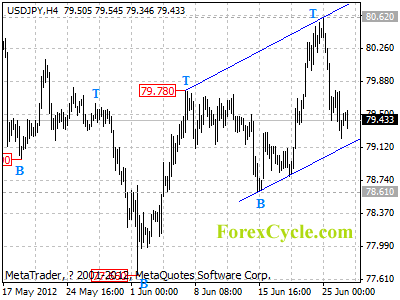
USDJPY’s fall extends to 79.23

USDJPY’s fall from 80.62 extends to as low as 79.23. Further decline towards the lower line of the price channel on 4-hour chart could be seen, a clear break below the channel support will indicate that the upward movement from 77.66 has completed at 80.62 already, then the following downward movement could bring price to 76.00-77.00 area. On the other side, as long as the channel support holds, the fall from 80.62 could be treated as consolidation of the uptrend from 77.66, and one more rise towards 83.00 is still possible.

usdjpy

Forex Signals

Global markets worries ahead of EU summit

The two-day EU summit in Brussels starting June 28 is the first meeting of European leaders since Greek parliamentary elections on June 17 that saw victories for pro-bailout parties. France and Italy are urging Germany to take decisive action to end the debt crisis, now in its third year.

The Senior Strategist Ib Fredslund Madsen expects three main subjects at the European Union summit; the future structure of the EU, the growth stimulus and thirdly there is the situation in Spain and Greece.

According to Ib Fredslund Madsen investors want to see what direction the summit’s outcome will point to. It’s very unclear what specific agreements may actually be made.

Legal information

Video courtesy of en.jyskebank.tv


“Negative Forecast” Remains for Gold, India Needs “Good Monsoon” to Boost Bullion Demand, Euro Integration Steps Outlined

London Gold Market Report
from Ben Traynor
BullionVault
Tuesday 26 June 2012, 07:45 EDT

SPOT MARKET prices to buy gold traded just above $1580 an ounce throughout Tuesday morning’s London session, up around 0.6% on last week’s close following gains the previous day.

Prices to buy silver traded in a tight range around $27.50 an ounce – 2.1% up on the week so far.
“After last week’s bearish price action it is hard to get excited about a sustained rally [for gold],” says the latest note from technical analysts at bullion bank Scotia Mocatta.

“In our opinion,” adds Commerzbank senior technical analyst Axel Rudolph, “gold has resumed its downtrend…we will retain this negative forecast while the gold price trades below the current June high at $1641.”

European stock markets meantime edged slightly higher by lunchtime in London – following losses the previous day – while commodities were broadly flat and US Treasury bonds fell, as markets continued to focus on upcoming policy discussions in Europe.

On the currency markets, the Euro struggled to stay above $1.25 this morning, having fallen from one-month highs last week.

“If the US Dollar remains strong, then gold may easily move down a little bit,” says one bullion dealer in Hong Kong.

“Sentiment in general is a bit mixed. If you have less money in your pocket, why should you buy gold? The only thing that people are buying for the time being is the US Dollar.”

The European Council – which according to its website “defines the general political direction and priorities of the European Union” – has called for “greater pooling of decision making on budgets” across the Eurozone, ahead of the EU summit which starts this Thursday and concludes Friday.

“A fully-fledged fiscal union,” it says in a report issued Monday, “would [ultimately] imply…the development at the Euro area level of a fiscal body, such as a treasury office.”

The report, which is expected to form the basis for discussions at this week’s summit, outlines “four essential building blocks” for greater European integration. As well as integrated budget setting, it calls for an “integrated financial framework” – including cross-border deposit insurance and bank resolution schemes – an “integrated economic policy framework” and stronger “democratic legitimacy and accountability”.

The report also suggests the issuance of common debt instruments such as so-called Eurobonds “could be explored…in a medium term perspective”.

“Steps towards the introduction of joint and several sovereign liabilities could be considered,” the report says, “as long as a robust framework for budgetary discipline and competitiveness is in place.”

German chancellor Angela Merkel yesterday described Eurobonds as “economically wrong and counterproductive”.

“There is now a growing suspicion that Germany is simply not ready to accept the level of debt mutualization necessary to restore confidence and keep the single currency project alive,” says Nicholas Spiro, managing director of Spiro Sovereign Strategy, a London-based consultancy specializing in sovereign credit risk.

Cyprus became the fifth Eurozone nation to apply for a bailout Monday, following a decision by ratings agency Fitch to cut the country’s credit rating to junk status. The Cypriot government aims to contain “spillover effects” from the Greek economy, to which Cypriot banks have “large exposure”, an official statement said.

Over in Athens, Greece’s new finance minister Vassilios Rapanos has resigned four days into his appointment, after he collapsed and was hospitalized Friday.

Ratings agency Moody’s meantime has downgraded 28 Spanish banks, including Santander, following its decision earlier this month to cut Spain’s sovereign rating to one notch above junk.

Over in India meantime, the Rupee continued to trade near all-time lows against the Dollar on Tuesday, despite moves a day earlier by the Reserve Bank of India aimed at boosting capital inflows, such as raising the limit for the amount of government bonds foreign investors can hold.

“These are just stop-gap arrangement,” says Sonal Varma, economist at Nomura in Mumbai.

“What has the government done to reduce the fiscal deficit and curb the current-account deficit?”

“The major issues in India,” adds Benoit Anne, managing director at Societe Generale in London, are the question marks about growth in the context of China being heavily scrutinized on the same topic, as well as the credibility of economic and financial policies.”

Raising the amount of Indian government bonds foreigners can hold “is not a guarantee that foreign investors will rush in,” Anne adds, “especially if the fundamental problems have not been addressed.”

Rupee prices to buy gold have hit a series of record highs this month, as the Indian currency has fallen against the Dollar.

“For the past two to three months, there has been virtually no gold buying in India,” says Krishna Kumar Nathani, managing director of Chennai-based consultancy Indiabullion.com.

“But if international prices were to retreat and the Dollar-Rupee holds at current levels, then I expect demand to pick up again.”

“If we have good monsoon rains,” adds Bombay Bullion Association President Prithviraj Kothari, “then gold demand could be anywhere between 750 and 800 metric tonnes this year.”

India was the world’s biggest gold buyer in 2011, with total Gold Bullion demand totaling 933.4 tonnes according to World Gold Council data. Gold demand in the first quarter of 2012 however was 207.6 tonnes, down 29% on the same period last year, with China overtaking India as the world number one for the second quarter running.

Ben Traynor
BullionVault

Gold value calculator   |   Buy gold online at live prices

Editor of Gold News, the analysis and investment research site from world-leading gold ownership service BullionVault, Ben Traynor was formerly editor of the Fleet Street Letter, the UK’s longest-running investment letter. A Cambridge economics graduate, he is a professional writer and editor with a specialist interest in monetary economics.

(c) BullionVault 2011

Please Note: This article is to inform your thinking, not lead it. Only you can decide the best place for your money, and any decision you make will put your money at risk. Information or data included here may have already been overtaken by events – and must be verified elsewhere – should you choose to act on it.


Hungary central bank keeps rate steady at 7%

By Central Bank News

    The Hungarian Central Bank left is benchmark base rate unchanged at 7.0 percent for the sixth month in a row, as forecast, saying inflation is expected to remain above its target for a “protracted period” even if the economy is first expected to expand in 2013.
    “The volatile risk environment and above-target inflation for an extended period continue to warrant a cautious policy stance,” the Monetary Council of  Magyar Nemzeti Bank said in a  statement.
    Although inflationary pressures from the economy will remain moderate, an increase in value-added-tax and duties early this year is boosting inflation. The bank said it expected the tax measures to have a temporary effect on inflation while higher production costs for firms is expected to feed through to inflation gradually and may therefore raise inflation over a longer time period.

    “But this indirect effect will be offset by falling domestic demand and slack in the labour market. Consequently, the price index is expected to fall back close to the target as the effects of increases in VAT and excise duties as well as the cost shocks wear off,” the bank said, adding:
   “The Council will consider a reduction in interest rates if Hungary’s risk premium falls persistently and substantially and the outlook for inflation improves.”


   www.CentralBankNews.info

EUR Falls Ahead of EU Summit

Source: ForexYard

The euro started the week off by extending its recent bearish trend, as investors remain doubtful that any meaningful strategy for combating the euro-zone debt crisis will be unveiled during an EU summit later in the week. The common currency took losses against its safe-haven currency rivals, including the US dollar and Japanese yen, over the course of the day. Today, in addition to any announcements out of the euro-zone, traders will want to pay attention to the US CB Consumer Confidence figure. Should it come in above the expected 64.0, the dollar could extend its gains vs. the euro.

Economic News

USD – Euro-Zone Fears Lead to Dollar Gains

The US dollar was able to benefit from its status as a safe-haven currency during trading yesterday, as investor concerns regarding the euro-zone debt crisis led to risk aversion in the marketplace. The EUR/USD fell more than 50 pips during European trading, eventually reaching as low as 1.2469. Against the Australian dollar the greenback gained close to 60 pips, eventually peaking at 0.9979 during afternoon trading. That being said, the news was not all positive for the USD. The USD/JPY fell close to 100 pips yesterday, eventually reaching 79.55 before staging a modest upward correction.

Turning to today, USD traders will want to pay attention to the US CB Consumer Confidence figure, set to be released at 14:00 GMT. American housing data came in above expectations yesterday, signaling modest growth in the US economy. If today’s news also comes in higher than the forecasted level of 64.0, the dollar may receive an additional boost against some of its higher-yielding currency rivals, including the EUR, AUD and GBP. Furthermore, any negative news out of the euro-zone could result in risk aversion, which may benefit the greenback.

EUR – Euro Resumes Bearish Movement

The euro took losses against several of its main currency rivals yesterday, as fears that the euro-zone debt crisis may be spreading, combined with doubts that leaders will be able to come up with new ways to stimulate economic growth in the region led to risk aversion in the marketplace. In addition to a 50 pip loss against the US dollar, the euro also tumbled well over 100 pips against the JPY during European trading. The EUR/JPY eventually fell as low as 99.24 during the afternoon session.

Today, traders will want to pay attention to any announcements out of the euro-zone and in particular Germany, which has recently signaled it was against different ways to solve the debt-crisis that have been offered by other countries in the region. Analysts are warning that the inability of leaders in the euro-zone to come to an agreement until now regarding the best way to combat the debt crisis, means that any agreement at an EU summit later this week is unlikely. The euro could remain under pressure until a clear plan is established to stimulate growth in the region.

Gold – Gold Range Trades ahead of EU Summit

Gold started off the week yesterday with little movement, as investors remained concerned regarding the results of an EU summit, set to take place on Thursday and Friday. While the precious metal has been used as a safe-haven asset in recent weeks, investors were reluctant to open long positions before any information out of the EU was released. Gold spent much of the day trading around the $1570 an ounce level.

Turning to today, gold traders should note that any developments out of the EU could have a dramatic effect on the precious metal. Furthermore, if US news, scheduled to be released this afternoon, comes in below expectations, investors may choose invest in gold as a safe-haven instead of the USD.

Crude Oil – Risk Aversion Leads to Losses for Oil

After staging a slight recovery to finish out last week, crude oil resumed its bearish trend yesterday as investor worries regarding the euro-zone debt crisis resulted in risk aversion. Oil once again fell below the psychologically significant $80 a barrel level, eventually reaching as low as $78.22 during the afternoon session.

Today, analysts are warning that oil could remain under pressure as long as news out of the euro-zone keeps on coming out negative. Furthermore, should today’s US CB Consumer Confidence figure come in higher than expected, the USD could see gains, which may result in oil taking additional losses during the afternoon session.

Technical News

EUR/USD

Both the Relative Strength Index and the Williams Percent Range on the weekly chart are very close to dropping into oversold territory, signaling that an upward correction could take place in the coming days. Traders will want to keep an eye on both of these indicators. Should they drop further, it may be a sign to open long positions.

GBP/USD

Long-term technical indicators show this pair range-trading, meaning that no defined trend can be predicted at this time. Traders may want to take a wait and see approach, as a clearer picture is likely to present itself in the coming days.

USD/JPY

The daily chart’s Slow Stochastic has formed a bearish cross, indicating that downward movement could occur in the near future. Additionally, the Williams Percent Range on the same chart is currently in the overbought zone. Opening short positions may be a wise choice for this pair.

USD/CHF

The weekly chart’s Williams Percent Range is approaching overbought territory, indicating that a downward correction could take place in the near future. This theory is supported by the Relative Strength Index on the same chart, which is currently near 70. Going short may be the wise choice for this pair.

The Wild Card

MSCI Taiwan

The daily chart’s Williams Percent Range has fallen into oversold territory, indicating that an upward correction could happen in the near future. Furthermore, the MACD/OsMA on the same chart has formed a bullish cross. This may be a good time for forex traders to enter into long positions, as bullish movement could occur shortly.

Forex Market Analysis provided by ForexYard.

© 2006 by FxYard Ltd

Disclaimer: Trading Foreign Exchange carries a high level of risk and may not be suitable for all investors. There is a possibility that you could sustain a loss of all of your investment and therefore you should not invest money that you cannot afford to lose. You should be aware of all the risks associated with Foreign Exchange trading.


Euro Tumbles Prior to EU Summit

By TraderVox.com

Tradervox (Dublin) – The 17-nation currency fell to almost two-week low versus the dollar on concerns the European Union leaders summit will not establish decisive measures to deal with the current debt crisis in the region. The euro remained down against the sterling pound as Spain and Italy prepare to sell bonds today despite fears that contagion will push borrowing costs higher. To add to the region’s woes, Moody’s has downgraded 28 financial institutions in Spain due to the increasing sovereign cost and real estate losses that have been experienced in the nation. There has been an increasing demand for the greenback as haven currency due to the continuing global losses of Asian Stocks.

According to Richard Grace, the Chief Currency Strategist and Head of International Economics at Commonwealth Bank of Australia, there is a high possibility of disappointing reports from the EU summit which has led him to predict a weakening euro as the weak comes to a close. He also suggested that the US dollar will remain one of the preferred safe haven currencies hence it might register another weekly gain this week. The Euro has so far depreciated from this year’s high of $1.3487 which was registered in February 24, dropping 3.4 percent against the greenback this year.

As Italy prepares to sell its two-year securities today, Spain will be trying to entice investors with its three and six-month bills. However, the 17-nation currency has continued to drop against most majors, dropping to $1.2471 the weakest since Jun 12. The euro dropped 0.4 percent against the pound to trade at 80.26 UK pence. However, the currency gained against the yen adding 0.2 percent to trade at 99.80 yen per euro. The Japanese currency dropped 0.1 percent against the dollar.

Investors are preparing for the US new home sales report which is expected to be positive for the dollar.

Disclaimer
Tradervox.com is not giving advice nor is qualified or licensed to provide financial advice. You must seek guidance from your personal advisors before acting on this information. While we try to ensure that all of the information provided on this website is kept up-to-date and accurate we accept no responsibility for any use made of the information provided. Opinions expressed at Tradervox.com are those of the individual authors and do not necessarily represent the opinion of Tradervox.com or its management. 

Article provided by TraderVox.com
Tradervox.com is a Forex News Portal that provides real-time news and analysis relating to the Currency Markets.
News and analysis are produced throughout the day by our in-house staff.
Follow us on twitter: www.twitter.com/tradervox