Unlocking the Mysteries of Bond Investing

Article by Investment U
Unlocking the Mysteries of Bond Investing

Buying many small, ultra-short bond positions in this market is the only way you won’t get crushed when rates turn back up. Avoid long-term bonds and bond funds.

Bonds are the answer to most investors’ needs, not their get-rich-quick dreams, but their real needs. So, you’d think the bond market would be doing everything possible to get these survivors of the stock market into bonds…

But they aren’t!

In fact, the bond market seems to do everything possible to keep the small investor out.

The walls, buying restrictions and ridiculous pricing structure of bonds are set up to keep the little guy out of individual bonds and in bond funds. Bond funds that have all kinds of flaws, such as hedging and very long average maturities, the implications of which most investors don’t fully understand.

But investing in bonds can have some real advantages. They’re custom made for investors who:

  • Want returns above what savings or CDs are paying.
  • Are tired of the wild fluctuations of the stock market.
  • Can’t afford any more of the losses they have incurred in the past 10 or 12 years.
  • Need more reliability and predictability in their investments.

But plenty of problems stand in the way of the novice investor who’s simply trying to buy a bond:

Lack of Exposure

Unlike most investments, there are no 24-hour television networks that have a constant flow of bond ideas. And most bond information that does exist consists of the 10-year Treasury, overnight rates and confusing quotes about rising and falling rates, treasury auctions and prices.

Frankly, the information available from all sources – The Wall Street Journal and Barron’s included – is useless! I don’t think I have ever seen a news story about an upcoming corporate bond offering, and if there was one, the offering was sold exclusively to institutions.

Lack of Information

Second, just getting to a page on an online broker’s site to buy a bond is ridiculously difficult.

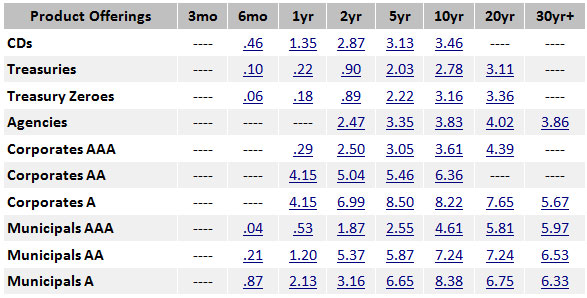
Go to any broker’s website and click on “Trade Bonds” and you’ll get something that looks like this.
Investing in Bonds

What you’re supposed to do with this chart is beyond me.

To get to any sort of usable information or the next page (which is never clearly marked), you must fill in as much information as the U.S. government wants from folks joining the military.

Here’s a partial list of the information that’s needed:

  • Cusip
  • Frequency
  • Maturity
  • Coupon
  • Yield
  • Price
  • Quantity
  • Current Yield
  • Bond
  • Bill
  • Notes
  • Zero Coupon
  • Indexed

If the average guy knew all this, he wouldn’t need a broker at all.

Even if you can come up with all the information necessary to find some bond possibilities, you usually end up with a list of thousands of bonds and no information about any of them other than their cusips and descriptions.

Lack of Access

Can you imagine having this much trouble trying to find a stock to buy? It’s absurd – but absurd by design – designed by the market to be virtually impossible.

You see, the bond market doesn’t want the small guy. They only want the big money, and they price their bonds accordingly.

If you buy 10, better yet 20 bonds or more, you have your pick of any type of bond and at the best price. But how many people have $20,000 to invest in each trade? Very few.

Try to buy five bonds or just one, and the most likely answer you’ll get from a bond desk is: “We can’t sell one bond,” or “It isn’t worth it to you to buy so few.”

Baloney! What they really mean is they don’t make enough money on a trade that small to make it worthwhile to them.

Plus, the small guy is annoying to the gods of the bond desks. The bond gods don’t like the little guy. They do annoying things like ask questions and expect the people on the bond desk to speak English, not the tree-fort, insider-only lingo they have concocted.

Better Returns Without Leveraging

The fact is you can buy one bond.

Yes, it will cost a little more and you will get a little less if you sell it before maturity. But most stockbrokers know so little about bonds, they don’t know this, either.

And fortunately, the increase in buying price isn’t so great that it makes a significant difference to the average guy. A bond desk will make the increased cost for small bond orders sound like the end of the world, but do the math and it isn’t that bad.

When you buy individual bonds instead of bond funds you can get better returns without any leveraging. Leveraging is one of the biggest unknowns to bond funds investors and it will come back to haunt them.

Buying individual bonds also allows you to buy many small positions in many different industries. This has the same effect as diversifying in your stock portfolio.

As you diversify, you also have the opportunity to spread your maturities over a much shorter range, preferably less than a seven-year average. The best part is you have control of the maturities you hold and you aren’t bound by a bond fund’s prospectus – which can cost you a lot of money when rates run up.

Buying many small, ultra-short bond positions in this market is the only way you won’t get crushed when rates turn back up. Even though we don’t expect any real uptick in rates for about three more years, you can’t risk holding long maturities (in excess of a seven-year maturity). It isn’t prudent!

The Oxford Club is a good place to begin to learn about the benefits of individual bonds. They have a list of brokers called the Pillar One Partners. Many of these brokers will buy as few as one bond and all of them have met our standard of excellence and have been a part of the Club for many years.

Bond investing can be the answer to almost all of the needs of the average person, it may take a little effort to get to the same level of comfort you feel with stocks, but it will be worth it.

Good Investing,

Steve McDonald

P.S. As I’m sure you’ve seen by now, we’ve created a new research service that aims to produce double-digit returns without touching any stocks or options. But we’ve signed up so many Investment U readers already that we have to cut off enrollment for the service at midnight tonight.

Unlike stocks, these investments tend to have a very limited inventory. So if you’re interested in learning more about my new service and how I’m doing it, click here before it’s too late.

Article by Investment U

Price of Natural Gas Strongly Shifts Upward

Article by Investment U

View the Investment U Video Archive

In focus today: Chinese liquor and African beer, a big “I told you so” on the price of natural gas with more to come, and a SITFA courtesy of a Wall Street insider.

China consumed 550 million cases of liquor last year and India 150 million cases. And their taste for the good stuff is growing in leaps and bounds as the more affluent from both countries come back from trips to the West with a taste for good liquor.

According to Thomas Russo of Gardner, Russo and Gardner, who manages about $5 billion in assets (most of it in European companies with big exposure outside Europe), the names to play to get in on this enormous market are Ricard Pernod, Diageo and Brown Foreman.

Russo said in a Barron’s article last week that Ricard Pernod has less than 1% of the Chinese market and it accounts for 15% of their earnings.

All three companies have been investing heavily in both China and India to capture a share of what promises to be a huge growth story for some time.

Brown Foremen is all about Jack Daniels. According to Russo, 25 years ago Jack Daniels sold five million cases a year in the U.S. Now it still sells five million is the U.S. and six millions cases outside of the U.S.

And if that isn’t big enough, the beer market in Sub-Saharan Africa dwarfs liquor in Asia.

Africa drinks, I hope you’re sitting down, 400 million barrels of beer a year, 400 million! Yet, only 90 million is bottled, the rest is home made.

The names Russo likes there are Heineken and SABMiller. Heineken makes 25% of its profits in Africa and SAB makes 35% of its profits there, as well. Both companies according to Russo have lots of room to grow. 310 million barrels a year of growth!

Natural Gas Runs Like Crazy

Natural gas was up 17% in one week and it looks like the excess supply in the system is finally beginning to evaporate and prices are in for a run to the $4-to-$6 area this year.

Last week natural gas numbers showed a smaller-than-expected increase in inventories, and that ignited a buying frenzy.

Pushing the run-up is the expectation that more utilities will switch to natural gas from coal and, with electric demand expected to rise 20% this year, gas futures are in play.

The number of producing gas wells has been reduced by almost a third this year alone and the expectation of a hot summer, which will add to demand for cooling and push the demand for electricity even higher, will drive prices even more.

Adding to the shift in gas sentiment is the news that natural gas could see broader use as a transportation fuel. One of the biggest roadblocks to its use in cars has been tank storage. Natural gas needs larger and heavier tanks in cars, and that poses all kinds of problems.

3M and CHK are working together to develop a natural gas storage tank for cars that will be 10% to 20% lighter than current tanks and will hold 10% to 20% more gas.

And the University of Missouri is working on a tank solution that’s made out of corncobs turned into charcoal briquettes. Early tests have been very positive.

Of course, if more gas vehicles were sold the cost would naturally come down for what has been a significantly more expensive vehicle than the conventional gasoline powered car.

All in all, the natural gas story is developing exactly as industry experts have predicted and it promises to be a huge long-term growth story.

You need to be in on this one for the long haul.

Finally, the SITFA

This week it comes to us from MarketWatch’s David Weidner, who after 15 years of covering Wall Street is leaving. His last article was called, So Long, Suckers! A real slap in the face to most of Wall Street

The final article was a collection of lessons learned while covering the money business. Some are worth noting.

First, a stock is only worth what someone is willing to pay for it.

Forget PEs, revenue, earnings and all the rest, especially technical analysis; it doesn’t work. If someone paid $10 for a stock, it’s worth $10 and no more. Ask the FB investors who got in on the IPO.

Merger and acquisitions may be necessary evils of our modern business world, but they almost never pan out. Too often they cost jobs, efficiency, eliminate competition, disrupt business and make customers miserable. Halleluiah!

Finally, on the positive side, Wall Street may be corrupt and it may reward thieves, but it’s vital to the success of this country. Every entrepreneurial effort in the history of this country and practically anything of any worth is here because someone was willing to take a risk with their money and they did it and are continuing to do it on Wall Street.

How true! But it does seem like there are more thieves there than usual.

In addition to being funny at times, this is really a worthwhile, quick read and I highly recommend it.

Article by Investment U

Iran Hunting for Dragons in the Caspian Sea

By OilPrice.com

Iran announced this week that it’s made its first oil discovery in the Caspian Sea in more than 100 years. The semiofficial Fars News Agency reports the find, in ultradeep waters, may hold the equivalent of 7 percent of the country’s known national reserves. Iran has touted its ability to continue with domestic energy production, notably in the South Pars natural gas field in the Persian Gulf, despite international sanctions targeting its energy sector. In the Caspian, however, Iran’s recent claims may put it at odds with its neighbours over their rights in disputed territorial waters.

Iranian officials reported the discovery of an oil field containing as much as 10 billion barrels of crude oil in the waters of the Caspian Sea. The find was reported at a depth of around 1.5 miles, however, and Iran seemingly has little experience with deepwater development. With Iran facing a diminishing consumer base because of European sanctions, the find, if correct, could be used as political capital by Tehran should global oil supplies constrict when international sanctions take hold later this summer. Iran insists the world needs its oil and 10 billion barrels of new oil in its pocket certainly makes for attractive bargaining.

The trouble, apart from the lack of experience in deep waters, is that the field could be situated in Azeri waters. Territorial boundaries in the Caspian Sea were never settled after the Soviet Union collapsed in the 1990s. More than twenty years on, Turkmenistan and Azerbaijan are at odds over maritime patrols near a Caspian field. A similar move by the Iranians into the waters to its north could excite regional tensions even further.

The International Energy Agency predicts Iran’s global share of oil production will likely decline during the next few years. Output has already declined by about 20 percent since 2008 to around 3.3 million barrels per day. This suggests Iran might be getting desperate as it looks for ways to prop up an economy financed in large part through natural resources.

Azerbaijan is a central player in European efforts to break Russia’s grip on the regional energy sector. British supermajor BP holds the cards in terms of natural gas with its stake in the Shah Deniz gas complex in the Caspian Sea. BP is already pumping oil from the Azeri-Chiraq-Guneshli complex, assumed to be the largest oil field in the Azeri waters of the Caspian Sea. That suggests Baku is tilting away from its former Soviet overseers and into the arms of Western allies. In 2001, Baku apparently agreed with Iran not to develop resources in the Caspian Sea until demarcation issues were settled. A decade later, however, Iran finds itself backed into a corner and flailing at whatever dragons appear ripe for the slaying.

Source: http://oilprice.com/Energy/Crude-Oil/Iran-Looking-for-Dragons-in-Caspian-Sea.html

By. Daniel Graeber of Oilprice.com


“Pressure Mounting” on Gold, But Central banks Still Adding to Reserves, Italy’s Borrowing Costs Creep Higher

London Gold Market Report
from Ben Traynor
BullionVault
Wednesday 27 June 2012, 08:15 EDT

U.S. DOLLAR gold prices dropped as low as $1565 an ounce during Wednesday morning’s London trade – 1.4% down on this week’s high – before recovering some ground by lunchtime, while stock markets posted slight gains ahead of tomorrow’s European Union summit.

Silver prices traded below $27 an ounce for most of this morning, while other industrial commodities were broadly flat on the day by lunchtime.

On the currency markets meantime, the Euro was broadly flat against the Dollar, trading just below $1.25 for most of the morning.

“We’re in a bit of a period over the summer when we are going to see very little meaningful action by policymakers in three key regions – Europe, the US and China,” reckons Daniel Brebner, head of metals research at Deutsche Bank.

“Pressures in the gold market will continue to mount…I don’t think there’s any kind of catalyst near term for a significant rebound in gold prices.”

Brebner adds however that he expects “very steady buying by central banks” to continue, which “should help gold prices from weakening too much”.

At tomorrow’s EU summit, Italian prime minister Mario Monti is expected to propose using money from Eurozone bailout funds to ease sovereign borrowing costs by buying debt on the open market, the Financial Times reports, despite the policy drawing criticism from Bundesbank president Jens Weidmann after it was put forward last week.

Weidmann described the idea as “state financing via the central bank printing press”, prompting Monti to respond that the Bundesbank chief has “badly misunderstood” the proposal.

Italy sold €9 billion of six-month bills Wednesday, at an average yield of 2.96% – up from 2.10% last month.

“Today’s bill sale points to the sovereign getting this supply away but at yield levels sufficiently elevated to leave a niggling doubt at least as to the medium-term sustainability of the country’s public finances,” says Rabobank strategist Richard McGuire.

Italy’s rise in borrowing costs follows an auction the previous day that saw 2-Year yields rise to 4.71%, their highest level since December.

Italy is due to auction €5.5 billion of 5-Year and 10-Year bonds tomorrow. On the bond markets, 10-Year bonds traded at yields as high as 6.2% Wednesday morning, up from 5.9% at the start of June.

Elsewhere in Europe, German chancellor Angela Merkel told the German parliament Wednesday
there is no “magic formula” that will solve the Eurozone crisis.

“It is imperative that we don’t promise things that we cannot deliver and that we implement what we have agreed,” said Merkel, adding that joint liability for sovereign debts “can only happen when sufficient controls are in place.”

“I don’t see total debt liability as long as I live,” German chancellor Angela Merkel reportedly told her Free Democrat coalition partners Tuesday.

Over in Madrid, the Spanish government has scrapped a tax rebate for homeowners brought in six months ago by prime minister Mariano Rajoy to meet election promises, citing its growing budget deficit.

“The deficit has started on a downward path and we expect that to intensify,” said deputy budget minister Marta Fernandez Curras Tuesday.

Here in London, Bank of England governor Mervyn King cited “worsening…in the [economic] position in Asia and other emerging markets” as a reason he voted for an additional £50 billion of quantitative easing earlier this month.

“We are in the middle of a deep crisis,” King told the Treasury Committee on Tuesday, “with enormous challenges to put our own banking system right and challenges for the rest of the world that they are struggling with.”

Proposed additional QE was defeated by five votes to four at the June Monetary Policy Committee meeting. The MPC makes its next policy announcement Thursday next week.

The central banks of Kazakhstan, Russia, Turkey and Ukraine were among those who added to their gold bullion holdings last month, according to figures published Tuesday by the International Monetary Fund.

India’s central bank meantime is considering banning the sale of gold coins by the country’s banks, according to India press reports on Wednesday.

Indian trade with Dubai meantime totaled $10 billion in the first quarter of this year – making India Dubai’s biggest trading partner ahead of China – data published by Dubai Customs show. gold bullion represented both the biggest import and biggest export for Dubai.

Ben Traynor
BullionVault

Gold value calculator   |   Buy gold online at live prices

Editor of Gold News, the analysis and investment research site from world-leading gold ownership service BullionVault, Ben Traynor was formerly editor of the Fleet Street Letter, the UK’s longest-running investment letter. A Cambridge economics graduate, he is a professional writer and editor with a specialist interest in monetary economics.

(c) BullionVault 2011

Please Note: This article is to inform your thinking, not lead it. Only you can decide the best place for your money, and any decision you make will put your money at risk. Information or data included here may have already been overtaken by events – and must be verified elsewhere – should you choose to act on it.


Central Bank News Link List – June 27, 2012

By Central Bank News

    Here’s today’s Central Bank News link list, click through if you missed the previous central bank news link list. The list is updated during the day with the latest news about central banks so readers don’t miss any important developments.

    If you want to submit links for inclusion in the daily link list, just email them through to us or post them in the comments section below.


Canadian Currency Shoots from Two-Week low

By TraderVox.com

Tradervox (Dublin) – Despite the dampening effect of the EU summit expectations, the Canadian currency managed to shoot for a while from two-week low after an advance by equities around the world advanced. The Canadian dollar started the week on a low on speculations the EU summit will not resolve the crisis in Europe which dampened demand for commodity related currencies. The demand for safe haven has continued to gain traction in the market but yesterday equity gain spurred some appetite for risk. Blake Jespersen of Bank of Montreal noted that the loonie is bound at half a cent range for this week.

Mark McCormick who is the Currency Strategist in New York at Brown Brother Harriman & Co noted that the Canadian dollar is being driven by the market sentiments as well as the developments in the euro area, hence the pending Merkel and Hollande meeting will have an impact on the currency today and the EU meeting that starts tomorrow will continue to affect the currency. He also added that the Canadian and US data are also central to the performance of this currency in the market. With the current situation in Europe and the uncertainties in the US economy, it is expected that the Bank of Canada will hold any move to hike interest rate.

The crude oil has become central in determining the Canadian dollar performance and the current fluctuations in the prices have resulted to the fluctuations in the performance in the Canadian dollar. The Canadian dollar has dropped 0.4 percent in May as a result while the euro has dropped by 1.1 percent. The greenback has increased by 0.9 percent. The Canadian dollar increased by 0.5 percent against the US dollar to trade at C$1.0238 at the close of trading yesterday in Toronto. It had fallen to C$1.0318 the previous day.

Disclaimer
Tradervox.com is not giving advice nor is qualified or licensed to provide financial advice. You must seek guidance from your personal advisors before acting on this information. While we try to ensure that all of the information provided on this website is kept up-to-date and accurate we accept no responsibility for any use made of the information provided. Opinions expressed at Tradervox.com are those of the individual authors and do not necessarily represent the opinion of Tradervox.com or its management. 

Article provided by TraderVox.com
Tradervox.com is a Forex News Portal that provides real-time news and analysis relating to the Currency Markets.
News and analysis are produced throughout the day by our in-house staff.
Follow us on twitter: www.twitter.com/tradervox

High Spanish Borrowing Costs Lead to Further EUR Losses

Source: ForexYard

The euro fell once again vs. its main currency rivals yesterday, as a sharp increase in Spanish borrowing costs combined with expectations that the upcoming EU summit will do little to combat the euro-zone debt crisis, weighed down on the common currency. Today, traders will want to pay attention to a batch of US news that has the potential to generate market volatility. The Core Durable Goods Orders at 12:30 GMT, followed by the Pending Home Sales figure at 14:00, are both expected to signal growth in the US economy, which if true, could lead to further euro losses against the USD.

Economic News

USD – Dollar Sees Additional Gains vs. EUR

The US dollar advanced further against the euro in trading yesterday, as low expectations for an upcoming summit of EU leaders in addition to general concerns regarding the global economic recovery caused investors to keep their funds with safe-haven assets. The EUR/USD fell over 70 pips during mid-day trading, reaching as low as 1.2455 before staging a slight recovery and settling at 1.2490. The greenback was not as fortunate against the JPY. The USD/JPY dropped close to 50 pips over the course of the day, eventually hitting 79.22 before bouncing back to settle around the 79.50 level.

Turning to today, dollar traders will want to pay attention to a batch of US news, including the Core Durable Goods and Pending Home Sales figures, each of which is considered an accurate gauge of overall economic health. Both indicators are forecasted to come in significantly higher than last month’s results. If true, the dollar could recoup some of its losses against the yen during the afternoon session and possibly extend its bullish trend against its higher-yielding currency rivals.

EUR – EUR Hits 4-Week Low vs. GBP

The euro tumbled to its lowest level in a month against the British pound yesterday, as rising borrowing costs in Spain and the recent news that Cyprus has requested a euro-zone bailout led to further losses for the common currency. The EUR/GBP fell over 40 pips during European trading, eventually reaching as low as 0.7983 before bouncing back to the 0.8000 level. Against the JPY, the euro dropped to a two-week low, eventually hitting 98.73 during the mid-day session.

Today, analysts are warning that the euro could see additional losses if investors remain pessimistic regarding the prospects that an EU summit later this week will lead to new ideas to stimulate growth in the euro-zone. That being said, traders will want to pay attention to the German Prelim CPI figure. As a key indicator of consumer inflation in Germany, the figure could lead to short-term gains for the euro if it comes in above the forecasted level of 0.0%.

Gold – Gold Tumbles as USD Turns Bullish

The price of gold fell during European trading yesterday, as a strengthening US dollar made the precious metal more expensive for international buyers. Gold fell close to $20 an ounce over the course of the day, eventually reaching as low as $1567.58 toward the beginning of the afternoon session.

Today, gold traders will want to monitor a batch of US news, set to be released at 12:30 and 14:00 GMT. Should the news signal growth in the US economy, the greenback could see additional gains during the afternoon session, which could cause the price of gold to fall further. In addition, if any disappointing euro-zone news is released today, the dollar could extend its bullish trend, which may lead to further losses for gold.

Crude Oil – Oil Remains Low amid Global Economic Concerns

Crude oil spent much of the European session range trading yesterday, as fears regarding the pace of the global economic recovery kept the commodity close to its recent lows. By the end of afternoon trading, crude was trading just below the $79 a barrel level

Today, oil is likely to see significant movement following the release of this week’s US inventories figure at 14:30 GMT. Analysts are forecasting that crude stockpiles in the US fell by 700,000 barrels last week, which if true, may be taken as a sign that demand for oil is going up among American consumers and cause the price of oil to go up. At the same time, the US inventories figure has consistently come in above expectations in recent weeks. Should that occur again today, oil could see further losses during the afternoon session.

Technical News

EUR/USD

Both the Relative Strength Index and the Williams Percent Range on the weekly chart are very close to dropping into oversold territory, signaling that an upward correction could take place in the coming days. Traders will want to keep an eye on both of these indicators. Should they drop further, it may be a sign to open long positions.

GBP/USD

Long-term technical indicators show this pair range-trading, meaning that no defined trend can be predicted at this time. Traders may want to take a wait and see approach, as a clearer picture is likely to present itself in the coming days.

USD/JPY

The daily chart’s Slow Stochastic has formed a bearish cross, indicating that downward movement could occur in the near future. Additionally, the Williams Percent Range on the same chart is currently in the overbought zone. Opening short positions may be a wise choice for this pair.

USD/CHF

The weekly chart’s Williams Percent Range is approaching overbought territory, indicating that a downward correction could take place in the near future. This theory is supported by the Relative Strength Index on the same chart, which is currently near 70. Going short may be the wise choice for this pair.

The Wild Card

Platinum

The daily chart’s MACD/OsMA has formed a bullish cross, indicating that an upward correction could occur in the near future. Furthermore, the Williams Percent Range on the same chart has dropped below the -80 line. Forex traders may want to open long positions ahead of a possible upward correction.

Forex Market Analysis provided by ForexYard.

© 2006 by FxYard Ltd

Disclaimer: Trading Foreign Exchange carries a high level of risk and may not be suitable for all investors. There is a possibility that you could sustain a loss of all of your investment and therefore you should not invest money that you cannot afford to lose. You should be aware of all the risks associated with Foreign Exchange trading.


Market Review 27.6.12

Source: ForexYard

printprofile

The EUR/USD came off a two-week low in overnight trading, but any gains are likely to be limited due to pessimism that the upcoming EU summit will produce any concrete solutions to the euro-zone debt crisis. The pair is currently trading at 1.2490. The price of gold fell further during the overnight session, largely due to the strengthening US dollar, which has made the precious metal more expensive for international buyers. Gold has dropped close to $18 in the last 24 hours and is currently trading at $1567 an ounce.

Main News for Today

US Core Durable Goods Orders- 12:30 GMT
• The figure is forecasted to come in well above last month’s result
• Should the news come in at or above the predicted level of 0.9%, the USD could see additional gains against the euro
• If the dollar extends its bullish trend today, commodities like crude oil and gold could fall further

US Pending Home Sales- 14:00 GMT
• Predicted to come in at 1.2%, well above last month’s -5.5%
• If true, the dollar could see gains against the JPY

Read more forex news on our forex blog

Forex Market Analysis provided by ForexYard.

© 2006 by FxYard Ltd

Disclaimer: Trading Foreign Exchange carries a high level of risk and may not be suitable for all investors. There is a possibility that you could sustain a loss of all of your investment and therefore you should not invest money that you cannot afford to lose. You should be aware of all the risks associated with Foreign Exchange trading.

Yen Gains as Merkel and Hollande Meet Prior to EU Summit

By TraderVox.com

Tradervox (Dublin) – Most economists have dismissed the EU Summit scheduled to start on Thursday claiming the meeting will not push Europe towards crisis resolution. The yen has advanced against all of its 16 major counterparts as German Chancellor Angela Merkel and French President Francois Hollande meet today before the EU Economic Summit starts tomorrow. Yen rose to one week high as low expectation from the EU Summit gripped the market increasing the demand for safe haven assets. The euro has remained down against the greenback after declining since the start of the week.

Sentiments that the yen will continue to rise as demand for safe haven currencies increase are shared by Daisuke Karakama who is a Market Economist at Mizuho Corporate Bank Ltd in Tokyo who suggested that there is nothing to expect from the summit which has spurred risk aversion in the market. Europe crisis has led to 3.6 percent decline of the region’s currency against the US dollar since the end of last year. The EU summit to be held in Brussels is the first meeting by the region’s leaders since the election in Greece. Hollande and Merkel have meet to discuss ways to handle the crisis as they have proposed two different ways to settle the crisis.

Merkel has continued to oppose the shared debt proposition supported by the French President F. Hollande. With these differing positions, economists such as MacNeil Curry have suggested that the 17-nation currency may drop to 23-month low levels. The yen advanced by 0.1 percent against the euro to exchange at 99.20 at the beginning of Tokyo trading session after it gained 0.9 percent against the currency yesterday in New York trading at 98.75. The Japanese currency increased 0.2 percent against the dollar to trade at 79.40 per dollar. The euro traded at $1.2492 after it lost 0.6 percent over the last two days.

Disclaimer
Tradervox.com is not giving advice nor is qualified or licensed to provide financial advice. You must seek guidance from your personal advisors before acting on this information. While we try to ensure that all of the information provided on this website is kept up-to-date and accurate we accept no responsibility for any use made of the information provided. Opinions expressed at Tradervox.com are those of the individual authors and do not necessarily represent the opinion of Tradervox.com or its management. 

Article provided by TraderVox.com
Tradervox.com is a Forex News Portal that provides real-time news and analysis relating to the Currency Markets.
News and analysis are produced throughout the day by our in-house staff.
Follow us on twitter: www.twitter.com/tradervox