If I May Slander My Profession…

By The Sizemore Letter

One of my favorite scenes in Martin Scorsese’s The Departed is the exchange where Jack Nicholson asks Leonardo DiCaprio what a nice kid like him was doing in the South Boston projects. “And if I can slander my own environment, it makes me sad, this regression.”

Unfortunately, I find myself asking the same question about my profession at times.  If I may slander my environment a little, it makes me sad to see people trust their financial security to the fickle whims of the stock market.  At best, it is a cold game of chance, and at worst—as the debacle of the Facebook ($FB) IPO showed—it’s a game that has been rigged against them.

To be sure, there are ways to mitigate the worst risks of stock market investing.  Never buy or sell on a “hot tip” unless you’ve done your homework first and have reason to trust the source.  Avoid microcap and penny stocks with anything other than your “play money.”  If you use an investment advisor or money manager, make sure they use a reputable third-party custodian, lest you fall victim to a Bernie Madoff-style Ponzi scheme.

Getting more into my areas of expertise, focus on dividends, though beware of chasing high dividend yields. Focusing on dividends and cash flows offers a degree of safety that a buy and hold (and pray) strategy can never offer, and you can realize a respectable cash return even in a down market.

But the best way to avoid taking unnecessary risk in the capital market is to refrain from putting your entire life savings into it.  Make sure that a significant chunk of your net worth and current income come from outside the traded markets.

This might sound like odd advice coming from a man who earns his living investing in the capital markets, but it is the only sound advice.

Think about it for a minute; what did your grandparents do?  Before the democratization of the stock market through mutual funds and 401k plans, people still invested their savings.  They still accumulated wealth, but they were more creative in how they invested it.

Let me throw out an example. My grandfather owned a small warehouse and shop floor in Fort Smith, Arkansas.  The rents generated from that property alone were sufficient to cover my grandmother’s modest retirement needs after he passed away.  He would have never left her financial security hanging on something as fragile as a 4% withdrawal rate from an index fund. (Ironically, given the theme of this article, his stock and bond portfolio ended up throwing off a lot more income than his warehouse, but he had no way to know that ahead of time.)

I’ve written before about rental houses as an investment (see “Here’s the catalyst for a housing rebound”), and I would like to reiterate that recommendation today. I know of no other legal investment that allows for both tax free current income (technically “tax deferred” for you accountants out there) and capital appreciation that will likely at least keep pace with inflation and allows you to do it all with borrowed money.

Yes, I know.  Home prices are falling.  Americans are broke.  There’s an enormous backlog of foreclosed properties that have to be worked off.  All of this is true.

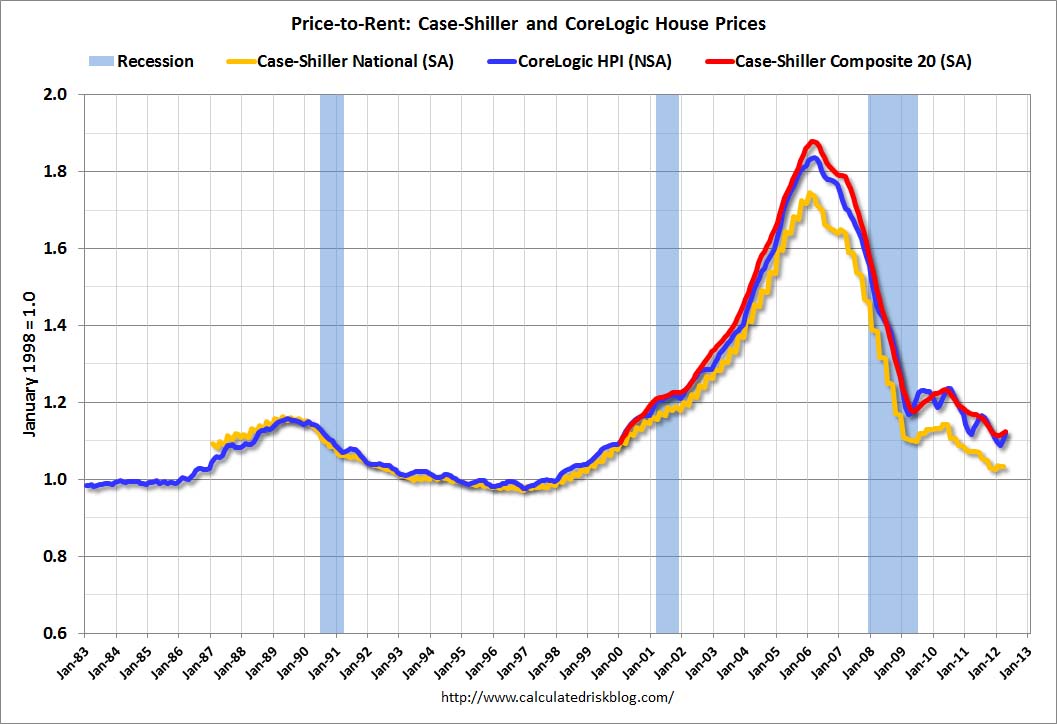
But it is also true that new construction has been close to nil in recent years even while the population has grown and that mortgage rates—even for rentals—are at low levels most of us never dreamed possible.  Nationally, the price-to-rent ratio has fallen to levels not seen in well over a decade, and in many markets it is far cheaper to buy than rent.

On balance, it would seem that flattish prices would be more likely than large declines in most areas, but that is not really the point.  I’m not recommending you buy-and-hold the Case-Shiller Housing Index (sadly, there were ETFs to track this for a while; thankfully, they folded).  I recommending you put on a good pair of walking shoes and that you look around for a handful of rental properties that you can reasonably expect to rent out at a profit after allowing for debt service and expenses.

To clarify, I’m not recommending you quit the stock market altogether.  There is money to be made for those with the patience and emotional temperament for it, and stocks—like rental real estate—can be fantastic generators of cash income.

But they shouldn’t be the only asset you own, and you shouldn’t bet your retirement on capital gains that may never come.

If you liked this article, consider getting Sizemore Insights via E-mail.  This article first appeared on MarketWatch.

No related posts.

Gold “Lacks All Safe Haven Interest” as Commodities Pull Silver Lower, Stocks Fall Ahead of Latest Euro-Crisis Talks

London Gold Market Report
from Adrian Ash
BullionVault
Thurs 28 June, 08:45 EST

WHOLESALE PRICES to buy gold ticked back above $1570 per ounce in London trade Thursday lunchtime, but held onto a 0.5% loss for the session as stock markets fell ahead of today’s Euro crisis summit in Brussels – the 12th such meeting in 12 months.

“Nein! No! Non!” said the front-page of German finance daily Handelsblatt, urging chancellor Angela Merkel not to concede to calls for weaker monetary or fiscal policy across the 17-nation currency zone.

Syria’s state TV meantime reported what it called “terrorist” bomb attacks on the main court in Damascus, while neighboring Turkey deployed anti-aircraft rockets along the border.

“There’s no semblance of a safe-haven [in gold] at the moment,” says Société Générale’s Robin Bhar, quoted by Reuters.

“But as the price goes lower that bid [to buy gold] does come back as you maybe get some renewed investor interest,” he adds, citing sovereign wealth funds and central banks.

Silver prices also slipped again early Thursday, “feeling the effects of lower base metals and crude oil prices,” according to one dealer, and retreating towards last week’s new 2012 lows beneath $26.70 per ounce.

Brent crude – Europe’s benchmark oil price – today slipped to $92.25 per barrel, only just above the marginal cost of production according to analysts at Sanford C. Bernstein & Co.

The recent drop “marks the start of the next oil price up-cycle,” they believe.

Back in silver bullion, “I suspect some fairly chunky stops will be lurking just under these levels,” says refiner and financier MKS’s senior trader in Sydney, Alex Thorndike.

“If we get closer, especially considering how thin this market is currently, we could see larger players gunning for these” to drive silver prices still lower, he believes.

Major government bonds meantime pushed higher Thursday morning, nudging 10-year German interest rates down to 1.51% per year as the Euro currency slumped one cent to a 3-week low of $1.2410.

Italy had to pay 6.19% per year today at a sale of new 10-year bonds, up from 6.03% a month ago.

Today in Greece – where bank deposits have apparently turned positive since the election of pro-bailout Samaras party last week, and where police in Thessaloniki said they’d broken up a Euro-coin counterfeiting ring, the country’s first such discovery – the new Parliament was sworn in.

New prime minister Antonis Samaras’ government yesterday dismissed the senior management of the Greek national bank, risking a revival of “the practice of making political appointments” according to one banker.

Cyprus was granted formal approval for a joint European Union, IMF and European Central Bank bail-out worth €10 billion – well over half the country’s annual economic output.

Slovenia “will see a Greek scenario” said its prime minister, Janez Jansa, in a radion interview unless debt-growth is stemmed by further spending cuts and tax hikes.

German unemployment today showed a rise of 7,000 for June, only its third rise of the last 3 years but suggesting that “the resilience of the German labour market is slowly cracking up,” according to analysts at ING bank.

Eurozone consumer confidence worsened in June, falling to its worse level since mid-2009 on the European Commission’s latest survey. Industrial sentiment worsened to 2.5-year lows.

A raft of UK economic data for the first quarter was revised lower, with GDP now seen contracting by 0.3% from the end of 2011.

“The elevated cost of wholesale funding for banks has continued to be passed through” to mortgage and business borrowers, the Bank of England said today in its latest Credit Conditions report.

Looking ahead, UK lenders see credit getting tighter for corporate borrowers than for households, especially in commercial real estate.

“Markets await news on the EU summit,” says Thursday’s note from Standard Bank in London, but “not much progress is expected on the key issues…[such as] a move towards a common bond markets, as Germany remains vehemently in opposition.

“Consequently, we feel that the Euro will stay on the backfoot, lending a downward bias to precious metal prices.”

Investment bank Morgan Stanley today cut its precious metal forecasts for 2012-2014, mapping the cut onto its outlook for global commodity prices, but remaining long-term bullish.

Morgan Stanley’s analysts now see the price to buy gold averaging $1677 per ounce this year, down from the previous forecast of $1825.

Adrian Ash
BullionVault

Gold price chart, no delay   |   Buy gold online at live prices

Adrian Ash is head of research at BullionVault, the secure, low-cost gold and silver market for private investors online, where you can buy gold today vaulted in Zurich on $3 spreads and 0.8% dealing fees.

(c) BullionVault 2012

Please Note: This article is to inform your thinking, not lead it. Only you can decide the best place for your money, and any decision you make will put your money at risk. Information or data included here may have already been overtaken by events – and must be verified elsewhere – should you choose to act on it.


Euro-Zone Fears Turn EUR/USD Bearish for Third Straight Day

Source: ForexYard

The euro fell to a two-week low against the US dollar during European trading yesterday, as investors remained doubtful that today’s EU summit will produce any meaningful solutions to the euro-zone debt crisis. The USD also saw gains vs. the JPY, as positive economic indicators boosted confidence in the US economic recovery. Today, in addition to any announcements out of the EU summit, traders will want to focus on the results of an Italian bond auction. Poor demand for Italian bonds could send the euro lower against its main currency rivals.

Economic News

USD – Positive US News Helps Boost USD

The greenback saw moderate gains against several of its main currency rivals yesterday, following the release of better than expected US news which boosted confidence in the American economic recovery. The US Core Durable Goods Orders and Pending Home Sales figures both came in well above their expected levels. The news contributed to the GBP/USD falling close to 90 pips during the European session, eventually reaching as low as 1.5544 before staging a mild upward correction. Against the JPY, the dollar advanced close to 40 pips over the course of the day, eventually peaking at 79.82.

Turning to today, dollar traders will want to pay attention to the weekly US Unemployment Claims figure, set to be released at 12:30 GMT. The number of people filing for first time unemployment insurance has steadily increased over the last several weeks. Should today’s news come in above forecasted number of 385K, the dollar may give back some of yesterday’s gains. That being said, any losses could be temporary due to the dollar’s status as a safe-haven currency and the high level of risk aversion among investors at this time.

EUR – EU Summit May Result in Additional Euro Losses

The euro took losses against several of its main currency rivals yesterday, as rising borrowing costs in both Italy and Spain caused investors to shift their funds to more stable currencies. The EUR/USD fell to a fresh two-week low during the afternoon session and was down more than 60 pips for the day. Against the Australian dollar, the EUR dropped close to 70 pips, eventually hitting 1.2361 toward the end of the European session.

Today, the euro is forecasted to see significant volatility as investors will be eagerly awaiting any news out of the EU summit. With no significant breakthroughs expected to take place regarding ways to combat the euro-zone debt crisis, the euro could see additional losses against the USD in afternoon trading. Traders will also want to pay attention to the results of an Italian bond auction. If there is poor demand for Italian bonds today, it may be taken as an additional sign that the euro-zone crisis is worsening, which could cause the euro to extend its bearish trend.

Gold – Euro-Zone News May Impact Gold Today

Gold largely range-traded yesterday, as euro-zone fears combined with a strengthening US dollar kept the precious metal near its recent lows. After falling as low as $1562.29 an ounce during the first part of the day, gold was able to finish out the European session slightly above the $1570 level.

Today, gold is likely to be influenced by euro-zone news, specifically any announcements out of the EU summit and the results of an Italian bond auction. Analysts are warning that without any significant breakthroughs at the EU summit, riskier assets, including gold, may continue falling for the rest of the week.

Crude Oil – US Inventories Figure Boosts Crude Oil

Crude oil saw moderate gains throughout the day yesterday as increased demand in the US helped boost prices. The weekly US Crude Oil Inventories figure showed that stockpiles fell by 100K barrels last week. As a result, the price of oil rose as high as $80.76 a barrel, up close to $2 for the day.

Turning to today, analysts are skeptical about whether oil will be able maintain its upward trend. With no breakthrough’s expected at today’s EU summit, investors may choose to abandon riskier assets, like crude oil, in favor of safe-havens, like the USD and JPY. That being said, any surprise breakthroughs at today’s summit could cause oil to extend its bullish trend.

Technical News

EUR/USD

A bearish cross on the daily chart’s MACD/OsMA indicates that this pair could see an upward correction in the near future. This theory is supported by the Williams Percent Range on the same chart, which has dropped into oversold territory. Going long may be a wise choice for this pair.

GBP/USD

Most long-term technical indicators show this pair range-trading, meaning that no defined trend can be predicted at this time. That being said, the Williams Percent Range on the weekly chart is slowly drifting into oversold territory. Traders will want to keep an eye on this indicator, as it may signal an impending upward correction.

USD/JPY

Long-term technical indicators show this pair trading in neutral territory, meaning that no defined trend can be determined at this time. Traders may want to take a wait and see approach, as a clearer picture is likely to present itself in the near future.

USD/CHF

The weekly chart’s Williams Percent Range has drifted into overbought territory, indicating that a downward correction could occur in the coming days. This theory is supported by the Relative Strength Index on the same chart, which is currently approaching the 70 level. Going short may be a wise choice.

The Wild Card

NZD/CHF

The Slow Stochastic on the daily chart has formed a bearish cross, meaning that this pair could see downward movement in the near future. Furthermore, the Relative Strength Index on the same chart has crossed into overbought territory. Forex traders may want to go short ahead of a possible downward breach.

Forex Market Analysis provided by ForexYard.

© 2006 by FxYard Ltd

Disclaimer: Trading Foreign Exchange carries a high level of risk and may not be suitable for all investors. There is a possibility that you could sustain a loss of all of your investment and therefore you should not invest money that you cannot afford to lose. You should be aware of all the risks associated with Foreign Exchange trading.


Market Review 28.6.12

Source: ForexYard

printprofile

The EUR/USD bounced back from a three-week low during the overnight session yesterday, reaching as high as 1.2523 before staging another downward correction. The pair is once again trading below the 1.2500 level. Traders can expect significant market volatility today, as a much anticipated EU summit is scheduled to begin.

Main News for Today

EU Summit- Scheduled for today and tomorrow

• Investors will be closely watching the summit to see if any new plans to stimulate euro-zone growth will be unveiled
• The overall feeling among analysts is that EU leaders will likely fail to unveil any new significant measures at the summit
• Should the EU summit disappoint, riskier currencies and commodities, like the euro, AUD and crude oil, could take heavy losses to finish out the week

Italian 10-y Bond Auction

• Investors will be watching the bond auction to see how hard the Italian economy has been hit by the euro-zone debt crisis
• Should demand for Italian bonds turn out to be poor, the euro could see heavy losses throughout the day

US Unemployment Claims-12:30 GMT

• The number of Americans filing for first time unemployment insurance has gone up over the last 2 weeks
• Should today’s news come in above the expected 385K, the dollar could take losses against the Japanese yen

Read more forex news on our forex blog

Forex Market Analysis provided by ForexYard.

© 2006 by FxYard Ltd

Disclaimer: Trading Foreign Exchange carries a high level of risk and may not be suitable for all investors. There is a possibility that you could sustain a loss of all of your investment and therefore you should not invest money that you cannot afford to lose. You should be aware of all the risks associated with Foreign Exchange trading.

Top Trader Says to Sell Australian Stocks – We Say Buy: See Why We’re Both Right

By MoneyMorning.com.au

Last night US stocks went up.

This morning Australian stocks are going up.

Is this the point where the bulls start beating up on the bears?

Or, as one trading guru told your editor yesterday afternoon, ‘Kris, this could be your last chance to sell.’

We agreed with him…which is why we replied, ‘That’s right, we’re buying.’

Confused? Don’t be. We’ll explain all below…

As we wrote on Monday, we find ourselves in the unusual position of having a bullish view on the market.

It’s unusual because we reckon you could count on two hands the number of months we’ve been bullish over the past four years.

But as a fundamental analyst in the small-cap market, we’re always looking for opportunities. And most of the time that means buying opportunities.

It’s not the trendy thing to say you’re buying when Europe is heading off a cliff and the Aussie economy is getting battered by a slowing Chinese economy, but looking at the market there are a lot (and we mean a lot) of stocks that have taken an absolute beating.

And in our view, that makes them worth buying.

We could show you 300-400 charts of Aussie stocks (probably more) that show the same pattern over the past five years: booming in 2007…crashing in 2008…recovering in 2009…and then crashing again in 2011 and 2012.

But rather than 400 charts, just one pretty much sums everything up. It’s the S&P/ASX 300 Metal & Mining Index (XMM):

S&P/ASX 300 Metal & Mining Index (XMM)

Source: CMC Markets Stockbroking

That chart looks pretty bad. And it is pretty bad. But for many small-cap mining stocks it’s worse. While the index is still above the 2008/2009 low, hundreds of small-cap stocks have crashed below this level.

And it’s not just small-caps. The ‘Five Stocks to Buy’ we wrote to you about last week are all lower today than they were at the beginning of 2009 – when the global economy was on the verge of collapsing (Myer didn’t list until 2010, but is 60% below its listing price).

Yet if you look at a chart of the blue chip S&P/ASX 200 Index, it’s still about 25% higher than the low reached in 2009. So why is that?

Flight to Australian Stock Safety

Slipstream Trader, Murray Dawes says the Aussie market has had a ‘silent crash’, and that it could still fall further.

That may sound odd seeing how bad things look, but what he means is that the main blue-chip index doesn’t reflect what’s happening to the rest of the market.

Because the Aussie market is concentrated into just a handful of big stocks – BHP, Rio and the big four banks – the performance of this small number of stocks hides what’s really happening.

You could even say that the Aussie banks especially have benefited from a perceived flight to safety, as the following chart shows:

Aussie banks especially have benefited from a perceived flight to safety
Click here to enlarge

Source: Google Finance

While each of our new ‘Five Stocks to Buy’ have fallen below the 2009 low, Aussie banking stocks (represented by Commonwealth Bank on the chart) haven’t crashed. CBA is still up 90% since 2009.

So perhaps you can see why we’re buying certain stocks while at the same time backing Murray’s view that the market (the index and high-priced stocks) is on a knife-edge.

Australian Stock Market on the Edge

The kind of stocks we look at have already fallen a bunch. And they could still fall further, but that’s part of the risk of punting on small-cap shares. You want to buy small-cap stocks while they’re cheap, when no-one else is interested. Because when they do recover, the early gains are often the best gains.

But just because we see value in some stocks, doesn’t mean we see value in all stocks. And if Murray is right, the market is on the verge of taking another hit, and this time even the ‘safe’ stocks may not be so lucky:

‘The market is currently having a tug of war at the last line of support before keeling over into a multi-hundred point fall. I don’t know how long this tussle will last, but it has lasted for about a month now. Last year when we were faced with a similar technical set-up the market took six weeks of to-and-fro before finally succumbing to selling pressure. It then fell 15% in a week.

‘We may see some buying support next week due to the end of tax loss selling pressure, but the outcome of the European summit will be the catalyst for the future direction. The market expects disappointment, so if there is a big announcement a bounce may be imminent. They are all squabbling like little kids at the moment so I’m not holding my breath for a good announcement. A poor outcome could see the selling pressure return. If the current support can’t hold then there is very little support beneath here. A quick fall to 3850 would ensue and from there it could look very scary indeed if that doesn’t hold.’

If you’re an active investor in blue-chip stocks, it always pays to listen to stock traders. Why? Because traders like Murray don’t care which way the market goes.

He’ll balance the probabilities of it going up against it falling and tell his traders to place the appropriate bets.

At the moment, Murray’s charts tell him the balance of probabilities is for the market to fall further, so that’s where he’s telling his traders to place their bets.

But in this market anything can happen, and it can happen quickly. It all depends on how the market behaves around a key level. As he says, ‘If the current support can’t hold then there is very little support beneath here.’

To find out that key support level and how you can set your portfolio to profit (or protect it) from a huge momentum shift, click here…

Cheers,
Kris.

Related Articles

Market Pullback Exposes Five Stocks to Buy

Three Reasons Why Silver Could Take Off in 2012

Bullish Gold Indicator at Five-Year Low Signals Time to Buy


Top Trader Says to Sell Australian Stocks – We Say Buy: See Why We’re Both Right

Why the German Economy Can’t Be Europe’s Sugar Daddy

By MoneyMorning.com.au

Investors seem to have finally learned something from the European crisis: “Expect nothing good”.

It now costs Spain more to borrow money over three months than it costs the German economy to borrow over 30 – yes, 30 – years. Spain sold just over €3bn of debt at auction at a 2.36% yield, up from 0.846% just a month ago.

At this rate, the Spanish government would be better off calling up Wonga.com for a little something to tide it over until its next payslip comes in, than asking the markets for money.

And judging by the progress made by Europe’s leaders so far, the chances of someone setting up a peer-to-peer lender for sovereign states before we get any sort of deal on how to save the eurozone doesn’t seem all that far-fetched…

The Outcome for Europe is Completely Unpredictable

A key element of investing is to balance risk and reward. You size up the odds of a given outcome. You look at the pay-off you’d get if it happens. You look at the consequences if it doesn’t. If the risk/reward pay-off looks attractive relative to the odds, then you invest. Otherwise you don’t.

Sure, plenty of investors don’t do anything that scientific. Human beings have all manner of psychological problems and an incredibly poor grasp of probability, so we’re not well-designed for investing.

But in aggregate, markets tend to have a fair stab at predicting outcomes. They’re not perfect, and sometimes they miss the obvious until it hits them over the head (as was the case with equity markets in 2007 and 2008). But they’re better than nothing.

The problem markets have right now, though, is that the European situation doesn’t lend itself terribly well to this sort of risk/reward analysis. We’re dealing with politics here. Anything could happen.

As a result, it’s clear from looking at the currency markets in particular, that no one is keen to take big positions ahead of the European meeting. No wonder. The outcomes are massively polarised.

No Eurobond Support From the German Economy

If Europe somehow comes out of this meeting with a genuine roadmap for reform, and creates some sort of bail-out fund that sticks, then markets could rocket. That would hurt anyone holding short positions.

But if they come out with the usual triumphal talk backed by nothing more than half-hearted, reheated versions of previous deals, then we’re still stuck in crisis mode. Things can only get worse until the next summit. Overall, that would leave ‘risk-on’ assets looking vulnerable, and investors keen to stick with ‘safety-first’ assets.

Worse still, if Germany decides to tell the rest where to shove their bail-outs, or one of the troubled countries throws a real wobbly and walks out, there could be a nasty collapse. Some of Europe’s biggest economies could end up being totally locked out of the lending markets. ‘Risk-on‘ would take a dive, and the dollar would surge.

That seems unlikely in the very short-term. But it’s not completely out of the question. Reportedly Angela Merkel has said that there won’t be joint Eurobonds (ie Germany acting as guarantor for everyone else) “in my lifetime”. A more sensationalist interpretation might be “over my dead body”.

The German Economy Can’t Afford to Play Sugar Daddy

You can see why Ms Merkel is concerned. Credit rating agency Egan-Jones has downgraded Germany’s credit rating by a notch to A+. Egan-Jones is not one of the ‘big three’ agencies, all of whom rate the German economy much higher. But among the smarter money, Egan-Jones commands all the more respect for that.

Egan-Jones makes the very fair point that regardless of the eurozone outcome, Germany will be left with “massive, additional, uncollectible receivables”. In effect, the German economy is owed €700bn by other central banks in Europe. The ratings agency reckons it stands to lose 50% of that.

And this doesn’t take into account German banks’ exposure to the rest of Europe. The German banking system is at least as broke as all the rest, so if the government has to stand behind it, that’ll make Germany’s fiscal picture look even worse.

In a way, Germany just needs to choose how it’s going to lose the money. So far, the path of least resistance has been to prop up troubled countries in order to avoid recognising the underlying banking crisis. But maybe, faced with the prospect of explicitly guaranteeing Spain’s debts, Germans would rather vote with their feet, and spend the money propping up their own banking system.

Of course, the most sensible thing to do – assuming you want the euro project to continue – would be to decouple the banks from the sovereigns. Spain’s big problem is that its banks are clearly bust, and the Spanish government can’t afford to stand behind them.

So if Europe clubbed together and agreed to bail out Spain’s banking sector directly, rather than going through the Spanish government, then a lot of the fear around Spain’s sovereign bonds would disappear.

But selling the idea of propping up Spanish banks to taxpayers in Germany and other countries probably isn’t any easier than selling the idea of propping up the state as a whole.

What can you do?

Of course you can bet on a specific outcome. But if you’re more an investor than a short-term trader, then the simple answer is, sit tight and try not to panic too much.

John Stepek
Contributing Editor, Money Morning

Publisher’s Note: This is an edited version of an article that originally appeared in MoneyWeek (UK)

From the Archives…

Fortescue’s Fight Against the State
2012-06-22 – Kris Sayce

Don’t Let the Fed Fool You, This Isn’t the Time to Abandon the Market
2012-06-21 – Kris Sayce

An Addicted Stock Market About to Suffer Withdrawals
2012-06-20 – Murray Dawes

Why Liquefied Natural Gas Makes Australia The Next Energy Hotbed
2012-06-19 – Don Miller

Why Greece is Just a Side-Show to the Economies of Spain and Italy
2012-06-18 – Dr. Alex Cowie


Why the German Economy Can’t Be Europe’s Sugar Daddy

How Gold Prices Look Set to Climb As Banks Crumble

By MoneyMorning.com.au

Something’s afoot in the world of high stakes finance.

The Basel Committee for Bank Supervision (BCBS) is about to decide something crucial to bankers, sovereign nations, and gold investors alike.

As part of the Bank of International Settlements (BIS), the BCBS is reviewing the upcoming new Basel III rules. That may sound arcane to you but I promise it’s not.

Though rarely discussed in the mainstream press, the all-important Bank of International Settlements is essentially a global central bank to the world’s central banks.

Its goal is ostensibly to provide global stability to the monetary and financial systems.

And in a surprise twist that only a few years ago would have been considered preposterous, the BCBS is entertaining whether gold should qualify as a full-fledged Tier 1 capital asset.

Currently, the precious metal is relinquished to a Tier 3 status, deserving no more than a 50% weighting at that.

Here’s why that distinction is important and potentially astonishing.

Achieving Tier 1 status would credit gold with the recognition it’s been denied ever since Nixon closed the gold window on August 15, 1971.

In essence, it would mark the official recognition that gold is real money.

But that’s not the only reason gold is gaining respect. Other factors are brewing that will set the stage for the next leg up in gold prices.

As Banks Teeter, Gold Gains Respect

One of them is the crumbling state of world’s banks. Once unwavering, the trust in these financial ivory towers is precarious at best.

In the last couple of months alone, Greek depositors have withdrawn billions of euros in deposits, as the fear of a “Grexit” looms large.

Not to be outdone, Spain banks have been emasculated by the Iberian nation’s own bursting real estate bubble. After denying for weeks that a Spanish bailout would be required, officials finally caved to a “Spailout“, giving Spain’s banking system a 100 billion euro rescue package.

This phenomenon is not exclusive to the Eurozone either.

Around the world, banks are under intense pressure from depositors, regulators, and even tardy ratings agencies.

In fact, Moody’s recently downgraded 15 of the world’s largest global financial institutions including those “too big to fail” behemoths.

We’re talking about Goldman Sachs, Citigroup, Morgan Stanley, Bank of America, Credit Suisse, and a host of other European and foreign banks. Some of them fell as far as three ratings notches.

While the shares of many of those same banks rallied briefly on the news, the longer-term impacts are likely to be ignored by a majority of investors, at their own peril.

These recent downgrades mean many affected banks will have to post higher collateral to their partners when trading derivatives.

Bob Young, managing director of North American banking for Moody’s, said every one of the concerned U.S. banks was placed on negative watch, signifying they could be subject to further downgrades.

To stem the risk of future meltdowns, regulators are now requiring banks to keep no less than 4% of their capital in Tier 1 assets, which are exclusively AAA-rated holdings, according to ratings agencies and regulators alike.

There’s that phrase again – Tier 1 assets. In the future that may mean more gold, depending on how the BSBC rules.

But there’s a third part to this story. Increasingly, the ownership of physical gold remains “sticky”.

The Ongoing Accumulation of Gold

Even when the price of gold endures a prolonged selloff as it has for several months, gold ETFs rarely see much of a decline in their total holdings.

In the past year or so, central banks across the globe have become net buyers of gold bullion, reversing a multi-decade trend.

Gold is also readily finding its way into a growing number of investment accounts as well.

According to Scott Powers, President and CEO of State Street Global Advisors (SSGA), the #2 money manager in the world with $ 2.3 trillion in assets under management, gold and “real assets” are an important component of client portfolios.

For discretionary accounts, SSGA recommends a 5% -15% weighting in hard assets, with gold representing a significant portion.

Surely, it doesn’t hurt that SSGA are the sponsors of the SPDR Gold Shares (NYSE: GLD), the second-largest exchange-traded fund in the world.

When such a large money manager considers gold not only legitimate but essential and recommends significant exposure to its clients, that speaks volumes about the level of recognition gold has achieved.

Clearly gold has gained favour not only with the world’s largest money managers, but even with central banks which are now accumulating the metal at a growing pace.

Right now it’s the perfect storm of ongoing aftershocks of the 2008 financial meltdown and the unrelenting rise and strength in the price of gold that may help it regain the financial respect it deserves.

Today, it seems even the BIS and commercial banks, those relentless proponents of fiat money, could well be forced to admit what’s becoming increasingly clear: gold is real money, free of both counterparty and credit risk.

An increase from 4% to 6% Tier 1 capital requirements, together with a favorable revision as a full-fledged Tier 1 asset, could combine to trigger the next massive upleg in the gold secular bull market.

Peter Krauth

Contributing Editor, Money Morning

Publisher’s Note: This article originally appeared in Money Morning (USA)

From the Archives…

Fortescue’s Fight Against the State
2012-06-22 – Kris Sayce

Don’t Let the Fed Fool You, This Isn’t the Time to Abandon the Market
2012-06-21 – Kris Sayce

An Addicted Stock Market About to Suffer Withdrawals
2012-06-20 – Murray Dawes

Why Liquefied Natural Gas Makes Australia The Next Energy Hotbed
2012-06-19 – Don Miller

Why Greece is Just a Side-Show to the Economies of Spain and Italy
2012-06-18 – Dr. Alex Cowie


How Gold Prices Look Set to Climb As Banks Crumble

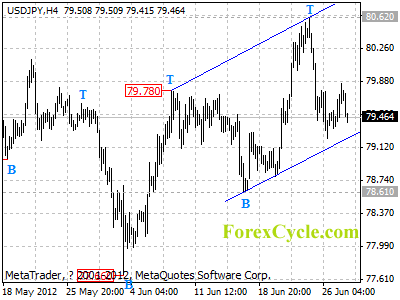
USDJPY stays in a upward price channel

USDJPY stays in a upward price channel on 4-hour chart. Support is at the lower line of the channel, as long as the channel support holds, the uptrend from 77.66 could be expected to resume, and another rise towards 83.00 is still possible. However, a clear break below the channel support will indicate that the rise from 77.66 has completed at 80.62 already, then the following downward movement could bring price back to 76.00-77.00 area.

usdjpy

Daily Forex Forecast

How to Build Consistent Trading Success

EWI’s senior analyst Jeffrey Kennedy shares with you practical advice on what it takes to improve the quality of your trades.

By Elliott Wave International

You’ve heard it all before:

  • If you want to trade using Elliott wave analysis, to succeed you first need to understand its rules and guidelines.
  • You need a clearly defined trading strategy (what? when? how? etc.) and the discipline to follow it.
  • Additionally, your long-term success depends on adequate capitalization, money management skills and emotional self-control.

Do you meet these qualifications, yet still struggle in the markets? If so, you may find some helpful advice in this quick trading lesson from Elliott Wave Junctures editor Jeffrey Kennedy:

We all know that the Elliott Wave Principle categorizes 3-wave moves as corrections and, as such, countertrend moves. We also know that corrective moves demonstrate a stronger tendency to stay within parallel lines, and that within A-B-C corrections the most common relationship between waves C and A is equality. Furthermore, we know that the .618 retracement of wave 1 is the most common retracement for 2nd waves, and that the .382 retracement of wave 3 is the most common retracement for 4th waves.

Knowing that all of these are traits of countertrend moves, why do traders take positions when a pattern demonstrates only one or two of these traits? We do it because we lack patience. We lack the patience to wait for opportunities that meet all of our criteria, be it from an Elliott wave or another technical perspective.

What is the source of this impatience? It could be from not having a clearly defined trading methodology, or not being able to control emotions. However, I think impatience stems more from a sense of not wanting to miss anything. And because we’re afraid of missing the next big move, or perhaps because we want to pick up some lost ground, we act on less-than-ideal trade setups.

Another reason traders lack patience is boredom. That’s because — and this may sound odd at first — “textbook” Elliott wave patterns and ideal, high-probability trade setups don’t occur all that often. In fact, I have always gone by the rule of thumb that for any given market there are only 2-3 tradable moves in your chosen time frame. For example, during a normal trading day, there are typically only two or three trades that warrant attention from day traders. In a given week, short-term traders will usually find only two or three good opportunities worth participating in, while long-term traders will most likely find only two or three viable trade setups in a given month, or even a year.

So as traders wait for these “textbook” Elliott wave patterns and ideal, high-probability trade setups to occur, boredom sets in. Too often, we get itchy fingers and want to trade any chart pattern that comes along that looks even remotely like a high-probability trade setup.

The big question then is, “How do you overcome the tendency to be impatient?” Understand the triggers that cause it: fear of missing out, and boredom.

The first step in overcoming impatience is to consciously define the minimum requirements of an acceptable trade setup and vow to accept nothing less. Next, feel comfortable in knowing that the markets will be around tomorrow, next week, next year and beyond, so there is plenty of time to wait for the ideal opportunity. Remember, trading is not a race, and over-trading does little to improve your bottom line.

If there is one piece of advice I can offer that will improve your trading skills, it is simply to be patient. Be patient and wait for only those textbook wave patterns and ideal, high-probability trade setups to act. Because when it comes to being a consistently successful trader, it’s all about the quality of your trades, not the quantity.

Developing patience isn’t easy — yet, if you are serious about improving the quality of your trades, it is vital.

How much more successful would you be if you could develop the patience to act only on high-probability trade setups?


Jeffrey Kennedy shares his 20 years of wisdom in analysis and trading — to help you decide when to act — in a new FREE report, 6 Lessons to Help You Find Trading Opportunities in Any Market.This report includes 6 different lessons that you can apply to your charts immediately. Learn how to spot and act on trading opportunities in the markets you follow.Get Your Free Trading Lessons Now >>

This article was syndicated by Elliott Wave International and was originally published under the headline How to Build Consistent Trading Success. EWI is the world’s largest market forecasting firm. Its staff of full-time analysts led by Chartered Market Technician Robert Prechter provides 24-hour-a-day market analysis to institutional and private investors around the world.