UK banks should boost capital during EU crises – BOE

By Central Bank News

    UK banks should continue to limit dividends and executive compensation and instead use the funds to boost their capital cushion to absorb any possible losses during the current risk to financial stability from the crises in the euro area, the governor of the Bank of England said.
    In his prepared remarks for a press conference, Mervyn King said the cushion that banks should build up may even be larger than the current planned increase toward meeting the tougher Basel III capital requirements.
    “The Committee continues to believe that there is a need for banks temporarily to raise their levels of capital, in view of the exceptional threats they currently face,” King said presenting the bank’s Financial Stability Report.

    That additional capital cushion should be used in the event that losses actually occur so banks don’t end up cutting back lending to consumers and businesses to cover the losses.
    “At that point, or if the current risks recede, banks’ capital ratios could then fall back to the official transition path to the Basel III standards,” King said, rejecting arguments that increasing the capital cushion would limit banks’ capacity to lend.
    “More capital and more lending go together,” King said. “Moreover, in the event that large losses are realised as a result of the euro-area crisis, it is vital that our banks are sufficiently well capitalised to be able to continue to provide the services on which we all rely.”
    UK banks have been building up their liquidity buffers in recent years and they are now above official guidance levels. In addition, the banks can access liquid funds through the bank, specifically through the BOE’s recently-extended extended repo facility and its discount window, King said.
    “That has put banks in a strong position to withstand a period of market stress. But it is important that banks are willing to make use of their liquid asset buffers in times of stress, in order to support lending to the real economy,” King said
    The Financial Stability Report was prepared by the BOE’s Financial Policy Committee (FPC), set up last year to reduce systemic risks to the UK financial system. The creation of the FPC was part of the UK’s wholesale reform of financial regulation, which gave  power to the bank’s FPC to address overall financial stability. It also set up a new Prudential Regulatory Authority at the BOE that would focus on systemically-important financial institutions.

    www.CentralBankNews.info

Italian Bond Auction Leads to EUR Losses

Source: ForexYard

The euro tumbled to a three-week low against both the US dollar and Japanese yen yesterday, following an Italian bond auction and general pessimism regarding an EU summit. While crude oil saw gains early in the day, the commodity turned bearish during mid-day trading as investors shifted their funds away from riskier assets. Turning to today, traders will want to continue monitoring any developments out of the EU summit. Should euro-zone leaders finish out the week without agreeing to any new strategies to combat the debt crisis, the euro could see additional losses.

Economic News

USD – Risk Aversion Leads to Broad Dollar Gains

The dollar was able to benefit from risk aversion in the marketplace to make gains across the board yesterday. Investor concerns about the euro-zone debt crisis were largely responsible for the gains made by safe-haven assets. The GBP/USD fell over 100 pips during the European session, eventually reaching as low as 1.5506 before staging a very mild upward correction. Against the aussie, the dollar advanced around 95 pips over the course of the day. The AUD/USD eventually fell to the 1.0025 level before staging a slight recovery and stabilizing at 1.0040.

As we close out the week, analysts are predicting that the greenback could extend its bullish trend as long as EU leaders fail to come to a consensus regarding the best way to combat the euro-zone debt crisis. That being said, should European leaders successfully come up with new ways to stimulate economic growth during today’s EU summit, investors could shift their funds back to riskier assets, which may lead to losses for the USD.

EUR – EUR Drops to 3-Week Low vs. USD, JPY

Differences of opinion between European leaders on the best way to combat the euro-zone debt crisis led to broad losses for the euro throughout the day yesterday. The common currency fell to a three-week low against the USD, eventually reaching 1.2406 before bouncing back to the 1.2430 level. The EUR/JPY also dropped to its lowest level in three-weeks, reaching as low as 98.31 during early morning trading. The pair eventually staged a slight upward correction to stabilize at the 98.60 level.

Turning to today, traders will want to continue monitoring any developments out of the EU summit. While analysts remain doubtful that euro-zone leaders will be able to reach any kind of agreement regarding how to stimulate economic growth in the region, traders should note that if any breakthroughs do occur, the euro could see upward movement to close out the week. That being said, with borrowing costs steadily rising in both Italy and Spain, any euro gains may turn out to be temporary.

JPY – Safe-Haven Yen Extends Gains

The yen was able to benefit from economic turmoil in the euro-zone yesterday, as investor fears regarding rising borrowing costs in Spain and Italy resulted in risk aversion in the marketplace. The CHF/JPY fell close to 80 pips over the course of the day, eventually reaching as low as 81.84 before staging a slight upward correction. The AUD/JPY dropped over 90 pips to reach as low as 79.40 by the end of European trading.

As markets get ready to close for the week, analysts are forecasting that recent lack of positive developments in the euro-zone may lead to further gains for the safe-haven yen today. That being said, should EU leaders successfully reach an agreement today on how to help boost debt stricken economies in the euro-zone today, the JPY could reverse some of its gains.

Crude Oil – Crude Oil Takes Heavy Losses

The price of crude oil tumbled during afternoon trading yesterday, as fears regarding the euro-zone debt crisis caused investors to abandon their positions in higher yielding assets. After peaking at $80.81 a barrel during the afternoon session, crude fell as low as $78.20 by the end of the European session.

Turning to today, oil traders will want to continue monitoring any developments out of the EU. In addition to the EU summit, which is widely expected to not produce any meaningful solutions to the region’s debt crisis, negative announcements out of Italy and Spain have the potential to bring the price of oil down further before markets close for the week.

Technical News

EUR/USD

A bearish cross on the daily chart’s MACD/OsMA indicates that this pair could see an upward correction in the near future. This theory is supported by the Williams Percent Range on the same chart, which has dropped into oversold territory. Going long may be a wise choice for this pair.

GBP/USD

Most long-term technical indicators show this pair range-trading, meaning that no defined trend can be predicted at this time. That being said, the Williams Percent Range on the weekly chart is slowly drifting into oversold territory. Traders will want to keep an eye on this indicator, as it may signal an impending upward correction.

USD/JPY

Long-term technical indicators show this pair trading in neutral territory, meaning that no defined trend can be determined at this time. Traders may want to take a wait and see approach, as a clearer picture is likely to present itself in the near future.

USD/CHF

The weekly chart’s Williams Percent Range has drifted into overbought territory, indicating that a downward correction could occur in the coming days. This theory is supported by the Relative Strength Index on the same chart, which is currently approaching the 70 level. Going short may be a wise choice.

The Wild Card

AUD/JPY

The Bollinger Bands on the daily chart are narrowing, indicating that a price shift could occur in the near future. Additionally, the MACD/OsMA on the same chart is currently forming a bearish cross, signaling that the price shift could be downward. This may be a good time for forex traders to open short positions.

Forex Market Analysis provided by ForexYard.

© 2006 by FxYard Ltd

Disclaimer: Trading Foreign Exchange carries a high level of risk and may not be suitable for all investors. There is a possibility that you could sustain a loss of all of your investment and therefore you should not invest money that you cannot afford to lose. You should be aware of all the risks associated with Foreign Exchange trading.


Two Stock Market Buy Signals You Shouldn’t Ignore

Article by Investment U

There are a number of signals that bode well for price appreciation with individual stocks: growing market share, rising sales, strong earnings growth and improving margins…

But you shouldn’t overlook another excellent indicator: share buybacks.

According to Standard & Poor’s, U.S. public companies spent at least $437 billion last year buying their own shares back. That was 46% more than in 2010.

Is this a good thing? Absolutely…

Regardless of whether you’re an individual or a corporation, sitting on cash isn’t terribly rewarding these days with the average money market fund paying five one-hundredths of 1%. And if the outlook is uncertain, a business owner doesn’t want to commit to building new facilities or taking on employees that aren’t needed. Nor is it necessarily in the best interest of shareholders to distribute this cash in the form of taxable dividends.

So buying back shares often makes good sense. Why? Because when you divide net income into a smaller number of shares outstanding, you get greater growth in earnings per share. And, ultimately, that’s what drives share prices higher.

Of course, stock buybacks boost earnings per share only if they’re larger than stock issuance. Historically, that hasn’t always been the case. (Much executive compensation today comes in the form of stock options that have a dilutive effect on existing shareholders.)

But in recent quarters, the supply of shares outstanding has been shrinking. And, according to analyst Howard Silverblatt at Standard & Poor’s, during the current earnings season, 97 of the S&P 500 enjoyed a boost to earnings per share of at least 4% from repurchases alone.

More Buybacks Ahead

Expect to see more of these buyback announcements in the weeks ahead. Why? Because U.S. corporations are sitting on more than $2 trillion in cash. That’s enough to buy all of ExxonMobil (NYSE: XOM), Microsoft (Nasdaq: MSFT) and IBM (NYSE: IBM).

There are some caveats, however. Some companies announce their intention to buy back shares and then don’t follow through. If business conditions change, interest rates rise, or cash flow decreases, a repurchase program may never get completed.

The other thing to watch is the exercise of stock options, as mentioned above. If a company is only buying back enough shares to offset the dilution that occurs when executives exercise stock options, you won’t see the buyback boost earnings per share.

But, generally speaking, share repurchase programs are a decided positive. And right now, with money cheap and corporate earnings strong, buybacks are occurring at record levels. Cash-rich companies in the midst of major share buybacks right now include Smithfield Foods (NYSE: SFD) and Juniper Networks (NYSE: JNPR).

Having Your Cake and Eating it, Too…

Of course, some analysts would rather see corporate executives buying shares with their own money rather than the company’s money. And I don’t disagree…

But sometimes you can have your cake and eat it, too. In a recent study, stocks that were subject to repurchases but not insider buying beat other stocks by nearly nine percentage points over four years. But stocks that were the subject of both repurchases and insider buying beat others by a whopping 29 points over four years.

Which companies have enjoyed share buybacks and insider buying recently? Two of them are CACI International (NYSE: CACI) and Crawford and Company (NYSE: CRD-A).

These are the kind of companies that should handily outperform the market in the months ahead.

Good Investing,

Alexander Green

Article by Investment U

The Hard Lesson of a Stock Trader: No Pain, No Gain

By MoneyMorning.com.au

One peril of investing – and especially stock trading – is an unexpected event.

Former US Defence Secretary Donald Rumsfeld would call it an ‘unknown unknown’.

Nassim Nicholas Taleb would call it a ‘Black Swan’ event.

And our in-house technical analyst, stock trader Murray Dawes would call it an ‘oh crap’ moment…or words similar.


The trouble is, the more that unexpected events happen, the more people expect them to happen. This tends to reduce their impact.

It’s why one stock trader is calm about the chances of another government or central bank stimulus boost. Which is surprising, seeing as four years ago the mother of all stimulus boosts cost him over a hundred grand, and a million-dollar payday…

European Union (EU) leaders are currently half way through a two-day meeting to try and fix the mess in Europe.

Leading up to the event, markets have risen and fallen depending on how confident investors are of the EU fixing the problem.

With the German DAX Index down 1.8% since last Friday’s close, it seems that for the most part, investors aren’t confident at all.

But that won’t stop the EU trying. Overnight, the leaders (or busy-bodies as we prefer to call them) released the first part of their cunning plan to spur growth.

Chief busy-body, EU President, Herman Van Rompuy told reporters, ‘The growth agenda is a sign of our unrelenting commitment.’

That’s good to know.

So, what is the first part of the EU’s plan?

According to Bloomberg News:

‘European Union leaders approved a 120 billion-euro ($149 billion) plan to promote growth in the 27-nation bloc that includes a capital boost for the European Investment Bank.

‘The government chiefs agreed on a 10 billion-euro capital increase for the EIB today as a centrepiece of the long-term growth plan, which includes infrastructure financing, tax-policy pledges and more focused use of EU funding. It also calls for project bonds and support of small and medium-sized businesses…

‘The Luxembourg-based EIB could use its capital infusion to increase its lending capacity by 60 billion euros and unlock 180 billion euros of additional investment, according to EU estimates.’

We won’t pretend to understand exactly how this new plan will work. But we already smell a rat. The EU will give the EIB 10 billion euros. This will ‘increase its lending capacity by 60 billion euros and unlock 180 billion euros of additional investment…’

Call us cynical, but it has all the hallmarks of a leveraged debt play. The same as the leveraged debt plays that have gotten Europe to where it is now. Borrowing from the future to pay for today’s growth.

Seen It All Before

That aside, let’s put the EU’s total 120 billion euro package in perspective. The plan is to spend or invest this money over three years from 2013 to 2015.

That works out as 40 billion euros a year…a lot of money. But not that much. Not when you consider that the GDP for the EU is 12.6 trillion euros.

In other words, it accounts for just 0.3% of annual GDP. Even if you include the leveraged position from the EIB, you’re still looking at the package contributing less than 1% of GDP.

So it means nothing.

That’s the problem with so-called ‘shock and awe’ tactics. They worked (in that they boosted the market, not that they were economically effective) in 2008 because they were a genuine ‘unknown unknown’, ‘Black Swan’ and ‘oh crap’ events.

But now, well, we’ve seen it all before.

The Million Dollar Miss of a Stock Market Trader

This brings us back to the stock trader who missed out on a million-dollar payday. His name is Murray Dawes, and he is our in-house technical trading guru.

For Murray, it’s a painful story. But even though he may not admit it, it’s one of those experiences any stock trader, sportsperson or entrepreneur needs if they want to taste real success.

A sportsman or woman can’t truly appreciate the joy of victory without first losing a championship game at the final whistle.

An entrepreneur can’t appreciate their billion-dollar idea without seeing other ideas crash and burn first.

And if a stock market trader wants to build a successful trading business, he or she needs to take a hit (a big hit) to the hip-pocket first.

That’s what happened to Murray in 2008. And the good news for Murray’s stock traders is that he has taken the pain on their behalf. They can learn the lessons Murray has learned without going through what he did in 2008…

He told everyone who attended the Daily Reckoning ‘Doomers’ Ball’ last November about it. But we asked Murray to (painfully) jot down the sequence of events for you to read this morning. Here’s how it panned out:

‘I was long 30 September 2008 emini S+P 500 1200 puts (Expiry on 19th September). Lehman collapsed on the 15th September.

‘On 17th September I bought 15 emini S+P 500 futures at 1160 to hedge my position. I.e. The whole position was US$60,000 in the money ($75,000 AUD – the exchange rate was about .80c then).

‘So I had locked in a little less than AUD$40,000 less the price of the options.

‘At 3am on the night before expiry, the market was getting hammered from the open and I thought the market could crash. So I exited my hedge (at a small loss of about 10-15 points) and let the whole 30 options run for the last night. When I went to bed the futures were trading below 1140 so I was up over AUD$100,000 at this point and thought I was home and hosed whatever happened from there.

‘While I was asleep the US government announced TARP 1 and the market opened the next day 14% higher than where it was when I went to bed. If I had kept the hedge on I would have been up over AUD$100,000 on the hedge alone. Instead my options expired worthless. Two months later when the S+P 500 fell to 741 the same position was worth USD$688,000 or over AUD$1,000,000 because the Aussie dollar had fallen to 64c by this stage.’

If you’re not into futures and options trading some of the jargon may be lost on you, but we didn’t want to change Murray’s words because the story he tells is one of experience.

Besides, if you’re in any doubt what this trade and the stimulus boost meant to him, just read the last two paragraphs…everything should be clear to you from that.

But that was 2008. The USD$700 billion TARP bailout was huge. It was unprecedented. No-one in their right mind could have predicted the size nor the impact it would have on the stock market.

It was an ‘unknown unknown’.

It was a ‘Black Swan’.

It was an ‘oh crap’ moment.

But with so many bailouts and stimulus programs over the past four years, each one has had less impact on the stock market.

As a Stock Trader or Investor You Must Take Risks

Last week, the US Federal Reserve announced an expansion of the ‘Operation Twist‘ bond program. The impact on markets? Nothing. The US S&P 500 has barely changed since then.

And last night’s news of the EU forming a growth pact to spend 40 billion euros a year? No-one cares. The Australian stock market is down and US stock futures are virtually unchanged from the close.

It’s for this reason that Murray is happy to have a number of short trades on the Aussie market – eight at the last count, with a few long positions to hedge the portfolio if the market does go up.

Of course, there’s always the chance of a bolt out of the blue. That governments and central bankers will do something most rational people couldn’t possibly expect.

But that’s part of the risk when you invest. It’s about balancing probabilities and managing your risk. The alternative is to do nothing, which in itself is an investment strategy…just not a very good one.

With interest rates plunging to multi-decade lows, investors have no choice but to take risks. The only question is what risks should you take?

As it happens, our technical stock trading analyst Murray, has a few ideas on the subject here…

Cheers,
Kris.

Related Articles

Market Pullback Exposes Five Stocks to Buy

Top Trader Says to Sell Australian Stocks – We Say Buy: See Why We’re Both Right

‘Big Wednesday’ For the Aussie Dollar


The Hard Lesson of a Stock Trader: No Pain, No Gain

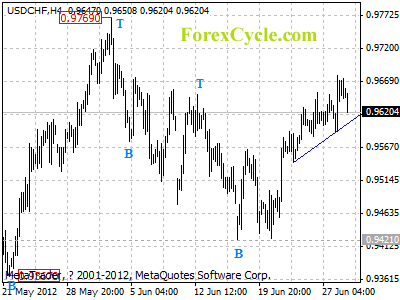
USDCHF’s upward movement extends to 0.9678

USDCHF’s upward movement from 0.9421 extends to as high as 0.9678. Support is now located at the upward trend line on 4-hour chart, as long as the trend line support holds, uptrend could be expected to continue, and further rise towards 0.9769 previous high is still possible. On the downside, a clear break below the trend line will indicate that a cycle top has been formed, and consolidation of the uptrend is underway, then pullback to 0.9500 area could be seen.

usdchf

Daily Forex Analysis

Why You Should Sell Your Microsoft Shares

By MoneyMorning.com.au

One day in 1983, my dad asked me a question over dinner after a long day at work.

He wanted to know what I knew about a little computer company called Microsoft. It was the brainchild of the son of one of his partners at Bogle & Gates, William H. Gates, Sr.

“Not much,” I replied.

But I did tell my dad that I loved using MS-DOS in the computer lab with my friends. I was a card-carrying member of the nerd herd back in the day, so I spent a lot of time there and knew Microsoft’s fledgling PC-based software pretty well.

My grandmother Mimi, though, had a different point of view. You’ve heard me mention her before.

She’s the one who was widowed at an early age and became a savvy global investor long before people ever thought to look at the bigger picture.

Mimi didn’t care that the buzz was about the MS-DOS language or even about computers. Having grown up in the Depression, she believed that what people would do with the technology was far more valuable.

She said she had confidence that Sr.’s son, Bill Gates Jr., understood this – which is why she invested heavily in the Microsoft IPO in 1986. Enough said.

Today, though, I think she’d voice an equally strong opinion about Microsoft (Nasdaq: MSFT) CEO Steve Ballmer. In fact, I think she’d fire him. Here’s why…

8 Reasons Why Steve Ballmer Must Go

1.   Ballmer took over Microsoft 12 years ago when Microsoft shares were $60. Now it struggles to  maintain a $30 share price. Microsoft has $58.16 billion in cash and this is the best Steve Ballmer can do?

2.   Office and Windows are dying. Once the business world’s de facto standard, both are being replaced by cheap, easy-to-operate software, much of which is actually free as well as compatible. This is a big problem considering that, according to the Wall Street Journal, roughly 85% of Microsoft’s revenue is coming from just two products: Windows and Office.

3. The company isn’t innovating fast enough or aggressively enough. What’s more, it’s attempting to compensate for its own shortcomings with increasingly ill-conceived acquisitions. For instance, Microsoft forked over $605 million for 18% of the Barnes and Noble Nook e-reader and still has no real ability to compete with Amazon’s Kindle. It also couldn’t seal the deal with Yahoo. Despite a sizable head start using Yahoo’s core search technology, Bing has a mere 15% of the search market today.

Ballmer waited nearly four years to respond to the iPad and his “Surface” tablet was ho-hum when it could have been jaw dropping. One more: Microsoft paid $8.5 billion in cash for Skype. Apparently the fact that Skype was not profitable didn’t matter. Ballmer’s track record suggests to me that he buys businesses that nobody else “must have.”

4.    Microsoft’s Internet offerings remain wannabes and are highly priced at that. Take Yammer. Microsoft just paid $1.2 billion through the nose to acquire a company that was valued at $600 million last fall when it raised $85 million in a venture offering.

Team Ballmer plans to integrate it into Office on the assumption that somehow the Microsoft marriage will endear the brand to customers anxious to socialize business. I think they’re delusional. Most Microsoft users I know, including myself, are actively planning to move away from the legacy software we’ve used for years the first instant we can in favor of software we actually like to use!

5.  Microsoft spent $26 billion on research over the last three years. Meanwhile, Apple spent $5.54 billion and managed to crank out products light years better than anything Microsoft has come up with. No question which group of shareholders is getting the most bang for the buck.

6. Windows 8 is a wreck. Versions I have played with are so unintuitive as to defy belief. There is neither a Control Panel nor a Start menu. It seems to me that very few people actually love their Windows anymore the way Apple users love their Mac OS.

7.  Ballmer can’t do a product launch without jumping around the stage like a Planet of the Apes extra according to Joel Hruska of ExtremeTech. No doubt an apt description if you’ve ever seen him do his thing– albeit not a very flattering one.

That’s a problem. Ballmer doesn’t appear to do anything without appearing sweaty and uncomposed. His competitors look calm, cool and collected. The late Steve Jobs wrote the book on creating real excitement for users, not just inwardly-focused developers who give birth to successive generations of questionable products.

8.    Spellbound nerds, once the company’s backbone, appear to be an endangered species. If you want to see the future, look at what teens are using and writing. Apple now allows teens as young as 13 to participate in its developer’s conference, where thousands of people learn about upcoming offerings (and help take the company to new heights).

A child of the Depression, Mimi knew how to cut to the chase. She was acutely aware of the need to identify companies that did too.

Those who weren’t acting in the best interests of their shareholders and maximizing their investments had no place in her portfolio.

Nor mine…which is why I don’t own Microsoft today and haven’t for years.

Keith Fitz-Gerald

Contributing Editor, Money Morning

From the Archives…

Fortescue’s Fight Against the State
2012-06-22 – Kris Sayce

Don’t Let the Fed Fool You, This Isn’t the Time to Abandon the Market
2012-06-21 – Kris Sayce

An Addicted Stock Market About to Suffer Withdrawals
2012-06-20 – Murray Dawes

Why Liquefied Natural Gas Makes Australia The Next Energy Hotbed
2012-06-19 – Don Miller

Why Greece is Just a Side-Show to the Economies of Spain and Italy


Why You Should Sell Your Microsoft Shares

10 Years Ago Today: Prechter’s Conquer the Crash Is Published. Read 8 Chapters Free Now

We’re sharing 8 Conquer the Crash chapters FREE to celebrate!

By Elliott Wave International

In June of 2002, the notorious dot.com bust was making way for a powerful housing boom, the European Union was growing, and American involvement in the Middle East promised a “quick and easy victory.”

Yet when EWI President Robert Prechter’s first edition of Conquer the Crash published ten years ago on this date, he wrote:

  • “Home equity loans are brewing a terrible disaster.”
  • “What screams bubble — giant historic bubble — in real estate is the system-wide extension of massive amount of credit.”
  • “The Middle East should be a complete disaster.”
  • “Look for nations and states to split and shrink.”

Today, 10 years later, the U.S. housing market still hasn’t overcome its worst downturn since the Great Depression; the eurozone is in crisis, and the expected quick victory in Iraq became a drawn-out mess.

Prechter’s analysis — based on the Elliott Wave Principle and socionomics, the study of how social mood motivates social actions — enabled him to foresee these changes in the economic, social, and political landscape.

What other eye-opening forecasts do the pages of the Conquer the Crash reveal? How about:

Banks: “Banks are not just lent to the hilt, they’re past it. In a fearful market, liquidity even on these so called ‘securities’ [corporate, municipal, and mortgage-backed bonds] will dry up.” (Remember the 2007-2009 “liquidity crisis”?)

Bonds: “The unprecedented mass of vulnerable bonds extant today is on the verge of a waterfall of downgrading.” (Remember the 2011 downgrade of the U.S. Treasury bonds?)

Credit: Credit expansion schemes — the primary role of the U.S. Federal Reserve Bank — “have always ended in a bust.” (Again, think back to the “credit crunch.”)

And — “Like the discomfort of drug addiction withdrawal, the discomfort of credit addiction withdrawal cannot be avoided.” (You could say that again.)

Anticipating “shocks” to the global system is a remarkable and true, decade-long achievement of Prechter’s Conquer the Crash. And on the 10th anniversary of its publication, we’d like to offer you 42 pages of excerpted material to commemorate Prechter’s work.


Take advantage of this FREE, 8-lesson report that can help you prepare your financial future. You’ll get valuable lessons on:

  • What to do with your pension plan
  • What to do if you run a business
  • How to handle calling in loans and paying off debt
  • And so much more

Get Your FREE 8-Lesson “Conquer the Crash Collection” Now >>

This article was syndicated by Elliott Wave International and was originally published under the headline 10 Years Ago Today: Prechter’s Conquer the Crash Is Published. Read 8 Chapters Free Now. EWI is the world’s largest market forecasting firm. Its staff of full-time analysts led by Chartered Market Technician Robert Prechter provides 24-hour-a-day market analysis to institutional and private investors around the world.


Czech central bank cuts interest rate to record 0.5%

By Central Bank News

  The Czech central bank has cut its key policy rate by 25 basis points to a record low of 0.50 percent, as widely expected, the bank said in a statement.
    The two-week repo rate was cut to 0.5 percent and the Lombard rate, a ceiling for short-term rates, was also cut by 25 basis points to 1.5 percent. The discount rate remains unchanged at 0.25 percent, the bank said, referring to rules that still use a multiple of the discount rate as basis for calculating penalties.
    “From the perspective of the spirit of the law the CNB deemed it justified to keep the sanction amounts above zero in such cases,” the bank said.
    The Ceska Narodni Banka last eased monetary policy on 6 May 2010, when it lowered the repo rate by 25 basis points to 0.75 %.he history of settings of main instruments of monetary policy and Bank Board minutes available attwo-week repo tenders.
    The reasoning behind the bank’s decision would be published later, the bank said.
www.CentralBankNews.info


Central Bank News Link List – June 28, 2012

By Central Bank News

    Here’s today’s Central Bank News link list, click through if you missed the previous central bank news link list. The list is updated during the day with the latest news about central banks so readers don’t miss any important developments.

    If you want to submit links for inclusion in the daily link list, just email them through to us or post them in the comments section below.