The ATR (Average True Range) Indicator

By MoneyMorning.com.au

When it comes to technical analysis, many people don’t know where to start.

That’s why last weekend we introduced you to one of the more basic tools, moving averages.

However, that’s just the beginning. There are many types of technical analysis indicators. Today we’ll show you another.

While we said that moving averages play a big part in Slipstream Trader, Murray Dawes’ analysis, there’s another indicator that plays an even bigger role. It’s the average true range indicator. It’s more commonly known as the ATR indicator.

Now unlike moving averages, which help you determine the market direction, the ATR indicator gauges market volatility.

Initially created for the volatile commodities markets, traders now use the ATR indicator for other markets too. Like Forex and major global indices.

How Does an ATR Indicator Work?

Basically, it calculates the total price range including gaps for a trading day. The smaller the price difference, the smaller the number. The higher the total trading range, the higher the ATR number.

Then, an ‘average true range’ is calculated over a given period. Generally, the time frame used is somewhere between 5 and 14 days. However, most traders tend to use a ten day time frame.

Each trader can then modify this to suit themselves. Murray adds his own twist. He takes the ATR number and divides it by the price, so he ends up with an average true range over ten days as a percentage of the price.

He then lays the indicator over the top of the market being analysed and inverts the scale for the ATR indicator. This means that as the ATR indicator rises on the chart, volatility falls and vice versa.

Let’s look at an example…

In a rising market, the ATR percentage will be quite low. Look at the chart below. On the left hand side of the chart, the numbers are percentages. So 1.0 is actually 1% and so on.

S&P 500 chart using a 10-Day ATR Percentage Indicator

S&P 500 chart using a 10-Day ATR Percentage Indicator
Click here to enlarge

Source: Slipstream Trader


Around December 2010 (on the left of the chart), you can see the ATR percentage indicator rising. The ATR indicator is well below 1.0 (remember the scale is inverted so a rising line means falling volatility). In fact, the price range for each trading day during this period is roughly around 0.7%. This suggests that the market wasn’t particularly volatile at this point.

But look how much things changed a few months later in late July and early August 2011 (in the middle of the chart). It moves from 1.5% to as high 3.3%. It’s this ‘drop’ on the chart that tells a trader that volatility is increasing.

There’s a simple way to remember how it works. When the market rises, the ATR percentage indicator range falls. That is, it shows a low number. When the market’s falling, the ATR range will increase. And you’ll see a much higher percentage number.

So how does this tell you what’s happening in the market now?

If you look at the far right of the chart, you can see that over the last few weeks, the S&P500 has tried to rally.

Yet, as Murray told his Slipstream subscribers earlier this week, it’s because of this chart he’s still ‘bearish’ on the market overall.

‘Sure the S&P 500 has attempted to rally. But at the same time, the volatility is increasing. Look, the ATR percentage indicator is hovering around 1.5%. It’s because of this rising volatility that I can remain bearish on the market.’

Simply put, he uses the indicator to either confirm or to question the current market movements. He looks at the relationship between the indicator and the market being studied. So when a divergence opens up between the two (when the indicator and market ‘separate’) it can be a great warning sign that a reversal may be imminent.

It’s important to remember when using indicators, that they are just that. An indication of what might happen. Murray finds the ATR percentage indicator useful to his technical analysis, but it’s not his only way of ‘reading’ the market. In fact, he has his own propriety technique. But he uses other technical tools, like the ATR indicator, to confirm a trade.

If you’d like to see how Murray is using this analysis to predict the next big market move, click here to learn more.

Shae Smith
Editor, Money Weekend

The Most Important Story This Week…

Since it hit a high of $49 an ounce in April last year, the price of silver has gone down almost 50%. It is currently trading around $26. That’s a big fall. But as commodities guru Jim Rogers often points out, big corrections in a long-term bull market aren’t unusual. It’s important not to get panicked into selling if you own silver already.

If you don’t own any silver, a big move down can be a great place to buy in. You will never be able to pick the bottom exactly. But if you agree that silver is in a bull market, then a 50% fall means you are much closer to the bottom. The key is to make sure the trends that have driven silver up 500% over the last ten years are still there. Money Morning editor Dr. Alex Cowie says they are and silver is getting ready for its next leg up. Learn more in Three Reasons Why Silver Could Take Off in 2012

Other Recent Highlights…

Kris Sayce on The Hard Lesson of a Stock Trader: No Pain, No Gain: “But that’s part of the risk when you invest. It’s about balancing probabilities and managing your risk. The alternative is to do nothing, which in itself is an investment strategy…just not a very good one. With interest rates plunging to multi-decade lows, investors have no choice but to take risks. The only question is what risks should you take?”

Ben Gersten on How Underwater Mining Could Lead The Next Gold Rush: “The next real gold rush won’t be on a far flung asteroid. It will be under the sea. In fact, The Wall Street Journal said earlier this month that underwater mining could be a $500 trillion business someday. That means underwater mining stocks, which are cheap now, could be headed for monster gains.”

Dr. Alex Cowie on the ‘Big Wednesday’ For the Aussie Dollar: “Australia has the 16th largest economy in the world. Yet the Australian dollar is the 5th most traded currency globally. A big reason why it punches above its weight on the foreign exchange markets is that traders use it as a proxy for China exposure. But now that China’s economy is decelerating fast, why hasn’t the Aussie dollar fallen further?”

John Stepek on Why the German Economy Can’t Be Europe’s Sugar Daddy: “And this doesn’t take into account German banks’ exposure to the rest of Europe. The German banking system is at least as broke as all the rest, so if the government has to stand behind it, that’ll make Germany’s fiscal picture look even worse. In a way, Germany just needs to choose how it’s going to lose the money.”

The ATR (Average True Range) Indicator

How to Build Wealth with Dividend-Paying Stocks

Article by Investment U

I recently received an email from a reader in his 50s who plans to retire in four years. He told me he’s just getting started in investing and wanted some ideas for “rapid growth.”

Yikes!

Hopefully, he’s got a large 401(k), a pension, or an inheritance. Four years isn’t enough time to get your finances ready for retirement if you’re starting from scratch.

While I like a good speculation as much as anyone, the reader’s approach flies in the face of how to actually make serious money in the markets…

The Dividends Statistics Speak for Themselves

If you’re investing in stocks for the long term, the best thing you can do is buy stable companies with a track record of increasing their dividends and then reinvest those dividends.

Sure, they may only be 3% or 4% dividends, but you’ll be shocked at the way they can create significant wealth. I’ll show you exactly what I mean in just a moment, but first, check out these eye-popping statistics on reinvested dividends:

  • From 2000 to 2010, reinvested dividends were responsible for 87% of the S&P 500′s total return.
  • From 1990 to 2010, reinvested dividends were responsible for 43% of the S&P 500′s total return.
  • From 1871 to 2003, reinvested dividends were responsible for 97% of the stock market’s total return.

Let’s dig deeper…

What Dividend-Paying Companies Are Telling You

The first question to ask yourself when investing in dividends is whether you want stocks that are Dividend Aristocrats or Dividend Achievers.

  • A Dividend Aristocrat is an S&P 500 company that has raised its dividend every year for the past 25 years.
  • A Dividend Achiever has raised its dividend for the past 10 years.

By raising the dividend, company executives are telling you two things…

  • They’re Committed to Shareholders: By returning capital to shareholders, companies are rewarding your faith in their business. Look at it this way: If you invested in your brother-in-law’s restaurant and the business was doing well, at some point, you’d expect him to start writing you checks. The same thing should hold true for the stocks you invest in.
  • They’re Confident: Raising the dividend payment shows investors that the company’s management is confident in their business now and in the future. It also shows that they take their dividend policy seriously. Executives are keenly aware that Wall Street doesn’t like dividend cuts – and investors tend to punish dividend-choppers accordingly.

And of course, if you receive more dividends every year, your yield on cost (i.e. the yield on the price you originally paid) rises. For example, if you buy a $50 stock with a $2 annual dividend, your yield is 4%. But five years later, if the dividend has risen to $3, your yield on cost is 6%, even if the share price has doubled to $100.

So what’s the best way to go about investing in dividend-paying stocks?

Are You Looking At These Two Crucial Numbers? You Should Be…

After you’ve identified a Dividend Aristocrat or Achiever, you want to be sure the company can continue to pay its dividend.

You can do that by examining its payout ratio – the percentage of net income that’s paid out in dividends. (And when it comes to determining income, I prefer to use levered free cash flow, as it’s much harder for a company to manipulate the numbers.) Generally speaking, you want the payout ratio to be 75% or less. That gives the company plenty of room to still pay the dividend if net income or cash flow decrease in any given year.

So once you’re pocketing healthy dividends, why should you then reinvest them?

Simple…

A 12.4% Return While Underperforming the S&P 500

Here’s a great example of the power of compounding reinvested dividends. It comes from one of my favorite stocks – Genuine Parts Co. (NYSE: GPC).

Genuine Parts has increased its dividend every year for the past 56 years! That’s an extraordinary record. To put that in perspective, the last time it didn’t raise its dividend, President Eisenhower was in office, Elvis made his television debut on the Louisiana Hayride and The Lawrence Welk Show premiered.

Needless to say, Genuine Parts is a strong performer. Over the past 10 years alone, its share price has doubled. And I expect it to keep rising, as earnings are projected to grow by more than 12% per year for the next five years.

But for the sake of our example, let’s assume a 9% annual increase in share price – less than the 9.6% average return of the S&P 500 over the past 50 years.

Let’s say you bought 200 shares today (with GPC’s current share price around $57, that would cost you around $11,400), reinvested the dividend and the dividend increased by 6.8% per year (the average of the past 27 years)… what would happen? After 10 years, your original $11,400 investment would be worth $36,659.98, growing by an average of 12.4% per year – even while the stock underperformed the S&P 500 by over half a percentage point.

I used the underperformance figure simply to illustrate a point. I actually expect Genuine Parts to outperform the S&P 500 over the next decade.

Now imagine if you have a portfolio of dividend-paying Aristocrat stocks doing the same thing. If you had a portfolio worth $100,000 and it had the same parameters of the Genuine Parts example above, but your portfolio simply matched the performance of the S&P, your $100,000 would nearly triple in 10 years.

And the power of compounding really gets going in the following decade, as your investment would soar to $891,000. That compares with $208,000 after 10 years and $520,000 after 20 years if you didn’t reinvest the dividend.

Unfortunately, for the reader I mentioned at the top, this is a long-term strategy and wouldn’t get him to his goals in four years. But if you have a longer timeframe, reinvesting in quality dividend-paying stocks is an excellent strategy for creating and preserving wealth.

Good Investing,

Marc Lichtenfeld

Article by Investment U

Jim Cramer says, “Contrarian Investing? Forget About It”

Article by Investment U

Jim Cramer says, “Contrarian Investing? Forget About It”

Contrary to Cramer's belief, contrarian investing works. Just ask the likes of Warren Buffet, George Soros, John Templeton, David Dreman, and Jim Rogers.

A couple of weeks ago Mad Money host Jim Cramer made the above declaration regarding contrarian investing. He went on to say, “I think it’s wrong. I think it doesn’t matter… I think it’s really a treacherous way to invest.”

I was a little baffled when I saw excerpt. Then I saw the editorial written by Producer Drew Sandholm where he gave the following definition of a “contrarian investor:”

“In the investment world, a contrarian is someone who takes a position that differs from the majority. If a particular sector is ‘hated’ by most investors, a contrarian might want to buy in. After all, if few investors like the sector, a contrarian thinks there are few people left to sell, making it immune to big declines.”

Sandholm went on to write that Cramer feels the strategy to be “too hazardous” to recommend. It infers that contrarian investing is based purely on sentiment and that investors should be using fundamentals and research to decide which companies to invest in.

However, here at Investment U, we don’t feel these two things are mutually exclusive. You can still look for solid fundamentals in regions and sectors that were abandoned by “the herd.”

For instance, Alexander Green recently wrote about finding fundamentally sound companies in the beaten-down natural gas sector.

Contrarian Investing is Based on Fundamentals

Contrarians aren’t rebellious teens, rejecting their parents’ way of investing. What the piece misses is that contrarian investing is based on fundamentals. Many times popular investment sentiment is not. Do we need to remind you of the dot com and housing bubbles?

Investment U defines a contrarian investor as someone who believes in independent wealth building and profits rather than the actions of the herd. The key isn’t to go against the grain for the sake of being different, but to find opportunities based on solid fundamentals that are ignored or shunned by everyone else. And if this is done successfully, then you get in on the ground floor and watch profits rise as the rest of the investment world gets a clue.

In Cramer’s defense, I believe he’s specifically speaking about those investors who are looking at whether a sector is under or overweighted compared to the S&P 500 in an attempt to time the market. But that definition doesn’t cover the whole contrarian movement.

The Vast Spectrum of Contrarian Investing

I don’t think anyone out there would call Jim Rogers, George Soros, or Warren Buffett contrarian day traders. However, the contrarian part of that statement is true.

  • Jim Rogers loves buying undervalued assets. What he saw in gold and silver over a decade ago, he currently sees in the agricultural sector. Agriculture prices are – on a historical basis – extremely depressed and this is where he sees his next opportunity.
  • On September 16, 1992, Black Wednesday, Soros’ fund sold short more than $10 billion in pounds, profiting from the U.K. government’s reluctance to either raise its interest rates to levels comparable to those of other European Exchange Rate Mechanism countries or to float its currency.
  • Warren Buffett is famously “greedy when others are fearful and fearful when others are greedy.” He focuses on the quality of the business rather than the short-term or near-future share price or market moves. He takes a long-term, large scale, business value-based investment approach that concentrates on good fundamentals and intrinsic business value, rather than the share price. His recent bets on housing are a good example of his contrarian prowess.

So, I do agree with Cramer that investors should avoid investing simply on sentiment. But that’s not our brand of contrarian investing anyways. We look for fundamentally strong businesses in areas where many investors essentially threw the baby out with the bathwater.

Good Investing,

Jason Jenkins

Article by Investment U

Turkcell: If I could be a Turkish general for a day…

By The Sizemore Letter

Not to play on stereotypes, but if Turkcell ($TKC) were a government and not a private company, a cabal of stone-faced Turkish generals would have surrounded its headquarters with tanks months ago and forcibly taken over its board of directors.

And if they had, you could bet that the share price would have enjoyed a nice rally. The battle for control of Turkcell’s board—which has prevented the company from paying a dividend in over two years—has exhausted investor patience to the point that a coup d’état (or perhaps a coup de compagnie?) would seem appealing.

Investors may get their way, though alas, there will be no tanks. After a special shareholder meeting scheduled for June 29 failed to materialize, Turkish Transport Minister Binali Yildirim told Reuters that the government may soon intervene in the public interest.

The Turkish state certainly has the grounds to intervene. The Capital Markets Board, the Turkish markets regulator, warned Turkcell earlier in June that it had failed to comply with new rules requiring at least three independent board members. And why is Turkcell out of compliance? Because the two major shareholder factions can’t agree on who qualifies as an “independent” board member, and no one wants to give a vote to the “other guys.” Sigh….

For those new to this little bit of boardroom drama, two major shareholder groups are vying for control of the company, but neither currently has enough votes on the board of directors to prevail. The court cases that have ensued have spanned the globe, even ending up in locales as remote as the British Virgin Islands and Britain’s Privy Council.

The board drama has been a major distraction for the company and has impaired its long-term strategic planning, but it hasn’t slowed down the company’s operating results, which continue to be strong. Turkcell is widely praised for its Western-educated executive team and consistently ranks high among European peers for customer service quality. (Yes, you read that right. I said “European” and not “emerging market.” Turkcell punches above its weight.)

The proof is in the pudding. In the first quarter of 2012, Turkcell enjoyed year-over-year revenue growth of 12.3% and profit growth of 56.0% (see investor presentation).

Even better, the sales mix is shifting in Turkcell’s favor. The company enjoyed 35% year-over-year growth in smartphone sales, with the lucrative data plans that this implies, and the subscriber mix (which, like many emerging market providers, is weighted heavily towards pre-paid customers) continues its shift to post-paid contract customers.

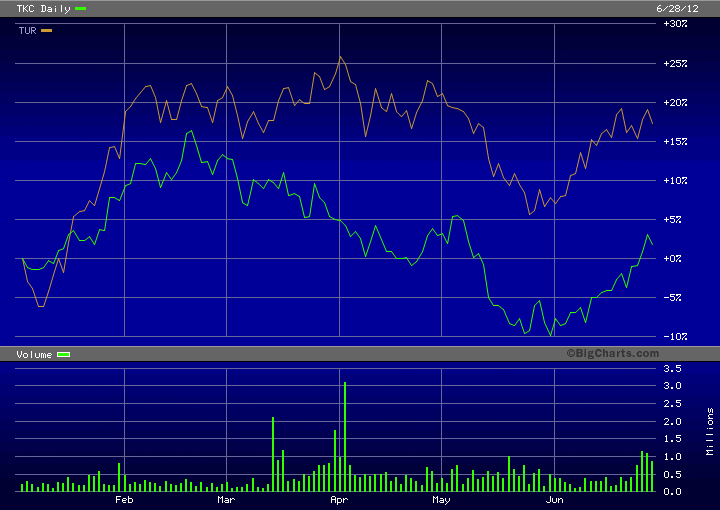
Though the boardroom fiasco is no doubt keeping a lid on Turkcell’s share price, its moves have not been out of line with the broader Turkish market (see chart). Turkcell and the iShares MSCI Turkey ETF ($TUR) have moved in virtual lockstep since hitting a bottom in early June.

Turkcell remains one of my favorite plays on the rise of the emerging market consumer, and I consider the stock to be very attractively priced. Shares trade for just 10 times forward earnings, and the company has very little debt.

The board impasse will be broken—eventually. And when it is, investors can expect a modest dividend windfall.

Until then, they will have to be content with owning an emerging-market gem with great growth prospects trading at a modest earnings multiple. Come to think of it, that doesn’t sound so bad.

Disclosures: TKC is held in Sizemore Capital accounts.

If you liked this article, consider getting Sizemore Insights via E-mail

Related posts:

G8 Summit Begins Today!

Source: ForexYard

printprofile

The focus is on the G-8 meeting today. Leaders from the Western economic powers and Russia meet in Italy on Wednesday and are joined the day after by leaders from China, India, Brazil and others to discuss global challenges. World leaders are also bound to express the hope that the worst of the global economic crisis is passing. Apart from the comments about global economic outlook, world leaders are expected to discuss potential ‘exit strategies’ of the aggressive stimulus plans.

Moreover, the market will be eager to see if there’s a discussion about a new reserve currency. World leaders, especially from emerging markets who have held enormous amounts of USD-denominated debts, have long been requesting for another dominant currency to replace the U.S. Dollar. The most delicate issue leaders will face in economic terms is probably China’s push for consideration of alternatives to the USD as the world’s reserve currency.

The Dollar already lost a cent versus the EUR at one stage last week when after it was reported that Beijing wanted the matter debated. Still, economists have said that the greenback is still the most important reserve currency of the day, and they believe that this situation will continue for many years to come. As for the outcome of the Italy summit, FX market players are wondering whether the BRICs, or China alone, will mount a serious challenge to the Dollar. But the fact remains that with a significant global recession, it’s important to aim for stability, and stability has been based on the U.S. Dollar as the global reserve currency.

Forex Market Analysis provided by ForexYard.

© 2006 by FxYard Ltd

Disclaimer: Trading Foreign Exchange carries a high level of risk and may not be suitable for all investors. There is a possibility that you could sustain a loss of all of your investment and therefore you should not invest money that you cannot afford to lose. You should be aware of all the risks associated with Foreign Exchange trading.

EUR Falls Broadly on Russian Downgrade

Source: ForexYard

printprofile

The EUR is trading near a two-month low against the Dollar on speculation the economic slump in Eastern Europe will cause the Euro-Zone’s recession to deepen, and markets are worried that Eastern Europe’s situation will get worse before it gets better.

The EUR was traded at 1.2852, up from 1.2849 late yesterday. It reached 1.2706 on February 2, the lowest level since December 5. The EUR also tumbled against the Dollar and the Yen after Fitch downgraded Russia’s long-term foreign and local currency ratings, sparking fears of a steep downturn in Eastern Europe. The European currency continues to have massive problems given the region’s association with Eastern European emerging markets as there are big Italian and German banks with large exposure there. Investors expect the currency to remain vulnerable for some time due to credit woes in Russia and Eastern Europe.

The EUR also weakened yesterday as the European Union’s (EU) statistics office in Luxembourg said retail sales fell 1.6% in December from a year earlier. Analysts say that in the Euro-Zone there is still a drip-feed of bad economic news, which is weighing on the EUR and keeping risk sentiment on the back burner. Data released earlier showed deterioration in Europe’s dominant services sector, and separate numbers showed Euro-Zone retail sales falling more than expected year-on-year in December. The EUR has also declined 1.6% to 88.76 against the British Pound after a report showed the U.K. services industry contracted less than forecast in January, and U.S. companies cut fewer jobs than previously expected.

Many economists expect, looking at the state of the Euro-Zone economy, another Interest Rate cut by the ECB this week. But even with low inflation expectations, Governing Council members have indicated that the ECB would not follow the U.S. Federal Reserve and the Bank of Japan (BoJ) in cutting rates to zero. With little room to cut Interest Rates, analysts are starting to look what else central banks have in store, especially whether the ECB would start to directly buy corporate debt.

Forex Market Analysis provided by ForexYard.

© 2006 by FxYard Ltd

Disclaimer: Trading Foreign Exchange carries a high level of risk and may not be suitable for all investors. There is a possibility that you could sustain a loss of all of your investment and therefore you should not invest money that you cannot afford to lose. You should be aware of all the risks associated with Foreign Exchange trading.

The EUR Maintains its Bearish Tone

Source: ForexYard

printprofile

The European currency retreated from gains made earlier in the week against its major counterparts. Against the USD it was down about 2% at $1.2889, after hitting a session low of $1.2875, and versus the Japanese currency, the EUR was down over 2% at 115.18 Yen. The EUR currency slipped on comments by European Central Bank (ECB) President Jean-Claude Trichet, who said that the ECB could cut key Euro-Zone Interest Rates below the current 2%, in addition to more unconventional measures.

The weak economic figures which came out of the Euro-Zone reversed any significant gains that the EUR made against the Dollar in recent days. The underlining weakness in the European economy was data showing that German unemployment posted its biggest increase in nearly four years in January. In addition, the European Commission said its index of executive and consumer sentiment declined to a record in January.

The index fell to 68.9, the lowest level since it was started in 1985. Analysts say that for many investors, the strategy appears to be simple: to avoid risk; which means funds are flowing out of the EUR and back into the Dollar and the Yen. The slowing economic growth of the Euro-Zone has prompted investors to repatriate funds from higher-yielding assets that might cause the EUR to decline further.

The EUR will likely to extend its downtrend into the middle of the next trading week as the Unemployment rate in the Euro-Zone raised in December to 8.0% its highest level since November 2006 and above the market’s forecast. Economists say that this data demonstrates just how strong disinflation pressures are in Europe and it will likely put more pressure on the European Central Bank to have further easing.

Forex Market Analysis provided by ForexYard.

© 2006 by FxYard Ltd

Disclaimer: Trading Foreign Exchange carries a high level of risk and may not be suitable for all investors. There is a possibility that you could sustain a loss of all of your investment and therefore you should not invest money that you cannot afford to lose. You should be aware of all the risks associated with Foreign Exchange trading.

Forex Trading Japan: Economy May Shrink by 0.8% in 2009

Source: ForexYard

printprofile

Japan’s Economic and Fiscal Policy Minister Kaoru Yosano said that the county’s economy may shrink by as much as 0.8% if economic woes continue at the current pace. According to Yosano, the only way to tackle the recession is by the government introducing a radical economic stimulus injection into the Japanese economy.

The country’s Tankan Survey reported that manufacturers in the world’s second-largest economy fell by their highest amount since 1974. Thus this in effect reveals that Japan is in her first recession since 2001.

One of the reasons for the decline in Japan’s economy is the strong Yen, which is about 25% stronger against the U.S. Dollar since the beginning of 2008. The main sector that has been hit is the manufacturing industry, which is significant as it makes up a large percentage of Japan’s economy. Additionally, Japan’s economy relies on exports of its manufactured goods. Things have deteriorated so much in Japan as of late, Honda, Japan’s major automaker cut it forecasted profits by over 60% this week.

Things are likely to remain volatile as Japan cut its Interest Rates to 0.1% earlier today in response to the U.S. Federal Reserve’s slash in its rates to 0.25%. The JPY is up about 70 pips against the USD since today’s market opened, and currently stands at around the 88.55 level. In the medium-turn, the Japanese rate cut may stabilize the Yen versus the Dollar. However, it is unlikely that the Dollar will make a dramatic recovery, and make gains to the levels it was a year ago.

Looking ahead to 2009, the Yen is likely to remain strong against the USD, and the Dollar may only recover to pre-2009 levels once the U.S. economy recuperates from the recession in the future. Additionally, Japan’s economy is likely to continue its deterioration into the 3rd quarter of 2009.

Forex Market Analysis provided by ForexYard.

© 2006 by FxYard Ltd

Disclaimer: Trading Foreign Exchange carries a high level of risk and may not be suitable for all investors. There is a possibility that you could sustain a loss of all of your investment and therefore you should not invest money that you cannot afford to lose. You should be aware of all the risks associated with Foreign Exchange trading.

Gold Gets “Shot in the Arm” from Europe, But H1 2012 Numbers Show Gold “Has Taken a Breather”

London Gold Market Report
from Ben Traynor
BullionVault
Friday 29 June 2012, 08:00 EDT

SPOT MARKET gold prices hit $1584 an ounce ahead of Friday’s US trading – a 2.3% rise from the previous day’s low – while stocks, commodities and the Euro also rallied following news of an “important” agreement at the European Union summit in Brussels.

Silver prices climbed to $27.38 by lunchtime in London – a 4.6% gain on yesterday’s low.

“Resistance [for gold prices] is at the top of the past week’s range in the $1587-88 area,” says technical analysts at bullion bank Scotia Mocatta, who add that further resistance is seen at $1625.

News of an agreement among European leaders on the use of bailout funds “”has been positive for the Euro and positive for confidence in general,” adds Scotia’s head of precious metals Simon Weeks.

“[This] means that equities and commodities, including gold for the time being, have all received a shot in the arm.”

European leaders meeting in Brussels have asked the European Council to consider proposals for the creation of a single Eurozone banking supervisor “as a matter of urgency by the end of 2012”, an summit statement issued early on Friday said.

The creation of a supervisory body could then be followed by allowing money from bailout funds to directly recapitalize banks, rather than being loaned to governments for that purpose, the statement continued.

“We affirm that it is imperative to break the vicious circle between banks and sovereigns,” said the statement from the EU summit, which continued Friday.

European leaders also confirmed that assistance given by the European Financial Stability Facility to Spain’s government – up to €100 billion to fund banking sector restructuring – will transfer to the permanent bailout fund the European Stability mechanism when it becomes operational next month.

The loans will transfer to the ESM “without gaining seniority status” over other Spanish government bonds.

The statement also included a commitment to use “existing EFSF/ESM instruments in a flexible and efficient manner in order to stabilize markets”.

“We have taken important decisions last night,” said German chancellor Angela Merkel, who prior to the summit expressed opposition to using bailout fund to buy bonds.

“We agreed that if countries need the instruments to buy bonds on the primary or secondary market from the EFSF or ESM then…conditionality would apply.”

A country report would need to be presented and a memorandum of understanding drawn up, Merkel added.

“That would be the case if Spain or Italy, with regards to their interest burden, make use of such instruments.”

Benchmark yields on Spanish 10-Year government bonds fell as low as 6.4% this morning, their lowest level this week. Italian 10-Year yields traded as low as 5.8%, also a weekly low.

“While not unwelcome, we do not see [the summit agreement] as a game changer,” says a note from Societe Generale.

“We remain concerned that the EFSF/ESM will be seen as lacking in both efficiency and size to offer credible support to Spain and/or Italy if requested. Attention is thus likely to turn again to the European Central Bank.”

European stock markets rallied this morning, with Germany’s DAX up around 2.5% by lunchtime, though it remained 1.6% off last week’s high. Spain’s IBEX index was up 2.7%, while Italy’s FTSE MIB gained 3.3%, although both indexes remained below June highs.

The Euro jumped 1.3% to $1.26 following the release of the summit statement, pushing Euro gold prices briefly below €40,000 per ounce Friday morning.

Based on London Fix prices, the gold price in Euros looked set by Friday lunchtime in London to end the second quarter of this year more or less where it began it. On a year-to-date basis, gold in Euros was heading for a 3.3% gain over the first half of the year. The Euro itself has lost around 3% against the Dollar during H1 2012.

Sterling gold prices by contrast looked set for a 0.8% H1 2012 loss, and a 2.8% loss over the second quarter. Gold prices in Dollars meantime were up slightly on where they started the year, but were sitting on a 4.9% quarterly loss by lunchtime in London, having given up gains made in the first three months of the year.

A PM London Gold Fix below $1581 per ounce would see gold record its largest quarterly loss since Q2 2004 – while a fix below $1553 would mark the worst quarterly performance this century.

“After 11 years [of gains] it is only natural that gold stops and pauses for breath before taking the next step higher,” says Ole Hansen, commodities strategist at Saxo Bank.

“The worry is obviously that momentum has been completely lost and leveraged players (such a hedge funds) have left the building…they will come back, but the market needs to reassert itself before that happens, as they are more followers than instigators of trends.”

Over in India meantime, Rupee gold prices fell to a two-week low Friday, as the Rupee gained against the Dollar, newswire Reuters reports.

“There was demand yesterday evening,” says Ketan Shroff, director at Pushpak Bullion in Mumbai.
“If prices are maintained at this level, we can see some buying.”

Gold demand in India, traditionally the world’s biggest market, was down 29% for the first quarter of 2012 compared to the same period last year. The Rupee has fallen around 25% against the Dollar over the last 12 months – while India’s government has twice raised its import duties on gold bullion since the start of 2012.

Ben Traynor
BullionVault

Gold value calculator   |   Buy gold online at live prices

Editor of Gold News, the analysis and investment research site from world-leading gold ownership service BullionVault, Ben Traynor was formerly editor of the Fleet Street Letter, the UK’s longest-running investment letter. A Cambridge economics graduate, he is a professional writer and editor with a specialist interest in monetary economics.

(c) BullionVault 2011

Please Note: This article is to inform your thinking, not lead it. Only you can decide the best place for your money, and any decision you make will put your money at risk. Information or data included here may have already been overtaken by events – and must be verified elsewhere – should you choose to act on it.


Central Bank News Link List – June 29, 2012

By Central Bank News
    Here’s today’s Central Bank News link list, click through if you missed the previous link list. The list is updated during the day with the latest news about central banks so readers don’t miss any important developments.

www.CentralBankNews.info