BKW: Will the Whopper Make a Comeback?

Article by Investment U

BKW: Will the Whopper Make a Comeback?

If your mind is set on owning a stock for the long haul in the traditional fast food industry, I don’t think BKW is the one right now.

With all the hoopla surrounding Mr. Zuckerberg and the Facebook IPO in the spring, other companies going public were overlooked.

You’d think a brand name like Burger King (NYSE: BKW) would garner some more attention than it did. However, its return to public trading and its background is a little peculiar. But its June 20 IPO passed with very little hoopla. Here’s why:

Back in early April, Burger King Worldwide Holdings Inc. (NYSE: BKC) announced it would go public again. The fast food chain was just taken private in 2010 by New York investment firm 3G Capital Inc. Here are the terms of the deal…

3G will get $1.4 billion in cash to transfer Burger King to special-purpose acquisition company (SPAC) Justice Holdings Ltd.

Justice Holdings will get a 29% piece of Burger King, which gives the third-largest burger joint an equity value of about $4.8 billion. This doesn’t seem like your run-of-the-mill initial public offering – and that’s because it’s not.

Let’s look at some of the deal’s peculiarities:

  1. What’s a special-purpose acquisition company? Well, it’s a publicly traded buyout company that raises money so it can buy a desired existing company. SPACs raise pools of cash for the possibility of a future merger. Most of the time, the SPAC is looking to deal in a specific industry. For this reason, many refer to these types of deals as a reverse IPO. The money is raised first just for the sake of going public. After that’s done, then they worry about a company to buy.
  2. Wasn’t the company just taken private two years ago? 3G Capital Inc. paid $3.3 billion for Burger King about 20 months ago. It’s still the biggest restaurant takeover in the last 10 years.

Trying to Be More Competitive

Right before they announced they were going public again, Burger King introduced its new menu. Now stores offer all types of new foods like salads, smoothies and chicken snack wraps.

Then BKW got rid of its long-running – sometimes disturbing – King mascot last year in an attempt to appeal to a wider spectrum of consumers. Apparently marketing found that a mute King with a permanent creepy smile just doesn’t appeal to women and children…

And finally, BKW tried to remodel their stores to a so-called 20/20 redesign model that gives them a more industrial and contemporary look.

So, is there any indication that the changes made a difference?

Well the jury is still out…

The Vital Points to Consider:

Last Year’s Numbers

Burger King reported to the SEC net income of $107 million on revenue of $2.34 billion. What’s really not good is its seven consecutive quarters of negative comparable sales in the United States and Canada. Sales at restaurants that were open for at least 13 months dropped .5%.

An Increase in Debt

When 3G Capital took Burger King private in October 2010, it had an equity valuation of $3.3 billion and about $700 million in debt. As of the June 20 public offering, the equity valuation is $5.1 billion and total debt is $3.1 billion. Debt has increased by four times in 20 months with little to show for it. It’s of note that many of these private companies will use takeovers as an ATM machine. They takeover the company and rack up a bunch of debt and then reintroduce them to the public.

3G Capital claims that the new debt went into improving Burger King’s operations and competitive positioning. But can you really say that a period of less than two years is a plausible length of time to turn around a company? And where are the vast improvements? Morningstar commented: “This is a pretty quick turnaround to be going public again, especially when a lot of their fundamentals still seem to be lagging a number of their competitors.” Caveat Emptor!

Competitiveness in the Industry

Here are four major points that put BKW at a competitive disadvantage:

  1. Burger King has about 12,512 restaurants, but for years, it struggled against sector leader McDonald’s (NYSE: MCD). To make matters worse, Wendy’s (Nasdaq: WEN) recently took the No. 2 spot in fast-food burger joints. We haven’t even discussed the infringements that companies like Panera Bread (Nasdaq: PNRA) and Chipotle (NYSE: CMG) made on the burger world.
  2. Even with its new menu, Burger King isn’t innovative in the fast food industry. It’s attempting to keep pace with McDonald’s, which already has similar items on its menu.
  3. More than half of Burger King’s restaurants are located in three states: Florida, North Carolina and Indiana. If it hopes to ever get back in the game against old and new rivals, it’s going to have to venture out, not just internationally, but also domestically.
  4. As far as the economy is concerned, things won’t be looking that rosy for the industry. A lack of job creation coupled with economic uncertainty could have an adverse affect on the industry. Input costs like wheat and corn are presently expensive and creeping upwards even more. McDonald’s is strong enough to weather these storms. The jury is still out on Burger King

The Bottom Line

Should you own this stock going forward? Well, the truth is, no one is sure change is around the corner. Attempts at change have been going on for years with nothing to show for it.

If your mind is set on owning a stock for the long haul in the traditional fast food industry, I don’t think BKW is the one right now.

Good Investing,

Jason Jenkins

Article by Investment U

Monetary Policy Week in Review – June 30, 2012

By Central Bank News

    The past week in monetary policy saw interest rate decisions by five central banks around the world, with two cutting rates due to a slowing economy and lower inflationary pressure. The other three central banks left rates unchanged.
    
    MONETARY POLICY DECISIONS:
    
    COUNTRY                NEW RATE            PREVIOUS RATE         RATE 1 YEAR AGO
    
    ISRAEL                        2.25%                        2.50%                               3.25%   
    HUNGARY                   7.00%                        7.00%                               6.00%
    ROMANIA                    5.25%                        5.25%                               6.25%

    CZECH REPUBL          0.50%                        0.75%                               0.75%

    COLOMBIA                  5.25%                        5.25%                              4.50%

    NEXT WEEK:

    Looking at the central bank calendar for next week, Australia kicks off the meeting schedule but the focus will remain largely in Europe with policy decisions by both the Bank of England and the European Central Bank.
    
    The Reserve Bank of Australia is expected to keep its benchmark cash rate unchanged at 3.5 percent following cuts in June and May.
    
    The National Bank of Poland: The fight to curtail inflation is the main factor governing monetary policy decisions in Poland with the bank raising rates by 25 basis points in May to the current 4.75 percent, the fifth rate rise since the beginning of 2011. The bank has said that inflation and growth forecasts will be a factor in determining the decision of the July 3-4 council meeting. In May inflation eased to 3.6 percent from 4.0 percent. The central bank’s goal is inflation of 2.5 percent.
    
    Sweden’s Riksbank: The Swedish central bank has room to cut rates with economic growth slowing and inflation below the bank’s 2 percent target. However, in April the bank said interest rates were likely to remain unchanged for more than a year. It’s last rate cut was in December 2011 to the current 1.5 percent.
    Central Bank of Malaysia: Expected to maintain benchmark overnight policy rate (OPR) at 3 percent. The committee said at its last meeting in May that it expected domestic demand to continue to grow despite the impact from global developments.

    Bank of England: Widespread expectation that the central bank will keep its interest rate unchanged but raise its target for purchasing bonds by at least 50 billion pounds following last month’s meeting when the nine-member Monetary Policy Committee voted 5-4 to keep the target at 325 billion pounds.

    The European Central Bank: Expectations for either a rate cut, which was already discussed at last month’s meeting, or some form of additional quantitative easing given the recession in the euro area. The ECB’s main refinancing rate was cut to 1.0 percent in December, 2011.
     MEETINGS:

Jul-03
AUD
Australia
Reserve Bank of Australia
Jul-03
PLN
Poland
National Bank of Poland
Jul-03
SEK
Sweden
Bank of Sweden
Jul-05
MNR
Malaysia
Central Bank of Malaysia
Jul-05
GBP
United Kingdom
Bank of England
Jul-05
EUR
Eurozone
European Central Bank


www.CentralBankNews.info


LIBOR – The Banking Scandal That Could Cause A Riot

By MoneyMorning.com.au

This is the biggest banking scandal in years – and that’s saying something.

Some of the biggest names in banking are being torn down, and heads are rolling.


The latest scalp is the Chairman of the world’s 4th biggest bank – Barclays Plc.

Barclays faces an industry record fine to boot: $451 million. That’s close to half a billion dollars.

It won’t stop with Barclays.

Many of the other global banking monoliths are heading for the gallows. The world’s 3rd biggest bank, HSBC, and the world’s 11th biggest, Lloyds, are being investigated.

Royal Bank of Scotland (RBS), the 5th biggest bank, is also under the microscope.

This is where things could get really sticky, as RBS is 82% publicly owned. So any fine will be mostly paid by the favourite cannon-fodder of the banking system – the taxpayer.

You’d think that this would be just too bitter a pill for the UK taxpayer to swallow. This is riots-in-the-streets material.

Will your editor’s fellow poms go and sharpen their pitchforks, or have another good old grumble over a cup of tea instead? With the 2012 Olympics around the corner, the last thing the government needs is a mass protest.

But what has amazed me is how little bile the public has expressed over this whole mess. Make no mistake – this is an atomic bomb going off in the banking sector – and yet there is hardly any talk about it at all.

The LIBOR Scandal

I’m talking about the London Interbank Offered Rate (LIBOR) scandal.

This banking scandal makes Bernie Madoff’s antics look like a mild case of teenage shoplifting.

Perhaps the reason no one seems to give a damn is that the term LIBOR means nothing to them. I suspect the less-than-catchy name makes it easier to stop anger from crossing over into mainstream awareness.

Yet LIBOR is the most traded interest market in the world. It is the reference point for $360 trillion in contracts worldwide.

It underpins everything in the global markets from, bond markets, to mortgage rates, and even right down to loans for small-cap mining stocks. For example, the latest Diggers and Drillers stock tip plans to raise its debt financing at a rate dependent on LIBOR.

The idea is that the banks set the rate between them each day according to how much spare cash they have, or how big a gap there is in their balance sheet. In essence it is supposed to use market forces to determine the cost of borrowing any spare cash.

But traders at these biggest banks have been using their firepower to manipulate LIBOR rates in their favour. Traders were tweaking it so they could trade profitably against it.

Some of the banter between these traders beggars belief. Anyone who has the concept that the bond market is full of humourless Swiss banker types may need to reconsider. Take a look at some of these quotes released through the investigation:

‘Dude. I owe you big time! Come over one day after work and I’m opening a bottle of Bollinger.’

‘[…]if you know how to keep a secret I’ll bring you in on it […]
we’re going to push the cash downwards on the imm day […]
if you breathe a word of this I’m not telling you anything else […]
I know my treasury’s firepower…which will push the cash downwards […]
please keep it to yourself otherwise it won’t work.’

‘This is the way you pull off deals like this chicken, don’t talk about it too much, 2 months of preparation […] the trick is you must not do this alone […] this is between you and me but really don’t tell ANYBODY.’

‘Duuuude… whats up with ur guys 34.5 3m fix…tell him to get it up!!’

Well it’s great to know the core of the financial system is being run by such smart and honest folk.

This outrageous scandal is simply another nail in the coffin for the credibility of the banking system. It sets a new low.

The truth may only be coming out now, but all this went down about 5 years ago, just as the credit bubble was starting to pop. Back in that credit-fuelled euphoria, banks’ trading desks were full of invincible 20-year olds wearing ten-thousand-dollar watches.

The Governor of the Bank of England, Mervyn King, is not having a good week. He just told reporters that thanks to Europe he reckons we are not even halfway through the financial crisis. Now he has the LIBOR scandal on his plate. Over the weekend he said:

‘Everyone now understands that something went very wrong with the UK banking industry, from excessive levels of compensation, to shoddy treatment of customers, to a deceitful manipulation of one of the most important interest rates, we can see that we need a real change in the culture of the industry.’

A real change in the ‘culture’ of the industry? That’s like saying a convicted murderer needs a haircut, a new wardrobe and some elocution lessons.

The Libor Scandal is Just Beginning

What the banks responsible for this need is far more drastic. A few prison sentences for the traders manipulating the biggest interest rate market in the world would be a good start.

One thing is for sure is that this is just the start of the LIBOR scandal. It will drag on for years as more comes out of the woodwork. The only winners will be the lawyers, as always.

But somehow I have a horrible feeling that the jaded public will soon lose interest in ‘this LIBOR business’, and the whole thing will end up as just be another chapter in the ever bigger book of banking crimes. I dearly hope not.

But if so, the banking sector will have got away with it yet again.

White collar criminal: 1, Johnny taxpayer: 0.

Dr. Alex Cowie
Editor, Diggers & Drillers

Related Articles

Market Pullback Exposes Five Stocks to Buy

How Gold Prices Look Set to Climb As Banks Crumble

‘Big Wednesday’ For the Aussie Dollar


LIBOR – The Banking Scandal That Could Cause A Riot

‘Super Brussels’ Saves The World Again: Maybe!

By MoneyMorning.com.au

The Pavlovian response of financial markets to the European leaders’ summit of 28th and 29th June 2012 was remarkable. The frugal communiqué of 322 words fired the ‘animal spirits’ of financial markets, which now believe that the European debt crisis has been ‘solved’. As comedian Robin Williams joked, ‘reality is just a crutch for people who can’t handle drugs.’

The summit supported a single regulatory body for all European banks.

The previously agreed €100 billion capital injection for Spanish banks was ratified. Payments will now be made directly by the European Financial Stability Fund (EFSF) and its successor the European Stability Mechanism (ESM) to the banks rather than as loans to the relevant country. Loans will also not have priority of repayment over commercial lenders.

The EFSF/ ESM will take whatever actions are ‘necessary to ensure the financial stability of the euro area… in a flexible and efficient manner.’ This was taken to mean that they will purchase bonds of beleaguered countries like Spain and Italy to reduce the cost.

The European Union will provide €120-130 billion of financing for investment to boost growth.

The language was vague and the details sketchy. After the meeting German Chancellor Angela Merkel told the Bundestag that ‘differing communications’ from various Euro-Zone leaders about the exact agreement had ‘led to a whole number of misunderstandings.’

The initiatives may require complex and time-consuming changes in European treaties.

The German Constitutional Court must rule on some aspects of the current proposal.

In essence, implementation risks remain.


Conditional…

Bank recapitalisation will require the establishment of the EU central bank supervisory body, which should only be ‘considered’ by the Council before the end of 2012. Given issues of national control and sovereignty, the risk of delays and failure of agreement are not insignificant.

Capital injections are subject to unspecified ‘economy wide’ conditions. One potential condition could be that the national government compensate the EFSF or ESM for any losses. This is what Germany sought pre-summit, arguing that the EU could only lend to sovereigns, not foreign banks over which it had little or no control.

Routing funding directly does little to break the deadly nexus between European banks and their sovereigns. It does not address the fact that the banks are heavily exposed to sovereigns and this exposure will increase over time. It does not address the banks reliance on the European Central Bank (ECB) for funding.

The fact that bailout funds will not have repayment priority is not a change. As investors in Greek bonds discovered, the EU can, if they wish, retrospectively change the terms to subordinate commercial creditors in any case.

While the exact terms of any capital injection are unknown, the proposal creates a perverse incentive for the EU, especially Germany, to push for existing shareholders and bondholders in Spanish banks to absorb losses prior to the injection of new funds. This will be resisted by both investors and possibly the government, making it difficult to implement.

The potential for EFSF/ ESM purchases of Spanish and Italian bonds to provide funding and manipulate interest rates was actually agreed last year. It requires a member state to request assistance and execute a Memorandum of Understanding, which involves less onerous conditions than those applicable to a full bailout. The 29th June 2012 statement confirms that any assistance would be conditional.

The ECB already has the ability to intervene by purchasing bonds under its Securities Markets Programme. In fact, bond purchases by the ESM may reduce buying by the ECB, meaning less, rather than more support.

The growth initiative amounts to only 1% of Euro-Zone Gross Domestic Product (GDP). It was a repackaging of existing unspent funds and is unlikely to be operational quickly.

The summit communiqu?did not mention any progress on a Europe-wide deposit insurance scheme to limit capital flight from peripheral countries, although this may be a matter for the new European super bank regulator.

Where’s the Money…

There was no commitment of new money of any kind. Since mid-2011, Germany has succeeded in ensuring that existing bailout facilities are not increased.

The ability of the EU to support the peripheral nations on an ongoing basis is questionable.

The €440 billion of the EFSF is largely committed to the Greek, Irish and Portuguese bailouts, as well as the €100 billion required for Spanish banks. After the new ESM is fully implemented, there will be at most €500 billion available.

Potential requirements include a third bailout for Greece and further assistance for Ireland and Portugal. Additional money for recapitalising European banks may be needed. Spain and Italy have financing requirements of around €600 billion in the period to 2014, mainly to pay maturing debt.

This also assumes that the EFSF (which is backed by guarantees from Euro-Zone Members including Spain and Italy) and the ESM (which will require capital contributions totalling €80 billion from all Euro-Zone members) can finance its activities.

Support from the International Monetary Fund (IMF) is uncertain. The lack of conditions and supervision of loans may be a barrier to IMF participation. Domestic politics within the US in a Presidential year may also limit flexibility.

Arithmetical Impossibility…

The cost of support for the peripheral nations is rising. The ECB has provided over €2 trillion in the form of bond purchases and funding for European banks. Euro-Zone members are directly and indirectly supporting the two European bailout funds -the EFSF and ESM- for around €1 trillion. National central banks in Germany, Netherlands, Finland and Luxembourg have provided more than €700 billion in financing for weaker nations.

Even without agreement on Euro-Zone bonds, mutualisation of debt is already a fact as stronger countries, especially Germany and France, effectively underwrite these facilities. As more financing for weaker nations moves to official institutions, the commitment will increase.

Germany faces potential losses of between €800 and €1.4 trillion (up to 40% of its GDP). France also faces large losses. Chancellor Merkel has increasingly emphasised that Germany’s financial strength is not infinite.

The monetary arithmetic of European debt problems looks unsustainable.

The EU may simply not have enough funds to carry out their programs, unless the bailout funds are increased in some way or the ECB follows the US, UK and Japan into full scale quantitative easing to monetise European sovereign debt. As those countries have found, such measures also do not represent a simple solution.

Political Impossibility…

In the short run, the ECB will probably lower rates and continue to provide liquidity to manage the risk of financial collapse. But the deep seated problems remain.

The real economy – growth, employment, investment, capital flight out of weak nations – will continue to be problematic. The economic performance of stronger countries like Germany will deteriorate. The problems of the financial system – loan losses, funding difficulties – will continue. Weaker sovereigns will continue to face challenges in raising funds at acceptable costs.

The problems are increasingly political.

The June Summit highlighted deep fissures within the Euro-Zone itself. Germany, which is substantially bearing the financial burden of the European debt bailouts, finds itself increasingly vilified and isolated.

Spanish, Italian and French newspapers and political commentary were triumphant, depicting the summit as a humiliating back down by Germany. Northern European countries aligned with Germany have expressed concern about weaker conditions for aid to the indebted European countries. Dutch financial daily Het Financieele Dagblad wrote that ‘the southern euro countries are taking the north hostage.’

While her political position remains relatively secure, the German Chancellor faces increasing domestic criticism for providing assistance without extracting agreement to suitably tough conditions from recipients.

Chancellor Merkel insists that German taxpayers’ money will not be committed without strict conditions. She has reiterated that there was no increase in German guarantees for the Euro-Zone rescue funds and no jointly guaranteed Euro-Zone bonds to finance weaker states.

She insists that the commitment to use the EFSF/ ESM to buy sovereign bonds for countries facing market pressure would be conditional. Spain and Italy’s gleeful boasts of unconditional aid does not square with Dutch and Finnish insistence that any money would require compliance with strict conditions.

Germany and the Northern European countries’ willingness to continue to finance the existence of the Euro-Zone may be weakening.

At the summit, the joke of the day was that Germany lost 2-1 to Italy in the semi-finals of 2012 European soccer championship in Warsaw but lost 16-1 at the EU summit in Brussels! Italian Prime Minister Mario Monto, with uncharacteristic indiscretion, boasted that ‘it is a double satisfaction for Italy’, referring to Italian victories over Germany in both soccer and the debt negotiation.

Spain, Italy and France may well live to regret their triumphalism in antagonising their paymasters. The Euro-Zone itself seems the loser in the longer term.

Real Impossibility…

Despite progress, European leaders refuse to acknowledge that a portion of the debt of the peripheral nations is unrecoverable. None of steps announced improves the sustainability of the debt levels of the affected countries, their access to markets or cost of borrowing in the medium to long term. Ultimately, it is not possible to solve the problem of excessive indebtedness with more debt or by simply changing the lender.

Austerity dooms Europe to a prolonged contained depression as the debt burden is worked off. The alternative, a debt write-off, would result in significant loss of wealth for the mainly European lenders and investors, triggering an economic contraction and prolonged period of economic stagnation. There are now limited policy options available.

For the moment, investors and the non-German members of the Euro-Zone are celebrating. It would be wise to remember American writer Edgar Howe’s observation that, ‘There is nothing so well known as that we should not expect something for nothing – but we all do and call it hope.’

Satyajit Das
Contributing Writer, Money Morning

2012 Satyajit Das All Rights Reserved.

Satyajit Das is author of Traders Guns & Money and Extreme Money.

From the Archives…

The Hard Lesson of a Stock Trader: No Pain, No Gain
2012-06-29 – Kris Sayce

How Gold Prices Look Set to Climb As Banks Crumble
2012-06-28 – Peter Krauth

‘Big Wednesday’ For the Aussie Dollar
2012-06-27 – Dr. Alex Cowie

Three Reasons Why Silver Could Take Off in 2012
2012-06-26 – Dr. Alex Cowie

Who is Winning the Battle Between the Bulls and Bears?
2012-06-25 – Kris Sayce


‘Super Brussels’ Saves The World Again: Maybe!

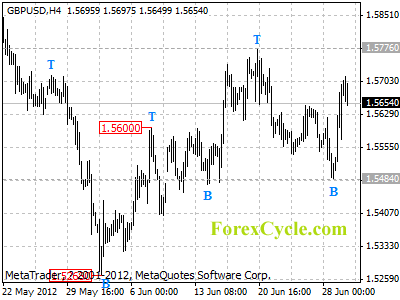
GBPUSD rebounded strongly from 1.5484

GBPUSD rebounded strongly from 1.5484, suggesting that a cycle bottom had been formed on 4-hour chart. Further rise to test 1.5776 resistance could be expected, a break above this level will signal resumption of the uptrend from 1.5268, then next target would be at 1.6000 area. However, as long as 1.5776 resistance holds, the rise from 1.5484 could possibly be correction of the downtrend from 1.5776, and another fall towards 1.5268 is still possible.

gbpusd

Forex Signals

Central Bank News Link List – July 2, 2012

By Central Bank News

    Here’s today’s Central Bank News link list, click through if you missed the previous link list. The list is updated during the day with the latest news about central banks so readers don’t miss any important developments.

www.CentralBankNews.info

Investing in Israel’s Epic Oil and Gas Boom

Article by Investment U

When I think of Middle Eastern nations with massive oil and gas reserves, Israel isn’t a country that comes to mind… ever, really.

After all, Israel still imports 99% of its oil and 70% of its natural gas.

In fact, for the last 60 years, energy companies there have basically drilled one dry hole after the next.

But that’s all getting ready to change in the coming years thanks to new drilling capabilities.

And Israel is set to shake up the energy landscape in the Middle East like no one has ever seen before.

Israel: An Energy Giant in the Making?

Last week, Israel Opportunity Energy Resources LP discovered an offshore oil and gas field with an estimated 1.4 billion barrels of oil and 6.7 trillion cubic feet of natural gas.

According to the company’s Chairman, Ronny Halman, “The quantity of gas discovered… makes it the third-largest offshore discovery to date.”

It follows last June’s announcement of uncovering 16 trillion cubic feet of natural gas and 800 million barrels of oil in Israel’s Tamar and Leviathan offshore fields.

Yet, for Israel, these discoveries are only the beginning. And investors should pay close attention.

That’s because Israel’s largest oil and gas opportunities aren’t offshore. They’re on land in the nation’s shale deposits.

As The Wall Street Journal reports, “The World Energy Council estimates Israel’s shale deposits, located some 30 miles southwest of Jerusalem, could ultimately yield as many as 250 billion barrels of oil.”

To put this into perspective, Israel could soon be the world’s third-largest nation in terms of proven oil reserves… behind Venezuela – which took the top spot last year – and Saudi Arabia.

To get an idea of the scope of these massive reserves, it would potentially be enough to cover the United States’ entire oil needs for the next 35 years.

Of course, not everything is hunky-dory. The biggest problem Israel faces right now is that the country isn’t prepared to handle such a dramatic increase in oil and gas production.

Translation: This is no short-term play.

But there are a number of ways to potentially cash in as Israel works to become one of the world’s leading energy providers… that is, if you can stand to wait.

Stocks and ETFs

The safe way to play Israel’s oil and gas boom is the iShares MSCI Israel Capped Investable Market Index Fund (NYSE: EIS).

That’s because, with such massive discoveries there, Israel’s entire economy is set to prosper for several years as it ramps up its oil and gas exports and slashes its imports.

EIS is designed to capture this overall growth by mimicking Israel’s broad-based equity market performance.

And, the best part, this ETF is likely trading at a hefty discount.

You see, one thing to watch for in ETFs is the fund’s net asset value, or NAV.

Typically, when a fund’s share price is trading for more than the NAV, it’s trading at a premium. When the price is less than the NAV, it’s trading at a discount.

In my experience, the best time to buy an ETF is when the share price trades at a discount of 20% or more to the NAV.

As I write, EIS is trading at $36.39 and its NAV is at 55.98. By this measure, that means EIS is currently trading at a 34% discount.

But there’s another play to keep on your watch list, as well

The company is called Genie Energy Ltd. (NYSE: GNE), a spin-off of IDT Corporation (NYSE: IDT).

Not many investors know this, but when it comes to Israel, Genie has an 89% interest in a private oil and gas drilling company out of Jerusalem called Israel Energy Initiatives (IEI).

IEI already holds the rights to a shale deposit in Israel that could contain as much as 40 billion barrels of oil.

This puts Genie in a perfect position to ride Israel’s oil and gas boom all the way to the bank. And for a company with a market cap of just $180 million, the sky really is the limit.

In terms of energy, over the next 10 years we’re going to see changes take place in the Middle East like we’ve never experienced before.

Just by preparing today for these changes, you could find yourself sitting on a windfall of gains in the not-too-distant future.

Good Investing,

Mike Kapsch

Article by Investment U

The Safest Way to Invest in Commodities

Article by Investment U

I’ll never forget my first visit as a teenager to the commodity trading pit of Chicago’s Mercantile Exchange (CME). The swirling bright-colored jackets, the shouting and rapid hand signals (looked like arm wrestling to me) was captivating and reminded me of past family gatherings.

It was also the polar opposite of my later visit to the currency trading floor of JP Morgan at 1 Wall Street – row after row of white shirts hunched over computer screens and dry IMF statistics.

Commodities sure looked like more fun to me.

My image of commodity markets hasn’t changed all that much since. It’s a volatile and wild ride where even a tiny bit of new information affecting supply or demand can send prices spinning. Weather, transportation costs, economic forecasts, currency movements and many other factors go into how prices change minute to minute.

I approach commodities trading cautiously since expert traders focused all day on one commodity, such as wheat, get it wrong as often as they get it right.

Still, I have to admit, the idea of making or losing a pile of money in a very short time gets my blood pumping.

So how should you approach commodities and what should you do right now?

The Game Has Changed

Even a decade ago, most individual investors didn’t think of investing in commodities except through companies like Alcoa (NYSE: AA) for aluminum, Freeport-McMoRan (NYSE: FCX) for copper and Comstock Resources (NYSE: CRK) for natural gas.

But the game has changed.

Online brokerage accounts and the arrival of exchange-traded funds (ETFs) and notes (ETNs) give individual investors the chance to get into the game with just the click of a mouse.

The choices are staggering:

  • Coffee – iPath Coffee (NYSE: JO)
  • Sugar – iPath Sugar ETN (NYSE: SGG)
  • Lead – iPath Lead ETN (NYSE: LD)
  • Nickel – iPath Nickel ETN (NYSE: JJN)
  • Corn – Teucrium Corn Fund (NYSE: CORN)
  • Grains – iPath Grains ETN (NYSE: JJG)
  • Cotton – iPath Cotton ETN (NYSE: BAL)
  • Tin – iPath Tin ETN (NYSE: JJT)
  • Aluminum – iPath Aluminum ETN (NYSE: JJU)
  • Silver – iShares Silver Trust (NYSE: SLV)
  • Oil – iPath S&P GSCI Crude Oil Total Return (NYSE: OIL)
  • Palladium – ETFS Physical Palladium Shares (NYSE: PALL)
  • Natural gas – iPath Natural Gas ETN (NYSE: GAZ)
  • Timber – Claymore Beacon Global Timber Index (NYSE: CUT)
  •  Livestock – iPath Livestock ETN (NYSE: COW)

The “Core-Explore” Commodity Strategy

Given the complexity and volatility involved in commodities investing, you must have an established strategy if you plan on having any success. So here’s an easy one:

Rule No. 1: Having a small allocation in a broad basket of commodities in your core portfolio makes a lot of sense.

This should make your overall portfolio less volatile and help preserve capital since commodities don’t usually move lockstep with stocks. In addition, raw materials provide you with a natural inflation hedge.

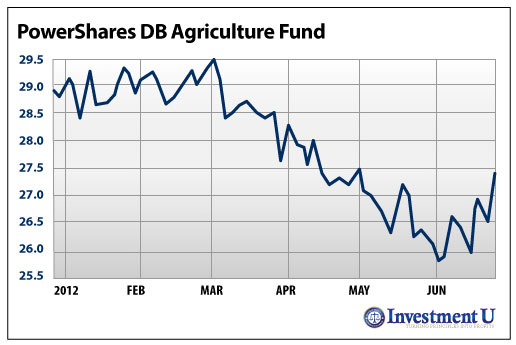
A great conservative play right now would be the PowerShares DB Agricultural ETF (NYSE: DBA). These agricultural commodities are down this year and tend to be less volatile than precious or industrial metals. In addition, the long-term bull story of a world population growing at a rate of 200,000 a day plus rising incomes driving higher food prices is very convincing.

The Safest Way to Invest in Commodities

To meet this growing demand, the World Bank estimates that farms worldwide will have to produce more food in the next 50 years than it did in the previous 10,000 years.

Here are the commodity weightings in this basket as of June 26:

  1. Soybean: 16.11%
  2. Corn: 14.17%
  3. Live Cattle: 12.39%
  4. Sugar: 10.97%
  5. Cocoa: 9.75%
  6. Coffee: 8.48%
  7. Lean Hogs: 8.25%
  8. Wheat: 6.71%
  9. Wheat (Kansas Wheat): 6.53%
  10. Cattle (Feeder Cattle): 4.45%
  11. Cotton: 2.19%

Rule No. 2: For your trading portfolio, explore for commodities that have pulled back sharply.

So far in 2012, the perception of a weakening world economy has driven many commodities lower. Industrial metals do well when the world economy is thriving. The concern that the world economy is slowing has hit them pretty hard in recent months.

This is exactly why you should be getting interested in these industrial metals. You want to get in when markets have pulled back and, even better, when they’re beginning to trend up. Keep an eye on the iPath Industrial Metals ETF (NYSE: JJM). The lower entry price gives you some downside protection, but remember to always have a sell stop in place in case markets move against you.

Now get out there and add some commodities to your global portfolio today.

Good Investing,

Carl Delfeld

Article by Investment U

Market Review 29.6.12

Source: ForexYard

printprofile

The euro shot up close to 180 pips against the USD in overnight trading after euro-zone leaders announced that they would take emergency steps to bring down borrowing costs in Spain and Italy. The EUR/USD is currently trading at 1.2590. Other riskier currencies benefited from the news as well. Both the AUD/USD and GBP/USD have gone up more than 150 pips since last night and are respectively trading at 1.0177 and 1.5661.

Main News for Today

EU Summit-All day

• Following last night’s announcement that EU leaders would work to bring down borrowing costs in Spain and Italy, investors will be closely watching for any additional developments out of the summit
• Any additional news on ways to combat the euro-zone debt crisis could lead to additional gains for the EUR

UK BOE Gov King Speaks-09:30 GMT

• The Bank of England Governor is expected to give a speech regarding further monetary easing steps to boost the British economic recovery
• If additional monetary easing is announced, the pound could extend last night’s gains against the USD

Read more forex news on our forex blog

Forex Market Analysis provided by ForexYard.

© 2006 by FxYard Ltd

Disclaimer: Trading Foreign Exchange carries a high level of risk and may not be suitable for all investors. There is a possibility that you could sustain a loss of all of your investment and therefore you should not invest money that you cannot afford to lose. You should be aware of all the risks associated with Foreign Exchange trading.

Why the Google Nexus 7 Tablet is a Poorly Aimed Shot at Rivals

By MoneyMorning.com.au

While impressive in many ways, the Google Inc. Nexus 7 tablet unveiled will struggle in a market already teeming with offerings from other tech titans.

Key competitors include tablet market leader Apple Inc. (Nasdaq: AAPL), Samsung Electronics Co. (PINK: SSNLF), Amazon.com (Nasdaq: AMZN) and as of last week, Microsoft Corp. (Nasdaq: MSFT).

The 7-inch Nexus 7 certainly has a lot going for it, primarily its 1,280 x 800 pixel high-definition screen, a powerful quad-core NVIDIA Corp. (Nasdaq: NVDA) Tegra 3 processor and a reasonable price tag. It will run a new upgrade to Android called Jelly Bean.

Apparently the Google tablet, actually built by Asustek Computer (PINK: AKCPF) and co-branded with Google, is intended to re-energize a moribund Android tablet market that has failed to dent the dominance of the iPad.

“The tablet market is a major challenge for Google at this point,” Clayton Moran, an analyst at Benchmark Co. told Bloomberg News. “They need to have a competitive product with the iPad.”

Another goal for the Nexus 7 is to show other Android tablet makers how Google thinks it should be done. Analysts suspected similar reasoning behind the Microsoft Surface tablet unveiled last week.

Finally, Google said it wanted to use the tablet to push users toward its services like YouTube and promote sales of its apps through its Google Play store. With the Nexus 7 priced so low, Google will need to sell such extras to make any money.

It’s ambitious, but a flop could end up doing more harm than good to the Android platform.

The central problem for the Nexus 7 is not that it’s a poor product, but that it doesn’t have an obvious niche in today’s crowded tablet market. The Google tablet faces established competition from top to bottom – and especially at the bottom.

The Tablet Breakdown

The Apple iPad: According to research firm IDC, Apple’s tablet controlled 70% of the worldwide market in the first quarter of 2012. The tight integration of the hardware and software – both made by Apple – and vast app ecosystem has made the iPad the king of the tablets. Its starting price is well above the Nexus 7, but then the iPad screen is significantly larger at 9.7 inches. As usual, Apple owns the top end of the market. Given the Nexus 7′s smaller size and the iPad’s advantages, it’s unlikely Google ever intended its tablet as an iPad killer.

The Microsoft Surface: Although the Windows 8-powered Surface faces its own uphill battle against the iPad, it does present another high-end choice to tablet shoppers. Like the iPad, the larger form-factor and (expected) higher price of the Surface make it an unlikely direct competitor to the Nexus 7.

Other Android Tablets: With its impressive specs, Google’s Nexus 7 beats pretty much every other 7-inch Android tablet out there. If those devices were all Google had to worry about, it might have a success on its hands. But one 7-inch Android tablet in particular stands in the way…

That tablet would be The Amazon Kindle Fire. Looking at the Kindle Fire, it’s clear that this is really the product Google had in its crosshairs. Like the Nexus 7, the Fire is a color, 7-inch tablet. It runs an Amazon-modified version of Android.

And like the Nexus 7, the Fire is priced too low for Amazon to make much (if any) profit on the hardware. But the Kindle Fire is a loss leader intended to spur sales of Amazon goods, especially digital content like music, books and movies.

When the Fire sold like hotcakes during the 2011 holiday season, Google surely noticed.

“Google has to be more than a little frustrated that the first mainstream hit Android tablet is the Kindle Fire,” Tom Mainelli, an analyst at IDC, told Computerworld.

Google now appears to be trying to mimic Amazon’s model with the Nexus 7, but it faces several obstacles.

Nexus Versus Kindle

For one thing, Amazon is expected to release a Kindle Fire 2 at the end of July. The word from DigiTimes, a Taiwan newspaper that covers the electronics industry, is that the Kindle Fire 2 will have a 1,280 by 800 pixel high-definition screen and a front-facing camera, putting it on par with at least some of the Nexus 7 features.

But the Kindle Fire 2 may pack a weapon potentially more lethal to Google’s tablet – a much lower price.

The new Fire will look mighty appealing to price-conscious shoppers at the lower end of the tablet market. That could mean a lot of Nexus 7 models collecting dust on store shelves this holiday season.

Finally, as a loss leader the Nexus 7 is unlikely to make anywhere near what the Kindle Fire does. Amazon has a major edge when it comes to digital content.

“If Google is looking to take a bite out of Amazon’s share, it will find that it’s competing against a much more well-developed entertainment orientated platform with huge, well-organized catalogues of books and media content,” Salman Chaudhry, an analyst at research company Context, told The Guardian.

David Zeiler
Associate Editor, Money Morning

Publisher’s Note: This article originally appeared in Money Morning (USA)

From the Archives…

Fortescue’s Fight Against the State
2012-06-22 – Kris Sayce

Don’t Let the Fed Fool You, This Isn’t the Time to Abandon the Market
2012-06-21 – Kris Sayce

An Addicted Stock Market About to Suffer Withdrawals
2012-06-20 – Murray Dawes

Why Liquefied Natural Gas Makes Australia The Next Energy Hotbed
2012-06-19 – Don Miller

Why Greece is Just a Side-Show to the Economies of Spain and Italy
2012-06-18 – Dr. Alex Cowie


Why the Google Nexus 7 Tablet is a Poorly Aimed Shot at Rivals