Who is Winning the Battle Between the Bulls and Bears?

By MoneyMorning.com.au

There’s an old saying that goes, ‘It takes two to make a market.’

OK, as sayings go it’s not quite on a par with Confucius, Einstein or Snooki.

The point is, in order for a market to form, you need at least one buyer and one seller. They agree on a price and a transaction occurs.

The stock market works on a much bigger scale. When a company releases bad news and the share price hits the skids you wonder just who it is who’s in there buying the shares?


Yet regardless of the bad news, some investors choose to buy. Why? Because, based on their own analysis, they think the stock is cheap. They figure the price has hit rock bottom and it can only go up from there.

Sometimes they’re right…and sometimes they’re wrong. So, how does this all fit in with the Aussie market? Now that it’s fallen 20% since April 2011 and 40% since the 2007 peak?

Well, it’s led to the bulls and bears facing-off in the Port Phillip Publishing editorial office. And so far, the bears are winning…

If we’re honest, it feels kinda strange being in the ‘bullish’ camp.

It’s a place we haven’t been in for a while. And with everything that’s going on in North America, Europe, and even here in Australia, it’s hard to believe we’re in this market buying stocks.

But, despite the fears about a Chinese slowdown…a Spanish/Italian/Greek bailout…and US unemployment levels still near 2008 highs, it’s hard to look at a lot of Aussie stocks without feeling that they’re cheap.

Of course, not everyone takes the same view.

Because while we’re buying, there are others in the market selling. Including our old pal, Slipstream Trader, Murray Dawes…

A Momentum Shift for Stocks

We asked him last week (perhaps hopefully) if he thought the 8% drop in May was the crash he had waited for. It turns out the 10.3% drop from the start of May to the first week of June is simply the entrée to what Murray sees as the main course.

That is, a potential 1,000 point drop from here.

If that happens we’re talking about the market falling below the 2009 low…when the global economy was on the edge of complete failure.

So could that happen? It seems crazy considering how far the market has fallen already. But Murray has some pretty convincing evidence to back his view.

For the past year the S&P/ASX 200 has traded around the key level of 4,200. We can show you this on the following chart:

S&P/ASX 200

Source: CMC Markets Stockbroking


The red line is what Murray calls the ‘Point of Control’ (PoC). The PoC acts like a gravitational point for the market. Again, you can see how the market has traded above and below this level since late last year.

Now, you may look at that chart and think, ‘Hang on, if the red line is the gravitational point, doesn’t that mean stocks will start to head north…so that now is a good time to buy?’

That’s the bet we’re taking. That with stock prices taking such a beating, investors will look for value and buy stocks at beaten-down prices.

But before you rush out to increase the limit on your margin lending account and bang out a few buy orders, Murray has a word of caution:

‘If the market sells off below the Point of Control…and DOESN’T break back to the 4,200 level…that’s when a huge momentum shift occurs.

‘People who are “long and wrong” [investors who bought at high prices] from the top half of the distribution will start to dump positions, giving the bears the upper hand to sell aggressively.’

Ominously, Murray adds:

‘That’s when the MASSIVE big sell-off begins.’

We’ve followed Murray’s analysis for a few years now. He rarely gets it wrong. Murray’s analysis is about weighing up the balance of probabilities.

Rapid and Vicious Fall On the Cards for Stocks

He’s not saying the stock market will definitely fall 1,000 points. But what he is saying is that the stock market is trading at a key level, and if it falls below this level you will likely see a rapid and vicious fall in stock prices.

This probably explains why Murray has set his traders up on the short side (betting on falling share prices). He’s got a bunch of open short positions, and as of right now, all of them are in the money.

So right now, the bears are winning. That’s understandable when you consider everything that’s happening to the global economy.

Just remember that it takes two to make a market. At some point (that could be today…or when the market is 1,000 points lower) the market balance will shift.

Today the momentum is clearly in favour of bearish traders. So only investors with extreme levels of risk tolerance should even think about buying shares.

Cheers,
Kris.

P.S. Look out for Murray’s latest special report. It should be in your inbox within the next couple of days. In it he explains exactly why the market has further to fall and how investors can still prepare themselves to avoid the worst of it.

Related Articles

Market Pullback Exposes Five Stocks to Buy

Moving Averages: A Simple Guide to Charting Winning Stocks

An Addicted Stock Market About to Suffer Withdrawals


Who is Winning the Battle Between the Bulls and Bears?

Why the Economies of Southeast Asia Are My New Investment Sweet Spots

By MoneyMorning.com.au

Having lived in Singapore as a child I’ve always been fond of Southeast Asia.

Fifty years later, though, I like it for a slightly different reason. It’s become a place where I like to invest.

In fact, I believe the region is the world’s newest “sweet spot” for investors.

Of course, you don’t hear much about the economies of Southeast Asia. Given the media’s penchant for bad news, that alone should tell you something.

But unlike the U.S., Europe, China, India and Japan, the region is doing just fine, which is why you should consider putting some money in places like  Malaysia and Singapore.

The Singaporean Economy

First, though, I’d like to give you a first-hand glimpse of the ongoing economic miracle in Singapore.

Because one thing is for certain: The place is gigantically richer than it was when I lived there as a child.

Needless to say, so much has changed since the new independent government took over from British rule.

At the time, most of our neighbours in Singapore were fearful of the change, and for good reason. Independence in other countries, notably India, had brought nothing but trouble and bloodshed.

However, my father reassured us. He said the new leader, Lee Kuan-yew, was both sensible and very able, so things would be fine.

Admittedly, father was no great shakes when it came to investments, but by George he knew his stuff on geopolitics. In the 50 years since then, Singapore has been just about the most successful society on earth.

According to The Economist, Singapore’s economy is expected to grow 3.1% in 2012 and 4.3% in 2013 – very decent figures for such a rich country. That is roughly 50% faster than what The Economist team expects for the U.S.

The Malaysian Economy

Of course, there are several poorer emerging markets in Southeast Asia. Indonesia, Thailand, Vietnam and the Philippines all have their advantages, but the one I like most is Malaysia.

Apart from a stable, mostly sensible government it has a nice economy that’s well balanced between resources and manufacturing – so it does well regardless of whether commodities prices are going up or down.

Malaysia’s economy has GDP per capita of $15,600, about half that of South Korea, and is ranked 53rd on the Heritage Foundation’s index, 60th on Transparency International’s index and 18th on the World Bank Ease of Doing Business – the latter is a very good rating indeed for a middle-income country.

The Economy of South Korea – Another “Must-Have” Investment Region in South East Asia

But the home of my youth is not the only place for investors in Southeast Asia.

The other “must-have” destination is South Korea. Admittedly it’s a bit far north geographically, but it’s Southeast Asian in spirit as well as a great place to put your money.

South Korea is also a fairly rich country. It’s not as rich as Singapore but it does have decent ratings on the three global surveys. For example, it’s eighth on “Ease of Doing Business.”

Like Singapore, it has more or less completely avoided the twin economic madness of the last few years – central banks that print too much money and governments that spend too much.

Perhaps its greatest difference from us is its budget balance. South Korea’s economy is running a surplus of 2.7% of GDP – in an election year!

With huge strengths in manufacturing, and technology and government spending that’s the lowest in the OECD club of rich nations, South Korea’s well worth some of your investment dollars, especially as the market is quite cheap, on a P/E of about 12.

The easiest way to participate in these markets is through exchange-traded funds.

Good management, dependable growth and the avoidance of the all the West’s mistakes. When it comes to your investments, you really can’t beat the economies of Southeast Asia!

Martin Hutchinson

Contributing Editor, Money Morning

Publisher’s Note: This is an edited version of an article that first appeared in Money Morning (USA).

From the Archives…

Fortescue’s Fight Against the State
2012-06-22 – Kris Sayce

Don’t Let the Fed Fool You, This Isn’t the Time to Abandon the Market
2012-06-21 – Kris Sayce

An Addicted Stock Market About to Suffer Withdrawals
2012-06-20 – Murray Dawes

Why Liquefied Natural Gas Makes Australia The Next Energy Hotbed
2012-06-19 – Don Miller

Why Greece is Just a Side-Show to the Economies of Spain and Italy
2012-06-18 – Dr. Alex Cowie


Why the Economies of Southeast Asia Are My New Investment Sweet Spots

USD/JPY Breaks Out Of Its Descending Range

After being range-bound for a couple of weeks, USD/JPY has finally broken out of its fences. Currently, the pair is ascending the charts like a new-born caterpillar. Where is it headed now?

During the recent monetary statement, the Federal Open Market Committee (FOMC) kept the interest rates of the United States on hold. Furthermore, the team made a decision against implementing aggressive easing measures.

Instead of adopting measures to solve the economic problems affecting the country, the FOMC decided to continue with its ongoing Operation Twist program. And, recently, there has been no significant economic news from Japan. Therefore, the yen has been trading at the mercy of market sentiment.

Technical analysis on the USD/JPY reveals that it has broken past its descending range pattern.  If the pair continues with its bullish run, it might encounter an immediate
resistance at 80.00. On the flipside, if it starts receding, it might encounter an immediate support at 79.00.

The pair is in an uptrend. Thus, medium term traders who were long in the pair should continue holding on to their positions as long as the bullish pressure is still evident. Short term traders would rather wait for all this drama and the earnings season to complete and then have a fresh call on pair.

Financial Market News by pipstoday.com

BIS: Growing risks from more central bank stimulus

By Central Bank News

     The benefits from additional monetary stimulus by central banks in advanced economies are shrinking while the risks are likely growing,  Jaime Caruana, general manager of the respected Bank for International Settlements (BIS) said.
    Central banks have been highly successful in driving down long-term interest rates to help stimulate economic recovery, but the success can create unrealistic expectations of the power of central banks, warned Caruana in a speech to the annual meeting of BIS in the Swiss border city of Basel.
    “Monetary policy can buy time needed for other policies to correct fundamental balance sheet problems. But even in this transitory role, monetary policy is not without limits or risks. Under current circumstances, the benefits of continued monetary easing cannot be taken for granted,” he said.

    Central banks responded to the global financial crises in 2008 by slashing interest rates to near-zero and extended loans to prevent liquidity in the banking system from drying up, moves that helped the world from plunging into another 1930-style depression.
    “But such results can create unrealistic expectations about the power of central banks. Monetary policy cannot resolve the fundamental problems that hold back sustainable growth. The root causes of the crisis are structural and fiscal, and only structural and fiscal reforms can bring the global economy back to sustainable growth,” Caruana said.
    Faced with continued financial instability and sluggish growth as governments fail to tackle the thorny structural issues, central banks have drawn on their arsenal of weapons to support economies: Purchasing government bonds or private assets, pledging to maintain low policy rates, keeping liquidity flowing in banking systems by relaxing the quality of collateral or intervening in foreign exchange markets.
    As a result, central banks’ balance sheets are exploding.
    “Since the start of this crisis, the total assets of five major central banks in the advanced economies have grown to more than $9 trillion, or over 13% of world GDP, and now stand at more than double the pre-crisis average of almost $4 trillion,” he said.
    The U.S. Federal Reserve, for example, now holds 11 percent of total outstanding debt and the Bank of England holds more than 18 percent of U.K. public debt.
     “The unprecedented size of their balance sheets has brought central banks into uncharted territory. With no history to rely on, they will find it difficult to calibrate and implement the tightening of monetary policy that will inevitably be required,” Caruana said.

    With interest rates already at rock bottom, the benefits of further monetary stimulus is questionable.   
     “As the benefits of extraordinary monetary easing shrink and become less certain, the risks of expanding central bank balance sheets are likely to grow. Such hazards may materialise in ways that are not completely clear today,” Caruana said, outlining four hazards from central banks’ easy money.
    Firstly, low interest rates makes it seem less urgent for borrowers and governments to cut debt. And continued high debt, increases the dependence on central banks.
    Secondly, there are significant risks to financial stability. Earnings in the financial sector could be undermined and with low earnings there is an incentive to place risky bets. Large exposure to interest rates by banks may also be used as an argument for keeping interest rates down.
    Thirdly, the exit from easy monetary policy could be “mis-calibrated or mis-communicated,” Caruana said. Although central banks have the tools to withdraw the excess reserves, there is a risk that central banks are too slow in tightening and excess bank reserves could lead to a sudden, unanticipated expansion of bank credit.
    “Even if these dangers are successfully avoided, communicating with the public in a convincing way will still be very challenging in such unprecedented circumstances,” he said.
    Fourthly, if financial markets believe that monetary policy is subject to the growing needs of government, the ability of central banks to control inflation could be compromised.
    “Fiscal consolidation is therefore essential not only to restore fiscal sustainability, but also to preserve the credibility of monetary policy. This credibility, built up over the past two decades, has proved its worth during the crisis. It must not be squandered,” Caruana said.

www.CentralBankNews.info


BIS warns central banks’ credibility under threat

By Central Bank News

     Central banks’ hard-won credibility and independence is threatened by the growing dependence on easy and abundant money by governments and financial markets, the Bank for International Settlements (BIS) said.
    The inability of many governments to tackle major challenges, both short-term deficits and the looming costs of unfunded pensions and healthcare systems, may put central banks under pressure to provide further stimulus, especially if economic growth remains sluggish.
    “However, there is a growing risk of overburdening monetary policy,” BIS said in its annual report. “Any positive effects of easy monetary policy may be shrinking whereas the negative side effects may be growing.”

     Investors and economists are increasingly worried that central banks cannot exit from their extremely accommodative policy in time to avoid inflation.
    But most central bankers, including Federal Reserve Chairman Ben Bernanke, are confident they can tighten policy in time, pointing to inflationary expectations that remain stable, a sign that central banks’ inflation-fighting credentials remain intact.
    “Simply put: central banks are being cornered into prolonging monetary stimulus as governments drag their feet and adjustment is delayed,” BIS said, warning that this “intense pressure puts at risk the central banks’ price stability objective, their credibility and, ultimately, their independence.”
    Near-zero interest rates weaken incentives for the private sector to shore up their balance sheets and for governments to stop borrowing. It also distorts the financial system by triggering a hunt for yield and excessive risk-taking, BIS said.
    Although inflationary expectations currently are stable and close to central banks’ goals, BIS said this should not be seen as a green light for more stimulus.
    “A vicious circle can develop, with a widening gap between what central banks are expected to deliver and what they can actually deliver. This would make the eventual exit from monetary accommodation harder and may ultimately threaten central banks’ credibility,” BIS said, adding:
    “If central banks’ credibility were to be eroded and inflation expectations were to pick up, it would be very difficult and costly to restore price stability, as the experience of the 1970s has shown.”
    Central banks vast holdings of government bonds — total assets held by central banks have more than doubled over the past four years to around $18 trillion at the end of 2011 – presents a threat to their independence as it starts to blur the lines between monetary and fiscal policy. In the United States, for example, the Federal Reserve purchased 60 percent of all newly issued Treasury bonds last year, in effect subsidizing Washington’s spending.
    “…central banks face the risk that, once the time comes to tighten monetary policy, the sheer size and scale of their unconventional measures will prevent a timely exit from monetary stimulus, thereby jeopardising price stability. The result would be a decisive loss of central bank credibility and possibly even independence.”
    Financial losses on their huge balance sheets could also undermine central banks’ operational autonomy if they have to rely on governments for funding.
    Low interest rates can also mask underlying financial problems, BIS said, looking back at Japan in the 1990s when insolvent borrowers and banks were supported, artificially inflating asset prices that posed a risk to financial stability.
    “An even more important lesson is that underlying structural problems must be corrected during the recovery or we risk creating conditions that will lead rapidly to the next crisis,” BIS said.
    Loose monetary policy in advanced economies since the 2008 global financial crises also presents a threat to emerging economies.
    High interest rates in rapidly-growing emerging economies attracts money and puts upward pressure on exchange rates. But out of fear of boosting capital inflows even further, those central banks hesitate to raise rates. Interest rates may therefore be systematically too loose in emerging markets, helping fuel a boom in credit and asset prices, BIS said.
    “This creates risks of rising financial imbalances similar to those seen in advanced economies in the years immediately preceding the crisis. Their unwinding would have significant negative repercussions, also globally as a result of the increased weight of emerging market economies in the world economy and in investment portfolios,“ said BIS.
    “This points to the need for central banks to take better account of the global spillovers from their domestic monetary policies to ensure lasting financial and price stability.”
    Another effect of loose global monetary policy is to push up commodity prices, and thus inflation, because of their close link to global demand. The growing role of investors in those markets may also have increased the sensitivity of commodity prices to monetary policy, BIS said.
 Clickfor the BIS 2011/12 annual report

BIS: Fix banks to break the vicious economic cycles

By Central Bank News

    The global economy is trapped in a maelstrom of vicious cycles and the best way to halt this downward spiral is to recapitalize banks so they no longer burden governments and can return to their role of supporting economic growth, the Bank for International Settlements (BIS) said.
    Major parts of the economy – households and firms, governments and banks – must improve their financial positions but they are stuck in vicious cycles: As households and firms cut debt, it hampers the recovery of governments and banks. As governments cut spending, it hurts households and banks, and as banks recognize losses, they have less money to lend.
    “Each sector’s burdens and efforts to adjust are worsening the position of the other two,” said BIS, known as the central bankers’ bank, in its annual report.

    Central banks have been called to the rescue, slashing the cost of money to historic lows and making sure there is plenty to go around. Real interest rates are negative in most major economies and the balance sheets of central banks has risen to some 30 percent of global economic output, double the level a decade ago, as they print money to buy government bonds and keep interest rates low.
    “Central banks find themselves in the middle of all of this, pushed to use what power they have to contain the damage: pushed to directly fund the financial sector and pushed to maintain extraordinarily low interest rates to ease the strains on fiscal authorities, households and firms,” BIS said.
    But the effects of central banks’ loose monetary policy is limited as households and banks are taking advantage of the stimulus to pay off debts rather than boost spending, holding back the recovery.
    “By itself, easy monetary policy cannot solve underlying solvency or deeper structural problems. It can buy time, but may actually make it easier to waste that time, thus possibly delaying the return to a self-sustaining recovery,” it said.
    BIS’ call for banks to shore up their balance sheets comes as Spain is set to make a formal request to euro zone finance ministers for as much as $100 billion to recapitalize its banks, which financed a huge building boom that went bust.
    Illustrating the destructive feedback between banks and sovereigns, Madrid’s bailout of its banks has put pressure on its own finances, leading to speculation that Spain may join Greece, Portugal and Ireland in restructuring its debt.
    With financial markets gyrating with each new twist in the dance of euro zone politicians, BIS cautioned that other countries around the world could face the same fate if they fail to take action.
    “But at its root the European crisis is a potential harbinger, a virulent and advanced convergence of the problems to be expected elsewhere if policy fails to break the vicious cycles generated by the global weaknesses,” BIS said.
   
    EXPLODING GOVERNMENT DEBT
    While the first step in breaking the vicious cycles is to recapitalize banks, governments can no longer postpone the arduous task of slashing debt.
    “Unsustainable debts were ultimately the source of the financial crisis, and there is little evidence that the situation has become much better since,” BIS said.
     Government debt in advanced countries has on average exploded to more than 110 percent of annual economic output from some 75 percent in 2007, and annual deficits are now 6.5 percent of output on average, up from 1.5 percent.
     The strain on government coffers has lead to the loss of a risk-free status for many sovereigns, distorting markets and raising the cost for private borrowers.
    “In most advanced economies, the fiscal budget excluding interest payments would need 20 consecutive years of surpluses exceeding 2% of GDP – starting now – just to bring the debt-to-GDP ratio back to its pre-crisis level. And every additional year that budgets continue in deficit makes the recovery period longer,” BIS cautioned.
    Aware of the political sensitivity of the issue, BIS tiptoed around the question of how governments should cut deficits but added that long-term measures should be forceful and credible, even if that means painful measures now.
    ”Governments in the advanced economies will have to convincingly show that they will adequately manage the costs for pensions and health care as their populations grow older. Spending cuts and revenue increases may be necessary in the near term as well,” BIS said.
    Countries in the deepest financial hole will have to be much more aggressive and quickly reform their public sectors to regain the trust of financial markets.
    “The road back to risk-free status for sovereigns is a long one. Some countries have already run out of options and will have no choice but to take immediate steps to restore fiscal balance. Others will need to strike the right balance between long- and short-term measures to be successful. A key challenge for governments as they strive for that balance is to avoid losing the confidence of investors,” BIS said.
    
    THREAT TO EMERGING MARKETS
    The intractability of the three, connected cycles is hindering reform, not only in advanced economies but also in emerging economies, where rapid growth is masking underlying weaknesses in their government accounts, much as they did in advanced economies before the financial crisis.
    “If recent signs of a slowdown persist, the fiscal horizon of emerging market economies could darken quickly,” BIS said.
    Emerging economies could soon face their own version of a boom and bust cycle if they don’t shift their reliance on exports and credit towards domestic demand, especially now that exports are likely to be less buoyant.
    Unfortunately, there are no quick fixes to the daunting challenge of solving deep structural problems, something many investors and consumers realize.
    “All of this is understood by advanced economy consumers who are reducing debts and are reluctant to spend; it is understood by firms postponing investment and hiring; and it is understood by investors wary of the weak and risky outlook – why else would they accept negative real interest rates on government bonds in many advanced economies?”
    And yet, BIS sees a ray of hope on the horizon, even in Europe, where BIS admitted the crises of confidence makes it even tougher to solve the problems.
    “Fixing structural problems during a confidence crisis is both more difficult and more important than it is in better times. It is more difficult because unemployment is already high and public funding that could mitigate short-term adjustment costs is scarcer. It is more important because confidence is unlikely to return until authorities have got to grips with structural weaknesses,” BIS said.
    It called for the euro zone to implement a banking union with unified bank regulation, supervision, deposit insurance and resolution to complement the existing pan-European financial market and pan-European central bank.
    “That approach will decisively break the damaging feedback between weak sovereigns and weak banks, delivering the financial normality that will allow time for further development of the euro area’s institutional framework,” BIS said, adding its support to the European Central Bank.
    Restoring the health of the banking sector in Europe and elsewhere is critical to end the “destructive interaction” with households and governments, BIS said, adding that a healthy banking sector would clear the way for governments and households to tackle their debt pile.  
     “Only then, when balance sheets across all sectors are repaired, can we hope to move back to a balanced growth path. Only then will virtuous cycles replace the vicious ones now gripping the global economy,” BIS said.
 Click to read the BIS 82nd annual report
   

Crisis Investing in Argentina

Article by Investment U

You probably agree that nothing gets the blood pumping like making a lot of money in a relatively short time. But to do this you need to think differently than the herd and see a crisis as an opportunity.

While you’ll find the best values in the midst of, or following, a crisis, you need to approach the crisis in the right way.

Let me share with you my three crisis investing rules as applied to Argentina.

  • Avoid the temptation to invest in the vortex of the crisis; wait for the dust to settle and the story to fade from the front page.
  • Identify and monitor a target company (or group of companies) and confirm value and prospects going forward.
  • Put in place a sell stop just in case you’re wrong.

Argentine Gambit #1

This brings me to Argentina, where pessimism is in the water and a crisis is usually just around the corner.

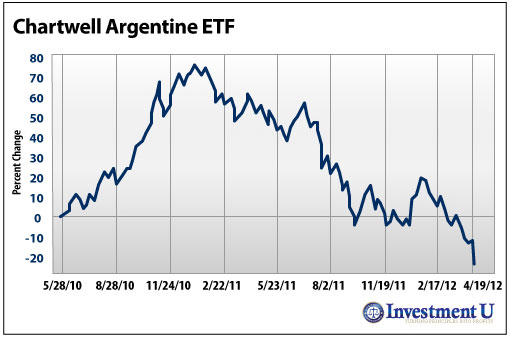
In late May of 2010, I noticed that an avalanche of bad news had beaten down the Argentine market and that the market was getting zero attention from financial media and gurus.

So I put together and recommended to members a diversified basket of seven Argentine stocks trading on the NYSE. You might call this a custom Argentine ETF.

This strategy was based on a belief that that most of the downside risk had been wrung out of the market and that the probabilities of a rebound were in my favor.

The results were well beyond my expectations.

By October 2010, this basket had rocketed almost 70% and then fell through my 15% sell stop for a neat 55% gain in less than five months.

Crisis Investing in Argentina

You can also see that since late 2010, this market has been through a disappointing and choppy decline. This dismal performance has tracked a sad series of anti-market policy blunders by the Argentine government.

The latest crushing blow to investor confidence was nationalizing Repsol’s equity stake in Argentina’s YPF. This sent my Argentina ETF to a level 25% below where it was in May 2010.

It seems that everyone hit the panic button, selling all of their Argentine stocks.

As Spain’s prime minister put it last month, “You would have to be crazy to invest in Argentina right now.”

Argentine Gambit #2

Call me crazy, but I see an opportunity.

This story faded from the front pages and nobody is pitching Argentine stocks that have been, drip by drip, driven to bargain-basement prices.

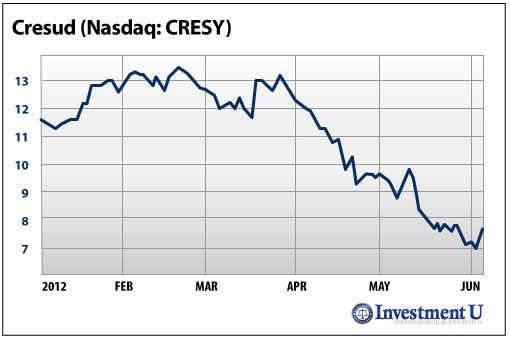
Next, I selected and have been watching my value target, Argentina farming giant Cresud (Nasdaq: CRESY). Cresud is one of the largest farming companies in Latin America.

Cresud (Nasdaq: CRESY)

The company produces agricultural commodities like corn, wheat, soybeans, sunflower, sorghum, milk and beef cattle on about half a million hectares of land. In addition to Argentina, Cresud owns significant farmland in Brazil as well as other South American countries.

Cresud, which has a great balance sheet, is largely an asset play as quality farmland is becoming more and more difficult to find in the world.

The stock is trading at about 20% below book value, but represents an even bigger value since land bought many years ago by the company is carried on the balance sheet at cost rather than current market value. As a bonus, Cresud owns 55% of Argentinean real estate developer IRSA (NYSE:IRS).

Some of you may wish to track CRESY for a while to get more comfortable with the situation. Others may wish to take action, but don’t confuse crisis investing with reckless investing. This is truly an aggressive value pick in the midst of max pessimism.

So always take a small position before rushing in. If it’s truly great bargain, there’s no need to hurry.

Put in place a 15% trailing stop loss in case the market moves against us and to lock in profits if we get it right.

Good Investing,

Carl Delfeld

Article by Investment U

Warren Buffett’s Big Bet on the U.S. Housing Recovery

Article by Investment U

Warren Buffett's Big Bet on the U.S. Housing Recovery

Warren Buffett's predictions last year were premature. But this year, his premonitions just may be spot on. And there are five little-talked-about reasons why…

Several years ago, Warren Buffett was asked how he and his partners managed to make so much money investing in the markets.

Buffett confidently answered, “We simply attempt to be fearful when others are greedy and to be greedy only when others are fearful.”

At Investment U, our readers hear a lot about this type of investing. It’s better known as “contrarian investing.”

And on Monday, Buffett proved once again that he’s one of the biggest contrarians in the world.

That’s because Berkshire Hathaway (NYSE: BRK-A) put in a $3.85-billion bid to buy a mortgage business and loan portfolio from now bankrupt Residential Capital LLC.

There’s no doubt the housing market in America is still in a very shaky state. As The Wall Street Journal reports, “Pessimists insist that… prices will continue falling – perhaps as much as 20% or more.”

Plus, it’s not even the first time Buffett placed a bet on the U.S. housing recovery and lost. His predictions early last year were premature.

But this year, his premonitions just may be spot on. And there are five little-talked-about reasons why…

  • Housing Recovery Fact #1: In May, more permits to build homes and apartments in the United States were requested than in the past three and a half years. And the U.S. Commerce Department also confessed that April was much better for housing starts than first thought – increasing figures to 744,000 from 717,000.
  • Housing Recovery Fact #2: Earlier this week, the Joint Center for Housing Studies at Harvard University released a report revealing new home inventories are at record lows. This is important for housing’s rebound because declines in listed inventory lead to less pressure on falling home prices. In fact, it’s a big reason why average U.S. home prices actually edged higher the last two months.
  • Housing Recovery Fact #3: So far, in 2012, U.S. employers added over one million jobs. As a result, the unemployment rate has dropped a full percentage point since August, from 9.1% to 8.2% today. And as this number heads lower, you can be sure the housing recovery will gain momentum.
  • Housing Recovery Fact #4: Last week, mortgage rates hit their lowest number since offering long-term mortgages began in the 1950s. For potential homebuyers, figures like these are simply impossible to ignore. Plus, in many places paying a mortgage today is even cheaper than renting a home of the same size. (Although, always remember, you have to pay for everything that happens to your home when you own it.)
  • Housing Recovery Fact #5: Peruse online and chat with industry professionals and you’ll see sentiment about the housing market is changing. Today major media outlets like MSN, The Economic Times and The Wall Street Journal are all reporting that right now is the time to buy a home. And it helps that investors like Buffett are backing them.

As the economy improves, bargain home prices and record-low mortgage rates will bring consumers back into the market and help home prices jump higher sooner than most people think.

This scenario is also set to benefit housing stocks, as well, many of which are down over 50% from their pre-crisis highs.

Of course, you probably aren’t in the position Buffett is to just buy assets outright from a bankrupt housing company.

So here are some other options to consider.

Three Ways to Play the Recovery

Real estate investment trusts, better known as REITs, are just one way to play the housing rebound. Last September, our colleague Jason Jenkins suggested taking a look at Vanguard REIT Index (NYSE: VGSIX). In addition to yielding 3.14%, VGSIX is up 26% to date.

Another option you should look into is investing in mortgage and title insurance companies like Fidelity National Financial (NYSE: FNF), MGIC Investment Corp. (NYSE: MTG) and even American International Group (NYSE: AIG).

Don’t take it from me, though. Go see for yourself that a number of housing stocks are on the rise right now.

And if the stock market is any indicator of things to come for the broader economy, I’d say a full-on U.S. housing recovery is just around the corner.

Good Investing,

Mike Kapsch

P.S. Not convinced yet? Take a look at our new Investment U whitepaper report on why the housing market has bottomed, and how to invest without leaving your home.

To access our free real estate investing whitepaper, click here.

Article by Investment U

Monetary Policy Week in Review – June 23, 2012

By Central Bank News

    The past week in monetary policy saw interest rate decisions by six central banks around the world, with all banks keeping rates unchanged, citing strains in global financial markets from 
the euro area’s debt crises.
    Although the banks affirmed their readiness to respond in the event of a shock to the global financial system, monetary policy worldwide is currently in a wait-and-see mode as Europe’s politicians try to dig their way out of the debt and institutional crises.
    
    The six banks that kept rates unchanged were:
    India – 8.0%, CRR at 4.75%
    Morocco – 3.0%
    United States – 0-0.25%
    Norway – 1.5%
    Turkey – 5.75%
    Taiwan – 1.875%

    NEXT WEEK:

    Looking at the central bank calendar for next week, monetary policy will be quiet, with only Israel and Hungary set to take decisions. 
    Israel kept its interest rate unchanged at 2.5 percent last month, citing inflation in the middle of its target range, but noting that uncertainty about Europe’s economy had intensified.
    The focus in Hungary is on the law governing the central bank. A law passed last year was criticized for threatening the central bank’s independence, but a revision, which could be approved early next month, is expected to open the way for fresh loan talks with the International Monetary Fund and the European Union.
    At its last rate-setting meeting, the Hungarian central bank left the base rate unchanged at 7 percent due to inflation above target. But the economy is contracting and the bank first expects growth to return in 2013.
    The focus will return to the euro area on Thursday and Friday when European Union heads of state meet in Brussels for a summit that will be dominated by efforts to transform the monetary union into some form of banking and fiscal union.

   
 MEETINGS:
Jun-25
ILS
Israel
Bank of Israel
Jun-26
HUF
Hungary
The Magyar Nemzeti Bank

www.CentralBankNews.info


The Big Investment Pay Off Worth Waiting For

By MoneyMorning.com.au

Amidst this very dark outlook for Europe, markets oscillate daily. Big rallies follow big sell-offs. Hope follows fear as faith in the ‘bailout’, the ‘rescue’ and the ‘stimulus package’ trumps all other logic.

That’s where you are today. Hope and fear are the two dominant market characteristics. They are also the enemy of the rational investor. So try to put the large daily moves into perspective. It’s what happens when risk and uncertainty are on the rise.

A good illustration of this is the VIX indicator – commonly referred to as the fear gauge. The VIX is a measure of volatility. A spike in the VIX correlates to a drop in equity markets. The chart below shows the VIX over the past 5 years.

Back in 2007 and early 2008, the VIX indicator displayed increased volatility and traded at a relatively high level, before blasting higher as the 2008 credit crisis hit. It then spiked to an index level of just over 45 in 2010 and 2011. This was in response to the end of the US Fed’s monetary stimulus measures.

As you can see, the recent increase in the VIX is not as severe as past spikes, suggesting market-wide ‘fear’ is still in its formative stages. Given Spanish and Italian bond yields are well over 6% (suggesting the market’s concern over their debt-dynamics) it appears investor faith in policymakers is alive and well.

The VIX – Not Very Scared…Yet

Source: StockCharts

To me, that remains a dangerous sign. It points to a mentality of ‘bad news is good news’. In other words, bad news on the economic front means good news on the government stimulus front. That doesn’t sound like a very good investment strategy to me. In fact, putting your faith (and your wealth) in the hands of those that ultimately destroy it seems like lunacy.

But such has the investment landscape become. We constantly need to weigh up the economic with the political/policymaking landscape.

Economics – which is simply a reflection of human action and the laws of nature – will trump policymaking every day of the week. But it will do so slowly and imperceptibly. Look at what’s happening in Europe now…as the true nature of debt overwhelms governments, investors still cling to the hope that policymakers can do something.

They can’t…they are simply pawns in the game masquerading as kings.

The Aim of Investing

With this continuing all-pervading noise dominating markets, it’s important to refocus on what the whole point of investing is about. It’s to compound your wealth.

That’s a very difficult thing to do in a bear market. In fact, in a bear market you’ll find it very difficult to compound your wealth at all. That’s why a bear market should be all about wealth preservation. The bull will inevitably follow the bear. Years of 5%, 0% or -20% returns will fade away, replaced by consistent 10-20% returns.

That’s when you make your money. Wealth preservation is the most important thing to think about in this market. If you can survive the bear and get to the start of the next bull with your wealth intact you will be miles ahead of most other investors.

Think about it.

Bear markets wear investors down psychologically. People spend years moving money around, trying to find a winner. The market chips away at their capital year after year. It’s only after the majority of investors feel the greatest amount of pain and get out of the market – for good – that a new bull market gets underway.

That’s what I want you to think about amongst all this gibberish about bailouts and government stimulus. You’re here for the long haul. You’re here to outlast the bear and be ready for the bull.

Waiting For The Bull

Government meddling will only make the bear worse, so the arrival date of the next bull market is anyone’s guess. Lower share prices are a good sign, as it will indicate a loss of government control of markets.

However, governments don’t like to lose control. Printing money will allow them to maintain the fa鏰de that they are in control. That being the case, I think the next step will be to think about at what point government printing tips the bond market over and forces a rush of capital from bonds into equities.

My guess is that point is still a year or two away. Asset price deflation awaits us first. But it’s worth starting to think about a shift in sentiment (and capital) well before that happens.

For now, the key is to continue with the wealth preservation and compounding theme. A bear market won’t reward compounding very much, but your patience should pay off in a big way when the bull returns.

Greg Canavan
Editor, Sound Money. Sound Investments.

From the Archives…

The Problem With the Spanish Bailout
2012-06-15 – Keith Fitz-Gerald

Australian Housing – How to Avoid This Pauper’s Retirement Trap
2012-06-14 – Kris Sayce

Why Warren Buffett is Loading Up on Tungsten
2012-06-13 – Don Miller

China’s Economic Data Statistics: Just Add Salt
2012-06-12 – Dr. Alex Cowie

Why Graphite is One of the Few Places For Savvy Investors to Make Money
2012-06-11 – Dr. Alex Cowie


The Big Investment Pay Off Worth Waiting For