The Currency Collapse in 1919 – and What it Could Mean for the Euro

By MoneyMorning.com.au

Austria-Hungary was a sprawling central European power. It comprised parts of the modern-day Czech Republic, Slovakia, Poland, Ukraine, Romania, Hungary, Serbia, Montenegro, Bosnia and Herzegovina, Croatia, Slovenia, Italy and Austria. Its currency, the krone, was formed in 1892 and managed by the central bank in Vienna and Budapest.

After World War I, the empire was broken into four parts by the Allies, who blamed Austria-Hungary for starting the war. By 1919, it had split into Czechoslovakia, Austria, Hungary and Yugoslavia. The empire had financed its war effort almost entirely by financing from the central bank (ie, money printing). It continued to fund itself in this way after the war.

A One-Krone Note Carrying An Austrian Stamp

A One-Krone Note Carrying An Austrian Stamp

Source: MoneyWeek

As you might expect, the policy was highly inflationary. Between 1914 and 1918, the cost of living rose by 1,226%. Economists Peter Garber and Michael Spencer wrote: “The new states shared a greatly devalued, hyper-inflating currency, a collapsed trade and payment system, and large external debts.”

By 1919, Yugoslavia decided it had had enough. It decided to leave the krone. And that’s when events started to spin out of control.

Yugoslavia’s ad hoc plan to escape the krone was simple: all krone in the country would be stamped with a two-headed eagle, the national symbol. So all krone in Yugoslavia would be turned into the new currency.

There was just one problem. The Yugoslavs were leaving the krone because they were sick of high inflation. That suggested to other krone users that the Yugoslavs would do a better job of defending the value of their currency than the existing guardians of the krone.

As a result, money flooded into Yugoslavia from all across the old empire. The economy of 1919 was mainly cash-based, so people literally pushed wheelbarrows of cash across the open fields in order to have them stamped. The Yugoslavs were left with no choice but to physically seal their borders to stop the flood and prevent massive inflation.

This cross-border flood of money forced the other countries’ hands too. One by one, the new countries of the old Austro-Hungarian Empire began to stamp their own currencies too. And as each country decided to break off and form their own currency, the flood got bigger, with savers desperately moving from country to country, seeking the best place to have their krone stamped.

By the time the flood washed over the last country to leave the krone, Hungary, there were railway wagons full of cash left in the country.

What Happened?

The breakup of the krone was chaotic. The new countries made up the rules as they went along.

When ink-stamped currency resulted in widespread fraud, they used sticker stamps. When authorities started to confiscate some of the cash as they converted it into the new currency (in the form of forced loans paying low interest rates), there were bizarre reverse bank runs as savers stuffed money into banks to evade expected levies on cash.

Austria even created separate currencies for natives and foreigners. All the while, the flood of capital across borders created havoc wherever it washed up. The equivalent to the entire money supply of Hungary was transferred out of Czechoslovakia and Austria alone. Most of it ended up in Hungary.

As a result, in the six years after the war, Hungary and Austria both suffered from dreadful hyperinflations. The League of Nations was ultimately called in to manage Austria’s money supply, and Hungary was forced to introduce yet another new currency.

However, Yugoslavia, the country that instigated the panic, was able to keep a fairly even keel throughout. It was better able to maintain its currency’s stability because it was less indebted than the others, and it suffered less from destabilising capital flows.

Could Better Co-operation Avoided the Collapse?

After the old Austro-Hungarian Empire dissolved into smaller states, it was thought that the old patterns of trade and co-reliance would continue. But under pressure, fraternity gave way to factionalism.

Trust between nations disappeared and they stopped trading with one another. Austrian farmers even stopped supplying their own capital city of Vienna, fearing food shortages. The stock of trains and coal was unevenly distributed among the new countries, so they resorted to confiscating whatever crossed their borders.

National self-interest ultimately undid the krone too, writes economist Eduard Marz. The Austrians and Hungarians held most of the war debt, while the Czechoslovaks and the Yugoslavians held relatively more cash. The trouble is, the Austrians and Hungarians also controlled the printing press, and so they were happy to erode the value of their own debt at the others’ expense.

Does 2012 Look Like 1919?

The krone warns of what happens when politics is out of sync with money. There is no neutral monetary policy – there are always, necessarily, winners and losers. So fraternity between the two groups is essential.

When the losers and winners line up along national lines, there’s a danger the currency will fragment. In other words – it’s not good when nine different languages appear on your bank notes, as was the case with the krone.

In 1919, the dominant powers in Austria and Hungary used the money to benefit themselves at the expense of Yugoslavia and Czechoslovakia, and the Yugoslavs were cohesive enough to fight back.

Similarly today, the winners and losers from eurozone monetary policy in 2012 are clearly lined up along national lines.

Money in Europe is tight. That suits Germany, but it is strangling the periphery. What’s different now – and not in a good way – is that in 1919, Yugoslavia, the first nation to leave the currency union, did so because it wanted a stronger rather than a weaker currency. As a result, money flooded in.

That’s a better problem to have than the inverse, which is what afflicts Greece and peripheral Europe. Greece needs a weaker currency than the euro, but if it talks about leaving then euros will flood out of the country in anticipation of being ‘stamped’ as drachmas. Greek banks would collapse and there would be a terrible crash.

1919 also tells us something about how ordinary people, not elites, drive the breakup of a currency. If savers believe the value of their wealth is in danger of being destroyed, they won’t wait for their politicians to catch up – they’ll take matters into their own hands.

If Greece fell out of the euro, its savers would be wiped out. Savers across the periphery would be right to take fright and move their euros to safety in Germany. That would be enough to drive those countries out of the currency.

There’s another end-of-euro scenario that looks more like the 1919 story. If Germany refuses to pay the price for keeping the euro together (via either higher inflation or explicit transfers to the peripheral countries), it might decide to walk away like Yugoslavia.

It could do so without collapsing its financial system. The main cost would be the devastation it would leave behind in its neighbours and trading partners. It’s a terrible price – but it may be the only one Germany is willing to pay.

Seán Keyes
Contributing Writer, Money Morning

Publisher’s Note: This article first appeared in MoneyWeek (UK)

From the Archives…

The Credit Market Debt Bubble and the Role of Gold
13-07-2012 – Greg Canavan

How to Survive and Thrive from China’s Bust
12-07-2012 – Kris Sayce

Payday Loans: Why This Lender of Last Resort Isn’t the Bad Guy
11-07-2012 – Kris Sayce

What A Slowing Chinese Economy Means For Pork Chops
10-07-2012 – Dr. Alex Cowie

Late News: Bankers Rig Interest Rates, No-One Fired
09-07-2012 – Dr. Alex Cowie


The Currency Collapse in 1919 – and What it Could Mean for the Euro
How to Profit from the Hidden Cost of Healthcare

Article by Investment U

When the Supreme Court was weighing arguments regarding the constitutionality of the Affordable Care Act, many phrases were being tossed around:

  • “Individual mandate”
  • “Pre-existing conditions”
  • “Parent’s insurance until age 26”
  • “Health insurance co-ops”

And when it came down to the end, Chief Justice John Roberts said that there will be a mandate that everyone must get health insurance by 2014 or get taxed. The tax would allow for subsidies or Medicaid to take over for those who can’t afford it.

Everyone was all up in arms over the mandate being a tax. But that’s not the tax we should all be worried about. The healthcare ruling means that a 3.8% surtax on investment income is almost certain. If it doesn’t come to pass, it means something uglier may be thrown upon us.

Either Way, It’s Going to Hurt

This new investment tax was originally passed by Congress in 2010. I’m about to get all “IRS” on you, so bear with me. It affects the net investment income of the majority of joint filers with adjusted gross income of more than $250,000 ($200,000 for single filers). January 1 of next year, the tax rates on long-term capital gains and dividends for these same earners bumps up from the lows of the Bush era ushered in at 15% to 18.8%. This will happen if Congress extends the current tax law.

But if they don’t…

If Congress – in their present state of dysfunction – allows the Bush era tax rates set in 2001 and 2003 to expire at the end of this year, the top rate on capital gains will jump to 23.8% and the top rate on dividends goes up nearly triple to 43.4%.

A lot of pundits and analysts got this wrong believing that Obamacare would be overturned. Now no matter what the case at the end of the year, people need to make moves to soften the blow of a new round of taxation.

Tax Will Affect a Lot of People

You may be asking yourself, “What is investment income? Does any of this political drama affect me?”

That’s a good question. Most experts will tell you that the following qualifies as investment income:

  • Dividends
  • Rents
  • Royalties
  • Interest (interest from munis doesn’t count)
  • Short- and long-term capital gains
  • The taxable portion of annuity payments
  • Income from the sale of a primary home above the $250,000/$500,000 exclusion
  • Any profit you would make from the sale of a second home
  • Any passive income received from such things as real estate and/or investments (such as partnerships)

That’s a lot of categories for you to fall into.

Now here are cases were the tax doesn’t apply:

  • Payouts from a regular or Roth IRA
  • 401(k) plan or pension
  • Social Security income
  • Annuities that are part of a retirement plan
  • Life insurance proceeds
  • Municipal-bond interest
  • Veterans’ benefits
  •  Schedule C income from businesses
  • Subchapter S firm or a partnership income – a business were you are paying self-employment tax

The game has changed. From 2013 on, many investors will have to vigilantly watch how they manage not only their reported adjusted gross income but also their investment income so that this tax will not eat them up.

“Gimme Shelter”

A classic Rolling Stone’s song just seemed like the perfect segue… You can see the list above of the types of investment income that are immune to the new tax. We are going to see many investors in the next six months running for shelter in these types of assets and vehicles. Robert Gordon of Twenty-First Securities, a tax-strategy firm in New York stated, “This [3.8%] tax alone makes accelerating investment income into 2012 profitable for many taxpayers.”

Here are three major trends to look for or to take advantage of over the rest of 2012:

  • You may see a growth outbreak in municipal bond investing soon. Municipal-bond income gets two thumbs up because not only does it not count against your adjusted gross income, it’s also not applicable to the 3.8% tax.
  • Roth IRAs once again will find a sweet spot in the hearts of retirement investors – because unlike traditional IRAs – their withdrawals are tax-free.
  • The self-employed may be more willing to turn to traditional defined-benefit pension plans. If you’re able and eligible to establish one of these, you may have the means to reasonably reduce adjusted gross income. But watch out. One the other side, withdrawals from these plans could increase your adjusted gross income to make you subject to the 3.8% tax for other investment income.

Here’s some food for thought. If you’re betting on a new President next year that will repeal all this legislation, good luck. That’s a gamble. If you bet wrong, it’s going to hurt you during filing season. You’ve been warned.

Good Investing,

Jason

Article by Investment U

Investing in Southeast Asia: Proceed with Caution

Article by Investment U

It’s no surprise to me that stock markets in Southeast Asia – what I call the “sweet spot” of Pacific Rim growth – are outperforming. While emerging markets are down so far this year, the Philippines is up 19%, Vietnam has bounced back 17% and Singapore has risen 13%.

Located south of China and east of India, this booming region is sometimes overlooked by even the most sophisticated investors. Yet it represents 10 countries with a population of 600 million and an economic output of $1.7 trillion.

A free trade pact between the Southeast Asian regional grouping (ASEAN) and China (ASEAN-China Free Trade Area), took effect in January 2010. By the end of that year, ASEAN exports to China had leapt 54% and overall trade between these countries jumped 47%. This free trade area has become the third largest in the world and more than 7,000 products trade at zero tariffs.

The next move is a work led by China’s prime competitors. The Trans-Pacific Partnership countries – Australia, Brunei Darussalam, Chile, Malaysia, New Zealand, Peru, Singapore, Vietnam and the United States – announced the achievement of the broad outlines of an ambitious, twenty-first century Trans-Pacific Partnership agreement that will supercharge trade and investment in the Pacific Rim.

This agreement will also boost America’s stake in this vital region. U.S. goods exports to the broader Asia-Pacific region totaled $775 billion in 2010, a 25% increase over 2009 and equal to 61% of all U.S. goods exported to the world.

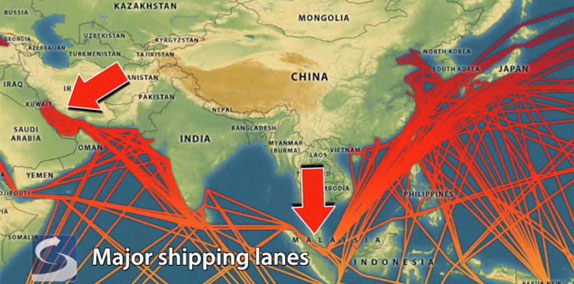
Southeast Asia also sits astride the biggest trade routes in the world and the two busiest ports, Hong Kong and Singapore.

Investing in Southeast Asia: Proceed with Caution

The South China Sea links the Indian Ocean with the western Pacific, but to get there ships need to move through one of several narrow straits that serve as chokepoints. To put things in perspective, the oil transported through the Malacca Strait from the Indian Ocean through the South China Sea, is triple the amount that passes through the Suez Canal and 15 times the amount that passes through the Panama Canal.

The stakes are high because roughly 65% of South Korea’s energy supplies, nearly 60% of Japan and Taiwan’s energy supplies, and about 80% of China’s oil imports come through the South China Sea. It also has proven oil reserves of seven billion barrels and an estimated 900 trillion cubic feet of natural gas.

The Probability of Conflict is Low, But Rising

But the importance of these prime trade routes and the natural resources in the area pose a risk to investors, as it makes the region a “cockpit” of rising confrontation.

China is intent on pushing its territorial claims well beyond conventional norms and Law of the Sea guidelines. Countries affected by China’s overreach, such as Malaysia, Philippines Taiwan, Brunei and especially Vietnam, aren’t rolling over, but rather pushing back hard.

Southeast Asia Investing

Oftentimes the confrontations are sparked by fishing boats and escalate from there. This is how the recent standoff between China and the Philippines over Scarborough Shoal began.

In late May, CNOOC (NYSE: CEO), a Chinese state-owned oil company, announced it was opening nine blocks off Vietnam’s coast to international bids for oil and gas exploration. These reach to within 37 nautical miles of Vietnam’s coast, which extends 2,000 miles. Then on June 21, Vietnam’s parliament passed a maritime law that reinforced its claims to the Spratly and Paracel Islands. China shot back that this a “serious violation” of its sovereignty.

The 200 small islands and coral reefs – only about 40 of which are permanently above water –  that support territorial claims are highly contentious.

The countries that are eye to eye with China often look to America’s diplomatic and military clout to balance the scales. Japan and South Korea also have a significant stake in how the dust settles.

These simmering conflicts rarely make the front page and shouldn’t discourage you from investing in Southeast Asia. But they should prompt you to manage risks using wide diversification and 20% sell stops.

Good Investing,

Carl

Article by Investment U

The Shocking Math Behind Dividend Growth Investing

Article by Investment U

Monday morning, I was interviewed by The South Florida Sun Sentinel about my book, Get Rich with Dividends. (Have I mentioned I have a new book?) The first question the reporter asked me was, “What do you say to investors who are nervous about the market?”

Then, a few hours later in a marketing meeting for Investment U, someone posed the question, “How do we market to investors who are nervous?”

And investors are scared. Their fears are completely valid:

  • The Euro seems to be falling apart at the seams.
  • Our elected officials in Washington (and many states) are the most incompetent and ineffective in generations.
  • There seems to be a new financial scandal every few weeks.
  • No matter who wins the election in November, half the population is going to be very upset.

The list goes on…

In the financial publishing business, it’s known that it’s easy to market yourself if you’re bearish. Fear has, and always will be, a powerful motivating factor. And there’s always a logical reason to be bearish. Stocks are overvalued, earnings are weak, the economy is weakening, investors are too complacent, etc. It’s a lot tougher to argue that investors should be in stocks.

But there’s one key reason why they should.

Long-term investors almost always win.

Last week, I told you that over 10-year periods, stocks have made money 91% of the time.

Since 1937, stocks finished positive in 67 out of 74 10-year periods. The average gain has been 129% over 10 years.

The seven negative 10-year periods were all tied to the Great Depression and Recession. And not all 10-year periods that included the Depression and Recession were negative. Only seven of them.

So based on history, it would take a catastrophic economic collapse to not make money in the stock market over the next 10 years.

How to Make Money Despite the Bad News

So how do you make money in the face of the euro, Obomney and Iran?

You invest in great companies that pay and raise the dividend every year and then you go about your life. That’s it.

You check in with those companies from time to time to make sure the dividend is safe and continuing to be raised and then you get back to what you were doing, i.e. your job, your family, Civil War re-enactments…

The beauty of investing in Perpetual Dividend Raisers – stocks that raise the dividend every year – is that they tend to continue to raise the dividend no matter what’s happening in the White House or around the globe.

If a company has been raising its dividend for 25 years, like Mercury General (NYSE: MCY) has, chances are it’s going to raise it for a twenty-sixth year. If they don’t, investors are going to be furious, as they’ve come to expect a dividend hike every year.

A company that doesn’t raise the dividend after 25 years in a row of dividend growth will find its stock in a steep sell-off and its executives getting their resumes together after being thrown out by shareholders.

Those executives are going to do everything in their power to ensure they can continue to raise the dividend year after year.

There are few sure things in life and past performance is no guarantee of future results, but chances are that a company that has lifted its dividend every year for a couple of decades is going to do it again this year, and next year, and the year after that, and that year after that…

Investing in Perpetual Dividend Raisers allows you to outpace inflation, earn more income every year and, if you’re reinvesting your dividends, compound those dividends to the point where you can easily make 12% per year in conservative blue-chip stocks.

At 12% per year, you more than triple your money in 10 years. Considering we’re emerging from the “lost decade,” I bet you would have been very happy tripling your nest egg while most people barely saw any return over 10 years, if they made any money at all.

Investing in dividend-paying companies is easy, it’s conservative and best of all, it almost always works. Certainly more than any other investing strategy. If you can name another strategy with a better than 91% track record that can grow your money at 12% per year in conservative investments, I’d like to know about it.

There are valid reasons to be nervous. No one is saying you shouldn’t be concerned about world and economic events. Just don’t invest like you are. History is not on your side.

Good Investing,

Marc

P.S. Thank you for making Get Rich with Dividends a bestseller. It spent the past week as No. 1 in “Investing” on Amazon and got as high as No. 14 in all books. It did so well Amazon actually ran out of copies. They’ll have more next week. If you don’t want to wait, you can download it for the Kindle on Amazon or you can order the book from Barnes and Noble.

Article by Investment U

Investing in Manganese: Two Ways to Play the Metal That Keeps Going…

Article by Investment U

At first, its name sounds more like a foreign language than a metal.

But you may be surprised to know that manganese – a grayish-white element essential to the production of steel – is actually the fourth most traded metal in the world.

Last year, 15.4 million tons of it was produced to help make better cars, infrastructure and even unleaded fuel.

And although prices have traded relatively flat in recent months, I’m writing you today because manganese is set up to become one of the most sought after minerals in the world. Here’s why…

(Click here to check out a detailed infographic about manganese from Visual Capitalist.)

Revolutionizing the Future of Transportation

In short, engineers at the University of Illinois recently created a prototype battery using lithium and manganese that can be recharged by 90% in just two minutes flat. That’s right, two minutes flat.

They’re called “lithiated manganese dioxide,” or LMD, batteries.

Now I don’t know what kind of car you drive, but two minutes is about how long it takes for my Chevy to refuel at the pump.

But the best part about these new LMD batteries in development is that, not only do they have higher power output and provide enhanced safety in comparison to other lithium ion batteries, they’re much cheaper to make, as well.

Because manganese is very abundant around the world. It’s actually the twelfth most common element found in the earth’s crust.

Today, 90% of global manganese output is used in the production of steel. But with new technologies, such as LMD batteries, new markets are opening up for manganese. And it could be a game-changer for the electric vehicle market – and switched-on investors – over the next few years.

Show Me the Money

So where could one look for opportunities to invest in manganese?

There aren’t many ways to go about it. Despite being such a major player in the world of metals, there aren’t any convenient ETFs tracking the price of manganese. And there really aren’t any legitimate miners that completely focus on the metal.

Until more investors catch on to the investment potential of manganese, you only have two real options.

First, look small and look abroad. For example, after 50 years of shutting down production, the South American nation of Guyana is on the brink of restarting its manganese mining industry.

According to Resource Investing News, in 2010, the government granted Reunion Gold Corp. (TSXV: RGD) four prospecting licenses to explore for and develop manganese at the nation’s old mine location at Matthews Ridge in northern Guyana.

This move alone could make Guyana one of the top five manganese producers in the world within the decade. If all goes according to plan, building the mine will begin in August 2013, with full production starting up in 2014.

Other countries with big opportunities in manganese include Gabon, China, South Africa and Ukraine.

A second way to play manganese is by simply sticking with the major players. It may not sound like a lot of fun, but it’s a safe bet. Among the top three manganese producers currently worldwide are BHP Billiton (NYSE: BHP), Anglo American (LSE: AAL, OTC: AAUKY) and Vale S.A. (NYSE: VALE).

Either way you approach it, manganese presents a great opportunity to invest today. And as I’ve shown, soon it won’t be used just for steel anymore.

In fact, carmakers like Chevrolet Nissan, and Hyundai are already putting LMD batteries in the Volt, Leaf and Sonata. Now if they could just hurry up on that two-minute battery recharge…

Good Investing,

Mike

Article by Investment U

Monetary Policy Week in Review – July 21, 2012

By Central Bank News

    The past week in monetary policy saw interest rate decisions by 4 central banks around the world, with just one, South Africa, cutting rates while the other four kept rates unchanged.
     Countries with solid domestic demand, such as Canada and Mexico, are so far able to shrug off the weakening global economy while those countries that are more exposed to Europe’s crises, such as South Africa, are cutting rates to stimulate economic activity.
LAST WEEK’S MONETARY POLICY DECISIONS:
   
COUNTRY
                NEW RATE
              OLD RATE
                ONE YR AGO
CANADA
1.00%
1.00%
1.00%
TURKEY
5.75%
5.75%
5.75%
S.AFRICA
5.00%
5.50%
5.50%
MEXICO
4.50%
4.50%
4.50%


NEXT WEEK:
    Looking at the central bank calendar for next week, there are expectations that Colombia will follow the trend of lowering interest rates to stimulate its economy but neither Israel, Nigeria, Thailand, or the Philippines are expected to follow suit.
    Hungary is now in talks with the IMF after the government passed amendments that restore the central bank’s independence.

COUNTRY
                          DATE
                       RATE
                      1 YR AGO
ISRAEL
23-Jul
2.25%
3.25%
HUNGARY
24-Jul
7.00%
6.00%
NIGERIA
24-Jul
12.00%
8.75%
THAILAND
25-Jul
3.00%
3.25%
NEW ZEALAND
26-Jul
2.50%
2.50%
PHILIPPINES
26-Jul
4.00%
4.50%
COLOMBIA
27-Jul
5.25%
4.50%


www.CentralBankNews.info

Central bank cooperation better since 2008 – Fed’s Duke

By Central Bank News

    Collaboration among the world’s central banks has improved since the 2008 financial crises, said U.S. Federal Reserve Board Governor Elizabeth Duke, and she expects this spirit of cooperation to continue in the future.
    But while central banks benefit from coordination and cooperation, adopting the same stance on monetary policy is not always the best choice, said Duke, who addressed a conference in Mexico City the same day Banco de Mexico kept interest rates steady due to inflationary pressures.
    In her speech, Duke recalled the coordinated interest rate cuts by major central banks in October 2008 as the effects of the credit crises were deepening worldwide. This was followed by moves to improve liquidity at financial institutions and currency swap arrangements by the Federal Reserve with 14 foreign central banks to ease pressures in dollar funding markets.

    “The success of these swap lines in alleviating funding pressures and reducing interbank borrowing rates is a testament to the benefits of central bank cooperation,” Duke said, adding:
   “Indeed, closer ties and more-open lines of communication across central banks are some positive outcomes of these difficult times. This spirit of cooperation should continue as our respective central banks work to pursue monetary policies appropriate for our own economies while supporting stable financial systems around the world.”
    The latest example of cooperation among central banks is the effort to tackle the problems posed by the benchmark Libor interest rate system, which major central bank governors will discuss at their bi-monthly meeting at the Bank for International Settlements in Basel, Switzerland, on Sept. 9.
    Duke said cooperation among central banks is indeed one of the ways that each central bank can attain their own mandates in an age of global financial integration when problems in one country can quickly spill over to other countries.
     She said Mexico’s economic recovery in the second half of 2009 had less momentum that in other Latin American countries, which meant the Mexican central bank didn’t consider it necessary to raise interest rates as other central banks in South America.
  “These developments underscore an important point–that while central banks may benefit from coordination and cooperation, taking the same policy stance at the same time typically will not be the best choice for all central banks,” Duke said, adding:
    “Accordingly, it is imperative for each central bank to have monetary policy tools to appropriately address domestic objectives independent of the actions of other central banks.”
   www.CentralBankNews.info

Euro Closes the Week at 12-Year Low against the Yen

By TraderVox.com

Tradervox.com (Dublin) – The euro has continued to decline against the Japanese currency for the fourth week in a row. It closed the week at 12-year low after concerns the region’s debt crisis is worsening increased the demand for safety as the market went into the weekend. Most traders went for the yen, as the demand for the US dollar was dampened by bets on Federal Reserve’s action to stimulate economic growth in the country. The greenback remained unattractive to investors prior to release of data this week expected to show a slowdown in US growth. The Australian dollar closed the week on a high as implied volatility fell to five-year low allowing traders to buy riskier assets. The 17-nation currency dropped despite the approval by European officials on Spanish banks’ loan.

According to Joe Manimbo who is a market analys at Western Union Business Solutions in Washington indicated that there is increased uncertainty in the market which has led to investors running away from the euro. He also added that there is a general hope for additional stimulus from major central banks around the world hence the continued demand for riskier assets.

The 17-nation currency dropped to the lowest levels since 2008 against the pound and dropped to new lows against the Australian dollar. The Spanish borrowing cost also increased to euro-era high which has added to speculations of adverse times ahead for the region. The euro zone currency dropped by 1.6 percent against the yen to trade at 95.43 yen on Friday in New York to record a weekly drop for the fourth week in a row. The euro had touched its lowest since November 2000 of 95.35 yen earlier in the day. The euro also continued to drop for the third week against the greenback, registering a 0.8 percent drop to trade at $1.2157, it also touched its June 2010 low of $1.2144 during trading on Friday.


Disclaimer
Tradervox.com is not giving advice nor is qualified or licensed to provide financial advice. You must seek guidance from your personal advisors before acting on this information. While we try to ensure that all of the information provided on this website is kept up-to-date and accurate we accept no responsibility for any use made of the information provided. Opinions expressed at Tradervox.com are those of the individual authors and do not necessarily represent the opinion of Tradervox.com or its management. 

Article provided by TraderVox.com
Tradervox.com is a Forex News Portal that provides real-time news and analysis relating to the Currency Markets.
News and analysis are produced throughout the day by our in-house staff.
Follow us on twitter: www.twitter.com/tradervox

This Week’s Technical Analysis For Major Pairs

By TraderVox.com

Tradervox.com (Dublin) – The USD has been down against major currencies but remained strong against the euro. However, the Euro has touched new lows against most majors reaching a 12-year low against the yen as new market concerns rose on euro zone debt crisis. Here is the market outlook for major pairs.

EUR/USD: the pair was spirited to break higher, but it had no enough support to breach the 1.2330 line. This pair dropped lower to close the week at just above 1.2150 critical support level. The euro-dollar pair is expected to continue on a bearish trend as Angela Merkel casts doubts on the success of efforts made by the euro zone leaders. The US on the other side is not providing enough data to quell QE3 speculations despite Fed Chairman Ben Bernanke refusing to provide any clues. The range between 1.2144 and 1.2150 is critical and loss of this could lead to a downfall.

USD/JPY: the yen continued to strengthen against the dollar and questions on whether BOJ will intervene are being asked. The pair attempted to reach 79.10 line with no success and fell to 78.46 where it closed. The uptrend support was broken and the pair moved sideways before dropping, there is a bullish outlook on the pair this week however as the dollar recaptures its safe haven demand.

GBP/USD: the cross moved upwards during the week as the pound strengthened against the dollar, but lost some of those gains to close the week at 1.5615. The pair had opened the week at 1.5580; dropped to 1.5517 and then rose to 1.5737 as the 1.5750 resistance line held firm. The pair dropped slightly to close the week at 1.5615. Due to concerns in the US data, the pair has a bullish outlook this week.

USD/CHF: the pair was choppy last week where it increased to 0.9874. The cross opened the week at 0.9806 and dropped to 0.9783 before climbing to 0.9887 as the resistance line of 0.9915 held strong. The pair then shed some of these gains to close the week at 0.9874. The cross is expected to remain within range this week as US safety status continues to lose confidence among investors.

Disclaimer
Tradervox.com is not giving advice nor is qualified or licensed to provide financial advice. You must seek guidance from your personal advisors before acting on this information. While we try to ensure that all of the information provided on this website is kept up-to-date and accurate we accept no responsibility for any use made of the information provided. Opinions expressed at Tradervox.com are those of the individual authors and do not necessarily represent the opinion of Tradervox.com or its management. 

Article provided by TraderVox.com
Tradervox.com is a Forex News Portal that provides real-time news and analysis relating to the Currency Markets.
News and analysis are produced throughout the day by our in-house staff.
Follow us on twitter: www.twitter.com/tradervox

Why Potash Stocks Are Set to Gain From a Global Food Warning

By MoneyMorning.com.au

We enjoyed some great winter sun down in Melbourne this weekend.

On Saturday the thermometer hit a balmy 17°C!

I took my kids down to the park in the morning, and met up with colleague Greg Canavan and his family. After recently moving from Sydney, they are still getting used to Melbourne’s crazy weather. I’ve been here ten years, and I’m still getting used to it!

What was even crazier was that on Saturday, Melbourne was a degree warmer, in the depths of its winter, than London was on Saturday, during the ‘height’ of its summer.

The UK’s ‘summer-time‘ has been a total washout so far. With the London 2012 Olympics round the corner, the Brits are not happy with the freakishly bad weather.

But it’s not just the UK dealing with extreme weather.

The US has been under a heatwave for weeks. The US National Oceanic and Atmospheric Administration is now saying that the US is in the middle of its worst drought since 1956.

The country’s agricultural sector is suffering badly. The corn harvest in particular looks like it is going to be a disaster.

Less than a third of the national crop is in good shape. We’ll have to wait until the harvest to see just how bad it will be, but prices are already soaring in anticipation of a huge drop in production.

The US agricultural secretary was quoted in the Financial Times saying:

‘I get on my knees every day and I’m saying an extra prayer right now … If I had a rain prayer or a rain dance I could do, I would do it.’

Hearing comments like that from the top of the agricultural sector hasn’t helped calm market nerves. The corn price has gone off like a rocket. Since the start of June it has jumped by 45% — setting a new record high.

Corn Price — Up 45% in Just 7 weeks

Source: Stockcharts

The US is now looking to Brazil to help bridge the shortfall. The result is that there won’t be much left over for other countries hoping for some corn this year. The corn market will be very tight.

This highlights the issue of ‘food security’: the increasing threat of inadequate or volatile food supplies for global population. This will be something we will hear more about if this harvest is as bad as they fear. The FT also reported:

‘”I’ve been in the business more than 30 years and this is by far and away the most serious weather issue and supply and demand problem that I have seen by a mile,” said a senior executive at a trading house. “It’s not even comparable to 2007-08.”‘

We could well see another swathe of food riots around the world — mostly in poor countries that bear the brunt of supply shocks — like we did the last time the corn price was at these levels, in 2008.

Then, after the market is reminded of the tragic human cost of crop failures, the global conversation will focus on food security once again.

Part of this conversation will be highlighting the importance of fertilisers to increase production rates.

In short — each year the world tries to feed more mouths with less farmland, while enduring more volatile weather. So farmers need to use fertilisers to make every hectare count.

Why Potash is a Key Resource

Potash (a potassium salt) and phosphate are two of the key raw ingredients for the fertiliser industry. And both of them are produced by mining.

The potash sector had been wallowing since the start of last year, despite potash prices holding firm.

However, the major potash stocks have finally turned around over the last 2 months — roughly in line with the corn price.

Majors like Potash Corp (NYSE:POT) have all jumped more than 20% in this time, while the rest of the mining sector crashed around them.

Potash was the darling of the Aussie market a few years ago, after BHP made a bungled bid for Potash Corp. As the excitement passed, the prices of ASX potash stocks slowly fell, as the hordes moved on.

But while the market has been looking elsewhere, some of these potash stocks have been very busy. I’m still following one of the stocks that I tipped for Diggers and Drillers readers, and the price is less than half of what it was when I tipped it. There is hardly a shortage of under priced resource stocks on the market today, but the value in this stock is remarkable.

Generally, Aussie potash stocks move up and down closely with the Canadian majors.

But so far the Aussie market seems to have completely overlooked the fact that the Canadian potash majors are now rallying.

So we may have a double opportunity here.

At some point, and probably soon, the Aussie potash juniors will start playing catch-up to the 20% rally seen in the Canadians. Meanwhile, the market should also start pricing in the progress made by those stocks that have been quietly getting on with things.

I’ve been watching and waiting for this turnaround, and for some potash stocks it looks like we might be witnessing the very start of it right now. Let’s hope so.

Dr. Alex Cowie
Editor, Money Morning

Related Articles

Market Pullback Exposes Five Stocks to Buy

When the Going Gets Tough, Entrepreneurs Innovate

Is This Man the Ultimate Contrarian Indicator for Mining Shares?


Why Potash Stocks Are Set to Gain From a Global Food Warning