The End of Growth Through Currency Wars

By MoneyMorning.com.au

The Plaza accord was initially set up in 1985 and included five countries; the United States, West Germany, Japan, France and the United Kingdom.

What was it?

The US dollar was strong against all the major currencies towards the end of the seventies, giving American trading partners, like Japan, and Europe a competitive advantage when it came to their exports. This was becoming a political problem for the US. Car manufacturers lost market share and jobs to Japan.

What’s more, Europe and Japan were so addicted to export led growth that domestic consumption fell off a cliff. Economies in Europe, much like Japan, ran huge trade surpluses with the US but actually experienced economic contraction.

The solution was now what’s known as the Plaza Accord of 1985, so called because it was negotiated in September at the Plaza Hotel in New York. Back then it was just the G-5. All five countries agreed to intervene in the currency markets to orchestrate a weaker US dollar.

The point of the whole exercise was to transfer growth from the US market to the rest of the world. The world has stopped growing. The monetary authorities agreed to engineer some growth by weakening the dollar (especially against the Yen and the Deutschmark) and encouraging consumption and investment in the rest of the world. It worked.

It worked too well.

By 1987, the G-5 had expanded to the G-6 to include Canada. The G-6 gathered in Paris to sign the Louvre accord. This time their goal was to strengthen the dollar in the name of stability. Global growth had been rebooted, but the dollar’s slide had resulted in too much volatility in currency and financial markets

The Start of the Currency War

A currency war is fundamentally an attempt to improve economic competitiveness at the national level. The self-defeating aspect of a currency war is that you can only do so at the expense of your neighbours, whom you hope to make your customers. Your growth comes at their expense. They must consume in order for you to save.

This was fine back in 1985 with the Plaza accord. The US could effectively ‘lend’ growth to Japan and Europe. The US ran large current account deficits. But the key difference between then and now was that there was a strong currency (the US dollar) which could be weakened, and weak currencies which could be strengthened.

The US could let the dollar slide because the economy was booming. Jobs were plentiful. The government deficits were growing but not huge. Devaluation hurt, but only to the national pride, not in any noticeable way on a purchasing-power basis.

Today, there is no one currency against which all others can strengthen to everyone’s mutual benefit. Competitive devaluations have become a zero sum game, always costing one country jobs and exports. This is why Brazilian Finance Minister Guido Mantega said in 2010 that the world was in a new currency war. He knew that interest rates were being used by central banks as a weapon to deal with domestic debt problems and boost export competitiveness.

Effectively, everyone in the world is trying to boost their own economic growth by weakening their currency so they can sell their goods to other countries. This has led Europe, Japan, and the US all to the same place: zero real interest rates.

These countries have chosen to deal with deflating asset bubbles and low growth by lowering real interest rates. They’ve avoided a reckoning. But in so doing, they’ve zombified their economies, sucking out all the life of a dynamic market and injecting it with the formaldehyde of unproductive debt. They have also trod the path of currency devaluation down to its logical conclusion.

Protecting Your Investments in a Currency War

What I’m almost certain of is that this is just the beginning. If the currency war moves from interest rates and monetary and fiscal policy to cyber weapons, price manipulation and an attack on the financial architecture of the modern world, then a threat exists that is neither fully understood nor appreciated. So what can and should you about this emerging threat?

How do you create non-financial wealth and personal security?

Short of opting out of the current system and dropping off ‘the grid’ — a radical option that most of us are not in the position to choose and probably wouldn’t choose anyway — what can you realistically do to hedge against major losses in the share market as a result of deleveraging and major disruptions to the economy as a result of the evolving currency war of all against all?

Well, I think the answer lies in thinking about what wealth really is. I don’t mean to get philosophical. But really, it doesn’t hurt to think about why we bother to invest and protect and grow our wealth. Is it for the love of the game? Is it because we enjoy the challenge?

It may be for those reasons. But fundamentally, wealth creation and preservation is about having the freedom to live the life you’ve imagined for yourself, a life of purpose and creation and value, whatever value means to you. Financial wealth helps us achieve those ends. But it is not an end in itself.

Building non-financial wealth means taking steps to improve your quality of life and personal security. For me, that means appraising the financial system with honest and sceptical eyes.

It then means reducing the amount of my wealth at risk in financial markets and converting it into tangible assets that have utility.

For some people it may mean living a simpler financial life with less risk and fewer day-to-day decisions (peace of mind). This is probably a demographic trend we’ll see anyway. As the baby boomers approach retirement age, I expect those that are able to will begin liquidating their retirement portfolios and living off their accumulated savings.

Dan Denning
Editor, Australian Wealth Gameplan

From the Archives…

No Mr. President, Entrepreneurs Did Build That…
20-07-2012 – Kris Sayce

How an Interest Rate Rise Could Trigger a ‘Punch Bowl’ Rally
19-07-2012 – Kris Sayce

When the Going Gets Tough, Entrepreneurs Innovate
18-07-2012 – Kris Sayce

Is This Man the Ultimate Contrarian Indicator for Mining Shares?
17-07-2012 – Dr. Alex Cowie

How Gold Stocks Could Become Your Gilded Lifeboat
16-07-2012 – Dr. Alex Cowie

The End of Growth Through Currency Wars

The Real Villain Behind the Curtain in the LIBOR Scandal

By MoneyMorning.com.au

There’s nothing like pulling back the curtain on the fraud that’s centre stage in the LIBOR manipulation scandal and finding the levers are really being pulled by central banks.

It’s not about the banks doing what they did. The revelation is this: Central banks are the biggest impediment to free markets and the reason capital markets have become casinos.

And until the tyranny of their grip is broken, the majority of public investors are going to rightfully sit on the sidelines and long-term economic growth will be impossible.

The LIBOR scandal is just a sideshow. There’s nothing new there.

Banks manipulated LIBOR (the London Interbank Offered Rate), the benchmark for over 800 trillion dollars in interest rate-sensitive loans and financial instruments, to jack up profits on trading positions they held.

Bankers scheming, lying and cheating for bigger bonuses at the expense of anyone in their way…that’s news?

No, but here’s the real inside scoop…

They were told to do it – both implicitly and explicitly – by the central banks that are supposed to regulate them (as is the case with the U.S. Federal Reserve Bank) and provide a safety net that facilitates capital formation and commerce on a global scale.

The Birth of the Housing Bubble

Let’s not get overly technical here.

Suffice it to say that global credit expansion due to artificially low interest rates caused the build-up of leverage in a yield-starved investment environment and led to the housing bubbles that burst from sea to shining sea.

Who orchestrated the low interest rate environment? That would be the Federal Reserve Bank and central banks across the globe.

If there was no manipulation by central banks, the free market for credit would have walled off a lot of speculators from access to credit they didn’t deserve.

Central banks, especially the Federal Reserve Bank as a regulator, knew the health of the banks, knew they were leveraging themselves, knew they were piling up under-collateralized, securitized “assets” in off-balance sheet special-purpose vehicles.

They also knew they were forcing banks to lend at low rates. They themselves manipulated the rates to be that low and wanted the banks to extend their articulated policy throughout the economy, like a pox on the population.

And when we ended up in a financial crisis and found out the banks were all insolvent, what did the central banks do?

They winked and nodded to the banks to manipulate LIBOR to prove to the world that there was no crisis and the system was still functioning as reflected in the low cost of interbank lending.

In fact, central banks were lying to the public and more than tacitly acknowledging that bank CEOs were also lying to the public’s face, saying they were in good shape when in fact they were borrowing hundreds of billions (trillions globally) from central banks.

Because the truth is if LIBOR wasn’t manipulated it would have gone through the roof and the whole world would have come to a standstill, which it did anyway.

And now to fix the mess they created by manipulating banks to keep interest rates low, central banks are adding “stimulus” (which is nothing more than giving banks more money) to keep interest rates low.

It never ends.

Breaking the Grip of Central Banks

The tyranny of central bank manipulation and the suffocation of free markets has to stop.

There’s only one way to do it. Dismantle all the big banks and limit the size of banking institutions so that any one or two or five or six that fail won’t implode the global financial system. Let them fail and resolve ring-fenced fiascos under existing bankruptcy laws.

If we get banks down to a sensible size, we won’t need central banks. Sure, we can still have them, but they should be run by academics (not bankers) with a singular mandate, price stability, that’s articulated in advance and achieved with total transparency.

The truth is that central banks are shills for the banking behemoths.

They manipulate politicians, overrun fiscal discipline at times (not that there’s much of that anywhere in the world these days) and use their limitless powers to feed profitability pools at banks.

The LIBOR scandal is a window into the workings of central banks and how they’ve aided and abetted the casino capital markets that serve the banks at the expense of long-term capital investment and sustainable economic growth.

It has to stop.

Shah Gilani
Contributing Editor, Money Morning

Publisher’s Note: This article first appeared in Money Morning (USA)

From the Archives…

No Mr. President, Entrepreneurs Did Build That…
20-07-2012 – Kris Sayce

How an Interest Rate Rise Could Trigger a ‘Punch Bowl’ Rally
19-07-2012 – Kris Sayce

When the Going Gets Tough, Entrepreneurs Innovate
18-07-2012 – Kris Sayce

Is This Man the Ultimate Contrarian Indicator for Mining Shares?
17-07-2012 – Dr. Alex Cowie

How Gold Stocks Could Become Your Gilded Lifeboat
16-07-2012 – Dr. Alex Cowie


The Real Villain Behind the Curtain in the LIBOR Scandal

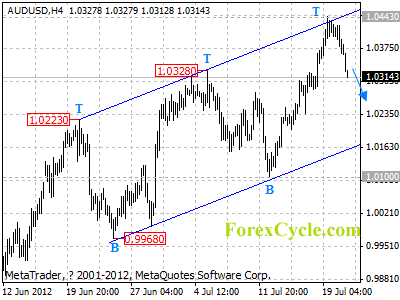
AUDUSD pulled back from 1.0443

After touching the upper border of the price channel on 4-hour chart, AUDUSD pulled back from 1.0443, suggesting that a cycle top had been formed. Further decline would likely be seen over the next several days, and the target would be at the lower line of the channel. However, the fall from 1.0443 would possibly be consolidation of the uptrend from 9581 (Jun 1 low), as long as the channel support holds, the uptrend could be expected to resume, and another rise towards 1.0700 is still possible after consolidation.

audusd

Forex Signals

Put Your Seatbelts On, It’s About To Get Bumpy!

By Chris Vermeulen, GoldAndOilGuy.com

It was just about a year ago today when the S&P was sitting at fresh highs and everyone was enjoying a rather upbeat summer.  It was a nice summer, the markets were calm, and there was a surreal sense of optimism.  Then, in the matter of a few days, things got real ugly, real quickly.

Well, it doesn’t seem like too much has changed since then.  We’ve had mixed earnings reports, ever-evolving worries in Europe, and the always looming fiscal mess in the U.S.  Once again, are we in the calm before the storm?

It looks like things in Europe may start to heat up again.  Riots turned violent again in Spain as protestors took to the street over austerity measures.  With seemingly no resolution, a sinking tourism industry in the PIGS, and a typically hot summer August on its way, all signs point to further turmoil.

Technically, we’re currently seeing a number of bearish indicators setting up in the S&P and other markets.  First, on the weekly chart of the SP500 Futures we can see what appears to be a bear flag formation developing.  Note the recent rise in price since the beginning of June on decreasing volume.

Weekly SP500 Futures Chart Patterns

Chart Pattern Trading

Chart Pattern Trading


Daily Chart Elliott Wave Count For SP500

A second look at the S&P daily illustrates a down trend and 5 wave count bounce in the market, both are currently pointing to lower prices.

  • Completion of two intermediate cycles within longer term 5 wave pattern
  • Downwards wave one from April until beginning of June followed by wave 2 correction from June until present.

The wave two correction typically proceeds the longest wave, wave three, which is pointing towards a large move down (Note that in the first shorter term cycle the downwards wave three was the longest by far.  We expect the same to be repeated in the longer term cycle.)

Elliott Wave Theory Chart Pattern Trading

Elliott Wave Theory Chart Pattern Trading


SP500 BIG PICTURE Wave Count

A look at the longer term view once again using the weekly chart, again supports our argument for a major correction.  We have just completed a 5 wave pattern since the 2009 lows, and it is looking more like a big pull back is due. Remember most major trends end after the fifth wave.

Stock Market Elliott Wave Count Chart Pattern Trading

Stock Market Elliott Wave Count Chart Pattern Trading


Copper Weekly Chart Patterns

If we take a look at the copper ETF, “JJC”, we are provided with further justification.  Copper is often referred to as “Dr.Copper” due to its industrial application and is known to be a leading indicator for equity markets.  Copper has significantly underperformed equity markets and is likely leading the next move down.  A look at the weekly chart which points to a rather dismal outlook.  There is a major head and shoulder patterns developing.

Copper Chart Pattern Trading

Copper Chart Pattern Trading


Major Market Pattern Analysis Conclusion:

Last summer turn into a bloodbath with nothing but red candlesticks taking stocks and commodities sharply lower. If you haven’t already, it’s time to lock in some profits.  Short, intermediate, and long term cycles are pointing down, and the increasingly bearish technical developments cannot be ignored.  We’ll be looking at entering multiple shorts potentially in the very near future once/if setups present themselves.  Buckle up and stay tune for more…

Stay in the loop by joining my free weekly newsletter
& videos to stay ahead of the crowd: GoldAndOilGuy.com

Chris Vermeulen


Corruption and Mismanagement See Much of the US without Power

By OilPrice.com

Amidst record-high temperatures and a very anti-climactic 4th of July, power outages have left millions without air-conditioning and even water in rural areas where households rely on electric pumps.  At least 52 people have died from heat and three million people are still without power.

No it’s not Yemen, where power outages in the capital Sana’a have sparked a new round of protests. It’s the United States of America, where corruption converges with a moribund electricity distribution system to produce increasingly frequent blackouts across the Midwest and East Coast.

A thunderstorm that struck the East Coast early last week left millions without electricity and power companies took days to restore power to about half of their customers. Four days after the storm, power was restored to 67% in the Northern Virginia suburbs and 61% in Baltimore, but Montgomery County, Maryland and parts of Washington, D.C. only managed to restore 43%, leaving over a million without electricity as temperatures soared above 100 degrees.

In the Midwest, there was less chance of blaming storms. In Michigan, for instance, an increasingly woebegone state, power outages are frequent. In counties near the capital, Lansing, hundreds of homes were without power for the 4th of July. Power was restored that evening, but lost again the following day. And this has been going on for some time.

Everyone would like to know why. The answer is simple, and three-fold: An outdated electricity distribution system, corruption and mismanagement.

Americans are now being told that keeping utility bills down means keeping maintenance of the country’s dismal electricity distribution system to a bare minimum. According to the American Society of Civil Engineers, the entire system could collapse by 2020 without an immediate investment of $673 billion. Furthermore, experts say that brownouts and blackouts will end up costing more in the end than re-hauling the entire system.

The system cannot handle increasing demand, especially when the entire country is turning on the AC. Last week’s brownouts and blackouts will become status quo.

In fact, as NPR quipped, “the basic principles of power delivery haven’t changed much since Thomas Edison flipped on the first commercial power grid in lower Manhattan on Sept. 4, 1882.”

According to the ASCE’s engineers, more than 60% of the country’s electricity transmission lines and power transformers are at least 25 years old, while 60% of the circuit breakers are more than three decades old.

This is to prepare Americans for higher utility bills in the future. But it also ignores the corruption and mismanagement that has allowed privately owned power companies to profit from bare-minimum maintenance and deregulation. There is no investment in infrastructure, no guarantees of service, and continually worsening standards of safety and maintenance.

It is an outmoded system of distribution compared to Europe’s for instance, where power lines are buried underground. While this makes them more difficult to reach and harder to fix, they are also much less at the mercy of Mother Nature.

With that in mind, all eyes are on the Potomac Electric Power Company (Pepco), the utility company that provides power to Montgomery County, Maryland and parts of Washington, D.C.  and which was rated last year by Business Insider as “the most hated company in America”.  Certainly, these past days and weeks have done nothing to help that rating.

According to OurDC, from 2008 to 2010, Pepco’s profit earnings were $882 million, yet they paid no federal or state income taxes and instead received $817 million in tax refunds. At the same time, local authorities allowed Pepco to cut back on maintenance to save money.

There was an attempt last year to take Pepco to task, but the result was a very public slap on the wrist. An investigating commission found that Pepco was not conducting inspections of its sub-transmission and distribution lines even after storms. It also found that the company was about four years behind on the tree-trimming necessary to ensure that the local greenery is not interfering with power lines. Pepco was made to promise a 3% increase in reliability year-on-year (beginning only next year), and it was fined a one-time fee of $1 million for failing to fix problems that led to frequent outages.

Of course, no major changes were enforced and Pepco paid lip service to the situation by submitting a five-year plan for improvements that would cost around $300 million and be passed directly on to the consumer.

Burying power lines would cost between $5 and $15 million per mile. Pepco likes to point out that this would mean an increase in consumer power bills by about $107 per month. The consumer would no doubt like to point out that the power companies’ greed and mismanagement, for which the consumer has long been footing the bill, should be rolled in to cover a large chunk of this cost.

As always, disunited, the consumer doesn’t have a chance. The consumer will pay for power company greed and neglect unless there is some form Arab-Spring (American Summer) manifestation.

Source: http://oilprice.com/Energy/Energy-General/From-Arab-Spring-to-American-Summer-The-Politics-of-Power-Outages.html

By. Jen Alic of Oilprice.com


Australian Dollar: “Still Surging” — Why, Again?

This is a story we’ve seen repeated in the forex markets again and again.

By Elliott Wave International

Picture this. It’s late May. You’re in Australia. You have an interest in the currency markets: Maybe you speculate in forex; maybe your business depends on the exchange rates.

Every morning, you scan the headlines. This is what you see regarding the Australian dollar during the last week of May:

  • “Aussie dollar sinks to eight-month low”
  • “Little long-term support for Australian dollar”
  • “Poor data slams Aussie dollar”
  • “Aussie dollar drops as investors seek safe-havens”
  • “Australian Dollar Down After Retail Sales Slip”
  • “Weak China PMI Sinks Euro, Australian Dollar”

Even after a strong rebound the AUD saw on May 28 and 29, you read that “analysts don’t see [the] improvement lasting too long unless the global economic backdrop improves.” You sit down to make some decisions in preparation for an even weaker Aussie, and…

…and now, six weeks later, the AUD is orbiting the moon. Yes, between June 1 and today, against the U.S. dollar the Aussie dollar shot up from near $0.96 to over $1.04, despite all the “bad fundamentals” from late May.

This is a story we’ve seen repeated in the forex markets again and again: Right when everyone accepts the trend (bullish or bearish) as “the new normal,” the trend reverses.

We are proud to say that we don’t follow the herd off the cliff each time they head that way — because we have the right forecasting tools. On June 1, our Senior Currency Strategist Jim Martens published this bullish AUD/USD forecast (excerpt; some Elliott wave labels have been erased for this article):

Excerpt from the June 1 forecast: “…AUD/USD is forming a corrective setback, either a flat or a triangle…to be followed by another push above [price target]”

This bullish forecast was based strictly on the Elliott wave picture in AUD/USD charts. Jim simply saw that the pair had reached the bottom trendline of the likely “triangle” Elliott wave pattern, so a strong rebound was due in the next wave of the pattern.

Today, after 6 weeks of rally, the AUD is “still surging,” as it has become “an attractive investment.” But you already know how rapidly this tune will change once the trend reverses.

Jim Martens has the near- and long-term AUD/USD price targets inside his Currency Specialty Service for you right now.

ALSO, don’t miss our ongoing July 18-26 “Free FX Trading Event.” Details below.


FREE FX Trading Event NOW ON!
How to Trade the Top 5 Forex Opportunities… Right Now

Now through July 26, EWI Senior Currency Strategist Jim Martens walks you through some of his best opportunities in key forex markets and shows you how to act on them using the Elliott Wave Principle.

Join in now and instantly watch online Martens’ special 1-hour kick-off webinar (recorded live July 18). You’ll learn:

  • How the Wave Principle can help improve your forex success
  • Jim’s favorite trade setups and strategies, including entries, exits and stop levels
  • Jim’s outlook for the U.S. dollar and other major currencies

PLUS, get 5 follow-up videos from Jim Martens featuring in-depth analysis of his top forex opportunities.

This is your chance to learn from one of the world’s most sought-after FX strategists. Follow the link below to join now, free.

Join EWI’s FX trading event now — 100% FREE >>


This article was syndicated by Elliott Wave International and was originally published under the headline Australian Dollar: “Still Surging” — Why, Again?. EWI is the world’s largest market forecasting firm. Its staff of full-time analysts led by Chartered Market Technician Robert Prechter provides 24-hour-a-day market analysis to institutional and private investors around the world.


Is Warren Buffett’s Bet on Housing Finally Paying Off?

Article by Investment U

Warren Buffett stated last Friday on Bloomberg Television’s In the Loop With Betty Liu that Wells Fargo & Co.’s (NYSE: WFC) dominance of the domestic mortgage market will reap huge rewards as the housing market rebounds.

Now he and his company have definitely put their money where their mouth is. Look at what he’s done over the last year and a half:

  • Back in January 2011, Buffett made additions to Berkshire’s “brick-and-mortar” portfolio by buying Jenkins Brick to combine with its existing brick maker Acme Brick.
  • Last month, Berkshire attempted to expand its real-estate brokerage by making a $3.85-billion bid for a mortgage business and loan portfolio from bankrupt Residential Capital, LLC.
  • Berkshire has gambled on commercial property through an entity owned jointly with Leucadia National Corp. (NYSE: LUK).
  • Berkshire Hathaway Inc. (NYSE: BRK-A) owns more than 7% of Wells Fargo common stock. On top of that, recent regulatory filings tell us that they are buying more shares – increasing their stake in Wells Fargo even further.

The world is pretty much enamored with the Oracle of Omaha and his track record speaks for itself. But a year ago he stated the housing market had already hit bottom. Following investment legends is a strategy some might use, but what do the numbers say?

Data Hinting Toward a Bottom?

  • Low Mortgage Rates – Federal Reserve Bank of Dallas President Richard Fisher stated to Bloomberg, “I do think the housing market has bottomed out… the improvement has been “assisted by these low mortgage rates that we’ve had.”

    Freddie Mac reported the average for a 30-year fixed-rate mortgage fell to 3.56% in the week ended July 12. That’s down from 3.62% just the prior week and 4.08% since the end of the first quarter. It’s the lowest in the company’s records dating back more than four decades.

  • Home Prices Are Rising – According to the Case-Shiller 20-City Index for April 2012, the price to purchase a home rose 1.3% for the period between March and April 2012. Before this report was released, Case-Shiller showed seven straight months of month-over-month price losses. If you take into account the prior year before the report, home prices went down a negative 1.9%.
  • Pending Home Sales – According to the National Association of Realtors, pending home sales rebounded in May. This matched the highest level for a period spanning the last two years – and the numbers are well above last year’s levels. The Pending Home Sales Index, a forward-looking indicator based on contract signings, went up nearly 6% to 101.1 in May. That’s an increase from the 95.5 in April and is 13.3% above May 2011 when it was 89.2.
  • New Residential Sales – Sales of new single-family houses in May 2012 were at a seasonally adjusted annual rate of 369,000, according to estimates reported last month by the U.S. Census Bureau and the Department of Housing and Urban Development. This is 7.6% above the revised April rate of 343,000. It’s 19.8% above the May 2011 estimate of 308,000.
  • Cheaper to Buy Than Rent – Trulia, the online residential real estate site for home buyers, sellers, renters and real estate professionals, found that in an environment of skyrocketing rents and record low housing prices, homeownership is now more affordable than renting in 98 out of 100 major metropolitan markets – even expensive real estate markets such as New York, Los Angeles and Boston.

Everything Isn’t Rosy Just Yet, Though…

Even though a good number of analysts from Wall Street see the current landscape as the bottom and a sign of a housing recovery to come, some believe that this environment is an entirely new animal. It’s different than the housing market we knew even just a decade ago. We now have to deal with:

  • Recent graduates dealing with overwhelming levels of student loan debt.
  • Stagnate incomes since 1996 when Bill Clinton was President.
  • Almost 50% of current homeowners are “stuck” in their houses.

These issues will weigh on the market for the foreseeable future.

But Beata Caranci, Deputy Chief Economist at TD Bank Group in Toronto, stated in a recent housing market report, “I don’t think it’s a head-fake, because when you look across all your price measures and construction measures on the starts side, you’re seeing broad-based indication of improvement… We have to be a little bit cautious… It’s the beginning of a recovery.”

A long those lines, a Reuter’s poll published on Friday showed most economists think the U.S. housing market has now bottomed and prices should rise nearly 2% in 2013 after a flat 2012.

Pro-Recovery Investing

If you believe in Warren Buffet and some of the other pro-recovery analysts out there, don’t expect a boom. This recovery will be slow and over the long haul. If you go in, this investment will be for the long term.

If you want to follow the Oracle, look at Wells Fargo. The bank created about one-third of U.S. mortgages in the first quarter of this year with aspirations to increase its market share to about 40%. The company said last Friday that the number of applications set a new quarterly high.

They accomplish these numbers as others in the industry have attempted to scale back mortgage operations.

You also may want to consider the SPDR S&P Homebuilders (NYSE: XHB). This ETF has broad exposure to housing related stocks. The index is up over 20% since opening the year at $17.44.

Good Investing,

Jason

Article by Investment U

11 Investing Lessons From Peter Lynch

Article by Investment U

Sometimes I almost feel sorry for the market timers.

There’s a reason famed money manager Ken Fisher calls the stock market “The Great Humiliator.”

Nobody can know with any certainty what the stock market will do next week, next month, or next year. The sooner you recognize that, the sooner you can start making money in stocks…

I learned this lesson from three world-beaters: Warren Buffett, John Templeton and Peter Lynch.

Going Outside My Research Department…

As a young man starting out in a stock brokerage 27 years ago, I made a startling discovery. The “analysts” at my firm picking stocks for clients weren’t just bad… they were awful. I soon found myself looking for ideas outside my “research department.”

After six months of sheer frustration, I had an epiphany…

If I were going to learn from someone else, why not the best?

Instead of listening to the talking heads at my firm, why shouldn’t I listen to the greatest investors in the world?

As this was the early 80s, it was Warren Buffett, who ran Berkshire Hathaway, Peter Lynch, who managed the Fidelity Magellan Fund, and John Templeton, who headed the Templeton Growth Fund.

These men had very little in common in their investment approaches:

  • Buffett was (and is) a value guy.
  • Lynch was a growth analyst.
  • Templeton was a global markets pioneer.

But they all started from the same premise: They didn’t have a clue what the broad stock market was going to do.

That was fine, because they knew something much more valuable: how to identify companies selling for far less than their intrinsic worth. And when the market recognized that value, they sold them.

11 Lessons From Peter Lynch

For instance, Peter Lynch taught me:

  • Behind every stock is a company. Find out what it’s doing.
  • Never invest in any idea you can’t illustrate with a crayon.
  • Over the short term, there may be no correlation between the success of a company’s operations and the success of its stock. Over the long term, there’s a 100% correlation.
  • Buying stocks without studying the companies is the same as playing poker – and never looking at your cards.
  • Time is on your side when you own shares of superior companies.
  • Owning stock is like having children. Don’t get involved with more than you can handle.
  • When the insiders are buying, it’s a good sign.
  • Unless you’re a short seller, it never pays to be pessimistic.
  • A stock market decline is as predictable as a January blizzard in Colorado. If you’re prepared, it can’t hurt you.
  • Everyone has the brainpower to make money in stocks. Not everyone has the stomach.
  • Nobody can predict interest rates, the future direction of the economy, or the stock market. Dismiss all such forecasts and concentrate on what’s actually happening to the companies in which you’ve invested.

Lynch’s advice had a profound effect on my stock market approach. He taught me that investment success isn’t the result of developing the right macro-economic view or deciding when to jump in or out of the market. Success is about researching companies to identify those that are likely to report positive surprises.

A Valuable Investment Lesson for Any Investor

I know investors who have spent a lifetime (and a fortune) in the stock market and have still not learned this lesson. Or lack the intestinal fortitude to follow it.

Worse, there are a number of gurus out there who are convinced that they have the smarts – or a system – that allows them to get in and out of the market just in the nick of time. Yet you’ll notice that system (ahem) always goes on the fritz just as soon as you start to follow it.

Count yourself a sophisticated investor the day you wake up and say, “Since no one can tell me with any consistency what the economy and the stock market will do, how should I run my portfolio?”

The answer to that question is: a well-defined, battle-tested investment approach that achieves high returns with strictly limited risk.

Of course, everyone in the industry claims that they’re beating the tar out of the market.

Our approach is based on a market-neutral investment philosophy. Our focus is on teaching investors how to seek out the most undervalued opportunities in the market.

As Buffett, Lynch and Templeton famously proved, that’s what actually works.

Good Investing,

Alex

P.S. Peter Lynch often said he found some of his best-performing investments while visiting the mall with his family. Indeed, he noted that, “If you like the store, chances are you’ll love the stock.”

That was definitely the case with a pick I made for The Oxford Club back in April. So far the stock is up 9.8% and I fully expect it to continue its rise in the months ahead. That’s why I’m recommending it in today’s Investment U Plus. For more information on how to access this pick along with our recommendations with each daily issue, click here.

Article by Investment U

American Inflationary Growth above Expectations

Source: ForexYard

printprofile

Today’s producer price index (PPI) data released by the US Bureau of Labor Statistics brought to light the solid growth in inflation across the United States. Last month’s 0.7% growth was one-upped today with April’s reading coming out at 0.8%, above the forecast 0.6%.

Though US retail sales came out slightly below expectations this past month, the inflationary figures grant support to those arguing for an interest rate hike by the Federal Reserve this quarter. While a tightening of monetary policy is not likely, the continual rise in inflationary pressure could generate an adjustment to outlook portfolios, which will likely help the US dollar regain much of the strength it lost since 2010.

Supporting the USD’s recent surge, moreover, is systemic weakness coming from Europe’s manufacturing and industrial sectors. In line with what forex traders have witnessed in much of Europe these past several weeks, today’s manufacturing reports out of the United Kingdom and industrial production figures from the euro zone all revealed sluggishness.

The impact on the British pound (GBP) and EUR have been felt, with both currencies pulling lower in today’s early sessions against the USD. The dollar has been higher against most of its counterparts due to heightened risk aversion, but also since a significant portion of forex market participants are bailing out of the euro in exchange for safety from the region’s debt woes.

Forex Market Analysis provided by ForexYard.

© 2006 by FxYard Ltd

Disclaimer: Trading Foreign Exchange carries a high level of risk and may not be suitable for all investors. There is a possibility that you could sustain a loss of all of your investment and therefore you should not invest money that you cannot afford to lose. You should be aware of all the risks associated with Foreign Exchange trading.

GBP and Gold to Dominate Trading

Source: ForexYard

printprofile

After quite a bearish trading session yesterday, the USD is continuing to lose support. The EUR/USD is continues its rise above the 1.4000 level, whilst the GBP/USD is trading at the 1.6275 level.

The most dominant currency and commodity today are the British Pound and Gold. The GBP showed much strength recently, rising against its major currency pairs yesterday. Now we wait for the GBP/USD to hit 1.6350 today.

Yesterday, Gold made the largest daily gains since July 1st of about $10. The extremely weak Dollar in yesterday’s trading played a large part in pushing-up Gold prices. A weaker USD again today, will lead to much of the same behavior. However, a turn of events may see the recent bullish trend of Gold short-lived.

Leading publications for today:

• British CPI, 08:30 GMT – The Consumer Price Index is a leading inflation indicator that measures the change in the price of goods and services, which are purchased by British consumers. The forecast is 1.8%, meaning the CPI was slightly lower this month than last month’s 2.2%. Such a result may lead to bearishness in the Pound as the British government and the Bank of England (BoE) feel that nearer to 3% is healthier for the Pound and British economy.
• German ZEW Economic Sentiment, 09:00 GMT – A leading measure of economic growth in Germany and the Euro-Zone. It evaluates the level of a diffusion index, which is based on a survey of German analysts and institutional investors. The forecasted result is 48.0, considerably better than the previous 44.8 publication. Such a result could drive up the EUR today due to the result signaling an improvement in the main economy of the Euro-Zone.
• U.S. Core Retail Sales, 12:30 GMT: Three major publications are set to be published simultaneously from the U.S. These include the Core Retail Sales, PPI (Producer Price Index), and Retail Sales. All 3 of these publications provide accurate signals as to the direction of the U.S. economy. If the figures are weaker than expected, then the USD may record another bearish session today.

Forex Market Analysis provided by ForexYard.

© 2006 by FxYard Ltd

Disclaimer: Trading Foreign Exchange carries a high level of risk and may not be suitable for all investors. There is a possibility that you could sustain a loss of all of your investment and therefore you should not invest money that you cannot afford to lose. You should be aware of all the risks associated with Foreign Exchange trading.