Is Spain the Opportunity of a Lifetime…or a Wicked Value Trap?

By The Sizemore Letter

When I tell readers that Spanish stocks are still cheap, I can’t help but recall Chevy Chase’s 1970s Saturday Night Live skit in which for weeks after his death, Chase announced “breaking news” that “Generalissimo Francisco Franco is still dead.”

Spanish stocks are still cheap, as they have been for over a year, but they have gotten quite a bit cheaper as 2012 has progressed. Spain’s economic woes have become a test of the European Union’s resolve, and judging by the market’s action this year, the EU is failing it and dragging down Spanish stocks in the process.

European stocks were down big on Monday after suffering deep losses on Friday. The catalyst? More bad news out of Spain.

The region of Catalonia—one of Spain’s wealthiest—joined Valencia in what is becoming a long list of regions needing bailout funds from the central government. But more than any specific news, it is the vicious cycle of rising bond yields that is both a cause and a symptom of the crisis.

Spain’s 10-year bond yields rose above 7.5% to a new euro-era high, as did the spread between Spanish yields and German yields. The higher yields rise, the more difficult it becomes for Spain to service its debts…thus causing investors to panic, sell their bonds, and send yields even higher.
Cycles like these are generally only broken by default, devaluation or a bailout. Default is unlikely and devaluation is impossible unless Spain leaves the Eurozone, which I do not view as being likely. This leaves bailout. Spain’s €100 billion banking sector bailout is already in progress, but a full sovereign bailout is looking more and more to be a foregone conclusion. The sooner it happens, the sooner we can all get on with our lives.

For investors, the far more pressing question remains: What does any of this mean for Spanish stocks?

The bullish argument for Spain is compelling. The large, publicly-traded stocks that dominate Spain’s market—such as Sizemore Investment Letter recommendations Telefonica ($TEF), Banco Santander ($SAN) and BBVA ($BBVA)—have globe-spanning operations and get the lion’s share of their revenues and profits from outside Spain. The economic woes plaguing the mother country matter relatively little.

Furthermore, Spanish stocks are shockingly cheap. The IBEX index trades for roughly half its 2007 value and at levels first seen in the late 1990s. Looking at the numbers, we see that Spanish stocks are cheaper than every other major European market—even cheaper than Greek!


CountryDividend YieldP/E
France4.0%12.0
Germany3.4%12.0
Greece2.6%10.3
Italy4.9%12.0
Spain8.1%9.8
United States2.1%15.1

Source: Financial Times

According to the Financial Times’ estimates, French, German and Italian stocks all trade for 12 times earnings and sport dividend yields of between 3.4% and 4.9%. Spanish stocks trade for just 9.8 times earnings and offer a dividend yield, at 8.1%, that is so high it looks like a typo.

To put that in perspective, Spain’s dividend yield could be cut in half and it would still be roughly double that of the United States.

It is truly a strange world in which we live when Spain’s globe-spanning blue chips trade at lower valuations than Greek stocks, which tend to cater to Greece’s weak domestic economy and carry the very real risk that Greece will be booted from the Eurozone.

The problem with my argument is that most of this was true a year ago. The numbers were slightly different, but Spanish stocks were significantly cheaper than most other world indices. That they have continued to get cheaper is a major source of frustration for investors.

The important thing to remember is that Spanish stocks are being driven lower by macro concerns and not by any news specific to the companies themselves. Spain’s large, liquid stocks are being used as a proverbial punching bag because, frankly, they make an easy target.

Is there risk involved in buying Spanish shares at current depressed prices? Of course. One risk I recognize is that paralysis in the Spanish capital markets will make it difficult for a company like Telefonica to raise needed funds (Santander and BBVA have access to the ECB for funding needs, so I am less worried about them). And with Spanish regulators banning short selling in the domestic market, I am mildly concerned that U.S.-listed ADRs will bear the brunt of selling (the ADRs of the Spanish stocks I mentioned are not affected by the short selling ban).

All of these are risks that must be acknowledged. Still, the attractive prices on offer make these risks worth taking. They may get cheaper in the short term, but I see gains of 100-200% over the next 18-24 months as being very likely in Telefonica, Banco Santander and BBVA. I continue to recommend buying all on dips, though be patient and wait for the dips to run their course.

Disclosures: Sizemore Capital is long BBVA, SAN and TEF

No related posts.

Weekly Outlook For the USD/CHF

By TraderVox.com

Tradervox.com (Dublin) – There is one event scheduled for release this week from Switzerland which has given the pair quite a quiet week. Last week, the US and Swiss data did not impress the market with US unemployment and Manufacturing numbers registering a below-market-expectation performance; on the other hand, the Swiss ZEW Economic Sentiments was in the negative territory.

This week, the KOF Economic Barometer report will be released on Friday at 0700hrs GMT. This is an important Index as it comprises 12 economic indicators in the Swiss economy. The Index came in at 1.0 level in June. The market expects this trend to continue with 1.24 points expected. The pair is expected to trade within range this week with no breach of critical levels.

Some of the technical levels to look at this week include from the top, the resistance line of 1.0368 has not been tested since August 2010. The next resistance line would be the one at 1.0220 followed by 1.0136; this resistance line has not been breached since September 2010. The other resistance line that has not been tested since 2010 is the one at 1.0066; which completes the highest level resistance lines. The pair is expected to remain below these resistance levels during the week.

The other resistance lines that have shown firmness this year are include the parity line and the weak resistance at 0.9915 which held firm last week despite the Swiss Franc showing some weaknesses. This week, the pair will continue to test this like with a slim chance of breaking it. After this resistance line is the line at 0.9783, which was touched as the pair dropped from its high last week.

Support levels for the cross include support at 0.9719. This support has strengthened over the week as the pair moves higher. 0.9510 has provided the pair with strong support; it has held strong since earlier this month. Other support levels for this pair are 0.9412, 0.9317, and finally 0.9250.

The market expects the pair to remain neutral this week, with movement held within range of 0.9719 and 0.9915.

Disclaimer
Tradervox.com is not giving advice nor is qualified or licensed to provide financial advice. You must seek guidance from your personal advisors before acting on this information. While we try to ensure that all of the information provided on this website is kept up-to-date and accurate we accept no responsibility for any use made of the information provided. Opinions expressed at Tradervox.com are those of the individual authors and do not necessarily represent the opinion of Tradervox.com or its management. 

Article provided by TraderVox.com
Tradervox.com is a Forex News Portal that provides real-time news and analysis relating to the Currency Markets.
News and analysis are produced throughout the day by our in-house staff.
Follow us on twitter: www.twitter.com/tradervox

Israel keeps interest rate steady at 2.25%

By Central Bank News
    The Bank of Israel left its interest rate unchanged at 2.25 percent, as expected by most economists, saying the recent decline in the value of the shekel against the dollar should help buffer the country against a weaker global economy.
    The BOI also said that inflation over the past year was one percent and an increase in commodity and energy prices should push the rate up to near the center of its 1-3 percent range.
    “Against the background of the previous month’s interest rate reduction and the recent weakness of the shekel, which are expected to assist the Israeli economy to deal with the difficulties it faces, the Monetary Committee assessed the factors noted above and voted to leave the interest rate unchanged this month,” the bank said in a statement.
     The Israeli central bank has already cut rates twice this year for a total of 50 basis points, the most recent 25 basis-point cut was in June.
     Economists are expecting the Israeli central bank to cut rates by another 25 basis points later this year but only a few were speculating that the rate cut could come as early as today.
    The bank said the shekel had fallen by 2.6 percent against the dollar since it’s last monetary policy meeting in June while it had risen 0.5 percent against the euro. The lower shekel improves the international competitiveness of Israeli exports.
    Inflation, as measured by the consumer price index, fell by 0.3 percent in June, below forecasts, pushing the annual inflation rate to 1.0 percent from 1.6 percent in May. The bank said inflationary expectations call for inflation of 2.1-2.2 percent in a year.
    The bank took note of the deterioration in Europe’s economy and a slowdown in the global growth rate.
    “The level of economic risks from the world following developments in Europe remained high, and with it the concern of negative effects on the domestic economy,” the bank said, adding that several central banks had already cut interest rates this month along with the central banks of the UK and Japan increasing their bond purchase programs.
    www.CentralBankNews.info


Global Interest Rate Movements: Half-Year Review 2012

By Central Bank News

    This article reviews the monetary policy interest rate activity of the world’s central banks during the first six months of 2012 until the end of June.
    Of the 89 central banks that we monitor, 48 (54%) kept their monetary policy interest rates unchanged, 29 banks (33%) cut rates and 12 banks (13%) increased rates.
    The dominant theme among the major central banks that kept rates on hold was the limitation of interest rates, the traditional tool of monetary policy, in stimulating economic growth when consumers, banks and governments are reducing their debt.
    Of those banks that cut rates, the main reason was to stimulate economic activity at a time of a slowing global economy amidst heightened uncertainty from the euro area debt crises.

         Of the banks that loosened monetary policy by cutting interest rates, the average reduction was 124.4 basis points (or 82.5 basis points excluding Belarus). 
   As usual the most common reduction quantum was 25 basis points, with 11 of 29 rate cutters opting for 25 points, while 5 went for 50 points and 4 went for 75 points. 
    The largest rate cut was delivered by the National Bank of Belarus, which cut a net 1,300 basis points or 13 percentage points to 32%. Vietnam -400bps, Uganda -300bps, and Brazil -250bps also made significant rate reductions as the focus on risks shifted from inflation to economic growth.

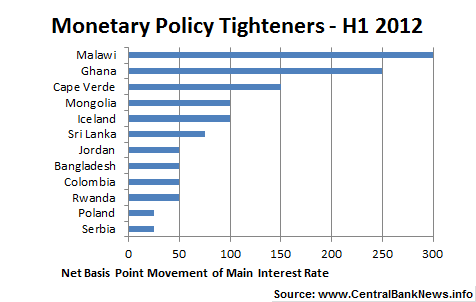
    In the tightening camp the average interest rate increase was 102.1 basis points, with a 50 basis point increase being the most common (4 out of 12), and 5 hiking rates by more than 100bps.
    Most of the countries hiking rates were in lesser developed regions, where it is common for general price levels to be more sensitive to food price inflation and uncontrollable movements in exchange rates; in addition a few of these countries had relatively strong growth, e.g. Mongolia. Malawi hiked rates the most, lifting its monetary policy rate by 300 basis points, while Ghana 250bps, Cape Verde 150bps, Mongolia 100bps and Iceland 100bps were among those making the highest interest rate increases.


    As noted, the dominant theme was for interest rates to remain unchanged; particularly where the limits of monetary policy stimulus has been reached e.g. in the US, Japan, and Europe. However, among emerging markets, and selected developed markets, the emphasis was more on easing policy to help provide good conditions for growth within a challenging global environment.


    Indeed, for most central banks that cut rates or kept rates at stimulatory levels, the rationale was to provide a pre-emptive measure in response to the euro crisis and its negative impact on confidence. Meanwhile, other reasons for the rate level was a response to a slowing economy; particularly among those with a higher exposure or sensitivity to international trade.


    The inflation picture was also a key determinant, as rates of annual consumer price inflation began to ease around the world, with some pundits warning of deflation in Europe and the US; while Switzerland did in fact experience deflation.


    Heading into the second half of 2012, it is likely that most economies will regain momentum following softening in growth through the first half. The key downside risk emanates largely from the European sovereign debt crisis, and the extent to which it can be contained, and default – and associated bank panics – avoided.

    But there are upside risks too; monetary policy settings are broadly very accommodative, and businesses have anecdotally held-off from investment decisions, and now have stronger balance sheets; banks have broadly experienced similar trends. Meanwhile, growth is likely to rebound in the second half of the year in China, and other emerging markets.


    So it could well be that towards the end of the year inflation becomes more of an issue than sustaining economic growth. But it wouldn’t take much for growth and inflation to remain subdued for the remainder of the year, so unchanged interest rates may remain the dominant theme.


    In any case, keep checking the central bank news website for timely monetary policy updates.


    Source: www.CentralBankNews.info

Central Bank News Link List – July 23, 2012

By Central Bank News

    Here’s today’s Central Bank News link list, click through if you missed the previous link list. The list is updated during the day with the latest news about central banks so readers don’t miss any important developments.

“Dollar Danger” Threatens Gold, Euro Hits 2-Yr Low as Spain Regions Say They’ll Need Bailouts

London Gold Market Report
from Ben Traynor
BullionVault
Monday 23 July 2012, 06:30 EDT

WHOLESALE gold bullion prices fell to $1569 an ounce during Monday morning’s London trading – 0.9% off Friday’s close – as stocks, commodities and the Euro also traded lower and US Treasuries gained, following news that two Spanish regions plan to ask for bailouts.

Silver bullion fell to $26.88 an ounce – a 1.9% drop on where it ended Friday.

Volumes of gold bullion held by exchange traded funds (ETFs) saw net losses last week, while on the currency markets this morning the Euro hit a new two-year low against the Dollar Monday, dropping below $1.21. As a result, the US Dollar Index, which measures the Dollar’s strength against other major currencies, hit a new two-year high.

“The great danger for the gold price is the stronger Dollar, because of its long-term negative correlation to gold,” says Eugen Weinberg, head of commodity research at Commerzbank.

“That’s definitely still dampening the interest of investors from the United States…but in Euro terms, gold is trading near six-month highs…it’s more about Dollar strength than gold weakness.”

European stock markets sold off sharply this morning, with the Euro Stoxx 50 index of blue chip companies down around 2.5% by lunchtime, and Spain’s Ibex down 5.3%.

Yields on 10-Year Spanish government bonds meantime set a new Euro-era record Monday, rising above 7.5% following news on Friday that Valencia’s regional government will ask Madrid for a bailout. On Sunday, the Spanish region of Murcia said it too will seek aid, with newspapers reporting several other regional governments plan to make similar requests.

Spain’s biggest region, Catalonia, is “working very hard to pay bills normally”, its economy minister Andreu Mas-Colell told Italian newspaper La Repubblica.

“But the pressure on our treasury is very high because the markets are closed [to us].”

Elsewhere in Europe, officials from the European Commission, European Central Bank and International Monetary Fund – collectively known as the ‘troika’ – are due to visit Athens tomorrow to assess progress meeting bailout conditions.

“If Greece doesn’t fulfill those conditions, then there can be no more payments,” German vice chancellor Philipp Roesler said Sunday, adding that the idea of Greece leaving the Euro “has long ago lost its terror”.

“There is no firewall around Greece,” counters Paul Donovan, senior economist at UBS.

“Or, if there is, it is constructed of high quality, dry kindling wood doused in gasoline. If Greece goes other countries seem certain to leave…if politicians have lost a sense of terror over the prospect of a Greek exit it suggests that politicians have lost any comprehension of economic reality.”

In New York meantime, the difference between bullish and bearish contracts held by noncommercial gold futures and options traders – the so-called speculative net long – rose slightly in the week ended last Tuesday, Commodity Futures Trading Commission figures show. The number of speculative long and short positions both fell however.

“Overall positioning in gold remains weak,” says a note from Standard Bank.

“We are skeptical about the sustainability of any gold rallies over the short term.”

The world’s biggest gold ETF the SPDR Gold Shares (GLD) saw a second straight day of outflows on Friday, sending holdings of gold bullion down to 1254.6 tonnes, just above where they were six months ago.

“ETFs are increasingly skeptical about gold,” says Standard Bank, noting that gold ETFs worldwide saw a 13.7 tonne decline last week, the biggest weekly drop since March.

“A lot of fund managers are just content sitting on cash without loading up on anything at all,” adds one trader in Singapore.

“They are happy to be in as stable a portfolio as possible.”

“Evidence of a significant response from physical buyers is needed first,” says a note from UBS, “before the investment community can be expected to follow suit.”

UBS adds that its gold sales to India “do not indicate any improvement as yet and neither does combined gold volumes on the Shanghai Gold Exchange, which have been 30% below average this month.”

India needs to see a “social and cultural revolution” in its attitude towards gold, according to the deputy governor of the central bank.

“Ninety percent of the gold demand is jewelry or to offer to God,” KC Chakrabarty told an audience in Mumbai over the weekend.

“Both have to stop… Wearing gold as an ornament was a culture when you were a rich society, when you were contributing to 30% of the GDP of the world. Today, we have become a poor country, we need to change our culture.”

Ben Traynor
BullionVault

Gold value calculator   |   Buy gold online at live prices

Editor of Gold News, the analysis and investment research site from world-leading gold ownership service BullionVault, Ben Traynor was formerly editor of the Fleet Street Letter, the UK’s longest-running investment letter. A Cambridge economics graduate, he is a professional writer and editor with a specialist interest in monetary economics.

(c) BullionVault 2011

Please Note: This article is to inform your thinking, not lead it. Only you can decide the best place for your money, and any decision you make will put your money at risk. Information or data included here may have already been overtaken by events – and must be verified elsewhere – should you choose to act on it.


Spain Worries Send EUR to Fresh Lows

Source: ForexYard

Renewed concerns regarding the debt situation in Spain sent the euro plunging to fresh lows against several of its main currency rivals, including the US and Australian dollars and the Japanese yen on Friday. Investors are now worried that Spain will have to seek a full scale international bailout to rescue its ailing banking sector. This week, the common-currency is likely to see additional volatility, as a batch of euro-zone news is set to be released. Tuesday in particular may be a busy day in the markets, as both France and Germany are scheduled to release manufacturing data. Should any of the indicators come in below their expected levels, the euro could extend its downtrend.

Economic News

USD – Dollar Extends Gains vs. EUR and CHF

Investors sought out safe-haven assets on Friday following renewed Spanish debt fears. The news sent the US dollar significantly higher against several of its main currency rivals, including the Swiss franc and euro. The USD/CHF gained close to 100 pips during European trading, eventually peaking at 0.9885 before staging a minor correction to close out the week at 0.9875. Against the euro, the USD was able to reach a fresh two-year high after investors became concerned that Spain would soon need to request an international bailout. The EUR/USD sank as low as 1.2143 before finishing the week at 1.2158.

This week, dollar traders will want to pay attention to several potentially significant news events. On Tuesday, a speech from Fed Chairman Bernanke could lead to volatility if he hints at a new round of quantitative easing to boost the US economy. In addition, home sale data on Wednesday, followed by Thursday’s Core Durable Goods Orders and Friday’s Advance GDP figure mean that the greenback is likely to see plenty of movement in the coming days.

EUR – EUR Continues to Fall against Main Rivals

The euro dropped to a record low against both the Australian and Canadian dollars on Friday, while the EUR/JPY hit an 11-year low. Fears that Spain, the EU’s fourth largest economy, will soon require a bailout were blamed for the euro’s downtrend. The EUR/AUD fell close to 70 pips during European trading, while the EUR/CAD dropped close to 60 pips. The pairs respectively finished out the week at 1.1707 and 1.2309. Against the yen, the euro tumbled over 100 pips before closing the week at 95.43.

This week, analysts are warning that given the current fears that the euro-zone debt crisis is spreading to other countries in the region, combined with the ongoing concerns regarding Spain, the euro could potentially fall further against its main rivals. In addition to any announcements out of the EU regarding the Spanish debt situation, traders will also want to pay attention to manufacturing and services data out of Germany and France, scheduled to be released on Tuesday. Should any of the news fail to come in as expected, the euro may extend its recent losses.

Gold – Gold Stabilizes Following Russian News

Risk aversion due to euro-zone news sent the price of gold tumbling close to $13 an ounce during the first half of the day on Friday. The precious metal eventually reached $1573.26 before correcting itself after Russia announced that it had boosted its gold reserves. Gold eventually closed out the week at $1584.25 an ounce.

This week, gold traders will want to pay attention to news out of the EU and US. While the euro-zone debt crisis has resulted in prices falling in recent days, gold has the potential to see gains following a speech from Fed Chairman Bernanke on Tuesday. Should the Fed Chairman hint at a new round of quantitative easing in the US, the precious metal may turn bullish as a result.

Crude Oil – EU Worries Cause Crude Oil to Resume Bearishness

After hitting an eight-week high earlier in the week, crude oil resumed its bearish trend on Friday as euro-zone news caused investors to shift their funds to safe-haven assets. The price of oil fell by well over $1 a barrel over the course of the day, eventually reaching as low as $90.90 before recovering to close out the week at $91.51.

This week, oil traders will want to monitor any developments in the Middle East. The military-conflict in Syria combined with the ongoing dispute over Iran’s nuclear program were the main reasons behind oil’s bullish movement last week. Any escalation in either conflict may lead to supply side fears among investors which could result in oil resuming its upward trend.

Technical News

EUR/USD

The weekly chart’s Slow Stochastic appears to be forming a bullish cross, indicating that this pair could see an upward correction in the coming days. Furthermore, the same chart’s Williams Percent Range has crossed over into oversold territory. Traders may want to open long positions for this pair.

GBP/USD

Long-term technical indicators indicate that this pair is range trading, meaning that no defined trend can be determined at this time. Traders may want to take a wait and see approach, as a clearer picture is likely to present itself in the near future.

USD/JPY

The daily chart’s Relative Strength Index has crossed into oversold territory, signaling possible upward movement for this pair in the near future. In addition, the Slow Stochastic on the same chart appears to be forming a bullish cross. Going long may be the wise choice for this pair.

USD/CHF

The weekly chart’s Williams Percent Range is currently well into overbought territory, signaling that downward movement could occur in the coming days. Furthermore, the Relative Strength Index on the same chart is currently at the 70 level. Opening short positions may be the wise choice for this pair.

The Wild Card

EUR/SEK

The Slow Stochastic on the daily chart is forming a bullish cross, signaling that this pair could see upward movement in the near future. This theory is supported by the Relative Strength Index on the same chart, which has crossed into oversold territory. Opening long positions may be the wise choice for forex traders today.

Forex Market Analysis provided by ForexYard.

© 2006 by FxYard Ltd

Disclaimer: Trading Foreign Exchange carries a high level of risk and may not be suitable for all investors. There is a possibility that you could sustain a loss of all of your investment and therefore you should not invest money that you cannot afford to lose. You should be aware of all the risks associated with Foreign Exchange trading.


China’s Big Move Could be a Game-Changer for Gold

By MoneyMorning.com.au

A report into attitudes towards owning gold bullion posed the following question: ‘What are the reasons for the continued sceptical attitude towards gold?’

There were three key answers:

  • Gold is considered a ‘barbarous relic’
  • It’s considered expensive to buy – or highly speculative
  • It’s confronted with the ‘normalcy bias’

The report pointed towards a positive future for gold as an investment tool. Yet, it also noted that the metal still needs to overcome its status as an investment tool for cranks, weirdos and old fashioned investors.


So how did gold get its reputation in the mainstream as a ‘barbarous relic’?

John Maynard Keynes is often credited with the term. But in actual fact, he wasn’t referring to gold directly, but rather the gold standard.

The reference to gold dates back further, to 1894 when a Tennessee merchant told the US Senate that, ‘Gold is a relic of barbarism and should be discarded by all civilized nations as a medium of exchange.’

No doubt that was just what the Senate and future US central bankers wanted to hear.

In 1946, the Bretton Woods agreement enabled a fixed exchange rate. It meant that you could exchange your US dollars for gold. The going rate was $35 per ounce for several decades. President Richard Nixon ended this system in 1971. From that point on, only faith in the American government was behind the greenback.

And what happened to gold? Soaring inflation (around 11% by 1979) enabled gold to rally over the next decade from $35 an ounce to more than $850 an ounce.

As the decadent eighties rolled in, all sorts of fancy financial tools were developed. These were the investing tools for the modern man. You could leverage yourself to the eyeballs.

After all, why buy something as simple as gold when there are complicated financial tools like swaps, futures, options, Forex, warrants, bonds and stocks to invest in?

This has led the modern man, with all his fancy financial products, to sneer at gold investors. He sees them as people who refuse to move with the times. The sort of people who were most likely your Great Depression surviving grandparents.

Gold’s a Relic…For Old Timers

So it’s not easy to change gold’s image from a ‘barbarous relic’ to an investing tool. And it’s made harder when today’s investing ‘gurus’ slam it.

Take this, from a speech given by billionaire investor Warren Buffett in 1998:

‘[Gold] gets dug out of the ground in Africa, or someplace. Then we melt it down, dig another hole, bury it again and pay people to stand around guarding it. It has no utility. Anyone watching from Mars would be scratching their head.’

11 years later, when the gold price had risen from $350 per ounce to $850 an ounce (a nice 142% gains), did Buffett change his tune?

No. He didn’t. In fact, when a CNBC reporter asked where the price of gold was going and if it had a place in value investing, he said gold does nothing but ‘…look at you’:

‘I have no views as to where it will be, but the one thing I can tell you is it won’t do anything between now and then except look at you. Whereas…Coca-Cola will be making money, and I think Wells Fargo will be making a lot of money…it’s a lot better to have a goose that keeps laying eggs than a goose that just sits there and eats insurance and storage and a few things like that.’

Since Buffett said that gold would do nothing between ‘now and then except to look at you’, the spot price has risen 84%.

But what about Coca-Cola [NYSE: KO] and Wells Fargo [NYSE: WFC]? Seeing as they were Buffett’s choice of investment at the time. Coke’s up 73% and Wells Fargo is 24% higher since then…


Click here to enlarge

Source: Google Finance

It’s not a bad return for either Wells Fargo or Coca-Cola. But it’s not as good as an 84% return.

Gold is Too Expensive

Shares in Coca-Cola are trading at USD$77.55. Does that sound like a good price to you? Well here’s the thing, for one ounce of gold at roughly USD$1,570, you’d get less than 21 Coca-Cola shares.

What do you actually get with the Coke stocks? A bit of paper that says you own a tiny smidgin of the company. You and about 9.2 million of your closest mates.

And here is one of the crucial differences owning shares versus gold. You’re at the mercy of company management.

At any time company management can dilute the value of your shares by issuing more. When that happens, if you want your shares to have the same value as previously, you have to buy more.

But with gold, no one can touch it. As in, the metal is ‘outside’ the financial system. No matter what central bankers do, they can’t fiddle with it. A corporation can’t water down the value of your gold by issuing more. It’s a finite resource. It’s a store of value. It’s a tangible asset. No one has yet found a way to create gold from thin air.

And yes, it’s pretty to look at.

Gold’s Not ‘Normal’ – It’s An Investment Only For Cranks

Times have changed. The thing is, owning gold is becoming normal.

Just recently, on a construction site in Melbourne, a few electricians were talking about how to best store their cash (they’re tradies after all). As they ate their meat pies and drank their cans of Coke, one of the sparkies’ said to Mr Smith, ‘Hey, can you get your wife to call me? I want to buy some gold but I don’t know where to start.’

No longer is the yellow metal only for the ‘gold bugs’, old timers and the rich…

But the changing attitudes over gold go deeper than a couple of tradie’s chatting over a smoko. Things are slowly changing at the big end of town too.

China is developing its own internal gold market.

According to the Financial Times: ‘China is set to launch interbank gold trading at the end of next month amid a broader set of banking reforms… A spokesman for the Shanghai Gold Exchange confirmed that the exchange “has this plan” to create an interbank gold market and was working with other government agencies to do so…’

Why would China want to enable gold trading between banks? Could it be because China wants to use more gold in their banking system?

Greg Canavan, editor of Sound Money. Sound Investments, has followed the China-Gold story for quite some time. In a recent report he wrote:

‘In 2007, China became the world’s largest gold producer. And by 2011, it produced 355 tonnes of gold… not one single ounce of China’s new supply made it to the global gold market.’

Greg sees this latest move by the Chinese government as a clear sign that ‘…the Chinese government is determined to make gold a much bigger part of their financial strategy in the coming years.’

China creating their own interbank gold market is just the first step of asserting their new found dominance of the gold market (China accounted for a quarter of global gold demand during the first three months of this year).

This move by China could be a big deal for the gold market, and it’s bound to have an impact. If you want to find out more about how Beijing is re-writing their own rules and the role gold will play in the kingdom’s survival, click here.

Shae Smith
Editor, Money Weekend

The Most Important Story This Week…

Commodities have had a tough year in 2012. Most of them have traded down pricewise on fears of falling demand as the world economy slows. The Australian Resources Minister was quoted as saying the era of high commodities is over. Does this signal a bottom? Money Morning editor Dr. Alex Cowie is still bullish on mining stocks – especially in strategic minerals and gold. See what he says in Is This Man the Ultimate Contrarian Indicator for Mining Shares?

Other Recent Highlights…

Kris Sayce on How an Interest Rate Rise Could Trigger a ‘Punch Bowl’ Rally: “He’s impossible to ignore. That’s right, we’re talking about US Federal Reserve Chairman, Dr. Ben S. Bernanke. He’s just finished giving testimony to the US Congress. Asked about the impact of low interest rates, the Fed Chairman said the Fed was ready to take ‘away the punch bowl’. In other words, raise interest rates. That’s bad news for stock markets, right? Maybe not.”

Greg Canavan on Why Gold is Flowing into China: “I want you to think differently about China and the way the Western media presents its economic development. There is no doubt China’s economy has some real challenges. One question the reader asked was if it’s possible China is cornering the gold market to solve their problems.”

Phil Oakley on What Are the Bond Markets Telling Us?: “Most small investors spend the majority of their time looking at stock markets. However, I’ve always believed that to get a deeper understanding of what’s really going on, the best thing you can do is to try to figure out what the bond market is telling you.”

John Stepek asks Annoyed by the LIBOR Rigging? You Should be Raging About The Fed: “What’s really happening now is that the general public is getting a look under the bonnet of the financial system. And they’ve discovered that the engine of the sleek-bodied sports car that delivered them the illusion of wealth in the good times, is in fact a mass of loose screws and unsheathed wiring held together with sticky tape and false promises.”


China’s Big Move Could be a Game-Changer for Gold