Gold in Euros “Making Gains” on Stronger Dollar, AAA-rated Debt “An Endangered Species” as Moody’s Issues Germany Warning

London Gold Market Report
from Ben Traynor
BullionVault
Tuesday 24 July 2012, 07:30 EDT

U.S. DOLLAR gold prices fell to $1573 an ounce Tuesday morning in London – a few Dollars above last week’s low – as stocks and commodities also traded lower, while US Treasuries were flat and German bunds fell after Germany’s credit rating was placed on negative outlook.

Silver prices briefly dipped below $27 per ounce – 1.2% below where they began the week.

On the currency markets, the Euro briefly dropped below $1.21 for the second day in a row, while Euro gold prices hovered around €1300 per ounce – 3.2% off its six-month high. The gold price in Euros has gained 8% since the middle of May.

“Thanks to the Euro’s depreciation vis-a-vis the US Dollar, gold in Euro terms has been making gains for some time now,” says a note from Commerzbank.

Ratings agency Moody’s said last night that it is placing three Aaa-rated Eurozone sovereigns, Germany, Luxembourg and the Netherlands, on negative outlook.

“There is an increasing likelihood that greater collective support for other Euro area sovereigns, most notably Spain and Italy, will be required,” said a statement from Moody’s.

“Given the greater ability to absorb the costs associated with this support, this burden will likely fall most heavily on more highly rated member states if the Euro area is to be preserved in its current form.”

The German finance ministry responding by insisting that “Germany will, through solid economic and financial policy, defend its ‘safe haven’ status and continue to maintain its responsible anchor role in the Eurozone”.

Moody’s also said it will “assess the implications” of recent Eurozone developments for Austria and France, whose Aaa ratings the agency put on negative outlook in February.

“In all large industrialized countries, AAA is an endangered species,” says Joerg Kraemer, chief economist at Commerzbank.

“They’re all under fire.”

Spain and Italy meantime both announced short-selling bans on Monday following heavy stock market losses. Spain’s regulator CMNV has banned short-selling – by which traders bet on a fall in prices – on all Spanish securities for three months, Reuters reports. Italy’s Consob has banned the short-selling of 29 banking and insurance stocks for one week.

Spain’s Ibex stock index saw the biggest loss of major European bourses in Tuesday morning’s trading, falling 2.7% by lunchtime, while Italy’s FTSE MIB index was down 1.3%.

Both nations introduced short-selling bans last August, which also saw similar bans implemented by Belgium and France.

Benchmark yields on Spanish 10-Year government bonds continued to rise Tuesday to just below 7.6%, after two Spanish regions confirmed over the weekend that they plan to seek financial aid from the government in Madrid. Several other regions are also expected to ask for bailouts.

Despite this, Spain managed to sell just over €3 billion of three-month and six-month debt at an auction this morning, although borrowing costs were higher than at a similar auction last month.

In Italy, ten major cities, including Milan, Naples and Turin, are on the verge of financial collapse, according to a report in newspaper La Stampa, which also reports on growing calls on social media sites for a return to the Lira, as well as for people to withdraw funds from their bank accounts.

Italian 10-Year bond yields hit six-month highs at over 6.4% on Tuesday.

CME Group, the futures and options exchange operator that runs the New York Comex, announced Monday that is “exploring the concept of having clearing houses or other depositories hold all customer segregated funds”.

A statement from CME Group said it “is appalled at the recent misuse of segregated funds by two firms, MF Global Inc. and PFG”, adding that “the current system in which customer funds are held at the firm level must be re-evaluated”.

Over in China – which has overtaken India in recent months to become the world’s largest source of demand to buy gold – manufacturing has contracted at a slower pace this month than last, according to preliminary purchasing managers index data published by HSBC today.

HSBC’s flash PMI for this month was 49.5, up from 48.2 in June, with a figure below 50 indicating sector contraction. The survey however showed a faster rate of employment contraction, with the sub-index for employment growth hitting its lowest level in 40 months.

“[This] should ring alarm bells in Beijing,” says Nikolaus Keis, economist at UniCredit, who adds that he expects authorities to respond with fiscal and monetary stimulus measures.

“Creating enough jobs for millions of new graduates and rural migrant workers is crucial for the government.”

Ben Traynor
BullionVault

Gold value calculator   |   Buy gold online at live prices

Editor of Gold News, the analysis and investment research site from world-leading gold ownership service BullionVault, Ben Traynor was formerly editor of the Fleet Street Letter, the UK’s longest-running investment letter. A Cambridge economics graduate, he is a professional writer and editor with a specialist interest in monetary economics.

(c) BullionVault 2011

Please Note: This article is to inform your thinking, not lead it. Only you can decide the best place for your money, and any decision you make will put your money at risk. Information or data included here may have already been overtaken by events – and must be verified elsewhere – should you choose to act on it.


Hungary leaves base rate unchanged at 7%

By Central Bank News

    Hungary’s central bank left its central base rate unchanged at 7.0 percent but said it would consider cutting interest rates if the risk premium on the country’s debt were to decline and the outlook for inflation were to improve.
    In a statement, the Magyar Nemzeti Bank described its monetary policy stance as “cautious” and this stance was warranted due to the risky economic environment and high inflation.
    “The volatile risk environment and above-target inflation for an extended period continue to warrant a cautious policy stance,” the bank said. “The council will consider a reduction in interest rates if Hungary’s risk premium falls persistently and substantial and the outlook for inflation improves.”
     The central bank last raised its base rate by 50 basis points in December, 2011.

    Hungary’s government started talks last week with the International Monetary Fund and the European Union on financial aid. The talks had been held up due to concern over laws that threatened the independence of the National Bank of Hungary. But talks began after law was amended.
    The central bank welcomed the talks and said an agreement could lead to a sustained improvement in the way investors perceive Hungary, just as it was critical for lowering risk premia that the government remained committed to meeting it’s fiscal targets.

    Hungary’s inflation rate rose to a higher-than-expected 5.6 percent in June from 5.3 percent in May, but the bank said this was due to temporary factors and inflationary pressures from economic activity remained subdued due to weakening demand. The bank targets 3.0 percent inflation.

    But tax increases early this year and higher duties are likely to push inflation over the central bank’s 3-percent target for a “sustained period,” the bank said, adding that increases in indirect taxes would also push the consumer price index above target into 2013.
    “Although this is unlikely to fuel second-round effects due to persistently weak demand and slack in the labour market,  meeting the inflation target is expected to be delayed,” the bank said.
    Hungary’s economy (GDP) shrank by 0.70 percent in the first quarter from the same 2011 quarter and is first expected to expand in 2013, with exports weighed down by slower external demand.
    “Persistently high unemployment, falling real incomes and precautionary behavior by households suggest that consumption will decline over the period ahead,” the bank said, adding that investment is also likely to remain subdued.

    www.CentralBankNews.info


Real-Forex Daily review- 24.07.2012

 
Date: 23.07.2012   Time: 17:28 Rate: 1.2236
Daily chart
 
Last Review
The price has checked again the 1.2290 price level, but at this point could not close a candle above this level, so at this point this level can be used as a resistance level. Breaking of the 1.2290 price level will probably lead the price to a Fibonacci correction in size of between a third and two thirds of the last downtrend which started at the 1.2692 price level. On the other hand, continuation of the downtrend will lead the price at first stage to the “One in, one out” pattern target on the 1.2122 price level (red broken lines).
Current review for today
As it is possible to see, the price could not breach the 1.2290 resistance level and descended to complete the “One in, one out” pattern target by reaching the 1.2122 price level. The price is moving now around this level while at the moment it is used as a balance point. It is possible to assume that breaking the 1.2067 price level will continue the downtrend towards the weekly chart target around the 1.1900 price level. on the other hand, establishment of the price at the current area and breaching the 1.2290 price level will indicate that we are headed towards a Fibonacci correction in size of between a third and two thirds of the down trend which started at the 1.2692 price level.
You can see the chart below:
eur/usd
 
4 Hour chart
Date: 23.07.2012   Time: 17:37  Rate: 1.2133
 
Last Review
The price breached the 1.2290 but came back right after. Now the price is in the middle of the range between the 1.2167 and the 1.2290 price levels. Breaching of the 1.2290 resistance level will indicate that the price will continue at first stage to the 1.2340 price level, which is a 38.2% Fibonacci correction of the downtrend marked in red broken line. On the other hand, breaking of the 1.2167 price level will sign the continuation of the downtrend.
Current review for today
It is clearly possible to say that the price has reached the “Wolfe waves” pattern target by reaching the line connecting points 1 and 4. Now it is possible that the price will perform an ascending move to check the 1.2167 price level, which is used as a support level and it is possible that will be checked by the price as a resistance as well. Breaking of the 1.2067 price level will probably continue the downtrend towards the 1.1900 level area. On the other hand, breaching of the 1.2167 price level will indicate that it is possible we will see the price checking the 1.2250 price level again.
You can see the chart below:
eur/usd  
 
GBP/USD
 
Date: 23.07.2012   Time: 17:48  Rate: 1.5519
4 Hour chart
Last Review
The price has reached the “One in, one out” pattern by touching the 1.5670 price level. Breaching of this level again will indicate that the price will continue towards the closest resistance on the 1.5716 price level. On the other hand, descend of the price under the 1.5517 price level will create descending price structure, that will probably lead the price back to the last low on the 1.5400 price level at first stage.
Current review for today
The price has reached under the 1.5517 price level, but it happened by a continuous downtrend without making a correction. Now the price is checking whether this level can change its function from a support to resistance, while breaking the 1.5485 price level will sign the continuation of the downtrend towards the 1.5400 price level. On the other hand, stoppage of the price at the current area will indicate that it is possible to see a Fibonacci correction in size of between a third and two thirds of the downtrend which started at the 1.5740 price level.
You can see the chart below:
gbp/usd  
 
AUD/USD
 
Date: 23.07.2012   Time: 20:50 Rate: 1.0287
4 Hour chart
Last Review
The price has breached the 1.0251 price level and reached the “One in, one out” pattern target on the 1.0300 price level. The price is moving in an ascending price structure while the continuation of the uptrend will lead the price towards the last peak on the 1.0326 price level. On the other hand, breaking of the 1.0202 price level will probably create a descending price structure which will lead the price towards the last low on the 1.0123 price level.
Current review for today
The price has corrected exactly 50% of the uptrend marked in blue broken line towards the 1.0270 price level and stopped at this area, at this point it is possible that the price will perform a correction in size of between a third and two thirds of the last downtrend which started at the 1.0444 price level. On the other hand, another breaking of the last low of the area at the 1.0240 price level will indicate that it is possible to see the price reaching the last low at the 1.0200 price level
You can see the chart below:
aud/usd
 
 
USD/CHF
Date: 23.07.2012   Time: 23:00 Rate: 0.9913
4 Hour chart
The price has breached the 0.9870 price level and continued upwards while at the moment it stopped at the 0.9950 price level. It is possible that we will see the price performing a correction move in size of between a third and two thirds of the last ascending move which started at the 0.9750 price level. Breaching of the 0.9950 price level will continue the uptrend with first target on the 1.0120 price level.
You can see the chart below:
usd/chf
USD/JPY
Date: 24.07.2012   Time: 23:07 Rate: 78.36
4 Hour chart
The price has broken the 78.70 price level and looks like it is making its way towards the last low at the 77.66 price level. Stoppage of the price at the current area and creation of an ascending price structure will probably lead the price towards an uptrend that will in first stage perform a correction in size of  between a third and two thirds of the downtrend which started at the 80.60 price level.
You can see the chart below:
USD/JPY
 
Important announcements for today:
13.30 (GMT+1) CAD –  Core Retail Sales (Monthly)

Daily Market Analysis provided by Real-Forex

Real-Forex offers institutional-level FX trading conditions, for private and corporate investors. We strive to provide our clients with superior technology and exemplary customer service through our live 24/5 online support and with one of the most advanced yet easy-to-use ECN platform on the market: the Real Stream FX platform.


Spanish Worries Continue to Weigh Down on Euro

Source: ForexYard

Rising Spanish bond yields combined with fears that the country will soon need an international bailout sent the euro to new lows against its main currency-rivals yesterday. The EUR/USD fell to its lowest level in more than two-years, while the EUR/JPY fell close to a 12-year low. Today, analysts are warning that, depending on the results of French and German manufacturing and services data, the euro could fall further. Traders will also want to pay attention to a speech from Fed Chairman Bernanke. If the Fed Chairman hints at a new round of quantitative easing to boost the US economy, the euro could reverse some of its recent losses against the greenback.

Economic News

USD – Safe-Haven USD Gains on Riskier Currencies

The US dollar extended its upward trend against most of its main currency rivals during European trading yesterday, as investors remained fearful about the debt situation in Spain. In addition, renewed concerns about the health of Greece’s economy sent investors to safe-haven assets. The EUR/USD dropped close to 80 pips to reach 1.2066, its lowest level since June of 2010. The AUD/USD fell just over 70 pips before finding support at the 1.0250 level. The USD was not as fortunate against its safe-haven rival, the JPY. The USD/JPY fell to a six-week low at 77.94 before staging a reversal and moving up to 78.20.

Turning to today, dollar traders will want to pay attention to a speech from Fed Chairman Bernanke, set to take place at 12:45 GMT. Given that the US economy has slowed down in recent months, investors will be closely watching today’s speech to see if the Fed Chairman will hint at a new round of quantitative easing. If he does, the dollar could reverse some of its gains from yesterday. That being said, if Bernanke remains quiet about any new steps to boost the US economic recovery, the dollar could extend its recent bullish trend.

EUR – Euro Slides Downward as Greek Worries Return to Marketplace

Investors once again grew fearful regarding the economic situation in Greece yesterday, following a report that the International Monetary Fund may not continue financing the country. The news, combined with rising borrowing costs in Spain, sent investors away from riskier assets and resulted in the euro falling across the board. After falling over 100 pips during overnight trading, the EUR/JPY hit a 12-year low at 94.23 during early morning trading. Against the British pound, the euro dropped to a 3 ½ year low at 0.7758 before staging a mild upward correction and stabilizing at the 0.7800 level.

Today, euro traders will want to pay attention to the French and German Manufacturing and Services Purchasing Managers Indices, set to be released at 7:00 and 7:30 GMT. Should any of the data indicate that the euro-zone debt crisis is weighing down on either the French or German economies, the common-currency may take additional losses during the European session. In addition, any negative reports or announcements regarding the Greek economy could result in further euro bearishness.

Gold – Strengthened USD Weakens Gold

The price of gold fell as low as $1562.92 an ounce during mid-day trading yesterday, as a strengthened US dollar made the precious metal more expensive for international buyers. Overall, gold fell more than $20 over the course of the day before staging a minor upward correction and stabilizing at $1570.

Today, gold traders will want to pay attention to the USD, and any movement it sees following a speech from Fed Chairman Bernanke. If the Fed Chairman strikes a pessimistic tone regarding the pace of the US economic recovery, investors may begin speculating that a new round of quantitative easing may be coming, in which case the dollar could reverse its bullish trend. As a result, gold could begin moving upward again.

Crude Oil – Risk Aversion Causes Oil to Reverse Bullish Trend

Risk aversion in the marketplace due to renewed worries regarding the Spanish and Greek economies resulted in the price of crude oil falling throughout the day yesterday. The euro-zone news outweighed the supply side fears due to conflict in the Middle East that had caused oil to turn bullish last week. The commodity dropped almost $2 a barrel during European trading, eventually reaching as low as $87.92.

Today, oil traders will want to continue monitoring any developments in the euro-zone, as they are likely to continue influencing the direction crude takes. Should the euro continue to slide against the US dollar, oil could take additional losses, as the commodity would become more expensive for international buyers.

Technical News

EUR/USD

The weekly chart’s Slow Stochastic appears to be forming a bullish cross, indicating that this pair could see an upward correction in the coming days. Furthermore, the same chart’s Williams Percent Range has crossed over into oversold territory. Traders may want to open long positions for this pair.

GBP/USD

Long-term technical indicators indicate that this pair is range trading, meaning that no defined trend can be determined at this time. Traders may want to take a wait and see approach, as a clearer picture is likely to present itself in the near future.

USD/JPY

The daily chart’s Relative Strength Index has crossed into oversold territory, signaling possible upward movement for this pair in the near future. In addition, the Slow Stochastic on the same chart appears to be forming a bullish cross. Going long may be the wise choice for this pair.

USD/CHF

The weekly chart’s Williams Percent Range is currently well into overbought territory, signaling that downward movement could occur in the coming days. Furthermore, the Relative Strength Index on the same chart is currently at the 70 level. Opening short positions may be the wise choice for this pair.

The Wild Card

EUR/GBP

The Relative Strength Index on the daily chart has crossed over into oversold territory, indicating that this pair could see an upward correction in the near future. Furthermore, the Slow Stochastic on the same chart has formed a bullish cross. Forex traders may want to open long positions ahead of a possible upward breach.

Forex Market Analysis provided by ForexYard.

© 2006 by FxYard Ltd

Disclaimer: Trading Foreign Exchange carries a high level of risk and may not be suitable for all investors. There is a possibility that you could sustain a loss of all of your investment and therefore you should not invest money that you cannot afford to lose. You should be aware of all the risks associated with Foreign Exchange trading.


The GBP/USD Pair This Week

By TraderVox.com

Tradervox.com (Dublin) – The GBP/USD pair opened the week at 1.5580 and dropped to 1.5517. The pair then rose to a high of 1.5737 close to the resistance line of 1.5750. However, it dropped to close the week at 1.5615. There are some important events from UK that are expected to affect the cross this week.

The first major event from UK is the BBA Mortgage Approvals data which will be released on Tuesday at 0830hrs. The indicator has not changed much over the last several releases but the market is expecting an increase this time round. At 1000hrs on Wednesday, the CBI Industrial Order Expectations report will be released. This indicator has been on the negative side in the past. It is expected to remain in the negative but with a slight improvement this month. Prior to this report, at 0830 hrs, the preliminary GDP reading will be released. The last two readings have posted a 0.2 percent decline consecutively and the market expects this trend to continue this month as the UK economy continues to contract. On Friday, the Nationwide HPI report is expected to be released. This is a significant housing inflation index which was weak in June, coming in at 0.6 percent. The market is expecting a rebound with an increase of 0.8 percent.

With these releases, the marketing is expecting the pair to remain bullish this week as it has shown some strength over the last week. This is due to concerns that are being raised over the US data which is disappointing to investors. If the UK data comes in within the market expectation we might see and increase in the strength of the pound.

Some of the technical levels to look out for include; from the top, the resistance line at 1.5805, which was last breach in May followed by the 1.5750 which remained strong last week. The next line is at 1.5648 which has been changing its roles in the past week as the cross breached on its way up and broke it when it declined to close the week at 1.5615. The support line at 1.5600 held strong last week; but it is weak going into the week. The other support line is at 1.5521 followed by 1.5415.

Disclaimer
Tradervox.com is not giving advice nor is qualified or licensed to provide financial advice. You must seek guidance from your personal advisors before acting on this information. While we try to ensure that all of the information provided on this website is kept up-to-date and accurate we accept no responsibility for any use made of the information provided. Opinions expressed at Tradervox.com are those of the individual authors and do not necessarily represent the opinion of Tradervox.com or its management. 

Article provided by TraderVox.com
Tradervox.com is a Forex News Portal that provides real-time news and analysis relating to the Currency Markets.
News and analysis are produced throughout the day by our in-house staff.
Follow us on twitter: www.twitter.com/tradervox

Major Events that Will Affect AUD/USD Cross This Week

By TraderVox.com

Tradervox.com (Dublin) – The cross opened the week at 1.0234 and dropped to a low of 1.0202; however, the pair staged an impressive run, climbing to 1.0444, breaking through the resistance line at 1.0402 to close the week at 1.0422. This has been attributed to the weak US data including the unemployment claims and manufacturing data. There are several releases this week from Australian that will affect the cross and they are discussed below.

On Monday, the Australian PPI will be released. The previous release was not impressive as it came in down by 0.3 percent, registering the first decline since January 2010. The market is expecting July reading to rebound and record a 0.3 percent increase. The PPI index will be released at 0130 hrs GMT. The other important event will be the Chinese Flash Manufacturing PMI which will be released on Tuesday at 0230 hrs GMT. The index has been below the pivotal level of 50 since October last year, which indicative of contraction in Chinese manufacturing industry. Any changes in Chinese data affect Australian as this is Australia’s biggest trading partner.

Almost about half an hour later, the RBA Governor Glenn Stevens will speak on the state of economy in Australia at 0305hrs GMT. Traders have a keen eye on his speech as it might contain clues of future monetary policy. If his speech is more hawkish than the market expectations, this pushes the Australian dollar. The other event to put a close eye on is the CB Leading Index which will be released on Wednesday at 0000hrs GMT. The index declined for the first time since January in June, but an improvement is expected this time round.

The CPI data will be released on Wednesday at 0130hrs; this index has remained constant with very little change since the third quarter in 2011. The market expects a increase of 0.6 percent for the second quarter this year. The Trimmed Mean CPI which will be released at the same time on the same day is also expected to rise with the same margin.

Disclaimer
Tradervox.com is not giving advice nor is qualified or licensed to provide financial advice. You must seek guidance from your personal advisors before acting on this information. While we try to ensure that all of the information provided on this website is kept up-to-date and accurate we accept no responsibility for any use made of the information provided. Opinions expressed at Tradervox.com are those of the individual authors and do not necessarily represent the opinion of Tradervox.com or its management. 

Article provided by TraderVox.com
Tradervox.com is a Forex News Portal that provides real-time news and analysis relating to the Currency Markets.
News and analysis are produced throughout the day by our in-house staff.
Follow us on twitter: www.twitter.com/tradervox

Market Review 24.7.12

Source: ForexYard

printprofile

Riskier currencies, including the euro and Australian dollar, received a moderate boost in overnight trading following a positive Chinese manufacturing indicator. That being said, fears that Spain will soon require a full scale international bailout limited gains, and the euro remains close to a two-year low against the US dollar. Crude oil was able to advance close to $1 a barrel as a result of the Chinese news, and is currently trading close to the $89 level.

Main News for Today

German Flash Manufacturing PMI- 07:30 GMT
• If the manufacturing figure comes in below the forecasted 45.3, fears that the euro-zone debt crisis is impacting growth in Germany may worsen
• Any disappointing news may weigh down on the euro

Fed Chairman Bernanke Speaks- 12:45 GMT
• Investors will be closely watching the speech for clues as to any future plans for the Fed to initiate a new round of quantitative easing
• If Bernanke does mention quantitative easing, the dollar is likely to reverse most of its recent gains during the afternoon session

Read more forex news on our forex blog

Forex Market Analysis provided by ForexYard.

© 2006 by FxYard Ltd

Disclaimer: Trading Foreign Exchange carries a high level of risk and may not be suitable for all investors. There is a possibility that you could sustain a loss of all of your investment and therefore you should not invest money that you cannot afford to lose. You should be aware of all the risks associated with Foreign Exchange trading.

Why the Melbourne Property Market Could Be Set For Two Years of Pain

By MoneyMorning.com.au

A family friend working in real estate recently told me:


‘Well, there are plenty of sellers, and also plenty of buyers,

…but never the twain will meet.’

It’s a tough challenge to bridge the expectations of the two parties.

But right now, buyers have the upper hand. They know there’s a fair chance that all they have to do to get a better price – is wait.

And if the recent analysis on the Melbourne property market is right, it will be worth their while waiting a bit longer…

The average capital city property is already down by around 8% from the start of last year. But it seems that sellers are finding it hard to accept that this figure could possibly apply to their home too. Which is part of the reason ‘never the twain will meet’.

This is the latest chart from the Reserve Bank of Australia (RBA) showing what’s happening to property prices around our main cities. This was updated a few weeks ago, so should be pretty current.

Most Australian City Property Prices Trending Down

Most Australian City Property Prices Trending Down

Source: RBA

Talking about ‘the Australian property market‘ is a bit like talking about ‘the stock market’. It overlooks that it is made up of many very different sectors. For example, property in the city of Brisbane has fallen around 10% from its peak – but Victorian regional property prices in regions like Bendigo have actually increased by 8% in the same time.

But I want to specifically take a look at the Melbourne property market, which is starting to look pretty ugly.

Melbourne Property Prices Falling Sharply

This is the blue line on the left hand side of the chart. I’ve circled it to highlight it.

Melbourne property prices are rolling over really quite sharply now, and are tracing the steepest decline of all the cities by far.

So what’s happening in Melbourne to cause it to suffer more than the other cities – and how much worse can it get?

Morgan Stanley Equity Research summed it up in a report yesterday, saying:


‘…with record levels of stock on market, and record levels of dwellings under construction, the Victorian residential market is precariously poised for continued pricing pressure.’

According to SQM research, the record level of ‘stock on market’ in Melbourne is now sitting at around 41,000 unsold houses (and 14,000 apartments). This level of stock has been increasing steadily, and is now double what it was just two years ago.

A note from Goldman Sachs a few weeks back suggested that the true clearance rate for Melbourne property at the time was in fact 11.8%, rather than the official 55.8%. Apparently the properties with no bids aren’t used in the final calculation…which is a bit like being on a diet – but not counting the food that no-one sees you eat.

As for ‘the record levels of dwellings under construction’, the number of apartments under construction is now about 80% above the long-term average.

The Melbourne property market was a favourite for developers, but it now looks like they might have got a bit carried away.

For years, we’ve had the property bulls banging on about a ‘housing shortage‘. Your regular editor, Kris Sayce, has taken that argument to pieces countless times since 2009.

Now we have recently heard from the National Census that Australia’s population is about 1% less than thought. The result is that the National Housing Supply Council’s estimates of a 228,000 undersupply of housing, could actually be an official oversupply to the tune of 341,000 properties.

So we now officially have too much supply at a national level, but even more so at Melbourne level – but what about demand?

Debt versus Demand in Melbourne Property

Debt is the lifeblood of the property market, but people are now borrowing less. The size of the average loan is 4% less than it was a year ago, and the number of loans made is starting to contract for the first time in decades. With the housing boom driven by available debt and rampant property speculation, the opposite is also true. The falling property market will partly be a factor of debt contraction.

So Melbourne’s case is a particularly potent mix of oversupply and weak demand.

And this comes at a time that Melbourne is the least affordable city in the country.

It has a long way to fall to return to the historic trend. But if you think the outlook for Melbourne already looks bad…it gets worse.

Melbourne property prices are in fact so bloated, that Melbourne scored as the 4th most unaffordable city in the WORLD. This is measured from the 325 major global cities in Demographia‘s recent survey.

This puts things in context, and shows just how much scope there is for Melbourne property to come back to a more sensible level.

Speak to 10 commentators, and you’ll get 10 different opinions of what Australian property prices will do next. But Morgan Stanley’s Equity Research team is one of the few institutions that called it pretty much spot on. I sold my property last year based on their views, so I like to keep an eye on their research.

And their prediction is for more pain in the residential property market.

On top of whatever happens in the second half of this year, they see a fall of 12% in 2013, and then a drop of 9% in 2014.

Assuming the market creeps down a bit more during the second half of this year, to finish 10% below the peak, then by the end of 2014 these predictions would see the market fall by a compound total of 28% under the peak.

With so much stock on the market, and buyers sitting on their hands, the stage is certainly set for some fireworks in the coming months and years.

Dr. Alex Cowie
Editor, Money Morning

Related Articles

Market Pullback Exposes Five Stocks to Buy

Why My Excitement Level for Gold Stocks Has Risen +33% Since Yesterday

Is This Man the Ultimate Contrarian Indicator for Mining Shares?


Why the Melbourne Property Market Could Be Set For Two Years of Pain

Why the Eurozone Will Sacrifice Greece to Save the Spanish Economy

By MoneyMorning.com.au

Markets across the globe tanked on Friday, with fears over the Spanish economy as the primary driver.

So what’s gone wrong this time?

The bond markets have almost closed to Spain.

Spain’s situation is rapidly deteriorating. On Friday, Spain’s benchmark index, the IBEX, dived by nearly 6%. The euro, meanwhile, slid sharply. It’s getting close to a two-year low against the dollar.

But the real problem is Spain’s borrowing costs.

Investors are concerned that the ‘no-strings’ deal to give its banks €100bn in aid from the European bail-out fund in fact had plenty of strings attached. In other words, the “doom loop” between sovereign and banking sector hasn’t been decisively broken.

If the Spanish economy still has to stand behind its broken banking sector, then that means no one in their right minds would invest in Spanish bonds. Because if the Spain takes bail-out money from the European authorities, then existing private sector creditors will be pushed down the queue.

Yes, I know that the Europeans said at the last summit that this wouldn’t happen. But if you believe that then you’re probably in the market for Spanish timeshare flats too.

So a disappointing bond auction on Thursday spooked buyers. And it only got worse on Friday, when the Valencia region asked for emergency assistance from the central government. On top of that, the Spanish economy now expects to be in recession until 2014.

Spanish ten-year borrowing costs spiked to a near-record high for the euro era, rising to just below 7.3%.

No Respite for the Spanish Economy

But the real problem is the short-term borrowing costs. Five-year borrowing costs hit 6.88%, a new record.

This matters. Up until now, even if it was too expensive to borrow over ten years, Spain could have borrowed over shorter periods at lower rates. That way it could buy itself time until some sort of longer-term solution had been reached.

Now, as one City expert put it: ‘To all intents and purposes, Spain is now frozen out of the bond markets.’

What happens now?

That’s scary. Money is fleeing Spain (and the other “troubled” states). Bond yields in many ‘safe’ countries are turning negative. In other words, people are willing to accept a small loss – even before taking inflation into account – to lend to these countries.

This isn’t as odd as it seems, by the way. If you have a large quantity of money, and all you care about is the return of your capital, rather than the return on your capital, then there aren’t many places to put it.

You can’t trust a bank: deposit insurance only goes so far, and what if you can’t rely on the government who backs it? As for corporations – they can go bust, or be targeted by governments.

All that really leaves is governments that won’t go bankrupt. So you park your money with the likes of Germany and Switzerland. Or maybe even the UK: yes, sterling might plunge if there’s too much money-printing, but right now, you’ll take that risk against the danger of the euro imploding.

Effectively, you are paying a premium for security. And in this kind of environment, for a lot of people, security looks worth paying for.

The Big Question: What Happens Next?

As we’ve often said, the eurozone crisis is about politics, not economics. People – the voters – still want the euro. To realise that, you just need to look at the comeback campaign of Italy’s Silvio Berlusconi. The FT quotes Italy’s former defence and foreign minister, Antonio Martino: ‘Berlusconi has been cured of his anti-euro ideas. He is convinced that going back to the lira is not a quick fix.’

As political opportunists go, Berlusconi is up there with Tony Blair. So the fact that he’s changed his take on the euro suggests that he knows it’s not a vote-winner.

The trouble with the euro is that every pathway is painful. That makes it hard to see the path that politicians will take – which is always the path of least resistance.

But letting the Spanish economy go bust is not that path. If Spain goes, the euro can’t survive. And that’s not yet an option for the eurozone elites.

It still seems to me that the likeliest way forward (although this is not a high conviction call) is that Greece gets thrown out. Using the casting aside of Greece as cover, the rest of the eurozone – Germany in particular – can then push through a deal to unite the remaining members more closely.

John Stepek
Contributing Editor, Money Morning

Publisher’s Note: This article originally appeared in MoneyWeek (UK)

From the Archives…

No Mr. President, Entrepreneurs Did Build That…
20-07-2012 – Kris Sayce

How an Interest Rate Rise Could Trigger a ‘Punch Bowl’ Rally
19-07-2012 – Kris Sayce

When the Going Gets Tough, Entrepreneurs Innovate
18-07-2012 – Kris Sayce

Is This Man the Ultimate Contrarian Indicator for Mining Shares?
17-07-2012 – Dr. Alex Cowie

How Gold Stocks Could Become Your Gilded Lifeboat
16-07-2012 – Dr. Alex Cowie


Why the Eurozone Will Sacrifice Greece to Save the Spanish Economy

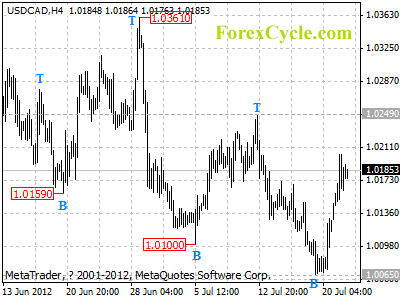
USDCAD remains in downtrend from 1.0445

USDCAD remains in downtrend from 1.0445, the rise from 1.0065 is treated as consolidation of the downtrend. Further rise to test 1.0249 key resistance is possible, as long as this level holds, we’d expect downtrend to resume, and another fall towards 1.0000 would likely be seen. On the upside, a break above 1.0249 will indicate that the downtrend from 1.0445 has completed at 1.0065 already, then the following upward movement could bring price to 1.0350-1.0400 area.

usdcad

Daily Forex Forecast