Central Bank News Link List – July 25, 2012

By Central Bank News

    Here’s today’s Central Bank News link list, click through if you missed the previous link list. The list is updated during the day with the latest news about central banks so readers don’t miss any important developments.


Thailand keeps interest rate at 3%

By Central Bank News

    The Bank of Thailand kept its benchmark one-day repurchase rate steady at 3.0 percent, as expected, judging the policy stance accommodative enough to cushion the economy against the global risks.
    But 2 of the bank’s 7-member Monetary Policy Committee voted in favor of cutting the rate, the bank said in a statement.
    The bank said the Thai economy continued to recover from the floods last year and was operating close to its potential, with domestic demand supported by low interest rates, strong credit and government stimulus. These factors should continue to sustain private consumption and investment.
    “The majority of members viewed the current monetary policy stance to be accommodative enough to support domestic economic growth going forward and cushion, to some degree, against global economic risks,” the bank said.
    The bank said the worsening global economic outlook had started to impact the Thai export sector and the growth outlook had been revised downward, which has moderated inflationary pressures and inflation is expected to remain within the bank’s target range.
    The Thai central bank, which targets a 3.0 percent inflation rate, most recently cut its policy rate by 25 basis points in January after cutting it by the same amount in November.
    In June, inflation inched up to 2.6 percent from 2.5 percent the previous month.


     www.CentralBankNews.info

Don’t Believe ‘the Bull’ on Australian House Prices

By MoneyMorning.com.au

In yesterday’s Money Morning our old pal, Dr. Alex Cowie, wrote to you about the terrible outlook for the Melbourne property market.

According to Morgan Stanley research, Melbourne house prices could fall by 30% from peak to trough.

That’s a bitter pill for the hundreds of thousands of investors who need house prices to rise in order to offset the losses from interest payments and running costs.

But indebted housing investors needn’t worry — if they believe BIS Shrapnel and academics at two Aussie universities — because help is on the way. In what form? Trains and the end of the resources boom!

To find out the latest excuses used to justify a housing boom, read on…

The Rising House Price Myth

You must remember that everything you thought you knew about investing has changed over the past four years.

You may have thought that despite a few bumps along the way, share prices would keep going up as the world economy grows. That was until share prices fell…and economies stopped growing.

You may have thought that money in the bank was safe. Until banks in North America, Europe and the UK went bust…and Aussie banks St. George and BankWest were taken over before their balance sheets were put through the mincer.

And you may have thought that house prices always go up. Because that’s what you’d always seen. And that’s what your parents told you. Until house prices stopped going up…and in fact started going down.

But with the old housing-never-falls claims revealed for what they are — myths (growing population myth, water views myth, better quality housing myth, housing shortage myth), the Aussie housing industry needs new ways to convince people to buy.

The two latest are right from the top drawer: trains and the end of the resources boom.

Let’s start with the trains first…

The Credit Boom Spurred Australian House Prices

As with all claims made by the housing bulls, at first glance they seem plausible. It’s only when you stop and think, that things don’t add up.

Yesterday, the Age reported the following:

‘A railway line to Doncaster could be built for $840 million and paid for using taxes raised from the higher property values it would generate, says a report…

‘The report’s authors have modelled their cost estimates for the proposed Doncaster railway on the highly successful Mandurah line in south-west Perth, a 70-kilometre railway that was built for $1.3 billion and opened in 2007…

‘The “funding possibilities” the authors propose are based on a US model called tax increment financing, whereby higher property values boost stamp duty, land tax and local government revenues and help pay for infrastructure projects.

‘The report found that property values in Brisbane in the past 25 years had risen 23 per cent more in suburbs with high-quality public transport than those without.’

As we say, the argument seems plausible. But strip away the layers and perhaps the claim isn’t quite so convincing.

First up, using 25 years of housing data covers the biggest house price boom Australia has ever seen. It would be like using the period from 2003 to 2007 and saying that’s how stock markets always behave.

The only reason Australian housing boomed during those 25 years is because of the huge increase in mortgage debt.

Even Reserve Bank of Australia (RBA) governor, Glenn Stevens admitted this in a speech yesterday:

‘It suggests that the global dwelling price dynamic had a lot to do with financial factors — and there is little doubt that finance for housing became more readily available.’

No kidding!

But back to the report. Are public transport and rising house prices a cause and effect, or is it a coincidence? After all, all house prices went up, not just those near transport.

House Prices Fall AFTER Rail Line is Built

The main reason house prices went up was due to ‘more readily available’ financing, rather than access to public transport. The availability of public transport was simply an added benefit that some would pay extra for during a credit boom.

And besides, the relationship isn’t uniform. As an academic paper from the Tinbergen Institute, titled ‘The Impact of Rail Transport on Real Estate Prices: An Empirical Analysis of the Dutch Housing Markets’, in March 2006 noted:

‘Finally we find a negative effect of distance to railways, probably due to noise effects: within the zone up to 250 meters around a railway line prices are about 5% lower compared with locations further away than 500 meters. As a result of the two distance effects, the price gradient starts to increase as one moves away from a station, followed by a gradual decrease after a distance of about 250 meters.’

Some prices go up, some go down…and we dare say some stay the same. But how will it impact house prices in a falling market? Arguably, now the credit boom is over it means those closer to rail lines will fall more than those less close to rail lines.

In other words, there’s absolutely no guarantee that a rail line will increase house prices and therefore result in increased stamp duty revenue for state governments, and rates rises for local governments.

But what about other examples of house price behaviour due to rail lines?

A paper from the University of Technology Sydney presented to the 18th Annual Pacific-Rim Real Estate Society Conference in January claimed:

‘Our findings show that dwelling prices appreciated more before the commencement of construction and after the opening of rail service than they did after starting the construction and before the opening.’

The study was based on the University of Sydney train station and the suburb where the station sits, Macquarie Park. The station was completed in December 2008. And it’s true that unit prices climbed in Macquarie Park.

But then, house prices climbed in many other Aussie cities and suburbs — those with and without rail lines. Remember that the Aussie credit boom went on after it had collapsed elsewhere. But if we look at house prices this year, now the Aussie credit boom has finally ended, you’ll see the link to public transport may not be clear cut…or at the very least, it doesn’t guarantee rising house prices.

House prices in the neighbouring suburb to Macquarie Park, Marsfield (we’ve chosen it because it has more sales data), have gained nothing since 2010. And in fact, this year the trend is lower rather than higher.

And this is exactly what happened to house prices in the other suburb mentioned in the report, Mandurah, Western Australia. According to RPData, in 2007 when the Mandurah line was completed, Mandurah’s median house price was $400,000.

In the latest numbers from RPData (April 2012), the Median house price in Mandurah was just $270,000. So much for public transport providing a boost to house prices ‘after the opening of [a] rail service’.

And what about South Morang in Victoria? That suburb benefited from the extension of the Epping line. South Morang median house prices have been falling since 2010. The new station opened in April this year, and according to RPData, the median house price is $364,000. That’s 13.3% lower than July 2011.

Bottom line: forget the notion that you can make a quick killing from buying a house near a new rail line. The biggest impact on Australian house prices over the past 30 years wasn’t access to public transport, it was access to easy credit.

Things like public transport, water views and extra bedrooms are things folks paid for during a credit boom. Now the credit boom is over, buyers are less willing to pay for these extras.

But that’s only half the problem…

Putting Taxpayers on the Hook With The Foolish Belief That Land Prices Always Go Up

The academics from Curtin University and RMIT who think that tax increment financing (TIF) is the answer to public infrastructure projects would do well to read an article from this week’s Chicago Tribune. And the politicians who are likely to follow the academic advice should read it too. Because it could stop them putting taxpayers on the hook for a multimillion dollar debt burden:

‘Revenue in the city’s 163 tax increment financing districts will drop by $56 million to $454 million, Orr said as he released his annual report on TIF districts. In nine districts that poured millions of dollars into city coffers just last year, nary a penny will be collected this year, he said.’

Tax Increment Financing (TIF) is nothing more than a current government spending money it doesn’t have. What makes it worse is that it’s robbing the wealth of future generations to spend on vote-winning follies today.

It’s nothing more than land speculation. The foolish belief that land prices always go up, just because land is finite. Wrong, land prices don’t always go up. They get a boost if there’s an expansion of credit, but once the credit expansion disappears, land prices will fall.

Simply because there are fewer buyers who can afford to pay the higher prices. If you’re in any doubt about that, check out Japan’s property bubble of the 1980s.

The fact is, bureaucrats, politicians and vested interests love nothing more than spending other people’s money. And they’ll go to amazing lengths to ‘prove’ how easy it is to raise the money.

One day it’s building rail lines…the next it’s roads…then special buildings…and soon enough as reported in the Lincoln Journal Star , it’s ‘brick archways’ and ‘large TV screens’ for a public area.

Or according to the Chicago Tribune, ‘a grocery store’.

As for the second reason why house prices will rise…well, it’s almost too ridiculous to mention, but we will anyway…

Houses Are Just One Big Consumption Item

Yesterday, the Age quoted Tim Hampton, senior economist at BIS Shrapnel (Aussie housing uber-bulls):

‘Mining investment will soon stop growing. It should remain high but it will stop growing. In its place we see an upswing in residential property investment from later this year.’

This is something we’ve tried to convince Aussies of for years: housing isn’t a productive asset. It’s just an expensive consumption item. You buy it or build it and then you live in it.

Housing is the reward you get for productive labour. It’s why most people lived in slums or mud huts for thousands of years, simply because there was no access to capital and limited productive labour.

But as soon as the power of Kings, Queens and Emperors faded and capitalism gained a foothold, people became productive. They worked and produced goods for consumers, and in return they earned a wage.

Eventually the accumulation of wages (savings) enabled people to consume more. They gradually bought more expensive trinkets until their wealth became so great they were able to afford the biggest consumption item of all…a house.

The availability of credit during the late 20th century sped up this process.

The point is, housing isn’t the means by which nations become productive and wealthy. Housing is the reward for a productive and wealthy nation.

So for any organisation to think that housing investment for domestic consumption will replace the export-driven mining boom is living in the clouds.

If there’s one message you can take away from today’s Money Morning it’s that housing isn’t a magic investment that just needs a multimillion dollar rail line running next to it to make you rich…and it isn’t the answer to Australia’s big problem of what to do when the mining boom ends.

Housing is for consumption, and the answer for what Australia should do after the mining boom is for it to rely on freer markets and capitalism…and for the government to keep its nose out.

Cheers,
Kris

P.S. Keep an eye on your inbox this afternoon. Our old pal, Sound Money. Sound Investments editor, Greg Canavan is writing a special afternoon edition of Money Morning about what you can do to protect your wealth and profits when the Aussie mining boom ends. As you’ll see later today, a new independent report has been released in the last few weeks that reveals we’ve already hit the plateau, and could only have two years before current big projects run their course.

With no new projects planned, the peak of the pipeline is now in view. As Greg explains, you can’t afford to wait until then to do something about it. Greg’s warned of this development for some time now…so we asked him to write you a dedicated letter about the situation…and what you can do. Look out for it this afternoon. (Don’t worry, you won’t be forced to view a long promotional video.)

Related Articles

Market Pullback Exposes Five Stocks to Buy

Why the Eurozone Will Sacrifice Greece to Save the Spanish Economy

No Mr. President, Entrepreneurs Did Build That…


Don’t Believe ‘the Bull’ on Australian House Prices

What Spiking Food Prices Mean For Your Portfolio

By MoneyMorning.com.au

What’s behind the latest spike in food prices?

In 2007 and 2008, when surging food prices led to riots in more than 30 countries, the spike was at least partly down to speculation. Commodities in general were enjoying a final surge before the credit crunch demolished asset prices across the board in late 2008.

America’s second batch of quantitative easing (QE) shouldered some of the blame for higher prices. This helped fuel the ‘Arab Spring’ protests in the Middle East.

But this time around, it’s hard to pin the blame on speculation or loose monetary policy. There’s little sign of further QE on the horizon. As a result, the dollar is steady to strengthening, which would normally mean lower commodity prices in general.

Instead, the current spike is very much down to Mother Nature. And the impact will stretch far beyond farmers in the American Midwest.

Soaring Corn Prices Will Have a Domino Effect

The US is experiencing its worst drought in more than 50 years. Needless to say, crops don’t cope well without water.

This is a serious problem: the US is the world’s largest exporter of corn. It’s also unexpected, which makes it even worse. Indeed, until very recently, the US Department of Agriculture had expected a record corn crop this year. Last week, it had to slash its production forecasts by 12%, ‘the most in a quarter of a century’, notes the FT.

Corn and soybean prices have now jumped to all-time highs. Wheat prices aren’t at record levels yet, but they have risen by more than 50% in a matter of weeks.

This will have a severe knock-on effect on consumers and businesses around the world. Some farmers will be in trouble, but those who manage to grow corn will make more money from it. Others will have insurance. Indeed, as Reuters reports, some experts are worried that government-backed crop insurance programmes mean that many farmers will just write off their whole crop rather than spending money to try to save it, making the situation even worse.

So what about other businesses? Richer farmers normally mean a boost for agricultural equipment makers. However, poorer crop yields may mean that even those who can afford it won’t need to buy new equipment, as another analyst tells Bloomberg.

Further down the line, any industry that uses corn will be affected. About a third of the corn crop goes on feeding livestock; if corn gets too expensive, then cattle will be slaughtered early to avoid the cost of feeding them. That means there’ll be less meat further down the line.

So, as David Fuller points out on Fullermoney.com, we can expect a big impact on general food prices ‘later this year, and for at least the first nine months of 2013′. That’s bad news for consumers who might have been hoping for a bit of respite from rising prices.

Demand for Food Will Keep Rising

What does all this mean for investors? As we’ve pointed out in the past, we’re not keen on playing soft commodities directly. Leaving aside the issue of how speculation affects prices, the factors driving ‘softs’ on a day-to-day basis are too complicated for non-specialists to risk betting on.

Also, if prices keep rising, there’s a potential safety valve in the form of the ethanol market. An incredible 40% of the US corn crop is used to make ethanol; petrol companies have to buy a minimum amount each year to turn into biofuel, by blending it with petrol. This subsidy for crop farmers is mainly down to the power of the farming lobby in US politics, as it makes neither environmental nor economic sense.

However, rising corn prices have seen some ethanol plants shut down, as the cost of making the fuel hurts profits. Meanwhile, because biofuel output was so high last year, oil companies can use a system of credits to meet this year’s quota without actually buying more ethanol.

Yet in the longer run, we can expect food price shocks to come more frequently. Even if extreme weather events can’t be predicted, population growth, and increasing wealth in emerging markets, make it all but certain that demand for food will continue to grow.

Those of a more Malthusian bent argue that we might even see ‘peak food’. However, just as rising oil prices have led oil companies to explore more expensive, higher-risk ways of getting oil and energy out of the ground.

As a result, in the past ten years, we’ve extracted oil from places that would once have been considered impractical or even impossible: tar sands, shale oil, deep beneath the waves.

The same will happen with food. While some worry about ‘peak food’, Africa holds two-thirds of the world’s uncultivated arable land, and as The Sunday Times points out, ‘even the land used for crops is farmed so inefficiently that training programmes and rudimentary solutions could vastly increase outputs’.

Paul Conway of agribusiness giant Cargill argues that ‘average production is so far below the known potential that this argument about whether the earth’s potential [to feed people] is tapped out is almost irrelevant.’

There will also be constant efforts to get more out of the resources we already have. One way to profit from all this is to invest in companies that are trying to improve farm yields.

John Stepek
Contributing Editor, Money Morning

Publisher’s Note: This is an edited version of an article that first appeared in MoneyWeek (UK)

From the Archives…

No Mr. President, Entrepreneurs Did Build That…
20-07-2012 – Kris Sayce

How an Interest Rate Rise Could Trigger a ‘Punch Bowl’ Rally
19-07-2012 – Kris Sayce

When the Going Gets Tough, Entrepreneurs Innovate
18-07-2012 – Kris Sayce

Is This Man the Ultimate Contrarian Indicator for Mining Shares?

17-07-2012 – Dr. Alex Cowie

How Gold Stocks Could Become Your Gilded Lifeboat
16-07-2012 – Dr. Alex Cowie


What Spiking Food Prices Mean For Your Portfolio

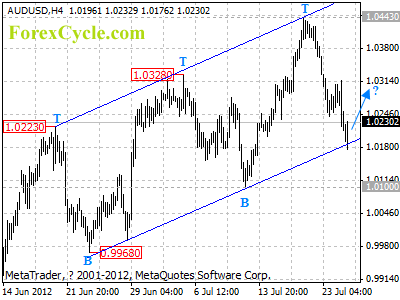
AUDUSD has reached lower line of price channel

AUDUSD has reached the lower line of the price channel on 4-hour chart, rebound could be expected later today. Resistance is now at 1.0280, a break above this level will indicate that a cycle bottom has been formed, then another rise towards 1.0500 could be seen. On the downside, a clear break below the lower line of the channel will suggest that the longer term uptrend from 0.9581 (Jun 1 low) has completed at 1.0443 already, then the following downward move could bring price back to 0.9900 zone.

audusd

Daily Forex Analysis

Nigeria keeps rate steady, raises cash requirement

By Central Bank News

    Nigeria’s central bank kept its benchmark Monetary Policy Rate (MPR) steady at 12 percent, as expected, but raised the Cash Reserve Requirement (CRR) by 300 basis points to 12 percent from 8.0 percent  in an attempt to reduce liquidity in the banking system.
    In its statement, the central bank said significant cash on the books of banks had not lead to increased lending to the private sector but instead banks had taken advantage of the high yields on Nigerian government bonds and used the funds to speculate in the foreign exchange market.
     By raising the cash reserve requirement but keeping the rate steady, the bank said it was choosing  “a policy trajectory that would have the least negative impact on the wider economy.”
    Nigeria’s central bank, which has kept its policy rate unchanged since October 2011, also reduced its net open foreign exchange position (NOP) to 1 percent from 3 percent to support the naira.

     The central bank’s statement showed a Monetary Policy Committee that was at great pains to strike the right balance between growing inflationary pressures, a slowing global economy and the need to defend the naira currency.

     “…the ominous signs for the domestic economy are evident,” the Central Bank of Nigeria said, noting the weaker global economic outlook, lower demand for crude oil — Nigeria is Africa’s largest oil exporter — a buildup in inflationary pressures and possible shortfall in projected 2012 revenue.
    Nigeria’s inflation rate rose to 12.9 percent in June from 12.7 percent and the bank expects domestic inflation to maintain its upward trend over the next six months due to higher tariffs on electricity and some imported goods.  The central bank targets inflation of 10 percent.

    The bank said a logical response to the inflationary pressures would be to raise the MPR, but the bank was “conscious of the impact of higher interest rates on small businesses and the potential for higher non-performing loans on the books of banks. In addition, it is important to leave room and flexibility for further tightening should conditions so warrant in the near future.”
   On the other hand, a lowering of the interest rate to counter slowing global growth could weaken the naira and affect currency reserves, which have been depleted following a nationwide strike in January, the bank said.
    www.CentralBankNews.info


USD/JPY Outlook This Week

By TraderVox.com

Tradervox.com (Dublin) – The pair opened the week with attempts to break the line at 79.10. However, this resistance line held firm and the pair fell to 78.46 after a series of poor US data. The BOJ meeting minutes revealed that board members were unanimous in keeping interest rates between 0 and 0.1 percent but domestic economy has been sluggish. Some of the events to lookout for this week are as follows.

On Tuesday at 2350hrs, the Japan’s Trade Balance data will be released. In May, the adjusted merchandise trade deficit climbed to 657.2 billion yen from 512.0 billion yen in April. The exports have dropped by 0.5 percent and imports increased by 1.9 percent. This data for last month is expected to show a contraction in trade deficit to 390 billion yen. The other major event will be released on Wednesday at 2350 hrs. The Corporate Services Price Index (CSPI) climbed by 0.1 percent in May to reach 96.1 points. This time, the market is predicting that the index will remain unchanged.

Masaaki Shirikawa will give his speech just 10 minutes on to Thursday GMT. The BOJ Governor will speak at a Futures Industry Association in Tokyo where he is expected to explain BOJ’s decision to keep its monetary policy unchanged despite the strengthening yen. He might also indicate any measures of intervention. On the same day at 2330hrs, Tokyo Core CPI data will be released in Tokyo. Last month’s data showed a decrease from the same month last year registering a decline of 0.6 percent; the index had dropped by 0.8 percent the previous month. This month an equal drop of 0.6 percent is expected.

The Retail Sales report will be the last report from Japan and will be released on Thursday at 2330hrs. There was an increase of 3.6 percent in May which was a lower value than the previous month increase of 5.7 percent. The positive data from Japan has been attributed to private consumption and the improved automobile sector which is getting support from the government. This data is expected to show a increase of 1.2 percent this for June.

Disclaimer
Tradervox.com is not giving advice nor is qualified or licensed to provide financial advice. You must seek guidance from your personal advisors before acting on this information. While we try to ensure that all of the information provided on this website is kept up-to-date and accurate we accept no responsibility for any use made of the information provided. Opinions expressed at Tradervox.com are those of the individual authors and do not necessarily represent the opinion of Tradervox.com or its management. 

Article provided by TraderVox.com
Tradervox.com is a Forex News Portal that provides real-time news and analysis relating to the Currency Markets.
News and analysis are produced throughout the day by our in-house staff.
Follow us on twitter: www.twitter.com/tradervox

(VIDEO) EUR/USD: A Great Real-Life Lesson in Elliott Wave Analysis

This is a story we’ve seen repeated in the forex markets again and again.

By Elliott Wave International

About once a week, the editor of EWI’s forex-focused Currency Specialty Service Jim Martens records a video for his subscribers.

On Thursday, July 5, with EUR/USD trading in the mid-$1.2400 range, Jim posted the video you see below. Watch as he explains how Elliott wave analysis helped him realize that EUR/USD was on its way to make a new low for 2012 — before the new round of “bad news” from Europe was subsequently blamed for the euro weakness.


FREE FX Trading Event NOW ON!
How to Trade the Top 5 Forex Opportunities… Right Now

Now through July 26, EWI Senior Currency Strategist Jim Martens walks you through some of his best opportunities in key forex markets and shows you how to act on them using the Elliott Wave Principle.

Join in now and instantly watch online Martens’ special 1-hour kick-off webinar (recorded live July 18). You’ll learn:

  • How the Wave Principle can help improve your forex success
  • Jim’s favorite trade setups and strategies, including entries, exits and stop levels
  • Jim’s outlook for the U.S. dollar and other major currencies

PLUS, get 5 follow-up videos from Jim Martens featuring in-depth analysis of his top forex opportunities.

This is your chance to learn from one of the world’s most sought-after FX strategists. Follow the link below to join now, free.

Join EWI’s FX trading event now — 100% FREE >>


This article was syndicated by Elliott Wave International and was originally published under the headline (VIDEO) EUR/USD: A Great Real-Life Lesson in Elliott Wave Analysis. EWI is the world’s largest market forecasting firm. Its staff of full-time analysts led by Chartered Market Technician Robert Prechter provides 24-hour-a-day market analysis to institutional and private investors around the world.


How Will the British GDP Figure Impact Sterling?

Source: ForexYard

printprofile

At FOREXYARD, we believe in keeping our clients prepared for potentially significant news events. As such, traders will want to carefully monitor the UK Prelim GDP figure, scheduled to be released tomorrow, July 25th at 8:30 GMT. Last quarter’s GDP figure showed that the British economy contracted by 0.3%, well below analyst’s predictions. As can be seen in the chart below, the GBP tumbled following the news.
GBPUSD

Don’t miss out on another opportunity to capitalize on market volatility!

Analysts are predicting tomorrow’s news to come in at -0.2%, which if true, would signal a further decline in the British economy and could lead to additional losses for sterling during European trading. This is an excellent opportunity for forex traders to take advantage of potentially significant news, so don’t miss out!

Read more forex news on our forex blog

Forex Market Analysis provided by ForexYard.

© 2006 by FxYard Ltd

Disclaimer: Trading Foreign Exchange carries a high level of risk and may not be suitable for all investors. There is a possibility that you could sustain a loss of all of your investment and therefore you should not invest money that you cannot afford to lose. You should be aware of all the risks associated with Foreign Exchange trading.