Buyer Beware: “Private Pension Plans”

Article by Investment U

Have you ever been trapped in automobile purgatory? It’s when you’re in a car with no satellite radio, no iPod docking station, or suitable CDs to play. You’re forced to station surf on the public radio airwaves.

Once in a while you find a gem from your days in high school on some out-of-state station that gives you about two and a half minutes of memories. Then, it’s back to pushing the tune button.

Last Saturday, while I was pushing radio buttons, I came across a financial program expressing the plight many retirees currently find themselves in. They have a lack of options in investing rollovers and other retirement funds. Europe, the U.S. debt problem and miniscule rates of return have many of them terrified.

But this program was offering some light at the end of the tunnel. They had a new “safe and secure” solution to all of their problems. It’s called the “Private Pension Plan.” I’ve dealt with pension plans before – but this was new.

The wealth management company who was sponsoring the show didn’t give the name of the company providing this product… or many details. But this is what they did say the plan offered:

  • Guaranteed upfront bonus of up to 10%
  • Guaranteed returns for income
  • Guaranteed protection of your principal
  • Guaranteed lifetime income for you and your spouse

At that point, I knew exactly what they were talking about. This had nothing to do with ERISA qualified pension plans. They were talking about annuities. More accurately, with the description they gave, a fixed-index annuity.

Just a New Marketing Tactic

The fact is these are nothing new… This re-labeling move may be due to the bad reputation these products received during the height of the economic downturn.

Four years ago the Securities Exchange Commission cracked down on abusive sales practices targeting seniors. It seemed that fixed-index annuities were one of the investment products found in the midst of senior investment fraud. I think there was even a sting operation on NBC’s Dateline. That’s when things have gotten out of hand.

So, if you hear this term going forward, here’s what you need to know.

First of all, don’t get confused. A fixed index annuity can also be referred to as an equity-index annuity. Many fixed-index annuities on the market are set up where they have two phases. The first is called the accumulation phase. This is when you’re supposed to let your money grow and earn interest. The other part of this process is the payout phase.

That’s when you get your withdrawals.

Like a traditional fixed annuity, it guarantees your principal. This vehicle doesn’t act like most securities or mutual funds. The premium deposited into a fixed-index annuity is guaranteed to never go down because of the market.

This vehicle also guarantees you will get at least a guaranteed minimum interest rate that’s written into the contract. Remember that the guarantees in the contract are backed by the insurance company’s claims-paying ability.

Are Fixed-Index Annuities Good for Me?

I started in the financial services industry back in 1997 and concentrated for years in retirement planning and products. And over that time I found a great many different opinions on annuities. Some think they are really good. Some think they’re horrible. But as it applies in most cases, the answer depends on the investor, investors and/or their specific situation.

So what I’ll do is give you the pros and cons, and then you can decide if it’s worth a second look.

Here are the pros:

  • What you initially put in is safe and guaranteed to grow at a contracted rate. The contract you sign with the insurance company will tell you the minimum amount you can expect when the surrender (or accumulation) period is over.
  • Just like all annuities, your money grows tax-deferred.
  • Many times a “new base contract value” can be locked in if the index the vehicle is based upon does pretty well over a certain period. This helps you by securing a new guaranteed basis during market upticks.

Here are the cons:

  • One con is called the capitalization rate. All fixed-index annuities will have a maximum amount of interest that will be credited to the account. They can be calculated monthly or annually. This means that if the market index returns more than your maximum, you don’t get the difference.
  • Also, there are participation rates. Once again, all contracts tell you specifically the percentage of the index gain that will be credited to the account. Usually this will be somewhere from 60% to 100%. Here’s a quick simple example. So, if the index goes up 10% and the contract has a 70% participation rate, the account will be credited with 7% interest.
  • Fixed-index annuities usually have long surrender periods. Your money will be tied up or you will have to pay a fee if you surrender your contract.
  • Be weary of how your return is accredited to your account. This can significantly affect the annuity’s performance. The two most popular methods are monthly averaging and point-to-point. Averaging will take the monthly index average and credit that to your account. The point-to-point method will take the starting and ending values of the index and figure out the total return to the annuity. This can be done on a monthly or annual basis.

And What You Must Remember…

I’ve made an attempt to simplify the basics of fixed-index annuities. I mentioned that the radio show talked of up-front bonuses. That’s not a typical option. The aforementioned are the basics.

Also, remember that these products are insurance contracts, so expect them to be complicated. Also, being insurance contracts, they can also come with riders that can include other guarantees and options. There was no way to even attempt to touch on everything out there available. As with anything, just make sure to read all the fine print before entering one of these contracts.

Hope this may clear some things up.

Good Investing,

Jason

Article by Investment U
Form 13F: The Easy Way to Track Hedge Funds’ Favorite U.S. Stocks

Article by Investment U

According to a recent study from U.S. audit, tax and advisory services firm KPMG, over the past 17 years, hedge funds have actually outperformed equities, bonds and even commodities.

What’s more, The Wall Street Journal reports, the hedge fund industry is expected to more than double in size over the next five years to over $5 trillion in assets.

I don’t know about you, but if hedge funds have earned investors more profits than bonds, stocks and commodities, and are only expected to continue growing, wouldn’t it be beneficial to know what these funds are buying and why?

Of course it would.

And here’s the best part for regular investors.

Any hedge fund with over $100 million in U.S.stocks under management is required to file a Form 13F with the Securities and Exchange Commission (SEC). (Read more about Form 13Fs here.)

In fact, in June, Global X launched an ETF dedicated specifically to following the biggestU.S.stock holdings of a number of top hedge funds.

In just over three months, the fund has already ticked up 11%. And if past performance is any indication, there’s much more room for growth.

It’s called the Global X Top Guru Holdings Index ETF (NYSE: GURU).

Double-Digit Gains in Just Three Months

Let’s face it, if you’re not rich, you won’t be investing in a hedge fund anytime soon.

Truth is, the SEC won’t even allow you to invest in hedge funds unless you can prove you’re an “accredited investor.” That means you must have a net worth of more than $1.5 million, or income in excess of $200,000 in each of the last two years.

On top of this, they typically charge clients a 2% management fee and a 20% performance fee.

It adds up to a lot of money that most people don’t have.

But thanks to 13F filings, every quarter, investors can see exactly what these managers are buying and selling, and can piggyback their picks for steady and solid gains, year after year.

I’m talking about following the moves of funds like Paulson & Co., David Einhorn’s Greenlight Capital, and Daniel Loeb’s Third Point. And that’s just to name a few…

But it doesn’t stop there.

Following the Gurus to Even Higher Gains

Global X’s Guru ETF follows 68 different hedge funds.

What are they investing in?

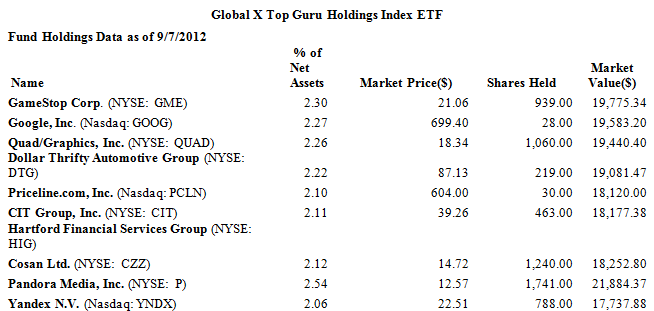
Well, here’s a look at their top 10 holdings in terms of market value:

Global X Top Guru Holdings Index ETF

CNN Money reports, “According to backtesting results, the ETF would have climbed roughly 30% annually during the past three years, beating the S&P 500’s 22% average yearly gain…”

It’s worth noting, GURU allocates over half of its holdings to the technology, financial and industrial sectors.

This shows these are clearly the places most hedge fund managers believe have the most potential for gains in the future.

Not everything about GURU is money in the bank, though.

Perhaps the biggest drawback is its expense ratio of 0.75%. The average expense ratio for ETFs is currently just about 0.55%.

But thus far, its performance has been well worth the higher-than-average fees. And at the end of the day, having a free look into what many of the most successful hedge fund managers are buying today is of great value just by itself.

Bottom line: Whether you want to buy shares of GURU or just use it to see which stocks hedge funds are trading, this is one ETF you’ll want to keep on your radar.

Good Investing,

Mike


Article by Investment U

Who Will Win in November? Economists Make Shocking Prediction

Article by Investment U

Finally, after years of campaigning, debates and never-ending television coverage, the November elections are upon us. Who will win and will it make any difference in your investments?

Yes and yes!

Will President Obama win re-election, or will Governor Romney occupy the White House in January?

Right now Intrade, the political futures market, shows Mr. Obama as the heavy favorite by 58% to 42%.

But much could change between now and November 6, and Intrade has had a checkered past in its ability to predict winners…

A better record has been recorded by several economists who have developed economic models that have been surprisingly accurate.

And all of them agree: President Obama is in serious trouble and is likely to lose in November!

Here are the results of four of the best forecasters in the business:

1. Two political scientists at the University of Colorado, Ken Bickers and Michael Berry, used their economic indicator model to predict who would win in November. Their model has correctly predicted the outcome of the past eight elections, and this year they predict a big Romney victory with nearly 53% of the vote, with Romney winning almost all the swing states.

2. Nigel Gault, the chief U.S. economist at HIS Global Insights, a Boston-based research firm, uses proprietary methods and various economic variables, shows the president in even worse shape. The high unemployment rate (8.1%) is a “crucial variable,” he states, and based on his model, Obama will garner only 45.4% of the popular vote.

3. Two economists, David Rothschild of Microsoft Research and Patrick Hummel of Google, have created a model that is both political and economic, and they too show President Obama losing.

4. Ray C. Fair, the Yale economics professor, has developed a successful prediction model that covers elections since 1916. His model depends entirely on the strength of the economy. Right now he has Romney leading by only one percentage point, 50.5% to Obama’s 49.5%, but he says there is a 2.5% “standard error,” so the election is “too close to call.”

What Does This Mean

I am convinced that a Romney victory would be extremely positive for Wall Street, as his election bodes well for maintaining low taxes on capital gains and dividends, oil and gas stocks, and he’s viewed as more “pro-business” than President Obama.

And the best way to play a Romney victory… Buy Northern Oil & Gas (NYSE: NOG), a fast-growing energy play in the Midwest. Main Street Capital (NYSE: MAIN), a business development company is another good choice. And for Eaton Vance Floating Rate Fund (NYSE: EFT), a prime rate fund that will benefit from rising interest rates, an economic recovery will result in higher rates.

Heck, these stocks may also do well in an Obama second term.

Good Investing, AEIOU,

Mark

Article by Investment U

EU Bites the Hand that Feeds It: Gazprom Will Bite Back

By OilPrice.com

Gazprom has Europe’s natural gas market in a stranglehold and Europe is attempting to fight back, first with a raid last year on the Russian giant’s offices and then with a probe launched earlier this week against its allegedly illicit efforts to control the EU’s natural gas supplies.

The bottom line is that the same natural gas revolution in the US, which was enabled by hydraulic fracturing (fracking), is now threatening to loosen Gazprom’s noose on the EU, and Gazprom simply won’t have it.

To head off a potential natural gas revolution in the EU, Gazprom is pulling out all the stops, and EU officials say that the company has been illegally throwing obstacles in the way of European gas diversification.

Poland’s situation is a case in point. Last year, a US Department of Energy report estimated Poland’s shale gas reserves at 171 trillion cubic feet. Gazprom got nervous. In March this year, the Polish Geological Institute suddenly felt compelled to contradict that report, saying reserves were only around 24.8 trillion cubic feet. In June, Exxon announced it would pull out of its shale gas projects in Poland. Investors started getting cold feet and shares began to drop. Chevron and ConocoPhillips are plodding along with their shale gas operations, for now.

Still, 24.8 trillion cubic feet is no paltry volume and enough to ensure that Gazprom remains nervous. And then there is Ukraine, which also has sizable shale gas reserves and where the Russian noose is even tighter.

Right now, the only thing keeping the shale gas revolution from hitting Europe as it has in the US is technology: the shale reserves in Europe are on land that is more inaccessible, there is a lack of necessary infrastructure and fracking equipment, and protests against the environmental impact of fracking are more serious. But the biggest problem is Gazprom.

EU governments are both desperate to break the Russian stranglehold by developing shale gas reserves and wary of going up against a gas giant on whom they depend for supplies. It’s a tough position and the outcome will depend on how the EU hedges its bets: Can it develop enough shale gas reserves quickly enough to take on Gazprom?

Poland is still a long way off from being able to fully develop its shale gas reserves. It will take time to conduct the necessary environmental impact studies and infrastructure would require a major overhaul.

The EU publics are divided between those who fear fracking and those who fear Gazprom and so far, the former fear is trumping the latter. France and Bulgaria have both banned fracking under pressure from the public, but Poland is marching on, its officials relentlessly insisting that fracking is safe.

Earlier this week, Germany’s Environmental Ministry urged a ban on fracking near drinking water reservoirs and mineral springs and called for environmental impact studies from developers, prompting concerns that Germany will tighten fracking regulations. Germany has massive natural gas potential, but environmental concerns are keeping a tight rein on development for now.

The end victory for Gazprom would come in the form of a European Commission ruling banning fracking-a ruling which would be applied to all EU countries, including Poland which has shown more political will to stand up to the Gazprom boogey man than others.

In the meantime, the EU is investigating Gazprom’s actions in eight countries-Bulgaria, Estonia, Latvia, Lithuania, Slovakia, Poland, Hungary and the Czech Republic. In Bulgaria, where fracking has been banned, Gazprom is the only supplier of gas. It is also the sole supplier to the Baltic states and Slovenia. It supplies over 80% of gas needs to Poland and Hungary, and nearly 70% of the Czech Republic’s.

It has strengthened its grip on Europe further due to the fact that it owns the one-way gas pipelines into the region and forces buyers into long-term contracts in which prices are tied to oil.

The EU has tried numerous tactics to loosen the Gazprom grip, including the implementation of new energy policies designed to separate supply from delivery and by seeking new pipelines that could deliver gas from elsewhere. While the EU’s alternative pipeline dreams have largely failed so far, it is eyeing developments now in Northern Iraq, where Turkey is courting the Kurds to build a new pipeline that could eventually deliver gas to EU markets. But this is a long way, and possibly a war, off.

Having failed so far in the area of alternative suppliers, the EU is now moving the front lines of the battle to the legal field, targeting unfair competition, which it stands a better, but still only minimal, chance of changing the rules of the game. The probe into Gazprom is looking at three things: Gazprom’s attempts to hinder the free flow of gas across the EU; its purposeful blocking of diversification efforts; unfair pricing and contractual arrangements.

Specifically, the EU says Gazprom has implemented a strategy to segment national markets by preventing gas exports and limiting delivery options, as well as by obligating buyers to use Gazprom infrastructure. Most significantly to the consumer, Gazprom’s pricing policies, which fix gas prices to oil prices, mean that European consumers see no benefit from the natural gas revolution in the US, which has increased global supplies and reduced prices on the open market.

Will the EU be able to actually levy fines for unfair competition and unravel the monopoly? Not unless it plays as dirty as Gazprom, which will simply cut off supplies and the circulation of those European countries that used to be in its back yard. Eastern and Central Europe will be the ones to pay the price for the European Union’s battle.

Let’s not pretend that energy companies are clean and that governments aren’t using them to forward nefarious geopolitical objectives (US multinationals in Northern Iraq, for instance). The point is not to paint Gazprom as the ultimate evil in energy. This is about Europe, and the EU’s “Mommy Dearest” struggle with Gazprom, which is undoubtedly playing an underhanded energy-politics game worthy of the most sinister of accolades.

One would not be surprised to discover that Gazprom has gone environmental and has had a hand in shaping the environmental concerns of the EU publics. As such, it is highly convenient that Gazprom has recently come under very public attack by our leading international environmental group. Everyone plays dirty, any means to an end.

Source: http://oilprice.com/Geopolitics/Europe/Europe-Has-Had-Enough-But-Can-It-Stand-Up-to-Gazprom.html
By. Jen Alic of Oilprice.com


Central Bank News Link List – Sept 14, 2012: Fed easing risks serious side effects for Asia

By Central Bank News

Here’s today’s Central Bank News link list, click through if you missed the previous link list. The list comprises news about central banks that is not covered by Central Bank News. The list is updated during the day with the latest developments so readers don’t miss any important news.

“Inflation Risks Higher” After Fed Launches QE3, Analysts See Gold Hitting $1850-$1900

London Gold Market Report
from Ben Traynor
BullionVault
Friday 14 September 2012, 08:00 EDT

WHOLESALE MARKET gold bullion prices held above $1770 an ounce for most of Friday morning’s London trading, near their six-month highs hit after the US Federal Reserve announced a third round of quantitative easing (QE3) yesterday, leading to warnings that the risk of inflation has risen.

“After the move [gold bullion] had, not just yesterday, but over the last two or three weeks I think it would be natural to look for a period of consolidation,” says Credit Suisse analyst Tom Kendall in London.

“But certainly going into the back end of this year, I would be looking for gold to be getting towards at least the $1850 level.”

Silver bullion traded around $34.70 an ounce this morning, also close to new six-month highs, as stocks, commodities and the Euro all moved higher after Fed policymakers voted 11-1 in favor of new asset purchases.

“Silver is poised to test the next resistance level at $35.4,” one trader in Shanghai tells newswire Reuters.

“The recent rally, which has lifted silver by about 25% over the past month, is suppressing short-term physical demand”

The Fed announced Thursday that it will purchase $40 billion of mortgage-backed securities per month, and will continue such purchases until the outlook for the labor market improves “substantially”.

In addition, the Fed will continue its policy aimed at lowering longer-term US Treasury bond yields, known as Operation Twist, due to run until December. The Fed will also continue its policy of reinvesting principal payments on currently-held mortgage-backed securities back into this asset class.

In its statement, the Federal Open Market Committee said that the combined effect of its actions would amount to around $85 billion of asset purchases per month until the end of 2012.

“This is a Main Street policy, because what we’re about here is trying to get jobs going,” Fed chairman Ben Bernanke told a press conference following the announcement.

“We’re trying to create more employment. We’re trying to meet our maximum employment mandate, so that’s the objective.”

“[Bernanke will] fight and fight until he sees a real improvement in the economy,” says Ethan Harris, New York-based co-head of global economics at Bank of America Merrill Lynch.

“He’s not going to let his critics stop him. He believes quantitative easing can help the economy and the Fed can avoid inflation, so he’ll just keep at it until there’s a real turn in the economy.”

The latest nonfarm payroll data suggest the US economy added 96,000 jobs in August, below the 150,000-200,000 Bernanke estimated in April is needed to meet Fed unemployment projections.

The US unemployment rate meantime has remained above 8% since February 2009.

“There is not a specific number we have in mind [for unemployment],” Bernanke told reporters.

“But what we’ve seen in the last six months isn’t it.”

In addition to announcing asset purchases, Fed policymakers extended their guidance for near-zero interest rates to at least mid-2015, beyond the previous guidance of late 2014.
US Treasury bond prices fell overnight for bonds with maturities of three years or more, pushing longer-dated yields higher.

“[The Fed’s decision to leave] purchases open-ended and extending their guidance means a steeper yield curve, as there is more inflation risk,” says Societe Generale trader Sean Murphy in New York.

“The need to come out with the operation at all is alerting everyone that there is a long road in this recovery and there are still many things that need to be addressed.”

“Controlling the fire of inflation once it is roaring is a difficult task,” warns Congressman Kevin Brady, a Republican from Texas and vice chair of the Joint Economic Committee.

“The Fed is overly confident about its ability to pick the right time to withdraw all this stimulus.”
Economist Paul Krugman however says that it’s “good to see the Fed moving, finally”.

Writing in his New York Times column, Krugman adds that “the Fed seems to be trying to ‘credibly promise to be irresponsible'” as a way of raising inflation expectations, something Krugman advocated the Bank of Japan do back in the 1990s.

“As [Bernanke] himself said,” adds Neal Soss, chief economist at Credit Suisse and a former New York Fed economist, the Fed has built up a lot of capital with respect to inflation credibility…the point of having capital is, from time to time, to spend it.”

“Should the Fed expand its balance sheet by a further $1.3 trillion,” says Standard Bank strategist Walter de Wet, “it would lift our fair value estimate for gold to around $1900. As a result, even from current levels of gold at $1770, we still see substantial upside for the metal.”

Here in Europe meantime, Spain would be “daft” to ask for a bailout on top of the €100 billion it has already agreed to fund banking sector restructuring, according to German finance minister Wolfgang Schaeuble.

“I’m not in the camp that says ‘take the money,'” Schaeuble said in an interview Thursday.

“I’m one of those who says we should do everything possible to convince the markets that…speculation against Spain is without any basis in reality.”

“Our desire and intention,” said Spain’s budget minister Cristobal Montoro yesterday, “is to return again to being a reliable partner in Europe that doesn’t ask for anything.”

On the currency markets, the Euro rallied above $1.31 against the Dollar for the first time since early May this morning. Despite this strengthening, Euro gold bullion prices set a record high at Friday morning’s London Fix above €1359 per ounce, before drifting lower towards lunchtime.

Ben Traynor
BullionVault

Gold value calculator   |   Buy gold online at live prices

Editor of Gold News, the analysis and investment research site from world-leading gold ownership service BullionVault, Ben Traynor was formerly editor of the Fleet Street Letter, the UK’s longest-running investment letter. A Cambridge economics graduate, he is a professional writer and editor with a specialist interest in monetary economics. Ben writes and presents BullionVault’s weekly gold market summary on YouTube and can be found on Google+

(c) BullionVault 2012

Please Note: This article is to inform your thinking, not lead it. Only you can decide the best place for your money, and any decision you make will put your money at risk. Information or data included here may have already been overtaken by events – and must be verified elsewhere – should you choose to act on it.


Fed Announces QE3 With $40 Billion Monthly Purchases

By TraderVox.com

Tradervox.com (Dublin) – After a two-day meeting, the Federal Open Market Committee resolved to undertake a quantitative easing program, which involve open-ended purchases of mortgage debt worth $40 billion as the Fed aims to expanding its holdings of long term securities to boost economic growth and salvage the labor market. Federal Reserve Chairman said in a press conference after the meeting that the Fed is focusing on sustained improvement in the labor market. The move sent stocks high, with benchmark indexes rising to 2007 levels. The price of gold increased as Fed indicated it would continue buying assets. Bernanke’s move has been opposed by many republican politicians who have claimed that the policies will damage the economy.

The FOMC will also hold interest rates close to zero for longer that its previous forecast of late 2014. It extended this to mid-2015 in a statement where it indicated that accommodative monetary stance is appropriate for the economy to recover and the labor market to improve. Unemployment rate, which has been above 8 percent since 2008, has been termed as a “grave concern” and is seen as the main reason the Fed has moved to make a third round of asset purchases. The move has boosted global equity, with the Standard & Poor’s 500 Index climbing by 1.6 percent to 1,459.99 at the end of trading in New York yesterday. Crude oil climbed by 1.3 percent to 98.31 per barrel as gold appreciated to a price last seen in February.

Julia Coronado, who is a former Fed Economist and currently the chief economist at BNP Paribas said that the announcement marks a significant shift in the FOMC policy. She added that it is an aggressive commitment to succeed in the Federal Reserve’s mandate. Fed’s commitment to improved labor market was evident in the statement where Bernanke said that the open-ended purchases would continue until a considerable improvement in the labor market was realized.

Disclaimer
Tradervox.com is not giving advice nor is qualified or licensed to provide financial advice. You must seek guidance from your personal advisors before acting on this information. While we try to ensure that all of the information provided on this website is kept up-to-date and accurate we accept no responsibility for any use made of the information provided. Opinions expressed at Tradervox.com are those of the individual authors and do not necessarily represent the opinion of Tradervox.com or its management. 

Article provided by TraderVox.com
Tradervox.com is a Forex News Portal that provides real-time news and analysis relating to the Currency Markets.
News and analysis are produced throughout the day by our in-house staff.
Follow us on twitter: www.twitter.com/tradervox

Pro Football Plays Defense Against Deflation

Downside pressure on prices has only begun

By Elliott Wave International

You’ve heard (and probably used) the phrase, “I’d rather watch the game on television.”

It’s what a sports fan says if he doesn’t want to face traffic jams, inadequate parking, overpriced tickets, noisy crowds, and possibly a poor view of the game.

These days, however, something else is keeping professional football fans at home: deflation.

Since the economic slowdown that started in 2007, fewer people are willing to fork over money to attend games. In turn, NFL teams are forced to play defense with ticket prices.

A Sept. 10 Yahoo Finance article points out that “10 teams lowered ticket prices this year,” and that, “average ticket prices to attend [an Atlanta] Falcons home game are down 8.1% this season. This is the biggest drop among the 30 NFL cities.”

Overall, NFL attendance has dropped 4.5% since 2007.

The article goes on to say: “It’s telling us that the overall economy still isn’t as strong as it was back in 2007 … . It’s also telling us that the upper-end consumer is still retrenching, they’re still pulling back. They haven’t felt the burst of either better employment numbers or better income and they’re actually attending fewer games.”

A weak economy leading to lower game attendance leading to lower ticket prices is a “domino effect” — and it says plenty about how deflation works in the larger economy.

The psychological aspect of deflation and depression cannot be overstated. When the social mood trend changes from optimism to pessimism, creditors, debtors, producers and consumers change their primary orientation from expansion to conservation. As creditors become more conservative, they slow their lending. As debtors and potential debtors become more conservative, they borrow less or not at all. As producers become more conservative, they reduce expansion plans. As consumers become more conservative, they save more and spend less. These behaviors reduce the “velocity” of money, i.e., the speed with which it circulates to make purchases, thus putting downside pressure on prices. [emphasis added] These forces reverse the former trend.

Conquer the Crash, second edition, p. 91

Even so, many observers say the economy is past due for a recovery. They promote this view despite the evidence, which points to the new deflationary trend.

Most economists are unwilling to abandon the growth consensus, but the reality of an economic contraction is starting to become unmistakable.

The Elliott Wave Financial Forecast, August 2012

Learn Why Deflation Is the Biggest Threat to Your Money Right Now

Discover Robert Prechter’s views on the unfolding deflationary trend by reading the 90-page report, The Guide to Understanding Deflation. This guide will help you understand the signs of deflation and allow you to prepare for what’s to come.

Plan and prepare for your financial future. Download your FREE 90-Page Deflation eBook now. >>

This article was syndicated by Elliott Wave International and was originally published under the headline Pro Football Plays Defense Against Deflation. EWI is the world’s largest market forecasting firm. Its staff of full-time analysts led by Chartered Market Technician Robert Prechter provides 24-hour-a-day market analysis to institutional and private investors around the world.


EUR/USD: Euro Benefits; Dollar Suffers from Fed Easing

Article by AlgosysFx Forex Trading Solutions

The Euro pared gains versus the US dollar in the previous European trading session prior to the announcement of the Federal Reserve to engage in another round of monetary easing to trigger economic growth in the US. Meanwhile, economic institutes reduced their respective outlooks for the Euro Zone’s largest economy, citing the impact of the debt crisis. In today’s European trades, the single currency is anticipated to rise versus the Greenback on the Fed’s announcement of QE3.

Yesterday, the Fed announced that it would buy 40 Billion Dollars of mortgage debt per month and would continue to purchase until unemployment in the US shows a marked improvement. At a press conference, Fed Chairman Ben Bernanke said: “We’re looking for ongoing, sustained improvement in the labor market. There’s not a specific number we have in mind. What we’ve seen in the last six months isn’t it.” The new round of aggressive monetary stimulus to promote job creation and bring back confidence to the US economy, is seen to weaken the Greenback against its peers.

For the shared currency, the German court’s decision that the European Stability Mechanism, the Euro Zone bailout fund, is not violating German law, is expected to continue to support it, clearing a major obstacle for the European leaders to extend financial aid to troubled Euro Zone economies. Today, the Eurogroup officials are slated to meet to discuss whether Spain should seek for financial help after the European Central Bank announced that it would purchase government bonds in unlimited quantities to drive down borrowing costs. Indications of progress are seen to support the shared currency. As such, a long position for the EUR/USD pair is suggested in today’s European exchanges.

For more news, analysis, technical charts and candlestick analysis, visit AlgosysFx


Dollar Sees Mixed Reaction to FOMC Statement

Source: ForexYard

The dollar saw a mixed reaction against its main currency rivals yesterday, following the Fed’s decision to expand its bond buying program. Even though the move was widely anticipated, the market still saw substantial volatility, with the USD/JPY jumping 50 pips and the EUR/USD gaining more than 90 pips in the minutes following the decision. Today, US news is once again forecasted to impact the marketplace. Traders will want to pay close attention to the Retail Sales and Core Retail Sales figures, both set to be released at 12:30 GMT. Any better than expected news could help the greenback against the JPY and EUR.

Economic News

USD – US Data Set to Generate Volatility Today

The dollar was able to bounce back from a seven-month low against the Japanese yen during evening trading yesterday, following the announcement that the Fed was expanding its bond buying program. The USD/JPY jumped some 50 pips following the decision to reach 77.73. A minor downward correction followed, and brought the pair to the 77.60 level. Against the Swiss franc, the dollar fell more than 50 pips following the announcement to trade as low as 0.9364. An upward correction brought the greenback back to the 0.9390 level during evening trading.

Turning to today, dollar traders will want to pay attention to another batch of potentially significant US news. Most importantly, the Retail Sales and Core Retail Sales figures, both scheduled to be released at 12:30 GMT, have the potential to generate volatility for the greenback. In addition, the Prelim UoM Consumer Sentiment indicator at 13:55 could result in the greenback reversing yesterday’s gains against the JPY if it comes in below the expected 74.1.

EUR – Euro Sees Gains Following Fed Announcement

The euro advanced against its safe-haven currency rivals during evening trading yesterday, following the Fed’s decision to initiate a new round of quantitative easing to boost the US economic recovery. The widely expected move resulted in the EUR/USD gaining more than 90 pips to reach 1.2961, a fresh four-month high. The pair experienced a slight downward correction before finding stability at the 1.2930 level. Against the Japanese yen, the euro advanced more than 70 pips following the news to peak at 100.33.

Today, whether the euro will be able to maintain its bullish trend is largely dependent on a batch of US news set to be released throughout the day. Any disappointing data could result in the common-currency extending its recent gains against the greenback. That being said, if the US indicators come in above their forecasted levels, demand for the greenback could go up, which would result in the euro possibly giving up some of yesterday’s gains.

Gold – Gold at Fresh 6-Month High

The price of gold reached a fresh six-month high yesterday, following a decision by the US Federal Reserve to initiate a new round of quantitative easing which resulted in risk taking in the marketplace. The precious metal gained more than $40 an ounce following the decision and was trading above the $1760 level by the evening session.

As we close out the week, gold traders will want to continue monitoring economic indicators out of the US. If the Retail Sales, Core Retail Sales or Prelim UoM Consumer Sentiment figures come in above their forecasted levels, the dollar may be able to see gains during afternoon trading, which could result in gold reversing its current upward trend.

Crude Oil – Risk Taking Boosts Demand for Crude Oil

The price of crude oil shot up by more than $1.50 a barrel during evening trading yesterday, as a move by the Fed to stimulate economic growth in the US led to risk taking in the marketplace. Crude reached as high as $98.32 a barrel, a four-month high after the Fed announced they were initiating a new round of quantitative easing.

Turning to today, oil may be able to extend its recent gains before markets close for the weekend if a batch of US news comes in above their forecasted levels. Any better than expected news may signal to investors that demand for oil in the US will increase. Oil typically sees gains when demand in the US, the world’s leading consumer country, increases.

Technical News

EUR/USD

The Bollinger Bands on the weekly chart are narrowing, signaling that this pair could see a price shift in the near future. Furthermore, the Williams Percent Range on the same chart has crossed over into overbought territory, while the Slow Stochastic on the daily chart has formed a bearish cross. Going short may be the wise choice for this pair.

GBP/USD

The daily chart’s Relative Strength Index has drifted into overbought territory, signaling that a downward correction could occur in the near future. This theory is supported by the Williams Percent Range on the weekly chart, which is currently at the -10 level. Opening short positions may be the smart move for this pair.

USD/JPY

A bullish cross appears to be forming on the daily chart’s Slow Stochastic, indicating that an upward correction could occur in the near future. Additionally, the weekly chart’s Williams Percent Range has crossed into the oversold region. Traders may want to open long positions for this pair.

USD/CHF

The Relative Strength Index on the daily chart is currently in oversold territory, indicating that an upward correction could occur in the near future. Furthermore, the Slow Stochastic on the same chart has formed a bullish cross. Opening long positions may be the smart choice for this pair.

The Wild Card

AUD/NZD

The Relative Strength Index on the daily chart has crossed into oversold territory, signaling that this pair could see upward movement in the near future. This theory is supported by the Slow Stochastic on the same chart, which has formed a bullish cross. Forex traders may want to open long positions for this pair.

Forex Market Analysis provided by ForexYard.

© 2006 by FxYard Ltd

Disclaimer: Trading Foreign Exchange carries a high level of risk and may not be suitable for all investors. There is a possibility that you could sustain a loss of all of your investment and therefore you should not invest money that you cannot afford to lose. You should be aware of all the risks associated with Foreign Exchange trading.