Market Review 14.9.12

Source: ForexYard

printprofile

The euro extended its upward movement against the US dollar in overnight trading, as investors continued shifting their funds to riskier assets following the Fed’s decision to initiate a new round of quantitative easing. Since the Fed’s decision was announced, the EUR/USD has advanced close to 150 pips, and is currently trading at the 1.3040 level. Gold was also able to take advantage of risk taking in the marketplace, and has been able to gain more than $40 an ounce since yesterday evening. The precious metal is currently trading above $1770 an ounce, a six-month high.

Main News for Today

US Core CPI- 12:30 GMT
• The indicator is forecasted to come in slightly higher than last month’s
• If true, the dollar could recoup some of yesterday’s losses against the euro

US Retail Sales/Core Retail Sales- 12:30 GMT
• Both indicators are forecasted to come in at 0.7%, slightly below last month’s 0.8%
• If the expectations turn out to be true, the dollar could see additional losses against its main currency rivals before markets close for the weekend

Read more forex news on our forex blog

Forex Market Analysis provided by ForexYard.

© 2006 by FxYard Ltd

Disclaimer: Trading Foreign Exchange carries a high level of risk and may not be suitable for all investors. There is a possibility that you could sustain a loss of all of your investment and therefore you should not invest money that you cannot afford to lose. You should be aware of all the risks associated with Foreign Exchange trading.

What the Central Banks Are Doing to Your Money

By MoneyMorning.com.au

Our first thought this morning was, ‘So when will QE4 start?’

It’s an irrelevant question, because QE3 (otherwise known as money printing) is now an ongoing program by the US Federal Reserve. QE3 will be ‘QE Forever’.

The old saying is that the definition of insanity is doing the same thing and expecting a different result.

We can now reveal a new saying: the definition of criminal insanity is doing variations of the same thing and expecting a different result.

But there’s something more important than that. In today’s Money Morning we’ll show you exactly why these inflationary policies are bad news for you, and how it has a devastating impact on your wealth…

So, what exactly is the US Fed up to?

Before this, the Fed has bought short-dated treasury bonds and mortgage-backed securities. It did this over a fixed timeframe.

The policy failed. It didn’t have a positive economic impact (unemployment is still high), although it did achieve one of their goals in reducing interest rates.

Unperturbed, the Fed varied the plan. This time it shifted from owning short-dated bonds to owning long-dated bonds. Again, it achieved the goal of reducing long-term interest rates…but it did nothing to fix the economy (unemployment is still high).

So now, after those policies failed, the Fed has varied the plan again. It plans on printing USD$40 billion per month to buy American mortgage debt. Plus it now says it will keep interest rates low ‘at least through mid-2015.’

In other words, by that time the US economy will be just three years away from completing a lost decade…a lost decade central banks and governments told you wouldn’t happen because they would do everything to prevent it from happening.

Of course, they’ve done exactly the opposite. The intervention ensured a lost decade. We warned of that nearly two years ago when we wrote, ‘Welcome to America’s Lost Decade’.

And just three months ago we warned that this current bear market ‘Could Last Another 18 Years…Just Like Japan’s’.

Both predictions have just edged closer to reality.

We won’t go into the details of the Fed’s latest madcap plan. We’re sure you’ll get to read about the nuts and bolts of it in the mainstream press here, here, here, and elsewhere.

Our role isn’t to spew up the same news you can read about anywhere else. Our role is to distil the news and give you the key bits of info that are important to you.

And in our view, there are few things more important to you than the value of money and the impact it has on your wealth…

The Hidden Danger of Inflation

Inflationary monetary policies are perhaps the greatest threat to wealth there is.

The reason it’s such a threat is because in the short-term it appears to help your wealth. As the money supply goes up, it filters through the economy, credit expands, and asset prices tend to rise.

You get higher house prices and higher share prices.

For those who own houses and shares, that’s great news. The problem is for those who don’t yet own those assets. The assets become more expensive. And gradually they become unaffordable for people unless they use credit.

This creates an upward spiral in prices. Prices rise so people start to panic. They fear that if they don’t buy now then they’ll never be able to afford it. So they borrow as much as they can. This naturally pushes prices up further.

That takes the market to the next phase of hysteria. That’s where prices have risen over such a long period that buyers and owners believe prices can never fall…because prices have always gone up.

This creates what Austrian School economists call malinvestments. In simple terms, these are investments that people wouldn’t otherwise make in a normal market.

But eventually these malinvestments go bad, and it has a terrible knock-on effect through the economy.

No-one wants to buy the assets at high prices, and lenders don’t want to lend money for people to buy these assets because they believe the price could fall further. If that happens it would make it tough for borrowers to repay the loans.

But aside from those fancy economic terms, inflationary policies have a further negative impact on your wealth. And that is on the value of the money in your pocket…

What if the Numbers Changed on Your Money?

The reason inflation is bad for your wealth is because it’s hard to see the impact on a day-to-day basis.

Sure, you know that things are more expensive today than they were 20 years ago. But it’s harder to gauge the change in prices over shorter periods.

It’s a bit like when you look at someone day after day, and don’t notice that they’ve aged. But look at a photo of someone from five years ago and compare it to how they look today and it’s pretty easy to see the change.

That’s the problem you get when you try to value money. You can’t see the devaluation on a daily basis.

When the central bank prints money, it devalues your money. But you can’t see that devaluation. After all, the $5 in your wallet or purse still has $5 printed on it, regardless of how much the central bank prints.

But what changes is the purchasing power of the $5.

Because the face value of money doesn’t change, the price of goods has to change in order to factor in the devaluation of the currency.

That’s why the central bankers love printing money. It’s much harder for you to see the devaluation.

But imagine if it didn’t work like that. Imagine if the numbers on the money in your wallet did change to take into account central bank money printing and devaluation.

‘Your $5 is Now $4.97′

Imagine if four times a year the central bank held a news conference. Each time it would instruct you to change the value on the bank notes in your pocket:

‘the little pink notes that used to be $5 are now $4.97; the blue notes that used to be $10 are now $9.95; the red notes that used to be $20 are now $19.89; the yellow notes that used to be $50 are now $49.73; and the green notes that used to be $100 are now $99.47.’

Can you imagine the uproar? You’ve worked for this money. You expected the $20 you worked for last month to still be worth $20 this month…but it’s not, it can now only buy you $19.89 of goods.

But that’s just one quarter’s change. It gets worse over time. For instance, if you had put a $5 note in a jar five years ago when we first published Money Morning, and every quarter you wrote the new value on it, that $5 note would only be worth $4.44 today.

That’s nearly a 12% devaluation of your money in just five years. You can see this on the chart below:

Data Source: Reserve Bank of Australia

If the face value of the money in your pocket changed on a daily or monthly basis, we can guarantee people wouldn’t stand for it.

That’s part of the reason why central bankers and governments don’t like gold as a currency, because the value is in the consumers’ pocket, rather than in the central bankers’ computer.

So the task we’ll set for you today is this: get hold of a $5 note. Stick a piece of paper to one side of it and in small writing, note the following in the top left-hand corner: ‘May 2007 – $5′. Then, immediately beneath it write ‘July 2012 – $4.4369′.

Each quarter, when the Reserve Bank of Australia (RBA) releases the latest monetary aggregates, we’ll publish the new value (purchasing power) of that $5 note here in Money Morning.

As you can see from the chart above, in most cases it will involve the devaluation of the note. In only six quarters during the past five years the RBA has contracted the money supply.

Granted, doing this may not achieve much. But it will show you exactly how central bankers the world over are intent on destroying your wealth…that includes the central bankers at the RBA.

Cheers,
Kris

Related Articles

What You Must Do to Survive the Coming China Crash

Why Does the World Still Trust This Man?

Gold Up, but Gold Stocks Up More


What the Central Banks Are Doing to Your Money

Germany Says ‘Yes’ – but the Euro’s Not Safe Yet

By MoneyMorning.com.au

The German constitutional court made its decision. And the eurozone breathed a sigh of relief.

The bottom line is that the European Stability Mechanism (ESM – or the big bail-out fund, as we call it) does not go against Germany’s ‘basic law’. This means the ESM can finally go ahead.

Any further increase in its value will have to be agreed by the German parliament, but this is as much a face saving measure as anything else.

On the face of it, this seems a victory for the euro. It suggests that Germans at all levels will do anything to try to save it. Indeed, the court mentioned that it took into account fears that any delay would entail ‘massive consequences for some member states’.

It also suggests that however tough politicians talk, neither the ‘peripheral’ nations nor the countries of northern Europe have the courage to pull the plug on each other.

All of this may be true. And certainly, the chances of full-blown eurozone quantitative easing (QE) are now much higher.

However, that doesn’t explain the rally in the value of the euro. While this might be down to relief that the currency has been saved from break-up, QE certainly won’t be good for its value in the long run.

So while we still like Italian, Spanish (and for the bold, even Greek) shares, we think the currency could be in for a fall.

Money Printing Will Weaken the Euro

There are two main reasons for the European Central Bank (ECB) to engage in QE.

The first is to ease the fiscal crisis in various nations by using the central bank’s ability to print money (electronically) to buy debt.

Bond buying by the ECB will push down the yields on bonds, and therefore the cost of government borrowing. We’ve seen this happen in the US and the UK.

The second reason to do QE is a little more controversial: it’s to stimulate demand in the economy by putting money in the pockets of firms and households via banks and pension funds.

We can’t be sure that QE actually does this very well. Britain’s economy, for one, doesn’t seem to have benefited much from this aspect of QE. However, there’s one thing we can say – and that’s that QE hits the value of the currency.

That makes sense – if you print more money, then all else being equal, the value of that money is going to fall.

The Euro Could Still Break Up

Capital Economics also thinks that the risks of a euro breakup haven’t gone away. It thinks that the ESM and ECB have roughly €800bn in funds to buy bonds.

While this certainly looks impressive, it would only cover Spain and Italy’s financing needs for the next two years. It also leaves nothing for any of the other highly indebted countries.

They also point out that agreeing an aid package, the precondition for any more QE, will take time. Already, Madrid is refusing to make any more concessions on budget cuts. Indeed, the Spanish PM has pledged that he will not cut state pensions further, a key demand.

While this could be a bluff, it shows that it may take longer for the ECB to start buying bonds than many people think. The longer the gap, the higher bond yields could start to rise.

And while Angela Merkel’s government has won a legal victory, it still has to fight a political battle. Indeed, the case has led to a surge in German anti-euro sentiment. Polls now suggest that a majority of Germans want to bring back their old currency.

The large number of experts and academics who backed the challenge also show that opposition to bailouts is spreading to policymakers. Even though a euro exit would make German exports dearer, some business leaders have called for a return to the deutschemark.

The matter may come to a head sooner than later. One theory doing the rounds is that the talk of bond buying is only designed to buy time.

The FT claims that the US has asked Brussels to delay any tough action until after the US elections, to prevent it affecting the outcome. While this is only a rumour, the International Monetary Fund’s report on Greek progress will now come out in November, rather than this month.

Whatever the ECB and Germany decide, the euro is likely to fall. Money printing on the scale necessary to kick start growth and bring debt down will be inflationary.

On the other hand, while a breakup of the euro will cure many of the imbalances, it will also make assets such as gold attractive (partly because any countries leaving the euro would likely end up printing their new currencies anyway). Either way, gold still looks like a useful insurance to be holding in your portfolio.

By Matthew Partridge
Contributing Editor, Money Morning

Publisher’s Note: This article originally appeared in MoneyWeek

From the Archives…

Outright Money Transactions – Why ‘Free’ Money Costs You More
07-09-2012 – Kris Sayce

Spanish Banks are in BIG Trouble
06-09-2012 – Bengt Saelensminde

With Iron Ore Prices Falling Will Fortescue ‘Break the Buck’?
05-09-2012 – Kris Sayce

Brace Your Portfolio for a Hard Landing in China
04-09-2012 – John Stepek

Australian Resources Boom Curse…or Industrial Renaissance?
03-09-2012 – Nick Hubble


Germany Says ‘Yes’ – but the Euro’s Not Safe Yet

AUDUSD continues its upward movement

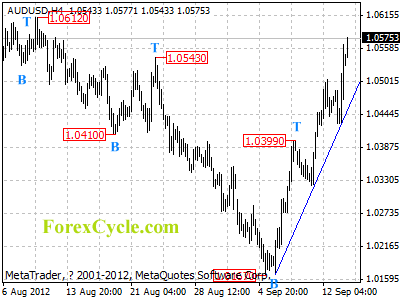
After a minor consolidation, AUDUSD continues its upward movement from 1.0167 and the rise extends to as high as 1.0577. Further rise to test 1.0612 previous high resistance could be expected, a break above this level will signal resumption of the longer term uptrend from 0.9581 (Jun 1 low), then next target would be at 1.0800 area. Support is now located at the upward trend line on 4-hour chart, as long as the trend line support holds, the uptrend will continue.

audusd

Forex Signals

Chile holds rate, notes easing of tensions after ECB move

By Central Bank News
    The central bank of Chile kept its benchmark interest rate unchanged at 5.0 percent, as expected, and said global financial conditions had improved but it could not rule out a resurgence of tensions in the euro zone.
     Banco Central de Chile said the domestic economy was evolving around its trend rate and inflation remains below 3.0 percent. It added that inflationary expectations remain around the bank’s target of 3 percent, plus/minus one percentage point.
    Chile’s annual inflation ticked up to 2.6 percent in August from July’s 2.5 percent. The central bank cut its interest rate by 25 basis points in January.

    The bank said recent information confirmed slow growth in developed markets and a slowdown in emerging economies. This had lead to additional monetary stimulus, especially in the United States.
    It added that commodity prices had rebounded in the last month, especially copper and fuels.
    “Internationally, global financial conditions have improved and the financial tensions in the Eurozone have moderated after the announcements of the European Central Bank. However, there is still uncertainty about the region’s performance and a resurgence of tensions in coming months cannot be ruled out,” Banco de Chile said in a statement.
    Last week the ECB announced a plan to buy an unlimited amount of bonds of euro zone member states as long as they agree to budgetary measures.
    Chile’s economy expanded by 1.7 percent in the second quarter from the first quarter, for a 5.5 percent annual rate, up from 5.3 percent.

    www.CentralBankNews.info


U.S. Fed launches third major economic stimulus program

By Central Bank News
    The Federal Reserve has launched its third major push to speed up the U.S. economy, worried that without further stimulus economic growth will be too weak to reduce unemployment.
    The U.S. central bank will purchase $40 billion worth of agency mortgage-backed securities each month for as long as it takes to improve the labor market and will also continue to reinvest proceeds from its holdings of maturing securities, boosting its holdings by some $85 billion a month.
    In addition, the Federal Reserve extended by another year its plan to keep interest rates at rock-bottom low, saying it would keep its target for the benchmark federal funds rate at 0-0.25 percent at least through 2015, when it expects the U.S. economy to be on a solid growth path.
    The Federal Reserve’s policy-making body made it clear that the central bank would not rest until the unemployment rate, at 8.1 percent in August, starts to decline, as long as inflation remains low.

    “If the outlook for the labor market does not improve substantially, the Committee will continue its purchases of agency mortgage-backed securities, undertake additional asset purchases, and employ its other policy tools as appropriate until such improvement is achieved in a context of price stability,” the Federal Open Market Committee (FOMC) said in a statement after its two-day meeting.
   “To support continued progress toward maximum employment and price stability, the Committee expects that a highly accommodative stance of monetary policy will remain appropriate for a considerable time after the economic recovery strengthens,” the FOMC added.
    Despite growing concern over the risks of continued asset purchases,  Chairman Ben Bernanke wants to his utmost to live up to the Federal Reserve’s mandate of fostering maximum employment along with stable prices.
    “This should make it more obvious that the Federal Reserve will do what is needed to support the economy,” Bernanke told a news conference.
    The Federal Reserve has already purchased $2.3 trillion of U.S. government and housing-related debt in an effort to keep interest rates and mortgage rates low, helping improve the housing market.  
    The Federal Reserve also released its latest economic forecasts, cutting its forecast for economic growth in 2012 to 1.7-2.0 percent, down from its June forecast of 1.9-12.4 percent. In 2013 the U.S. Gross Domestic Product is forecast to increase by 2.5-3.0 percent, up from June’s 2.2-2.8 percent.
    The forecast for the unemployment rate was unchanged at 8-8.2 percent in 2012 and then falling to 7.6-7.9 percent in 2013. Inflation was expected to remain below 2 percent through 2105.

    www.CentralBankNews.info


Reactions to Bernanke’s QE3

By The Sizemore Letter

Investor’s Business Daily contributor Trang Ho interviewed Charles Sizemore in his report on investor reactions to Bernanke’s QE3 announcement (See “Five Best ETF Buys After Fed Unleashes QE3“).

Exchange traded funds rallied across the board after the Federal Reserve fired off another round of economic stimulus.

The Fed said it would buy $40 billion per month of agency mortgage-backed securities, MBS, and it would hold interest rates “exceptionally low” to mid-2015…

Cyclical and high-volatility stocks such as technology, industrials and materials will benefit most, says Charles Lewis Sizemore, founder of Sizemore Capital in Dallas.

“While the economy is slowly improving, (Ben) Bernanke fears a relapse into deflation,” Sizemore said. “This means he’ll err on the side of dovishness.”

Industrial Select Sector SPDR (XLI) leapt 0.94%. It cleared a 37.49 buy point in a classic cup-with-handle pattern.

Technology Select Sector SPDR (XLK) flew 1.24% to an 11-year high.


No related posts.

Central Bank News Link List – Sept 13, 2012: Will Fed easing spur China’s central bank into quick action?

By Central Bank News
Here’s today’s Central Bank News link list, click through if you missed the previous link list. The list comprises news about central banks that is not covered by Central Bank News. The list is updated during the day with the latest developments so readers don’t miss any important news.

Federal Reserve launches QE3, keeps rate until 2015 – text

By Central Bank News
    The Federal Reserve will stimulate the sluggish U.S. economy further, purchasing additional agency mortgage backed securities and said it expects to maintain the target for the federal funds rate at 0-0.25 percent at least through 2015, one year longer than it previously had forecast.
    Click to read the statement from the Federal Open Market Committee.

    www.CentralBankNews.info

Latvia cuts rate 50 bps to bolster economy as inflation falls

By Central Bank News
    The central bank of Latvia cut its key refinancing rate by 50 basis points to 2.5 percent to help counter the negative effects of Europe’s debt crises on the country’s economy while inflation continues to recede. The bank also cut its marginal facility rates by 100 basis points.
    The Bank of Latvia said the previous cut in the refinancing rate in July and cuts in marginal facility rates in March “will provide the banks with an additional stimulus to direct available lats resources for economic development.”
    In addition to its refinancing rate, the Bank of Latvia also cut its overnight deposit rate to 0.050 percent from 0.10 percent and the seven-day deposit rate to 0.075 percent from 0.125 percent.
    The bank’s three marginal facility rates were reduced by 100 basis points each. 

    The rate for the facility that is used for up to five days was cut to 3.0 percent from 4.0 percent, the rate for using it for maximum 10 days was cut to 6.0 percent from 7.0 percent and the rate for using the facility for more than 10 days was cut to 9.0 percent from 10.0 percent.
    “In view of the fact that risks for price stability in the medium term are limited and inflation continues to go down as well as the expected negative influence of the European debt crisis on the Latvian economy, the Bank of Latvia council today resolved to reduce interest rates set by the Bank of Latvia,” the bank said.
    When the Bank of Latvia cut its refinancing rate by 50 basis points in July, it left the marginal facility rates unchanged.
    In March this year the bank cut its marginal facility rates as interbank markets started to normalize following tensions late 2011. Marginal rates were initially raised in December 2008 to stimulate the interbank money market as the global financial crises started to spread.
    Latvia’s inflation rate was steady in August from July at 1.7 percent, while the economy’s annual growth rate eased to 5.0 percent in the second quarter from 6.9 percent in the first quarter.    
     Latvia plans to introduce the euro currency in 2014.

    www.CentralBankNews.info