Questionable Easing 3

By MoneyMorning.com.au

After the RIP-ROARING SUCCESS of the Federal Reserve’s last two efforts to kick start the US economy — by simply reinflating asset bubbles to get people spending — the wise and bearded one has gone all-in with his third round of QE (quantitative easing). In plain English it means money printing.

Or as I call it, ‘Questionable Easing‘.

The markets have been crying for it all year, and ‘QE3′ is now here.

The most important aspect of it is that it is open ended. The Fed will keep buying US$40 billion of bonds each month —until the unemployment rate falls to some unspecified level.

This makes it a very different beast to QE and QE2. And importantly, how long will it last?

What the Questionable Easing Means for the USA

I’d assume that it lasts for at least 12 months, based on previous form. But the fact is no-one knows. And what is the Fed’s unemployment target anyway? Seeing as Questionable Easing hasn’t worked so far, we could see QE3 continue in vain for years.

Why has the Fed opted for such open-ended policy? They would probably say that it gets over one issue of the past 2 rounds of QE, which was a sudden vacuum of uncertainty at the end of it. This is too volatile a business environment for anyone to make long-term decisions in.

The board members deny their plan is politically motivated, but…when was the last time hundreds of billions of dollars were spent without politics being involved?

The elections are looming, and Mitt Romney could lead the Republicans to victory. And they want Bernanke out of a job. So it looks a lot like Bernanke is putting his legacy in place: the printing presses will keep spitting out dollar bills regardless of whether he’s still Chairman, or writing his memoirs. We’ve got a suggestion for a title: How to Fix America Using Counterfeit Money.

With this nudge from the Fed (QE3), the global economy is drunkenly stumbling into a dangerous and complex future. An endless stream of cheap money coming into the market is one hell of an experiment, and will cause unforseen results.

But the effect won’t be limited to the US. It will cause monetary mayhem in other nations. During QE2, Brazil rightly accused the US of ‘Casino Capitalism’.

And as with all casinos, the key is to drive punters back into this ‘casino’, to get them giddy on the spinning dollar signs, so they start spending at the shops again. It’s all part of the Fed’s money printing policy. Last week, Bernanke said as much:

‘There are a number of different channels…for example, the prices of homes. To the extent that home prices begin to rise, consumers will feel wealthier, they’ll feel more — more disposed to spend. If house prices are rising, people may be more willing to buy homes because they think that they’ll, you know, make a better return on that purchase. So house prices is one vehicle.

‘Stock prices — many people own stocks directly or indirectly…And if people feel that their financial situation is better because their 401(k) looks better or for whatever reason — their house is worth more — they’re more willing to go out and spend, and that’s going to provide the demand that firms need in order to be willing to hire and to invest.’

I could complain at length about the criminality of this, but … you don’t want to get me started. Besides, as editor of Diggers and Drillers, my job is to think about how this affects financial markets in general and mining stocks specifically.

Commodities Rally, Some to Surge

Anyone invested in the market already will be rightly excited by the prospect of a Fed-driven rally. The old saying: ‘Don’t fight The Fed’ holds true, because the Fed’s actions are squarely aimed at forcing investors back into the market if they want yield.

In fact equities are already rallying, with some of the biggest gains coming in smaller stocks, and commodities are surging. The London Metals Exchange index was up 4.3% on Friday night alone, and is now up 13.8% in a month. Gold is up nearly 10% in a month, and silver tops the charts with a 23.4% gain in the same time.

Even iron ore is lifting its head after a recent beating, probably on the prospect of massive Chinese infrastructure spending when the government changes guard soon. As regular as a Swiss cuckoo clock, this has been the pattern in the past.

Copper has held its ground well over the last 12 months, and is looking explosive now. In fact, US Commodity Futures Trading Commission data show that copper traders’ holdings surged 25-fold — the biggest ever gain.

And after 18 months of sinking markets, small-cap indices are at bargain levels, like the Small Ords (XSO) and Emerging companies (XEC). Coupled with rising prices in shares and commodities, this is an explosive mixture for small-cap mining stocks.

So I’d be lying if I said I wasn’t very excited at the prospect of Diggers and Drillers readers doing very well in the next 12 months…despite the craziness of the Fed’s actions.

Watch Precious Metals

Gold stocks have gained more in the last week, with the Market Vectors Gold miners index (GDX) up 28% since the start of August. The gold chart is looking more bullish by the week, but is looking incredibly bullish now.

Gold’s golden cross — to herald the next 3 year long, 100% rally?

Source: stockcharts

One important point in this chart is that the gold 50-day moving average (blue line) is about to cross the 200-day moving average (red line). This is the ‘golden cross’ — and is a powerful confirmation of a change of trend. We last saw this at the start of 2009 and it led to a three-year rally that saw the gold price DOUBLE.

As for silver, it has been outperforming gold two-to-one on the latest move, and I’d expect this to continue. Silver comprises a far smaller market, so is more sensitive to the kind of liquidity we are seeing now from the Fed. And don’t forget that the European Central Bank (ECB) is talking about unlimited bond purchases, which will increase the liquidity much further.

The gold to silver ratio shows how many ounces of silver it costs to buy one ounce of gold. Silver has risen so much faster than gold that this ratio has dropped from 60 to 50 already. During QE2, the ratio fell from 70 to 30, so we could have much further to go just yet. This makes this a very exciting time for silver investors.

The key is going to be how to position your trading for the coming rally. I’ve been busy all year with Diggers and Drillers tips focusing on gold, silver, oil, and strategic minerals. These should all do well, but as ever…there are always other hidden opportunities that I’ll keep looking out for.

Dr. Alex Cowie
Editor, Diggers and Drillers

Related Articles

What You Must Do to Survive the Coming China Crash

Why Does the World Still Trust This Man?

Gold Up, but Gold Stocks Up More


Questionable Easing 3

Central Bank News Link List – Sept 17, 2012: RBA says up to 23 central banks hold Australian dollars

By Central Bank News
Here’s today’s Central Bank News link list, click through if you missed the previous link list. The list comprises news about central banks that is not covered by Central Bank News. The list is updated during the day with the latest developments so readers don’t miss any important news.

India keeps rate steady but cuts CRR to revive growth

By Central Bank News
    The Reserve Bank of India (RBI) held its benchmark repurchase rate unchanged at 8.00 percent, as largely expected, but trimmed its Cash Reserve Ratio (CRR) by 25 basis points to 4.50 percent to help growth revive yet still maintain pressure on inflation.
     The cut in CRR will inject some 170 billion rupees into the banking system, the RBI said in its mid-quarter policy review.
    The RBI’s move comes on the heels of a flurry of reforms by the Indian government, which the central bank said had started to reverse negative sentiment. It added that steps to increase foreign direct investment should help capital inflows and productivity in the food supply chain.
    “Importantly, however, for the moment, inflationary pressures, both at wholesale and retail levels, are still strong,” the RBI said, adding: “As inflationary tendencies have persisted, the primary focus of monetary policy remains the containment of inflation and anchoring of inflation expectations.”
    In August India’s annual inflation rate rose to 7.5 percent, up from July’s 6.9 percent. The bank has said that it is comfortable with inflation of 5 percent.

    The RBI cut its repo rate by 50 basis points in April, a move it described as front-loading on expectations for fiscal policy support and supply-side initiatives. However, these expectations did not materialize and inflation did not fall significantly.
    India’s economic growth has been slowing the last two  years, and in the second quarter the economy  expanded 0.8 percent from the first quarter, for a 5.5 percent annual growth rate, only slightly improved from the first quarter’s record low of 5.3 percent.
    But the RBI said the government’s policy actions should stimulate growth and monetary policy would reinforce the positive impact of these actions while maintaining the focus on inflation.
    The RBI said global growth was weakening in the third quarter of 2012 and Europe’s weak economy poses significant downside risks to the global economy. The European Central Bank and the U.S. Federal Reserve have responded with liquidity measures.
    “While these measures have certainly mitigated short-term growth and financial risks, they will also exert pressure on global asset prices, and particularly, commodity prices,” the RBI said.
    www.CentraBankNews.info


Getting an Exposure to Market via FX Trading Platforms

With the visible growth of stock trading business, trade aspirants are looking for a platform to imbibe the right strategies. The whole idea is to brush up FX trading talent and attract profitable deals eventually.

What exactly do you need to trade professionally? Sharp trading skills, apt trading tools and pragmatic approach are some of the basic requisites of stock trading, but, all these traits can be obtained only through a trade platform. The website which is equipped with all the necessary tools meant for reference prior to trading forex has been termed as trade platform. These trading zones or platforms may differ from their counterparts’ trade portals due to the utilization of effective software package. As a matter
of fact, foreign exchange is an intricate system full of various currencies’ transaction. Therefore, it is highly advisable for the trade aspirants to join a trading platform according to their needs initially in order to shed all the inhibitions regarding the risks of FX market through broker’s consultant. Hang on! The role of broker needs to be addressed here, to understand the aforementioned statement. Precisely, the forex broker plays an unmatched role in cementing the users’ confusion with former’s due attention as well as guidance.

In addition, when you shortlist the options of these portals for trade, your focus must be clear and determined. It is this very determination that fetches you one of the best trading platforms further enhancing your performance. The trading tools and indicators offered by these platforms are no doubt, tested for their functionality prior to grouping them under trade resources. Basically, the websites which have been designed to serve the purpose of Forex traders comprise of user-friendly interface. Due to
this attribute, these platforms of FX trade are popular among individuals seeking suitable guidance in terms of stock trading and likewise. Generally, Etoro, Metatrader 4 or MT 4,  Forexyard and Finexo are few of the common FX trading platforms which have been preferred by the trade enthusiasts. Extracting the best deal through their services is the primary goal of these traders.  Apart from this, the companies which support the necessities of currency trading, are being listed among the resourceful
demands of traders or trading groups.


United World Capital is one such company that provides tools for analysing the market updates through its practical interface. The entire procedure of grooming, assigning demo account to buying the FX services from Forex currency trading platforms is totally systematic to avoid any interruption while dealing with currencies’ transactions. It is worth adding that the services of a trading platform must deliver beneficial results by quoting the real-time value of chosen pair of currency as visible in the market. The services of FX market are accessible to the users for 5 days in a week, though it is opened throughout the day from Monday to Friday. Furthermore, the subscribed trade platform ought to be geared up with customer support every time, so that, the FX traders can get their queries resolved smoothly. This help and guidance of broker is effectual for trade aspirants who are in their phase of learning Forex tactics. Last but, not the least, stock or currency trading is a framework of strategies which need to be utilized  precisely by enrolling with the trade platform.


About Author:

Brown Hazle is an experienced forex broker and recommends UWCFX. Currently she is writing on forex trading, online future trading platform, swap free account . For more detail about the company Visit: http://www.uwcfx.com/en/


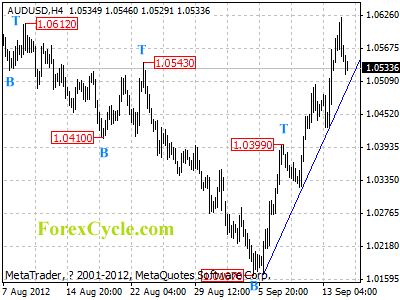
AUDUSD stays above a upward trend line

AUDUSD stays above a upward trend line on 4-hour chart, and remains in uptrend from 1.0167. Initial support is at the trend line, as long as the trend line support holds, further rise could be expected after a minor consolidation, and next target would be at 1.0700 area. Key support is at 1.0425, only break below this level could signal completion of the uptrend.

audusd

Forex Signals

Libya – Doomed from Day One

By. Jen Alic of Oilprice.com

People often ask me why the West doesn’t attempt a Libya-style intervention in Syria. After all, things are going so well in Libya. Oil production is up. But oil production is merely a mirage, as is security in Libya, which was doomed from the day one PG (post-Gaddafi) because of the way it was “liberated”.

Last Wednesday, US envoy to Libya Christopher Stevens was killed along with three other American diplomats in a rocket attack on the US consulate in Benghazi.

What about the oil, that global elixir? Well, the violence will not bode well for Libya’s production ambitions, coming at a time when the country looked prepared for a boost in output and was banking on this for economic growth.

Security was already dubious at best, and now international oil companies will be more reluctant than ever. Those that are already there-Germany’s Wintershall AG, Italy’s Eni and France’s Total-will be seeking to beef up security and have already started sending some of their workers home.

If the picture was not clear from the onset of the post-Gaddafi atmosphere, it certainly came into focus earlier this summer when protests over parliamentary elections forced the temporary closure of the el-Sider oil terminal, the country’s biggest.

Anyone who thinks that Libya will be a secure oil frontier after the formation of a new government next summer is mistaken. The road to destruction runs from Afghanistan to Benghazi (incidentally, the oil-producing region), branching off to southern Iraq and Pakistan’s tribal regions.

So, you ask, what about the controversial anti-Islamic movie apparently put together by an Israeli-American real estate developer with too much time on his hands?

According to Jellyfish Operations – a private intelligence and analysis boutique that has spent much time dissecting the intervention in Libya and the conflict in Syria-the anti-Islamic movie is a red herring in all of this.

Speaking to Oilprice.com, Jellyfish President Michael Bagley said that while the movie is being upheld as the root cause of the intensifying protests and the death of the US envoy to Libya, it has only served to give added momentum to another more important development.

“The key to all of this is al-Qaeda’s second in command, Abu Yahya al-Libi, who was killed by a US drone attack in Waziristan on 4 June,” Bagley said. “The real catalyst for the attack in Libya and the unrest that has spread to Yemen, was a lengthy video released by al-Qaeda leader Ayman al-Zawahiri, marking the anniversary of 9/11 and admitting to the death of al-Libi, who is Libyan.”

“This was a very powerful call to avenge al-Libi’s death,” Bagley said, “and it came only 24 hours before the attack on the US consulate in Benghazi.”

To put this into perspective, let’s reminisce a bit about al-Libi, whose past is a roller coaster, enemy-foe ride with the US.

Al-Libi was captured in the “war on terrorism” in Afghanistan in 2002 and held for three years in Kabul’s high-security Bagram prison. Against all odds, he escaped in 2005.

In 2011 he resurfaced again, but this time as a friend to Washington who had decided that it was no longer friends with Gaddafi, despite all the efforts leading up to this to rebuild relations after that nasty Lockerbie business and all the sanctions. So here is al-Libi again, but this time around his terrorist inclinations are a bonus rather than a liability: He fights alongside intervention forces to oust Gaddafi.

With Gaddafi gone, al-Libi once again became a liability so he was taken out by a drone in Pakistan.

This brings us back to the present, with al-Zawahiri on the rampage and Libyan’s wise to their liberators.

“This is a cut and dry example of the backfire of the US intervention strategy,” Bagley said. “Let’s hope it isn’t attempted in Syria.”

The post-Gaddafi Libya is not real. It’s a dangerous fabrication of materials stuck together by the glue of dubious alliances with jihadists who are cut loose with their weapons once the immediate goal (Gaddafi’s demise) was achieved. Forget about the oil for now.


Source: http://oilprice.com/Geopolitics/Africa/Libya-Doomed-from-Day-One.html

By. Jen Alic of Oilprice.com


International debt issuance drops 30% in Q2 – BIS

By Central Bank News
    The issuance of international debt securities, such as bonds and collateralized securities, fell in the second quarter of 2012 due to a plunge in issuance by financial institutions, especially euro area banks, the Bank for International Settlements (BIS) said.
    Global gross issuance of international debt securities fell 30 percent to $1.83 trillion in the second quarter from the first. Taking account of repayments, net issuance plunged by 92 percent to $63 billion, the smallest amount since the second quarter of 1995, the BIS said in its September Quarterly Review.
    Net issuance declined across the globe, with European issuers making net repayments of $92 billion while issuance by U.S. nationals was cut in half to $50 billion and that from emerging market borrowers fell 40 percent to $75 billion.

    BIS said the decline may reflect a front-loading of issuance to the first quarter by banks who wanted to take advantage of the European Central Bank’s longer-term refinancing operations (LTROs).
    “Moreover, funding conditions in global debt markets deteriorated in the second quarter on revived market tensions in the euro area, weaker than expected economic data in the United States, and worries about the growth outlook in emerging markets, especially China,” BIS added.
    As a whole, corporate issuers cut issuance by 10 percent to $144 billion. But among corporates, U.S. issuers raised an additional 17 percent, or $88 billion, in the second quarter, taking advantage of investors’ appetite for investment grade bonds while interest rates are low. European corporate issuers decreased their issuance by 35 percent to $37 billion.
    Click to the read the September 2012 BIS Quarterly Review.

    www.CentralBankNews.info
    

International bank lending up in Q1, but still subdued – BIS

By Central Bank News
    International lending by banks rose slightly in the first quarter of 2012, reversing a $811 billion plunge in the fourth quarter, helped by a stabilization of lending among banks and a rebound in lending to emerging markets, the Bank for International Settlements (BIS) said.
    But despite a $126 billion, or 0.4 percent, overall increase in cross-border lending in the first quarter from the fourth, international lending remains subdued from a longer term perspective, BIS said in its latest quarterly review of international banking and financial market developments.
    As an example of the vitality of lending prior to the onset of the global financial crises, cross-border lending in the first quarter of 2007 had rocketed $2.2 trillion, BIS data shows.
     Figures from banks in the 44 countries that report to the Swiss-based BIS showed that lending to non-banks rose $154 billion, or 1.4 percent, in the first quarter of 2012, helped by a 3.1 percent rise in lending to emerging economies.

    Credit extended to non-banks in Latin America, which includes offshore centres in the Caribbean, showed “the largest absolute increase since the start of the BIS international banking statistics.”
    Cross-border interbank lending stabilized in the first quarter following a severe contraction in the fourth quarter, with 1.7 percent rise in lending to euro area banks as wholesale funding markets reopened following the European Central Bank’s longer term refinancing operations (LTROs).
    However, BIS pointed to the “distinct north-south divergence in cross-border lending to euro area banks.”
    While cross-border claims on banks in Germany surged by $271 billion (or 26 percent, – the highest quarterly growth rate in more than 20 years – interbank lending to banks in Ireland, Italy, Spain, Portugal and Greece decreased.
   International lending – especially from German and French banks – to residents of those five southern European countries shrank by $92 billion, or 4.7 percent, adjusted for foreign exchange effects, with lending to banks down 11 percent and to the public sector down by 5.4 percent.
    “Overall, the figures suggest that the two three-year LTROs conducted by the ECB in 2011 and 2012 did not unlock new foreign financing to these countries,” BIS said.
    Meanwhile, banks were eager to lend to residents in emerging markets, with lending rising $86 billion, or 2.8 percent, after a drop of $77 billion in the previous quarter.
    “It was the first expansion in three quarters, a possible indication of how these economies benefited from improving market conditions in the first quarter of 2012,” BIS said.
    Cross-border claims on emerging market banks rose $41 billion, or 2.5 percent and lending to non-banks rose by $45 billion or 3.1 percent.
    The increased lending to emerging markets was driven by banks in Asian offshore centres and from banks in the United Kingdom while euro area banks held their lending to emerging market steady following a fall in the fourth quarter.
    The Asia-Pacific region attracted 79 percent of the total rise in lending to emerging economies, with lending to China rising $54 billion, or 11 percent, primarily driven by interbank lending that rose 14 percent.
    Click to read the September 2012 BIS Quarterly Review.
 
    www.CentralBankNews.info

Emerging markets may support global growth less – BIS advisor

By Central Bank News

       Slower growth in many emerging markets could put those countries on a more sustainable growth path but it also means that they won’t help support the global economy as much as in recent years, according to the chief economist of the influential Bank for International Settlements (BIS).
    Despite the rally in financial markets since late July, BIS Economic Advisor Stephen Cecchetti warned investors against complacency as the pace of recovery in the global economy remains disappointing and there are signs of slower growth in emerging market economies.
    “This could be a welcome moderation that helps put growth in these economies on a more sustained footing but even so it means that the emerging market economies won’t support global growth as much as they have in recent years,” Cecchetti said in connection with publication of the latest BIS Quarterly Review.
     European Central Bank (ECB) President Mario Draghi sparked the rise in global financial markets in late July when he assured investors the ECB would do “whatever it takes” to protect the euro. Earlier this month the ECB said it would buy an unlimited amount of bonds of euro zone member states if needed.
     But the rise in markets, which has driven down corporate bond spreads to their lowest level in year, should not obscure the fact that the fundamental weaknesses of Southern European countries remains in place and only structural solutions can solve their competitiveness and fiscal problems, Cecchetti said.
    Despite progress in reforming the global financial system, Cecchetti said that process is far from complete and many banks still rely on central banks for funding and activity in unsecured interbank markets remains low.
     Nevertheless, international banks are now smaller, less leveraged and less connected to each other than five years ago.
    More fragmented banking systems across national boundaries could mean a return to more sustainable levels of banking, Cecchetti said, but cautioned that this could trigger new problems “if the pendulum swings too far and markets become overly fragmented.”
      “It reduces the scope for contagion but also increases the risk of domestic crises and reduces the ability to share risks across borders,” he added.