U.S. Stocks: Where We’ve Been, Where We Are and Where We’re Going

Get limited-time, free access to EWI’s insights into financial markets
November, 2012

By Elliott Wave International

After years of campaigning and billions of dollars spent, the U.S. Congress is virtually no different than before Election Day: a Republican-controlled House, a Democratic majority in the Senate and the same occupant in the White House.

The same can be said for the S&P 500 — and then some.

Investors who’ve been in an S&P index fund over the past 13 years would have been better off in a money market account! From July 1999 through August 2012, the S&P 500 was back to where it started.

We think this is the longest topping process in the history of the United States.

— Steve Hochberg, EWI Chief Market Analyst

Yet, the long ride to nowhere is likely headed somewhere very soon — but not where most investors think. Moreover, the market’s trend may unfold much faster than many observers suspect.

You see, according to recent sentiment indicators, the long ride to nowhere has lulled many investors into a sense of complacency.

But please know that we see abundant evidence that should create a sense of urgency in the mind of investors.

That’s why the editors of EWI’s Financial Forecast Service are hosting a limited-time, free event for U.S. investors.

They want you to see what they see in U.S. financial markets.

You will learn why the stock market top has occurred over a period of time, and why the resolution may be swift.

EWI’s editors guide you through chart after chart, including a real eye-opener that shows the triple top in the Great Asset Mania. As you see the scope of this chart, Hochberg provides his insightful commentary.

Hochberg also describes what he means by “inter-market non-confirmation” and observes, “We’ve had broad swaths of the market peel away from the rally that started in March 2009.”


Now learn what Hochberg sees unfolding next by accessing EWI’s free Financial Forecast Service limited-time special event.This free rare event is available to you by joining Club EWI (membership is also free).Joining Club EWI only takes a few moments. Please follow this link to learn how >>

This article was syndicated by Elliott Wave International and was originally published under the headline U.S. Stocks: Where We’ve Been, Where We Are and Where We’re Going. EWI is the world’s largest market forecasting firm. Its staff of full-time analysts led by Chartered Market Technician Robert Prechter provides 24-hour-a-day market analysis to institutional and private investors around the world.


UK House-Prices Rose the Fastest in Two Years

By TraderVox.com

Tradervox.com (Dublin) – According to a Royal Institution of Chartered Surveyors report, the UK house prices improved to the best in more than two years in October. The housing index reached 7 percent in October from negative 14 registered in September. In their report emailed today, the RICS said that the measures of enquiries from new buyers increased from 5 to 18, making it the fastest pace of improvements since December 2009.

The report has signaled stabilization in the housing sector after the economy barely escaped a recession in the last quarter. The report was released a day before the Bank of England releases its inflation and growth prospects after halting the 375 billion-pound asset purchases program.

According to Ian Perry, the RICS spokesman, the number of potential buyers going out and viewing property grew last month. Perry’s statement also noted that the overall activity remains low in most parts of country and the availability of affordable mortgage eludes most first-time buyers. The reported noted that the gauge of three-month price expectations increased to negative 3 from negative 9 while the newly agreed sales rose from zero to 20, the highest since December 2009.

The pound has remained low prior to the BOE release of its latest growth and inflation projections. The market is expecting the report to show room for more easing to boost growth in the country which has had some growth in the third quarter. According to Ian Stannard, the head of European Currency Strategy in London at Morgan Stanley, the pound remains under pressure as data is likely to suggest there are challenges in the future in the UK economy. He also noted that the BOE started talking about the negative impacts of a strong pound, hence there might be measures put in place to curb this strength. He projected that the pound may continue to decline against the dollar.

The sterling dropped by 0.2 percent against the euro to 80.11 at the close of trading in London. The UK currency dropped to 0.2 percent to $1.5869 against the dollar.

Disclaimer
Tradervox.com is not giving advice nor is qualified or licensed to provide financial advice. You must seek guidance from your personal advisors before acting on this information. While we try to ensure that all of the information provided on this website is kept up-to-date and accurate we accept no responsibility for any use made of the information provided. Opinions expressed at Tradervox.com are those of the individual authors and do not necessarily represent the opinion of Tradervox.com or its management. 

Article provided by TraderVox.com
Tradervox.com is a Forex News Portal that provides real-time news and analysis relating to the Currency Markets.
News and analysis are produced throughout the day by our in-house staff.
Follow us on twitter: www.twitter.com/tradervox

Market Trends 13.11.12

Source: ForexYard

printprofile

Hey Everyone,

Here are some predictions for today.

Good luck!

-Dan

Gold- May see upward movement today
• Support- 1714.83
• Resistance- 1736.66
Silver- May see upward movement today
• Support- 31.84
• Resistance- 32.72
Crude Oil- May see downward movement today
• Support- 84.41
• Resistance- 86.69
DAX30- May see upward movement today
• Support- 7041.72
• Resistance-7214.75
EUR/USD- May see downward movement today
• Support- 1.2587
• Resistance- 1.2805

Forex Market Analysis provided by ForexYard.

© 2006 by FxYard Ltd

Disclaimer: Trading Foreign Exchange carries a high level of risk and may not be suitable for all investors. There is a possibility that you could sustain a loss of all of your investment and therefore you should not invest money that you cannot afford to lose. You should be aware of all the risks associated with Foreign Exchange trading.

Market Review 13.11.12

Source: ForexYard

printprofile

The euro fell to a new two-month low against the US dollar during overnight trading, after euro-zone officials failed yesterday to agree on a plan for Greece to receive a new round of bailout funds.

Additionally, investors are still concerned with the prospect that massive tax increases in budget cuts in the United States will automatically occur if congress is unable to reach a budget deal. The threat of the so called “fiscal cliff” resulted in other higher yielding currencies and commodities, including the AUD and crude oil, taking losses during the Asian session.

Main News for Today

German ZEW Economic Sentiment- 10:00 GMT
• Recent fears that the EU debt crisis is spreading to Germany means that this indicator is likely to take on added importance when it is released today
• Analysts are forecasting the figure to come in at -9.9, slightly better than last month’s -11.5
• Any worse than expected data could result in the euro extending its recent losses

Forex Market Analysis provided by ForexYard.

© 2006 by FxYard Ltd

Disclaimer: Trading Foreign Exchange carries a high level of risk and may not be suitable for all investors. There is a possibility that you could sustain a loss of all of your investment and therefore you should not invest money that you cannot afford to lose. You should be aware of all the risks associated with Foreign Exchange trading.

Central Bank News Link List – Nov 13, 2012: China’s central bank policy seen steady despite drop in loans

By Central Bank News
Here’s today’s Central Bank News link list, click through if you missed the previous link list. The list comprises news about central banks that is not covered by Central Bank News. The list is updated during the day with the latest developments so readers don’t miss any important news.)

Why Lithium is Another ‘Rare’ Element on China’s Radar

By MoneyMorning.com.au

What have iPhones, laptop computers, electric toothbrushes, and power-tools all got in common?

They’re all powered by a ‘magical’ element that’s on the British Geological Survey’s Risk List of strategic minerals.

You may have heard of rare earths and tungsten. Both are key ingredients in modern technology. And both are dominated by China.

But there’s another element that’s just as strategic to modern technology. And unlike rare earths and tungsten, this one isn’t dominated by China. In fact, this strategic element is a key Australian export. And it’s now in play as resources companies scramble to get a cut of the action.

What element am I talking about? Lithium.


And specifically, the market for lithium ion batteries.

The once humble lithium ion battery sector is taking off like a stung cat. And if the market moves as I expect, early-mover investors stand to make some very tidy profits indeed.

Lithium reminds me of iron ore about ten years ago. Of course iron ore’s best days are behind us. The trick is to foresee what will drive the next decade’s bull market.

And I’m certainly not alone in seeing how important lithium will be in the future.

Just this morning we heard that Chinese battery maker Chengdu Tianqi Industry Group is making a move on Aussie-based but Canadian-listed Talison Lithium (TSE:TLH).

Things are hotting up in the lithium stakes. This will be the second bid for Talison. Just three months ago, global lithium leader Rockwood Holdings (NYSE:ROC) bid the equivalent of A$700 million.

We don’t know how much Chengdu will offer yet, but they will exceed Rockwood. This is already driving the price higher in anticipation.

The result is some spectacular results for Talison holders, who have seen the share price jump by 133%, from $3 to nearly $7 in just six months. And I don’t think the bidding is over yet.

Talison Lithium – Takeover Bids Raise the Price 133% in Six Months

Talison Lithium - Takeover Bids Raise the Price 133% in Six Months

Source: Stockcharts


The irony is that even though the project is in Western Australia, there wasn’t enough investor interest in Talison to list on the Australian market a few years ago, so the company had to list in Canada.

Good News for Aussie Lithium Investors

But the good news for Aussie investors in that when companies start fighting to outbid each other it tends to shine the spotlight on that sector.

So we can expect other lithium stocks to get some attention soon.

Better yet, there is a truly world class lithium stock listed on the ASX. The lithium sector isn’t big, and for my money this stock is next in line for a takeover bid in the future.

The scarcity of lithium (in terms of that which is economically recoverable) means that it is a key part of my ‘strategic mineral strategy’ in Diggers and Drillers.

The bidding war for Talison is a good advert for just how important this sector has become.

Governments are getting anxious about securing lithium as well. The British Geological Survey’s (BGS) has increased lithium’s ‘risk rating’ by 22% in just a year.

Last year it scored 5.5/10. But in this year’s risk it has been pushed right up the list to 6.7/10 – making it more critical than silver, or diamonds.

So what’s all the fuss about anyway?

Lithium is essential for lithium ion batteries, and this market is growing fast.

It might have been out of the spotlight for a few years, but the growth has been staggering in that time. Since lithium was the ‘hot commodity’ of 2009, the size of the lithium ion battery market has increased at around 14.9% annually, or 52% in total.

Lithium ion Battery Market – Growing Fast

Lithium ion Battery Market - Growing Fast

Source: Citi Research


The interesting thing here is the red bars are for consumer technology, mostly laptops and phones. Demand from electric vehicles (brown) and hybrid vehicles (purple) are just starting to make an impact now. And you can see this is growing fast. Even so it still has a long way to go.

Watch the Graphite Sector Too

The other big ingredient for a lithium ion battery is graphite.

The growth rate in this sector is creating a lot of new demand for quality graphite. So this has been another key part of my strategic minerals strategy.

And we have more good news here. Just this morning, the graphite stock I’ve tipped has announced two exploration targets, each of which would be larger than the world’s largest graphite mine.

This staggering find makes this graphite stock the likely new king of the sector, and will make it very hard for new players to get a look in.

In fact there is so much graphite in the deposit the company is now talking about a 100-year mine-life!

The nature of the deposit will ensure it will be cheap to produce from, and it’s this type of mega-long life, low-cost project that make sound long term investments.

The reality is that this also makes it a takeover target for bigger players, so it’s possible we could see bidding wars in the graphite space too.

The bottom line is that thanks to the explosion in lithium ion battery demand, there’s plenty happening in strategic minerals stocks.

At a time that the old bull markets of iron ore and coal are a very tough sell, I believe the lithium ion battery sector is building the way for a whole new decade-long bull-market.

Dr Alex Cowie
Editor, Diggers & Drillers

PS. Investing in resources stocks is high-stakes investing. You make small bets, but if they come off you can make big returns. I believe almost every investor should set aside part of their portfolio for small-cap resource stocks.

But aside from that it’s also important to have a balanced side to your investments. That is, you should invest in lower-growth, income-earning stocks too. This is something the office income specialist, Nick Hubble has been researching for the past three years. What he’s come up with is something you should pay close attention to. To find out the details of Nick’s Aussie income strategy, click here…

From the Port Phillip Publishing Library

Special Report:
Retire Rich, Happy and Free From Money Worries

Daily Reckoning:
Accelerando Towards the Fiscal Cliff

Money Morning:
Who Says Gold Doesn’t Pay ‘Interest’?

Pursuit of Happiness:
What’s Your Entrepreneurial Idea?

Diggers and Drillers:
Why Graphite is the High Tech Commodity Driving an Investment Revolution


Why Lithium is Another ‘Rare’ Element on China’s Radar

Rising Food Prices Means Latin America is the Place to Invest

By MoneyMorning.com.au

Right now, the market is urgently trying to tell us something. In fact it’s been trying to tell us something for the last few years.

In the last decade or so we’ve seen regular bouts of record-busting food prices. This is the market’s way of warning us that our supply of the stuff is running low.

And as the global population grows and also becomes wealthier, demand for food will only keep rising.

Clearly, rising food prices are bad news for consumers, and particularly for the world’s poor. But these food price spikes aren’t entirely bad. In the long run, higher prices encourage farmers and food processors around the world to raise food production.

In turn, that’s going to mean a lot more money will be invested in boosting farm productivity. One region in particular looks likely to capture the lion’s share of the extra investment – Latin America.

Latin America: the Perfect Farmyard Investment

My colleague Merryn Somerset Webb covered the reasons behind booming food prices in a recent Money Morning so I won’t repeat the argument here.

Suffice to say that growing populations and richer diets mean the world’s farmers will need to produce a lot more food in the future. And Latin America is the perfect place to do it.

The first essential in farming is that you need the right conditions to grow crops. Latin America has these in abundance.

Take South America. It’s divided between mountains, jungle, flatlands and coastal regions. This diversity is good for farmers because – aside from extremes such as Chile’s arid Atacama Desert or the frozen southern tip of Argentina – it means that almost anything can be grown there.

To the south, the cool slopes of the Andes provide the perfect conditions for wine production. To the east of the mountains, the temperate prairie-like pampas give Argentina, Brazil and Paraguay excellent land for rearing cattle and growing grains.

Indeed, thanks to the pampas, Argentina and Brazil are two of the world’s ‘big six’ grain growers, and major livestock producers.

As you move north, towards the equator, the four seasons merge into two. This means farmers in Ecuador, Colombia, Venezuela and northern Brazil can plant two harvests per year.

Meanwhile, countries on the west coast benefit from the warm waters of the Pacific and have strong fisheries. Chile and Peru are both in the world’s top ten fish producers.

Once you reach Central America, the tropical climate provides the perfect conditions for sugar cane, coffee and tobacco.

Latin America’s Farmers are Still in Second Gear

Of course, Latin America isn’t the only place in the world with good farming conditions. The US, Eastern Europe, and Australasia are all major food exporters that help keep more densely populated areas – ie Asia – well stocked with food. The reason Latin America stands out is its potential to crank up production.

Victor M. Villalobos of the Inter-American Institute for Cooperation on Agriculture (IICA), says that Latin America has 42% of the world’s potential for agricultural production.

That’s a rather specific number, and I don’t see how anyone could work it out so exactly, but the IICA certainly comes out with strong reasons to back its view.

Firstly, Latin America still isn’t using all of its farmland. For example, the UN’s Food and Agriculture Organisation reckons that Brazil has the most ‘spare farmland’ in the world. The country has 350 million hectares of potential arable land, which isn’t currently being used to produce food.

In total, the World Bank estimates that about a third of the world’s spare farmland is in Latin America. Putting all that into production won’t be easy, but the region has the necessary resources to do it. Latin America also has just under a third of the world’s freshwater resources; more than any other region.

Moreover, as Villalobos notes, Latin American farmers have suffered ‘a great lag in the increase of yields’ over the last 50 years. There are some highly productive farms in Argentina, Uruguay and Brazil, but many of the region’s farms rely on out-dated techniques and machinery.

The problem is that Latin American countries ‘invest little in R&D in agriculture’, says the IICA. But now, thanks to the generous prices on offer, and a more investor-friendly political atmosphere, that’s changing.

Farmers realise that ‘the rise in food prices will create opportunities for exporting countries’. For example, Latin America now supplies around a third of China’s agricultural imports. China’s economy may be slowing, but its population – and therefore appetite for agricultural imports – should continue to grow.

According to the IICA ‘the sectors that will benefit most are those that produce grains, oilseeds, dairy products [and] meat’.

James McKeigue
Contributing Writer, Money Morning

Publisher’s Note: This is an edited version of an article that originally appeared in MoneyWeek

From the Archives…

APRA Spins Another Yarn On Australian Banks
9-11-2012 – Kris Sayce

The Secret Return to the Gold Standard
8-11-2012 – William Patalon

Forget the US Election, This Stock Market Event is the One to Watch For
7-10-2012 – Murray Dawes

The Greeks Giving Economists Nightmares
6-10-2012 – Bill Bonner

Super Fund Results: Whoopdeedoo
5-10-2012 – Nick Hubble


Rising Food Prices Means Latin America is the Place to Invest

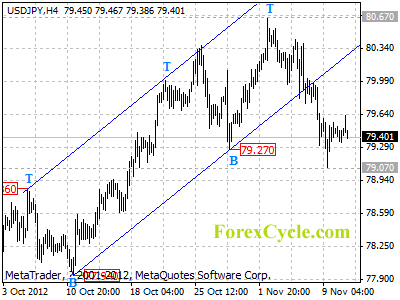
USDJPY remains in the short term downtrend from 80.67

USDJPY remains in the short term downtrend from 80.67, the rise from 79.07 would possibly be consolidation of the downtrend. Another fall could be expected after consolidation, and the target would be at 78.80 area. However, the fall from 80.67 is likely consolidation of the longer term uptrend from 77.14 (Sep 13 low), one more rise to 82.00 area is still possible after consolidation. Resistance is now at 79.65, a break above this level will indicate that a cycle bottom has been formed at 79.07 on 4-hour chart, and the short term downtrend from 80.67 has completed, then the following upward movement could bring price to 81.00 zone.

usdjpy

Forex Signals

Get a Free Week of U.S. Stocks, Bonds, Gold, Silver, USD Forecasts (through Nov. 19)

Greetings,

Now – Nov. 19, you can join a free analysis-packed event for investors in the U.S. markets, hosted by Elliott Wave International, the world’s largest financial forecasting firm.

Packed with videos, charts, analysis and more, this event centers around EWI’s three flagship publications: The Elliott Wave Theorist, The Elliott Wave Financial Forecast, and the Short Term Update. During this rare event, you will get to see the analysis and forecasting from each of these premier U.S. market publications.

Here’s an overview of what you’ll get when you sign up now:

  • Robert Prechter’s November video edition of The Elliott Wave Theorist: In the 30 years of publishing Theorist, this is only the third time that Bob has recorded a video issue. You will get select clips of his landmark presentation. You don’t want to miss this!
  • Complete Short Term Updates on Monday, Wednesday and Friday: Chief Market Analyst Steve Hochberg gives you forecasts for the markets’ near-term turns through use of extensive Elliott wave charts.
  • October 2012 Elliott Wave Financial Forecast: 10 pages of analysis of U.S. stocks, bonds, gold, silver and the U.S. Dollar.
  • Steve Hochberg’s “Buy and Hold or Sell and Fold” video presentation, plus his Nov. 8 video interview on CNBC’s Fast Money program.
  • Prechter’s best-seller Conquer the Crash: You can read eight chapters now, including: “When Do Depressions Occur?”, “The Significance of Historically Optimistic Psychology”, and “When Do Stock Markets Turn from Up to Down?”

We could tell you more about this exciting event from EWI, but why not learn more for yourself?

Join EWI’s free event for U.S. investors now >>

There’s no obligation beyond creating your free online profile for instant access to the resources you see above and much, much more.


P.S. This free event will end promptly at noon Eastern time Monday, Nov. 19. Join now for instant access to the free charts, video, analysis, forecasts and more. Learn more.


About the Publisher, Elliott Wave International
Founded in 1979 by Robert R. Prechter Jr., Elliott Wave International (EWI) is the world’s largest market forecasting firm. Its staff of full-time analysts provides 24-hour-a-day market analysis to institutional and private investors around the world.


We’re Getting Older and Poorer

Editor Andrew Snyder

America’s money problem is not political. It’s far more sinister.

Finally, somebody has the guts to talk the truth. He didn’t dare do it before the election… too many voters to anger. But now that the results are in and the thoughts and opinions of the American electorate no longer matter… our leaders are free to speak their minds.

Every once in a while, the truth squeaks out.

“This is year two of a 25-year demographic bubble that — wasn’t like anyone couldn’t see it coming,” John Boehner said of Washington’s fiscal woes last week. “10,000 baby boomers, like me, retiring every day; 70,000 a week. It’s 3.5 million this year, and this is just the second year of the 25-year baby boom bubble, and it’s not like there’s money in Social Security or Medicare. This has to be dealt with.”

Yup… somebody needs to do something. The problem, though, is the boomers are a powerful lot. No politician — except maybe a jaded lame ducker — dares mess with the “bulge.” That’s why Boehner can rightfully claim we’ve seen this mess coming for decades, yet nobody bothered to try to fix it.

Now that the great retirement has started, there’s not much that can be done that won’t infuriate at least one segment of the American population. Since there are fewer rich folks and, therefore, fewer voters to anger, we know where Washington’s target lies. Wealthy Americans are in for a rough year.

But the fact is we can tax the wealth right out of the rich, and it still won’t do a lick of good. Our problem is far bigger. Stealing from the rich and giving to the poor won’t cut it. Not with demographics as lopsided as these.

Get this. By the time this year comes to an end, the number of 55-and-older workers will eclipse the number of workers between the ages of 25 and 34. It is a skew that makes the idea of fixing this mess flat-out impossible.

A recent chart from the Fed tells the tale:

Employment Chart
View larger chart

This intersection of young and old workers threatens to hammer at the knees of our Ponzi-scheme economy. Without the chance to pilfer the pockets of the nation’s youngest wage earners, everything from the stock market to the mess of federal entitlement programs will collapse.

In a recent report, the Congressional Budget Office took a look at what America’s aging population means for our economy and our tax-and-spend fiscal policy.

The news was not good:

The aging of the baby-boom generation portends a significant and sustained increase in coming years in the share of the population that will receive benefits from Social Security and Medicare and long-term care services financed through Medicaid. Moreover, per-capita spending on health care is likely to continue to grow faster than per-capita spending on other goods and services for many years…

Without significant changes in the laws governing Social Security, Medicare and Medicaid, those factors will boost federal outlays as a percentage of GDP well above the average of the past several decades — a conclusion that applies under any plausible assumptions about future trends in demographics, economic conditions and health care costs.

Now, let me ask you this. How many times over the last few months have you heard any politician utter anything about serious changes to our Big Three entitlement programs? Zip. Zero. Zilch.

The fact is these programs are untouchable. Our leaders refuse to even look at them. It’s a fact Senate Majority Leader Harry Reid reinforced last Wednesday. “We’re not going to mess with Social Security,” he said.

That’s the end of that.

My point here is simple. The markets are acting like we’re at a critical juncture. The herd that drives prices thinks this fiscal cliff mess — no matter how it is resolved — will end in some sort of long-term solution. But we will see nothing of the sort.

What we need is not a policy adjustment. That’s far too easy. Our problem is systemic. Our economy is lopsided, and there is nothing any politician can do about it. The only thing that will fix this mess… is time. And a lot of it.

Our problems will stretch on for generations… not weeks. You portfolio and your investment strategies had better reflect that idea. If not, it’s a slow and steady march to the bottom.

I hope you have the guts to admit it.

Disclaimer

Article brought to you by Inside Investing Daily. Republish without charge. Required: Author attribution, links back to original content or www.insideinvestingdaily.com. Any investment contains risk. Please see our disclaimer.