High Risk Investing – The New Trend in Energy: Interview with Andrew McCarthy

By OilPrice.com

Risk perception isn’t what it used to be. Ask the swelling ranks of Canadian junior oil and gas companies braving high-risk venues like Sudan, Iraq and even Yemen.

Technological advances and the shale revolution are making risk easier to digest. And political risk is no longer limited to developing countries. Plus, risk is increasingly relative: Ask anyone who’s been caught up in the politics of the Keystone pipeline.

Sudan is a case in point. While instability and a very fragile peace with South Sudan remains a threat, there is also growing optimism. The philosophy is this: Sudan and South Sudan will come to terms for the sake of economic growth, and oil will get them there. The prize: An estimated 5 billion barrels of oil.

In an exclusive interview with Oilprice.com publisher James Stafford, Emperor Oil CEO Andrew McCarthy reveals:

• Why investors are hitting up high-risk regions
• Why Africa is more opportunity than risk
• How political risk is no longer limited to developing countries
• Why Shale WILL live up to the hype
• Why conventional oil is still a great investment
• And why human ingenuity will prevail

Emperor Oil (TSXV: EM.V) is an international oil and gas company with a focus on the Middle East and North Africa. Most recently, the company has renegotiated the terms of a joint venture gas deal in Turkey and introduced a significant conventional oil project in Sudan.

James Stafford: Oil and gas juniors are now setting up shop in high-risk countries like Sudan, Iraq and even Yemen. What’s behind this new era of risk, and are we likely to see more of this?

Andrew McCarthy: This question creates an opportunity for risk comparison – is it less risky to drill a mile below the ocean surface and create the kind of disaster we saw BP (NYSE: BP) deal with in the Gulf, or do we continue to look for work in regions that have accessible resources and are anxious to advance their economic position along with the health and welfare of their community?

James Stafford: So you are saying that on a comparative level even North America has become a political risk? And that in this balancing act, volatile places like Sudan do not necessarily pose any greater political risk?

Andrew McCarthy: Yes, there are always risks associated with any investment. The US halted all exploration in the Gulf of Mexico for extended periods following the BP disaster. This is a risk that few would have foreseen when exploration and development began in a country whose level of political risk is considered to be negligible.

James Stafford: Furthering your point, there have been a number of other unforeseen political risks, both in the US and Europe…

Andrew McCarthy: Certainly. The US banned all exploration and production in the Marcellus Shales in the State of New York. The US has also stalled the construction of Keystone XL pipeline that would link the US to Canada’s oil sands. In Canada, we have seen the province of British Columbia place a moratorium on offshore drilling. Across the Atlantic, we have also seen Europe place a moratorium on all shale exploration and development.

James Stafford: What is your message to investors who still view Africa and the Middle East as too risky?

Andrew McCarthy: Based on all of these North American and European developments, is it any less risky than operating in developing countries?

James Stafford: Which brings us to Emperor’s operations in Sudan. When South Sudan declared independence in July 2011 it took with it some 75% of the known oil resources. Since then, the situation between Juba (the capital of South Sudan) and Khartoum (the capital of Sudan) has been tense and even bloody. How will this affect exploration and extraction?

Andrew McCarthy: Well, now we have healthy competition due to the secession of the south and the need for both countries to maximize their economic opportunity. The skirmishes fought in the spring were quickly squelched when both countries realized the impact it was having on their economy and their people. Rather than fight over existing production they have chosen to expand their resource development so that there is a larger pie to share.

There have certainly been many difficulties over the years but the country recently emerged from a democratic process that the South secede in a diplomatic fashion. Both countries are now keen to advance, and the competition to succeed is healthy and beneficial. Of course, one also has to remember how truly enormous this country is and how remote some of the areas are in which much of the oil reserves are located.

James Stafford: There is also the question of infrastructure. South Sudan is seeking alternatives to transiting oil through Sudan, and Juba is extremely optimistic about the prospects of a new pipeline from South Sudan to Kenya. This is all part of Kenya’s massive regional infrastructure plan—the $24.7 billion Lamu Port-South-Sudan-Ethiopia Transit corridor (LAPSSET). How feasible is this pipeline? What are the implications for Khartoum?
How much would Khartoum stand to lose in transport revenues if this pipeline is realized?

Andrew McCarthy: I think this is an unnecessary undertaking that will be difficult to finance for many different reasons. Pipelines are exorbitantly expensive to build and would seem especially unnecessary given the fact that they could face similar problems to those which they have just overcome in Sudan [in terms of prohibitively high transit fees].

It is doubtful that a new pipeline would have any negative effects in Sudan. If anything it would likely cause the country to push for further exploration and production so as to maximize the infrastructure already in place.

James Stafford: The International Energy Agency (IEA) forecasts a drop in Sudan’s oil production through 2017. This contradicts Sudan’s own projections that it could double production in the next two years. How realistic is this?

Andrew McCarthy: I think that they are more than realistic. The main pipeline and port in Sudan is more than capable of handling the capacity. The resources are proven and available.

James Stafford: Despite the problems between Juba and Khartoum, Emperor seems confident that development and production will proceed without interruption. Can you tell us more about your recent progress in Sudan that boosts this optimism?

Andrew McCarthy: Emperor has signed an MOU to acquire a 42.5% interest in concession Block 7 in Sudan. The other 57.5% is owned by the country’s energy company, Sudapet. Block 7 is 10,000 sq km in size and tens of millions have been spent on the property. The property has 3 discovery wells which have been drilled, capped and are waiting for production. Initial production will be shipped by truck using existing roads which connect the property to the country’s main pipeline, located approximately 60kms away. A tie-in pipeline will be constructed during the second phase of development.

James Stafford: Beyond Sudan, another key area of focus for Emperor has been Turkey, a key strategic player in Middle East oil and gas, where oil majors like Chevron Corporation (NYSE: CVX) and ExxonMobil (NYSE: XOM) have significant interests. What can you tell us about Emperor’s recent activities here?

Andrew McCarthy: Emperor has a JV agreement with a partner in the Catalca Block in Turkey’s Thrace Basin. A major gas discovery was made on the property, which is located 30 kilometers west of Istanbul and only 5 kilometers from the natural gas pipeline supplying the country. The short-term plan is to complete the discovery well and connect it with the pipeline tie-in located only 5kms away. The long-term plan is to drill 5-10 more wells and expand the resource significantly.

James Stafford: In high-risk countries, what should investors look for risk mitigation?

Andrew McCarthy: Management with experience and diplomatic skills; a country with a history and commendable track record in negotiation and resolution; resource potential; development costs; production curves.

James Stafford: Certainly, the reverse would be true as well?

Andrew McCarthy: Yes. In Sudan, for instance, Canadians have an excellent reputation for quality work. They embrace the community and are willing to share their technologies and knowledge with the local people. Canadians are seen as net contributors and effective partners whose relationships are valued.

James Stafford: How are technological advances contributing to the juniors’ readiness to operate in risky territory?

Andrew McCarthy: With ever improving technical advantages in extraction methods I believe we will see more opportunities for resources which have a lower cost structure. Shale oil and gas developments will continue to evolve and conventional oil will have to compete on a cost level. Traditional extraction methods won’t have the same exploration budgets nor will they be able to compete unless the extraction is simple and inexpensive. I believe this is why we are starting to see a renewed interest in Africa and South America.
Energy reserves are abundant, they are often defined by past work and are inexpensive, efficient and safe to extract. This creates a significant advantage that can in many cases offset the political and geopolitical risk that was once associated with these parts of the world.

I also see the world becoming a safer place. Modern communication has improved access to information and changed people’s basic needs to wants and desires. Resource development creates employment and wealth – the cornerstone from which luxury and comfort is attained. Energy development is fundamental to advancing social, economic, health and safety standards for the world.

James Stafford: On a broader level, does natural gas have much further to fall, or have we seen the bottom?

Andrew McCarthy: I think we have seen a bottom in North America but Europe’s moratorium on shale exploration and China’s environmental concerns and air quality issues create a huge demand for natural gas, which in turn creates a long-term, sustainable model for natural gas exploration, development and export.

James Stafford: Will the shale revolution live up to the hype?

Andrew McCarthy: I really don’t believe the hype has even started yet. Unfortunately, the uninitiated are still focusing on the concept of ‘fracking’, while this is in fact one of the oldest technologies. We’ve been ‘fracking’ oil and gas wells since the 1930s. What has changed and continues to change is the technology applied – do you know they actually use CAT scan equipment to check shale porosity? It’s truly a fascinating region of science. The shale oil developers refer to 2010 like its ancient history and there is no reason to expect this rapid pace of development and advancement to slow.

James Stafford: While shale is currently the hot item, which sector will be the next big thing for energy investors?

Andrew McCarthy: Conventional oil is an excellent place to invest if you can find opportunities in areas that have excellent resources and are overcoming or mitigating their political risk. I think that technology stocks which are focused on the energy sector create wonderful investment opportunities. We are in a technological revolution in this industry. When people speak of peak oil they should first realize that the issue is energy – not oil. And in order to talk about a peak we have to eliminate the human factor – man’s creativity, ingenuity, invention and design always has and always will prevail.

Source: http://oilprice.com/Interviews/High-Risk-Investing-The-New-Trend-in-Energy-Interview-with-Andrew-McCarthy.html

By. James Stafford of Oilprice.com


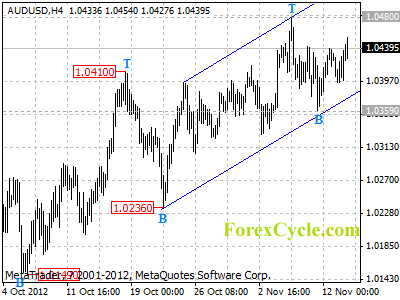
AUDUSD stays in a upward price channel

AUDUSD stays in a upward price channel on 4-hour chart, and remains in uptrend from 1.0236, and the price action from 1.0480 is treated as consolidation of the uptrend. Support is located at the lower line of the price channel, as long as the channel support holds, the uptrend could be expected to resume, and another rise towards 1.0500 is possible after consolidation. On the downside, a clear break below the channel support will suggest that the uptrend from 1.0236 had completed at 1.0480 already, then the following downward movement could bring price back to 1.0200 zone.

audusd

Daily Forex Analysis

Chile hold rates, output and demand better than expected

By Central Bank News
    Chile’s central bank left its policy interest rate steady at 5.0 percent, as expected, saying domestic output and demand was better than forecast while inflation expectations were in line with the target.

    Banco Central de Chile affirmed its commitment to a flexible monetary policy to ensure than inflation is 3 percent – the bank’s target – and any “future changes in the monetary policy rate will depend on the implications of domestic and external macroeconomic conditions on the inflationary outlook.”
    The central bank, which has held rates steady since a 25 basis point cut in January, also said the labor market in Chile remains tight and the rise in consumer prices in October was due to one-time factors.
    “Inflation expectation over the policy horizon are aligned with the target,” the bank said in a statement following a meeting of its board.
    Chile’s inflation rate rose to 2.9 percent in October, the fourth monthly increase in a row.
    Chile’s Gross Domestic Product expanded by 1.7 percent in the second quarter from the first quarter, for an annual rate of 5.5 percent, up from 5.3 percent in first quarter.
    The bank said global financial conditions were “somewhat tighter than they were a month ago,” adding that the dollar had appreciated in international markets.
    It added that uncertainty persisted about the euro zone’s fiscal and financial situation, and the risk of a sharp fiscal adjustment in the U.S., and a resurgence of financial market tensions could not be ruled out.

    www.CentralBankNews.info

Value of outstanding OTC derivatives falls 1% – BIS

By Central Bank News

    The total notional amount of outstanding Over-The-Counter derivatives declined 1.0 percent to $639 trillion at the end of June from the end of 2011, mainly because a rise in the value of the U.S. dollar reduced the value of euro-denominated contracts, the Bank for International Settlements (BIS) said.
    The overall decline was driven by a 2.0 percent drop in interest rate contracts, BIS said, adding that the notional amounts of credit derivatives fell by 6.0 percent.
     In contrast, BIS said the value of outstanding foreign exchange contracts rose by 5.0 percent to $67 trillion.
    Gross credit exposures, which measure the exposure of dealers reporting to the BIS, fell to $3.7 trillion after taking into account netting agreements. Gross market values, which measure the cost of replacing existing contracts, fell by 7 percent to $25 trillion.
     A detailed analysis of the recent trends in the OTC derivatives markets, which will soon be traded on exchanges, will be published in the next BIS Quarterly Review on Dec. 10.


Mozambique cuts rates again as inflation continues to fall

By Central Bank News
    The central bank of Mozambique cut its benchmark interest rates by 100 basis points to 9.50 percent, its sixth rate cut this year, saying inflation continues to drop and is expected to finish the year below the central bank’s 5.6 percent target.
    The Bank of Mozambique (CPMO), which has now slashed its standing lending facility rate by 550 basis points this year, said its Monetary Policy Committee had taken note of the growing global risks and uncertainties, coupled with moderate growth in most developed and emerging economies.
    Nevertheless, the central bank said its board had taken into account that economic growth prospects remained positive.
    “Despite adverse international environment, the CPMO found that the main economic and financial indicators of the country continue to evolve in line with the macroeconomic program established in 2012,” the central bank said in a statement.
    The CPMO said it would also reduce the interest rate on its standing deposit facility (FPD) by 25 basis points to 2.25 percent while the required reserve ratio would remain at 8.0 percent.

    It will also intervene in interbank markets to ensure that the monetary base expands to a maximum balance of 39,136 billion meticais by the end of this month.
    Mozambique’s inflation rate rose slightly to 1.8 percent in October from 1.55 percent in September while the Gross Domestic Product rose by 0.4 percent in the second quarter from the first quarter, for an annual rate of 8.0 percent, up from 6.3 percent in the first quarter.
   
    www.CentralBankNews.info
   

Latvia holds rates steady, sees limited inflation risks

By Central Bank News
    Latvia’s central bank held its key policy rate steady at 2.50 percent as inflation risks remain limited and the Bank of Latvia doesn’t see any mid-term risks to price stability.
    The Bank of Latvia, which cut its refinancing rate in September and July for a total reduction of 100 basis points, said economic growth has been more sustained that expected and there has been a gradual redirection of the economy from external to domestic demand.
    “The Bank of Latvia Council is of the opinion that the current monetary policy conditions match the economic situation,” the bank said in a statement following a meeting of its council.
    Latvia’s economy expanded by 1.70 percent in the third quarter from the second quarter for an annual growth rate of 5.3 percent, up from 5.0 percent in the second quarter.
    The inflation rate eased further to 1.6 percent in October, the lowest rate this year.
   
    www.CentralBankNews.info
   

Soak the Rich!

We’re on the cliff now… the Falaise… the escarpment…

And we’re holding on by our fingernails.

According to the popular press, if we lose our grip, we will surely fall into the red-hot bowels of Hell.

Here’s the latest from Reuters:

Optimists assumed that Congress and President Barack Obama would return after last week’s elections with a plan — perhaps a temporary fix — to avoid the $600 billion in tax increases and budget cuts set to start in January that threaten to throw the economy back into recession.

But they didn’t.

Some also assumed the election would give one party or the other an edge that could break the impasse over how to reduce the nation’s deficit.

It didn’t…

The non-partisan Congressional Budget Office reiterated last week that jumping off the cliff would boost the jobless rate to 9% from the current 7.9%.

The stock market has already registered its disquiet. The Dow lost more than 400 points on the two days following President Obama’s victory. On Friday, prices stopped falling, but there was no bounce. Investors are worried…

The Battle of the Fiscal Cliff

You know our view. It ain’t a cliff; it’s a waterslide. There will be some howls of fear and excitement going down the chute. And then we all get soaked!

President Obama is on the case. According to the weekend news, he’s fired the opening shot in what is supposed to be the “Battle of the Fiscal Cliff.”

He led off with a direct hit on the 1%… the rich. Heck, they can pay more taxes, says the president of all the Americans. From the Economic Times of India:

President Barack Obama said Friday that he would insist that tax increases on affluent Americans be part of any agreement to avoid a year-end fiscal crisis, setting up a possible confrontation with congressional Republicans who say they will oppose a rise in tax rates for the rich.

In his first remarks from the White House since his re-election, Obama made it clear that he believed his victory had validated his relentless campaign call for wealthier Americans to pay more, and he expected Republicans to heed that message.

We have no argument against him. Sure, the rich can pay more tax. But according to the National Taxpayers Union (the organization we used to run back in the 1970s), the top 1% of taxpayers already pays 36% of all federal taxes.

In other words, the rich pay 36 times more, proportionately, than they should.

Do they get greater benefits out of the SEC, the FDA, the CIA and the rest of the feds’ scammy agencies? Do they get more security from the feds’ drones? Do they get more food stamps? Or more unemployment comp? Or more Medicaid? No? Then why should they pay more?

Never mind. The top 1% of taxpayers pays an average tax of $343,927. Seems like more than enough for anybody.

Capital Lost

But forget fairness. Just look at what happens when they pay more.

Presumably, these are people who have already satisfied their lifestyle ambitions. They don’t need to buy a bigger car or a bigger house — they already have these things. They don’t need the money for consumption purposes.

So if the feds didn’t take that $343,927, what would happen to it? It would, of course, be invested. It’s capital, in other words. It is the stuff that you need if you’re going to build a new factory… or a new app… or whatever.

Sometimes the wealthy make good investment decisions. Sometimes they make bad decisions. Still, this capital — the savings of people who can afford to save — is what funds new jobs, new technology and new industries. It’s what powers an economy toward real growth, with higher wages… and greater prosperity.

If the feds take away that capital, what happens to it? It is consumed. It pays for more drones. Or maybe to give more drugs to old people. Or maybe it is used to hire more regulators and administrators who further gum up the economy.

It would be better — in terms of final results, at least — to let the economy go over the cliff. At least spending would be going in the right direction: down.

But wait. Is that true?

Nope. Even going over the cliff still leaves the feds spending more money… just not as much as they planned to spend. It still leaves the U.S. with an additional $8.3 trillion in deficits over the next 10 years. Some cliff!

As it is, Congress stands on the edge. Politicians are battling with each other. One group wants to tax the rich. The other wants to cut spending.

They’re fighting it out on the edge of the precipice… each side trying to force the other to pay… each trying to protect its own zombie clients and zombie voters

What the hell. Give them all a shove!

Disclaimer

Article brought to you by Inside Investing Daily. Republish without charge. Required: Author attribution, links back to original content or www.insideinvestingdaily.com. Any investment contains risk. Please see our disclaimer.


Euro Spikes from 2-Month Low Following Greek Bailout Story, Gold Deposits “Getting Harder to Find” says Barrick

London Gold Market Report
from Ben Traynor
BullionVault
Tuesday 13 November 2012, 07:30 EST

PRICE FOR gold bullion on the wholesale market rose to $1730 an ounce this morning in London, after drifting lower overnight, as the Euro jumped half-a-cent against the Dollar following a report that the German government is considering a plan to speed up the payment of bailout money to Greece.

“There had been a decoupling in the relationship between gold and the Dollar in terms of the daily trading range, and now we are seeing a readjustment,” says LGT Capital Management analyst Bayram Dincer.

German tabloid Bild reports that the German government is proposing to bundle the next three tranches of Greece’s bailout into one payment of around €44 billion, citing government sources. Greece has to meet a €5 billion debt repayment this week.

Earlier in the day, stock markets and the Euro fell to two-month lows after a public disagreement between policymakers over Greece and news that Greece’s next bailout tranche, worth €31.3 billion, will be delayed for another week.

Greece’s deadline reducing its debt-to-GDP ratio to 120% will be extended from 2020 to 2022, Jean-Claude Juncker, chairman of the Eurogroup of single currency finance ministers, told reporters.

“In our view, the appropriate timetable is 120% by 2020,” countered International Monetary Fund chief Christine Lagarde.

“We clearly have different views [on whether to give Greece more time],” she added.

Lagarde “appeared exasperated” with Juncker at the press conference, the Financial Times reports.

The FT adds that the IMF has for months argued that there should be a further write down of Greek debt, in addition to the restructuring deal back in February that saw losses imposed on private sector creditors.

In order for Greece to reduce its debt to 120% by 2020, “a much more drastic debt stock reduction (possibly north of €80 billion in total) will be required,” says Goldman Sachs senior economist Themistoklis Fiotakis.

“This seems politically infeasible at present. We think a more likely outcome will involve some debt relief, continued official sector funding…and a continued uncertain Greek debt profile [which will] hold back a Greek recovery relative to a more decisive write-off.”

Silver bullion meantime climbed to $32.67 an ounce, in line with where it started the week, while other industrial commodities ticked lower and US Treasury bond prices gained.

“The fiscal cliff is being priced in because it’s the biggest risk facing the market right now,” says Priya Misra, head of US rates strategy at Bank of America Merrill Lynch in New York, referring to the combination of tax rises and spending cuts due at the start of next year unless US lawmakers agree a deal to avoid them.

Here in the UK, inflation rose to its highest level since May last month at 2.7%, official consumer price index data published Tuesday show.

“The largest upward pressure came from university tuition fees, followed by food and housing,” the Office for National Statistics said.

Fees paid by undergraduates have almost trebled in the last year, after the government raised the cap on what universities can charge from £3375 to £9000.

“Where do we go from here?” Scotiabank economist asks Alan Clarke.

Onwards and upwards. Utility bill increases are on their way. We’ve also got the effect of the US drought and increased food prices to factor in…I don’t think we’re going to get anything like the 2% [Bank of England] inflation target.”

Inflation has been above the Bank’s 2% target in every month since November 2009.

“Growth for 2013 is likely to be revised down,” adds Chris Williamson, economist at financial information firm Markit.

“The higher cost of living caused by the rise in inflation will hit consumer spending [while]worries about the impact of austerity and wider concerns about the Eurozone and US fiscal woes look set to ensure that domestic demand, investment and exports all remain subdued.”

Over in India, traditionally the world’s biggest gold buying nation, rural gold sales during today’s Diwali festival were hit by this year’s poor monsoon, the Economic Times of India reports.

“Despite the weddings and traditional gold dowries that are of high importance during this period, demand once again stalled,” adds a report from refiner Heraeus.

Retail gold bullion demand during Sunday’s Dhanteras festival was however up 8.3% on last year, according to the Bombay Bullion Association.

The Rupee is down 11% against the Dollar from its level during last year’s Diwali.

Gold mining firms are discovering gold at a decreasing rate despite spending a record $8 billion on exploration last year, according to Jamie Sokalsky, chief executive of world’s largest gold producer Barrick Gold.

“It’s getting harder to find large deposits and to get those deposits into production takes at least twice as long as it might have taken a decade ago,” Sokalsky told Bloomberg.

Ben Traynor
BullionVault

Gold value calculator   |   Buy gold online at live prices

Editor of Gold News, the analysis and investment research site from world-leading gold ownership service BullionVault, Ben Traynor was formerly editor of the Fleet Street Letter, the UK’s longest-running investment letter. A Cambridge economics graduate, he is a professional writer and editor with a specialist interest in monetary economics. Ben writes and presents BullionVault’s weekly gold market summary on YouTube and can be found on Google+

(c) BullionVault 2012

Please Note: This article is to inform your thinking, not lead it. Only you can decide the best place for your money, and any decision you make will put your money at risk. Information or data included here may have already been overtaken by events – and must be verified elsewhere – should you choose to act on it.