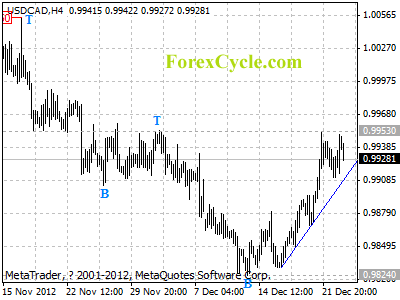
USDCAD stays above a upward trend line

USDCAD stays above a upward trend line on 4-hour chart, and remains in uptrend from 0.9824. Support is at the uptrend line, as long as the trend line support holds, the fall from 0.9953 is treated as consolidation of the uptrend, and another rise to 0.9970 is still possible. On the downside, the rise from 0.9824 would possibly be correction of the the longer term downtrend from 1.0055, a clear break below the trend line could signal resumption of the downtrend, then another fall towards 0.9700 could be seen.

usdcad

Forex Signals

Kris Sayce: Uncensored

By MoneyMorning.com.au

Dear Reader,

It’s not very often Money Morning editor Kris Sayce has time for a chat. Luckily for us, he kindly agreed to sit down and reflect on the year that’s been and the one that’s coming.

If you’ve read Money Morning for a while, you’ll know Kris doesn’t hold back.

So if you’d like to hear what your editor has to say about the state of play in the Aussie market, exciting opportunities in 2013 and even a few words for some old foes – take a look below…

Callum Newman: For new Money Morning readers: Why are you so critical of central banking?

Kris Sayce: I’ve made my case about this in Money Morning over the past four years. It’s quite simple: central banks are arch-market manipulators.

The board members of the Reserve Bank of Australia have the crazy idea that they can fine-tune an economy. They believe all they need to do is raise rates or cut rates and they can influence how people and the economy behave.

The fact is they can’t.

No one can micro-manage an economy to influence the actions of 20 million people. The Soviets tried to do it and failed. And right now the North Koreans, Cubans, Venezuelans and Chinese are trying to micro-manage their economies.

Given time, they’ll all fail too.

That’s right, even China. That’s despite comments from GE CEO, Jeffrey Immelt, who like many so-called capitalists, believes China is the model economy.

He told Bloomberg, ‘The one thing that actually works, state run communism […] may not be your cup of tea, but their government works.’

But if you read history, you’ll know that during the 1930s, many in the West thought the Russians were on to something with their economic planning. The US and other nations even sent delegations to learn from the Russians.

They reported back about the remarkable progress in the Soviet Union…without mentioning the Stalinist purges.

It took several decades, but eventually the Soviet Union collapsed. What does this have to do with central banks?

The actions of central banks are no different to the Soviet Union. It’s all about a small group of central planners believing they can pull levers and push buttons to steer an economy in their chosen direction.

In short, every time you hear the word ‘central banks’, just replace it with ‘central planning communists’. Don’t let their pin-striped suits fool you into thinking they’re capitalists.

They’re about as capitalist as I am the Pope!

Callum Newman: Gold has gone mostly gone sideways this year. What are your thoughts on gold in 2013?

Kris Sayce: Look, I’m not a gold expert. I can’t tell you why gold does or doesn’t go up on any given day. But what I do know is this: there’s a lot of manipulation going on with the gold and silver price. Again, it comes back to central planning communists (central banks).

Let me put it this way. The battle between central banks and gold is like a boxing match. They’re in opposing corners. Central banks can’t allow the gold price to rise too high because they know that the gold price reflects the devaluation of paper currencies.

The central banks were happy for gold to rise when the stock market went up during the 2000s. After keeping the price down for years, they happily released the spigot. Why? Because when stocks soared few people cared about gold.

But since 2008 more and more people have become aware of the destruction caused by the central planning communists.

The game is up.

The gold price has gone up, but now rather than allowing it to go higher, the central banks are determined to keep a lid on the price for fear that even more people will grasp how central planning communists are destroying wealth through inflation.

Eventually they’ll have no choice but to loosen the spigot again. I don’t know if that will happen next year, the year after or later. But I know it will happen, and that’s why I continue to add to my gold position, and suggest other people do too.

Callum Newman: What do you expect from the Aussie dollar next year? Why?

Kris Sayce: Many investors now view the Aussie dollar as a ‘reserve’ currency. Due to the government’s relatively low debt levels and the size of Australia’s resources base, it’s considered a safe option.

But stop and think about it. As I wrote in Money Morning a couple of weeks ago, Aussie debt is now up to $259 billion, and the government is running a budget deficit. Add to that the issues surrounding the slowing Chinese economy.

In short, the Aussie dollar will only be strong for as long as investors believe the government won’t go further into debt…and that the Chinese economy won’t collapse.

But right now I see many analysts making the same mistakes about the Australian government finances and the nation’s natural resources, as they made about Aussie resources stocks and natural resources five years ago.

Leading up to 2008 many people thought that mining stocks wouldn’t fall because those stocks had millions and billions of dollars-worth of resources in the ground. But what they didn’t realise is that a resource in the ground isn’t the same as a resource above ground.

Digging stuff out of the ground is expensive. And unfortunately, most mining firms don’t have cash at the ready. A small mining company could have a huge resource in the ground, but if they can’t afford to dig it up, it’s almost worthless to them.

In 2008 those mining stocks needed to raise a lot of cash in order to recover the resources. But when credit markets froze, it didn’t matter how much was in the ground; share prices fell through the floor.

The Australian government faces the same problem.

If China continues to prop up its economy and Aussie government debt remains low by international comparison, then the Aussie will stay high.

But when things go wrong, don’t be surprised to see the Aussie head south…and fast.

Callum Newman: Are you still bearish on Aussie property?

Kris Sayce: Yes. Next question!

Only kidding. To be honest, I’ve stopped paying much attention to Aussie property prices. I proved that the property spruikers were wrong when they said house prices couldn’t fall.

I also proved that house prices don’t double every seven years.

And to various degrees the price slump is progressing as expected. In Queensland and Western Australia it has been a rapid slump. Elsewhere (especially in Melbourne) it’s a slow death.

In the Northern Territory however, reports suggest that prices have taken off on the back of the resources rebound. But before the spruikers get too excited I’ll make one point.

Buying an investment property in the Northern Territory is like buying a small-cap stock. The price can take off quickly, but it can collapse just as quickly.

When you’re punting just a few thousand dollars in small-caps, that’s fine. You can cope with that volatility, and it’s easy to sell if things go wrong.

But property investors don’t have that luxury. The Northern Territory is a limited market, and the resources influence is just a flash in the pan. If you can get in and get out quickly then you may do OK.

But if you borrowed $500,000 to buy an investment property in the middle of nowhere, try getting out of that with less than a six-figure loss when NT house prices collapse.

In short, housing is still a bad investment. If you want to buy a house to live in, or a holiday home, go for it. But in both cases don’t assume you’ll make a profit. Housing is going back to what it has been for most of history, and that is an expensive consumption item.

Invest in housing at your peril.

Callum Newman: Did 2012 pan out as you expected?

Kris Sayce: In short, no. I didn’t foresee the size of the slump in risky assets. I expected something to happen. I expected a volatile market (as you’d know if you came to the Daily Reckoning Doomers’ Ball last year) but not this.

Fortunately, thanks to the asset allocation strategy I recommended at the end of last year, investors who spread their savings across cash, precious metals, and dividend paying stocks will have done fine.

But investors who kept their money in growth assets most probably haven’t done as well.

The market has been super-volatile all year and I’ll bet that most investors haven’t benefited from the marginal rise in stock prices. Many would have sold their stocks as share prices slumped during the year.

On the flip side, I’m banking on growth assets (especially small-cap stocks) to rebound in 2013.

Callum Newman: What was your investment strategy this year?

Kris Sayce: This year I used the same idea I’ll use again in 2013 – buying beaten-down stocks. I’ve done this in Australian Small-Cap Investigator, and of course I recommended five beaten-down blue-chip stocks in Money Morning: Harvey Norman, Qantas, JB Hi-Fi, Toll Holdings and Myer.

So far this strategy has worked well. And with the sheer number of stocks that have fallen this year there are still plenty of beaten-down stocks.

A classic example of how far stocks have been beaten-down are the two stocks I tipped in the November issue of Australian Small-Cap Investigator.

In terms of the size of their brand in the Aussie market, these stocks are blue-chip. But if you look at the share price and market cap, they fit right in with most of the high-risk small-cap stocks I look at.

It’s not unusual to see once great companies fall off the perch. Times change and sometimes it’s hard for companies to keep up.

The fall of Eastman Kodak in the US is just one example. It had a proud history and went from being one of the world’s biggest camera and film companies, to a company that quickly went bust.

Of course there’s no guarantee that won’t happen with the beaten-down stocks I’ve tipped this year. But with the stocks trading at bargain prices, almost all the downside risk is already priced into the stocks.

In fact, there’s so much bad news built in, I believe these ‘blue-chip’ stocks could pack in nearly a 200% gain next year.

Callum Newman: Explain your strategy for investing in 2013?

Kris Sayce: As I mentioned before, my 2013 strategy will be similar to this year’s strategy.

Let me show you a chart:

The blue line is the Aussie financial stocks index. Since the middle of this year, prices have taken off…they’re up about 20%.

Compare that to the performance of small-cap stocks. Since March, small-caps have dropped about 30%. And this doesn’t even take into account all the beaten-down blue-chip and mid-cap stocks.

So when I see a chart that has fallen that much it makes me more convinced that there are great opportunities in small-cap stocks.

But exactly where will I look for those opportunities? I still believe the technology and online media sectors will be the best performers next year.

I’ve already tipped seven stocks in this category and will look for other stocks to add to the buy list.

The key driver for this sector in the short-term is the National Broadband Network (NBN). Whether you agree with the NBN or not, it will have a huge impact on how consumers and businesses interact with each other.

That’s why I’ve backed internet and technology stocks since 2011, and it’s why I’ll continue to back them next year.

Callum Newman: If it’s true that the mining boom is over, which – if any – resource stocks are still worth investing in?

Kris Sayce: I leave the in-depth fundamental analysis on resource stocks to my old pal, Dr Alex Cowie. When I look at resource stocks I’m always thinking about getting the biggest bang for my buck.

That usually means buying a resource stock that’s out of favour or not even on the map of most investors.

I’ve done this before with rare earths stocks in 2008 and again in 2010. I did the same with natural gas stocks through 2009.

Over the past two years I’ve backed energy stocks again. And since 2011 I’ve jumped on the technology bandwagon.

But next year I’ll look at resource stocks too.

The areas I’ll look at are those stocks that have taken the biggest beating this year. Commodities such as iron ore, copper and uranium are at the front of my thoughts right now.

Callum Newman: Thanks for your time, Kris.

Kris Sayce: My pleasure.

Publisher’s note: Editor Kris Sayce has delved into the history books to discover how a ‘Big Money Secret’ made one ordinary Aussie bloke richer than Kerry Packer, Andrew Forrest and Gina Rinehart combined. Not once…but TWICE. Now the force behind one of the world’s largest family fortunes could make 2013 a prosperous year for you. To hear more about Kris’s big money discovery, go here.

Market Trends 26.12.12

Source: ForexYard

printprofile

Hey Everyone,

Below are some market trends for today.

Good luck!

-Dan

Gold- May see upward movement today
Support- 1645.68
Resistance- 1667.91

Silver- May see upward movement today
Support- 29.70
Resistance- 31.15

Crude Oil- May see downward movement today
Support- 88.42
Resistance-89.88

Dax 30- May see upward movement today
Support- 7584.30
Resistance- 7700.00

EUR/USD May see downward movement today
Support- 1.3164
Resistance- 1. 3299

Read more forex news on our forex blog

Forex Market Analysis provided by ForexYard.

© 2006 by FxYard Ltd

Disclaimer: Trading Foreign Exchange carries a high level of risk and may not be suitable for all investors. There is a possibility that you could sustain a loss of all of your investment and therefore you should not invest money that you cannot afford to lose. You should be aware of all the risks associated with Foreign Exchange trading.

Market Review 26.12.12

Source: ForexYard

printprofile

The Japanese yen fell to its lowest level against the US dollar since April of 2011 during Asian trading, as the new Japanese government assumed power. The yen has weakened significantly in recent weeks due to speculations that the Japanese Prime Minister will advocate for intense monetary easing.

Most other currency pairs and commodities saw little movement during overnight trading, as the majority of international markets remain closed for the Christmas holiday. The EUR/USD gained some 20 pips and is currently trading at 1.3197, while gold prices advanced slightly less than $6 an ounce.

Main News for Today

With no significant economic indicators scheduled to be released today, traders will want to pay attention to developments in the US “fiscal cliff” negotiations. Any indication that a deal is closer to being reached may result in risk taking in the marketplace, which could boost the euro, AUD and crude oil.

Read more forex news on our forex blog

Forex Market Analysis provided by ForexYard.

© 2006 by FxYard Ltd

Disclaimer: Trading Foreign Exchange carries a high level of risk and may not be suitable for all investors. There is a possibility that you could sustain a loss of all of your investment and therefore you should not invest money that you cannot afford to lose. You should be aware of all the risks associated with Foreign Exchange trading.

Botswana holds rate, sees inflation moving to target

By www.CentralBankNews.info     Botswana’s central bank kept its Bank Rate steady at 9.5 percent, saying economic output will remain below potential in the medium while inflation is expected to move toward the bank’s target in the second half of 2013 but remain above target in the short run due to temporary factors.
    Based on its economic assumptions, the Bank of Botswana said that keeping its rates on hold would be consistent with inflation meeting the bank’s 3-6 percent target range. The bank has held rates steady since December 2010.
    Inflation in Botswana rose to 7.4 percent in November from 7.1 percent in October, mainly due to higher administered prices, but weak domestic demand and modest external inflationary pressures contribute to a positive inflation outlook, the bank said.

    However, the underlying trend remains downwards and, in the circumstances, inflation is expected to converge to the medium-term objective range in the second half of 2013,” the bank said in a statement after a meeting of its Monetary Policy Committee on Dec. 24.
    Botswana’s Gross Domestic Product rose by 8.7 percent to the year ended in June with non-mining output up by 12.1 percent but mining output was down by 8 percent. But non-mining GDP is expected to remain below potential in the medium term and therefore be non-inflationary, the bank said.

    www.CentralBankNews.info     

Central Bank News Link List – Dec. 26, 2012: Aso named Japan’s next finance chief as Abe primes fiscal pumps

By www.CentralBankNews.info Here’s today’s Central Bank News link list, click through if you missed the previous link list. The list comprises news about central banks that is not covered by Central Bank News. The list is updated during the day with the latest developments so readers don’t miss any important news

How to Use Entry Orders in Forex

Source: ForexYard

printprofile

For most traders, getting into the market is a process that requires seeing an opportunity to enter, or reading about breaking news and jumping on it. This requires opening a position at that time and being physically in front of their computer or on their mobile. What if there was a way to get into the market when you’re away from your trading station?

What if your technical analysis shows the EUR/USD will fall once the pair reaches a specific price level? The ForexYard trading platform has the tools to get you into the market; however, many traders are reluctant to use these options at their disposal.

By using the tools below, a trader can enter the market when a certain price is reached without having to be at their computer to do so.

An Entry Limit Order is used when a trader would like to enter the market at a price below the current market price for a Buy, or above the market price for a Sell order.

In other words, an Entry Limit Order is used when a trader believes the price will reverse its direction once a certain price level is reached.

For example, if a trader believes the EUR/USD is overvalued at the price of 1.5000, and the current market price is 1.4950, he can place an Entry Limit Sell order. When the price hits the 1.5000 mark, his order will be executed.

An Entry Stop Order is used when a trader would like to enter the market at a price above the current market price for a Buy or below the current market price for a Sell.

In other words, an Entry Stop Order is used when a trader believes the price will continue moving in the same direction once a specific price is reached.

For example, if the price of gold is trading at $975 and a trader believes that if gold crosses the psychological price level of $1000, the price will continue to rise. The trade to make is an Entry Stop Buy at, or slightly above $1000.

These tools can be used for a number of reasons; whether you’re away from your trading station because you’re at work, or sleeping, you can always open a position. If through your technical analysis, you believe a currency pair is going to break out when it arrives at a specific price, place an entry order to get into the market!

Forex Market Analysis provided by ForexYard.

© 2006 by FxYard Ltd

Disclaimer: Trading Foreign Exchange carries a high level of risk and may not be suitable for all investors. There is a possibility that you could sustain a loss of all of your investment and therefore you should not invest money that you cannot afford to lose. You should be aware of all the risks associated with Foreign Exchange trading.

“Fiscal Cliff” News Set to Drive Markets Today

Source: ForexYard

Despite low liquidity in the marketplace due to the Christmas holiday and a lack of economic indicators, the US dollar started off the week on a bullish note. Fears regarding the prospect of the US going over the “fiscal cliff” of spending cuts and tax increases at the beginning of the year were the main reason behind the safe-haven greenback’s upward momentum. Today, another slow news day means that traders will want to once again pay attention to any developments in the ongoing budget negotiations between President Obama and Congressional leaders.

Economic News

USD – US Budget Crisis may Impact Dollar Today

The safe-haven US dollar saw additional gains to start off the week, as concerns that the US could sink back into another recession if ongoing budget negotiations are not resolved led to risk aversion in the marketplace. The USD/CHF gained close to 40 pips during European trading on Monday, eventually reaching as high as 0.9163. The pair was last trading at 0.9153 when markets closed for Christmas. Against the JPY, the dollar gained more than 50 pips on Monday to reach a new 20-month high at 84.85.

Turning to today, another slow news day is expected, as most international markets remain closed. Still, the markets could see volatility as US lawmakers rush to reach a budget deal before a batch of automatic tax increases and spending cuts, known as the “fiscal cliff”, go into effect and threaten another recession. Any positive developments in the negotiations today will likely lead to risk taking among investors, which would likely lead to the dollar erasing some of its recent gains.

EUR – Progress in US Budget Talks Could Drive Euro Higher

The euro saw a mixed trading session to start off the week on Monday, as the ongoing deadlock in budget negotiations between US lawmakers led to risk aversion in the marketplace. The EUR/USD fell some 45 pips during afternoon trading to reach as low as 1.3173. By the time markets closed for Christmas, the pair was trading at 1.3189. The common currency had better luck against the Japanese yen, as speculations that the Bank of Japan will soon ease monetary policy further weighed down on the JPY. The EUR/JPY gained 75 pips during European trading, eventually reaching as high as 111.99.

Today, with several European markets still closed for the Christmas holiday, the euro is not forecasted to see significant volatility unless there is any news or announcements regarding the US “fiscal cliff” negotiations. Signs that the budget crisis is closer to being resolved are likely to lead to risk taking in the marketplace, which could boost the euro. At the same time, a lack of developments today may lead to additional risk aversion, which would send the euro lower against the USD.

Gold – Gold Prices Steady in Thin Trading

The price of gold took minor losses during trading on Monday, but a lack of significant news limited the precious metal’s bearish trend. By the time markets closed for Christmas, gold was trading at $1658.85 an ounce, down slightly more than $6 from the beginning of European trading.

Today, traders will want to note that the lack of significant economic indicators will make gold vulnerable to seemingly random price shifts. Any mention of the US “fiscal cliff” or the ongoing budget negotiations between US lawmakers may generate volatility in the price of gold.

Crude Oil – Crude Oil Prices Flat to Start Week

The price of crude oil saw very little movement ahead of the Christmas holiday on Monday due to the lack of developments in US “fiscal cliff” negotiations and international economic indicators. The commodity ended Monday’s session at $88.60 a barrel, down $0.30 for the day.

Today, crude oil prices are likely to see volatility if there are any announcements or developments in the US “fiscal cliff” negotiations. Signs of progress in the negotiations are likely to lead to risk taking among investors, which may boost oil as a result.

Technical News

EUR/USD

The Williams Percent Range on the weekly chart has crossed over into overbought territory, signaling that a downward correction could occur in the near future. This theory is supported by the MACD/OsMA on the daily chart, which appears close to forming a bearish cross. Opening short positions may be best choice for this pair.

GBP/USD

While a bearish cross has formed on the daily chart’s MACD/OsMA, most other long-term technical indicators place this pair in neutral territory. Traders may want to take a wait and see approach, as a clearer picture is likely to present itself in the near future.

USD/JPY

The weekly chart’s Relative Strength Index has crossed over into overbought territory, indicating that a downward correction could occur in the coming days. Furthermore, the Slow Stochastic on the same chart has formed a bearish cross. Going short may be the best choice for this pair.

USD/CHF

The Bollinger Bands on the weekly chart are beginning to narrow, signaling that a price shift could occur in the near future. Additionally, the Williams Percent Range on the same chart has dropped into oversold territory, indicating that the price shift could be upward. Opening long positions may be the best choice for this pair.

The Wild Card

NZD/USD

The Williams Percent Range on the daily chart has fallen into oversold territory, indicating that an upward correction could occur in the near future. Additionally, the Slow Stochastic is close to forming a bullish cross. This may be a good time for forex traders to open long positions for this pair.

Forex Market Analysis provided by ForexYard.

© 2006 by FxYard Ltd

Disclaimer: Trading Foreign Exchange carries a high level of risk and may not be suitable for all investors. There is a possibility that you could sustain a loss of all of your investment and therefore you should not invest money that you cannot afford to lose. You should be aware of all the risks associated with Foreign Exchange trading.


USD/CHF: A Fiscal Disaster Bears on the Greenback-Swissie

A sideways trend persists for the US dollar-Swiss franc currency pair. So are the anxieties over the looming fiscal cliff, which could turn into a fiscal disaster for the world’s largest economy if a budget deal cannot be agreed upon before the dreaded deadline. But with US lawmakers seemingly unable to come into an agreement, market participants are turning jittery, which could lead to selloffs of the Greenback and purchases of the Swissie.

Most markets are trading on thin volume today, which is not a big surprise during the holidays. But with less than a week left before the United States goes over the fiscal cliff, investors are seen limiting their risk exposure and are likely to bank on safer assets.

Anxieties over what is believed to be a failed grand bargain affect the demand for the riskier single currency. US lawmakers remain deadlocked on a deal to avert the so-called fiscal cliff, a week before the dreaded deadline. It has been reported that President Barack Obama plans to leave his Hawaii vacation December 26 and return to Washington on December 27, the same day that Congress returns to continue negotiations on averting the fiscal cliff.

Though there is still a chance for a deal, it grows more unlikely by the day, and there are not many days left, says Ron Bonjean, a Republican strategist who formerly served as a spokesman for House Speaker Dennis Hastert and Senate Majority Leader Trent Lott.

A report by Cotten Timberlake of Bloomberg states that Americans have become warier as Washington approaches the end of the year without an agreement to forestall higher taxes and automatic spending cuts. Last month, retailers from Macy’s Inc. to Target Corp. posted same-store sales that trailed analysts’ estimates. Consumer confidence fell in December to a five-month low, according to a December 21 report. The Thomson Reuters/University of Michigan consumer sentiment index slid to 72.9, the weakest since July, from 82.7 in November.

In another sign that consumers are pulling back, US online sales increased 8.4 percent this holiday season, compared with last year’s almost 16 percent gain, MasterCard Advisors SpendingPulse said.

As fiscal cliff apprehensions bear on the trades today, and as consumers are seen pulling back, a short position is suggested for the USDCHF today. Technical price corrections are still likely, however.

For more news, analysis, technical charts and candlestick analysis, visit AlgosysFx Forex Trading Solutions.

Obama and Alternative Energy: the Paradox

Source: ForexYard

printprofile

One of Barack Obama’s primary initiatives during his first week in office has been focused on generating the incentives necessary to help proliferate the usage of renewable energy. Mixed with this environmental push is also legislation designed to entice auto makers to begin researching and producing more fuel-efficient cars as well as providing incentives to make them more affordable in the U.S. market.

The drastically rising Crude Oil prices of 2008, analysts believe, may have been one of the driving forces behind this recent financial crisis and recession. As the price of Crude Oil spikes upward, as it did last year, the cost of gasoline also obviously increases, which affects the disposable income of consumers. “Our leaders raise their voices each time there is a spike in gas prices,” President Obama said, “only to grow quiet when the price falls at the pump.”

By addressing this issue so directly, President Obama has pin-pointed the paradox of our push for renewable energy and fuel-efficiency. When the price of Crude Oil rises, the voice of the people echoes defiantly that the government is not doing enough to protect the people or the environment; yet when the prices come back down, the roar silences and the push for renewable energy stops. As such, the most desirable outcome would be to find a price level for Crude Oil which will maintain the environmental initiatives while protecting the wallets of consumers by helping them save at the gas pumps.

It is the belief of the ForexYard analyst team that the $30-35 price range for Crude Oil is just such a desirable level. Oil producing countries which benefited greatly from last year’s price increases began developing infrastructure projects which may now be difficult to maintain. As such, oil producers are looking to curb production and increase prices. On the other side of that equation are governments who are looking for ways to decrease dependency on oil. The race between these two forces, along with an economy badly damaged by recession, may likely go in favor of oil consumers. The downward pressure on the price of Crude Oil is evident. If you were looking for a safe investment as a forex trader, Crude Oil is where you need to be looking. An early sell position on Crude Oil at the current price of $45 a barrel carries with it the potential to earn enormous profits for the wise trader.

You can start trading Crude Oil now with ForexYard’s trading platform. Simply open one of our Standard Accounts, put forth the amount you’d like to invest, and start seeing your profits shoot through the roof!

Forex Market Analysis provided by ForexYard.

© 2006 by FxYard Ltd

Disclaimer: Trading Foreign Exchange carries a high level of risk and may not be suitable for all investors. There is a possibility that you could sustain a loss of all of your investment and therefore you should not invest money that you cannot afford to lose. You should be aware of all the risks associated with Foreign Exchange trading.