The U.S. Dollar Has Finally Corrected. Will the Correction Continue?

The U.S. Dollar Has Finally Corrected. Will the Correction Continue?

EURUSD

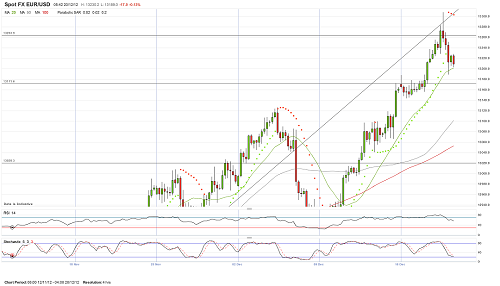
Yesterday, bulls in the EUR/USD continued to amaze by its tenacity and optimism, pushing the pair higher and higher. The single currency did not even try to test the broken-through resistance near 1.3170 and finding its support at 1.3229 its growth was resumed. The pair immediately passed the resistance at 1.3255 and continued to increase until it reached the level of 1.3308. There, market participants decided to take profits, having led the pair decrease to 1.3236, but during the Asian session on Thursday, the pair dropped to 1.3189. There, the pair rolled back from the level of 1.3228, which acted as the resistance again. Consequently, the pair left the overbought state on the 4-hour chart, due to its correction to 1.3189, and it is wise to assume that its growth will be resumed towards the current high, because yesterday’s drop is corrective and while quotes are holding above the broken-through level of 1.3170, the euro prospects remain constructive. In anticipation of the holidays and in the absence of news, the pair could well remain in the range of 1.3170 — 1.3308. In case of the loss of the support near 1.3170, the euro will drop to the level of 1.3126, which can be considered as the key one for the bulls in the pair. By and large, the EUR/USD could well be corrected to this level too.
eurusd20.12.2012

GBPUSD

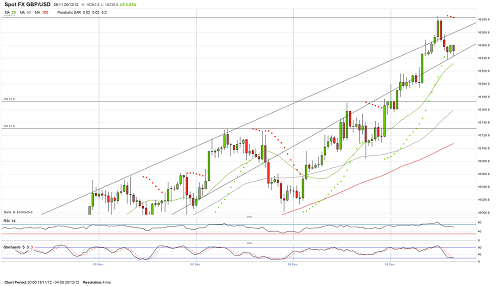
The GBP/USD pair also demonstrated a positive mood. The pound continued increasing to the level of 1.6262 and reached the 1.6306 resistance without any pullbacks, rising above the upper line of the ascending tunnel. Both on the 4-hr and daily charts, the RSI was in the overbought zone, the pair hit the highs of September, from which it dropped to 1.5828, thus profit-taking was surprisings. As a result, the GBP/USD ended the day with its drop to 1.6238, having returned to the bottom line of the ascending tunnel. There, on the 4-hr chart, the RSI left the overbought zone, thus if the pound can consolidate at the current support, it will be wise not to exclude another attempt to increase to the 63rd figure. The loss of 1.6238 would decrease the rate to the 1.6180/70 proximity, which can be considered as the key one for the British pound bulls.
gbpusd20.12.2012

USDCHF

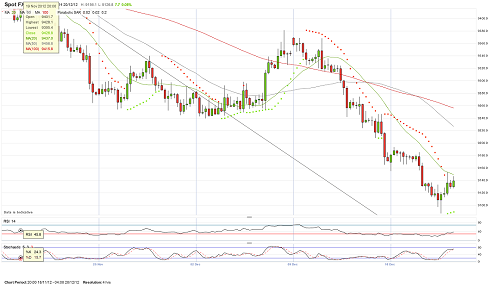
Yesterday, bears in the USD/CHF pair completed their minimum program. They brought the dollar to 0.9088, due to their sales from 0.9133. When this level was reached, the pair was undergone an upward correction, which allowed the dollar to recover to 0.9153. There, on the 4-hr chart, the RSI out of the oversold zone that promotes re-testing of the 91st figure. Nevertheless, the upward correction could well last up to the 0.9200 — 0.9240 proximity. Its rise above the latter resistance, would weaken the bearish pressure in the pair. In the absence of fresh incentives, breakdown of the current highs seems unlikely.
usdchf20.12.2012

USDJPY

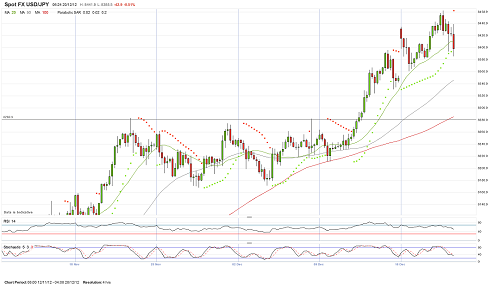
The dollar continued to push the Japanese yen higher. After reaching the level of 84.61, there’s something happened to the bulls that did not allow the dollar to increase higher. Having felt the bulls’ weakness, bears decided to take advantage of the situation and made the pair’s rate decrease to 83.86. Even the fact that the Bank of Japan expanded its Asset Purchase Program did not encourage the bulls to increase above 84.40. Despite the increased chance of the dollar’s decrease towards 83.20 — 81.80, it is premature to talk about changes in the speculators’ attitude towards the Japanese currency. Nevertheless, the probability of the USD/JPY pair’s growth above the 84.40/60 proximity looks pretty low.
usdjpy20.12.2012


Provided by IAFT


Israel trims rate 25 bps, cuts growth, inflation forecasts

By www.CentralBankNews.info     Israel’s central bank cut its policy rate by 25 basis points to 1.75 percent, a move expected by some economists, saying inflation is continuing to decline and economic growth was still weakening.
    The Bank of Israel (BOI), which has cut by 100 basis points this year, also cut its growth forecast for 2013 to 2.8 percent from a previous 3 percent, excluding the projected impact of the start of natural gas production from a new field in the second quarter.
    Including the output from that field, the 2013 growth forecast is for 3.8 percent, up from forecast 2012 growth of 3.3 percent, but down from 2011’s 4.6 percent.
    Israel’s Gross Domestic Product in the fourth quarter is expected to decline from the third quarter due a slowdown in exports related to global economic weakness, the bank said.
     Israel’s economy grew by 0.7 percent in the third quarter for annual growth of 3.12 percent, slightly down from 3.24 percent in the second quarter.

    “In addition, the shekel’s recent strength may make it more difficult for the economy to deal with the challenges it faces,” the BOI said, adding the level of global economic risks remain high and there is still uncertainty regarding the U.S. fiscal situation and Europe’s debt crises.

    Israel’s inflation rate fell by a monthly 0.5 percent in November to an annual rate of 1.4 percent, down from 1.8 percent, the third consecutive month in which inflation has surprised on the downside.
     The BOI said forecasts for inflation over the next 12 months have also declined to around 1.8 percent and average expectations for the central bank’s interest rate one year from now are for 1.8 percent.
    The BOI’s own staff now expects 2013 inflation of 1.8 percent, down from its previous forecast of 2.2 percent. The bank targets inflation of 1-3 percent.
    Through Dec. 21 from Nov. 25, the shekel has strengthened some 3 percent agains the U.S. dollar and 1.5 percent against the euro due to renewed purchases by nonresidents, the bank said.
    Home prices rose by 0.5 percent in September-October for an annual rise of 3.7 percent, up from 2.3 percent, but the bank said it was too early to “assess the impact on home prices on the LTV ratio limitations which were imposed by the Supervisor of Banks and went into effect at the beginning of November.”
    “Against the background of the need to provide additional support for economic activity and the absence of inflationary pressures at this time, the Monetary Committee decided to reduce the interest rate by 0.25 percentage points,” the bank said.

    www.CentralBankNews.info

Merry Christmas & Happy Holidays

Merry Christmas & Happy Holidays from CountingPips.com

Forex Newsletter December 24, 2012

Currency Speculators add to US Dollar short positions. Euro bets at lowest short level of the year

The latest Commitments of Traders (COT) report, released on Friday by the Commodity Futures Trading Commission (CFTC), showed that large futures speculators continued to add to their overall short position in the US dollar last week for a fourth straight week.

Using a Put Butterfly to Trade Cummins Inc.

The essential elements of the pattern are an initial impulsive thrust (classically termed the X:A leg), a reversal of 0.618 to 1.00 of the initial thrust (the A:B leg), a second thrust in the direction of the initial leg (the B:C leg), and the final reversal thrust opposite in direction from the initial X:A leg extending from 1.272 to 1.618 of the initial leg.

2012′s Top 5 Oil & Gas Plays

2012 has been a stellar year for oil and gas. From East Africa to North America, new technology, major new discoveries, an unparalleled appetite for exploration and a metamorphosing perception of risk have changed the playing field.…

Chart Example – How to Identify High Confidence Reversal Zones

Technical analysis offers several ways to spot pullbacks that indicate a reversal of the larger trend. When you use the Elliott Wave Principle, it can be very useful to “gain a consensus” from more than one indicator to spot a high-confidence trading opportunity.…
800px-Ukraine_flag_map

Trading the ABC Sentiment Shifts Ahead Of The Crowd

One of the most obvious keys to successful trading or investing is buying low and selling high. The problem being if it was that easy to pinpoint those low and high points then all traders would be batting 1000%. What we use at my ATP service is a combination of fundamental analysis and catalyst spotting inter-twined with charting techniques.

Oil Prices Could Drop Substantially: An Interview with Michael Levi

There’s been plenty of talk about potentially radical US foreign policy changes as a result of the shale boom. While one shouldn’t expect any dramatic US foreign policy move away from the Middle East, factors are influencing a greater focus on Asia. Only one thing is certain in this transforming world: The shale boom is real and the implications are many and difficult to predict.


TODAY’S FOREX HEADLINES:


FREE RESOURCE:

In July 2008, when crude oil prices were at $148 a barrel and “peak oil” bulls were forecasting a rise to $200, even $300 a barrel, contrarian technical analyst Robert Prechter took the opposite stance: “One of the greatest commodity tops of all time is due very soon,”…


Market Trends 24.12.12

Source: ForexYard

printprofile

Hey Everyone,

Below are some market trends for today.

Good luck!

-Dan

Gold- May see downward movement today
Support- 1645.40
Resistance- 1675.97

Silver- May see downward movement today
Support- 29.70
Resistance- 30.96

Crude Oil- May see upward movement today
Support- 87.42
Resistance-89.42

Dax 30- May see upward movement today
Support- 7584.30
Resistance- 7700.00

EUR/USD May see upward movement today
Support- 1.3164
Resistance- 1. 3299

Read more forex news on our forex blog

Forex Market Analysis provided by ForexYard.

© 2006 by FxYard Ltd

Disclaimer: Trading Foreign Exchange carries a high level of risk and may not be suitable for all investors. There is a possibility that you could sustain a loss of all of your investment and therefore you should not invest money that you cannot afford to lose. You should be aware of all the risks associated with Foreign Exchange trading.

Market Review 24.12.12

Source: ForexYard

printprofile

The yen came within reach of a 20-month low against the US dollar in overnight trading, amid increased pressure on the Bank of Japan to adopt a more aggressive monetary easing policy.

The euro was able to recover some of its recent losses against the USD last night, and is once again trading above the 1.3200 level.

Both gold and silver also saw upward movement during Asian trading, while crude oil prices were largely flat to start off the week.

Main News for Today

With many markets already closed for the Christmas holiday, traders can anticipate low volatility in the marketplace, which could lead to seemingly random price shifts for little or no reason.

Read more forex news on our forex blog

Forex Market Analysis provided by ForexYard.

© 2006 by FxYard Ltd

Disclaimer: Trading Foreign Exchange carries a high level of risk and may not be suitable for all investors. There is a possibility that you could sustain a loss of all of your investment and therefore you should not invest money that you cannot afford to lose. You should be aware of all the risks associated with Foreign Exchange trading.

Gold Regains Some Ground, “Good Demand” for Gold from India

London Gold Market Report
from Ben Traynor
BullionVault
Monday 24 December 2012, 07:00 EST

ON THE FINAL day before Christmas, gold prices edged higher Monday morning, climbing to $1665 per ounce and recovering some of the ground lost last week.

Friday afternoon’s London gold fix was $1651.50 an ounce, a 2.6% weekly fall and the biggest weekly drop since June.

“[Gold’s fall] opens up a move to the next major support, which are the lows in the $1520s,” says Friday’s technical analysis note from Scotiabank.

On the physical bullion market, gold demand from traditional world number one India picked up Monday, dealers reported.

“Demand is good,” one dealer at a state-run bank in Mumbai told newswire Reuters earlier today.

“Buyers are placing orders for limited stocks with banks. They know the supply situation will remain tight for the next few days. Overseas suppliers are going on leave.”

Silver meantime rallied to $30.39 an ounce before easing slightly, like gold regaining a little of the

Stocks and commodities were broadly flat Monday morning, while the Euro gained against the Dollar but remained below last week’s seven-month high.

In New York, the so-called speculative net long position of gold futures and options traders – the difference between bullish and bearish contracts held – fell to its lowest level since August in the week ended last Tuesday, weekly data published by the Commodity Futures Trading Commission show.

Elsewhere in the US, politicians negotiating over how to deal with the government’s deficit have left Washington for Christmas without any deal being agreed. The US economy is due to hit the so-called fiscal cliff of around $600 billion of spending cuts and tax cut expiries, starting next Monday, if Congress does not agree new legislation.

Here in Europe, current Italian prime minister Mario Monti said Saturday that he will not run in February’s parliamentary elections. He added however that he would consider being prime minister if nominated to the post by an elected coalition that would back what he called “the Monti agenda” of economic reforms.

“While he may not have thrown his hat into the ring,” says Nicholas Spiro, managing director at consultancy Spiro Sovereign Strategy, “Il Professore has become Il Politico whether he likes it or not…[Monti] has made it crystal clear where his political allegiances lie and that he’s ready to head
Italy’s next government.”

Ben Traynor
BullionVault

Gold value calculator   |   Buy gold online at live prices

Editor of Gold News, the analysis and investment research site from world-leading gold ownership service BullionVault, Ben Traynor was formerly editor of the Fleet Street Letter, the UK’s longest-running investment letter. A Cambridge economics graduate, he is a professional writer and editor with a specialist interest in monetary economics. Ben writes and presents BullionVault’s weekly gold market summary on YouTube and can be found on Google+

(c) BullionVault 2012

Please Note: This article is to inform your thinking, not lead it. Only you can decide the best place for your money, and any decision you make will put your money at risk. Information or data included here may have already been overtaken by events – and must be verified elsewhere – should you choose to act on it.


Renewed “Fiscal Cliff” Fears Lead to Risk Aversion

Source: ForexYard

A setback in budget negotiations late last week generated fears that the US was closer to going over the “fiscal cliff” of automatic tax increases and spending cuts, which led to significant risk aversion before markets closed for the weekend. As a result, safe-haven currencies, like the USD and JPY, turned bullish. This week, low volatility in the marketplace is expected due to the Christmas holiday. Still, traders will want to pay attention to any developments in the US budget talks, as well as several pieces of significant US news. Thursday’s CB Consumer Confidence and New Home Sales, followed by Friday’s Pending Home Sales figures, all have the potential to create market volatility.

Economic News

USD – Dollar Sees Gains amid Breakdown in Budget Talks

The safe-haven US dollar saw bullish movement against its higher-yielding currency rivals on Friday, following a breakdown in budget negotiations between Congressional leaders and President Obama. The news resulted in fears that the US was closer to going over the “fiscal cliff” of tax increases and spending cuts which threaten to bring another recession. The AUD/USD fell more than 80 pips over the course of the day, eventually trading as low as 1.0393, before closing out the week at 1.0402. The GBP/USD tumbled around 120 pips before finding support at 1.6150. The pair finished the week at 1.6169.

This week, traders should expect a low liquidity environment in the marketplace, as many investors will be on Christmas holiday. That being said, it should be remembered that seemingly random price shifts can occur unexpectedly during slow trading intervals. In addition, US home sales data, set to be released on Thursday and Friday, has the potential to create market volatility. Should the either the housing figures or CB Consumer Confidence report, also scheduled for Thursday, show gains in the US economy, the dollar is expected to go up as a result.

EUR – Euro Takes Losses Ahead of Slow Trading Week

Concerns that the US could slip back into recession following a breakdown in budget negotiations late last week led to risk aversion in the marketplace, which caused the euro to take losses throughout Friday’s trading session. Against the US dollar, the common-currency fell close to 70 pips to trade as low as 1.3156, before a slight upward correction brought it up to 1.3181 to close out the week. The EUR/JPY fell more than 100 pips during the first half of the day, eventually reaching 110.60, before bouncing back to 111.04 during evening trading.

This week, a lack of European news due to the Christmas holiday means that euro pairs are likely to see low liquidity. Traders will want to watch out for sudden price shifts, which are known to occur for seemingly no reason. In addition, and developments in the US “fiscal cliff” talks are likely to impact the markets, with any positive developments likely to turn the euro bullish.

Gold – Shift to Safe-Haven Assets Boosts Gold

The price of gold increased by close to $10 on Friday, as investors, worried about the US “fiscal cliff” and a breakdown in budget negotiations, shifted their funds to safe-haven assets. The precious metal rose as high as $1659.54 an ounce during afternoon trading, after which a minor downward correction brought prices to $1656.87.

With any progress in “fiscal cliff” negotiations unlikely to occur until after the Christmas holiday on Tuesday, gold is unlikely to see significant volatility until the second half of the week. That being said, any announcements or rumors regarding US budget negotiations today could lead to erratic shifts in prices, with any positive developments likely to turn the precious metal bearish.

Crude Oil – “Fiscal Cliff” Concerns Send Oil Tumbling

The price of crude oil fell more than $2 a barrel during the first half of the day on Friday, following a breakdown in US budget negotiations that resulted in investors shifting their funds to safe-haven assets. The commodity traded as low as $87.93 during afternoon trading before bouncing back to $88.93 where it closed out the week.

This week, oil traders will want to pay attention to several potentially significant US indicators. Specifically, the New Home Sales, CB Consumer Confidence and Pending Home Sales figures all have the potential to boost oil prices if they come in above their expected levels.

Technical News

EUR/USD

The Williams Percent Range on the weekly chart has crossed over into overbought territory, signaling that a downward correction could occur in the near future. This theory is supported by the MACD/OsMA on the daily chart, which appears close to forming a bearish cross. Opening short positions may be best choice for this pair.

GBP/USD

While a bearish cross has formed on the daily chart’s MACD/OsMA, most other long-term technical indicators place this pair in neutral territory. Traders may want to take a wait and see approach, as a clearer picture is likely to present itself in the near future.

USD/JPY

The weekly chart’s Relative Strength Index has crossed over into overbought territory, indicating that a downward correction could occur in the coming days. Furthermore, the Slow Stochastic on the same chart has formed a bearish cross. Going short may be the best choice for this pair.

USD/CHF

The Bollinger Bands on the weekly chart are beginning to narrow, signaling that a price shift could occur in the near future. Additionally, the Williams Percent Range on the same chart has dropped into oversold territory, indicating that the price shift could be upward. Opening long positions may be the best choice for this pair.

The Wild Card

EUR/CAD

The daily chart’s Slow Stochastic has formed a bearish cross, indicating that a downward correction could occur in the near future. Furthermore, the Williams Percent Range on the same chart is in overbought territory. This may be a good time for forex traders to open short positions ahead of possible bearish movement.

Forex Market Analysis provided by ForexYard.

© 2006 by FxYard Ltd

Disclaimer: Trading Foreign Exchange carries a high level of risk and may not be suitable for all investors. There is a possibility that you could sustain a loss of all of your investment and therefore you should not invest money that you cannot afford to lose. You should be aware of all the risks associated with Foreign Exchange trading.

Central Bank News Link List – Dec. 24, 2012: Japan’s Abe heaps pressure on BOJ to set 2 percent inflation target

By www.CentralBankNews.info Here’s today’s Central Bank News link list, click through if you missed the previous link list. The list comprises news about central banks that is not covered by Central Bank News. The list is updated during the day with the latest developments so readers don’t miss any important news

Using a Put Butterfly to Trade Cummins Inc.

By J.W Jones: www.OptionsTradingSignals.com

Entomologists tell us that a group of butterflies can, at the choice of the writer, be termed a lek, a rabble, or a swarm. I was first struck today by the bearish Fibonacci based pattern initially described by Larry Pesavento termed a bearish butterfly which had completed in heavy engine manufacturer Cummins Incorporated (symbol CMI).

As improbable as it might be, I was pleased to find that a high probability option structure that could be used to trade it, the put butterfly. I thought it would be interesting to examine for educational value this rabble.

First, let’s look at the chart pattern. The price pattern termed a butterfly is a high probability reversal pattern that can occur in both bullish and bearish configurations. It is a variant of a two step pattern and also a variant of a more commonly known Fibonacci pattern, the Gartley.

The essential elements of the pattern are an initial impulsive thrust (classically termed the X:A leg), a reversal of 0.618 to 1.00 of the initial thrust (the A:B leg), a second thrust in the direction of the initial leg (the B:C leg), and the final reversal thrust opposite in direction from the initial X:A leg extending from 1.272 to 1.618 of the initial leg.

Verbal descriptions are confusing, but consider the characteristic visual pattern which is easily recognized once the trader is familiar with the pattern.

Chart1

The pattern completed last Friday as indicated on the graph, and today’s bearish candle constitutes a trigger for the trade. These patterns have approximately a 67% probability of success.

The option position I chose to trade this pattern is that of a classic put butterfly. For those not familiar with this structure it is a three legged structure that is composed of long positions for the wings and a short position for the body.

The classic butterfly is always constructed in the ratio +1/-2/+1 and the long positions are equi-distant from the short position comprising the body. The position is a debit position meaning that money is deducted from the buying power of the account.

An option butterfly can be constructed using either puts or calls. It is important to understand that the maximum profitability of these trade structures occurs when price is at the strike of the body at expiration.  Therefore, if an individual butterfly is constructed to express a directional bias, it can be constructed using either puts or calls since the strike price of the body determines maximum profitability.

As an aside, variations of a classic butterfly do exist. Two commonly encountered variants are an iron butterfly and a broken wing butterfly.  The iron butterfly is a credit trade and is constructed using both puts and calls.

The broken wing butterfly is built by buying the long options at different distances from the central body. We will discuss these less common positions as different trading opportunities are presented to us.

To return to our current situation in CMI, I chose a put butterfly using the 90/100/110 strike prices in the January series. I chose January because December expiration is only a few days away, and butterflies work best when given a bit of duration.

Had weekly options been available for this underlying, I likely would have chosen to use them in order to tailor the time frame a bit shorter to allow a faster response to changes in P&L.

The P&L graph of this put butterfly is presented below.

Chart2

Pay particular attention to the intermediate time curves indicated by the two broken lines in relation to the expiration curve indicated by the solid blue line. The broken lines represent the P&L today (the lower broken line) and halfway to expiration (the higher broken line). Note that the butterfly only reaches its maximum profitability at expiration.

Another characteristic is the difference in slope of the intermediate and expiration lines. While the intermediate time frames react gently to changes in price, the pace of reaction to price change increases dramatically as expiration approaches.

It is for this reason that many option traders routinely close their butterfly positions ahead of expiration. Most experienced butterfly traders do not allow their positions to go to expiration because of the position risk with adverse price moves.

We welcome you to try our service to learn about more high probability trade set ups and option positions to extract potential profits while defining risk precisely.

Simple ONE Trade Per Week Trading Strategy?
Join www.OptionsTradingSignals.com today with our 14 Day Trial

JW Jones

This material should not be considered investment advice. J.W. Jones is not a registered investment advisor. Under no circumstances should any content from this article or the OptionsTradingSignals.com website be used or interpreted as a recommendation to buy or sell any type of security or commodity contract. This material is not a solicitation for a trading approach to financial markets. Any investment decisions must in all cases be made by the reader or by his or her registered investment advisor. This information is for educational purposes only.


Monetary Policy Week in Review – Dec. 22, 2012: Six of 14 central banks cut rates, policy debate picks up speed

By www.CentralBankNews.info

    Last week 14 central banks took monetary policy decisions, with six banks cutting rates (Hungary, Sweden, Turkey, Georgia, Colombia and Vietnam) and eight banks leaving rates on hold (India, Morocco, Norway, Taiwan, Czech Republic, Japan, Armenia and Trinidad & Tobago), accelerating the global trend toward easier monetary policy.
    Like other central banks whose policy rates have hit the zero bound, the Bank of Japan pushed its foot further down on the quantitative easing accelerator by expanding its asset purchase program and then announced it would review its 1 percent inflation target next month, igniting speculation that it would listen to the incoming prime minister and raise the target to 2-3 percent.
    The possibility of a higher inflation target in Japan follows on the heels of the Federal Reserve’s perceived softening of its inflation target, triggering speculation of a fundamental shift in central banks’ myopic obsession with inflation fighting.
    It’s too soon to tell whether we are witnessing the start of a change to central banks’ mandates with a stronger emphasis on growth, but it seems clear that central banks’ policy framework is changing.
   Although most central banks are independent in their conduct of monetary policy, they have never operated in a political vacuum and have always been responsible and responsive to the wishes of governments and thus citizens.
    As high unemployment and an unsettling degree of human suffering still haunt advanced economies five years after the outbreak of global financial crises, a debate over the goals that societies set for their central banks is long overdue.
    NO INFLATIONARY PRESSURE
    Year-to-date, policy rates have been cut 126 times by the 88 central banks followed by Central Bank News, more than four times the 30 times that rates have been raised.
    Developed market central banks have cut rates 17 times this year, with not a single rate rise, while emerging market central banks have cut rates 38 times and raised them seven times.
    In addition to the debate over monetary policy objectives, the main message from central banks last week was the absence of inflationary pressure, which allows for a further loosening of policy to stimulate growth.
    All 14 central banks – both those that eased policy and those that kept rates steady – specifically mentioned the low levels of inflation, which in some cases was below banks’ target ranges.
    And while global growth was weak in the fourth quarter, prospects for next year look more optimistic. Turkey and Colombia, which cut their rates, look forward to better times, Norway’s central bank kept its tightening bias and Taiwan said the global economy was stabilizing and the outlook for 2013 had improved.
LAST WEEK’S (WEEK 51) MONETARY POLICY DECISIONS:

COUNTRYMSCI    NEW RATE     OLD RATE       1 YEAR AGO
HUNGARYEM5.75%6.00%7.00%
SWEDENDM1.00%1.25%1.75%
TURKEYEM5.50%5.75%5.75%
INDIAEM8.00%8.00%8.50%
MOROCCOEM3.00%3.00%3.25%
GEORGIA5.25%5.50%6.75%
NORWAYDM1.50%1.50%1.99%
TAIWANEM1.88%1.88%1.88%
CZECH REPUBLICEM0.05%0.05%0.75%
JAPANDM0.10%0.10%0.10%
ARMENIA8.00%8.00%8.00%
TRINIDAD & TOBAGO2.75%2.75%3.00%
COLOMBIAEM4.25%4.50%4.75%
VIETNAMFM9.00%10.00%15.00%

NEXT WEEK (WEEK 52) official holidays dominate the calendar and only three monetary policy committees are scheduled to meet: Israel, Albania and Angola.

COUNTRYMSCI    MEETING     RATE      1 YEAR AGO
ISRAELDM24-Dec2.00%2.75%
ALBANIA26-Dec4.00%4.75%
ANGOLA28-Dec10.25%10.50%