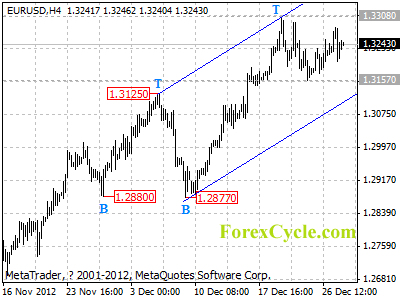
EURUSD stays in a trading range between 1.3157 and 1.3308

EURUSD stays in a trading range between 1.3157 and 1.3308. Another fall towards the lower line of the price channel on 4-hour chart would likely be seen. As long as the channel support holds, the price action from 1.3308 could be treated as consolidation of the uptrend from 1.2661, and another rise towards 1.3500 is still possible after consolidation. On the downside, a clear break below the channel support will indicate that the uptrend from 1.2661 has completed at 1.3308 already, then the following downward movement could bring price back to 1.2700-1.2800 area.

eurusd

Daily Forex Forecast

A Reminder of How to Get Ahead Financially in 2013

By MoneyMorning.com.au

Dear Reader,

We hope you enjoyed our brief Q&A with Kris yesterday. He argued – with some conviction – that the markets are rigged by the world’s central banks.

So how are you meant to navigate markets that DON’T act like markets should?

Kris’s answer is simple: you must take risks.

To that end, perhaps unsurprisingly, Kris suggests putting up to 15% of your investment capital into small cap stocks – his speciality.

But what small cap stocks does Kris think are worth looking at as we move into 2013?

You can find more detail on that in his recent presentation. In it, he also tells the fascinating story of an Aussie fortune made from calculated risk-taking. Take a look if you haven’t already.

If you have, we’ve republished one of the most popular articles of 2012 for you. It looks like nothing is going to change to a large degree in 2013. But it’s also a good reminder that to get ahead financially in the year ahead you must embrace risk.

Enjoy,

Callum

Why You MUST Speculate

First published on Saturday, 9 April 2012 – Melbourne, Australia
By Kris Sayce

If you want any chance of getting ahead, you must speculate. Four central banks – the U.S. Federal Reserve, European Central Bank, Bank of Japan and Bank of England – have rigged the stock, bond and commodity markets.

Their goal is to make stocks fall, but without causing a terrible crash.

But why on earth would they do that?

The global economy is going through the end stages of 40-plus years of credit growth.

This period has seen huge growth in government and private debt. For instance, U.S. government debt is more than USD$14 trillion. And Australian consumer debt now tops $1.5 trillion.

Paying Off Old Debt With New Money

That’s a problem. Because most governments will never repay the debt honestly. The only way they’ll repay it is dishonestly, through inflation. In other words, they’ll devalue their debt by increasing the money supply. It means the debt they racked up in the past is worth less. But it also means your savings will be worth less. So individuals have to work harder and borrow more money.

The reason for that is higher inflation means indebted governments can pay off old debt with new devalued currency. It can then create new debt that it will eventually repay with future devalued currency.

It’s how central banks and governments have worked for the past 40 years. And they’re in no rush to stop.

The thing is, even they know there’s a limit to how far they can push credit growth and inflation. And they know it will be hard to repeat what they’ve done for the last 40 years. So, they’ve got to go with their next best option – propping up the market to stop its collapse.

Central banks will continue to let markets fall until they near breaking point. Then they’ll come to the rescue… announcing a bond-buying program, money printing, currency intervention… or some other crazy scheme.

This will boost the market, and may even filter through to the economy as businesses invest, believing the economy is on the mend. But, it’s short lived. Soon enough, the market realises the stimulus won’t help, and stocks and commodity prices fall.

Until again, the market nears breaking point… and the central banks intervene again. And so it goes on. The result they’re after is to institutionalise central bank intervention… so intervention becomes the norm rather than the exception.

In other words, they’re rigging the market.

But one day even that plan will break down. Yet for now the market wants central banks to intervene.

If this all sounds like gobbledygook, don’t worry. Because in simple terms it just means that markets are set for more volatility.

The Upside

And that creates a dream environment for stock speculators.

Whether that’s buying small-cap stocks to bet on the market going up… or short-selling stocks to bet on the market going down. Either way, it’s forcing investors to be speculators…

And speculating is something you have to do. But that doesn’t mean you should use all your cash. You’ve got to be smarter than that.

“Punting” Money

We suggest you use our “safe” money and “punting” money approach:

Make sure you put most of your “safe” money in a bank savings account or term deposit. This should be as much as 80% of your savings. But with deposit rates falling, it also helps to own a few blue-chip dividend payers… say between 10-20% of your assets.

Not forgetting gold and silver.

In our view, precious metals are a must-have in any portfolio. This is your long-term investment money. An asset you should keep until you’re well into retirement. And with any luck, an asset you’ll never have to use (there’s no better legacy than leaving a few bars of gold and silver to the kids or grandkids).

After you’ve sorted out your “safe” money, anything left over is your “punting” money.

That’s where small-cap stocks enter the frame.

Going After Big Gains

In our view small-cap stocks are the best place to put your punting money to work. You get the potential for big triple- and quadruple-digit gains, yet you only have to put a small amount of cash on the line.

In terms of reward versus risk, nothing beats it.

And with the volatility we mentioned earlier, it improves your chances of locking in big gains within a short timeframe.

That’s why it’s important to have a robust risk-management system. We recommend the use of trailing-stop orders to lock in profits or cut losses when selling a stock. And buy-up-to prices when buying a stock.

This is something to pay closer attention to this year to make the most of the volatile market. It will mean tighter buy-up-to prices (by that we mean setting the maximum buy price closer to the previous closing price) and potentially tighter trailing-stop prices.

Plus, set shorter-term price targets and taking profits earlier. For instance, taking a 50% profit in a few months rather than waiting for a 100% profit over a year or more.

While we’d prefer to hold small-cap picks for longer, we’d rather lock in a profit now (or take a small loss) than give back those profits or take a bigger loss.

Cheers.
Kris

Australian Small-Cap Investigator:
How to Make Money From Small-Cap Stocks

Review: The Revenge of Geography

By The Sizemore Letter


“The present, as permanent and overwhelming as it can seem, is fleeting,” writes Robert Kaplan in the introduction to The Revenge of Geography: What the Map Tells Us About Coming Conflicts and the Battle Against Fate.   “The only thing enduring is a people’s position on the map.”

As a country built with a spirit of self-reliance and an ideology of free will, Kaplan’s idea of “the map as a country’s destiny” might seem a little offensive to American readers.  But the United States is itself a case in point.  It is the United States’ isolation, bordered by two oceans, that allowed it to develop virtually unmolested for the first two centuries of its independence.

And as disappointing as it might be to American patriots who remember the Cold War, Kaplan’s colleagues at Stratfor has always maintained that the Soviet Union’s eventual defeat was inevitable.

Even if Ronald Reagan had never become president and escalated the arms build-up that led to the Soviets throwing in the towel, geography had already sealed their fate, at least according to Stratfor’s analysis.  Due to Russia’s lack of seaports—and the ease with which enemies could block access to the few that Russia has—it was always going to be easier for the United States or Britain to contain Russia than vice versa.  In an age of nuclear missiles and air power, geography may matter less than it once did.  But the world is still far from flat, and geography still very much matters.

Students of history no doubt remember that it was the Russian winter and bleak landscape that defeated Napoleon Bonaparte’s invasion, not the Russian army.  As continental land powers, both Russia and Germany have an appreciation for geography that few other countries would appreciate.  As Kaplan writes,

As heirs to land power, Germans and Russians have over the centuries thought more in terms of geography than Americans or Britons, heirs to sea power.  For Russians, mindful of the devastation wrought by the Golden Horde of the Mongols, geography means simply that without expansion there is danger of being overrun.  Enough territory is never enough.  Russia’s need for an empire of Eastern European satellites during the Cold War, and its [more recent] use of military power, subversion, and the configuration of its energy pipeline routes all designed to gain back its near abroad…are the wages of a deep insecurity. 

But Germans, at least through the middle of the 20th century, were more conscious of geography still.  The shape of German-speaking territories on the map of Europe changed constantly from the Dark Ages through modern times…   Historically changeable on the map, lying between sea to the north and Alps to the south, with the plains the west and the east open to invasion and expansion both, Germans have literally lived geography.

Robert Kaplan has had a long and distinguished career as an analyst on geopolitical issues, and he currently writes for George Friedman’s global intelligence service Stratfor.

I reviewed Friedman’s The Next 100 Years, and his follow-up The Next Decade.  Though I have never fully forgiven Dr. Friedman for some of his more outlandish forecasts—such as a Japanese-Turkish military alliance attacking America from bases on the moon—I continue to recommend both books as two of the more thought-provoking long-term forecasts in print today.

If you liked The Next 100 Years or if you enjoy reading Stratfor geopolitical insights, then The Revenge of Geography is a book you will want to add to your reading list in 2013.

Readers might notice some similarities between Revenge and another book I reviewed, Ian Morris’ Why the West Rules—For Now. 

It was Morris’ contention that it was “maps, not chaps” that led to eventual dominance of the West over the globe.  In other words, it was the conditions of geography and the chain of events that followed it and not some innate cultural superiority  that eventually led to British warships shooting their way up the Yangzi River rather than Chinese warships shooting their way up the Thames.  (Adding credence to this view, Kaplan notes that Europe has a coastline that is 23,000 miles long—long enough to encircle the earth—full of natural harbors and that Europe has a higher ratio of coastline-to-landmass than any other continent or major region.)

Kaplan’s focus is very different—and tends to focus around the impact that major mountain ranges have had on the development of the peoples in and around them—but his conclusions are remarkably similar.  In situations where man-made borders based on politics and ideology (such as the former East and West Germany or the current North and South Korea) come into conflict with natural borders based on geography and culture, it is the map that determines the outcome.

Kaplan reserves some of his most controversial comments for North America, and particularly the relationship between the United States and Mexico—and the role that geography plays.

The United States has been overly fixated on the Middle East since the September 11, 2001 terror attacks.  The Obama Administration has since tried to “re-pivot” American policy towards East Asia and the Pacific.  But what about Latin America?

It would seem that the American attitude towards Latin America is best summarized by an off-the-cuff comment that President Nixon once made to a young Donald Rumsfeld: “Latin America doesn’t matter.”

Kaplan might beg to differ.  Paraphrasing the views of other policy experts, Kaplan writes,

While the United States was deeply focused on Afghanistan and other parts of the Greater Middle East, a massive state failure was developing right on America’s southern border, with far more profound implications for the near and distant future of America, its society, and American power than anything occurring half a world away.  What have we achieved in the Middle East with all of our interventions since the 1980s? … Why not fix Mexico instead?

Aside from the obvious point that Mexico might not want to be fixed by its northern neighbor or that the “fixing” might be better done by Mexican citizens themselves than by outsiders, Kaplan does have a valid point.  The United States shares a long border with Mexico, and the realities of geography mean that our destinies are linked—regardless of prevailing political views about immigration.   As Kaplan writes,

It is in the Southwest where the United States is vulnerable.  Here is the one area where America’s national and imperial boundaries are in some tension: where the coherence of America as a geographically cohesive unit can be questioned.  For the historical borderland between America and Mexico is broad and indistinct…

Why does this matter?

Mexico and Central America constitute a growing demographic powerhouse with which the United States has an inextricable relationship. Mexico’s population of 111 million people plus Central America’s of 40 million constitute half the population of the United States… 85 percent of all Mexico’s exports go to the United States, even as half of all Central America’s trade is with the U.S…

The destiny of the United States will be north-south, rather than the east-west , sea-to-shining-sea of continental and patriotic myth.

Kaplan is not so much delving into mass-immigration scare statistics as he is emphasizing the growing importance of our southern neighbors to our own globalized economy.

Again returning to geography, Kaplan notes that Mexico has far more natural borders internally between its various regions than it does with the United States.  Baja California and the Yucatan Peninsula (home of Cancun, Cozumel and many of Mexico’s other famous beaches) are separated from the rest of the country  by sea and, in the case of the Yucatan, by jungle.  And northern Mexico is separated from Mexico City and the central highlands by desert and mountains.

Kaplan notes something that I have noticed in my own travels.  Northern Mexico is very different than southern Mexico.  The people are every bit as distinct as New Yorkers and Mississippians, and they don’t particularly like each other.

Northern Mexico, including the large business hub of Monterrey, is gritty and industrial with a strong “get it done” mentality.  It’s people, by and large, are rugged individualists and very entrepreneurial.  As Kaplan notes, Northern Mexico is responsible for 85% of all U.S.-Mexican trade.

If you can understand Spanish, watch how norteños from Monterrey are portrayed in Spanish-language television.  They’re generally hard-nosed, no-nonsense small businessmen who, in contrast to the urbane residents of Mexico City, have no interest in or time for cultural pursuits.  Oh, and they’re usually wearing an obnoxiously-large cowboy hat and flashy boots.

Kaplan sees a “borderland” culture along the Texas-Mexico border that is distinct from both the U.S. and Mexican heartlands.  It is a hybrid culture, mostly Spanish-speaking but with “American” attitudes towards business and commerce.  Both northern Mexico and the southwestern United States are subtly separating from the rest of their respective countries.

I agree with Kaplan’s analysis, even if I do not share his degree of alarm over drug violence.  Kaplan views the loss of control by Mexico City over the drug gangs of the south as further evidence of the northern Mexico’s effective separation.  I believe the fears of drug violence are overdone.

What is the potential result of the interaction between geography and demographics along the U.S.-Mexican border?

Kaplan cites University of New Mexico Professor Charles Truxillo’s prediction that, by 2080, the states of the American southwest and Mexican north will secede and form a new country of their own—La Republica del Norte.

We’ll see about that.  In any event, I agree with Kaplan that the realities of geography make some degree of melding between the countries inevitable.

All in all, The Revenge of Geography is a worthwhile read for anyone with an interest in geopolitics.  I don’t agree with all of Kaplan’s conclusions, but he gave me plenty of fodder for thought.  If reading a 350-page tome is not to your liking, check out Kaplan’s writings at Stratfor.

This article first appeared in the HS Dent Forecast.

SUBSCRIBE to Sizemore Insights via e-mail today.

The post Review: The Revenge of Geography appeared first on Sizemore Insights.
Central Bank News Link List – Dec. 27, 2012: Japan PM adviser urges unlimited BOJ easing, higher price goal

By www.CentralBankNews.info

Here’s today’s Central Bank News link list, click through if you missed the previous link list. The list comprises news about central banks that is not covered by Central Bank News. The list is updated during the day with the latest developments so readers don’t miss any important news

Market Review 27.12.12

Source: ForexYard

printprofile

The yen extended its bearish trend during overnight trading last night, amid speculations that the Bank of Japan will initiate new monetary easing steps in the near future. The USD/JPY hit a more than two-year high while the EUR/JPY traded at its highest level since July of 2011.

The euro saw additional upward movement against the US dollar during the Asian session, as hopes that US lawmakers will soon reach an agreement to avoid the “fiscal cliff” of tax increases and budget cuts, boosted risk taking. The EUR/USD is currently trading at 1.3265.

After gaining more than $2 a barrel yesterday, crude oil was able to advance another $0.40 last night, as speculations of an impending “fiscal cliff” deal led to risk taking among investors.

Main News for Today

US Unemployment Claims-13:30 GMT
• Forecasted to come in at 365K, slightly higher than last week
• A higher than expected figure today could lead to the dollar giving up some of its recent gains against the yen

US CB Consumer Confidence- 15:00 GMT
• Forecaster to come in at 70.3, significantly lower than last month’s 73.7
• A worse than expected figure today could weigh down on the dollar

US New Home Sales- 15:00 GMT
• Forecasted to come in at 382K, which would represent a substantial increase over last month’s 368K
• Positive data could help the dollar recoup some of its recent losses against the euro and CHF

Forex Market Analysis provided by ForexYard.

© 2006 by FxYard Ltd

Disclaimer: Trading Foreign Exchange carries a high level of risk and may not be suitable for all investors. There is a possibility that you could sustain a loss of all of your investment and therefore you should not invest money that you cannot afford to lose. You should be aware of all the risks associated with Foreign Exchange trading.

AUD/USD: Fiscal Cliff Talks Resume, Geithner Intervenes, Greenback Wanes

With fiscal cliff talks set to resume today in Washington, some risk sentiment is placing the safety bet US dollar to the sidelines. Despite the thin volume of the exchanges, the mild risk confidence in the markets is seen to push the Australian dollar over the US currency. US lawmakers will continue to attempt to strike a deal before the government hits the debt ceiling on New Year’s Eve. Market participants are expectant that a deal, however small, will be agreed to by both sides to avert a fiscal disaster in the world’s largest economy.

Bloomberg reports that US Treasury Secretary Timothy F. Geithner notified Congress that he will take “extraordinary measures” to postpone a US default into early 2013, while the White House and Congress work out a deficit-reduction deal. In a letter to congressional leaders, Geithner reminded that the government will hit its statutory debt ceiling on December 31. To avert such a default, the Treasury will take action to create about $200 Billion in headroom under the debt limit, which would normally last about two months. Until a higher debt ceiling is approved as part of a deficit reduction deal or separately, Geithner said the Treasury actions would include halting sales of certain securities and stopping new debt issues.

“However, given the significant uncertainty that now exists with regard to unresolved tax and spending policies for 2013, it is not possible to predict the effective duration of these measures,” Geithner said. The aforementioned letter adds urgency to talks between Obama and congressional Republicans on a deficit-reduction plan. Obama has asked that raising the debt ceiling be part of that plan.

Despite the medium-term bearish run by the Aussie-Greenback, the currency pair found support at the 1.0353 price mark and is now attempting a bullish correction, if not an eventual reversal. Uncertainty and concerns about the fiscal cliff still weigh on risk markets such as the Australian commodity dollar, but developments on the budget negotiations are seen to give a nudge to risk confidence.

As fiscal cliff talks resume today, a buy bias is suggested for the AUDUSD today. Technical price corrections are still likely, however.

For more news, analysis, technical charts and candlestick analysis, visit AlgosysFx Forex Trading Solutions.

Third Waves are “Wonders to Behold”

One of the best rides a trader can take is on a third wave

By Elliott Wave International

The Elliott Wave Principle states that in financial markets, prices unfold in 5 wave patterns:

In wave 1, the trend has begun. Wave 2 makes a sucker outta you. Wave 3 is a powerful sight to see. Wave 4 is a corrective chore. And wave 5 is time to look alive — once more.

Elliott Wave Principle — Key to Market Behavior (the ultimate resource for all things Elliott) provides this definition for wave 3:

“Third waves are wonders to behold. They are strong and broad, and the trend at this point is unmistakable. Increasingly favorable fundamentals enter the picture as confidence returns…

AND: “It follows, of course, that the third wave of a third wave and so on will be the most volatile point of strength in any wave sequence. Such points invariably produce breakouts… and runaway price movement.”

This chart shows the personalities of each of the five waves. As you can see, wave three usually begins just when investors are convinced the bear market is back. (You can flip this chart for a five-wave move to the downside — in which case, wave three begins just as investors think the bull market is back.)

To witness a wave 3 in action is “a powerful sight to see.” The first chart below of natural gas comes from EWI’s January 2011 Global Market Perspective. It showed prices gearing up for a third-of-a-third wave decline to $2 — a level the market had not seen in over a decade.

The 2nd chart moves ahead to current day. It shows exactly how prices followed their Elliott third wave script to a T — as in a 60%, 16-month long TUMBLE.


Get on Board for the Ride in Wave Three with the Wave Principle Learn the Wave Principle with a free, 10-lesson comprehensive online course. The Elliott Wave Basic Tutorial describes each of the patterns and explains how they relate to one another. You’ll learn the basic patterns, the rules and guidelines, wave personalities and the common Fibonacci relationships between waves. Plus, you’ll learn when to expect Wave Three!Get 10 FREE Lessons on The Elliott Wave Principle now >>

This article was syndicated by Elliott Wave International and was originally published under the headline Third Waves are “Wonders to Behold”. EWI is the world’s largest market forecasting firm. Its staff of full-time analysts led by Chartered Market Technician Robert Prechter provides 24-hour-a-day market analysis to institutional and private investors around the world.


Free Report: 5 Hidden Market Opportunities for 2013

Free Report: 5 Hidden Market Opportunities for 2013

Our friends at Elliott Wave International have just released a new free report, 5 Hidden Market Opportunities for 2013. It gives you a new U.S. dollar forecast for 2013 — a forecast that would astonish most mainstream experts. You also get 5 precise Elliott wave “roadmaps” for 5 distinct market opportunities in 2013.

Get instant online access to your FREE report now.

Dear Trader,

Today, you have a chance to see a unique new report on 5 hidden market opportunities that should be coming your way in 2013.

The report was put together by Elliott Wave International’s Senior Currency Strategist, Jim Martens. EWI prides itself on finding opportunities that others miss. This free report is no exception.

Jim looks past the “fiscal cliff,” the Fed, etc. Instead, you get a one-of-a-kind perspective on the U.S. dollar for 2013 — a forecast that most mainstream experts are missing.

Plus, Martens walks you though his Elliott wave “roadmaps” for 5 exciting market opportunities for 2013.

Get a one-of-a-kind perspective on the markets that you won’t find in mainstream discussions today.

Get instant access to this free report now >>

About the Publisher, Elliott Wave International
Founded in 1979 by Robert R. Prechter Jr., Elliott Wave International (EWI) is the world’s largest market forecasting firm. Its staff of full-time analysts provides 24-hour-a-day market analysis to institutional and private investors around the world.


Precious Metals “Under Pressure” Ahead of Year-End, US “Due to Hit Debt Ceiling This Monday” says Geithner

London Gold Market Report
from Ben Traynor
BullionVault
Thursday 27 December 2012, 05:45 EST

U.S. DOLLAR gold prices traded above $1650 an ounce Thursday morning, in line with where they started the week, as the London market reopened following Christmas.

Silver meantime hovered either side of $30 an ounce, while stock markets edged higher and the Dollar fell, following news that the US Treasury is to take extraordinary measures to avoid hitting the federal debt ceiling next Monday.

“I am still friendly with the [precious metals] market, but it looks like until the new year starts, it’s under pressure,” says Yuichi Ikemizu at Standard Bank in Tokyo.

US president Barack Obama has flown back early from Hawaii to resume talks on the so-called fiscal cliff, the $600 million of spending cuts and tax cut expiries due to come into effect from Monday. The House of Representatives remains on vacation.

“The Senate must act first” said a statement issued Wednesday by House speaker John Boehner and senior Republican colleagues.

“The House will then consider whether to accept the bills…or to send them back to the Senate with additional amendments.”

Boehner’s so-called ‘Plan B’ for dealing with the federal deficit, which included maintaining tax cuts for anyone earning less than $1 million, failed to reach a House vote last week due to lack of support from members of Boehner’s own party.

The US Treasury meantime is to take extraordinary measures to avoid hitting the statutory federal debt limit next Monday, a letter from Treasury secretary Timothy Geinther published yesterday says.

The measures include a halt to issuing debt for the purposes of assisting state and local governments, and suspending reinvestment of maturing securities into funds for government workers and the Exchange Stabilization Fund, an emergency fund set up for the purpose of exchange rate intervention.

“These extraordinary measures…can create approximately $200 billion in headroom under the debt limit,” Geithner’s letter says.

“Under normal circumstances, that amount of headroom would last approximately two months.

However, given the significant uncertainty that now exists for unresolved tax and spending policies for 2013, it is not possible to predict the effective duration of these measures.”

The measures will “postpone the date that the United States would otherwise default on its legal obligations,” the letter adds.

The US Treasury has taken similar measures on a number of occasions over the last two decades, including a series of measures starting in May 2011 that ended when the debt ceiling was last extended.

The 2011 debt ceiling negotiations lasted until August 2 of that year, the date the Treasury had said the US would hit the ceiling. Ratings agency Standard & Poor’s stripped the US of its triple-A credit rating a few days later.

“Progress on the fiscal cliff will continue to affect market sentiment,” Feng Liang, analyst at GF Futures, part of China’s third-biggest listed brokerage, told news agency Bloomberg yesterday.

“Gold’s one of the few investments with positive returns this year and it’s normal to get some [year-end selling].”

The gold price at Thursday morning’s London Fix was $1655.25 an ounce, 5.1% up on the final fixing of 2011.

Over in India, gold demand stayed strong Thursday, newswire Reuters reports.

“Retail demand is still weak, but jewelers are restocking for Pongal festival,” says Daman Prakash Rathod, director at Chennai wholesaler MNC Bullion, referring to next month’s harvest festival in the state of Tamil Nadu.

Ben Traynor
BullionVault

Gold value calculator   |   Buy gold online at live prices

Editor of Gold News, the analysis and investment research site from world-leading gold ownership service BullionVault, Ben Traynor was formerly editor of the Fleet Street Letter, the UK’s longest-running investment letter. A Cambridge economics graduate, he is a professional writer and editor with a specialist interest in monetary economics. Ben writes and presents BullionVault’s weekly gold market summary on YouTube and can be found on Google+

(c) BullionVault 2012

Please Note: This article is to inform your thinking, not lead it. Only you can decide the best place for your money, and any decision you make will put your money at risk. Information or data included here may have already been overtaken by events – and must be verified elsewhere – should you choose to act on it.


Japan’s Economy Tumbles on Strong Yen

Source: ForexYard

printprofile

Japan’s economy continues to decline as the Yen goes from strength to strength, and global the global recession deepens. The International Monetary Fund (IMF) forecasted that Japan’s GDP will decline by 2.6% this year, just behind Britain’s forecasted -2.8%.

The report was published yesterday, sending shock waves across the Atlantic, and to the Far Eastern markets. Japan’s economy is expected to be hurt as long as the global recession lasts. What will eventually help Japan’s economy recover our carry trades, in which people borrow Yen and buy higher yielding currencies. This will happen when the developed countries put up their Interest Rates when their economies start growing again.

Against the Dollar, the JPY has climbed over 23% in the past year, and currently stands at 89.35. The Yen has also risen dramatically against other major currencies, such as the Pound, Dollar, and EUR. The global economic recession and strengthening Japanese Yen has severely hurt Japan’s exports. For example, Japan’s 2 largest car makers, Honda and Toyota have been significantly hit by the turn of events. This is seen especially in the U.S., which is Japan’s largest trading partner. This is important, because in recent years Japan’s car industry has gained a big foothold in the U.S. Analysts thus foresee a dim future for Japan’s economy.

The country’s unemployment rate is currently 4.4%, up from the previous 3.9%. Japan’s Labor ministry predicts that the economy will lose an additional 125,000 jobs by March 31. However, many analysts foresee a grimmer figure, as they predict a far higher figure of 400,000. Adding to negative data, Japan’s output tumbled by a staggering 11.9% in the 4th quarter of 2009. Companies plan to cut production further in the coming months, as demand from the U.S., the Euro-Zone, Britain, and China is set to fall further.

Analysts predict that as long a the Yen is bullish, and the developed economies led by the U.S. fail o show some improvement, then Japan’s economy is likely to show dismal results. However, if the Obama stimuli lead to a quicker-than-expected global recovery, then the Yen may start to fall, and Japan’s economy may start to recover too. Forex traders are advised that whenever the U.S. and other Western countries show a string of good economic figures, then the Yen is likely to lose some of its value. This is so, because as investments seem lees risky, people pull their money out of the safe-haven Yen. To learn more about the global economy and to start trading on the forex market, please visit ForexYard.

Forex Market Analysis provided by ForexYard.

© 2006 by FxYard Ltd

Disclaimer: Trading Foreign Exchange carries a high level of risk and may not be suitable for all investors. There is a possibility that you could sustain a loss of all of your investment and therefore you should not invest money that you cannot afford to lose. You should be aware of all the risks associated with Foreign Exchange trading.