Will 2013 Show Us Up?

By MoneyMorning.com.au

Dear Reader,

Christmas is finally over and 2012 is almost over too.

For the final edition of Money Weekend we’ve brought you a taste of this year’s most popular articles (and more).

There’s plenty of food for thought below, but only 2013 and beyond can really tell us how it will all stand up.

But see what you think!

Here’s to a great new year for you.

Enjoy,

Callum Newman

Editor, Money Weekend

The Sales Secret that Screams DANGER for Australian Banks in 2013

Find out why this salesman’s ‘tie down’ technique virtually guarantees Australia’s budget will end up in the red next year…

The funny thing is, thanks to this trick most Aussies will support it!

If This Red Flag Goes Up For This Doomed Currency, Buy it!

History says paper currencies always die.

Here we predict one currency heading towards destruction…and why you should keep an eye on it.

How to Survive the Implosion of the Australian Economy in 2013

Hard-hitting film exposes three coming ‘detonations’ in the Australian financial system.

Why China Wants a Higher Gold Price Later, Not Sooner

The Chinese are as gold hungry as ever.

They’re the world’s biggest gold producer…the largest gold buyer…and not one single ounce leaves their shores.

Find out what’s really going on here.

A Tale of Oil and African Pirates

For all the talk about replacing oil as an energy source, it’s still the world’s most important form of energy. That means high prices are here to stay.

But it’s not just Middle East dictators who will pocket the profits. Aussie companies investing in new energy frontiers are set to profit too.

The Most Important Aussie You’ve Never Even Heard Of

You’d think the man who made one of Australia’s greatest family fortunes, and changed the world in the process, would be a household name.

But most people haven’t even heard of him.

Today we reveal his story.

Lies Lies Lies!

You can never really protect yourself from this government DECEPTION….but you can minimise its impact.

Here we discuss one proven way to protect yourself from the Great Wealth Destroyer.

Could These Four Cash-Paying Income Stocks Save Your Retirement?

They have the power to pay out thousands in cash every year…even if their share price drops.

All is revealed right here.

Macro Trader: Prediction 2033

This week I gave my Macro Trader readers a prediction. But that prediction wasn’t just for 2013…

Neil Armstrong said, “Science has not yet mastered prophecy. We predict too much for the next year and yet far too little for the next ten.”

Neil Armstrong died on Aug. 25, 2012, and closed a chapter in our great book of science and innovation. But this quote reaches into economic forecasting, too.

I told my readers:

For the past five years we’ve been worrying about the next quarter or two without a care in the world for what will happen in the next decade. As we head into the new year, we carry with us the threatening promise from our Federal Reserve to cheapen our dollar until unemployment falls to a “reasonable” level.

We carry with us the fear of impending economic disaster.

Will we be talking about the fiscal cliff in 10 years? Sure, but in the same context as the dot-com bubble, or the stock market crash in 1987.

We will have moved on.

And all those predictions for 2013 will have been a blip on the screen.

I’d rather talk about what the world will look like in 2023…

In 2023, emerging market middleweight cities will contribute more to global growth than the developed world and global mega-cities. Over the next 10 years, more than 230 million households will earn more than $20,000 in the developing world. That’s up from only 80 million in 2007. In other words, an extra $3.1 trillion worth of consumption will hit the markets in developing economies.

But through a combination of consumption and investment, emerging markets could contribute nearly 50% of the world’s GDP.

And many of these markets are already pulling wealth from Western developed countries and shifting it East… and South.

I’ve already picked out one country for my Macro Trader subscribers to watch, but it’s not the only one.

Let me give you the secret to finding out which countries will be game changers over the next decade.

It’s not just about money… It’s about people.

Demographics will play the biggest role in the economics of growth markets. The one segment we should be paying attention to is the number of people on the verge of the middle class.

The McKinsey Global Institute predicts that there will be more than 4 billion members of the “consumer class” by 2025, and half of them will live in emerging market cities.

Three cities with an annual income of $20,000 or more, with large numbers of working-age people are Mexico City, Istanbul and Cairo.

Of course, you’ve also got Mumbai, Shanghai, Beijing, Sao Paolo, and a couple other cities in well-known emerging markets. But Mexico City, Istanbul and Cairo might get you thinking about other areas of the world with growing demographics and climbing incomes.

One of my favorite companies in Mexico that we’re holding in Macro Trader is Empresas ICA, S.A.B de C.V. (ICA:NYSE). It’s a construction company that does a lot of civil works, like hydroelectric dams and airports, and also builds a lot of housing. Shares have climbed as high as $10.28 recently, and we’ve locked in gains of more than 24% since mid-September.

But shares have pulled back over the past week, and you might have a good chance to get in on this temporary move.

Another Mexican company that really takes advantage of demographics is FEMSA – Fomento Economico Mexicano S.A.B. de C.V. (FMX:NYSE), a beverage and beer company that holds the right to bottle Coke in Mexico and other Latin American countries, and is just getting into the drugstore business. But right now, this company is pretty expensive. It’s been on a fantastic run since the bottom of 2008.

Fomento Economico Mexicano
View Larger Chart

The company put up some great numbers for its third quarter… double-digit growth in total revenue and income from operations across all three of its business segments.

This company’s key statistics aren’t that far out of line with others in the industry, but judging by the chart movements, I think you could probably get in at a better price if you wait a couple months. This would be a prudent move as we head into the new year anyway.

Mexico – though very different economically from the U.S. – has a strong sympathetic response to financial news here in the States. Check on this company again in late January or early February.

Happy Investing,

Sara

P.S. A debt-fueled “Super-Bubble” — over 25 years in the making — is bearing down on the global financial markets. The devastation will be fierce, and will forever change what people think about investing, savings, and retirement. But within this crisis exists a remarkable opportunity that will likely create a new wave of millionaires. Will you be one of them? Follow this link to secure your chance at a mega fortune…

Other Related Articles:

Disclaimer

Article brought to you by Inside Investing Daily. Republish without charge. Required: Author attribution, links back to original content or www.insideinvestingdaily.com. Any investment contains risk. Please see our disclaimer.

Angola keeps rate steady, inflation and FX rates stable

By www.CentralBankNews.info     Angola’s central bank kept its base rate (BNA) steady at 10.25 percent against a backdrop of stable inflation and kwanza exchange rates.
    The National Bank of Angola said credit to the economy returned to growth in November, continuing the trend from previous months. Loans in local currency represent almost 60 percent of total credit to the economy.
     Angola’s inflation rate was largely steady in November, with prices up 0.93 percent from the previous month for an annual rate of  9.83 percent compared with October’s 9.76 percent rate.
    The prices for Housing, Water and Electricity, Gas and Fuel; Transportation; Food and non-alcoholic beverages recording the largest price changes, the central bank said.

    Angola’s central bank last cut its rates in January and the decline in inflation to a single-digit level has been its aim for many years.
  The average exchange rate of the kwanza to the U.S. dollar was at 95.712 at the end of November, “reflecting the stability observed since the beginning of the year,” the central bank said, repeating its statement from last month.

    Interest rates on government bonds also eased during November, the bank said, with the LUIBOR overnight rate at 6.25 percent and 3 and 12 month rates at 8.53 percent and 10.56 percent, respectively.

    www.CentralBankNews.info

Make Dividend Achievers a Core Holding in 2013

By The Sizemore Letter

High dividend stocks were all the rage in 2011 and 2012, as yield-starved investors hunted for income where they could find it.

Yet two of the sectors best known as “high yield” sectors—utilities ($XLU) and telecom ($XTL)—are on track for a sub-par 2012 (the utilities sector is actually negative for the year).  It’s not particularly hard to see why.  For slow-growth sectors, both have become expensive relative to the broader market.

Utilities yield just over 4% as a sector, which is nearly double the yield on the S&P 500 and more than double the yield on the 10-year Treasury.  But in terms of cash payout, you’re not going to be getting significantly more next year than you did this year.  Utilities do grow their dividends over time, but they tend to do so slowly.

Don’t get me wrong; I’d prefer to take a basket of utilities stocks, equity risk and all, over most bonds at current yields.  The uncertainty of the equities markets beats the virtually guaranteed losses that bond investors face, particularly after inflation.

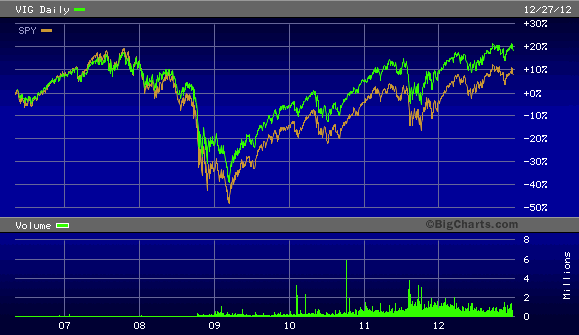
Yet the yield is only part of the story.  Dividends are about more than just current income.  They are about quality.  Which brings me to my recommendation this week: the Vanguard Dividend Appreciation ETF (NYSE: $VIG). 

Fig. 1: VIG vs. SPY

For a “dividend focused” ETF, VIG yields a relatively puny 2%.  But unlike bond coupon payments or slow-growth utilities or telecom stocks, VIG’s cash payout will almost certainly be significantly higher in the years ahead.

You see, in order to be a holding of VIG, a company has to have at least ten consecutive years of rising dividends behind it.  These are growth stocks, not cash cows for widows and orphans.

Yet at the same time, the holdings are generally high enough quality to be held by widows and orphans.  Think about it.  If you’re able to raise your dividend throughout the 2008-2009 meltdown and recession, your company must be bulletproof.

VIG is stuffed full of the highest-quality companies in America; Wal-Mart (NYSE: $WMT), Coca-Cola (NYSE: $KO) and IBM (NYSE:$IBM) are its three largest holdings, to drop a few names.  And interestingly enough, utilities and telecom together make up less than 2% of the portfolio.

VIG is not an ETF that I recommend you trade aggressively.  VIG—and the stocks that comprise it—is the sort of investment that you should use as the foundation of your core portfolio.

As we start a new year, consider ditching any S&P 500 index funds you might own and replacing them with VIG.  And for the developed international allocation of your portfolio, you might consider the PowerShares International Dividend Achievers ETF (NYSE: $PID).  It’s built on the same principles as VIG but covers developed non-U.S. markets.

Disclosures: Sizemore Capital is long VIG, WMT and PID.  This article first appeared on TraderPlanet.

SUBSCRIBE to Sizemore Insights via e-mail today.

The post Make Dividend Achievers a Core Holding in 2013 appeared first on Sizemore Insights.

Central Bank Calendar 2013

By www.CentralBankNews.info Central Bank News provides you with the 2013 calendar for meetings by central bank committees that decide monetary policy. The table includes scheduled meetings of over 25 of the world’s central banks. In the event that meetings by monetary policy committees take place over several days, the date listed below is for the final day when decisions are normally announced.
Work is underway to expand the number of central banks covered, including expanding the existing inflation targets table, and global interest rates table. You may replicate the table in part or in full only if you link to this page.

             DATE  FX CODECOUNTRYCENTRAL BANK
3-Jan    UAHUgandaBank of Uganda
7-Jan    RONRomaniaNational Bank of Romania
9-Jan    THBThailandBank of Thailand
9-Jan    PLNPolandNational Bank of Poland
10-Jan    IDRIndonesiaBank Indonesia
10-Jan    GBPUnited KingdomBank of England
10-Jan    EUREuro areaEuropean Central Bank
11-Jan    KRWKoreaBank of Korea
16-Jan    BRLBrazilBanco Central do Brasil
17-Jan    RSDSerbiaNational Bank of Serbia
18-Jan    MXNMexicoBanco de Mexico
22-Jan    JPYJapanBank of Japan
23-Jan    CADCanadaBank of Canada
23-Jan    ARSArgentinaCentral Bank of Argentina
24-Jan    PHPPhilippinesCentral Bank of Philippines
24-Jan    ZARSouth AfricaSouth African Reserve Bank
28-Jan    ILSIsraelBank of Israel
29-Jan    HUFHungaryMagyar Nemzeti Bank
30-Jan    USDUnited StatesFederal Reserve
31-Jan    NZDNew ZealandReserve Bank of New Zealand
31-Jan    MYRMalaysiaCentral Bank of Malaysia
5-Feb    AUDAustraliaReserve Bank of Australia
5-Feb    UAHUgandaBank of Uganda
5-Feb    RONRomaniaNational Bank of Romania
6-Feb    ISKIcelandCentral Bank of Iceland
6-Feb    PLNPolandNational Bank of Poland
7-Feb    GBPUnited KingdomBank of England
7-Feb    EUREuro areaEuropean Central Bank
8-Feb    PHPPhilippinesCentral Bank of Philippines
12-Feb    IDRIndonesiaBank Indonesia
13-Feb    SEKSwedenSveriges Riksbank
13-Feb    GELGeorgiaNational Bank of Georgia
14-Feb    JPYJapanBank of Japan
14-Feb    KRWKoreaBank of Korea
20-Feb    THBThailandBank of Thailand
25-Feb    ILSIsraelBank of Israel
26-Feb    HUFHungaryMagyar Nemzeti Bank
5-Mar    AUDAustraliaReserve Bank of Australia
6-Mar    CADCanadaBank of Canada
6-Mar    BRLBrazilBanco Central do Brasil
6-Mar    PLNPolandNational Bank of Poland
7-Mar    JPYJapanBank of Japan
7-Mar    IDRIndonesiaBank Indonesia
7-Mar    EUREuro areaEuropean Central Bank
7-Mar    GBPUnited KingdomBank of England
7-Mar    MYRMalaysiaCentral Bank of Malaysia
7-Mar    RSDSerbiaNational Bank of Serbia
8-Mar    MXNMexicoBanco de Mexico
14-Mar    CHFSwitzerlandSwiss National Bank
14-Mar    NOKNorwayNorges Bank
14-Mar    PHPPhilippinesCentral Bank of Philippines
14-Mar    NZDNew ZealandReserve Bank of New Zealand
14-Mar    KRWKoreaBank of Korea
20-Mar    ZARSouth AfricaSouth African Reserve Bank
20-Mar    USDUnited StatesFederal Reserve
20-Mar    ISKIcelandCentral Bank of Iceland
24-Mar    ILSIsraelBank of Israel
26-Mar    MADMoroccoBank of Morocco 
26-Mar    HUFHungaryMagyar Nemzeti Bank
27-Mar    GELGeorgiaNational Bank of Georgia
2-Apr    AUDAustraliaReserve Bank of Australia
3-Apr    THBThailandBank of Thailand
3-Apr    UAHUgandaBank of Uganda
4-Apr    JPYJapanBank of Japan
4-Apr    GBPUnited KingdomBank of England
4-Apr    EUREuro areaEuropean Central Bank
10-Apr    PLNPolandNational Bank of Poland
11-Apr    IDRIndonesiaBank Indonesia
11-Apr    KRWKoreaBank of Korea
11-Apr    RSDSerbiaNational Bank of Serbia
17-Apr    CADCanadaBank of Canada
17-Apr    SEKSwedenSveriges Riksbank
22-Apr    ILSIsraelBank of Israel
23-Apr    HUFHungaryMagyar Nemzeti Bank
24-Apr    NZDNew ZealandReserve Bank of New Zealand
25-Apr    PHPPhilippinesCentral Bank of Philippines
26-Apr    MXNMexicoBanco de Mexico
1-May    USDUnited StatesFederal Reserve
2-May    EUREuro areaEuropean Central Bank 
3-May    UAHUgandaBank of Uganda
7-May    AUDAustraliaReserve Bank of Australia
8-May    NZDNew ZealandReserve Bank of New Zealand
8-May    NOKNorwayNorges Bank
8-May    PLNPolandNational Bank of Poland
8-May    GELGeorgiaNational Bank of Georgia
9-May    KRWKoreaBank of Korea
9-May    GBPUnited KingdomBank of England
9-May    MYRMalaysiaCentral Bank of Malaysia
10-May    PHPPhilippinesCentral Bank of Philippines
13-May    RSDSerbiaNational Bank of Serbia
14-May    IDRIndonesiaBank Indonesia
15-May    ISKIcelandCentral Bank of Iceland
22-May    JPYJapanBank of Japan
23-May    ZARSouth AfricaSouth African Reserve Bank
28-May    HUFHungaryMagyar Nemzeti Bank
29-May    THBThailandBank of Thailand
29-May    CADCanadaBank of Canada
29-May    BRLBrazilBanco Central do Brasil
4-Jun    AUDAustraliaReserve Bank of Australia
5-Jun    UAHUgandaBank of Uganda
5-Jun    PLNPolandNational Bank of Poland
6-Jun    GBPUnited KingdomBank of England
6-Jun    EUREuro areaEuropean Central Bank
6-Jun    RSDSerbiaNational Bank of Serbia
7-Jun    MXNMexicoBanco de Mexico
11-Jun    JPYJapanBank of Japan
12-Jun    ISKIcelandCentral Bank of Iceland
13-Jun    NZDNew ZealandReserve Bank of New Zealand
13-Jun    IDRIndonesiaBank Indonesia
13-Jun    KRWKoreaBank of Korea
13-Jun    PHPPhilippinesCentral Bank of Philippines
18-Jun    MADMoroccoBank of Morocco 
20-Jun    CHFSwitzerlandSwiss National Bank
20-Jun    NOKNorwayNorges Bank
24-Jun    ILSIsraelBank of Israel
25-Jun    HUFHungaryMagyar Nemzeti Bank
26-Jun    GELGeorgiaNational Bank of Georgia
2-Jul    AUDAustraliaReserve Bank of Australia
3-Jul    SEKSwedenSveriges Riksbank
3-Jul    PLNPolandNational Bank of Poland
4-Jul    GBPUnited KingdomBank of England
4-Jul    EUREuro areaEuropean Central Bank
10-Jul    THBThailandBank of Thailand
11-Jul    JPYJapanBank of Japan
11-Jul    IDRIndonesiaBank Indonesia
11-Jul    KRWKoreaBank of Korea
11-Jul    MYRMalaysiaCentral Bank of Malaysia
11-Jul    RSDSerbiaNational Bank of Serbia
12-Jul    MXNMexicoBanco de Mexico
18-Jul    ZARSouth AfricaSouth African Reserve Bank
25-Jul    NZDNew ZealandReserve Bank of New Zealand
25-Jul    PHPPhilippinesCentral Bank of Philippines
29-Jul    ILSIsraelBank of Israel
31-Jul    USDUnited StatesFederal Reserve
1-Aug    GBPUnited KingdomBank of England
1-Aug    EUREuro areaEuropean Central Bank
6-Aug    AUDAustraliaReserve Bank of Australia
7-Aug    PHPPhilippinesCentral Bank of Philippines
7-Aug    GELGeorgiaNational Bank of Georgia
8-Aug    JPYJapanBank of Japan
8-Aug    KRWKoreaBank of Korea
8-Aug    RSDSerbiaNational Bank of Serbia
15-Aug    IDRIndonesiaBank Indonesia
21-Aug    THBThailandBank of Thailand
21-Aug    ISKIcelandCentral Bank of Iceland
26-Aug    BRLBrazilBanco Central do Brasil
26-Aug    ILSIsraelBank of Israel
3-Sep    AUDAustraliaReserve Bank of Australia
4-Sep    PLNPolandNational Bank of Poland
5-Sep    JPYJapanBank of Japan
5-Sep    MYRMalaysiaCentral Bank of Malaysia
12-Sep    NZDNew ZealandReserve Bank of New Zealand
12-Sep    IDRIndonesiaBank Indonesia
12-Sep    KRWKoreaBank of Korea
12-Sep    PHPPhilippinesCentral Bank of Philippines
12-Sep    RSDSerbiaNational Bank of Serbia
19-Sep    ZARSouth AfricaSouth African Reserve Bank
19-Sep    CHFSwitzerlandSwiss National Bank
23-Sep    ILSIsraelBank of Israel
24-Sep    MADMoroccoBank of Morocco 
25-Sep    GELGeorgiaNational Bank of Georgia
1-Oct    AUDAustraliaReserve Bank of Australia
2-Oct    PLNPolandNational Bank of Poland
2-Oct    ISKIcelandCentral Bank of Iceland
2-Oct    EUREuro areaEuropean Central Bank
4-Oct    JPYJapanBank of Japan
8-Oct    IDRIndonesiaBank Indonesia
9-Oct    BRLBrazilBanco Central do Brasil
10-Oct    KRWKoreaBank of Korea
10-Oct    GBPUnited KingdomBank of England
16-Oct    THBThailandBank of Thailand
17-Oct    RSDSerbiaNational Bank of Serbia
23-Oct    CADCanadaBank of Canada
24-Oct    SEKSwedenSveriges Riksbank
24-Oct    NOKNorwayNorges Bank
24-Oct    PHPPhilippinesCentral Bank of Philippines
28-Oct    ILSIsraelBank of Israel
30-Oct    USDUnited StatesFederal Reserve
5-Nov    AUDAustraliaReserve Bank of Australia
6-Nov    PLNPolandNational Bank of Poland
6-Nov    ISKIcelandCentral Bank of Iceland
6-Nov    GELGeorgiaNational Bank of Georgia
7-Nov    GBPUnited KingdomBank of England
7-Nov    EUREuro areaEuropean Central Bank
7-Nov    MYRMalaysiaCentral Bank of Malaysia
7-Nov    RSDSerbiaNational Bank of Serbia
12-Nov    IDRIndonesiaBank Indonesia
14-Nov    KRWKoreaBank of Korea
21-Nov    JPYJapanBank of Japan
21-Nov    ZARSouth AfricaSouth African Reserve Bank
25-Nov    ILSIsraelBank of Israel
27-Nov    THBThailandBank of Thailand
3-Dec    AUDAustraliaReserve Bank of Australia
4-Dec    CADCanadaBank of Canada
4-Dec    PLNPolandNational Bank of Poland
5-Dec    GBPUnited KingdomBank of England
5-Dec    EUREuro areaEuropean Central Bank
5-Dec    NOKNorwayNorges Bank
6-Dec    MXNMexicoBanco de Mexico
11-Dec    ISKIcelandCentral Bank of Iceland
12-Dec    KRWKoreaBank of Korea
12-Dec    NZDNew ZealandReserve Bank of New Zealand
12-Dec    PHPPhilippinesCentral Bank of Philippines
12-Dec    RSDSerbiaNational Bank of Serbia
12-Dec    CHFSwitzerlandSwiss National Bank
12-Dec    IDRIndonesiaBank Indonesia
17-Dec    SEKSwedenSveriges Riksbank
17-Dec    MADMoroccoBank of Morocco 
18-Dec    USDUnited StatesFederal Reserve
20-Dec    JPYJapanBank of Japan
25-Dec    GELGeorgiaNational Bank of Georgia

Market Trends 28.12.12

Source: ForexYard

printprofile

Hey Everyone,

Below are some market trends for today.

Good luck!

-Dan

Gold- May see downward movement today
Support- 1651.05
Resistance- 1655.33

Silver- May see downward movement today
Support- 29.69
Resistance- 30.42

Crude Oil- May see downward movement today
Support- 89.31
Resistance-91.43

Dax 30- May see upward movement today
Support- 7613.37
Resistance- 7700.00

EUR/USD May see downward movement today
Support- 1.3085
Resistance- 1.3280

Forex Market Analysis provided by ForexYard.

© 2006 by FxYard Ltd

Disclaimer: Trading Foreign Exchange carries a high level of risk and may not be suitable for all investors. There is a possibility that you could sustain a loss of all of your investment and therefore you should not invest money that you cannot afford to lose. You should be aware of all the risks associated with Foreign Exchange trading.

Market Review 28.12.12

Source: ForexYard

printprofile

The US dollar shot up to a fresh two-year high against the yen during overnight trading, as speculations that the Bank of Japan will initiate aggressive monetary easing policies in the near future weighed down on the Japanese currency.

The euro saw slight upward movement against the dollar during the Asian session as investor hopes that US lawmakers can reach a budget deal before the end of the year boosted riskier assets. All eyes will be on a meeting between President Obama and Congressional leaders today to see if any progress in negotiations has been made.

Main News for Today

US Pending Home Sales-15:00 GMT
• Analysts are forecasting the home sales figure to come in substantially lower than last month’s
• Worse than expected data today could weigh down on the dollar during afternoon trading

Forex Market Analysis provided by ForexYard.

© 2006 by FxYard Ltd

Disclaimer: Trading Foreign Exchange carries a high level of risk and may not be suitable for all investors. There is a possibility that you could sustain a loss of all of your investment and therefore you should not invest money that you cannot afford to lose. You should be aware of all the risks associated with Foreign Exchange trading.

“Gold Market Overhang” Poses Risk of Another Price Fall, Fiscal Cliff “Will See Minimal Last Minute Deal”

London Gold Market Report
from Ben Traynor
BullionVault
Friday 28 December 2012, 06:30 EST

THE SPOT MARKET gold price fell back to $1660 an ounce Friday morning, close to where it started the week, as stock markets also edged lower, ahead of talks in Washington aimed at avoiding the $600 billion “fiscal cliff” of spending cuts and tax rises due within days.

Gold will break its four-week losing streak today if the spot price ends the week above $1657 an ounce, while spot silver needs to close above $30.03 an ounce to do likewise.

“The weight of the [gold] market still overhangs with resistance seen at $1673, the November low, and $1685, the December support,” says the latest technical analysis from bullion bank Scotiabank.

“While the market holds below $1685 the technical risk remains for another leg lower.”

“There’s some buying but you don’t see heavy activity,” one physical gold bullion dealer told newswire Reuters this morning.

Silver meantime eased back towards the $30 an ounce mark, while other commodity prices were little changed.

On the currency markets, the Euro fell against the Dollar Friday morning, dropping 0.6% in two hours, with traders blaming thin volumes and stop loss selling.

President Obama is due to hold talks with congressional leaders later today, as part of ongoing negotiations on how best to tackle the US federal deficit. The US economy is due to hit the so-called fiscal cliff next week unless Congress agrees to halt planned spending cuts and extend tax cuts from the Bush administration.

Democrats have proposed maintaining the Bush tax cuts for anyone earning $250,000 a year or less, while Obama has indicated he would consider raising that threshold to $400,000.

Republican House of Representatives speaker John Boehner meantime has said he would consider allowing the cuts to expire for anyone earning more than $1 million a year, after previously expressing outright opposition to a rise in taxes. Boehner included this proposal in his so-called ‘Plan B’ last week, but failed to garner enough support from fellow Republicans for it to be put to a House vote.

“The way to avoid the fiscal cliff has been right in the face of Republican leaders for days and days and days,” Senate majority leader Harry Reid, a Democrat, told the Senate Thursday, adding that Boehner’s unwillingness to agree a deal is motivated by concerns about being re-elected speaker of the Republican-controlled House next week.

“I say to the speaker, take the escape hatch that we’ve left you. Put the economic fate of the nation ahead of your own fate as Speaker of the House.”

“Republicans aren’t about to write a blank check for anything Senate Democrats put forward just because we find ourselves at the edge of the cliff,” countered Republican Senate minority leader Mitch McConnell.

“That having been said, we’ll see what the president has to propose.”

“Time is running out for the long-awaited solution in fiscal-cliff negotiations,” says Kai Fachinger, portfolio manager at Sustainable Asset Management in Zurich.

“As the positions of the two parties are just too far off, it’s likely to happen in the very last second.”

“[We expect a] deal to happen at the last minute,” agrees Dominic Schnider at UBS Wealth Management.

“But it will be a minimal deal…I think that should be gold supportive.”

Vietnam’s central bank meantime will play the role of market maker in the gold market next year in a bid to control the domestic gold price, Vietnamica reports, citing comments from State Bank of Vietnam governor Nguyen Van Binh.

Earlier this year the SBV claimed the exclusive right to manufacture gold bars in Vietnam.

Ben Traynor
BullionVault

Gold value calculator   |   Buy gold online at live prices

Editor of Gold News, the analysis and investment research site from world-leading gold ownership service BullionVault, Ben Traynor was formerly editor of the Fleet Street Letter, the UK’s longest-running investment letter. A Cambridge economics graduate, he is a professional writer and editor with a specialist interest in monetary economics. Ben writes and presents BullionVault’s weekly gold market summary on YouTube and can be found on Google+

(c) BullionVault 2012

Please Note: This article is to inform your thinking, not lead it. Only you can decide the best place for your money, and any decision you make will put your money at risk. Information or data included here may have already been overtaken by events – and must be verified elsewhere – should you choose to act on it.

 

How to Deposit into your Trading Account using Western Union

Source: ForexYard

printprofile

To transfer funds, simply visit your nearest authorized Western Union branch or alternatively you may transfer online.

Transfers made into your ForexYard Trading Account should be made using the following details:

• Name of Recipient: Penelope Christodoulou
• Country: Cyprus (Southern)
• City: Limassol

Once you have transferred funds, you must contact the FOREXYARD’s Customer Support team at [email protected], confirming the following information:

• First and Last name (as it appears on the deposit slip)
• Currency and amount of money sent
• Country from which the transfer was made
• 10 digit tracking code (you will be given this code when you send the money)

You are, however, unable to withdraw money via western union and will need to request a withdraw via bank wire transfer.

Forex Market Analysis provided by ForexYard.

© 2006 by FxYard Ltd

Disclaimer: Trading Foreign Exchange carries a high level of risk and may not be suitable for all investors. There is a possibility that you could sustain a loss of all of your investment and therefore you should not invest money that you cannot afford to lose. You should be aware of all the risks associated with Foreign Exchange trading.

Central Bank News Link List – Dec. 28, 2012: Brazil central bank eases reserve rules to boost investment

By www.CentralBankNews.info

Here’s today’s Central Bank News link list, click througif you missed the previous link list. The list comprises news about central banks that is not covered by Central Bank News. The list is updated during the day with the latest developments so readers don’t miss any important news