COT Forex Speculators: US Dollar bets jumped last week to highest level since July

By CountingPips.com

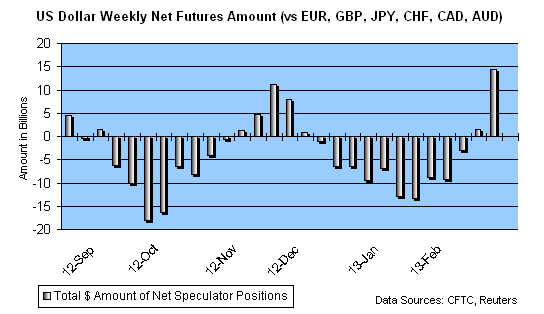
The latest weekly Commitments of Traders (COT) report, released on Friday by the Commodity Futures Trading Commission (CFTC), showed that large futures traders sharply increased their bets in favor of the US dollar last week and brought the American currency’s overall long position to the highest level in seven months.

Non-commercial large futures traders, including hedge funds and large International Monetary Market speculators, registered an overall US dollar long position of $14.39 billion as of Tuesday February 26th. This was a change from a total long position of $1.481 billion that was registered on Tuesday February 19th, according to the CFTC’s COT data and trader position calculations by Reuters, which calculates the dollar positions against the euro, British pound, Japanese yen, Australian dollar, Canadian dollar and the Swiss franc.

The non-commercial large trader position in the dollar has now improved for three straight weeks and is at the highest level since July 24, 2012, according to Reuters.

cot-values-usdollar


Individual Currencies Large Speculators Futures Positions:

The individual currency contracts quoted directly against the US dollar last week saw just a slight improvement for the Japanese yen while the euro, British pound sterling, Swiss franc, Australian dollar, New Zealand dollar, Canadian dollar and the Mexican peso all had a declining number of contracts compared to the previous week.

Individual Currency Charts:

EuroFX:
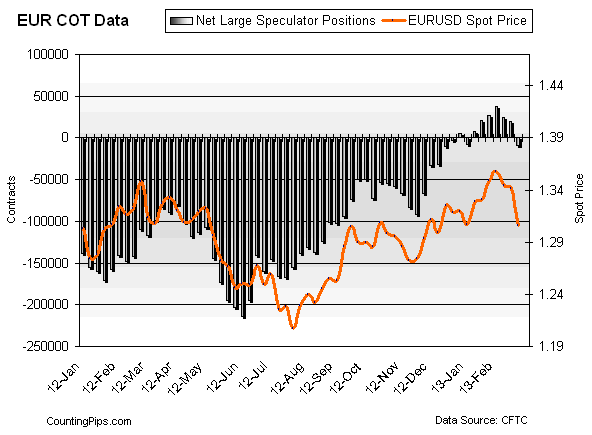
eur

EuroFX: Large trader and speculator sentiment for the euro fell somewhat sharply last week to drop for a third straight week as euro positions crossed back over to a negative bearish position. Euro contracts decreased to a position of -9,394 contracts in the data reported for February 26th following the previous week’s total of +19,103 net long contracts on February 19th.

Euro spec positions are now back on the bearish side after turning bullish on January 15th and reaching a recent high level of +37,952 contracts on February 5th.


Great Britain Pound:
gbp

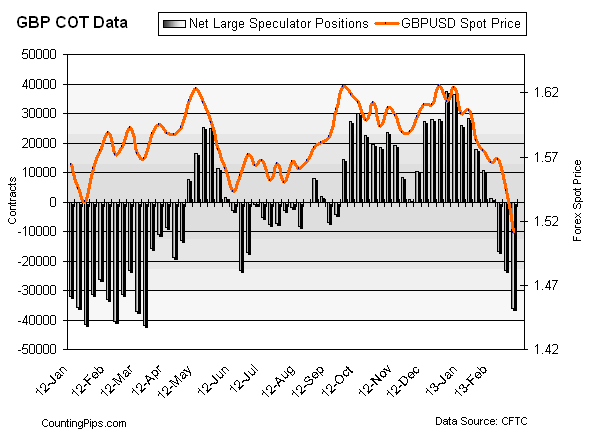
GBP: British pound sterling positions declined sharply again last week to fall for a sixth consecutive week. British pound speculative positions dropped to a total of -36,130 net contracts on February 26th following a total of -23,365 net contracts that were reported on February 19th.

Pound speculator positions have now been in a negative bearish position for three weeks and are at the lowest level since March 12th, 2012 when positions equaled -41,848 contracts.


Japanese Yen:
jpy

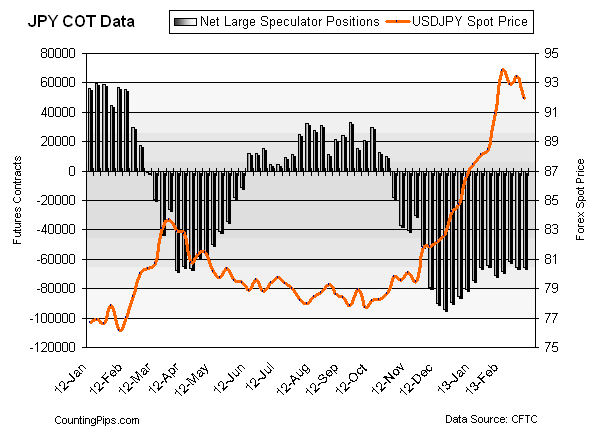
JPY: Japanese yen speculative contracts inched up last week after dipping the previous week. Japanese yen positions advanced slightly to a total of -65,344 net contracts reported on February 26th following a total of -65,891 net short contracts on February 19th.

Yen positions have been on the bearish side since October 2012 with a recent low point reached on December 11th with -94,401 contracts.


Swiss Franc:
chf

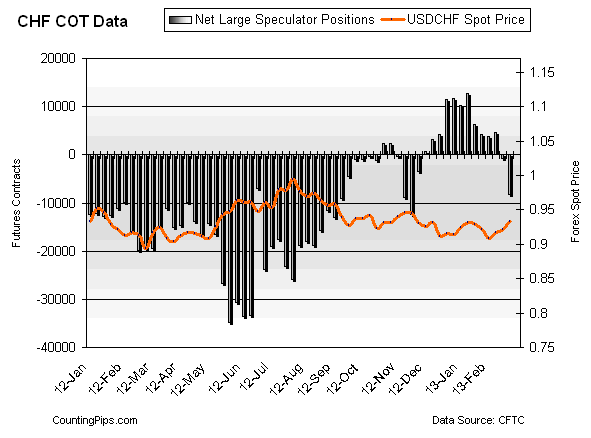
CHF: Swiss franc speculator positions decreased last week to fall for a second week and to the lowest level since November 2012. Net positions for the Swiss currency futures dropped to a total of -8,191 contracts on February 26th following a total of -675 net contracts as of February 19th.

CHF positions are on the short side for a second straight week and are at the lowest level since November 20, 2012.


Canadian Dollar:
cad

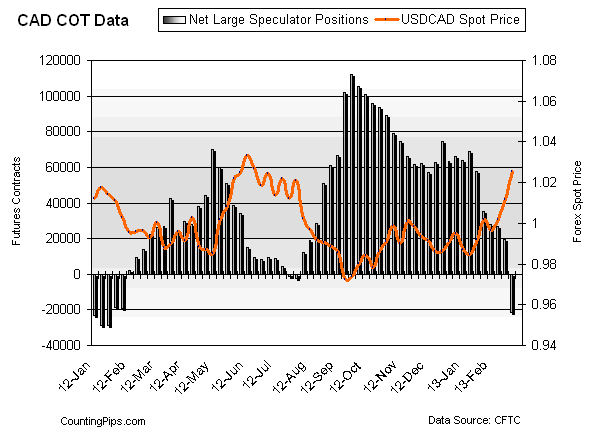
CAD: Canadian dollar positions decreased sharply lower last week to decline for a sixth consecutive week and to the lowest level in over a year. Canadian dollar positions fell to a total of -21,433 contracts as of February 26th following a total of +19,379 net contracts that were reported for February 19th.

Canadian dollar speculator positions are now at their lowest level since January 17th, 2012 when positions totaled -28,730 contracts.


Australian Dollar:

aud

AUD: The Australian dollar continued to decrease last week to fall for a fifth straight week. Aussie speculative futures positions declined to a total net amount of +25,695 contracts on February 26th after totaling +43,981 contracts as of February 19th.

Australian dollar contracts are at their lowest level since July 17, 2012 when long positions equaled just +13,931 contracts.


New Zealand Dollar:

nzd

NZD: New Zealand dollar speculator positions decreased last week after reaching their highest level in over a year the previous week. NZD contracts decreased to a total of +20,297 net long contracts as of February 26th following a total of +24,693 net long contracts on February 19th.

The New Zealand dollar positions two weeks ago just surpassed their 2012 high level (reached on December 11th at +24,600 contracts) and have remained over the +20,000 long contracts threshold for seven consecutive weeks.


Mexican Peso:
mxn

MXN: Mexican peso speculative contracts dropped last week to decline for a sixth straight week. Peso positions decreased to a total of +104,804 net long speculative positions as of February 26th following a total of +116,165 contracts that were reported for February 19th.

Peso speculative positions continue to be at their lowest level since November 27, 2012 when long speculative positions equaled +93,858 contracts.


The Commitment of Traders report is published every Friday by the Commodity Futures Trading Commission (CFTC) and shows futures positions data that was reported as of the previous Tuesday (3 days behind).

Each currency contract is a quote for that currency directly against the U.S. dollar, a net short amount of contracts means that more speculators are betting that currency to fall against the dollar and a net long position expect that currency to rise versus the dollar.

(The graphs overlay the forex spot closing price of each Tuesday when COT trader positions are reported for each corresponding spot currency pair.)


Article by CountingPips.comForex News & Market Analysis


Monetary Policy Week in Review – Mar 2, 2013: Rates still declining but most central banks in wait-and-see mode

By www.CentralBankNews.info

    Last week seven central banks took monetary policy decisions with two banks (Hungary and Jamaica) cutting rates and the remaining five banks (Angola, Israel, Trinidad & Tobago, the Dominican Republic and Zambia) keeping rates on hold.
    The main message from last week’s policy statements was that the global economy continues to slowly improve, risk appetite in financial markets is strengthening and inflationary pressures are contained by weak demand.
    But is the global economy strong enough for central banks to shift from an accommodative stance toward a more neutral stance without killing the recovery?
    The Bank of Israel illustrates the wait-and-see approach that currently characterizes global monetary policy.  Last year’s threat of financial meltdown from Europe’s debt crises has been averted by a combination of monetary easing and astute policy guidance. The main issue for many central banks this year is how to nudge interest rates higher without undermining economic confidence.
    The Israeli central bank, which last year cut its rate by 100 basis points as the economy slowed, noted that recent economic indicators were mixed. While an improvement in activity was possible in January, fourth quarter growth was below previous quarters.
     “It is therefore too early to assess whether this represents a turnaround in economic activity,” the BOI said.
    Through the first nine weeks of the year, 76 percent of the policy decisions taken by the 90 banks followed by Central Bank News have favored unchanged rates, own from last week’s 77 percent.
    But 20 percent of decisions have lead to rate cuts, slightly up from the 19 percent seen after the first eight weeks, showing that the trend in global monetary policy is still toward more easing.
    Emerging market central banks remain the most active rate cutters, with 26 percent of their deliberations so far this year leading to rate cuts compared with 22 percent of central banks in frontier markets.
    No central bank in developed markets has cut rates this year but that is largely because some of the major ones, such as the Federal Reserve, the Bank of Japan and the Bank of England, years ago slashed their rates to effectively zero and then started using their balance sheets to guide rates.
    And though much attention is focused on how the Bank of Japan and the European Central Bank can further stimulate their economies, the Bank of Israel and the Federal Reserve illustrate that the global trend is starting to shift toward a more neutral stance.
    While Federal Reserve Chairman Ben Bernanke last week assured financial markets of his commitment to easy policy, his testimony and the minutes from the previous week were a stark reminder that the days of quantitative easing are likely numbered.
    Another topic in monetary policy last week was the nomination of new central bank governors in Japan and Hungary, with both decisions triggering a heated debate over central banks’ independence along with expectations that the new governors will pursue aggressive pro-growth policies.
    In Tokyo Prime Minister Shinzo Abe nominated Haruhiko Kuroda as successor to BOJ Governor Masaaki Shirakawa and in Budapest Prime Minister Viktor Orban picked Gyorgy Matolcsy to replace Andras Simor.
LAST WEEK’S (WEEK 9) MONETARY POLICY DECISIONS

COUNTRYMSCI    NEW RATE          OLD RATE       1 YEAR AGO
ANGOLA10.00%10.00%10.25%
ISRAELDM1.75%1.75%2.50%
HUNGARYEM5.25%5.50%7.00%
JAMAICA5.75%6.25%6.25%
TRINIDAD & TOBAGO2.75%2.75%3.00%
DOMINICAN REPUBLIC5.00%5.00%6.75%
ZAMBIA9.25%9.25%                 N/A *
* Note: The Bank of Zambia introduced a policy rate in April 2012, replacing money supply targeting. 

NEXT WEEK (week 10) features 13 scheduled central bank meetings, including Mauritius, Australia, Uganda, Poland, Brazil, Canada, Japan, Indonesia, Malaysia, the European Central Bank, the Bank of England, Peru and Mexico.

COUNTRYMSCI         MEETING              RATE       1 YEAR AGO
MAURITIUS4-Mar4.90%4.90%
AUSTRALIADM5-Mar3.00%4.25%
UGANDA5-Mar12.00%21.00%
POLANDEM6-Mar4.00%4.50%
BRAZILEM6-Mar7.25%9.75%
CANADADM6-Mar1.00%1.00%
JAPANDM 7-Mar0.10%0.10%
INDONESIAEM7-Mar5.75%5.75%
MALAYSIAEM7-Mar3.00%3.00%
EURO AREADM 7-Mar0.75%1.00%
UNITED KINGDOMDM7-Mar0.50%0.50%
PERUEM7-Mar4.25%4.25%
MEXICOEM8-Mar4.50%4.50%


Kris Sayce’s Money Weekend Market Digest: 02 March 2013

By MoneyMorning.com.au

Before we go through this week’s digest, an announcement. As you know, we’ve been bullish on this market for months. And despite the recent rally and the continued volatility, we still see a lot of good value on the Aussie market (not just in small-caps either).

Well, you’ll be pleased to know that we’ve put our money where our mouth is. Because we’re so convinced of the value and opportunities on the market that we’ve decided to invest in our business. We’ve done that by hiring an assistant research analyst to help us scour the market for beaten-down stocks and breakthrough innovators.

So, please welcome Samuel Volkering (he prefers Sam). You’ll see Sam’s name in Money Weekend, Money Morning, Australian Small-Cap Investigator, and a new project we’re working on — we’ll have more details on that soon.

Until then, on with today’s digest…

ENERGY: Breakthrough in ‘Battery’ Technology

To be fair this breakthrough really isn’t a battery as we know it. It should be and will be referred to as a power cell.

Think about this. You probably have a phone. And if you do, every night you’ll plug it in to a wall socket. You use electricity from the grid to recharge your phone so that it will last you through the next day. Where does the electricity come from? Typically the power company burns coal to generate the electricity. You get the idea.

Burning coal is the number one way to generate electricity worldwide. But it’s not great for the environment.

This is where the power cell breakthrough enters the scene. This breakthrough was discovered by Dr. Zhong Lin Wang and his team from Georgia Tech University. They’ve harnessed physical movement, or as the boffins refer to it, kinetic energy.

The Kinetic Energy Recovery System (KERS) isn’t new. Formula One has used it since 2008. But KERS is a two-step process. You have to generate the energy and then store it in a battery.

The great thing is with Dr. Wang’s power cells it’s a simple one-step process. Literally. Put the cell in a shoe, go for a walk and you generate and store the power in the cell. The scalability of this breakthrough is even more exciting.

A one cubic metre cell in the sea, charged by the ocean’s movements, could hold 30,000 watts of energy. More than enough to power your home for 38 days.

Multiply that out and you can say ‘bye bye’ to burning coal, build no more wind turbines, and potentially even see the end to solar technology.

According to Dr. Wang this technology will be ready for mainstream commercialisation within the next three to five years. So keep watching this space.

GOLD: What if Gold isn’t What it Used to Be?

Gold continues to trade in the doldrums. After rallying back to USD$1,600, it fell again yesterday, trading around USD$1,585.

So, what’s the problem with gold? Why isn’t it soaring? After all, central banks are printing money like it’s going out of fashion. Isn’t this the perfect environment for gold to boom?

You’d think so. But investor psychology isn’t always rational. Investors don’t always behave as you, as an individual, think they should (just ask Murray Dawes, our chief technical analyst; a big part of his analysis is studying, predicting and balancing the probabilities of how traders and investors will react to a stock).

We don’t mind if the gold price falls. We see gold as an insurance policy against a long term collapse in the global money system. So when the gold price falls it cheers us in two ways: first, it suggests that the collapse won’t happen just yet, and second it gives us the chance to top up our insurance at a cheaper price.

If that isn’t a win-win we don’t know what is.

But gold isn’t just about the theory of money and whether it’s good or bad for central banks to print money. Gold in some ways is now just like any other tradeable assets — in the case of the Aussie market, it’s a four letter code that you can buy and sell through your stockbroker…just like you can buy and sell bank, mining or retail shares.

You can trade gold on the Australian Securities Exchange (ASX) using the ETFS Physical Gold ETF [ASX: GOLD]. It’s a pretty liquid market with more than $2 million traded each day. Of course the big market is in the US where the SPDR Gold Trust [NYSE: GLD] trades more than USD$400 million per day!

That means to a large degree, gold is just like any other tradeable asset right now. As Rick Santelli points out in this video on CNBC:

‘When I was trading gold, the newspapers used to have on the front page of the Tribune, the gold watch, the silver watch. People were taking antique silver sterling that was passed down and melting it. It is not the same now. If you trade paper, the notion of many who trade gold – the ‘Ayn Randers’ – if the financial world comes to an end, they’re going to have gold. If you’re playing in ETF’s, you’re going to have a piece of paper… So it takes away some of what I perceive are the driving forces behind the run-up in the early stages after the [financial] crisis.’

As usual, Rick Santelli is the only one worth listening to on CNBC, and he makes a great point. If gold is now a ‘paper’ asset where people trade it without any intention of ever taking delivery of the gold, can we say it’s a safe haven anymore?

In the old days when people would have gold certificates or when cash was redeemable for gold there was always the understanding that someone someday would want to collect and hold their gold bars.

That’s something you can’t say for the thousands of traders who buy and sell the gold ETF on the New York Stock Exchange every day. Maybe gold has changed. It’s worth thinking about anyway.

And while you’re thinking about it, we’ll go and buy some more…

TECHNOLOGY: Is This the Next Great Leap Forward in Wearable Computing?

Here’s an example of the wild speed in which the technology world moves forward. In 11 months we’ve gone from smartphone, to smartglasses, to smartwatches and now the next frontier, smart armbands.

This ground breaking piece of kit is called MYO (www.getmyo.com). It will allow you to simply use the action of your arm, hand and fingers to get your gadgets to do what you want. Think, ‘Luuuke use the force,’ in an armband.

Source: MYO

So, how is MYO different to current motion controlling devices?

To put it simply the current devices use a camera to see you. By contrast, MYO uses the muscle activity and motion in your forearm to control your linked devices. You can check it out by watching the video here.

Let’s imagine the possibilities… Flick from one TV station to the next with a swipe of your finger. Even better, open that germ ridden public toilet door with a swipe of your hand rather than trying to find the least wet spot to push. Or imagine the ease for a video editor piecing together a whole film with the smoothness of an orchestra conductor.

It’s a mime artist’s dream come true. And if the technology catches on, it’s the end of the computer mouse.

The potential to develop this is huge. We’ll show you what we mean…

Within the year you could have a MYO on your arm and Google Glass on your head. You might look like a squash player from the future, but you’ll be seamlessly connected to the world physically and digitally. And playing some serious online squash.

As you can see this kind of innovation in wearable computing continues to drive the technology revolution. We can’t wait to see what comes next. Note: Flying cars are still not coming.

HEALTH: How to Use Your Smartphone to Save Your Life

It’s likely someone you know has diabetes, or early onset of diabetes. The occurrence is increasing at an alarming rate. The frustrating part is it’s completely preventable. Diet and lifestyle are the key contributing factors to Type 2 diabetes. But did you ever consider that your smartphone can help you prevent this terrible disease?

The noise about the evils of your online and mobile data falling into the wrong hands is growing. And you should be worried. But think about the benefits that your data might actually hold.

Without knowing it, you’re potentially sitting on a treasure chest of your own information.

And it’s because some smart guys at the MIT Human Dynamics Lab have looked at the ‘Big Data’ from a group of smartphone users (obtained with permission we might add) and their behavioural patterns. The man leading this charge is Professor Alex ‘Sandy’ Pentland.

You see Prof. Pentland and his team have collected all the data from the smartphones in their test group. The type of data they collected included; where people went, how active they were, what routes they took day to day, who they called and for how long. They also looked at where and how often people ate or drank at particular restaurants, pubs and bars.

What they found were mini-communities within larger communities. These mini-communities were highly repetitive in their behaviours. We like to call it ‘Sheep Theory’.

This data was analysed and used to accurately predict when people were getting sick and what particular moods they experienced. Notably they could also determine when the users were at risk of early onset of Diabetes. And which mini-communities were at higher risk than others.

We don’t know about you, but we’d like to know if the social groups we spend time with or the groups we’re a part of are vulnerable to early onset of diabetes. We think that armed with this kind of personal data, it’s possible to implement changes to bad behavioural patterns

MINING: It’s Only Bonkers Until it’s Proven to Work

While most people worried about the prospects of a meteor crashing into their house a few weeks back, one group of…well, we suppose they’re entrepreneurs…were thinking of something else.

They were thinking about the chance to make money from asteroids (that’s what a meteor is called before it enters the Earth’s atmosphere).

According to the Christian Science Monitor:

‘The space rock set to give Earth a historically close shave this Friday (Feb. 15) may be worth nearly $200 billion, prospective asteroid miners say.’

That’s right, ‘asteroid miners’. We’re not kidding.

The firm that one day plan to mine passing asteroids is Deep Space Industries. Right now it doesn’t have the space mining capability. That means it had to let the supposedly $200 billion 2012DA-14 pass by without shooting a rocket into space with a payload of drills, trucks and a method to return back to earth.

The Christian Science Monitor report states:

‘Deep Space Industries wants to use asteroid resources to help humanity expand its footprint out into the solar system. The company plans to convert space rock water into rocket fuel, which would be used to top up the tanks of off-Earth satellites and spaceships cheaply and efficiently.

‘Asteroidal metals such as iron and nickel, for their part, would form the basis of a space-based manufacturing industry that could build spaceships, human habitats and other structures off the planet.’

We love this story because it seems so completely bonkers. But that’s the great thing about progress and science, almost everything seems bonkers before it happens — think radio, TV, cars, skyscrapers, mobile phones, prosthetic arms, bionic eyes and ears.

But when people with a vision make something happen and it becomes commercially successful, you hear the common refrain, ‘If only I’d thought of that.’

Who knows, maybe we’ll hear the same things said about asteroid mining twenty years from now.

Kris Sayce and Sam Volkering

Join Money Morning on Google+
From the Archives…

The Biggest Crisis to Hit the Stock Market Since the Last One
22-02-2013 – Kris Sayce

My Wife and Warren Buffett
21-02-2013 – Kris Sayce

How a Share Trader Approaches the Market
20-02-2013 – Murray Dawes

The Poster-Child for the US Shale Gas Revolution
19-02-2013 – Dr. Alex Cowie

The Two-Dimensional Diamond That’s Set to Turn Your World Upside Down
18-02-2013 – Dr. Alex Cowie

Why Aristotle Still Matters to Traders and Investors

By MoneyMorning.com.au

It is the task of Money Weekend this week to transport the philosophers Aristotle and Plato from the Greek agora of centuries past to today’s stock market. If this sounds like a turn off, stick with us, because your trading account might benefit.

But before we get to those two, there’s the small matter of the US Fed and the glitch in the bull run on the ASX.

Greed and Fear Trading

Stocks actually finished up for the month of February. In fact, the ASX / 200 broke through the 5,000 points mark for the first time since early 2010. And despite a few bumps, it’s managing to hold above that figure. But it is slightly down from the high it hit in the third week of February. You can’t have everything.

It could be thanks to the 2.3% drop in the market following the release of the January minutes from the US Federal Reserve. That spooked markets worldwide. The Fed reminded everyone that stocks look a lot riskier if the US central bank stops pumping money into the system.

Of course, it’s since been written off as an empty threat for now. Uncle Ben Bernanke says the Fed’s actions have helped markets and the economy. And stock markets worldwide recovered. But it was a good reminder of the old notion that there are two things that drive investors: greed and fear. And before the feelings of greed and fear turn up in stock prices, they show up as hormones in human beings.

Now, that might sound a bit out of left field. But hormones might play a much more important role in financial markets than you may think, if John Coates is to be believed. Coates is a former trader with a couple of global banks. He is also a trained neuroscientist. That’s not a usual combination, as far as we know. Coates is also the author of the curious book The Hour Between Dog & Wolf: Risk Taking, Gut Feelings and the Biology of Boom and Bust.

His book is a kind of speculative theory about biological reactions to financial triggers and risk taking. The key point is that if you want to understand financial markets, you must understand the psychology of traders and investors in the market. And you can’t understand their psychology, he says, unless you understand their biology.

All the Way Back to Ancient Greece

This where Plato and Aristotle come into it. According to Coates, Aristotle studied human behaviour as a whole. But Plato was different. He believed in a distinct divide between the human mind and body. We know now this isn’t true. But the idea hung on over the centuries.

What’s this got to do with today? Coates argues Plato’s line of thinking still shows up in an unlikely place: the assumption of highly rational ‘economic agents’ in today’s most dominant form of economics: the neo-classical school of thought.

This is the economic model Ben Bernanke takes to work every day. It’s how central banks and governments model stock markets and the financial system. Coates calls it ‘economics from the neck up’.

No wonder they miss everything. For our purposes today, it’s the one economic model you don’t want to use approaching the stock market. Remember, the US Federal Reserve misunderstood the Nasdaq bubble, the US subprime crisis and the US housing bubble. If you follow their model, your investments might end up like those.

But there’s another insight in The Hour Between Dog & Wolf that could be worth a lot more from a trading perspective. It’s that experienced traders can develop an advanced skill for anticipating the market.

Remember, there’s the efficient market theory that says stocks only change when news hits the market and then it’s quickly factored into prices. In other words, it’s pointless to try and beat the market. But Coates’ believes experienced traders can and do beat the market consistently.

The emphasis here is on skill, based on learning. But how?

A Time Worn Skill

Coates makes a convincing case that some traders develop expertise as different (but repeating) patterns are stored in their memory bank over a long period of time. The instant feedback of either winning or losing money acts as a reinforcement.

They also learn to master their emotions and stress levels to the point where they can take advantage of volatility in the market. Coates argues there is such a thing as gut reactions or intuition that can be trusted alongside normal rational analysis. Of course, traders like this are rare.

The amateur can’t trade intuitively, or at least shouldn’t. Most amateurs lack trading expertise, for starters. And if the market triggers their stress levels, they’ll be panicked out of positions and will be reluctant to initiate new ones because of the anxiety it creates.

What’s unusual about all this is there are plenty of tales of traders and speculators acting on hunches in the financial markets. Until now, though, there haven’t been many scientists backing them up.

It wouldn’t surprise Slipstream Trader Murray Dawes. He has his own theory of price action that he uses to trade. He’s been doing it for twenty years. That’s a lot of patterns and a lot time studying charts. But it’s also combined with fundamental analysis.

Here’s how he put in just this week on Wednesday:

‘The volatility of stock prices is so intense that a purely fundamental approach will often get you into trouble. That’s because the volatility will either shake you out of the stock at the wrong time or you’ll need to risk a large portion of the stock’s price since you have no idea of when you’re proven wrong. On the other hand, being purely technical means that you could end up playing with fire by buying a stock that is fundamentally unsound.

‘Here’s a weekly chart of the stock in question going back nearly ten years:

A Weekly Price Chart Over Ten Years

Source: Slipstream Trader

‘I’ve included some horizontal lines on the chart to show you how I analyse the stock’s price technically. The key levels are the solid blue lines based on the range created all the way back in 2006 between $1.00 and $1.64. The dotted line in between is called the ‘point of control’ and is what I see as the gravitational point around which all of the subsequent price action oscillates. Using this method I have a point of reference for analysing the past ten year’s price action.’

Murray thinks amateur traders do try to read the market, but they read it in the wrong way. He’s going to shed some more light on his theory with a report shortly.

Callum Newman
Editor, Money Weekend

PS. Don’t forget if you want to keep track of the latest things we’re reading and brief commentary on events that happen through the day, check out our Google+ page here or Kris Sayce’s here.

From the Port Phillip Publishing Library

Special Report: The Gold Mirror of Kaieteur Falls

Daily Reckoning: In Bernanke We Trust

Money Morning: The Primary Colours of Investing

Pursuit of Happiness: Exclusive: Your Eight-Point Wealth Protection To-Do List

Viva Sequester!

America missed an asteroid. It dodged a depression. It sidestepped
the Mayan’s End-of-the-World curse. But the “sequester” strikes Planet
America today.

Thursday morning, the Dow was headed for an all-time high based on two rationales.

First, housing seems to be in a real recovery. Here in Delray a business partner told us:

It’s unbelievable. Prices are almost
back up to where they were before the crisis. I used to buy houses and
apartment buildings for 5 times rental income. That was a good deal. But
now, I can’t get those deals. Too many buyers in the market.

But Delray is special. It’s a very strong market.

The second rationale for a stock market boom was announced by Ben Bernanke. He’ll keep printing money, he told the Senate, come Hell or High Water, whichever comes first.

The End Is Near

With the Fed behind it, stock market bulls felt sure the Dow would
hit a new record yesterday. But it didn’t. Instead, it backed away from
Wednesday’s gains. Yesterday, the Dow went down 20 points in
anticipation. Gold dropped too… adding to the confusion.

Why?

When Congress passed the Budget Control Act of 2011, it kicked the
can down the road… to the first of March 2013. That’s when the dreaded
“sequester” was supposed to happen. Automatic U.S. government budget
cuts are meant to be triggered… cutting off “demand” for certain
public and private services.

To hear some in the press and the government describe it, this
sequester will be the end of life as we have known it. The feds will
lack money for the basic services that maintain civilized life. After
tomorrow, the borders will be opened… terrorists will launch an
assault on Washington… old people will drop dead in hospitals…
cancer cures will be abandoned… troops won’t be fed…

… and worst of all… the Zombie Apocalypse will begin… with
millions of zombies marching on Washington in search of money they never
earned.

Well, you know that this is nonsense. But you may not realize how
preposterous it is. Even with the sequester, spending still goes up. The
difference between the sequestered budget and the non-sequestered
budget is trivial.

For Krugman, Bernanke, Stiglitz et al. the worst thing that can
happen to an economy is a fall in “demand.” And they see it coming
today!

The sequester
reduces “demand” from the federal government. But that is a good thing.
When the depression of 1920-21 struck, Presidents Warren Harding and
Calvin Coolidge had no Nobel Prize-winning neo-Keynesian economists to
help them. So they had to use common sense. They simply cut the burden
of government – reducing taxes and cutting (sequestering) government
spending.

Result? The depression was over within two years. Full employment was restored. GDP roared ahead.

But today’s leading economists are convinced that they know better.
They believe “sequester” means less demand. And less demand is bad.

Mushy Thinking

Meanwhile, on the front page of The Wall Street Journal, more mushy thinking. Describing Japan’s economic problem:

… the country’s economy is stagnating because prices are stuck at 1980s levels.

Come again?

Prices are “stuck.” Is that any different from saying prices are
stable? No, it isn’t. In Japan, consumer prices are about the same today
as they were 30 years ago. According to the sages at the WSJ, that too is a bad thing; it causes economic stagnation. Why? Because it cuts demand!

Oh dear, dear reader… only a person who has studied economics could
believe such a silly thing. In America especially, the economics
profession has led itself into mush. It believes that what really
matters is “demand” and that rising prices encourage it. It also
believes that the role of policymakers is essentially demand management.

When prices go up, people don’t want to save… and don’t want to
wait. They know they’ll get their best deal now. So, they spend. Demand
increases.

Rising prices also mislead investors and households on the other side
of the ledger. They see their investments going up. They see their
income rising. They figure they can spend more. Demand increases.

Anyone who thinks about it seriously knows that there is more to a
good economy than just demand. Spending isn’t what makes a healthy
economy. It’s saving. Building capital. And using the capital to earn
profits and pay wages.

Demand is what you get as a result of saving and investment… not
the other way around. There is no real demand, in other words, until you
have wealth. Wealth allows you to spend. Real demand goes up.

But if you try to push up demand without adding real wealth you are
just wasting your time. Or worse, you’re tricking everyone in the
economy and causing them to make mistakes.

Which brings us back to prices that are “stuck.” Stable prices are a
good thing. They make it easy to tell where you are and where you’re
going. If, for example, your income is “stuck” and your wealth is
“stuck”… then you should be stuck too. Spending more money you don’t
have is not the way to unstick yourself.

Sequester? Bring it on!

Regards,

Bill Bonner

Bill

http://www.billbonnersdiary.com/


“Too Early to Proclaim Gold Bull Market Over” Despite Biggest Ever ETF Monthly Outflow

London Gold Market Report
from Ben Traynor
BullionVault
Friday 1 March 2013, 07:15 EST

SPOT MARKET gold bullion fell to one-week lows below $1570 per ounce Friday morning, on course for a third straight weekly loss, having ended February down 5.9% as gold exchange traded funds saw their biggest calendar month bullion outflows on record.

“ETFs will probably contribute negatively to investment demand for the first time in eight quarters,” says today’s Commerzbank commodities note.

“It is nonetheless too early to proclaim the end of the twelve-year bull market for gold. The ultra-loose monetary policy of major central banks, negative real interest rates and gold purchases by the central banks of emerging economies continue to suggest that gold prices will rise.”

Silver meantime fell to just above $28 an ounce this morning, while stocks and commodities also ticked lower as the US Dollar gained.

Over in India, traditionally the world’s biggest gold buying nation, the government’s annual budget unveiled Thursday included the introduction of inflation-linked bonds as part of an effort to encourage people to invest in alternatives to gold.

“The household sector must be incentivized to save in financial instruments rather than buy gold,” said finance minister P. Chidambaram.

India’s authorities have expressed official concern about the impact of gold imports on the country’s trade deficit, with the government raising the import duty on gold to 6% last month.

“We are happy with the budget,” said All India Gems & Jewellery Trade Federation chairman Bachhraj Bamalwa.

“We were expecting something wrong to happen in the form of another hike in import or excise duty. Today is the first day after the budget, we are not expecting great sales in March due to the fiscal year end, but April sales should increase due to weddings.”

Elsewhere in Asia, “[gold] demand from jewelers has recovered a little [with] prices below $1600,” says Heraeus Metals general manager Dick Poon in Hong Kong, “though investors are either selling or sitting on the sidelines.”

Growth in China’s manufacturing sector slowed a little last month, according to both the official purchasing managers index and the one produced by HSBC which were published Friday.

Over in Europe, Germany’s manufacturing PMI rose back above 50, indicating the sector returned to expansion, while for the Eurozone as a whole the PMI held steady at 47.9, slightly better than analysts’ consensus forecast.

The Eurozone unemployment rate however rose to a record high 11.9% in January, data published Friday show.

“All the data is supporting a [European Central Bank interest] rate cut, which we see in the second quarter,” says Standard Chartered economist Sarah Hewin.

Britain’s manufacturing sector meantime fell back into contraction last month, PMI data published Friday show.

“Clearly the data are weak,” says ING economist James Knightley, “and with [Wednesday’s] GDP report showing little sign of rebalancing in the UK economy, the Bank of England has more work to do.”

BoE deputy governor Paul Tucker confirmed earlier this week that the Monetary Policy Committee has discussed the possibility of introducing negative interest rates.

The Pound fell sharply against the Dollar this morning following the release of the PMI data, hitting its lowest level since July 2010 at just above $1.50. Gold in Sterling meantime recovered earlier losses as the Pound fell to trade around £1045 per ounce by the end of Friday morning.

The average Sterling gold price in February was £1051.35 an ounce, slightly up on the previous month, in contrast with the average Dollar gold price which fell 2.6%.

In the US meantime, President Obama is due to meet with congressional leaders later today, as $85 billion of defense and welfare spending cuts known as the sequester begin today.

“We do not think the US sequester…will change [gold market] sentiment one way or the other,” says Ed Meir, metals analyst at brokerage INTL FCStone.

“The $85 billion in spending cuts is simply too small to make much of a difference to the economy and although it could cause some problems, it will have no bearing on influencing investor allocations among different asset classes… [but] we suspect that we will see more price erosion heading into next week given gold’s poor fundamental and technical backdrop.”

US Mint gold coin sales meantime fell from a month earlier in February, but were up 283% year-on-year, while by contrast, exchange traded funds saw their biggest monthly outflow on record, according to Bloomberg data.

Ben Traynor
BullionVault

Gold value calculator   |   Buy gold online at live prices

Editor of Gold News, the analysis and investment research site from world-leading gold ownership service BullionVault, Ben Traynor was formerly editor of the Fleet Street Letter, the UK’s longest-running investment letter. A Cambridge economics graduate, he is a professional writer and editor with a specialist interest in monetary economics. Ben can be found on Google+

(c) BullionVault 2013

Please Note: This article is to inform your thinking, not lead it. Only you can decide the best place for your money, and any decision you make will put your money at risk. Information or data included here may have already been overtaken by events – and must be verified elsewhere – should you choose to act on it.


Gold’s Dark Hour Before Dawn

By MoneyMorning.com.au

This Wednesday, at 5.25pm, Diggers and Drillers readers got an email from me with a bold prediction.

I’ve put myself squarely on the chopping block in saying that:


‘…We can expect gold to start a multi-month rally that could see it close to or even above a new high by the middle of the year. ‘

That would require gold to rally 20% in the next four months.

It’s a bold call, but in the last few weeks, three long-dormant alarms went off to warn me of a major move in gold.

Each one was enough on its own to suggest that the game is back on.

But in combination, they were yelling at me to sit up, pay attention, and get ready to make some money from gold – and gold stocks

The first of these ‘top secret indicators’ is shouting that the gold supply has dried up. No one is selling. And if the market wants more, the market has to start paying far more for it.

It wouldn’t be fair to Diggers and Drillers readers for me to reveal too much about this indicator, but I can tell you that since 2008, every single time the indicator hit a certain level, gold went on to start a 20%-30% rally straight afterwards.

I’ll be clear – this indicator has had a 100% strike rate predicting big moves in gold, and that is a track record to pay attention to.

This is possibly the most exciting thing to happen to gold since the US debt downgrade in August 2011 sent it soaring $300.

So know this: this indicator has already crashed through this level and just keeps falling.

It’s already at a three year low, which warns us of a major move brewing.

But last night it fell again – in a big way.

It’s now a gnat’s whisker away from reaching levels not seen November 2008, the depths of the GFC. Back then, such low levels for this indicator shortly preceded gold doubling inside of two years.

If you’ve been watching the gold price in recent months, my big call on gold may sound like the ramblings of an overexcitable madman.

As you can see in the chart below, gold has been anything but strong recently. In fact it has just seen its fifth consecutive month of falls.

The Dark Hour Before Dawn for Gold?

gold price chart

Source: StockCharts


This February was particularly rough, with a 5% drop. But this sharp fall is part of the process. Every time my indicator has gone off, the first thing gold did was to have one quick, sharp shakeout; and then the rally started.

So the current pullback simply looks like the dark hour before dawn for gold.

The World’s Biggest Gold Buyer

It’s hard to see it falling much further. Because, when gold dipped last week, buying on the Shanghai gold exchange reached record levels. The other thing is that gold is trading at a $20, or 1.2% premium, in China to the US. China is the world’s biggest gold consumer, so what is happening in China is more important than just about anything else in the gold market.

So it’s good for gold investors to see that 2012 was China’s biggest ever year of gold imports. These jumped 94% on the previous year, to hit 834 tonnes in 2012.

This represents 18.5% of the annual global gold (mine and scrap) new supply; up from just 1.1% of the annual global gold market in 2009. China is putting vast and growing pressure on the physical supply.

This pressure on the physical supply of gold is showing up all over the place now. Apart from my top secret indicator, you can also see it in the futures market.

Gold futures have been trading slightly below the spot price of gold. This is called ‘backwardation’, which is another one of those long words finance types coin to sound clever.

All that matters is that this is another warning siren. It means that investors don’t reckon that counterparties will be able to deliver gold when they say they will. In other words, it’s another sign that physical supply has dried up.

The few times it has happened before, gold has seen major moves very soon after.

The fundamentals are pointing towards a move in gold. But the charts are also sending out some powerful signals too.

The ‘RSI’ is a measure of how oversold, or cheap, something is.

For gold, last week it got down to levels only seen three times in ten years.

Last time it happened was in May 2012, which marked the start of a 15% rally. You can see this in the chart below. The RSI is in the line at the top. I’ve circled that record low in red. Gold is the big chart below that, and I’ve highlighted the subsequent move in green.

Gold’s 15% Move in 2012 – History Repeating Now?

Gold's 15% Move in 2012

Source: StockCharts


It looks like history is now repeating. After gold’s RSI hit record lows last week, gold has followed the same script as it did last year: first a big bounce (4% in a week), and now a slight pullback.

I don’t think it will be long before we see it recover fully, and take off in earnest as the lack of physical supply kicks in.

Watch the US Fed

Besides, we only have to wait until tomorrow for US Federal Reserve Chairman Ben Bernanke to give a speech called ‘Low long-term interest rates’. He’s speaking at a conference called ‘The past and future of monetary policy’, which should be a riot.

But the important point is that he will use this as a platform to argue why the Fed will keep rates low for a long time. As a rule, gold rallies every time the ‘Bernank’ opens his mouth in public.

So this public outing of the bearded wise one could give gold fresh legs next week.

And don’t forget, when gold rallies – silver tends to rally even harder.

…But silver’s a story that will have to wait until Tuesday.

Dr Alex Cowie
Editor, Diggers & Drillers

Join me on Google Plus

From the Port Phillip Publishing Library

Special Report: The Gold Mirror of Kaieteur Falls

Daily Reckoning: In Bernanke We Trust

Money Morning: The Primary Colours of Investing

Pursuit of Happiness: Exclusive: Your Eight-Point Wealth Protection To-Do List

There’s Money to Be Made in US Oil

By MoneyMorning.com.au

Protesters descended upon Washington, DC, recently. They visited our nation’s control centre to oppose construction of the Keystone XL Pipeline, from Alberta to the Gulf Coast.

At a higher level, Keystone protesters don’t want Canada to develop its oil sand resources in Alberta. It’s ‘dirty oil,’ they say. Leave it in the ground is their view.

One way or another, whether the pipeline operators build Keystone XL or not, there’s money to be made on either side of the outcome. Let’s look into it. Read on…

Strategic Keystone

I’ve discussed Keystone XL on other occasions. It’s a very important project. It’s strategic, in a profound way. Expanding the pipeline – or not – impacts America’s strong relationship with Canada, a longstanding ally.

Also, Keystone is a major issue for the US in terms of long-term energy security. Will Canadian oil flow south from Alberta, toward the US midcontinent? Will Canada’s energy economy remain tied up with the US energy economy? Or will Canadian oil flow west to Pacific ports, and thence load into tanker ships bound for Asia – and all that such a turn of events implies?

Keystone XL boils down to basic American national interests. Keystone will help secure Canadian-sourced hydrocarbons for the US economy, and do so well into the next century. Or not.

Security of oil supply will certainly matter, as time goes by, because most of the ‘traditional’ oil-exporting nations of the world – most of the critical US suppliers – have profound problems and risks associated with future oil exports.

That is, oil fields are depleting in many states (Kuwait, Arab Emirates, et al.), and/or societies are in turmoil (Libya, Saudi Arabia, Nigeria, et al.).

By building Keystone XL, the US will send a message to the rest of the world – or not, as I’ve mentioned. We’ll answer the question of whether the US is serious about long-term energy security.

Will the US take steps to develop world-class energy resources here in North America? Or – not to put too fine a point on it – has US national governance become fully divorced from energy reality?

Carry out that last line of thinking a bit more. Is the US truly in free fall from great power status? If so, should the rest of the world continue to use the dollar as a reserve currency? Some people – important people – are already discussing the need for ‘gold trade notes’ to use in international commerce. These are people with lots of gold and an antipathy toward the dollar and US hegemony in the world. I just thought I’d mention it.

‘Dirty’ Oil?

Oil from Canada’s oil sands is, to be sure, energy intensive. Still, ‘dirty’ – as the Keystone protesters label it – is the wrong word. Oil from oil sands is no more carbon-intensive than heavy oil from most places in the world – say, Venezuela, Russia, California.

When it comes to energy, we’re riding history’s timeline. It’s not your father’s world of energy. It’s not the 1970s or 1980s anymore. Heck, it’s not even the 1990s or early 2000s. The energy landscape has changed dramatically over the past decade. Large-scale energy development today requires putting lots more energy into the ground to get energy back out.

Specifically, oil sand development requires more of everything than in the past – more wells, more steel, more concrete, more equipment, more natural gas, more water, more labour, more money and capital. With more inputs of everything, we see lower ‘energy return on energy investment’ (EROI) – more goes in, less goes out. It’s thermodynamics, but it’s not ‘dirty’ oil.

At root, we’re dealing with energy economics. Oil sand development also requires higher prices to support all of the investment. If there were lots of ‘cheap’ oil out there, every barrel of which was threatening to undermine the market, then few would dare to dig oil sand in Alberta.

We’re Going to Make Some Money

We’ll see how it all unfolds over time. One way or the other, however, we’re going to see a lot of money flow into energy development in the years to come.

Look at Shell Oil, for example. Shell delivered strong numbers in the fourth quarter of 2012. Cash flow was about $10 billion, with worldwide earnings up 15%, to $5.6 billion. For the full year 2012, Shell’s cash flow was $46 billion, and earnings were $27 billion. Shell has poured funds into exploration and development, while successfully reducing debt. And the shares pay a dividend yield of 5.3%.

Or consider Norwegian oil giant Statoil. Here’s an oil major that puts its spending to good use. Statoil’s Q4 earnings were $2.7 billion, with fabulous news from the field in terms of operational performance.

That is, Statoil delivered 110% reserve replacement – it found 110 barrels for every 100 barrels it produced, thus replacing its output and then some. Statoil shares pay a dividend yield of 3.5%.

Statoil management added about 1.5 billion barrels of oil-equivalent resources in 2012. The company forecasts 2-3% annual production growth through 2016 and targets 2.5 million barrels per day of output (oil equivalent – oil plus natgas) by 2020, up from the current level of 1.8 million barrels.

That said, we’re still dealing with the oil business. As I learned long ago working for the former Gulf Oil Co., the only easy day was yesterday. No one can rest on their laurels. What did you find this morning? What are you going to find this afternoon? The key is to figure out how to improve operating performance, deliver new discoveries and operational successes and truly move the needle.

We’re in the midst of sustained high oil prices. We live in a world of growing demand and constrained supply – Keystone protesters or no.

With high prices, these should be great times for oil companies. Still, the reality is that despite oil generating immense piles of cash, everyone has to work harder and harder to keep the pipelines flowing and the tankers filled. As I said at the beginning, there’s money to be made in all of this, whichever way the winds blow.

Byron King
Contributing Editor, Money Morning

Publisher’s Note: This is an edited version of an article that originally appeared in Daily Resource Hunter

From the Archives…

The Biggest Crisis to Hit the Stock Market Since the Last One
22-02-2013 – Kris Sayce

My Wife and Warren Buffett
21-02-2013 – Kris Sayce

How a Share Trader Approaches the Market
20-02-2013 – Murray Dawes

The Poster-Child for the US Shale Gas Revolution
19-02-2013 – Dr. Alex Cowie

The Two-Dimensional Diamond That’s Set to Turn Your World Upside Down
18-02-2013 – Dr. Alex Cowie
Latin America’s Recipe for Massive Hyperinflation or Bankruptcy

By MoneyMorning.com.au

Nobody was really shocked when Venezuela devalued the bolivar from 4.3 to the dollar to 6.3.

When it comes to the currency wars, massive devaluations are simply one of the keys to this ‘race to the bottom’ strategy.

But Venezuela’s bad behaviour, and that of several other countries in the region, means that several Latin American countries are now likely to suffer hyper-inflation or declare bankruptcy.

For investors in Latin America, that raises the risks for everyone, even for countries with good policies and relatively low debt.

Unfortunately, long-standing investors in this part of the world have seen this hyperinflationary pattern before.

Hyperinflation Gone Wild

For instance, Argentina suffered average annual consumer price inflation of 546% between 1975 and 1991. During that period it went through three currency re-denominations that included a 10,000-for-1 devaluation in 1983, a 1,000-for-1 in 1985 and another 10,000-for-1 change in 1992.

Similarly, Brazil suffered average inflation of 773% between 1981 and 1995. During that period it went through four currency re-denominations, with multiples of 1,000 for 1 in 1986, 1989 and 1993, and 2,750 for 1 in 1995.

Finally, Peru suffered average inflation of 809% between 1978 and 1993; during that period it went through two currency re-denominations, with multiples of 1,000 for 1 in 1985 and 1,000,000 for 1 in 1991.

In other words, in a period of less than 20 years, the three countries knocked 9, 11 and more than 12 zeros off the value of their currencies.

You’d think hyperinflation would prevent debt defaults, but in these cases it didn’t.

Argentina defaulted in 1982 and 1989, in addition to its other defaults in 1827, 1890, 1951, 1956 and 2002. Brazil defaulted three times during its period of hyperinflation – and another 7 times outside it.

Peru also defaulted three times during its period of hyperinflation – and six more times outside it. You wouldn’t want to buy the debt of any of these three losers, in my view, although Peru is currently notably better run than the other two.

As for Venezuela, it has managed so far to avoid the hyperinflation that has afflicted the other countries, in the sense that its annual inflation rate has never made it into three digits.

However, its record on default is correspondingly worse, having defaulted no fewer than 11 times in its 202 years of existence as an independent nation.

What Latin American Investors Need to Know Now

Foreign investors in these sorry track records have lost their shirts, over and over again.

In the 1990s and 2000s, it seemed that the Latin American countries had grown up, with Argentina being carefully run and very popular in the 1990s, and Brazil having a very good run since 2002.

In some cases, the perception has continued:

  • Chile has been well run economically by both autocratic and democratic governments since President Augusto Pinochet took over in 1973. It now has very little foreign debt and a reputation for integrity better than that of the United States, according to global surveys.
  • Colombia, which had always been better at avoiding debt defaults (none since 1935) and has also avoided hyperinflation, currently appears one of the world’s best growth stories.
  • Peru, which had a dreadful track record in 1978-93, has been much better managed since then, with relatively low debt. Even in 2010, in the early stages of the current enthusiastic market for emerging-market bonds, it managed to issue 40-year bonds.

Nevertheless, overall there are as many likely losers as winners.

Venezuelan inflation is clearly headed towards the triple digit level (49% annually in the last two months) and even if Hugo Chavez goes, his Vice President, Nicolas Maduro, is committed to the same overspending and hostility to international capital.

Argentina’s Cristina Kirchner jails people who disclose the true inflation rate (somewhere north of 30%) and is likely to run out of money soon – if she doesn’t start a war with Britain over the Falkland Islands first.

Brazil under Dilma Rousseff has gone ex-growth and is about to ramp up public spending again to pay for the 2014 World Cup and 2016 Olympics. In addition, smaller countries such as Bolivia, Nicaragua, and Ecuador are enthusiastically following in Chavez’ and Kirchner’s footsteps.

The point is if half the South American continent goes bust, it can’t be good news for the other half.

For one thing, trade relationships will be disrupted and companies with large operations in the bankrupt countries will suffer large losses.

For another, international capital markets are likely to ‘redline’ the continent altogether as they did in the 1980s, even though at that time a number of Latin American countries were competently run.

Then there are the political repercussions if countries suffering hyperinflation or bankruptcy try to distract their citizens by starting a war. Old rivalries die hard, and Argentina/Chile, Bolivia/Chile and Venezuela/Colombia are all borders that have seen flare-ups in recent years.

It’s a great shame for the well-run countries of Latin America, which are doing things right, growing their economies rapidly, and deserve to be rewarded.

But as investors, we should be careful with our money. The currency wars make Latin America a very slippery slope.

Martin Hutchinson
Contributing Editor, Money Morning

Publisher’s Note: This article originally appeared in Money Morning (USA)

From the Archives…

The Biggest Crisis to Hit the Stock Market Since the Last One
22-02-2013 – Kris Sayce

My Wife and Warren Buffett
21-02-2013 – Kris Sayce

How a Share Trader Approaches the Market
20-02-2013 – Murray Dawes

The Poster-Child for the US Shale Gas Revolution
19-02-2013 – Dr. Alex Cowie

The Two-Dimensional Diamond That’s Set to Turn Your World Upside Down
18-02-2013 – Dr. Alex Cowie