Dr. Tobias Preis of Tedx Zurich to Speak at 3rd Annual Social Mood Conference

Dr. Tobias Preis of Tedx Zurich to Speak at 3rd Annual Social Mood Conference

Preview what you can expect to hear from the scientist who founded Artemis Capital Asset Management

An exceptional gathering of movers and shakers in finance and behavioral research will share their latest work this April 14 in Atlanta, at the Georgia Tech Conference Center. From physics to psychology and hedge funds to herding, these thinkers will cover the vast yet interconnected disciplines in social mood research.

Dr. Tobias Preis is one such esteemed speaker. A physicist and complex systems scientist by training, Preis and his research team are at the cutting edge of financial systems modeling. Preis will share some of his latest work, from his role as Associate Professor of Behavioral Science and Finance at Warwick Business School in the United Kingdom.

His presentation at the Social Mood Conference, “Quantifying Economic Behavior Using Big Data,” will touch on many ideas he shares in the following video:

To learn how big data provides insight into financial market crises — and how patterns of interaction on the internet provide insight into different perceptions of economic wellbeing around the globe — you won’t want to miss Dr. Preis’ talk.

Register now to attend the 3rd Annual Social Mood Conference on April 14 in Atlanta, GA — and gain the opportunity to meet and mingle with others who follow the exciting new science of socionomics.

Reserve your seat today and save $50 >>

If you would like to receive the free socionomics content each week, sign up here.

Is the Worst Over for Coal?

By The Sizemore Letter

As the fracking boom has generated massive new interest in domestic oil and gas production, coal has become the red-headed stepchild of the energy industry.  Soaring new supplies of natural gas have led to a glut that has kept prices depressed for the past several years, but they’ve also pushed down the prices of energy competitors such as coal.  Coal prices collapsed during the 2008 meltdown and are still less than half their old highs.

In an age of climate change awareness, coal is about as politically incorrect as you can get.   By Energy Information Administration estimates, coal use produces 77% more carbon dioxide than natural gas for a comparable amount of energy.  This is a tough sell in an era when we have abundant alternatives.  Not surprisingly, coal consumption fell in the United States in 2012 and is expected to rise only modestly this year and next.

So what are we to make of this?  In the age of cheap gas and environmental awareness, is coal an industry in terminal decline?

Absolutely not.  Though we may associate coal with mines in America’s Appalachian region, China is the most significant player in the coal market.  China consumes nearly as much coal as the entire rest of the world combined, and despite being a major producer of coal for its own domestic use, China also imports massive quantities for use in the production of both energy and steel.  In 2012, a year that saw anemic economic growth, China’s coal imports rose by nearly 60%.

Demand for coal among other emerging markets, such as India, is also on the rise.  India is expected to overtake the United States as the second-largest consumer of coal by 2017, and its coal imports are expected to grow by well over 50% between now and then.  And even in the developed world, coal consumption is on the rise in several countries, most notably the manufacturing juggernauts Germany and Japan.  Worries of global warming have taken a backseat to fears of nuclear meltdowns after the Fukushima incident.

Coal’s pricing is also not as weak as the action of the past five years might suggest.  Looking at the longer term picture we see a very different story.  Aside from the 2007/2008 price spike, which saw the thermal coal CAPP price soar from $40 per ton to nearly $140 per ton in a matter of months, the price of coal has been relatively stable by energy standards.  Prices have spent most of the past 12 years in a fairly tight band of $40-$80 per ton.

KOL

Market Vectors Coal (NYSE:KOL)

 So, is coal a viable investment theme?  Judging by the performance of the Market Vectors Coal ETF (NYSE:$KOL), you might have second thoughts.  Coal stocks have fallen by half over the past two years and have barely budged at all since June of last year.  Yet coal stocks as a group trade for just 14 times rather depressed earnings, and the worst is likely over for coal pricing, as natural gas prices have shown some sign of stabilizing.

If you are pondering an investment in coal, Peabody Energy (NYSE:$BTU) is not a bad option.  Peabody has enormous coal mining operations in Australia, which now account for the majority of the company’s profits.  The Australian mines are well placed to serve China’s insatiable need for coal, which should only increase now that China is showing signs of life again.

Peabody is reasonably priced at 11 times expected earnings and just 0.7 times sales.  This is not rock-bottom pricing by energy stock standards, but it is by no means expensive.

Longer term, the company’s biggest risk is a true hard landing in China, not the 7.5% growth we saw in 2012 that (only in China) counts as “slow growth.”

By “hard landing,” I mean a prolonged economic contraction not unlike that experienced by Japan starting in the early 1990s.  I expect that hard landing to come before the end of this decade due to the country’s aging demographics and its apparent overbuilding of infrastructure in most of the higher-income coastal regions.  But in the meantime, a short-to-medium-term rebound in China should bode well for coal prices and for coal stocks such as Peabody.

Disclosures: Sizemore Capital has no position in any security mentioned at time of writing.    This article first appeared on MarketWatch.

SUBSCRIBE to Sizemore Insights via e-mail today.

The post Is the Worst Over for Coal? appeared first on Sizemore Insights.

Central Bank News Link List – Mar 4, 2013: Kuroda signals aggressive monetary policy coming

By www.CentralBankNews.info Here’s today’s Central Bank News link list, click through if you missed the previous link list. The list comprises news about central banks that is not covered by Central Bank News. The list is updated during the day with the latest developments so readers don’t miss any important news.

Gold Upside “Limited” Despite Comex Repositioning, ECB “May Cut Rates” This Thursday

London Gold Market Report
from Ben Traynor
BullionVault
Monday 4 March 2013, 07:00 EST

THE SPOT gold price dropped to $1575 per ounce Monday morning in London, broadly in line with where it ended last week, while stocks ticked lower and the Euro held steady near two-month lows against the Dollar ahead of this Thursday’s European Central Bank policy meeting.

“For gold, the trending and momentum indicators are pointing lower,” says a note from UBS, “indicating any upside in the near-term must be limited.”

Gold in Sterling dipped below £1050 an ounce, while gold in Euros fell back below €39,000 per kilo (€1213 per ounce) this morning as the Euro traded either side of $1.30.

“The political uncertainty in Italy is a good reason to be bearish on the Euro,” says Saxo Bank currency strategist John Hardy.

“The ECB will be in defensive mode and they may cut rates this meeting.”

On New York’s Comex exchange, the so-called speculative net long position of gold futures and options traders – calculated as the overall difference between ‘bullish’ and ‘bearish’ contracts held by hedge funds and other professional money managers – rose in the week ended last Tuesday, a week after hitting its lowest reported level since 2008, weekly data from the Commodity Futures Trading Commission show.

The number of short gold futures positions held by professional money managers fell meantime.

The previous Tuesday saw the highest number of short gold positions held by speculative traders reported this century.

The week ended last Tuesday saw gold fall below $1600 an ounce for the first time since August.

“Clearly, [futures market] participants were encouraged to re-position at these lower prices,” says Standard Bank commodities strategist Marc Ground.

“From a risk/return perspective, we believe that the value in being short gold has declined substantially and that the largest part of the decline in the gold price has taken place already.”

The world’s biggest gold exchange traded fund, SPDR Gold Trust (ticker: GLD), continued to see outflows last week, with the volume of gold held to back its shares hitting a seven-month low at 1253.9 tonnes Friday.

“While ETF investors have been making a significant retreat from the gold market of late, demand for coins has not dropped off,” says today’s commodities note from Commerzbank, citing February’s US Mint sales.

In China meantime, the world’s second-largest gold buying nation, today’s closing price for the Shanghai Gold Exchange’s most popular gold forward contract was 320 Yuan per gram, equivalent to just under $1600 an ounce, a premium of around $20 an ounce over the international spot price.

“Most likely we will see banks bringing the metal onshore to take advantage of the wide spread,” one Hong Kong-based trader told newswire Reuters this morning.

Gold dealers in world number one India meantime reported light demand as the Rupee touched a two-month low against the Dollar.

Silver dipped below $28.70 an ounce this morning, while other industrial commodities were broadly flat.

In the US, interest rates are likely to stay near record low levels until the economic situation improves significantly, Federal Reserve chairman Ben Bernanke said in a speech on Friday.

“In the current environment,” Bernanke told an audience in San Francisco, “both policymakers and market participants widely agree that supporting the US economic recovery while keeping inflation close to 2% will likely require real [inflation-adjusted] short-term rates, currently negative, to remain low for some time.”

In the UK meantime the Bank of England could announce a further £25 billion of quantitative easing when it makes its latest policy decision this Thursday, according to a note from Standard Bank.

The nominee to be next Bank of Japan governor, Haruhiko Kuroda, said Monday the BOJ “will do whatever we can do” to end deflation in Japan.

Speaking at his confirmation hearing, Kuroda added that the central bank has not bought enough assets and should buy longer-dated bonds, saying it should send a clear anti-deflationary message.

Ben Traynor
BullionVault

Gold value calculator   |   Buy gold online at live prices

Editor of Gold News, the analysis and investment research site from world-leading gold ownership service BullionVault, Ben Traynor was formerly editor of the Fleet Street Letter, the UK’s longest-running investment letter. A Cambridge economics graduate, he is a professional writer and editor with a specialist interest in monetary economics. Ben can be found on Google+

(c) BullionVault 2013

Please Note: This article is to inform your thinking, not lead it. Only you can decide the best place for your money, and any decision you make will put your money at risk. Information or data included here may have already been overtaken by events – and must be verified elsewhere – should you choose to act on it.


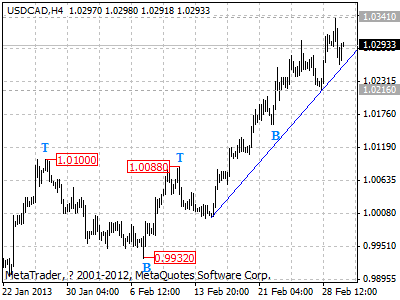
USDCAD stays above a upward trend line

USDCAD stays above a upward trend line on 4-hour chart, and remains in uptrend, the fall from 1.0341 is likely consolidation of the uptrend. As long as the trend line support holds, the uptrend could be expected to continue, and next target would be at 1.0400 area. On the downside, a clear break below the trend line support will suggest that lengthier consolidation of the uptrend from 0.9932 is underway, then deeper decline to 1.0225 area could be seen.

usdcad

Forex Signals

Do You Want to Be Right About Investing, or Do You Want to Make Money?

By MoneyMorning.com.au

You’ve got a choice: you can either be right, or you can make money.

Perhaps you’re wondering what the heck we’re talking about.

Of course you want to make money.

You’ll make money because you correctly predict something, right?

Unfortunately, that’s not always how investing works.

And we’ll explain why today. Because if you get this right, you can avoid one of the biggest mistakes most investors make…

Most investors and so-called experts like to predict things.

They like to give you a year-end target for the Aussie index, the Dow Jones or the FTSE 100.

They like to give you a target for the Aussie dollar.

They like to predict where gold, silver or iron ore will be twelve months from now.

And that’s fine. Heck, we enjoy making predictions too. It’s fun. It’s all part of investing. In fact if you don’t make predictions about the future you’ve got no business investing.

Investing without making predictions about the future is like driving with a blindfold…you wouldn’t do that, so why invest without thinking about the future?

The problem is most investors make a prediction about the future and invest accordingly, without really thinking it through. If this all sounds too complicated, let us explain…

The 2004 Bust That Never Happened

Back in your editor’s broking days during the 2003 to 2007 bull market we had a number of clients who were convinced the market was set to collapse.

Bear in mind that March 2003 was the bottom of the market following the dot-com boom that had turned to a crash three years before. The US had just invaded Iraq and investors assumed a quick ‘victory’ would spur another bull market.

It turns out the ‘victory’ wasn’t so quick. But that didn’t stop the market soaring…thanks to near-zero percent interest rates in the US. This helped the market get the credit-fuelled boom it was looking for.

The low interest rates, credit boom and certain technical indicators (Gann and the Elliot Wave as we recall) had these investors convinced the market would crash before another boom could get going.

And credit to these guys. They put their money where their mouth was and punted on a collapse. Most of them were pretty sensible about it. They knew it wouldn’t happen tomorrow or the next day, so they bought long dated put options on the US market.

By long dated we mean one year options. In investing that’s a long time. But in hindsight buying one-year put options in 2003, banking on a collapse in 2004…well, it wasn’t long enough.

You see, in one way these guys were right…they were absolutely right. And they were smart too. They were much smarter than 99% of the Wall Street and Martin Place analysts who didn’t see the crash coming.

These investors believed in sound money. They knew the US Federal Reserve was creating the mother of all asset bubbles. But despite being spot on about what would happen, they were absolutely wrong about how best to make money from it.

It’s all very well predicting an economic and stock market collapse, but what if the market hangs in there much longer than you think? That’s exactly what happened…

Don’t Miss the Opportunity of a Rising Market

To be honest, we had some sympathy with the investors who wanted to bet on a total collapse. In 2003 we just couldn’t see how the market would ever get back to the dot-com highs. It seemed like the era of growth was over.

But when the market started to grind higher, we also saw there was an opportunity to make money…regardless of whether we thought the boom was justified or not. Our biggest bet was on oil.

At the time oil was around USD$40 a barrel. Most people thought the oil price would fall as Iraqi oil came back online. We had a different view. We thought the trend would be higher as OPEC nations got a taste for high oil, and as the US encountered what we expected to be an energy crisis.

(Back then we hadn’t figured on the transformative impact of shale oil and gas.)

As you know, eventually the oil price hit USD$140 as Hurricane Katrina hit Gulf of Mexico oil production. But despite that disastrous event, world stock markets would go higher for another two years.

The point we’re making is this: you can be right about the future but still get the investing angle wrong if you don’t take all the market factors into account.

What the bearish investors didn’t take into account was the impact of low interest rates on the economy and mainstream investors. They didn’t bank on homeowners using their home as an ATM by borrowing to increase their disposable income.

And they didn’t take into account the impact that would have on corporate America…the increase in revenues, the increase in profits. They didn’t factor in the willingness of China to buy US government bonds that would allow America to keep spending and spending.

It was, for a time, a virtuous circle…until it became a death spiral when the market collapsed. But by then, even for those investors who made a profit as the market collapsed, it came nowhere near making up for the opportunity they missed by not buying into a rising market four years earlier…

Bragging Rights Aren’t Worth a Penny

Bottom line: we can’t know for certain, but it’s possible that the Aussie, US and European markets could keep going up for another one, two or three years. On the other hand they could collapse tomorrow.

That means if you’re pessimistic about the future you’ve got a choice.

You can cheer for it and be right when it happens (even if that’s three years from now). Or you can understand the lengths that central banks will go to make sure the collapse doesn’t happen on their watch.

Remember that Alan Greenspan worked his magic for nearly 20 years to avoid complete collapse. And despite the 1987 crash, the Dow Jones Industrial Average gained 367% while he was US Federal Reserve chairman.

It’s great to get a prediction right. You get a lot of bragging rights. Unfortunately, bragging rights aren’t worth much in retirement when you haven’t made a penny from investing.

So our advice is if you want to make money as an investor, put the bragging rights to one side and learn how to use the information available to you to make money from investing.

Cheers,
Kris

Join me on Google+

From the Port Phillip Publishing Library

Just Discovered: The Pangaea Bond

Daily Reckoning: When the Bernanke Bluff is Called

Money Morning: Why Aristotle Still Matters to Traders and Investors

Pursuit of Happiness: Exclusive: Your Eight-Point Wealth Protection To-Do List

Cheers,
Kris

Join me on Google+

What the US Sequester Means for Your Money

By MoneyMorning.com.au

Try as it might, Europe doesn’t have a monopoly on dysfunctional politicians.

Over in the US, squabbling politicians can’t agree on how to run the country’s budget.

Because of the way the US system works, that means we can expect any amount of disruptive brinksmanship in the year ahead, as each of the two parties tries to paint the other as the baddies.

It also means that you’re going to be hearing a lot about the ‘sequester‘ over the next few weeks (maybe months if we’re really unlucky).

So what is it? And more importantly, does it matter for your money?

The Story of the Sequester

In 2011, the Democrats and the Republicans were trying to hammer out a way to bring the US government’s finances back onto a sustainable path.

Like many developed nations, the US is spending more each year than it makes in taxes. Its current deficit – the annual overspend – is over $1 trillion. Its overall national debt is around $16.6 trillion.

As Robert J Samuelson notes in the Washington Post, depending on how you measure it, the debt-to-GDP ratio could be anything from 73% (if you take the most common measure) to more than 200% (if you include various government guarantees to the financial sector).

To put that into some perspective, sovereign debt experts Carmen Reinhart and Kenneth Rogoff suggest that an economy starts to run into real problems when a debt-to-GDP ratio rises above 90%. This is a very rough and ready theory. But the basic point is that the US – like lots of other economies – needs to start living within its means more.

But how do you do it? To cut a long story short, the Democrats would prefer to make ends meet by raising taxes. The Republicans would prefer to cut spending. And within the overall budget, there are lots of areas that are sacrosanct to one side or the other (like defence, or ‘entitlements’ spending).

In the end, they couldn’t reach a deal. So instead they put together a package of automatic cuts – the sequester – that would kick in if they didn’t reach a deal.

The idea was that the cuts would be so indiscriminate and uncomfortable for both sides, that politicians would feel forced to find a better way. This was always a long shot. Perhaps if the sequester had included a clause that would cut their own wages in half, they might have been more motivated. But oddly enough, that sort of measure never made it into the package.

As it is, they still haven’t reached a deal. $85bn is set to be cut from government spending this year. Over the decade, the cuts add up to $1.2 trillion.

So how much does this matter, if at all?

An Arbitrary Deadline that Won’t Be the Last

Markets certainly seem quite relaxed about all this. The Italian election rattled them, but there’s been no obvious panic about ‘sequestration’. There are a few good reasons for that.

Firstly, these cuts don’t happen all at once. This isn’t like the ‘fiscal cliff’. The last minute panic over that was to avert tax rises that would have taken effect immediately. The cuts will take place over several months. So there’s plenty of time for politicians to keep arguing.

Secondly, it’s not entirely clear what the eventual impact of the cuts will be.

Both the Democrats and the Republicans have every incentive to lie about the scale of the disruption, to make the other side look bad. Also, the departments affected by the cuts might change if a new deal is reached.

Thirdly, and more importantly, there’s a bigger deadline looming. On March 27th, the US needs to agree a budget for the year ahead or else the federal government could shut down altogether. The current optimistic hope is that both parties will be able to use this much more obvious deadline to come to some sort of compromise.

So markets probably won’t start to fret until closer to the end of the month. But as the March 27th deadline approaches, and it becomes clear that politicians will be arguing down to the wire, you can expect to see another fit of the jitters.

And then, beyond that, there’s the whole argument over the overall debt ceiling again. Which is what kicked the whole sequester deal off in the first place back in 2011.

What This Means for Your Money

There is unlikely to be a single catastrophic blow-up over the US government’s finances in the near future. And all the fighting just gives Ben Bernanke more of an excuse to keep the quantitative easing taps open.

However, it’s possible that individual sectors might end up running into trouble depending on where the cuts fall. Also, the latest US economic growth figures have been on the disappointing side. With more political gridlock ahead, it’s quite possible that companies and consumers will be feeling less upbeat in the months to come. There might be further growth shocks to come.

This might not be an issue if US stocks were pricing in the potential bad news. But they’re not. While European and Japanese stocks look cheap enough to discount many of the risks facing those regions, US stocks aren’t – indeed, they’re almost at record highs. So as usual, we’d suggest you stick with the cheaper markets.

John Stepek
Contributing Editor, Money Morning

Publisher’s Note: This article first appeared in MoneyWeek

Join Money Morning on Google+

From the Archives…

Gold’s Dark Hour Before Dawn
1-03-2013 – Dr. Alex Cowie

The Primary Colours of Investing
28-02-2013 – Kris Sayce

Revealed: Inside a Share Trader’s Den
27-02-2013 – Murray Dawes

Where to Find Value in this Rising Stock Market
26-02-2013 – Kris Sayce

China Bull Versus China Bear – There Can Only Be One Winner
25-02-2013 – Dr. Alex Cowie

The Global Economy, Ketchup and Gold

By MoneyMorning.com.au

It’s fair to say that the US economy is showing an improved heartbeat, compared with recent quarters and years.

There’s even the proverbial ‘big news’ on Wall Street. Last month, for example, Warren Buffet’s $23 billion take-over play for the H.J Heinz Co., an iconic food brand.

Is the Buffet play for Heinz a harbinger of better days ahead for stock markets generally, versus the future fortunes of the world’s flinty gold buyers? Even more optimistically, will this takeover play kick off the next nirvana for deal-makers?

Well, let’s give Herr Buffet credit for his excellent sense of timing. He’s a great picker of old-line companies with durable names, competitive advantages and predictable earnings. That’s Buffet’s gig, and he’s very good at this game.

Still, let’s take a clear look at what Buffet is buying. H.J Heinz is global, to be sure, but not really ‘international’ in the way that, say Boeing or General Electric arc across the world. That is, Heinz is mostly a trans-national collection of local facilities.

The basic business model for Heinz is to own food-processing factories in dozens of countries. Heinz buys into local and regional brands, across a multitude of nations, ethnicities and cultures.

Heinz then produces products derived from local agriculture, under tight hygienic standards, and emplaced into cans and bottles. In other words – and as the people who work at Heinz will be the first to tell you – it just doesn’t pay to ship tomato-flavoured water, in bottles and cans, all that far.

So Buffet buying Heinz is good news, in many respects, to deal-maker wannabes. Heck, any big deal is a good deal, as long as the bankers and lawyers get their fees.

Yet the Buffet-Heinz hook-up seems limited in scope. It reflects an evolving world economy at, literally, the grass-roots level. More and more people have more and more money to buy higher quality, branded food items from factories that are located not too far away. That’s good, but it’s not necessarily the signal for a new global boom.

How’s that Global Economy?

Aside from the market for beans and ketchup, how’s that global economy doing? I can’t help but ponder some strange bits of information I keep seeing.

For example, last year the German central bank asked the US Federal Reserve to arrange an audit of German gold on deposit in the US. The Fed people declined to permit that. Odd, right?

Then in January, the Germans asked for part of their gold hoard back from the Fed bank in New York. And despite the fact that there are plenty of armoured cars around, and many daily air flights across the Atlantic Ocean, it’ll take seven years for the Fed to make the gold transfer. Like I said, it’s strange. Or, not to put too fine a point on it, where’s the gold?

Here’s something else. Consider Russia’s Vladimir Putin, and his effort to acquire gold for the Russian central bank.

Under Putin, Russia’s central bank has added 570 metric tons of gold to its asset base over the past decade, a quarter more than runner-up China, according to data from the International Monetary Fund (IMF), as compiled by Bloomberg News. (China’s gold holdings are MUCH larger than they admit to, I suspect, which is the subject of a major new trend I’m developing.)

Just last year, in 2012, Putin made news when he stated that the US is ‘endangering the global economy’ by abusing its dollar monopoly. Perhaps it’s bluster, but then Putin is putting money where his mouth is.

Late last year, Putin instructed the Russian central bank not to ‘shy away’ from buying gold, according to a press release from the Kremlin. ‘After all,’ said Putin, ‘they’re called gold and currency reserves for a reason.’

Looking ahead, the Kremlin plans to keep on buying gold. According to Russia’s first deputy Alexei Ulukayev, ‘The pace [of gold buying] will be determined by the market.’ He added, with characteristic Russian secretiveness, ‘Whether to speed that [buying] up or slow it down is a market decision, and I’m not going to discuss it.’

Too Big to Sail

So could things change quickly in the precious metal markets? Could metal prices melt-up from the current levels? Yes, because human psychology can change quickly.

As a rule, people act on what they know. Right now, a lot of people seem to think that the world economic system is working alright. Buffet bought Heinz, right? Sure, the world economy could be better. But generally, the evidence indicates that the world economic system does the job, day to day. At least, goes the thinking, the economy is not falling apart.

Yet consider the passengers on last month’s ill-fated Carnival cruise ship that just pulled into Mobile harbor. Last week, everyone was looking forward to a nice, relaxing Caribbean vacation afloat. What could go wrong?

Then the ship had an engine failure. Within hours – certainly by the second day – people descended to pushing and shoving over stale onion sandwiches.

What do stale onion sandwiches have to do with the price of silver or gold? Well, do you usually eat stale onion sandwiches? Do you expect to eat stale onion sandwiches when you’re on a luxury cruise ship, with storage lockers below-decks, filled with provisions?

When things go awry, however, the previous rules go away. Yes, the cruise ship had food in the hold, but nobody could use it. There was no power to run the kitchen, let alone to cook and serve meals. People descended in a hurry, and gave the media a true spectacle.

What’s the analogy? Well, perhaps some of these new cruise ships are just too big to sail, in the same way that many large banks are too big to fail – until they actually fail. Then we can all fight over the stale onion sandwiches.

Byron King
Contributing Editor, Money Morning

Join Money Morning on Google+

From the Archives…

Gold’s Dark Hour Before Dawn
1-03-2013 – Dr. Alex Cowie

The Primary Colours of Investing
28-02-2013 – Kris Sayce

Revealed: Inside a Share Trader’s Den
27-02-2013 – Murray Dawes

Where to Find Value in this Rising Stock Market
26-02-2013 – Kris Sayce

China Bull Versus China Bear – There Can Only Be One Winner
25-02-2013 – Dr. Alex Cowie

Gold, Oil & the SPX Trends and Setups

By Chris Vermeulen, GoldAndOilGuy.com

Over the past year my long term trends and outlooks have not changed for gold, oil or the SP500. Though there has been a lot of sideways price action to keep everyone one their toes and focused on the short term charts.

As we all know if the market does not shake you out, it will wait you out, and sometimes it will do both. So stepping back to review the bigger picture each weeks is crucial in keeping a level trading/investing strategy in motion.

The key to investing success is to always trade with the long term trend and stick with it until price and volume clearly signals a reversal/down trend. Doing this means you truly never catch the market top nor do you catch market bottoms. But the important thing is that you do catch the low risk trending stage of an investment (stage 2 – Bull Market, Stage 4 Bear Market).

Lets take a look at the charts and see where prices stand in the grand scheme of things…

Gold Weekly Futures Trading Chart:

Last week to talk about about how precious metals are nearing a major tipping point and to be aware of those levels because the next move is likely to be huge and you do not want to miss it.

Overall gold and silver remain in a secular bull market and has gone through many similar pauses to what we are watching unfold over the past year. As mentioned above the gold market looks to be trying to not only shake investors out but to wait them out also with this 18 month volatile sideways trend.

A lot of gold bugs, gold and stock investors of mining stocks are starting to give up which can been seen in the price and selling volume for these investments recently. I am a contrarian in nature so when I see the masses running for the door I start to become interested in what everyone is unloading at bargain prices.

Gold is now entering an oversold panic selling phase which happens to be at major long term support. This bodes well for a strong bounce or start of a new bull market leg higher for this shiny metal. If gold breaks below $1500 – 1530 levels it could trigger a bear market for precious metals but until then I’m bullish at this price.  I think we could see another spike lower in gold to test the $1500- $1530 level this week but after that it could be off to the races to new highs.

GoldWeekly


Crude Oil Weekly Trading Chart:

Oil had a huge bull market from 2009 until 2011 but since then has been trading sideways in a narrowing bullish range. I expect some big moves this year for oil and technical analysis puts the odds on higher prices.  If we do get a breakout and rally then $130 will likely be reached. But if price breaks down then a sharp drop to $50 per barrel looks likely.

OilWeekly


Utility  & Energy Stocks – XLU – XLE – Weekly Investing Chart

The utility sector has done well and continues to look very bullish for 2013. This high dividend paying sector is liked by many and the price action speaks for its self… If the overall financial market starts to peak then these sectors should hold up well because they are services, dividend and a commodity play wrapped in one.

XLURally

XLERally 


SP500 Trend Daily Chart:

The SP500 continues to be in an uptrend which I am trading with until price and volume tell me otherwise. But there are some early warning signs that another correction or a full blown bear market may be just around the corner.

Again, sticking with the uptrend is key, but knowing what to look for and prepare for is important so that when the trend does change your transition from long positions to short positions is a simple measured move in your portfolios.

SPYTrend


Weekend Trend Conclusion:

In short, I remain bullish on stocks and commodity related stocks until I see a trend change in the SP500.

Energy sector is doing well and looks bullish for the next month. As for gold and gold miners, I feel they are entering a low risk entry point to start building a new long position. Risk is low compared to potential reward.

When the price of a commodity or index trade near the apex of a narrowing range or major long term support/resistance level volatility typically increases as fear and greed become heightened which creates larger daily price swings. So be prepared for some turbulence in the coming weeks while the market shakes things up.

If you like my work then be sure to get on my free mailing list to get these each week on various investments for investment ideas at www.GoldAndOilGuy.com

Chris Vermeulen