The Easiest Way to Get Big Gains with Limited Risk in Any Market

By MoneyMorning.com.au

‘We have two classes of forecasters: those who don’t know – and those who don’t know they don’t know.’ – John Kenneth Galbraith

The year of the American contagion, the year of chickens coming home to roost, the year of the bailout, 2008, went into history as a momentous time of tumultuous market moves in stocks, commodities, currencies and interest rates.

The year witnessed the onset of a worldwide economic panic with an assault on the global economic system and our form of democracy. The forces of deflation and inflation continue to slug it out in a titanic struggle for dominance. We’ve managed to navigate the stormy seas with a steady hand on the tiller. One of the keys to our success is keeping a sense of perspective.

I’d like to share some seemingly impracticable musings you may find useful.

Some Cautionary Tales on the Market

In 2008, volatility skyrocketed beyond belief. Most market participants, even professionals, were caught by surprise. Big money was made and lost, both up and down, with astonishing speed.

It’s long been known speculators make their fortunes from changing prices, and leverage is an important tool for speculators. Leverage involves using OPM (other people’s money) to try to make more money than you can with your own funds.

Using OPM may augment your reward when you are right, but it may also greatly accelerate the risk of additional loss when you are wrong. That’s the aspect of leverage that so many forgot during the heady times of money trees growing to the sky.

Even some of the market’s smartest participants are done in by blind arrogance. The famous story of the 1990s rise and fall of hedge fund giant Long-Term Capital Management, excellently chronicled in Roger Lowenstein’s When Genius Failed, comes to mind.

That cautionary tale is particularly apropos to today’s enduring financial crisis. Successful trades blinded the firm’s brilliant partners to the possibility of failure, ultimately sealed their fateful demise and threatened the stability of the entire financial system.

Leave Your Ego Behind

In this business, I believe you are better served by checking your ego at the door. Having a complete game plan includes preparing for the worst in every trade. Remember to always speculate based on what you can lose, not what you can gain.

Applying sound money management principles (such as never adding to a losing trade) allows you to stay in the game and avoid being knocked out through inevitable times of losing trades.

If you have anticipated the possibility of loss and are prepared to withstand it, no matter the severity – because you positioned always with known and completely limited-risk vehicles – never be surprised when the market moves against you.

People invariably ask me what I think the market is going to do. I always say that if I knew what the market was going to do, I wouldn’t have to work. Use technical levels of support and resistance to set your exit strategy for each trade.

Make sure that you or your broker monitor your positions closely. The market doesn’t ring a bell when it’s time to get out. Have your plan in place ahead of time and you can smile, laugh, take your profit a step ahead of the crowd and enjoy your accomplishment with a sense of wonder. No matter your success, always be surprised when the market goes your way.

So, like me, never be surprised and always be surprised. Don’t forget that forecasters, even those with good reasoning and strong opinions, are practitioners of uncertainty. That view will serve you well. I hope you found the above mentioned thoughts helpful and wish you all good fortune as you vie for fun and profit for the rest of the year.

Steve Sarnoff
Contributing Writer, Money Morning

Publisher’s Note: This article originally appeared in Penny Sleuth

Join Money Morning on Google+

From the Archives…

Why the Stock Market Boom is on Pause
8-03-2013 – Kris Sayce

Why the Dow Jones Record High Doesn’t Matter
7-03-2013 – Murray Dawes

Taking China’s Economic Pulse from Hong Kong
6-03-2013 – Dr Alex Cowie

Buy Gold When They’re Crying…Sell Gold When They’re Yelling
5-03-2013 – Dr Alex Cowie

Do You Want to Be Right About Investing, or Do You Want to Make Money?
4-03-2013 – Kris Sayce
New Zealand holds rate and sees steady rate through 2013

By www.CentralBankNews.info     New Zealand’s central bank left its Official Cash Rate (OCR) unchanged at 2.5 percent, as expected, saying the country’s economic recovery was uneven with both upside and downside risks so it expects to keep the key rate steady for the rest of the year.
   The Reserve Bank of New Zealand (RBNZ), which has held its rate steady since March 2011, said demand and output was expanding with rebuilding from the Canterbury earthquake gaining momentum and residential investment and business and consumer confidence was rising.

    “House price inflation is increasing and the Bank does not want to see financial stability or inflation risks accentuated by housing demand getting too far ahead of supply,” the RBNZ said.
   However, the the labor market remains weak and the “overvalued New Zealand dollar is undermining profitability in export and import competing industries, and worsening drought conditions are creating difficulty in much of the country,” the bank said, adding that fiscal consolidation will also slow overall demand.

   “There are both upside and downside risks to this outlook. At this point we expect to keep the OCR unchanged through the end of the year,” the RBNZ said, quoting its governor Grame Wheeler.
    New Zealand’s inflation rate was 0.9 percent in the fourth quarter of 2012, close to the third quarter’s 0.8 percent and the second quarter’s 1.0 percent.
    The RBNZ targets inflation of 1-3 percent.
    New Zealand’s Gross Domestic Product expanded by 0.2 percent in the third quarter from the second for annual growth of 2.0 percent, down from the third quarter’s 2.6 percent.

    www.CentralBankNews.info

Kenya holds rate to let cuts work, election aids confidence

By www.CentralBankNews.info      Kenya’s central bank held its Central Bank Rate steady at 9.50 percent to give last year’s rate cuts time to stimulate the economy and said there were still risks to the economic outlook and price stability.
    The Central Bank of Kenya (CBK), which cut rates by 700 basis points in 2012 starting in July, said inflation had stabilized within the government’s 5 percent target range, the exchange rate was stable and the peaceful election should further enhance confidence and optimism about 2013.
     Kenya’s inflation rose by 0.7 percent in the month to February, pushed up by higher prices of food and non-alcoholic beverages, to an annual rate of 4.45 percent from January’s 3.67 percent.
    Inflation that excludes food and fuel, and thus measures the impact of monetary policy, declined from to 4.46 percent from 4.51 percent, the CBK said.
    “The predicted favourable weather conditions coupled with non-inflationary credit growth are expected to offset the impact of rising international oil prices, and hence support a low and stable short-term outlook for inflation,” the bank said.
    Kenya’s  Gross Domestic Product grew by 2.2 percent in the third quarter from the second for annual growth of 4.7 percent, up from 3.3 percent in the second quarter.
    Kenya’s economy is bouncing back from the central bank’s aggressive rate hike campaign from 2011 to mid-2012 to combat inflation. Private sector credit growth maintained its upward trend with annual growth in private sector credit up by 11.95 percent in January from December’s rate of 10.42 percent.
     The central bank’s market perceptions survey from last month showed that the private sector expects inflation and the exchange rate to remain stable in the rest of this year and “sustained optimism for a strong growth recovery in 2013 on account of the prevailing macroeconomic stability and enhanced confidence in the economy following a peaceful election,” the CBK said.
    Despite the positive developments, the central bank said the risks to the outlook stem from the renewed upward drift in international oil prices and a weak outlook for the global economy with the expectation of a more pronounced recession in the euro zone and a slow recovery in the United States.
    “This outlook, coupled with the persistent balance of payments pressure due to the high current account deficit remain a threat to the general stability of prices,” the bank said.
   
    www.CentralBankNews.info

American Silver Eagles: Demand So High the Mint Ran Out

By Investment U

In an interview in January 2012, I took some flak from a number of people in the local gold industry.

I said of gold, “Now it’s like any other commodity and is subject to speculation… When you have more speculating taking place, what’s really driving the price becomes murkier, and you get into the situation where there’s a possibility for bubbles… It’s no longer a safe haven…”

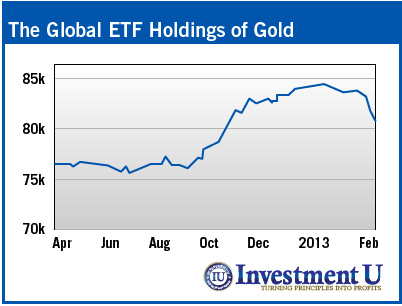
I told the reporter: Watch the outflows of precious metals exchange-traded funds (ETFs). When the liquidating begins en masse, there starts to be nothing left propping up the price of precious metals. That means investor demand is waning.

I said this is the first of many red flags.

This was rejected by other “experts.” Gold is only going to go higher and higher, they claimed…

Thirteen months later, the price of gold is down 10.96% since the end of January 2012 and 16.83% from its peak in August 2011.

Investor demand for gold has fallen 10%.

In February, gold ETFs liquidated a record 109.5 tonnes. This represented 4.2% of their holdings, and the largest single-month percentage liquidation since April 2008.

In the fourth quarter of 2012, gold demand from ETFs – which have represented 9% of total gold demand over the last five years and 17.3% of investor demand over the last four years – fell by 16.3 tonnes.

And it’s an international phenomenon, not just limited to the United States.

When ETFs are selling gold – not buying – it’s a bearish signal.

A Buying Spree in Silver Eagles

But there’s a divergence taking place…

The pullback in precious metals prices, combined with uncertain sentiment about the economy, is sparking a buying spree in one investment instrument for precious metals…

Coins.

In fact, demand is so enormous that in mid-January, the U.S. Mint actually had to briefly suspend sales of American Eagle silver coins because it ran out.

And sales of gold coins surged to levels not seen since July 2010.

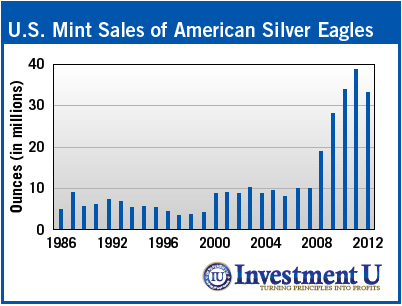
The past two Januarys for the U.S. Mint have been record-shattering. In January 2012, sales of silver coins hit an all-time high of 6.1 million ounces. The record was short-lived though, as the mint sold 7.1 million ounces in January 2013.

An increase of 16.39% from January to January.

What’s surprising is that the majority of sales are in the form of the box of 500 one-ounce silver coins the mint offers. Investors can’t get their hands on enough of them. And it smells of stockpiling, either for the apocalypse or financial collapse.

It’s part of an interesting trend we’ve seen the last couple of years.

In 2012, sales of silver coins popped in January and then fell sharply and flattened out for much of the year. The pace picked up in the fall but eventually hit a roadblock in December… The mint ran out of its stock and announced there would be no more coins minted until 2013.

This led to a build-up in demand that took shape with January’s record-breaking results. And it carried over into February, where sales of both gold and silver coins – though about half of their January totals – were double what they were in February 2012.

And silver has been the metal of choice for a good stretch.

Before a decline in 2012 of 15.37%, the U.S. Mint set four consecutive years of record-breaking silver coin sales. As you can see from the chart above, the increase in sales is pretty astronomical.

On the other hand, the sale of gold coins continues its trend downward, falling every year since its last peak in 2009.

Sales of gold coins from the U.S. Mint tumbled 24.70% in 2012.

One of the attractive things about minted coins is they have collector value, not just precious metals value… Though with sales of coins from the U.S. Mint at such high levels, it’s hard to imagine those coins appreciating much in the near-term.

Value on those types of items come from scarcity, quality and limited supply.

Good Investing,

Matthew

Article By Investment U

Source: American Silver Eagles: Demand So High the Mint Ran Out


Real-Forex Market Analysis 13.3.2013

Forex Daily review brought to you by REAL FOREX | www.Real-forex.com

EUR-USD
Date: 03/12/2013 Time: 18:09 Price: 1.3031
Strategy: Short / Long
Graph 4 hours
Quote previous review:
Again the price has climbed to the upper lip of the parallel descending channel (broken red line), which was blocked at the level of 1.3100 and went back down to the level of support at 1.2967. Another breaking level of 1.3100 will,most likely, continue going north towards the next resistance level untilan outbreak of 1.3166level appears, whichwill certainly lead to the next resistance level of 1.3265, a level which is also a 38.2% Fibonacci correction on the last downtrend (described by the black broken line). However, a level of 1.2967, will initially support the price levelsin the areaof 1.2880 (you can see the daily chart).
Current Review today:
The price couldn’t break into the top lip of the parallel descending channel, when another attempt today ended in a long “cord” down and back again to the middle range position. Another breaking of the level of 1.3100will, most likely, continue going north towards the next resistance level of 1.3166, thatmight lead the next resistance level of 1.3265, a level which is also a 38.2% Fibonacci correction on the last downtrend, described by the black broken line. However, breaking of the price at the level of 1.2967, will initially support the levels around the 1.2880 (you can see the daily chart).
You can see the graph here:
GBP-USD
Date: 13/03/2013 Time: 18:22 Price: 1.4886
Strategy: Short
Graph 4 hours
Quote previous review:
The pair continues its determination to step down,while all rising attempts are being only a technical correction attempts during continues descent before. As long as the falling price structure doesnotchanges, it is most likely that it is on its way towards the bottom lip of adescending parallelchannel (described by the fragmented red lines).
Current Review today:
Again, during the last trading day, the price went lower thanprevious lows were created and nowthe price fails to raise above the moving average of the Bollinger bands. Every move increases a technical correction during the last descent before it, and as long as the falling price structure doesn’t changes, it is most likely,that it’s beingon its way to the bottom lip of the parallel descending channel (described by the fragmented red lines).
You can see the graph here:

Gold “Being Strongly Influenced by Technicals”, Grillo Tells Germans: “Italy is Already Out of the Euro”

London Gold Market Report
from Ben Traynor
BullionVault
Wednesday 13 March 2013, 08:15 EST

U.S.DOLLAR gold prices ticked higher to $1597 per ounce Wednesday morning, holding gains from a day earlier, as the Dollar fell against the Euro despite warnings from a prominent Eurozone policymaker that the crisis in the region is not over.

Gold in Euros rose to its highest level this month at €1229 an ounce, in contrast with gold in Sterling, which failed to move back above £1070 an ounce as the Pound recovered some ground against the Dollar after hitting a fresh two-and-a-half-year low yesterday.

Silver dipped briefly below $29 an ounce this morning before rallying 20¢, while stock markets ticked lower, commodities were broadly flat and US Treasury bonds gained.

A day earlier, gold climbed above $1590 an ounce for the first time in March Tuesday after Bundesbank chief Jens Weidmann said he does not believe the Eurozone crisis is over.

A number of analysts have suggested the speed of yesterday’s move reflected so-called short covering of gold positions, whereby traders who have bet on the price of gold falling cover themselves as it rises by taking bets in the opposite direction i.e. buying gold.

“The price rise yesterday will not sustain as there was no major change in fundamentals,” reckons Jinrui Futures analyst Chen Min in China.

“We’ll see strong influence from technicals on prices as there isn’t much data on the plate this week.”

Speaking publicly again Wednesday, Weidmann told an audience in Cologne that European governments are “not giving clear direction” and reiterated yesterday’s comments that an end to crisis “is not in sight”.

Weidmann also said it does not make sense “to speculate about individual countries leaving the Euro area”, having been asked about a comment from a German politician last week who suggested Italy may exit the single currency.

“In fact, Italy’s already out of the Euro,” Italian comedian-turned-politician Beppe Grillo, whose Five Star movement won the biggest share of the vote in last month’s Italian election, says in an interview published by German newspaper Handelsbaltt Wednesday.

Northern European countries, he adds, will keep Italy in the Euro “until they are able to get back the funds their banks invested in Italian government bonds. Then they will drop us like a hot potato.”

China can only invest around 1% to 2% of its foreign currency in gold as the market is too small to invest any more, the deputy governor of the central bank and head of the State Administration of Foreign Exchange (SAFE), Yi Gang, told reporters Wednesday. Yi added however that gold is always an option for China.

In January, SAFE created a new unit, the SAFE Co-Financing office, tasked with exploring new investments through which to diversify China’s $3.3 trillion of foreign exchange reserves.

Two percent of this would equate to just under 1300 tonnes of gold at today’s price, more than the 1054.1 tonnes the World Gold Council reports in its latest World Official Gold Holdings. China however does not regularly report when it adds to its official reserve, and has not reported how much gold it holds since 2009.

China’s Renminbi currency, along with Australian assets and gold, “emerge as the most important assets for diversification” for central bank reserves, according to a report published this morning by the World Gold Council.

Using portfolio optimization analysis the authors of the report, ‘Central bank diversification strategies: rebalancing from the Dollar and the Euro’, found that “gold received a prominent 8% allocation, surpassing the 4% allocation to Renminbi and 3% to Australian assets.

“Gold’s allocation,” the report adds, “was matched only by Japanese Yen which was also weighted at 8% of the optimized portfolio.”

The latest World Official Gold Holdings shows that the top three nations by size of official gold reserves, the US, Germany and Italy, have 75.6%, 72.7% and 72.2% of their reserves as gold respectively.

Ben Traynor
BullionVault

Gold value calculator   |   Buy gold online at live prices

Editor of Gold News, the analysis and investment research site from world-leading gold ownership service BullionVault, Ben Traynor was formerly editor of the Fleet Street Letter, the UK’s longest-running investment letter. A Cambridge economics graduate, he is a professional writer and editor with a specialist interest in monetary economics. Ben can be found on Google+

(c) BullionVault 2013

Please Note: This article is to inform your thinking, not lead it. Only you can decide the best place for your money, and any decision you make will put your money at risk. Information or data included here may have already been overtaken by events – and must be verified elsewhere – should you choose to act on it.


Is Bitcoin a Viable Currency?

By Robby Brookings

The viability of bitcoin is the question on many interested people in the world of finance, politics and technology. Bitcoin exists at an interesting crossroads where the three worlds collide.

If bitcoin were to sustain any amount of viability into even the near future it could be a game changer for the global currency markets and the financial world as a whole. Since bitcoin has a fixed volume that is estimated to be fully in public circulation by the year 2040 it could not be easily manipulated. The price of goods could fluctuate but the supply of bitcoins would not fluctuate.

A good analogy is the US federal government’s ability to run deficits that contribute to their debt and then monetize that debt with money created out of thin air. This practice destroys the value of the currency and it is done on an ad hoc basis. There is no long term plan on when to stop the monetizing of the debt, only loose targets for employment and inflation. So that is the situation where the US dollar finds itself. Bitcoin however is more akin to how individual states inside of the United States are forced to balance their budgets or borrow money by issuing bonds. The bonds need to be paid back on time or it may hurt their ability to receive reasonably priced loans in the future.

If bitcoin where to play a major role in the world, governments and private citizens alike would have to operate within the money supply that is provided. Governments would not have the ability to pay down debt with devalued currency. The value of the currency would be driven solely by the market. Once the entire bitcoin money supply was in circulation there is a decent likelihood that bitcoin could achieve a level of stability. Bitcoin would force any entity whether it be governments or private citizens to think twice before going into debt to live outside of their means. The reason being that currently as the world reserve currency is on a perpetual slope of decreasing value as a result of inflationary policy at the Federal Reserve and US Treasury. When the currency had the ability to go either towards inflation or deflation any borrower runs the risk of being forced to pay back their loan with more expensive money.

The key is that direct manipulation as it exists now would be impossible. The currency markets would be driven solely by wider market forces and not just the latest news out of the Federal Reserve, European Central Bank, Bank of Japan and the Bank of England.

About the Author

If you are interested in the latest bitcoin updates you can go to http://miningforbitcoins.com.


Central Bank News Link List – Mar 13, 2013: China PBOC Zhou: To use policy to stabilize prices, expectations

By www.CentralBankNews.info

Here’s today’s Central Bank News link list, click through if you missed the previous link list. The list comprises news about central banks that is not covered by Central Bank News. The list is updated during the day with the latest developments so readers don’t miss any important news.

    Is Bank of America (BAC) Truly “A Must Own Stock” for 2013?

    By WallStreetDaily.com

    Holy smokes, Batman. Meredith Whitney is at it again!

    You’ll recall, she’s the banking analyst who infamously predicted in an interview with “60 Minutes” that “hundreds of billions” of dollars in municipal bond losses would occur in 2011.

    She was way off the mark, though. Only about $3 billion in losses was actually reported. So we gave her the honor of making The Worst Prediction of 2011.

    Well, fast forward to today, and she’s dusting off her crystal ball again – on Bloomberg Television, no less. This time around, she’s predicting that “Bank of America (BAC) is the stock to own this year.”

    Is this just another attention-grabbing media stunt? Or a bona fide prediction that we should consider acting on? My answer might surprise you…

    The Only Smart Way to Invest

    First things first, I need to confess that my crystal ball doesn’t always work, either. So I can’t be too tough on Whitney.

    Take, for instance, my call back in August 2011 that Bank of America was a screaming “Buy” on the heels of Warren Buffett’s investment.

    By the end of the year, shares dropped almost another 30% in value.

    Of course, I did double down on my erroneous call, saying that Bank of America would “rally mightily in 2012.” And it did. In fact, it ended up being the top-performing stock in the Dow Jones Industrial Average last year, rising 109.5%.

    I bring this up not to brag. Instead, I want to put Whitney’s call into perspective.

    It’s more about momentum than boldness. And based on the results of our own personal “stress test” on Bank of America, I’ll concur with her that the momentum will most likely continue. But I don’t agree with her on how to profit from it. (More details on that in a moment.)

    First, let’s cover the six reasons why I expect the bullish trend to continue for Bank of America in 2013…

    ~Reason #1: First in, First Out

    The banks got us into the financial crisis. So it stands to reason that they need to lead us out, too. That recovery is undeniably underway. But given the severity of the downturn, we still have a long way to go.

    Just look at Bank of America’s results. In the six years leading up to the recession, it averaged about $14.5 billion in net income. Over the last 12 months, though, the company’s net income checked in at roughly $5.5 billion. By that metric alone, profits need to more than double before we’re back to pre-recession averages. And since share prices ultimately follow earnings, it’s not a stretch to expect that shares could double again, too.

    ~Reason #2: Top of the Tier

    Bank of America has engaged in an aggressive effort to shore up its finances by restructuring, cutting costs and selling off assets. In fact, the company remains on track to shed $8 billion in annual costs by mid-2015.

    The end result? Its Tier 1 Capital Ratio, which is the industry standard measurement of financial stability, currently ranks at the top of the list for the nation’s largest banks, at 9.25%. So if we’re betting on a banking recovery, it makes sense to bet on the bank that’s the strongest financially, right?

    ~Reason #3: A Building Recovery

    We can all agree that the residential housing market is recovering. It’s still in the early stages, though. So as consumers refinance and take out new mortgages, banks stand to book even more profits. In other words, the housing market is finally switching from being a hindrance to a help in terms of banks’ profitability.

    ~Reason #4: Still on Sale

    Even after the impressive run-up last year, Bank of America’s stock represents a good bargain. The forward price-to-earnings (P/E) ratio of 9.4 is 32.4% less than the forward P/E ratio for the average stock in the S&P 500 Index.

    As Stephen Weiss of Short Hills Capital notes, the stock is “still” cheap on a price-to-book (P/B) basis, too. Shares currently trade at about a 40% discount to the industry P/B ratio.

    ~Reason #5: Institutional Support

    When it comes to investing, I typically advise against betting with the crowd. The one exception? When the crowd is heavy-hitting institutional investors. The size of their bets provides much-needed support to share prices.

    If you have any doubt, just ask Apple (AAPL). New data from Reuters suggests that the massive drop in Apple’s share price in the fourth quarter was precipitated by big hedge funds selling out of their positions.

    In Bank of America’s case, however, institutional investors are mostly doing the opposite. For instance, Europe’s largest hedge fund, Lansdowne, purchased 26.5 million shares in the fourth quarter, according to regulatory filings. Both Adage Capital Management LP and Arrowstreet Capital LP purchased 14.7 million more shares. The list goes on.

    It’s also important to note that these purchases came after the stock rose 55% in the first three quarters of 2012. It stands to reason that hedge funds wouldn’t be making such sizeable bets in recent months unless they expected much more upside ahead. Any additional purchases promise to provide an additional boost to share prices, too.

    ~Reason #6: Dividends, Please

    Retail investors’ love affair with dividend-paying stocks continues to heat up. And if Bank of America increases its dividend this year, which is a strong possibility, it could lead to a massive influx of dividend investors.

    The trick, of course, is being positioned ahead of any such moves.

    Buying Shares isn’t Enough

    To be fair, risks remain for Bank of America’s business. Like unknown settlement costs for past mortgage practices, continued deleveraging by consumers and historically low interest rates, which squeeze profit margins.

    No doubt, such factors prompted some institutional investors to take their profits and run. In the last quarter, hedge fund, Perry Corp., sold out of its entire 7.5 million-share position.

    Meanwhile, other investors, like Boston-based Geode Capital Management LLC, pared back their holdings by about 10%.

    On the whole, though, the investment case for Bank of America remains much more bullish than bearish.

    Whitney expects the stock to top $15 per share in the next six to nine months. I think that’s a conservative estimate. But let’s go with it anyway. Doing so implies that the stock carries about a 25% upside to current prices.

    I’m sorry. But that’s not enough profit potential to earn a “must own” distinction from yours truly.

    Bottom line: Forget simply buying Bank of America’s stock, as Whitney suggests. If you want to profit from this momentum trade, I recommend buying just “out-of-the-money” LEAPS options, instead.

    Doing so involves tying up about 90% less capital. So it limits our downside and frees up capital to invest in other compelling opportunities.

    At the same time, it also increases our profit potential by putting the power of leverage to work in our favor.

    Less risk and more potential profits? Who doesn’t want that?

    Ahead of the tape,

    Louis Basenese

    Article By WallStreetDaily.com

    Is Bank of America (BAC) Truly “A Must Own Stock” for 2013?