Three Banking and Retirement Scams To Look Out For

By MoneyMorning.com.au

Let us tell you about three banking and retirement scams the Australian government is getting ready to inflict on you. Two are already in operation and a third is in the works.

Australian savers, investors and retirees are about to be slapped about by our country’s two biggest institutions. The banks and the Australian government are both going to take a swipe at your savings. And there’s even more swiping to come. Below, you’ll find out exactly how this is going to happen, and what you can do about it.

Scam Number 1 – The Bank Account Scam

You expect the government to steal some of your income in income taxes. And you know it takes 10% of your money when you spend it too. When you invest and when your business makes money, the government takes another cut. Heck, even if you leave your money in a savings account, the government will tax the interest.

But you don’t expect the government to simply take all the money out of your bank account just because you haven’t used it recently. Believe it or not, that’s exactly what’s about to happen.

From May 31st, any bank account which has been inactive for three years can be raided by the government. The legislation making this possible was rushed through the parliament and includes all accounts with more than $1 in them. You can keep the change. The raid could take up to $109 million of Australians’ money.

Here’s what one subscriber sent to our feedback inbox:


‘Got a letter from St George today about a bank acc…that has not been operated on for just under 3 years. Will transfer to the gov coffers if I do not operate on it before the three years are up. Gov obviously desperate for money. Imagine the hassles, time wasted, and public teat time and cost in getting your money back.’

It’s time to go digging through your old paperwork for any old accounts you might have forgotten about. If you find any, it’s time to withdraw or deposit a dollar to keep the account active. Also, let your family and friends know.

If you’re sceptical you could be hit, keep in mind that $109 million is going to come from somewhere. Chances are, the big losers of this will be Australians living overseas who kept an account open here. They’ll return to find it empty.

Scam Number 2 – The Retirement Scam

The government isn’t just raiding ordinary bank accounts. It’s also raiding retirement accounts.

Forcing someone to deposit 9% of their income into an account the government later gets to raid is audacious even for politicians. But that didn’t stop them from scheduling their first raid for the 31st of May. Yes, that’s the same day as the bank account raid.

For now, only inactive bank accounts with less than $2000 can be raided. That’s still an impressive $760 million at stake.

Scam Number 3 – Retirement Scam Stage 2

The political genius of the retirement system is that it creates a huge pool of money for politicians to play with. They can force you to invest certain amounts in certain ways and siphon off funds as needed. That sounds harsh, but once again, it’s all real.

The latest plan is to increase Super contributions from 12 to 15 percent, and then allocate that money to something other than your retirement pot!

The Australian newspaper reported that, ‘Mr Keating…said the additional money raised by increasing [the] compulsory guarantee from 12 to 15 per cent should be paid into a government “longevity insurance fund” which would be used to help fund the retirements of people over 80.’

If you don’t live past 80, tough. Someone else gets your money.

Not only that, an accounting body recently issued ‘… a warning that the system could collapse if retirees are given too much freedom in how much money they spend’. Yes, the government took your money for safe keeping and now you don’t even get to choose how you spend it.

Here’s what the accountants are worried about: People are so indebted, even by the time they retire, that retirees will take lump sum payouts and use the cash to pay off their debts. That will leave them with no income from their investments, putting a bigger burden on the pension.

If you want to join Kris Sayce’s protest about all this, you can sign his petition here. But you can also fight back in other ways…

You Have One Big Advantage

It’s frustrating that there isn’t more outrage over these thefts. You should do what you can to protect yourself and your friends and family. But in the end, there’s a different front you can fight on, with much greater consequences. That’s what we want to tell you about later in the week.

You see, the government can only make incremental changes to banking and retirement laws without causing public outrage. But you can pick a fight on the things that really matter. And few financial decisions matter more than your mortgage…

Nickolai Hubble.
The Daily Reckoning Weekend Edition

Join me on Google+

From the Port Phillip Publishing Library

Special Report: Australia’s Energy Stock BLOWOUT

Daily Reckoning: Hugo Chavez, RIP

Money Morning: A Small-Cap Speculator’s Delight

Pursuit of Happiness: Can You ‘Pygmalion’ Your Finances?

REVEALED: One Opportunity to Escape Your Mortgage

By MoneyMorning.com.au

The Aussie banks and the Australian government have made a crucial mistake. One that could turn out to be very profitable for you. It’s a huge opportunity for Aussie battlers to get their own back by enforcing their rights against two of the biggest bullies in their financial lives.

This opportunity could see you burn your mortgage decades before you hoped to, without having to sell your house. Yes, that’s hundreds of thousands of dollars in debt…gone.

We’ve just finished recording a controversial video presentation that reveals exactly what you need to do to find out if you can take the banks to the cleaners. You can watch it later this week.

Why should you find the time to see us explain all this to you on camera?

Simply: this story is HUGE…

Could You Cancel Your Mortgage?

You see, in their rush to churn out mortgages as fast as possible in order to earn commissions, some lenders made a big mistake. They altered people’s financial details on seemingly unimportant loan paperwork to get them past lending standards.

In our brand new video presentation, released later this week, you’ll be able to see for yourself exactly what’s been going on. But for now you should know that the initial victims of this fraud have unwittingly exposed an opportunity for wronged Aussie borrowers to cancel or reduce their loans. And yes, they get to keep their house.

If it seems like this couldn’t apply to you, you should definitely watch the video to find out just how widespread this problem is. It’s the biggest source of feedback we’ve been getting lately, all from readers who were willing to find out if the opportunity applied to them.

The government and financial world’s arcane rules and manipulations are enough to make your head spin. But they also create opportunities. No opportunity is as big as the one presented by Australia’s mortgage fraud scandal.

Keep an eye out later this week for the step by step guide you need to find out if you can cancel your mortgage too.

(In the meantime don’t forget to check out the latest analysis from our trading expert Murray Dawes. In this report he reveals what he calls the ‘Market Matrix’ and the impact it could have on your investments. Check it out here…)

Of course, we’re well aware that big financial scandals are losing their power to shock. So maybe the thought that bankers and brokers are fiddling mortgage application paperwork is no big surprise to you.

And maybe it’s no surprise to learn that this is just one way those in a position of power are looking to manipulate, embezzle and acquire the fruits of your hard work and saving.

Let us tell you about three more thefts the government and banks are getting ready to inflict on you. Two are already in operation and a third is in the works.

Nickolai Hubble.
The Daily Reckoning Weekend Edition

Join me on Google+

From the Port Phillip Publishing Library

Special Report: Australia’s Energy Stock BLOWOUT

Daily Reckoning: Hugo Chavez, RIP

Money Morning: A Small-Cap Speculator’s Delight

Pursuit of Happiness: Can You ‘Pygmalion’ Your Finances?
The Best Gold Stock Advice to Ignore

By MoneyMorning.com.au

Every year since 2007, bank and brokerage analysts have as a group predicted that the gold price would fall, sometimes dramatically, over the next four-year period. That’s not merely bad advice; that’s flawlessly bad advice.

Bank and brokerage analysts certainly know their sectors. But when it comes to helping you make an informed decision about where the gold market is headed, they have ‘a record unblemished by success,’ as resource stock expert, Rick Rule, is fond of saying.

Every year, major banks and brokerage houses provide their four-year forecasts for the gold price. The following chart documents the average price projection of 25 top analysts over the past seven years, many of whom specialize in the resource industry. I might suggest pushing away from your desk so that when your jaw drops it doesn’t hit the keyboard.

In 2007 the consensus of all estimates was that gold would decline from US$656 to US$523 by 2011. Instead, the gold price rose 140% to an average of US$1,572 that year. The consensus has issued similarly errant forecasts every year since then. So far, they’ve been wrong every time.

Some Big Implications on Gold

For the most part, these are analysts who do nothing but study the resource markets all day long. It’s their job. No one gets it right all the time, but this kind of track record is embarrassing.

The obvious lesson for investors is to ignore price predictions from the major banks and brokerage houses – they just don’t get it. I’m sure most readers of this publication already know that.

However, there’s a much bigger implication of this data that may not immediately come to mind…

  • Why would I as a fund manager or institutional investor buy a gold stock if my analysts tell me the price of gold is going to fall?

    Answer: I wouldn’t.

    If the price of the product a company sells is expected to decline over the next few years, would you buy the company’s stock? Its earnings are almost certain to fall. As a manager of millions (or billions) of dollars, you wouldn’t buy any investment with this kind of outlook.

    There’s more. These same banks and brokerages have also been predicting the price of oil would rise (almost) every year. While they’ve occasionally been right about that, it means that margins for the gold producers would be expected to fall, since roughly 10% of their costs are related to fuel. So again…

  • Why would I as a fund manager or institutional investor buy a gold stock if my analysts tell me profit margins are expected to fall?

    Answer: I wouldn’t.

    It doesn’t matter that analysts have been consistently wrong. What matters is that if the institutional world believes the gold price is likely to decline and/or that margins are likely to fall, they’re not going to stick their necks out and buy gold stocks. They could lose their bonuses or even their jobs if their analyst’s predictions came true and they’d bet against them.

    This could be the explanation for why hedge funds, institutional investors, and other large investors haven’t entered this market en masse, and could also account for the disconnect between the price of gold and the trajectory of gold stocks.

    But once the facts sink in and the institutional world becomes convinced gold and silver prices will maintain a sustainable uptrend, they’ll be much more attracted to the equities – and just as stubborn about changing their minds once they’re on board.

    Now, it’s possible this group may have to be beat over the head by relentlessly rising precious-metals prices before they enter the sector. They’ll have to believe that, say, gold hitting US$1,900 again isn’t a temporary fluke but a sustainable uptrend.

    I don’t know what price the metal would have to maintain or how long it would have to stay there before they’d jump on board. Given the above chart, I think it’s safe to say they won’t be the first to the party.

Position for When the Gold Herd Comes

Whenever and however it happens, though, the stampede from institutional investors into this tiny industry will be sudden and dramatic, because they tend to have a herd mentality. No one wants to be left behind. Just like they don’t want to risk buying something all their colleagues are ignoring now, they’ll rush to own the popular and exciting investment when gold stocks have their day.

The consequence of this group-think will result in dramatically higher stock prices. How high? Well, ‘fair value’ for Newmont Mining (NEM), based on its reserves, would be about US$200/share (it’s currently trading around US$40). And that’s at US$1,700 gold – as the spot price rises, the value of NEM will rise exponentially, since the gold price would be rising faster than costs.

That is why I’m excited about the producers. It’s the first place the institutional world will turn when gold makes a sustained move higher.

Come the day those investors believe gold is about to become part of the monetary system, that bonds are no longer a safe place for money, that inflation is about to get out of control, or whatever it might be that changes their paradigm, they’ll flood into our little market and push share prices higher by an order of magnitude.

Jeff Clark
Contributing Editor, Money Morning

Join Money Morning on Google+

From the Archives…

Why the Stock Market Boom is on Pause
8-03-2013 – Kris Sayce

Why the Dow Jones Record High Doesn’t Matter
7-03-2013 – Murray Dawes

Taking China’s Economic Pulse from Hong Kong
6-03-2013 – Dr Alex Cowie

Buy Gold When They’re Crying…Sell Gold When They’re Yelling
5-03-2013 – Dr Alex Cowie

Do You Want to Be Right About Investing, or Do You Want to Make Money?
4-03-2013 – Kris Sayce

How to Profit as China’s Economy Tackles Social Unrest

By MoneyMorning.com.au

Even as the US market hits a new all-time high, all the little niggling worries that kept investors on their toes last year are starting to rear their ugly heads again.

Italy’s election results have resurrected the threat of a messy eurozone crisis. The inability of US politicians to agree on the nation’s finances are raising fears of another argument over the debt ceiling later this year.

And now China’s economy is back in the spotlight. It seems a ‘hard landing’ isn’t as out-of-the-question as everyone had hoped.

Can markets keep climbing the ‘wall of worry’? Or will gravity reassert itself?

China’s Big Problem

China has quite a serious dilemma.

At the moment, the country’s growth is overly dependent on building stuff (that’s the technical term). Indeed, no country in history has ever been this dependent on building infrastructure, without suffering some sort of horrible crash.

So China wants to get more of its growth from its citizens trading goods and services with one another. Consumption, in other words.

This is what everyone means when they talk about China’s economy ‘rebalancing’. Trouble is, it’s easier said than done.

That’s because China also has to try to keep the population happy while it manages this rebalancing act. And that’s not straightforward.

According to Bloomberg, China’s Gini coefficient, which measure the gap between the rich and the poor, came in at 0.474 last year. That’s ‘higher than the 0.4 level that analysts say signals the potential for social unrest.’

Meanwhile, inflation rose more rapidly than expected last month, driven mainly by food prices. In a nation where many people still spend a large chunk of their income on food, that’s another potential trigger for social problems.

So at the same time as China is trying to encourage consumption, it’s having to crack down on many of its key drivers. For example, in the first two months of this year, retail sales growth slowed sharply. This is down to the government’s ‘anti-extravagance drive’, notes China Weekly.

China is trying to have a visible crackdown on corruption. One way to do that is to stamp on high-rolling party officials. As a result, ‘luxury’ businesses are feeling the pain. ‘Upscale restaurants in cities such as Beijing, Shanghai and Ningbo saw revenues fall by 35%, 20% and 30% respectively, year on year in January,’ reports the site.

With inflation higher than is comfortable, meanwhile, the government has to be more cautious about monetary policy. It can’t just pump more money into the economy for fear of driving prices higher.

A third front in the battle against inequality is the property market. Chinese house prices are rebounding from last year’s slowdown. But that’s the last thing the government wants. Property bubbles merely widen the gap between the haves and the have-nots. And they’re very destructive when they eventually blow up.

So many of the traditional drivers of consumption (in the West, at least) – property booms, conspicuous consumption, loose monetary policy – are not easily available to China’s leadership.

As a result, as Louis Kujis of Royal Bank of Scotland tells Bloomberg, growth so far this year is still showing ‘an old-fashioned pattern, relying especially on exports and investment, with consumption lagging.’

The Impact of a Chinese Slowdown

But why should you care what happens in China?

For a start, China is the world’s second-biggest economy. Trouble there can’t fail to have an impact on the rest of us. Around half of global GDP growth is expected to come from China’s economy this year. If that doesn’t happen, then sales growth from companies around the world, all trying to expand in emerging markets, will disappoint.

Any such disappointment may be felt most keenly in the US market. Why? Because it’s one of the most expensive. The US economy is already showing more than a few signs of life. Friday’s employment data soared past expectations. But the stock market is priced for it.

As the Wall Street Journal points out, the S&P 500′s price/earnings multiple is nearly 18, based on earnings over the last 12 months. ‘That multiple would rise into the low-20s if [profit] margins reverted to past form.’ So it’s vulnerable to nasty surprises.

There will also of course, be a big impact on commodities markets. In short, the ‘supercycle’ is still over. Beyond ‘dash for trash’ rallies, we wouldn’t make any big bets on the mining sector coming back.

A potentially bigger worry is if fears over the economy make China more belligerent. It’s very tempting to appeal to nationalism by ramping up rhetoric against foreigners when your domestic economy is ailing.

The most obvious flashpoint is Japan and China’s dispute over the uninhabited Senkaku/Diaoyu islands. Hopefully the two countries will work out a way to sort out their differences peaceably, but it’s worth monitoring.

There is, however, at least one very interesting, more positive, opportunity in China – pollution. Problems with toxic smog and other forms of pollution are becoming one of the single biggest causes of social unrest.

That means we can expect the government to prioritise dealing with it. And that’s good news from the companies providing the equipment needed to help China tackle pollution.

John Stepek
Contributing Editor, Money Morning

Publisher’s Note: This article originally appeared in Money Week

Join Money Morning on Google+
From the Port Phillip Publishing Library

Special Report: Australia’s Energy Stock BLOWOUT

Daily Reckoning: Hugo Chavez, RIP

Money Morning: A Small-Cap Speculator’s Delight

Pursuit of Happiness: Can You ‘Pygmalion’ Your Finances?

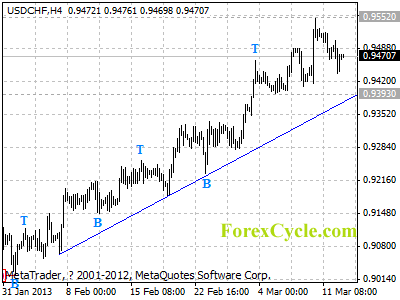
USDCHF’s fall from 0.9552 extends to 0.9436

USDCHF’s fall from 0.9552 extends to as low as 0.9436. However, the fall is likely consolidation of the uptrend from 0.9021. Key support is located at the upward trend line on 4-hour chart, as long as the trend line support holds, the uptrend could be expected to resume, and another rise to 0.9600 area is still possible after consolidation. On the downside, a clear break below the trend line support will indicate that the uptrend from 0.9021 had completed at 0.9552 already, then the following downward movement could bring price back to 0.9200 zone.

usdchf

Forex Signals

This is (Still) the Biggest Tech Trend Ever… and These Five Stats Prove It

By Louis Basenese, Chief Investment Strategist, wallstreetdaily.com

Almost two years ago to the day, I boldly proclaimed: “The exploding use of mobile devices promises to be the fastest-growing – and possibly biggest – technological trend ever.”

Since that time, reality has lived up to all my hype. (Phew!)

Even better, WSD Insider subscribers have parlayed the historic growth into multiple double- and triple-digit profit opportunities. And they continue to do so with companies like InterDigital (IDCC).

The best part? The “Mobile Revolution,” as I like to call it, isn’t even close to petering out.

To the contrary, the growth is actually accelerating.

Of course, I don’t expect you to take my word for it. So I’m sharing five irrefutable statistics to prove it…

Five Undeniable Signs of a Hypergrowth Market

Longtime subscribers know that I like to anchor my investments to the market’s fastest, most sustainable growth trends. Ones that promise to continue, no matter what happens in the world or economy.

I mean, why wouldn’t we want to stack the odds so heavily in our favor?

Well, there’s no better example of such a “forever growth trend” than the mobile industry. And here are the five statistics to prove it, courtesy of Cisco’s (CSCO) latest market research:

~ Mobile Stat #1: A Market of 10 Billion (or More)

By 2017, mobile device subscriptions are expected to top 10 billion. That works out to 1.4 devices for every person expected to be on Earth at that time (7.6 billion). Previous estimates by Morgan Stanley (MS) had us hitting the 10-billion mark in 2020. So we’re now three years ahead of schedule. I’d say that growth is accelerating, wouldn’t you?

~ Mobile Stat #2: Data Overload (Part 1)

IBM (IBM) points out a fascinating fact that 90% of the digital data in the world has been created in just the last two years. However, we’re still nowhere close to slowing down. Mobile data traffic alone ballooned 70% in 2012. And Cisco expects it to increase another 13-fold by 2017.

~ Mobile Stat #3: Data Overload (Part 2)

Smartphones (those electronic leashes we all carry with us approximately 97% of the time – even to the bathroom) only make up about 18% of all handsets. Yet they account for roughly 92% of global handset traffic. Put another way, the average smartphone generated 50 times more mobile data traffic (342 MB per month) than the typical basic cellphone (6.8 MB per month). And that shocking discrepancy is only about to get bigger. By 2017, the average smartphone is expected to generate 2.7 GB of traffic per month, which works out to an eight-fold increase over the current average.

~ Mobile Stat #4: An Insatiable Need for Speed

Forget just processing more and more data. Consumers want to do it faster and faster, too. So it’s no surprise that the average mobile network connection speed more than doubled – to 526 kilobits per second (Kbps) – in 2012. But that still won’t cut it for the speed freaks. The end result? Mobile connection speeds are set to increase another seven-fold over the next five years, to reach almost 4 megabits per second (Mbps).

Newsflash: That’s not possible if companies don’t create new technologies to increase connection speeds. (Hint: investment opportunity ahead.)

~ Mobile Stat #5: Who Would Ever Want a Tablet? How About Everyone?!

It’s almost unfathomable that analysts originally doubted the market potential for tablets, particularly when Apple (AAPL) debuted its now iconic iPad. In reality, though, consumers are adopting tablets faster than any other consumer electronics device in history. However, we’re still nowhere near the peak of popularity or impact. Case in point: In the last year, the number of mobile-connected tablets more than doubled to 36 million. In the next five years, the amount of tablet-driven data will be 1.5 times higher than all mobile data traffic in the world today.

Against the backdrop of such runaway growth, a natural question arises: What’s the best way to profit?

Well, a single chart provides the answer.

It’s All About the Apps

We spend way more time using applications on our mobile devices than we do surfing the internet – more than six times as much per month, in fact, based on recent analysis by Business Insider.

Add it all up, and pure-play mobile application makers with patent-protected technologies represent the best way to profit from the Mobile Revolution.

Today I’m sending out an alert to WSD Insider subscribers detailing a $32-million market cap stock that could prove to be the most profitable mobile recommendation I’ve ever made. Shares could easily surge 300% to 600%, if all goes as planned.

That’s no exaggeration, either. The company is completely unknown to almost everyone on Wall Street. As a result, it’s trading for less than $0.50 per share.

In a matter of weeks, though, that situation will change. I say that because the company is getting ready to debut its game-changing application on Apple’s iTunes store. And once the word gets out, it won’t be long before shares start marching higher.

Out of fairness to paying subscribers, I can’t reveal the company’s identity. But if you want to find out when we send the alert later today, all you have to do is sign up for a risk-free trial here.

Ahead of the tape,

Louis Basenese

wallstreetdaily.com

Original: This is (Still) the Biggest Tech Trend Ever… and These Five Stats Prove It


Global Monetary Policy Rates – Feb. 2013: Rates decline further but pace slows as growth prospects improve

By www.CentralBankNews.info
    Global interest rates declined further in February as six central banks cut rates by a total of 150 basis points, pushing the average global monetary policy rate down to 5.86 percent from January’s 5.88 percent and December’s 5.92 percent.
    The pace of rate cuts cooled from January when the 90 central banks followed by Central Bank News trimmed rates by a total of 342 basis points, as many central banks start to shift towards a more neutral stance to gauge the impact of last year’s rate cuts, U.S. budget cuts and Europe’s recession.
    Only one central bank raised rates in February: Serbia, which has now raised rates by 50 basis points this year, continuing its dogged fight against inflation.
    Apart from Denmark, which raised its rate in January for exchange rate reasons, Serbia is the only central bank worldwide to have tightened policy this year, illustrating how weak global demand is keeping inflation at bay and allowing central banks to cut interest rates to stimulate growth.
    Declining inflation rates and subdued upward pressure was specifically cited by five of this month’s rate cutters (Georgia, Azerbaijan, Poland, Hungary and Colombia) in their policy statements.
    Nevertheless, some central banks are starting to voice concern over inflationary pressures, especially Brazil, Russia and Malaysia, while China has been draining funds from the banking system to temper the rise in inflation.
    While there are still major risks to the global economic recovery, the overall picture of the global economy is one of brightening prospects, with the U.S., China and emerging markets growing stronger while Europe is weakening.
    The Reserve Bank of Australia (RBA) and the Bank of Israel (BOI) typify those central banks that are in a holding pattern. After last year’s sizable rate cuts, their economies are adjusting with the RBA saying the full impact of “significant easing” is yet to come while the BOI notes it’s too early to tell whether the economy has reached a turning point.
    Asia remains the hub for global growth, with a pickup in China’s economic activity cited by both Indonesia and far-away Chile as helping their exports. South Korea, Thailand, Japan and Sweden also noted improving exports.
     New Zealand, whose strong currency is helping curtain inflation, is also more upbeat about its economic prospects and keeping a close eye on house prices for any signs of overheating.

INTEREST RATE CUTS, YEAR-TO-DATE IN BASIS POINTS, FEBRUARY 2013:

COUNTRYMSCI   CURRENT RATE      YTD CHANGE
KENYAFM9.50%-150
MONGOLIA12.50%-75
COLOMBIAEM3.75%-50
GEORGIA4.75%-50
HUNGARYEM5.25%-50
JAMAICA5.75%-50
POLANDEM3.75%-50
AZERBAIJAN4.75%-25
ALBANIA3.75%-25
ANGOLA10.00%-25
INDIAEM7.75%-25
MACEDONIA3.50%-25
BULGARIAFM0.01%-2

www.CentralBankNews.info

Gold Breaches $1590 after Weidmann Says “Eurozone Crisis Not Over”, Chinese Physical Demand “Supporting Gold Right Now”

London Gold Market Report
from Ben Traynor
BullionVault
Tuesday 12 March 2013, 08:15 EST

AFTER trading sideways for several sessions, gold bullion jumped above $1590 an ounce for the first time this month Tuesday morning in London, in what analysts called a “technical” move after gold broke through a key level following remarks from Bundesbank president Jens Weidmann.

“We see support at the bottom of the sideways range at $1561 and resistance at the top at $1586,” said yesterday’s technical analysis note from Scotiabank.

Gold rose above that level however shortly after Weidmann told reporters that the Eurozone crisis “is not over” and said that the Eurozone has “declining inflation risks”.

Weidmann was presenting the German central bank’s 2012 results, which show it more than doubled the amount it holds in reserve for what Weidmann called “risk provisioning”.

Silver meantime rose to $29.25 an ounce this morning, still below last week’s high, as other commodities were broadly flat on the day and US Treasuries gave up earlier gains.

European stock markets were also flat, a day after US markets rallied and the Dow Jones set another new record, having beaten its 2007 nominal peak last week.

Gold in Sterling meantime hit a five-week high above £1070 an ounce as the Pound fell this morning, while gold in Euros rose to a two-week high above €1225 an ounce.

“We still doubt a sustained rebound [in gold] is warranted at this point while the market is set to remain depressed,” says Andrey Kryuchenkov, analyst at VTB Capital.

“Strong physical demand in China is the main reason behind gold’s resilience,” one trader in Beijing told newswire Reuters this morning.

“But the overall sentiment in prices is still weak. If demand from China weakens and we continue to see good US [economic] data and a stronger Dollar, gold has the chance to test $1500 this year.”

On February 18, the first trading after Lunar New Year, volumes on the Shanghai Gold Exchange for its most popular gold contract, The Au9999, set a new record of just over 22 tonnes. Since then, daily Au9999 volumes have been more than double last year’s average.

China was the world’s second-biggest gold consuming nation in 2012, according to the latest data from the World Gold Council.

In world number one India meantime “there is no demand [for gold right now] due to financial year closing,” according to Haresh Acharya at bullion wholesaler Parker Bullion in Ahmedabad.

Holdings of bullion backing gold exchange traded funds tracked by Bloomberg meantime continued to fall yesterday, the fifteenth straight day of net outflows.

In Washington, Congressman Paul Ryan is campaigning for the support of his fellow House of Representatives Republicans for his plan to balance the federal budget in a decade. Even if the plan is passed by House however it is not expected to win a vote in the Democrat-controlled Senate.

Senate Democrats meantime, who are expected to unveil an alternative budget plan this week, yesterday put forward plans to prevent a so-called government shutdown currently scheduled for 27 March, Reuters reports.

The bill contains adjustments to spending aimed at ensuring government agencies are funded to the end of September, but does not seek to make up for the $85 billion in government spending cuts known as the sequester that came into effect March 1 and was originally agreed as part of the 2011 debt ceiling deal.

Across the Atlantic, UK manufacturing production fell 3% in the year to January, more than analysts were expecting, according to official data published Tuesday.

“Unless we have a stellar performance from the services sector, we’re almost certainly in a triple dip [recession],” says London-based Scotiabank economist Alan Clarke.

Sterling fell to a fresh low against the Dollar this morning, touching $1.4831, its lowest level since July 2010.

The Bank of England’s Funding for Lending scheme, which seeks to lend to banks at low rates so that they can provide credit to small and medium enterprises, should be put “on steroids” according to Britain’s deputy prime minister Nick Clegg.

Ben Traynor
BullionVault

Gold value calculator   |   Buy gold online at live prices

Editor of Gold News, the analysis and investment research site from world-leading gold ownership service BullionVault, Ben Traynor was formerly editor of the Fleet Street Letter, the UK’s longest-running investment letter. A Cambridge economics graduate, he is a professional writer and editor with a specialist interest in monetary economics. Ben can be found on Google+

(c) BullionVault 2013

Please Note: This article is to inform your thinking, not lead it. Only you can decide the best place for your money, and any decision you make will put your money at risk. Information or data included here may have already been overtaken by events – and must be verified elsewhere – should you choose to act on it.


No Significant Changes Happened in the Markets Due to the Low Activity

EURUSD

eurusd12.03.2013
Yesterday, it was a dull trading day. The EUR/USD was flatly trading near the 30th figure and only at the end of the day, it decided to move up to the level of 1.3053. Given the extremely low market’ activity, it is difficult to say whether this move would cause something serious, thus it makes sense not to pay attention to it and await developments. If the pair exceeds the level of 1.3053, the bulls may rely on testing the 31st figure. If the rate drops below 1.3000, the current low will be in danger of passing again.


GBPUSD

gbpusd12.03.2013
The GBP/USD dropped to 1.4866 yesterday, then recovered to 1.4933 and fell again. This time – to 1.4885. All this was happening in a downtrend. There is no hint of an upward correction observed at all. The next target for the bears will be the 48the figure. The pound still needs to increase and consolidate above 1.5050, the pressure on it has been weakened.


USDCHF

usdchf12.03.2013
The USD/CHF left the 0.9551 high reached on Friday during the past day and dropped to the support near 0.9465. Nevertheless, since the pair is trading above 0.9465-0.9420, there still the uptrend in it, and the rate may well increase in the short term again – to 0.9551. The breakdown of this resistance would mean the upward dynamics to 0.9600-0.9634. The loss of the 94th figure will weaken the bullish momentum.


USDJPY

usdjpy12.03.2013
Yesterday’s trading was sluggish for the USD/JPY pair as well. However, this did not prevent the bulls come closer to the level of 96.70, having overcome the previous high of 96.56. But the bulls failed to stay above the latter level — the pair rolled back to 96.36. The upward trend in the USD/JPY remains. In fact, the global target of the bulls is the 100the figure, it is possible that the overbought state will not prevent them from reaching this target.

provided by IAFT


Serbia holds rate, pauses after 8 hikes, sees lower inflation

By www.CentralBankNews.info     Serbia’s central bank held its benchmark interest rate steady at 11.75 percent, pausing after eight rate hikes since last June, saying its current policy stance should return inflation to the bank’s target.
    The National Bank of Serbia, which has raised rates in the last eight of nine committee meetings since June 2012, said a low monthly inflation rate in the last four months confirms the impact of recent policy measures even if the annual inflation rate remains above target.
    Serbia’s inflation rate rose rose to 12.8 percent in January from December’s 12.2 percent, sharply above the central bank’s target of 4.0 percent, plus/minus 1.5 percentage points.
    Economists had expected the central bank to hold rates unchanged following last month when it said that inflation should start to decline due to its recent rate rises – 2.25 percentage points since June – a new agricultural season and the disappearance of the base effect of higher administered prices.
    The National Bank said the expected decline in inflation should help the government implement its fiscal consolidation program, reach a preliminary agreement with the International Monetary Fund, and stabilize agricultural administered prices.

    “So far, the monetary policy measures have taken into account the strength and character of inflationary pressures and demonstrate the bank’s firm commitment to returning inflation to the target range,” the central bank said.
     Serbia’s Gross Domestic Product contracted by 0.8 percent in the third quarter from the second quarter for an annual contraction of 1.5 percent, below the second’s quarter’s rate of minus 2.5 percent but above the first quarter’s 0.8 percent.
    Serbia’s inflation rate started accelerating in April last year when it hit a 30-year low of 2.7 percent and peaked at 12.9 percent in October due to higher agricultural prices and administered prices.
    Last month the central bank said in its quarterly inflation report that it would consider relaxing its policy stance as inflationary pressures from higher food and administered prices disappear.
    The central bank estimated that the country’s economy contracted by 1.7 in 2012 and forecast an expansion of 2.5 percent in 2013.

    www.CentralBankNews.info