Gold “Facing Competition from Stock Market” for Investment Dollars, CFTC Asks if Gold Fix Manipulated Like Libor

London Gold Market Report
from Ben Traynor
BullionVault
Thursday 14 March 2013, 09:00 EST

GOLD dropped below $1580 per ounce Thursday morning, while gold in Sterling and Euros fell back below £1060 and €1225 an ounce respectively, extending losses from a day earlier that following stronger-than-expected US retail sales data.

Like gold, silver drifted lower this morning, dipping below $28.60 an ounce, while other commodities were broadly flat and European stock markets ticked higher.

US, UK and German government bond prices fell, while the US Dollar Index, which measures the Dollar’s strength against a basket of other currencies, rose to its highest level since August.

The Dow Jones meantime ended higher Wednesday for the ninth day in a row, setting another new record high.

“The US stock market [is] now increasingly viewed as gold’s main ‘competition’ for investment Dollars,” says Ed Meir, metals analyst at brokerage INTL FCStone.

“We think gold lacks both technical momentum and investment interest to recover significantly from current levels,” adds a note from Credit Suisse.

“Gold has lost its luster,” agrees Danske Bank senior commodities analyst Christin Tuxen, speaking at Bloomberg’s FX Debates event in London Wednesday.

“Some of the reasons investors had last year to buy into gold are now gone. The focus will be on interest rates not surging, but gradually moving higher.”

China’s central bank has moved from last year’s pro-growth loose monetary policy stance to a “neutral” one, People’s Bank of China governor Zhou Xiaochuan has said.

“Obviously there’s a lot of [gold] investment demand in China… a large part of why people in China bought gold is because prices went up ” says Credit Suisse analyst Ric Deverell, adding that a price fall could be detrimental for Chinese gold demand.

In the US, the Commodity Futures Trading Commission is considering whether the twice-a-day London Gold Fix, which sets the international benchmark gold price, could have been manipulated in the same way as the London interbank offered rate (Libor), the Wall Street Journal reported Wednesday.

“[The fixings are] not arbitrary,” said a spokesman for the London Bullion market Association.

“It’s very much done on a demand-supply basis until a price is arrived at. It’s fully transparent, it’s nothing like Libor.”

Over in Europe, “substantial progress is being made toward structurally balanced [government] budgets,” according to a draft European Union summit statement obtained by news agency Bloomberg ahead of the two-day meeting which starts today.

The statement, reports Bloomberg, calls for “growth-friendly consolidation” of government finances.

Elsewhere in Europe, Ireland borrowed €5 billion selling new benchmark 10-Year bonds yesterday, the first such sale since the country was bailed out in 2010.

The volume of gold production in South Africa fell 8.1% year-on-year in January, despite total mineral production rising 7.3% over the same period, according to Statistics South Africa figures published Thursday.

Ben Traynor
BullionVault

Gold value calculator   |   Buy gold online at live prices

Editor of Gold News, the analysis and investment research site from world-leading gold ownership service BullionVault, Ben Traynor was formerly editor of the Fleet Street Letter, the UK’s longest-running investment letter. A Cambridge economics graduate, he is a professional writer and editor with a specialist interest in monetary economics. Ben can be found on Google+

(c) BullionVault 2013

Please Note: This article is to inform your thinking, not lead it. Only you can decide the best place for your money, and any decision you make will put your money at risk. Information or data included here may have already been overtaken by events – and must be verified elsewhere – should you choose to act on it.


The Stock Market Trend & Hot Sector ETF’s

By Chris Vermeulen, GoldAndOilGuy.com

Trading with the trend should be your main focus for long term success no matter what type of trader you are (Options Trader, Stock Trader, or ETF Trader) although it’s not as easy as it sounds.

The good news is that there is a simple trading model that removes 95% of trading analysis and greatly reduces trading related emotions because the key technical analysis rules based on one of the world’s best chart technicians (John Murphy) technical analysis methods have been applied to the chart automatically. The key is to identify the trend of the market. Once that is known you can focus on trading strategies that take advantage of the current trend.

Over the past few years I have been creating this indicator/chart layout tool which converts my chart reading experience, tips and tricks into a simple system removing analysis paralysis which cause most individuals to second guess what they see and don’t pull the trigger. Using too many indicators or read/listening several other traders commentaries with different views than you causes this paralysis.

My simple red light, green light model clearly shows a viewer the current trend and expected price range (high and low) looking forward a couple days. I uses a series of data points like volatility, volume, cycles, momentum, chart patterns and logic rules. It even shows extreme pivot points helping you find low risk entry prices for both bull and bear market conditions.

Recent trends and signals for the SP500 Index Daily Chart:

SPY1

Trading With the Trend – The Sweet Spots

Knowing the direction of the market is simple using the chart system above but trading with the trend is not that simple because of natural human behavior. Instead traders fall victim to trying to pick a top or bottom because they think the price is overbought or oversold and they want to catch the next big trend change.

We all know the saying “the market climbs a wall of worry”.  Well, the biggest worry most traders have is buying long in a bull market because stocks and price always look overbought and ready to top each week… This leads to people trying to get fancy picking a top only to get their head handed to them a few days or weeks later depending on how stubborn they are to exit a losing position.

The key to long term success is to buy during broad market (SP500) corrections once sentiment, cycles and momentum are starting to flash extreme oversold conditions. These show up as green arrows on the trend chart. At that point most sectors and high beta stocks like IBM, GOOG etc… should be at a key entry points with most of the downside risk removed already. Remember ¾ stocks follow the broad market so it only makes sense to follow it also.

What about a runaway stock market? This is when the stock market does not pullback but just keep grinding its way higher and higher… The only thing you can do is sit in cash, or look for a stock or sector that is having a small pause or pullback and get long with a small position until you get that broad market pullback and major by signal to add more.

Below are a few sectors showing a minor pause/pullback within this bull market.

XLP

XLI XLU  XLF


Mid-Week Trend Conclusion:

Overall, the broad market remains in an uptrend. While I would like to see the SP500 pullback and give us another major buy signal like it did in December and February I do mind that much if prices keep running higher as it just give us more cushion and potential profits for when the trend does eventually roll over and flip signals. I hope you found this report interesting. It’s just scratching the surface of this topic but it’s a start.

Know the stock market trends by joining my free newsletter: www.GoldAndOilGuy.com

Chris Vermeulen


Norway holds rate, delays rate rise to first half 2014

By www.CentralBankNews.info     Norway’s central bank kept its policy rate steady at 1.5 percent, saying economic growth and inflation had been slightly lower than projected so it first expects to raise rates in the Spring of 2014.
    Norges Bank started easing its upward rate bias last October when it delayed a planned rate increase until this year from end-2012. At its previous meeting in January, the bank maintained a slight upward bias but it has now delayed any rate change until next year.
    “The analysis suggests that the key policy rate be kept lower longer than previously anticipated,” the bank quoted its governor Oeystein Olsen as saying.
    “The first increase in the key policy rate is now projected to take place in spring 2014,” he added. Norway’s central bank cut rates twice in 2012 for a total cut of 49 basis points.
    While growth and inflation remain low, the central bank said household debt and house prices were still rising faster than income.
     The central bank said it would introduce a countercyclical capital buffer to give banks more capital to draw on in an economic downturn. The size would be determined later this year.

    Norway’s inflation rate fell to 1.0 percent in February from 1.3 percent in January and the central bank said its policy rate was low because inflation is low and because interest rates abroad are low.
    The central bank targets inflation of 2.5 percent.
    The bank added that growth prospects for trading partners had weakened though global growth remains robust. Capacity utilization in the Norwegian economy is above normal and unemployment is low.
    “At the same time, there are now prospects that it will take longer for inflation to move up to the inflation target,” the central bank said.
    Norway’s Gross Domestic Product rose 0.4 percent in the fourth quarter from the third quarter for an annual rate of 2.1 percent.

    www.CentralBankNews.info
 

Swiss keep FX, interest rate targets, cut inflation forecast

By www.CentralBankNews.info     Switzerland’s central bank maintained its interest rate and exchange rate targets, as expected, and said the downside risks to the Swiss economy remain considerable while revising downwards its inflation forecast.
    The Swiss National Bank (SNB) kept its target range for three-month Libor at zero to 0.25 percent and repeated its pledge to “buy foreign currency in unlimited quantities” to keep the Swiss franc below 1.20 per euro.
    The cap on the Swiss franc was introduced in September 2011 as jittery investors from the euro zone sought refuge in Swiss assets, pushing up the value of the Swiss franc and negatively affecting the competitiveness of Swiss industry.
    Switzerland’s headline inflation rate in February was minus 0.3 percent, the 17th month in a row with deflation. In 2012 the average inflation rate was minus 0.7 percent
    The SNB now expects an inflation rate of minus 0.2 percent for 2013, plus 0.2 percent for 2014 and 0.7 percent for 2015. This compares with its previous forecast of 0.1 percent in 2013 and 0.4 percent in 2014.
    “Under this assumption, the Swiss franc weakens over the forecast period,” the SNB said, adding that “in the foreseeable future, therefore, there continues to be no threat of inflation in Switzerland.”

    Switzerland’s economic growth slowed as expected in the fourth quarter, but the SNB said it continues to expect growth of 1.0-1.5 percent in 2013.
    Gross Domestic Product expanded by 0.2 percent in the fourth quarter from the third, for annual growth of 1.4 percent, up from 1.2 percent.
    “Downside risks to the Swiss economy remain considerable,” the SNB said, adding that tensions in the euro area may rise again and uncertainty about the future of fiscal policies in many advanced countries is dampening consumer and investment confidence, posing risks to growth.
    “The global economic situation and sentiment on the financial markets therefore remain vulnerable,” the SNB said.

    www.CentralBankNews.info

Philippines keeps key rate steady, cuts SDA rate again

By www.CentralBankNews.info     The Philippine central bank kept its benchmark overnight borrowing, or reverse purchase facility, rate steady at 3.50 percent but again cut the rate on its Special Deposit Account (SDA) facility due to a “benign inflation outlook and improving growth prospects.”
    Bangko Sentral ng Pilipinas (BSP) cut the rate on the SDA facility by 50 basis points to 2.50 percent  on all maturities, effectively immediately. In January the BSP set the SDA rate at 3.0 percent, the first time it was set below the benchmark rate.
    The BSP said the decision to keep benchmark rates steady was based on its view that inflation was “likely to remain manageable” – a phrase often used by the central bank – and inflation expectations also remain firmly anchored.
    “Although global economic activity has gained traction, lingering fiscal and financial market stresses in the advanced economies continue to dampen the broad outlook, thereby mitigating upward pressures on commodity prices,” the BSP said.
    However, further capital inflows, along with rate adjustments to domestic power rates and stronger growth in domestic liquidity posed upside risks to the inflation outlook, the central bank cautioned.
   “Latest baseline forecasts have risen slightly due to the higher inflation out-turns in recent months but continue to track the lower half of the 4 +/- 1 percent target range for 2013 and 2014,” the bank said.
    The Philippines’ headline inflation rate rose to 3.4 percent in February from January’s 3.0 percent within the BSP’s forecast of 2.8-3.7 percent for the month. The central bank attributed the rise to higher prices on food, alcohol and tobacco, and domestic petroleum products.
    On average, the inflation rate is 3.2 percent year-to-date, within the government’s 2013 target range of 3-5 percent, the central bank said earlier this month. The core inflation rate rose to 3.8 percent in February from 3.6 percent.

    BSP cut rates by a total of 100 basis points in 2012, most recently in October as low inflation gave it room to ease policy. Since then, the central bank has maintained its policy stance to allow the rate cuts work their way through the economy.

    The Philippine’s Gross Domestic Product in the fourth quarter rose by 1.5 percent from the third quarter for annual growth of 6.8 percent, down from the third quarter’s 7.2 percent.

    The bank is using its SDA to help contain the effects of foreign capital inflows from abundant global liquidity. Previously, the SDA rate was at a premium to the benchmark rate and this attracted capital, not only costing the central bank funds but also detracting from funds that could be used for lending. The bank also tightened rules on the SDA to make it more difficult for foreign funds to use.
    Earlier this week the BSP’s governor said the central bank would be moving to an interest-rate corridor system.

    www.CentralBankNews.info

Central Bank News Link List – Mar 14, 2013: Much to prove for Putin’s central bank pick Nabiullina

By www.CentralBankNews.info Here’s today’s Central Bank News link list, click through if you missed the previous link list. The list comprises news about central banks that is not covered by Central Bank News. The list is updated during the day with the latest developments so readers don’t miss any important news.

Korea holds rate, says growth weak and inflation low

By www.CentralBankNews.info     South Korea’s central bank held its base rate steady at 2.75 percent, as expected, and said economic growth is weak and inflation low though likely to rise as downward pressures disappear.
    The Bank of Korea (BOK), which cut interest rates by 50 basis points last year, said it expects the global economy to sustain its modest recovery “but judges that the uncertainties related for instance to the fiscal crises in the euro area and to fiscal consolidation in the US have not lifted and remain as downside risks to growth.”
    Korea’s consumption and investment in facilities declined due to temporary factors but the BOK still expects the country’s negative output gap to remain for a considerable time due to slow global growth mainly due to “the sluggishness of economic activities in the euro area” – the same phrase the central bank used in February.
    Korea’s Gross Domestic Product expanded by 0.4 percent in the fourth quarter from the third, up from a quarterly rise of 0.1, for an annual increase of 1.5 percent, the same year-on-year rate as in third quarter.

   Inflation continues to be low – headline inflation rate eased to 1.4 percent in February from January’s 1.5 percent and core inflation was 1.3 percent – and is expected to remain low due to weak demand.
    “The Committee forecasts, however, that it will rise above its current level as downward pressures from institutional factors partially disappear,” the BOK said in a statement.
     In January the BOK cut its forecast for economic growth and inflation in 2013 and said the pace of recovery in the first half of this year would be below South Korea’s long-term trend. For 2013 it forecasts growth of 2.8 percent.
    The headline consumer price inflation rate is forecast to rise to an average of 2.5 percent in 2013 and then rise further to 2.8 percent in 2014. In 2012 the inflation rate was 2.2 percent.    Foreign investors have invested in Korean financial markets with long-term interest rates down due to large inflows, the bank said, adding that the Korean won recently risen against the U.S. dollar due to the emergence of geopolitical risk.

   www.CentralBankNews.info

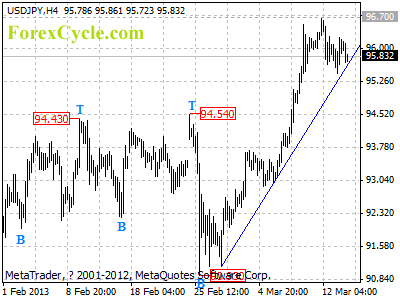
USDJPY stays above a upward trend line

USDJPY stays above a upward trend line on 4-hour chart, and remains in uptrend from 90.93, the fall from 96.70 is treated as consolidation of the uptrend. As long as the trend line support holds, the uptrend could be expected to resume, and further rise to 97.00 area is still possible. On the downside, a clear break below the trend line support will indicate that the uptrend from 90.93 has completed, then the following downward movement could bring price back to 93.00 zone.

usdjpy

Daily Forex Forecast

Stock Market Warning: Next Week Could be a Blood Bath

By MoneyMorning.com.au

The Dow Jones has just recorded nine up days in a row.

That’s the longest winning streak since November 1996.

I have just released a new video revealing why the odds are now incredibly high that we’ll see a stock market fall in the immediate future – perhaps as early as next week – and how you can successfully trade this move for profit.

You can watch it here.

You see, there comes a time in trading when you need to back yourself and stand firm in a view.

That moment has arrived for me.

After what has seemed like an eternity the ASX has now done the work necessary and set itself up beautifully to catch many investors and share traders with their pants down.

The long overdue correction in prices is very close.

That doesn’t mean prices won’t eventually find support and then turn back up again, it just means that the risk is well and truly to the downside from here for the immediate future.

Here’s why…

The next time the ASX 200 closes below 5025 my conviction levels will increase dramatically.

The most amazing thing about price action is its ability to constantly fool the great majority of traders. Even after watching prices for many years it still astounds me how consistently the stock market can tempt you into a bad position.

It all comes down to the underlying structure of price action. Let me explain…

How the Stock Market Leads You Astray

Prices trace out distributions that have many false breaks at either edge of the range before breaking out of the range and shooting higher or lower.

Share traders tend to place stop losses outside the extremity of the range. That means the false breaks stop out those traders, while also sucking other share traders into bad positions at exactly the wrong time.

The current set up in the ASX 200 is a perfect example…

From the very small scale to the large scale we’re now getting signs that a sharp correction is around the corner.

One of the key things I like to look for is when a distribution occurs around an important point, such as a key support or resistance level.

This is quite logical when you think about it for a minute.

If there is a very important technical level, then every man and his dog will be looking at that level and making decisions based on whether they think that level will hold or not.

If everyone focused on this ‘line in the sand’ so to speak, then the most frustrating thing that can happen is if prices create a distribution around that level. Both bulls and bears will be whipped out of positions before the price is ready to either breakout above a resistance level or fail to hold above it.

The major high of 5025 in the ASX 200 is a perfect example of this phenomenon.

All the commentators are saying that ‘prices have broken out to multi-year highs’ because the stock market closed for one day above the 5025 level, which was the high from April 2010.

Look at the chart below to see what I mean:

ASX 200 Daily Chart


Click here to enlarge

First of all let’s analyse the price action around the low from May 2010.

You can see quite clearly that prices spent over a year tracing out a distribution around that 4175 low from May 2010.

If you knew there was a probability that prices would do this then your task becomes trading the distribution that occurs around that very important point.

There were plenty of opportunities to do this over the last year.

Next, look at where we are now:

ASX 200 Daily Chart


Click here to enlarge

You can see from this close up of the ASX 200 that prices are in the early stages of creating what will probably be a distribution around the key 5025 level.

The false break of the high of this range at 5106 is the first low risk opportunity to short sell this stock market. But you would get out of any short position if we close above the recent highs at 5163.

That means you only need to risk 57 points (1.1%) to find out if you’re right. The upside from being correct is the potential of seeing a fall towards the Point of Control of the long-term structure at 5600. That’s a 500 point (10%) fall from here, makes the potential risk/reward of this trade 9:1.

Even a fall to the bottom of the current range would see a 131 point fall to 4975. This gives you a potential 2:1 risk/reward which has a pretty high probability of coming off.

The more conservative approach from here is to wait for further confirmation that the correction has begun.

Nothing Goes Up in a Straight Line

As I said previously, a close below the key 5025 level from here is important. Last week’s low was 5010, so a weekly close below that level would also create a weekly sell pivot, having had a false break of the high.

If we saw that happen this week then I would feel very confident that next week was going to be a bloodbath for the markets.

As I look at the markets I can see a lot of complacency. Many traders and investors think that things are on the mend and the stock markets will continue to rally. Trouble is…nothing could be further from the truth. Traders need a dose of reality to remind them that markets never go up in a straight line.

This current set up has been many months in the making.

The stock market is incredibly overbought at the moment and the fact is when you rally so far so fast, when the music stops there is very little technical support below the market.

That means once the selling begins it will surprise everyone by how quickly it can fall.

Well, everyone that is, except you.

Murray Dawes
Editor, Slipstream Trader

Join me on Google Plus

[Editor’s Note: Murray has just published a brand new film warning about the dangers of the over-bought Aussie share market. In fact on 13th February the market breached a major level that Murray says will have a key impact on how the market behaves in the coming months. To find out more about this breach and how you can learn to trade this important signal alongside Murray, and reap the potential rewards, simply click here.]

From the Port Phillip Publishing Library

Special Report: Australia’s Energy Stock BLOWOUT

Daily Reckoning: A Crazy Warning Sign for BHP and CBA Shareholders

Money Morning: Three Banking and Retirement Scams To Look Out For

Pursuit of Happiness: Freelance Investigator Takes on the Australian Mortgage Industry

‘I fought the banks and got 75% of my mortgage cancelled’

By MoneyMorning.com.au

The markets went quiet again last week after the sudden jump in volatility surprised everyone in the weeks before. For a while, the Euro crisis featured in headlines again. But nothing proved more exciting than America’s Sequester. Alongside Filibuster, it’s just another word the Americans use to describe political shenanigans.

If you don’t know about the Sequester and the Filibuster, it looks like you don’t need to. Now that both have happened, the Volatility Index (VIX) is back to 2007 lows and the market is heading back up.

While Bernanke continues to print money, why do Sequesters, Filibusters and Euro crises even matter? He can just print more if things get worse. Warren Buffett is fond of saying, ‘Only when the tide goes out do you discover who’s been swimming naked.’ Well, the tide has turned on Australia’s largest industry – finance.

It turns out there are nudists galore. This has exposed an opportunity that isn’t about financial markets and investing. It’s about enforcing your rights if you’ve been wronged. And the rewards could be enormous.

A Mortgage Scandal in the Making

We first wrote about Australia’s mortgage scandal in August last year. Back then, everyone in Australia knew that those American NINJA loans (no income, no job, no assets) couldn’t happen here. And they were right. It’s even worse. Australia has NINJAD loans. No income, no job, no assets and dodgy documentation.

The NINJA loans wrought havoc with America’s economy in 2008. So finding out the same thing was happening here was horrifying. Could we experience a similar financial crisis as a result? Maybe, but never mind that. It’s the dodgy documentation that’s the real story.

Here’s why: If you find the right kind of errors on your mortgage paperwork, it could mean cancelling your mortgage and owning your home outright.

Most people just refuse to believe that statement. It’s just not possible you could cancel your mortgage, is it? The bank won’t suddenly say, ‘You no longer owe us money, stop sending us the monthly cheque.’

Let’s be clear. If your mortgage documentation was manipulated, your loan could be reduced or extinguished altogether. You would own your home with far less debt owing, or no debt at all.

That probably still sounds surreal. Well, it took months of research to confirm this opportunity is very real for vast amounts of Australian borrowers who know nothing about it. Today Tonight, Four Corners, The Australian and many more media outlets have reported on this story.

Today Tonight‘s expose featured two best friends who were separately conned into making property investments they couldn’t afford. Their documentation was manipulated after they signed it to get them past lending standards. Today Tonight featured them both saying, ‘I fought the banks and got 75% of my mortgage cancelled.’ There are many more stories like theirs.

Some borrowers ‘only’ had their mortgage reduced by around 75%. But dozens of people have had their mortgages reduced to a whopping $0.00.

At least, that’s what we thought. Most of these examples are kept secret, so you don’t really know how much people’s mortgages end up being reduced. The banks don’t want word getting out that they are cancelling mortgages, so they make borrowers sign confidentiality agreements as part of the deal.

But the consumer advocate who helps these people fight their lenders did reveal how many people she’s helped. Denise Brailey of the Banking and Finance Consumer Support Association gave an interview to Today Tonight. In that interview, she said this:


‘Well I’m only one person and I’ve been able to get at least 200 of these mortgages extinguished.’

That’s one person cancelling hundreds of mortgages. And that was last year. Never mind dozens, there must be hundreds more people cancelling their loans. And who knows how many hundreds more if word gets out.

But here’s the kicker in Denise’s interview. ‘There could possibly be $50 billion worth of mortgages to be extinguished…’ That could be more than 150,000 mortgages.

In other words, there is a massive opportunity for far more borrowers to enforce their rights against lenders than the hundreds who have done so already. And you could be among them. All you need is a step by step guide on how to find out if you could get your mortgage cancelled too.

So that’s what we’ve come up with. A report explaining exactly what happened, how to find out if you could cancel your mortgage, and how to go about doing it. It’s surprisingly easy to get started and find out if the opportunity applies to you, or your friends and family. More on that in a moment.

But you’re probably wondering just what kind of manipulation of documentation can get a loan cancelled. Well, here are some examples of what people have found on their paperwork:

  • Jobs have been INVENTED: in one case an unemployed NSW man was listed as a ‘self-employed coffee shop owner’ with a fortnightly income of $3,500… In another, an elderly retired man from Sydney’s Assyrian community was described as being employed and earning a salary of $43,000. And in another, a 70-year old retired printer from Carrum, Vic was described as a ‘self-employed painter’ – a job he last held in the 1950s
  • Salaries have been INFLATED: in one case a lowly-paid deckhand was described as a ship’s captain earning $150,000 a year…in another a self-employed musician earning $36,000 a year was listed as earning $120,000…and a toll booth operator earning $28,000 was listed as earning $38,000…
  • Assets have been OVERSTATED: A Sydney couple with a business worth $25,000 and no superannuation were listed as having a business worth $125,000 and super savings of $30,000… In another case a 64 and 75-year old pensioner couple claimed their assets were inflated from $395,000 to $901,263 by their lender…
  • People have been DUPED or COERCED: In one case a 98-year-old woman was granted a 30-year loan, prompting one Australian Senator to quip, ‘She must have a good doctor’… In another, a couple ‘were persuaded to sign forms in blank and were told that they would be filled in later.’ And in a third, a retired pensioner couple were persuaded to take out a 30-year loan for $520,000. They were listed on their loan forms as a ‘stock broker’ and ‘solicitor’…

Not All Bad News

The thing is, these stories can have a happy ending…for the borrower, not the lender. When borrowers have challenged the bank on its document manipulation, the courts, financial ombudsman and credit ombudsman have all sided with borrowers.

The real question now is whether people will take this opportunity seriously. Will average Aussie battlers find out about this opportunity and bother to find out whether their mortgage could be cancelled?

We certainly hope so. Back when one of the first court case established the law on these cases, the person who organised funding for the borrower’s 7 year legal campaign said, ‘This could mean that thousands of people may also be able to cancel their loans and that would be a huge win for justice in this country.’ More than $3 million was spent taking the bank to the High Court. The borrower won every step of the way. And other borrowers have been cancelling and reducing their loans since.

Now is the time to fight back against lenders who manipulated people’s legal documents to earn more commissions. Do you want to be able to say ‘I fought the bank and got my mortgage cancelled’?

If people allow this opportunity to sink away, the lenders will get away with what they’ve done. You have the chance to hold them accountable.

The report that reveals what borrowers need to know is being finalised now. It should be ready sometime this week. Keep your eyes open for the video and be sure to send it to anyone you know with a mortgage.

Regards,

Nick Hubble

Join Money Morning on Google+

From the Archives…

Why the Stock Market Boom is on Pause
8-03-2013 – Kris Sayce

Why the Dow Jones Record High Doesn’t Matter
7-03-2013 – Murray Dawes

Taking China’s Economic Pulse from Hong Kong
6-03-2013 – Dr Alex Cowie

Buy Gold When They’re Crying…Sell Gold When They’re Yelling
5-03-2013 – Dr Alex Cowie

Do You Want to Be Right About Investing, or Do You Want to Make Money?
4-03-2013 – Kris Sayce