Silver Stalls, Gold Gains as CFTC Clarifies London Fix “Investigation”, US Inflation Rises

London Gold Market Report
from Adrian Ash
BullionVault
Fri 15 Mar, 09:30 EST

GOLD ticked higher but silver prices stalled Friday morning, as a rise in Asian stock markets failed to carry over into European or pre-opening trade in US equities.

The Euro currency rose sharply through $1.30, knocking the gold price in Euros back below €1220 per ounce, virtually unchanged for the week.

Sterling gold prices slipped to £1050, some 2.3% below Tuesday’s new 4-month high.

For Dollar investors, Friday morning’s London Gold Fix came in at $1593.25 per ounce – more than $6 above yesterday afternoon’s level and the highest AM fixing in more than two weeks.

Silver achieved only a 2-day high at its London Fix on Friday, set at $28.91 per ounce.

“Given what we have seen in Libor [the interbank lending rate], we’d be foolish to assume that other benchmarks aren’t venues that deserve review,” said Bart Chilton of US regulator the Commodity Futures Trading Commission in an email Thursday, clarifying reports that the London Fix is under investigation by US derivatives regulators.

The CFTC has not begun an investigation, but is “discussing internally” whether the global benchmark for valuing and pricing gold – a snapshot taken at 10:30am and 3pm for gold, and at midday for silver – may be open to “manipulation”, along with “energy, swaps…and the whole litany of ‘bors,” as Chilton said in testimony more than 2 weeks ago.

Back in today’s markets, “Gold prices are not being supported by the current confluence of events,” says French investment bank and bullion dealer Natixis in its latest weekly comment.

“[The] stronger Dollar predicated upon fiscal retrenchment suggests further downward pressure upon gold prices, while any move by the Fed to scale back QE3 in response to a pick-up in growth…also represents a downside risk for gold prices.”

Consumer price inflation in the US rose to 2.0% annually in Feb, new data showed today, with gasoline prices rising at the fastest pace since 2009.

“Inflation is still contained, but there’s a fear that it’s starting to rebound,” Bloomberg quotes Hideo Shimomura, chief fund investor for $63 billion in assets at Mitsubishi UFJ in Tokyo.

“Treasury yields at 2.0% show people expect improvement in the economy.”

Money markets are now pricing in 2.6% inflation, the newswire adds, the highest level of inflation expectations since September.

“The American economic revival, diverging monetary policy expectations and the unfinished Euro area crisis…all point in the same direction,” says a note from SocGen analyst Sebastien Galy – “a stronger Dollar.”

“Gold’s fate will largely ride on what direction US equity markets will take,” counters Thursday night’s note from INTL FCStone, saying that “only a sizable correction in US equities will likely prompt funds to get back into gold.”

Noting that silver investment has risen while ETF trust fund holdings in gold fell, “We find this divergence surprising given that silver investment demand tends to be closely linked to sentiment towards gold,” says Anne-Laure Tremblay, precious metals strategist at BNP Paribas.

Trimming her silver price forecast from a 2013 average of more than $34 per ounce to $31.35, “A reversal in trend is likely in the next two months if our forecast for a subdued gold price performance [also] proves correct.”

Adrian Ash
BullionVault

Gold price chart, no delay   |   Buy gold online

Adrian Ash is head of research at BullionVault, the secure, low-cost gold and silver market for private investors online, where you can buy gold and silver in Zurich, Switzerland for just 0.5% commission.

(c) BullionVault 2013

Please Note: This article is to inform your thinking, not lead it. Only you can decide the best place for your money, and any decision you make will put your money at risk. Information or data included here may have already been overtaken by events – and must be verified elsewhere – should you choose to act on it.
 

Russia holds rate steady, says rise in inflation poses risks

By www.CentralBankNews.info
    Russia’s central bank held its benchmark refinancing rate steady at 8.25 percent, as expected, saying the rise in inflation was expected and poses risks while economic growth is continuing to slow down.
    The Bank of Russia, which raised its rate by 25 basis points in 2012 and is under pressure to cut rates to boost growth, warned that if inflation remains above target for a prolonged period it may affect expectations and thus poses risks, in particular in light of planned increases in the tariffs of monopolies.
    However, the central bank omitted last month’s phrase that the risk of a significant slowdown from tighter monetary conditions were considered minor, indicating a slightly less hawkish stance.
    Russia’s inflation continued to climb in February, hitting an 18-month high of 7.3 percent, up from January’s 7.1 percent.
    The central bank repeated that it expects inflation to exceed its 5-6 percent target in the first half of 2013 due to higher food prices and certain regulated prices.
     In 2012 prices rose 5.1 percent and the central bank targets 4-5 percent inflation in 2014.

     The Bank’s Chairman Sergey Ignatiev has lead a dogged campaign against inflation which started accelerating in mid-2012 after easing in the second half of 2011. Ignatiev is retiring in June and is being replaced by Elvira Nabiullina, economic aide to Russian President Vladimir Putin.
    “The dynamics of the key macroeconomic indicators in January 2013 point to a continuing slowdown in economic growth,” the central bank said, adding that investment in productive capacity was subdued, retail sales decelerated and industrial output decreased.
    At the same time, economic confidence remains positive and labor market conditions, along with credit expansion, is providing support to domestic demand, the bank added.
     Russia’s Gross Domestic Product rose by 0.6 percent in the third quarter from the second for annual growth of 2.9 percent, down from the second quarter’s 4.0 percent rate. In 2012 the economy expanded by 3.4 percent.
     It is the weakest growth rate since 2010 and economists expect the bank to start cutting rates after inflation begins to ease over the next few months.
    The appointment of a Putin ally as new bank president has further stoked these expectations with some economists expecting the bank to cut rates sooner rather than later.

    www.CentralBankNews.info

Understanding How Bitcoin Works

By Matt Michaels

More and more businesses are now expanding their operations into the digital world. And there has always been a need for virtual currencies and online transaction systems like Paypal. To answer this demand, bitcoin a type of digital currency that is accessible on the Internet, and can be used wherever you are. Bitcoin is a crypto-currency which uses peer-to-peer (P2P) technology. This allows it to operate without the need of a central authority. The maximum amount of bitcoins in the market at a single time is 21 million units and new bitcoins are produced at a diminishing rate. This ensures that existing bitcoins have value in today’s market.

By using peer-to-peer (P2P) systems, bitcoin eliminates the requirement for a third party to enable transactions between a buyer and a seller. Therefore, bitcoins will allow you to save in terms of transaction expenses. A majority of online transaction systems like Paypal charge a certain fee for each transaction. For individuals and businesses that carry out huge amounts of online transactions, bitcoins is a good way to help you reduce total costs. Besides that, the bitcoin currency is decentralized. This essentially means that the currency is not controlled by any oversight body or authorities. This means that bitcoins are not suppressed and controlled unlike the printing and distribution of real currencies which are controlled by the Government.

To use bitcoins, the first thing you need is an online bitcoin wallet. You will need an e-wallet to store your bitcoins as it is a virtual currency. There are many websites that provide users with free bitcoin wallets – like My Wallet from blockchain.info. To get started with the bitcoin system, all you need to do is visit one of these websites and sign up for a bitcoin wallet with the website. After that, you are all set to go. Bitcoin wallets can also be accessible using your smartphone through various mobile applications. This allows you to make online transactions, even when you are away from your computer.

To enhance the security of your bitcoin wallet, you might want to download and use a reliable desktop client. These clients help you to store bitcoin transactions onto your computer. Always remember to back up and save your transactions onto your client from time to time. This ensures that your money is safe, even if your smartphone gets stolen or your computer breaks down. Most users download the Satoshi Client for this purpose as it is a reliable and reputable software.

Once you have your wallet set up, you can begin to transacting with bitcoins. There are many ways for you to earn bitcoins. Firstly, you can purchase bitcoins from different online sellers. You can also receive it from carrying out business transactions. And if you have the time, you can gain free bitcoins by completing simple tasks like surveys, or you can do bitcoin mining to ‘dig out’ unfound bitcoins. Despite being relatively new to the market, many companies and individuals are now accepting bitcoins as a form of payment. If you think that bitcoin is able to help you grow your business, you should get started right away by creating an e-wallet.

About the Author

Are you looking for more information regarding Bitcoin? Visit http://blockchain.info/wallet today!


Central Bank News Link List – Mar 15, 2013: Fed to hold course on stimulus despite debate over risks

By www.CentralBankNews.info

Here’s today’s Central Bank News link list, click through if you missed the previous link list. The list comprises news about central banks that is not covered by Central Bank News. The list is updated during the day with the latest developments so readers don’t miss any important news.

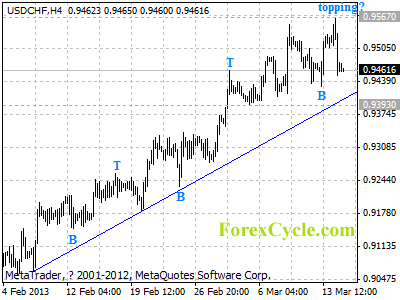
USDCHF’s upward movement extends to 0.9567

USDCHF’s upward movement from 0.9021 extends to as high as 0.9567. Key support is located at the upward trend line on 4-hour chart, as long as the trend line support holds, the fall from 0.9567 could be treated as consolidation of the uptrend, another rise to 0.9600 area is still possible after consolidation. On the downside, a clear break below the trend line support will indicate that a cycle top has been formed at 0.9567, and the uptrend from 0.9021 has completed, then the following downward movement could bring price back to 0.8500 zone.

usdchf

Daily Forex Analysis

Can This Indicator Predict The Dow Jones Next Move?

By MoneyMorning.com.au

In yesterday’s Money Morning, Murray noted that the Dow Jones Industrial Average had clocked up gains for the past nine trading days. It was the best winning streak since 1996.

Well, last night the Dow went one better. It’s now 10 straight days of gains.

What does that mean? Is it something or nothing?

Look, Murray’s game is technical analysis. It involves studying charts and working out the probability of an event happening. You can check out Murray’s latest analysis and where he thinks the market is heading here.

This analysis played a big part in the trades he has recommended on the big Aussie resource stocks and Aussie banks.

And if one of Murray’s favourite indicators is anything to go by, it may not be long before the Dow’s glory streak comes to an end

As you may know, your editor isn’t much chop when it comes to technical analysis.

In fact, until we first met Murray nearly six years ago, we didn’t give technical analysis the time of day. It really was just squiggly lines and a lot of what we considered ‘Hindsight Harry’ analysis.

But after just half an hour of sitting with Murray and him explaining how he interprets the stock markets…well, it was as though we’d found the Rosetta Stone of technical analysis.

And we’re not kidding either.

Most share traders see a new high (or low) as a signal to join the momentum. The old saying is ‘the trend is your friend’.

But Murray takes the opposite view. When he sees a stock or index hitting a significant high or low, it rings alarm bells.

For Murray, a new high (or low) is a potential turning point. It’s where investors should look to bet against the trend.

But that doesn’t always mean jumping in straight away.

The breakthrough point is only part of Murray’s analysis. It’s what Murray commonly refers to as a ‘false break’. That’s where most traders believe the market will surge to a higher high.

However, instead of the market surging higher, what frequently happens is that it breaks through and then shortly afterwards does a complete reversal, heading back the other way.

This is a set-up that’s starting to take shape in one of the world’s most well known stock indexes…

Not Everyone Has The Dow Jones Going Higher

The Dow Jones Industrial Average has recently hit an all-time high. It has led some commentators to say the index will go even higher.

But not everyone is convinced.

For instance, if you look at one of Murray’s favourite indicators, the Relative Strength Index (RSI), it’s potentially telling a different story.

The RSI is just one of the indicators Murray uses to judge the probability of the market’s future direction.

Specifically, Murray looks for a key behaviour in the RSI…that isn’t what most people use it for.

Put simply, the RSI indicates when a stock or index appears to be under- or over-bought. However, the key word is relative. Just because the index is at a high point today (meaning overbought), doesn’t mean it can’t go even higher tomorrow.

Murray’s analysis involves looking for a particular set-up in the relationship between the stock or index price and the RSI. Namely, he looks for instances where the stock or index remains at a high point (if he’s looking to short sell) but where the RSI is falling.

This alerts Murray to a potential directional change in the price.

Understand that this is only one part of his analysis. He uses other indicators plus fundamental analysis to form a view on whether a stock or index is a buy or sell.

Is it Too Early to Sell?


But right now an interesting set-up is taking place with the Dow Jones Industrial Average as it trades above the old 2007 high. You can see this on the chart:


Click here to enlarge

Source: Google Finance


As you can see, the RSI (lower chart) is currently in overbought territory, while the index remains high. So right now, this wouldn’t trigger a short selling opportunity for Murray.

But, when or if the RSI starts going lower, that’s when Murray would combine this analysis with the other indicators he uses, and his fundamental analysis, to decide if the potential reward outweighs the risk of taking on the trade.

It’s also important to note that the falling RSI can pre-empt the falling index by several months – as happened from early to mid 2011.

That’s where other indicators can help with the timing of a trade.

But whatever happens, the US market is at a key level. Whether the market will keep rising or begin to fall is anyone’s guess. But it’s worth keeping an eye on this indicator over the coming weeks.

Cheers,
Kris

Join me on Google+

From the Port Phillip Publishing Library

Special Report: Australia’s Energy Stock BLOWOUT

Daily Reckoning: A Crazy Warning Sign for BHP and CBA Shareholders

Money Morning: Three Banking and Retirement Scams To Look Out For

Pursuit of Happiness: Freelance Investigator Takes on the Australian Mortgage Industry

From the Archives…

Why the Stock Market Boom is on Pause
8-03-2013 – Kris Sayce

Why the Dow Jones Record High Doesn’t Matter
7-03-2013 – Murray Dawes

Taking China’s Economic Pulse from Hong Kong
6-03-2013 – Dr Alex Cowie

Buy Gold When They’re Crying…Sell Gold When They’re Yelling
5-03-2013 – Dr Alex Cowie

Do You Want to Be Right About Investing, or Do You Want to Make Money?
4-03-2013 – Kris Sayce

Seven Situations to Watch in the Pacific Currency War

By MoneyMorning.com.au

It’s now one year to the day since the end of our first-ever investment conference at Sydney’s Intercontinental Hotel last year. The great economic power struggle that was discussed at the ‘After America’ conference is raging even more intensely this year.

Big political and economic moves have been made by all the key players – Australia, China, America, Japan, and both Koreas. In this short update, I’ll review the five most significant changes investors must reckon with as they’re caught in the cross-fire of this Pacific power struggle.

The topics raised and questions debated over those two days last year – China’s political power transition, the fate of Australia’s commodities boom, and the ultimate fate of the American dollar in the currency war – are still as urgent to investors today as they were a year ago. I went back and viewed some of the presentations recorded on DVD during the week. Here is a quick summary of the key-note presentations and their key ideas:

Knowing What You Don’t Know by Dylan Grice: Before he left the Alternative Views team at Societe Generale to join Edelweiss Holdings, our favourite Scotsman delivered a tour of history that puts today’s currency war in context. He explored the reasons for the fall of Rome, the cause of the Great Depression, and why Romanian witch doctors have a better record of forecasting than central bankers.

Chinese Grand Strategy and American Hegemony by Dr Paul Monk. ‘For most of the past two millennia, China was a world unto itself, turned inward, and in no sense dominant, even in Eurasia, to say nothing of the world at large,’ said Dr Monk. The former analyst of the Department of Defence and the Defence Intelligence Organisation added that, ‘We should not, therefore, get carried away by what I call the ‘middle kingdom mystique’. China’s past did not and does not make its ascent in our time natural.’

Following the Money – New Bull Markets for the 21st Century by David Thomas. Thomas, a 30-year veteran of emerging markets and Asia Pacific focused on the opportunities ahead over the long-term. He asked ‘Where do we look for growth in the future? After America, what are the clues and the things we should be looking for as an indicator of future booming economies?’

The Great Re-Set by Satyajit Das: The author of Traders, Guns, and Money gave a command performance to close the show. For an hour and a half he showed precisely how Australia’s economy is tied to the China story, and how the European debt crisis is a small part of a larger systemic problem requiring a great ‘Re-set.’ His remarks earned him a standing ovation from the crowd.

And those are just the keynotes!

There are over six discs in the DVD set. Dr Steve Keen dropped in for a cameo presentation on the Australian housing market and the world economy. He said, ‘We wouldn’t be in this room if it wasn’t for the level of private debt in the world right now. Private debt is what’s caused the bubble.’ He showed in great detail what to expect.

And of course, all of my colleagues at Port Phillip Publishing gave their take on the question. Some of the presentations had immediate investment consequences. But most were longer-term, dealing with the question of how to craft an investment portfolio that takes into account this huge sea-change in economic affairs.

I’m not going to go through each of those presentations. You can watch them all on the DVD. You can also print out and read the transcripts that were made of the entire event’s proceedings. If you are just starting to grapple with this issue, it’s a perfect way to start your thinking and planning.

Seven Situations Complicate the ‘After America’ Story

If anything has become clearer in the last year since the conference, it’s that Australia is caught in the crossfire of a currency war. The Aussie dollar is making new highs against the Japanese Yen. With the cash-rate at an ‘emergency low’ of 3%, the Reserve Bank of Australia (RBA) is one of the few central banks in the world NOT engaged in a war to cheapen its currency.

The RBA’s strategy has produced mixed results for investors. The strong Australian dollar has induced capital to flow into the country from abroad, driving up bank stocks and other high-yielding blue chips like Telstra. But for manufacturing, tourism, and exports, the high dollar is a bane.

Those are some of the domestic impacts of the currency war. But to put the issue in a larger context, let’s briefly look at six big changes to the story since last March. In this long-term battle for economic and political ascendancy, these are the six developments that will determine who wins and who loses. Investors will have to reckon with all of them.

#1: New Chinese political leadership

Xi Jinping officially became China’s new President on Thursday, March 14th. His ascension marked the end of an intricate, year-long process marked by a huge internal power struggle within the Communist Part of China (CPC) that resulted in the ousting of Chongqing mayor Bo Xilai. Xi now has the reins of power for the next ten years. His leadership group will decide whether to respond to the global currency war with a new round of ‘stimulus’ on urban development. This spending, if it comes, is one factor that could contribute to a ‘second wind’ for the Australian resources market.

#2: Japan and China feud over the Senkaku Islands

The Senkaku Islands are located in the East China Sea, between Japan and China. In September of last year, a long-running territorial dispute over the ownership of the islands reignited after the Japanese government purchased the islands from their private owners. Since then, an escalating game of brinksmanship and political rhetoric has marked this as a flashpoint between Japan-China relations. The US is conspicuous for its absence so far, but may be un-interested (or unable) in managing affairs in the Pacific.

#3: Japan’s offensive in the currency war

A key factor in Japan’s growing geopolitical tension with China has been the election of the new Prime Minister Shinzo Abe in December of 2012. But Abe’s influence over Japanese monetary policy has been just as momentous. He has replaced the governor of the Bank of Japan with a ‘dove’ who’s vowed to fight deflation. This is Japan’s offensive in the currency war. The result has been a new-high in the Aussie dollar/Japanese Yen exchange rate. With Japan determined to weaken the Yen, capital flows to Australia have supported a fast start to 2013 for the All Ordinaries (up 8.3% year-to-date).

#4: Renewed tension between South and North Korea

New UN sanctions against the regime of Kim Jong Un have prompted the North Koreans to threaten America and South Korea with nuclear annihilation in recent days. The rhetoric has also ramped up to coincide with annual joint US/South Korean military exercises. China’s ability to manage its client state is an open question. Is it using the North Korean regime to destabilise US influence in the region? Or is North Korea a true geopolitical wild card, not answerable to anyone and capable of being the ‘Black Swan’ of 2013?

#5: Political stale mate in US fiscal policy

Barack Obama surprised the press by cruising to re-election in November of 2012, despite getting fewer total votes than his victory in 2008. But since his official inauguration in January, his administration has been engaged in a series of running fiscal battles with the Republicans in Congress. Deals over the debt ceiling, the sequester, and the budget have become permanent features of the Washington landscape. Despite all this, the Dow Jones Industrials have made a new all-time high and enjoyed their longest rally in 16 years. America’s long-term fiscal position of high deficits and a bigger debt continues to worsen.

#6: The ‘Code War’

It’s clear to most investors that the Pacific Powers – China, the US, and Japan – are engaged in a currency war. The objective of this war is to boost economic growth through exports by making your currency cheaper. But in recent months, another war has hit the front pages. Commonly referred to as ‘hacking’, I prefer to think of it as the ‘code war’, wherein governments use computer hackers to attack strategic competitors. When the New York Times published an article on Unit 61398 – a unit of the People’s Liberation Army of China that’s allegedly in the business of staging cyber-attacks on American groups like the Department of Defence – it was a clear sign that a new era of cyber warfare has begun.

#7: Australia’s Federal Election

Australians go to the polls on September 14th to vote for members of Parliament. At stake is the fate of the mining tax, the carbon tax, and the size and scope of future government deficits. Though I’m sceptical that a change in political leadership will mean a big change in fiscal management, Australia’s strategic posture relative to China and America IS up for review. How the country navigates between two Pacific powers – one rising economically and the other trying to get back on its feet – is one of the great political challenges of the day.

With stocks rising, investors couldn’t be blamed for not taking geopolitical matters too seriously right now. But this is precisely the time to consider them – BEFORE they burst on the scene to affect investment values in the middle of a crisis. That was the whole purpose of the ‘After America’ conference in 2012. And it’s what makes the comments and presentations at the conference valuable today.

Of course a simple review might ask the question: was the premise of the conference even valid? Is China rising? Is America falling? Must Australia choose between the two? Or can it chart a more independent course?

And finally, what are investors to make of all the different forces and factors? Is the commodity boom still a safe bet? Or should recent market highs be taken with a big grain of salt? Could geopolitical factors affect investment markets this year in ways we haven’t anticipated? Stay tuned.

Dan Denning
Publisher, Money Morning

Join me on Google Plus

A Lucrative Play in Turkey: A Shale Gas Hotspot

By MoneyMorning.com.au

‘A game changer…and highly lucrative’ – Reuters

I grabbed a taxi and headed up to the Le Meridien Hotel in Etiler, a neighbourhood in Istanbul, Turkey. I was on my way to have breakfast with N. Malone Mitchell III. He is the CEO, chairman and 40% owner of TransAtlantic Petroleum.

Malone’s company is the best way I’ve found to play a fascinating emerging energy story. It comes with risk, but offers a potential two-five times return on your money over the next few years…

A New Shale Gas Player

Let me start with the big picture in Turkey.

Turkey sits on large untapped resources of shale gas. Nobody yet knows just how much natural gas Turkey might hold. One guess puts Turkey’s shale gas reserves at 20 trillion cubic metres. A fraction of that in Ukraine drew a $10 billion investment from Shell last month.

The irony is that Turkey depends heavily on expensive imports for both oil and gas. Depending on your neighbours for oil and natural gas is not so bad. The problem is that it is expensive in this case. Natural gas prices in Turkey top $10 per thousand cubic feet compared with just $3 in the US. So you can see the economic incentive to develop those native resources. For years out of reach, new technology makes accessing them possible.

On the day of my meeting with Malone, Reuters released a story on Turkey’s gas potential. Malone got it on his phone while we were eating breakfast and showed it to me. A key excerpt:


‘With domestic gas consumption rising and
[Turkey’s] geographic location meaning it is also well placed to supply international markets, major exploitable reserves could be a game changer for Turkey’s economy and highly lucrative for whoever finds them.

‘”We are keen to exploit this method and we must make economic use of shale gas,” energy minister Taner Yildiz told Reuters, saying it would be a priority for the near future.’

This sets up the macro appeal of TransAtlantic. The other part of the appeal is in the micro, which begins with the talented Mr. Mitchell himself. He is a self-made oil and gas billionaire, a successful builder of companies. He is also, as I noted above, a big shareholder. And he has been buying more of late.

I’ve been following TransAtlantic for a few years now. I share it with you here because it is one of the most intriguing ideas I have in Turkey and a good way to get exposure to a unique energy story.

The Perils of the Energy Business

It has not been a happy story to date. Over breakfast, Malone and I talked about the challenges TAT has had so far.

There has been a big learning curve in figuring out the geology. In many ways, TransAtlantic’s experiences mimic those of other successful unconventional plays. ‘It can take two years of failures before it all comes together,’ Malone said.

There has also been the challenge of finding the right mix of people and getting the right systems in place. Malone told me about the intricacies of Turkish tax accounting, for instance. And he related some stories about personnel issues.

It is always easier to draw up the blueprint than to put it into action – especially in emerging markets. On the positive side, Malone said doing business in Turkey was as easy as doing business in Texas or Oklahoma from a regulatory point of view.

And though there have been setbacks, the plum of Turkey is as ripe as when Malone got involved in March 2008. He said Turkey then was like Texas in 1938 – a practically virginal land flush with oil and gas possibilities.

I asked him if he was still as excited about it as he was then. ‘Yes,’ he said, ‘but I wish we knew then what we know now. Knowledge comes at a price.’

Frustrated by delays in ramping up production, the market has all but abandoned the shares. They now languish at around $1. Even just the value of its proved reserves – the so-called SEC PV-10 value – is about $1.75 per share (pretax). That gives the company no credit for whatever lies in its 5 million acres of underexplored land area. Yes, 5 million acres.

I asked Malone what he thought the market was missing with TransAtlantic.

‘Well, the market thinks we aren’t going to do anything,’ he said, thinking about that languishing share price. ‘The truth is if we weren’t a public company, I’d be fine about where we are.’

A Strategic Base in a Growing Market

Indeed, the company is in a good position in a strategic sense. It has those 5 million acres locked up on long-term leases. It was early enough that it grabbed some of the best acreage. There are only three oil companies of consequence in Turkey: the national oil company, a privately held oil company and TransAtlantic. Everybody who comes after gets the crumbs left by these three.

Besides, TransAtlantic is already doing its bit to provide oil and gas to Turkey’s thirsty industrial base. In the Thrace Basin, TransAtlantic gas supports the city of Bursa. About 60 miles southeast of Istanbul, the Ottomans captured the city in 1326 and made it their first capital. Surrounded by forested hills and fruit orchards, it was once a Silk Road city.

Today, there are nearly 2 million people in Bursa and it is home to thriving automotive and textile industries. And there are a couple of big catalysts on the horizon that could make 2013 the year when the cards finally turn up right for Malone and his fellow shareholders.

First, Turkey’s unconventional oil and gas plays are getting more attention. Just a couple of days after our meeting, Malone would attend Turkey’s first shale gas and oil conference at the Bilkent Hotel in Ankara. There is an excitement in the air about what could happen in Turkey. And it is still very early.

The buzz could help Malone as he is trying to nail down a joint venture to accelerate the development of TransAtlantic’s acreage. The JV, Malone has said before and repeated at breakfast, could be as big as the sale of Viking (the company’s oil field services arm).

For reference, this sale brought TransAtlantic $164 million, gross. As the whole market cap of TAT is only about $370 million, a JV that brought in that kind of cash would be huge.

Second, the company is drilling some potentially high-impact wells. We should get the results on these wells within in the next six months. Malone was optimistic that these would bring strong results. Exciting results here could also light a fire under the stock.

I was glad to meet up with Malone. I have confidence he will figure it out and make it work. I think he is honest. He also owns a bunch of stock – an owner-operator, for sure. His track record of success is beyond dispute. All in all, a good mix, in my experience.

Reflecting on what TAT is building, I thought about how a bigger oil outfit will one day want to own it all. ‘Someday, somebody is going to want to write you a big check,’ I said.

Malone said nothing, but his expression and his eyes told all. Exactly, they seemed to say. Exactly.

Chris Mayer
Contributing Editor, Money Morning

Join Money Morning on Google+

From the Archives…

Why the Stock Market Boom is on Pause
8-03-2013 – Kris Sayce

Why the Dow Jones Record High Doesn’t Matter
7-03-2013 – Murray Dawes

Taking China’s Economic Pulse from Hong Kong
6-03-2013 – Dr Alex Cowie

Buy Gold When They’re Crying…Sell Gold When They’re Yelling
5-03-2013 – Dr Alex Cowie

Do You Want to Be Right About Investing, or Do You Want to Make Money?
4-03-2013 – Kris Sayce

Read this shocking new report: A Gathering Storm Threatens Europe and America

Dear investor,

We’re about to share with you a developing social trend from Europe that may shock you — it might even enrage you — so please be forewarned.

A new report from the Socionomics Institute, a U.S.-based think tank that studies developing global trends in social mood, reveals a striking resemblance between modern-day Greece and pre-WWII Germany.

  • Nazi salutes.
  • Praise for Adolf Hitler
  • Swastika-like banners

Now, before you write off this warning as a run-of-the-mill, Nazi-name-dropping scare tactic, consider this: A rising political party known as Golden Dawn is resurrecting such practices, all hallmarks of Hitler’s Third Reich, in modern-day Greece, which has suffered a dramatic, 88% stock market decline over the past five years — a decline far greater than that of Germany’s 73% stock rout from 1927 to 1932.

“History doesn’t repeat itself, but it does rhyme,” goes an old saying attributed to American author Mark Twain. And new research from the Socionomics Institute sees a disturbing pattern of rhymes between modern-day Greece and pre-WWII Germany.

To be sure, market and political developments in Greece will have a significant impact on the future of Europe, the Americas and beyond.

Read the rest the Institute’s new February report to learn more about the developing threats out of Greece. The full report is available for free for this month only as part of a special promotion run by the Institute in conjunction with its partners at Elliott Wave International, the world’s largest market forecasting firm.

>> Follow this link to read more about the negative social mood wave washing over Europe in the full February issue of The Socionomist (a $19 value) – for free this month only.


About the Publisher, Elliott Wave International
Founded in 1979 by Robert R. Prechter Jr., Elliott Wave International (EWI) is the world’s largest market forecasting firm. Its staff of full-time analysts provides 24-hour-a-day market analysis to institutional and private investors around the world.


Latvia holds rate steady on low inflation and no risks

By www.CentralBankNews.info     Latvia’s central bank held its benchmark refinancing rate steady at 2.5 percent, saying it’s policy stance is appropriate in light of low inflation and no risks to price stability from economic growth.
   The Bank of Latvia, which cut rates by 100 basis points in 2012, also said it would retain its reserve requirement.
    In February Latvia’s inflation rate fell to 0.3 percent from 0.6 percent, and in January the bank forecast 2013 inflation of 2.0 percent. The Bank of Latvia aims for price stability but does not have an actual inflation target.
    “Since the inflation indicators are consistently low and the rate of economic growth poses no risks to price stability in the medium term, the Bank of Latvia Council is of the opinion that the current stance of monetary policy is appropriate for the economic situation,” the bank said.
    Latvia’s Gross Domestic Product expanded by 1.4 percent in the fourth quarter from the third quarter for annual growth of 5.1 percent, slightly down from the third quarter’s rate of 5.2 percent.
    The bank forecasts 2013 growth of 3.6 percent, down from 2011’s 5.5 percent.
    Earlier this month Latvia’s government applied to join the embattled euro zone with a final decision expected in July.

    Latvia pegged its currency to the single currency after joining the European Union in 2004 and stuck with the link through the past five years of financial and economic turmoil though many economists said it would have softened the economic downturn if it had devalued the currency. Latvia needed a bailout in 2009 by the International Monetary Fund and the EU.
    Neighboring Baltic state Estonia already joined the euro in 2011 and Lithuania pegged its currency to the euro in 2002 and has said it is considering joining the euro in 2015 or 2016.
    Many mortgages in Latvia are already denominated in euros

    www.CentralBankNews.info