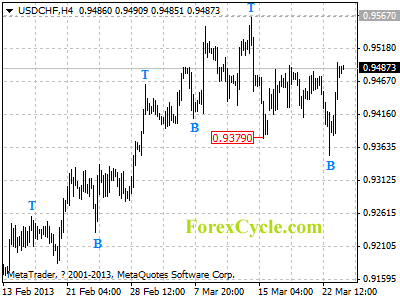
USDCHF remains in downtrend from 0.9567

USDCHF remains in downtrend from 0.9567, the price action from 0.9379 is likely consolidation of the downtrend. As long as 0.9567 key resistance holds, the downtrend could be expected to resume, and another fall towards 0.9200 is still possible. On the upside, a break above 0.9567 will indicate that the longer term uptrend from 0.9021 (Feb 1, low) has resumed, then the following upward movement could bring price to 0.9750 area.

usdchf

Daily Forex Analysis

11 Billion Reasons to Expect a 200% Move in Gold Stocks Within Months

By MoneyMorning.com.au

How does the prospect of making 200% in twelve months sound to you?

Far-fetched?

Well this is exactly what happened for gold stock investors between 2008 and 2009. The HUI gold stock index was intensely oversold in October 2008, and went on to soar 200% over the next year.

That was back then, of course.

But right at this very moment we’re looking at a near identical set up in the markets. Gold stocks are just as unloved and oversold. They’re at similar relative valuations. It won’t take much of a catalyst to see a serious move from here.

And it’s certainly not just me banging the golden drum today…

Last week in Hong Kong for the Mines and Money conference, I was extremely lucky to score a meeting with and interview keynote speaker and legendary precious metals expert, Eric Sprott

An Investing Legend

Eric Sprott is the CEO and Senior Portfolio Manager of Sprott Asset Management, currently managing $11 billion in the precious metals markets.

With 40 years of experience making money in the precious metals markets, his views are worth listening to.

The good news is that right now he thinks it would only take a 6% move in gold, to pass $1700, to catalyse a massive move for gold stocks.

Our interview went for a full 25 minutes, on economics, politics, and the huge opportunity brewing in gold, gold stocks,silver, and silver stocks, as well as platinum group metals.

Q+A with Eric Sprott – Full Transcript on Monday

I’m working with my production team to get the whole interview out to you. It’s a tough ask in this short week, but look out for it on Easter Monday. Here’s a sample of what we talked about:


Alex: If we could move to gold equities, they’re at record lows whichever way you want to slice and dice them, whichever metrics you want to look at. Do you see an inflection point happening there soon?

Eric: Well I’ve always said the stocks won’t go up until the metals go up, because everyone looks at the metal price and says, ‘Oh my god the price of the metal went down I don’t want to own the stocks,’ but typically when the metal goes up, the stocks outperform by at least two to three times, so if we can get a sustained move here – and we can’t just go to 1650 and give it up again, we’ve got to look like we’re going to a new high here, then of course the metal stocks have so much to get back again. And out of the 2008 bottom, the metal stocks put on a 200% gain

I think that as [gold] approaches 1700, people will realise it’s going to be a sustained rally, and it’s not as though the stocks haven’t started moving already.

I mean they have, we had a day recently where the gold price went up half a percent and the gold stocks went up 2.5%, because they are so oversold here. Plus you’ve got short positions on them so there’s a bit of vulnerability from the guys that are short.

Look out for more from Eric next Monday.

At the conference, I also had my chance to get up on the stage and talk gold too. Part of my talk had been to remind investors what that move from the 2008 bottom looked like.

Gold Stocks Tripled in a Year – History to Repeat?

Source: Stockcharts


The 200% gain, or three-fold increase, during 2008/2009 was breathtaking. The increasingly realistic chance of a repeat of this is worth getting ready for.

And if you’re fed up of hearing it from me, then take it from Eric Sprott, a man who has invested $11 billion on this probability!

A tripling in gold stock prices wouldn’t be something to sniff at. However, the previous big move in gold equities, which started in 2001, saw the HUI index increase ten-fold. That kind of move isn’t just breathtaking, it can be life-changing:

HUI Index Increases Tenfold in Seven Years

Source: Stockcharts


Fantastic moves, no doubt.

Now consider that these charts show the HUI, which is made up of the big-cap gold stocks.

Small-cap and mid-cap stocks, the type I tip in Diggers and Drillers, stand to do better than 200%, or even 900%. As Eric told me:


‘The small companies always outperform the big companies, because they have more room to expand. I’d much rather buy a guy whose producing 100,000 ounces who can go to 200,000 ounces, ie who could double his income, than a major guy who’s at five million who thinks he might get to 5.5 million in three years, so there’s not the same growth element. So I always prefer the small to midcap guy, as providing by far the bigger return.

That’s something worth thinking about.

What Can Light the Spark?

But could we really be looking at a move of that magnitude from here?

What needs to happen to drive a major move in gold equities like this?

Some dividends wouldn’t go amiss, but that’s a story for another day. Before that happens, essentially the gold price needs to start rising faster than the production costs. This hasn’t been the case for a few years. Margins have been pinched, and gold stock prices have fallen as a result. I’ll explain why a reversal of this is possible in a moment.

First I’ll show you one more chart so you can see where we are in the valuation cycle. In short – we’re at the bottom of the cycle. Gold stocks don’t come much cheaper than this! This shows the HUI index divided by the gold price to show its relative valuation. Today it’s exactly at the same level it was in late 2008, as well as 2001.

The importance of this is that as you can see in the two charts above, late 2008, and mid-2001 are exactly when the last two major gold stock rallies started.

Gold Stock Index Divided by Gold – Telling You to Buckle Up, Buttercup

Source: Diggers and Drillers


Of course you could argue that gold stocks are sagging because production costs are out of control? Indeed they are. In fact costs have increased by 256% in the last ten years. Ouch.

However, the reason for this is mostly because major miners have been mining super-low grade iron ore, which is expensive, to increase production volume. Rising labour costs, fuel costs, and costs of consumables like explosives haven’t helped matters.

But I can’t tell you how much grovelling we saw at the conference from the CEO’s and MD’s from the major gold companies about their costs. Each one promised cost-cutting programs, and a big change in strategy, focusing on profits over production volumes.

It’s probably no coincidence that we saw this grovelling, considering Barrick and Kinross, both top ten gold producers, fired their CEO’s for high costs in recent months. A whole swathe of other mid-cap gold stocks have followed suit since.

If the new guys, or any of the others who’ve hung on, actually want to keep their jobs – then cost cutting is mandatory.

They’ll whine that it can’t be done of course. Yet we saw gold companies cut costs by 25% between 1997 and 2001 – so it’s not impossible. On a positive note, a recent report by PwC researched the whole industry and reported this cost cutting has started.

It remains to be seen how successful this will be, but imagine if they come through with the goods, and gold sector costs actually fell, or even just levelled off.

And then imagine that gold also then hits a new high this year, as Eric Sprott and I both believe it will.

Gold producers’ profit margins will increase from the top and the bottom, taking them from ‘skinny’ to ‘obese’.

This would see stock prices do a massive U-turn from currently oversold levels, and a three-fold, 2008-2009 type, move for the HUI would be quite possible from here.

Then throw some dividend growth into the pot, stir vigorously and just maybe…a 2001-2007, ten-fold type move could be possible too…

Dr Alex Cowie
Editor, Diggers & Drillers

Join me on Google+

From the Port Phillip Publishing Library

Special Report: Australia’s Energy Stock BLOWOUT

Daily Reckoning: Inflation: When You’re In the Government’s Sights

Money Morning: You Want Proof the Stock Market’s Heading Up? Try This…

Pursuit of Happiness: Learn This Lesson from Cyprus Before it’s Too Late

Diggers and Drillers:
Why You Should Invest in Junior Mining Stocks

3-D Printing: The Future of Manufacturing

By MoneyMorning.com.au

The first time I heard about 3-D printing, I thought to myself, ‘Impossible!’ But then I thought, ‘What if it actually is possible?’

Guess what? It’s possible…and it has the potential to change the ways of global manufacturing forever. Forbes says, ’3-D printing will change absolutely everything it touches.’ Wired proclaims, ’3-D printing will be the next industrial revolution, and [it] will compete with mass manufacturing in many areas.’

3-D printing holds the promise of unlimited customization of the kinds of products you want to use and buy. You’ll have greater control, and more of a say in how things are created… how they come into the physical world.

This technology could create many new jobs and careers and strengthen the economy. It will also decrease the cost in time, money and materials it takes to transport your possessions. But at the same time, the resulting technological disruption facing existing industries is likely to shift the balance of wealth around the world.

The last time there was such a shift in the standard of manufacturing may very well have been the early 1900s, when Henry Ford invented mass production for his Model T automobiles.

For roughly 30 years, 3-D printing has been in development under the name ‘rapid prototyping’. But in the past five years, it has finally gained real traction within the marketplace. Now both inventors and investors have hit the ground running.

Soon enough, the 3-D printer will be as familiar to you as the personal computer. Catch the idea before the idea catches on and you could put some extra cash in your pocket.

3-D Printing isn’t when a 2-D image is applied onto a 3-D surface. That’s called pad printing. And it’s not printing 2-D holograms. That’s holography.

Think about the 2-D printer in your office, and in just about every office in the developed world. That 2-D printer uses ink from its cartridges and paper from its tray to print something on a flat piece of paper.

First, as always, you start with an idea. Then you use computer software as a tool to develop your idea. When you’re ready to have the real thing, you click ‘print’ and the command travels through a computer network and out from your printer. That’s what you’re used to.

But a 3-D printer is an ‘evolved’ 2-D printer.

You develop your idea on a computer-aided design (CAD). After you’re finished, it travels through a network and out from a 3-D printer as…an object. An object! A real three-dimensional object. Not an image on a piece of paper. A design that’s become incarnate!

It’s…alive! Well, not quite…not yet anyway. That’s another story.

OK, OK…So How Does 3-D Printing Work?

There are a few methods, but let’s keep it simple for now.

3-D printers lay down successive layers of micro-thin ‘ink’.

In between each layer, a binding agent may be applied. A fully automated laser eventually fuses everything together. After doing this many times, it builds up from a series of cross sections and becomes a 3-D object.

In other cases, the nozzle of the printer acts like a hot glue gun.

Click here to see an example.

The ‘ink’ is typically a polymer or metal, and it comes in a fine powder or molten liquid form. The ‘paper’ is actually the object itself, and the applied binding agent helps hold it all together. Those ingredients are often held in a heated container so they don’t clump.

Eventually, what usually happens is that a fully automated laser fuses together the “ink” and the ‘paper’ until the whole thing solidifies. This means that 3-D printing is a kind of ‘additive manufacturing’ and can create almost any shape with extreme precision.

It’s a revolutionary upgrade and distinctly different from the traditional machining method of ‘subtractive manufacturing’. That is, when you have to mould, cut, drill or beat something out of a larger chunk of material.

It is, therefore, extremely cost-effective. The leftover raw material can be reclaimed and used just as easily for what you print next. It also allows products to be made in a matter of minutes to hours, not days or weeks.

This method is a way to build from the bottom up, from small to big. And it can build from the inside out. Another great advantage with this technology is that it derives from computer-aided design (CAD). That means there’s virtually no limit to customization.

Luckily for everyone: When industrial-scale technology advances enough, it has a way of finding itself into people’s homes.

Just remember how personal computers got here. Computers used to be the exclusive tool of the military, science labs and a select few universities. Then visionaries like Steve Jobs and Bill Gates made a market that enabled the PC to infiltrate your own life.

And just remember, before the personal computer revolution took off, Ken Olsen, founder of Digital Equipment Corp. in 1977 said, ‘There is no reason anyone would want a computer in their home.’ You know how that turned out. It’s likely that 3-D printing will follow suit.

Technologies like 3-D printing don’t disrupt industries as soon as they’re discovered and invented. They disrupt industries when there is a cost-efficient business model that allows them to spread through the greater population.

The Model T Ford, for example, was not the first automobile. Cars were luxury items for the rich. It was when Henry Ford found a way to make them affordable and mass-produced them that the market was disrupted.

That’s where 3-D printing is now. It’s becoming more affordable, and it’s going to change the landscape on which your investments sit. And the rug will be entirely pulled out from under some industries.

Josh Grasmick
Contributing Editor, Money Morning

Join Money Morning on Google+

From the Archives…

Why You Should Buy This Falling Stock Market
22-03-2013 – Kris Sayce

Stock Market Warning: Part II
21-03-2013 – Murray Dawes

New Developments on Whether You Can Get Your Mortgage Cancelled
20-03-2013 – Nick Hubble

Your Retirement or Your Mortgage?
19-03-2013 – Nick Hubble

Get Used to This Stock Market Action, It’s Set to Last…
18-03-2013 – Kris Sayce

Crisis in Cyprus Puts Paper Currencies under the Spotlight

By MoneyMorning.com.au

Like Lehman Brothers before it, Cyprus may well come to be seen not so much as the cause of further crisis but as yet another symptom of the ‘long emergency’ that continues to suffocate the western economies.

We would describe this emergency as, fundamentally, an inevitable crisis triggered by an unsustainable explosion of credit; western banks and western governments are now like Macbeth’s ‘…two spent swimmers, that do cling together / And choke their art.’

The prime minister of Luxembourg, Jean-Claude Juncker, has provided two clear insights into this world of deceit:

‘We all know what to do, we just don’t know how to get re-elected after we have done it.’

And,

‘When it becomes serious, you have to lie.’

This is what we now have by way of government: a self-serving elite who cannot be trusted, operating to a timetable defined by, and limited to, the electoral cycle.

This liberty deficit is possibly more severely damaging than the supposedly intractable fiscal one that lies beneath it. Yet whatever emerges from the disaster, Cyprus has reminded us of a couple of awkward truths:

1) A deposit in a bank is not a riskless form ofsaving.

We may not see eye to eye with the FT’s Martin Wolf on many aspects of modern economics and central banking in particular, but he described banks well last week:

‘Banks are not vaults. They are thinly capitalised asset managers that make a promise – to return depositors’ money on demand and at par – that cannot always be kept without the assistance of a solvent state.’

2) When states become insolvent, the piper must ultimately be paid. Fatal, embarrassing insolvency is not a problem that can be perpetually or painlessly deferred.

Cyprus matters not because of the size of its economy or because it is (for the time being) a member of the euro zone.

It matters because the inept handling of its crisis last week threw one facet of modern banking into sharp relief: if a deposit guarantee is seen to be fraudulent or sufficiently fragile to be easily smashed by politicians, then confidence in banks, and in unbacked paper currency itself, will be vulnerable to an unpredictable run.

CLSA strategist and financial market historian Russell Napier writes as follows:

‘The key impact will be long term as the citizens of the Euro, like the citizens of the Soviet Union or the American colonies before them, eventually reject the sacrifice of political rights necessary to support the system.

‘When the history books are written, the Brussels-imposed sequestration in Cyprus will be seen as the tipping point when the citizens of the Euro system realised that the socio-political sacrifice needed to sustain a single currency was just too great.’

Actions have consequences. Cyprus may end up being a storm in a teacup. Like Russell Napier, we fear it may well be the start of something altogether more sinister.

If you have yet to consider the sanctity, stability, ‘store of value-ness’ and true safety of the paper currency you hold within the banking system, now might be a good time to start.

Tim Price
Contributing Editor, Money Morning

Join Money Morning on Google+

Publisher’s Note: This article first appeared in Sovereign Man: Notes From the Field

From the Archives…

Why You Should Buy This Falling Stock Market
22-03-2013 – Kris Sayce

Stock Market Warning: Part II
21-03-2013 – Murray Dawes

New Developments on Whether You Can Get Your Mortgage Cancelled
20-03-2013 – Nick Hubble

Your Retirement or Your Mortgage?
19-03-2013 – Nick Hubble

Get Used to This Stock Market Action, It’s Set to Last…
18-03-2013 – Kris Sayce

3 Common Trading Pitfalls — Plus 6 Free Lessons

If your technical approach needs improvement, you are not alone. Our FREE report can help!

By Elliott Wave International

Long-term trading success depends on more than the right trading method: adequate capitalization, money management skills and emotional discipline are also vital.

Yet it isn’t always easy to put your finger on which elements of trading success may cause you to struggle in the markets. Elliott Wave Junctures editor Jeffrey Kennedy shares some of his insights on what often gets in the way of trading success.

1. Inability to Admit Failure
“Have you ever held on to a losing position, because you ‘felt’ that the market was going to come back in your favor? This behavior is the ‘Inability to Admit Failure.’ No one likes being wrong, and for traders, being wrong usually costs money. What I find interesting is that many of us would rather lose money than admit failure. I now know that being wrong is much less expensive than being hopeful.”

2. Fear of Missing the Party
“This one is responsible for more losing trades than any other. Besides encouraging overtrading, this pitfall also causes you to get in too early. How many of us have gone short after a five-wave rally just to watch wave five extend?

The solution is to use a time filter, which is a fancy way of saying, wait a few bars before you start to dance. If a trade is worth taking, waiting for prices to confirm your analysis will not affect your profit that much. I would much rather miss an opportunity than suffer a loss, because there will always be another opportunity.”

3. Systems Junkie
“My own biggest, baddest emotional monster was being the ‘Systems Junkie.’ Early in my career, I believed that I could make my millions if I had just the right system. I bought every newsletter, book and tape series that I could find. None of them worked.

I even went as far as becoming a professional analyst — guaranteed success, or so I thought. Well, it didn’t guarantee anything really. Analysis and trading are two separate skills; one is a skill of observation, the other is a skill of emotional control. Being an expert auto mechanic does not mean you can drive like an expert, much less win the Daytona 500.”

It isn’t easy to come to terms with our mistakes, yet, if you are serious about improving the quality of your trades, this is a vital step!

What is one of the biggest obstacles to successful trading? According to Kennedy, it is lack of patience:

“Impatience stems more from a sense of not wanting to miss anything. And because we’re afraid of missing the next big move, or perhaps because we want to pick up some lost ground, we act on less-than-ideal trade setups.

Another reason traders lack patience is boredom… as traders wait for these “textbook” Elliott wave patterns and ideal, high-confidence trade setups to occur, boredom sets in. Too often, we get itchy fingers and want to trade any chart pattern that comes along that looks even remotely like a high-confidence trade setup.

The first step in overcoming impatience is to consciously define the minimum requirements of an acceptable trade setup and vow to accept nothing less. Next, feel comfortable in knowing that the markets will be around tomorrow, next week, next year and beyond, so there is plenty of time to wait for the ideal opportunity. Remember, trading is not a race, and over-trading does little to improve your bottom line.”

Kennedy’s advice on how to be patient is another important step towards improving the quality of your trades.


If you are ready for the next steps on how to become a more successful technical trader, get Jeffrey Kennedy’s free report, 6 Lessons to Help You Spot Trading Opportunities in Any Market.

Jeffrey has taught thousands how to improve their trading through his online courses, his international speaking engagements, and in his new service Elliott Wave Junctures.

This free report includes 6 different lessons that you can apply to your charts immediately. Learn how to spot and act on trading opportunities in the markets you follow, starting now!

Access Your Free Report Now >>

This article was syndicated by Elliott Wave International and was originally published under the headline 3 Common Trading Pitfalls — Plus 6 Free Lessons. EWI is the world’s largest market forecasting firm. Its staff of full-time analysts led by Chartered Market Technician Robert Prechter provides 24-hour-a-day market analysis to institutional and private investors around the world.


As Cyprus Collapses, It’s a Race to the Mediterranean Gas Finish Line

By OilPrice.com

Cyprus is preparing for total financial collapse as the European Central Bank turns its back on the island after its parliament rejected a scheme to make Cypriot citizens pay a levy on savings deposits in return for a share in potential gas futures to fund a bailout.

On Wednesday, the Greek-Cypriot government voted against asking its citizens to bank on the future of gas exports by paying a 3-15% levy on bank deposits in return for a stake in potential gas sales. The scheme would have partly funded a $13 billion EU bailout.

It would have been a major gamble that had Cypriots asking how much gas the island actually has and whether it will prove commercially viable any time soon.

In the end, not even the parliament was willing to take the gamble, forcing Cypriots to look elsewhere for cash, hitting up Russia in desperate talks this week, but to no avail.

The bank deposit levy would not have gone down well in Russia, whose citizens use Cypriot banks to store their “offshore” cash. Some of the largest accounts belong to Russians and other foreigners, and the levy scheme would have targeted accounts with over 20,000 euros. So it made sense that Cyprus would then turn to Russia for help, but so far Moscow hasn’t put any concrete offers on the table.

Plan A (the levy scheme) has been rejected. Plan B (Russia) has been ineffective. Plan C has yet to reveal itself. And without a Plan C, the banks can’t reopen. The minute they open their doors there will be a withdrawal rush that will force their collapse.

In the meantime, cashing in on the island’s major gas potential is more urgent than ever—but these are still very early days.

In the end, it’s all about gas and the race to the finish line to develop massive Mediterranean discoveries. Cyprus has found itself right in the middle of this geopolitical game in which its gas potential is a tool in a showdown between Russia and the European Union.

The EU favored the Cypriot bank deposit levy but it would have hit at the massive accounts of Russian oligarchs. Without the promise of Levant Basin gas, the EU wouldn’t have had the bravado for such a move because Russia holds too much power over Europe’s gas supply.

Cypriot Gas Potential

The Greek Cypriot government believes it is sitting on an amazing 60 trillion cubic feet of gas, but these are early days—these aren’t proven reserves and commercial viability could be years away. In the best-case scenario, production could feasibly begin in five years.

Exports are even further afield, with some analysts suggesting 2020 as a start date.

In 2011, the first (and only) gas was discovered offshore Cyprus, in Block 12, which is licensed to Houston-based Noble Energy Inc. (NBL). The block holds an estimated 8 trillion cubic feet of gas.

To date, the Greek Cypriots have awarded licenses for six offshore exploration blocks that could contain up to 40 trillion cubic feet of gas. Aside from Noble, these licenses have gone to Total SA of France and a joint venture between Eni SpA (ENI) of Italy and Korea Gas Corp.

But the process of exploring, developing, extracting, processing and getting gas to market is a long one. Getting the gas extracted offshore and then pumped onshore could take at least five years and some very expensive infrastructure that does not presently exist. The gas would have to be liquefied so it could be transported by seaborne tankers.

The potential is there: Cyprus’ gas discoveries adjoin Israeli territorial waters where the discovery of the massive Leviathan gasfield (425 billion cubic meters or 16 trillion cubic feet) and smaller Tamar gasfield (250 billion cubic meters or 9 trillion cubic feet) have foreign companies in a rush to cash in on this.

There are myriad problems to extracting Cypriot gas—not the least of which is the fact that some of this offshore exploration territory is disputed by Turkey, which has controlled part of the island since 1974.

Gas exploration has taken this dispute to a new level, with Turkey sending in warships to halt drilling in 2011, and threatening to bar foreign companies exploring in Cyprus from any license opportunities in Turkey. The situation is likely to intensify as Noble prepares to begin exploratory drilling later this year in Block 12.

In the meantime, there is no shortage of competition on this arena. Cyprus will have to vie with Israel, Lebanon and Syria—all of which have made offshore gas discoveries of late in the Mediterranean’s Levant Basin, which has an estimated total of 122 trillion cubic feet of gas and 1.7 billion barrels of oil.

Blackmailing Cyprus?

While Greek Cypriot citizens are not willing to gamble away their savings on gas futures, Russia and the European Union are certainly less hesitant.

This is both a negotiating point for Cyprus and a convenient tool of blackmail for Russia and the EU. Essentially, the bailout is the prop on a stage that will determine who gets control of these assets.

Theoretically, Cyprus could guarantee Russia exploration rights in return for assistance. As much as this is possible, the EU could ease its bailout negotiations if it becomes clear that a Russian bailout of sorts is imminent.

Gas finds in the Mediterranean and particularly across the Levant Basin—home to Israel’s Leviathan and Tamar fields—could be the answer to Russian gas hegemony in Europe. The question is: How much does Cyprus count in this equation? A lot.

Though only half of the estimated resources in the Levant Basin, Cyprus’ potential 60 trillion cubic feet of gas could equal 40% of the EU’s gas supplies and be worth a whopping $400 billion if commercial viability is proven.

Russia is keen to keep Cyprus and Israel from cooperating too much toward the goal of loosening Russia’s grip on Europe before Moscow manages to gain a greater share of the Asian market.

Russia is also not keen on Israel’s plan to lay an undersea natural gas pipeline to Turkey’s south coast to sell its gas from the Leviathan field to Europe. Turkey hasn’t agreed to this deal yet, but it is certainly considering it. This is fraught with all kinds of political problems at home, so for now Ankara is keeping it as low profile as possible.

With all of this in mind, Russia is doing its best to get in on the Levant largesse itself. While it’s also courting Lebanon and Syria, dating Israel is already in full force. Gazprom has signed a deal with Israel that would give it control of Tamar’s gas and access to the Asian market for its liquefied natural gas (LNG). Tamar will probably begin producing already in April at a 1 billion cubic feet/day capacity.

In accordance with this deal, which Israel has yet to approve, Gazprom will provide financial support for the development of the Tamar Floating LNG Project. In return, Gazprom will get exclusive rights to purchase and export Tamar LNG. It is also significant because Tamar is a US-Israeli joint venture—so essentially the plan is to help Russia diversify from the European market.

What does this mean for Cyprus? The chess pieces are still being put on the board, and both fortunately and unfortunately, Cyprus’ gas potential will be intricately linked to its bailout potential.

Source: http://oilprice.com/Energy/Natural-Gas/Cypriot-Bailout-Linked-to-Gas-Potential.html

By. Jen Alic of Oilprice.com


BlackBerry Z10 Gets a Respectable Start Stateside

By WallStreetDaily.com

More than a month after its initial launch overseas, Research in Motion’s (BBRY) BlackBerry Z10 smartphone is now available in the United States.

Needless to say, there’s a lot riding on this debut.

As you know, BlackBerry used to be the smartphone before Apple’s (AAPL) iPhone and Google’s (GOOG) Android operating system came onto the scene.

Now it’s struggling with less than 6% market share.

Will the Z10 give BlackBerry the boost it needs? The jury is still out.

However, according to Kevin Burden, the Director of Mobility at Strategy Analytics, pre-sale numbers indicate that it will at least have a solid start:

“It certainly appears when we look at the pre-orders, it appears as though BlackBerry will have a successful first weekend. There are enough good reviews around its hardware, around its platform and certainly a lot of pent-up demand from the BlackBerry faithful that should make this first weekend very good.”

Article By WallStreetDaily.com

Original Article: BlackBerry Z10 Gets a Respectable Start Stateside

The Last Time the Market Flashed This Signal Stocks Fell off a Cliff

By Chris Hunter, insideinvestingdaily.com

Last week, investors got more happy news. The Fed announced it would
keep printing $85 billion a month to buy Treasury and agency
mortgage-backed bonds.

By printing money and buying bonds (aka monetizing debt),
the Fed is going to keep shooing investors out of bonds and into
stocks… funding government spending… and pushing up inflation rates
to make outstanding debt easier to pay back.

And not only that, but it’s also going to keep doing so until the
unemployment rate becomes “acceptable” again – in other words, as far as
the eye can see. The one thing that has not responded to the Fed’s
credit and cash deluge is the unemployment rate, which is still at 7.7%.

Against this backdrop, stocks have been rallying. And the big question everyone is asking is: Should they join the party?

Frankly, this is a terrible question. I can virtually guarantee that
if this is the way you think about investing, you’re going to have a
miserable time in the markets over the long run.

Here’s how my friend and legendary resource investor Rick Rule put it recently (with my own emphasis added):

Speculating on the events that are
certain or almost certain to occur is almost always more profitable than
gambling on a long shot, unlikely occurrence. Make investments based on
unlikely scenarios only when the potential risks and rewards are disproportionately in your own favor and you can afford the loss that you may incur.

This is the only question that matters: Are the potential risk and rewards disproportionally in your favor?

Usually that happens when you can buy a stock… or other investment
asset… at a price that is below its intrinsic value. It certainly
doesn’t happen when you rush out and buy something because: (a) everyone
else is buying or (b) because you think you can find a “greater fool”
to buy something that is already overvalued.

So are the risks and rewards of following the crowd into U.S. stocks disproportionately in your favor right now?

To answer that question, let me share with you an observation made by
bearish fund manager John Hussman recently. Then you can decide for
yourself.

[Two weeks ago], Investors Intelligence
reported that the percentage of bearish investment advisors has
declined to just 18.8%. The last time bearish sentiment was below 20%,
at a four-year market high and a Shiller P/E above 18 (S&P 500
divided by the 10-year average of inflation-adjusted earnings – the
present multiple is 23) was for two weeks in May 2007 with the S&P
500 at about 1,525.

The next instance before that was two
weeks in August 1987 (bearish sentiment never dipped much below 27
approaching the 2000 peak except for a reading of 22.6 in April 1998,
just before the Asian crisis). The next instance before that was for
three weeks of a five-week span in December 1972 and January 1973, which
was immediately followed by a 50% market plunge.

Now, I realize this isn’t the kind of analysis you’ll find on CNN
Money or CNBC. But it’s vitally important because it shows you what has
happened in the past when we have had the same kind of market setup we
have today.

Here’s a chart of what happened after the most recent instance of this same setup – in May 2007.

S&P 500 2007-2009
View Larger Image

I am not saying that stocks are destined to plunge again. They may or
they may not. I’m simply pointing out that the kind of sentiment
readings we’re seeing today mixed with the kind of valuations we’re
seeing today have not been a recipe for profits in the past.

The risks and rewards, in other words, have NOT been disproportionately in investors’ favor.

Forewarned is forearmed, as they say.

Good investing,

Chris Hunter

Chris


Gold Back Below $1600 after Cyprus Deal, “Could Test Low at $1522”

London Gold Market Report
from Ben Traynor
BullionVault
Monday 25 March 2013, 08:45 EST

U.S. DOLLAR gold prices fell back below $1600 per ounce Monday morning in London, falling
back towards where they started last week, as stocks and commodities gained after news that
Cyprus has agreed a bailout deal.

“We expect gold to move sideways this week with, however, a tendency for lower prices,” says a
note from precious metals refiner Heraeus, adding that it saw increased demand for investment gold
bars, with gold “much influenced by worries over Cyprus”.

“[Gold’s] price action remains well below the uptrend which was broken in February,” says the
latest technical analysis note from bullion bank Scotia Mocatta.

“There is a major base of support in the $1522 area, which will be pivotal to the long-run trend; the
risk is for a test of this low.”

Silver meantime dropped below $28.60 an ounce, while US, UK and German government bond
prices also fell.

Cyprus has reached agreement with international lenders over a €10 billion bailout deal. The
country’s second-largest lender Laiki will close, with shareholders, bondholders and uninsured (over
€100,000) depositors set to take losses.

The largest bank, Bank of Cyprus, will take over those assets of Laiki deemed viable. European
Union officials have said uninsured depositors at Bank of Cyprus should not lose more than 40%,
Bloomberg reports.

The deal also “safeguard[s] all deposits below €100,000 in accordance with EU principles,” says a
statement from the Eurogroup of single currency finance ministers. An earlier plan, unveiled a week
ago but rejected by the Cypriot parliament, would have imposed a 6.75% levy on deposits below
€100,000 and a 9.9% levy on those above that level.

“This solution…doesn’t have the downsides that the solution of last week did,” said Jeroen
Dijsselbloem, Dutch finance minister and Eurogroup chair, adding that the agreement now reached
was not one of the “political possibilities” a week earlier.

“The Cyprus situation is a dramatic situation but it was well managed,” reckons Dider Duret, chief
investment officer at ABN Amro Private Banking in Amsterdam.

“It has not turned into a big systemic fear. We’re not in the abnormal years of the big systemic risks
that we’ve seen with Greece or Lehman.”

The agreement means that the European Central Bank will not carry out its threat to cut off
Emergency Liquidity Assistance to Cyprus’s banks today as it warned it would do if there were no
deal and it had reason to believe banks were insolvent.

In the US meantime, the difference in the number of ‘bullish’ long minus ‘bearish’ short contracts
held by gold futures and options traders classed as noncommercial, that is managed money such
as hedge funds, rose 3% in the week ended last Tuesday, weekly data published Friday by the
Commodity Futures Trading Commission show. The rise took the so-called speculative net long
position to its highest reported level since November.

“The gold price rise in the period under review was supported by financial investors,” say analysts
at Commerzbank,”as a result of which short-term investors have evidently acquired greater
influence again.”

“The underlying moves also smacked of a keenly bullish attitude,” says a note from Standard Bank,
adding that short positions were unwound on aggregate while the number of long positions went
up.

Last month saw the number of short gold futures contracts rise to its highest level this century.

“The impact of recent events for Eurozone crisis-management ahead offers underlying support for
gold,” says UBS.

“The fragile situation in Europe combined with the recent display of vigor from physical demand
would make shorts think twice before moving as aggressively as they did last month.”

Over in India, traditionally the world’s biggest gold buying nation, “demand [for gold] is very thin”
one trader at a state-run bank told newswire Reuters this morning.

Ben Traynor
BullionVault

Gold value calculator | Buy gold online at live prices

Editor of Gold News, the analysis and investment research site from world-leading gold ownership
service BullionVault, Ben Traynor was formerly editor of the Fleet Street Letter, the UK’s longest-
running investment letter. A Cambridge economics graduate, he is a professional writer and editor
with a specialist interest in monetary economics. Ben can be found on Google+

(c) BullionVault 2013

Please Note: This article is to inform your thinking, not lead it. Only you can decide the best
place for your money, and any decision you make will put your money at risk. Information or
data included here may have already been overtaken by events – and must be verified elsewhere –
should you choose to act on it.