Vietnam cuts rate 100 bps, says inflation under control

By www.CentralBankNews.info     Vietnam’s central bank cut its benchmark refinancing rate by 100 basis points to 8.0 percent, as expected, saying inflation was under control and at a low level but firms have faced with numerous difficulties in expanding their output and business.
    The State Bank of Vietnam, which cut rates by 600 basis points in 2012, said its discount rate had also been cut to 6.0 percent from 7.0 percent along with the overnight rate in the interbank market, which has been cut to 9.0 percent from 10.0 percent.
   Vietnam’s consumer price inflation rate fell by 0.19 percent in March from February for an increase of 2.39 percent from the end of 2012, the central bank said.
    It attributed the low rate of inflation to joint measures together with the government, ministries and agencies.
   On an annual basis, Vietnam’s inflation rate was steady at 7.02 percent in February from January’s 7.07 percent.
    The State Bank also said liquidity in the banking sector had improved while money markets, the exchange rate and inter-bank rates have been stable. International reserves have risen.

    “However, production and business have faced with numerable difficulties due to the decline of the market’s purchasing power, and the limited absorption of banking capital resources for recreating and expanding production and business,” the central bank said.
    Last month Vu Duc Dam, head of the government office, told reporters that the central bank would cut interest rates and the level of bad debt in the banking system has been cut to 6 percent from 8.82 percent.
     In 2012 Vietnam’s economic growth eased to 5.03 percent from 2011’s 5.9 percent.
    
    www.CentralBankNews.info

Why You Should Get Ready for Capital Controls in America

By Bill Bonner, billbonnersdiary.com

“Can you by legislation add one farthing to the wealth of the
country?” The great classical-liberal thinker Richard Cobden asked the
House of Commons on Feb. 27, 1846.

The Argentines think so. So do the Europeans. And of course, the Americans.

But first let us continue with Cobden’s remarks:

“You may, by legislation, in one evening, destroy the fruits and
accumulations of a century of labour; but I defy you to show me how,
by the legislation of this House, you can add one farthing to the wealth
of the country.”

Two news items yesterday reminded us how vain and treacherous the politicians can be.

Uh Oh!

First, from the Argentine press came a story with the following headline: “Kirchner Government to Tighten Capital Controls.”

Uh oh! It’s already a pain in the neck to try to keep the lights on
south of the Rio de la Plata. If you move money into the country
officially, you will take about a beating. Officially, the exchange rate
is under six pesos to the dollar. But guys will come up to you on the
street and offer you eight pesos to the dollar – and more.

In Salta, for example, you pull up in front of a bank at the corner
of the central square. You beckon to one of the many money changers
standing on the sidewalk. You don’t get out of your car.

“How much do you want,” he asks.

“I want to change $1,000,” you reply.

“Then, I’ll give you eight.”

“No thanks,” you say… shooing him away.

“Alright, 8.1.”

“OK… we have a deal.”

You count out your money and go on your way. No standing in line. No
need for photo IDs. Cash and carry. Remarkably efficient. As long as you
stay in the black market. You can spend your money, no problem.

But try to do business in an aboveboard way and you will quickly be
caught in a trap. The government is running out of dollars. It tries to
force you to give up dollars at less than the market rate.

Already, these controls have driven many imported products off the
market completely. And now, with even stricter controls coming, it’s
going to get even tougher.

But what would you expect from Argentina? Is there any foot in the Argentina banking system

that isn’t missing at least a couple of toes? Give them a super-stupid policy “gun,” and they will aim for their feet.

The Turning of the Screw

Europe is a different matter. Or so we thought. More sophisticated.
More subtle. More careful. Run by German bankers with memories that
stretch all the way back to the Weimar debacle of the 1920s.

But here’s another story from yesterday’s news. You’ll see that Europe is thinking of imposing the same capital control policies that are hobbling the Argentine economy. From Reuters:

Eurozone finance officials acknowledged
being “in a mess” over Cyprus during a conference call on Wednesday and
discussed imposing capital controls to insulate the region from a
possible collapse of the Cypriot economy.

“In detailed notes of the call seen by
Reuters, one official described emotions as running “very high,” making
it difficult to come up with rational solutions, and referred to “open
talk in regards of (Cyprus) leaving the eurozone.”

“Some additional laws need to be
passed. Overall we are in a very difficult situation,” the official
said, according to the notes. “(We’re) trying to do everything within
the powers to limit any unauthorised outflows.”

We hope you are paying attention, dear reader. The euro feds are
talking about passing laws to stop “unauthorized” outflows. In other
words, they will make it illegal for you to put your money where you
want. You will need their permission to move it. They want it right
where they can get it… if they need it.

They think they can pass laws and add to the wealth of the nation –
or at least parts of it. And it won’t be too long before Americans join
in. They’re already robbing savers with ultra-low interest rates. And
the U.S. has already passed laws to make it difficult to keep funds in
foreign bank accounts.

As their financial problems mount, the feds will turn the screws harder – just like the Europeans and the Argentines.

Regards,

Bill Bonner

Bill


Central Bank News Link List – Mar 25, 2013: Last-minute Cyprus deal to close bank, force losses

By www.CentralBankNews.info

Here’s today’s Central Bank News link list, click through if you missed the previous link list. The list comprises news about central banks that is not covered by Central Bank News. The list is updated during the day with the latest developments so readers don’t miss any important news.

Hi Ho Silver: Making the Case for This Precious Metal

By MoneyMorning.com.au

Even though the newsletter I write for Casey Research is focused primarily on gold, our metals investments cover all the precious metals, and when warranted, some base metals plays too. And with the markets in the state they are, I want to say something about silver

My talk at the Vancouver Resource Investment Conference in January was titled ‘Is D-Day for Silver Approaching?’, and highlighted the delicate balance between supply and demand. I concluded that there would be insufficient precious metal to meet a major spike in investment demand if it were to occur, leading to all kinds of negative consequences for those who don’t own silver (and lots of wonderful rewards for those who do).

I had plenty of compelling charts and convincing data. But here’s the rub: I don’t believe that what’s ahead for the price of silver and gold will have anything to do with that data. After all, there are articles from researchers and analysts that use similar data to paint a bearish outlook for the metal.

Instead, my reasoning is based on psychology. Here’s a good example…

At a recent outpatient hospital visit, the nurse ran through the usual background questions, one of which was what I do for a living. I told her, and this was her response:

‘Oh, gold. That’s exciting. But it’s too expensive for me. I can’t afford it.’

Now, this is an RN in a hospital – someone who earns a good living and can afford to take a vacation and eat at the occasional fancy restaurant. She has money to buy birthday presents for her kids and probably contributes to a retirement account.

But when the value of money begins to erode more seriously and inflation makes front-page headlines, and my nurse turns to precious metals to gain some semblance of lifestyle protection, what is she going to buy? If she can’t ‘afford’ gold now, it won’t be any ‘cheaper’ later.

She’ll buy silver. And so will a lot of other panicked investors who don’t think they can ‘afford’ gold and are watching their purchasing power relentlessly decline. It will drive prices higher. Perhaps wildly so.

The effect on the availability of bullion is obvious and will be all negative – high premiums, delayed delivery, and mandatory rationing. For those of you who’ve followed our lead and purchased bullion, consider this: you’ll be paid above spot for any ounces you sell during this time.

The message is crystal clear: if you don’t have a meaningful amount of silver bullion, buy more now.

Why Silver Will Outperform Gold

This is why I’m not worried that the silver price continues to be range bound. Precious metals will be pursued by an alarmed and increasingly angry citizenry as their money loses more and more value. And just like my nurse, many will find silver more affordable. The result is that silver’s percentage gain will almost certainly be much greater than gold’s.

Meanwhile, the ramifications for silver producers are all positive. Revenue will jump. Earnings will rise. Dividends will increase. Stock prices will soar. And given the small number of stocks of primary silver producers trading in the industry, the rise in their share prices could be breathtaking.

This may seem like a distant scenario. And there will be retreats along the way, based on the false appearance of economic recovery – but these will just be last-gasp buying opportunities.

Don’t worry about the timing. Whatever happens in the near term, global economies cannot avoid the fallout from currency abuse indefinitely. History has repeatedly shown this. We don’t know if the shift to price inflation will be sudden, occur in fits and jolts, or appear in a slow dawning, but escape it we will not.

Make sure you own some silver bullion, my friends. And then buy the grossly undervalued miners.

Jeff Clark
Contributing Editor, Money Morning

Join Money Morning on Google+

From the Archives…

Why You Should Buy This Falling Stock Market
22-03-2013 – Kris Sayce

Stock Market Warning: Part II
21-03-2013 – Murray Dawes

New Developments on Whether You Can Get Your Mortgage Cancelled
20-03-2013 – Nick Hubble

Your Retirement or Your Mortgage?
19-03-2013 – Nick Hubble

Get Used to This Stock Market Action, It’s Set to Last…
18-03-2013 – Kris Sayce

You Want Proof the Stock Market’s Heading Up? Try This…

By MoneyMorning.com.au

Is that it?

Is the Cyprus crisis over?

That seems to be the message coming out of Europe…or not.

If it is over, it means you can rest easy now…until the next crisis hits.

In last Friday’s Money Morning we explained why it’s a mistake to sell this stock market. In fact, we laid it on the line and told you to buy this market.

Today, we’ll give you another reason, and provide ‘proof’ that despite the talk of crisis, this is the best time to buy a certain class of stocks…

Our old pal, Diggers & Drillers editor Dr Alex Cowie, spent last week mixing it up with the resources elite at the Hong Kong Mines & Money conference.

As you may have read in the reports he sent back, he’s as bullish as heck about the prospects for gold and gold stocks. And he’s not the only one.

One of the keynote speakers was gold and silver investing guru Eric Sprott. The Doc sat down with him on Friday morning to chew the fat over the commodities markets, and especially gold.

As Alex wrote on his Google+ page over the weekend:


‘I spent the whole morning today with Eric Sprott, who manages an $11 bil precious metals fund, and he was kind enough to do a half hour interview with me at the end.

‘It was a cracking interview and I’m relieved as all hell that he agrees fully with me that gold stocks are on the verge of massive moves.’

We hope to get excerpts of the Doc’s chat with Eric Sprott to you as soon as we can.

This Stock Market: Buy When No One Else is Buying

To be honest, the Doc’s views on gold played a big part in our decision to tip two gold stocks in the March issue of Australian Small-Cap Investigator…the first time we’ve tipped a gold stock in more than two years.

One of the clinchers was a nifty little chart the Doc included in his presentation at the Hong Kong Mines & Money conference:

Source: Diggers & Drillers

As you can see on the chart, the Doc circled periods when the stock market has reached extreme pessimism. At those points, the gold price has sold off and mainstream commentators have run up the flag announcing the end of the gold bull market.

Only, each time they’ve gotten it wrong. Gold has continued to rally, and while we’re not convinced gold will take out the all-time high this year, you won’t find us betting against gold finishing the year in the black.

Looking at the chart it seems as though the Doc has missed out a few other times when gold has dipped as pessimism has taken hold.

To our mind, this chart is as good as proof that gold is about to march higher. It’s already gained USD$40 since the start of March. That was when plenty of folks said the gold price had started a precipitous fall.

There’s More to High Stock Prices
Than High Commodity Prices

However, the gold price isn’t the same as gold stocks, as the following chart demonstrates:

Source: Google Finance

The blue line is the SPDR Gold Trust (ETF) [NYSE: GLD], which tracks the US dollar gold price. The red line is the Market Vectors Gold Miners ETF [NYSE: GDX], which tracks a range of small, medium, and large gold stocks.

As you can see, since 2006 the GLD has gained 169%, while the GDX has gained just 10.6%.

You’ll note that both ETF’s tracked each other until global markets started to crash in 2008. Then they diverged. Why? This goes back to what we wrote in the March issue of Australian Small-Cap Investigator.

A rising commodity price is only part of the equation when it comes to rising stock prices. You also need two other parts: economic growth (especially in China), and credit expansion.

You’ve had both of those to some degree. China is still growing by about 7.5% per year. And central bank money printing has created some credit expansion. Trouble is, neither have fully filtered through to all parts of the economy.

So at the moment the stock market is lacking a key fourth factor: confidence.

And it’s pretty hard for confidence to take hold when governments worldwide are looking at any way possible to get their mitts on private savings – taxing bank accounts and nationalising retirement accounts.

Not the Time to Sell

But as bad as that all sounds, we believe an epic bull market run is on the cards. With the stock market recently trading at its highest point since 2008, thanks largely to gains by dividend stocks, our analysis tells us that investors will soon start putting their money to work in a different type of stock – growth stocks.

That won’t happen overnight. And it may not even happen within the next few months (that’s why you’ll see a lot of volatility in dividend stocks as they range between ‘expensive’ and ‘cheap’).

But based on what we’ve seen of the stock market’s behaviour here and overseas, it’s only a matter of time before the epic bull run begins.

Commodity prices are high. The Chinese economy continues to grow. And credit markets continue to recover and expand. That’s pretty much the three ingredients that caused the stock market to boom from 2003 to 2007.

All that’s remaining is investor confidence. But if you think back to that time, you’ll remember that investors had the confidence knocked out of them more than once during that four year run, and yet stocks gained 127%…more than doubling the performance of the Dow Jones Industrial Average.

If we’re right, we’ve barely begun this bull run, and it’s only a matter of time before growth stocks lead the stock market higher. As we said last Friday, this isn’t the time to sell stocks…it’s time to buy.

Cheers,
Kris

Join me on Google+
From the Port Phillip Publishing Library

Special Report: Australia’s Energy Stock BLOWOUT

Daily Reckoning: The Global Property Obsession Continues

Money Morning: Mountains of Natural Gas and Oceans of Sunlight

Pursuit of Happiness: The Bright Side of the Cypriot Banking Crisis

Australian Small-Cap Investigator:
How to Make Money From Small-Cap Stocks

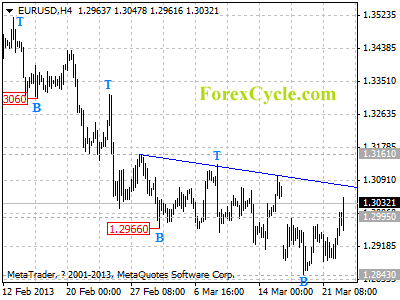
EURUSD is facing trend line resistance

EURUSD is facing the resistance of the downward trend line on 4-hour chart. A clear break above the trend line resistance will indicate that the downtrend from 1.3711 (Feb 1 high) had completed at 1.2843 already, then the following upward movement could bring price to 1.4000 zone. On the downside, as long as the trend line resistance holds, the rise from 1.2843 would possibly be consolidation of the downtrend, one more fall to 1.2700 area to complete the downward movement is still possible.

eurusd

Forex Signals

Cyprus Crisis: The Test Case for a Euro Exit?

By MoneyMorning.com.au

The nice thing about being a member of the European Union is that you always get a second chance.

If you vote one way, and the Europeans don’t like it, they’ll give you another chance to vote the ‘right’ way.

Of course, this does rather undermine local democracy somewhat. But that’s all part of the price of being one big happy European family. Didn’t you realise that?

Anyway, now it’s the turn of Cyprus to go back to the drawing board. Having ditched its original plan to tax savings to secure a bailout, the Cypriots have been told to come up with a new deal.

Or else…

How Cyprus Ended Up Here

A quick recap of the Cyprus story so far.

Cyprus needs a bailout. It needs €17bn. But the ‘troika’ (Europe’s big bailout committee) is only willing to lend it €10bn, because they knowCyprus could never pay back the whole €17bn. Even €10bn will be a push, but we can at least pretend it’s feasible.

So Cyprus needed to raise the extra from somewhere else fast. That’s where the bright idea of taxing bank deposits came from. Everyone with less than €100,000 in the bank was set to lose 6.75%. More than that would be taxed at 9.9%.

Great idea. Except of course that it tore up pretty much every unwritten rule about bank deposit security, and was an open invitation to bank runs across the eurozone.

As the queues formed in front of the cash machines, Cypriot politicians had a rapid rethink. They rejected the bailout deal out of hand, without a single pro-vote.

That left everyone floundering around. The Russians don’t seem willing to help much, despite the Kremlin’s outrage and all the money they’re said to have on the island. And if the Russians aren’t willing to pay, that leaves two options: Cyprus leaves the eurozone, or the bailout deal is renegotiated.

No one really wants Cyprus to leave the eurozone. As Die Zelt editor Josef Joffe notes in the FT, Cyprus itself is just ‘a tiny sliver of the EU economy’.

But given the backdrop, if it leaves the euro now, you could see ‘millions of panicked savers start a run on their banks from Lisbon to Athens’. That in turn would unleash ‘a broad-scale attack by the markets. Auf Wiedersehen, euro.’

Cypriot citizens also realise full well that returning to the Cypriot pound would be a lot more damaging to their savings than even a 10% ‘haircut’. Any new currency would plunge in value against the euro – that might be good for the tourist industry, but the resulting social unrest probably wouldn’t be.

So quitting the euro isn’t an easy option. But as far as Germany is concerned, neither is giving Cyprus a no-strings attached handout. If it does that, everyone from Greece to Italy will want one. As Joffe puts it, Germany will be left ‘bleeding for the greater good forever’.

So it’s back to the drawing board for Cyprus. The European Central Bank (ECB) has threatened – once again – to pull the plug on Cyprus’s banks if it doesn’t come up with a plan.

At the moment, the European Central Bank emergency funding is the only thing keeping those banks open. So a deposit tax would be the least of savers’ worries if that happens.

What this Means for Markets

So what’s likely to happen? And what does it all mean for your money?

In terms of the actual outcome, this is too close to call. It’s very hard to work out exactly what’s going on in policymakers’ minds.

A cynic might argue that this is just a cleverly-played, high-stakes negotiating game. You present everyone involved – the public, the troika, other politicians – with an utterly outrageous opening deal. And it doesn’t get much more outrageous than saying you’re going to take money that people thought was insured against loss.

As a result, whatever you end up with seems moderate by comparison. Chastened by the prospect of how bad things could have been, everyone involved walks away poorer, but feeling they’ve been let off the hook somehow.

But given the risks involved, it’s hard to believe this was deliberate. Regardless of what deal is reached, serious damage has been done to the banking system.

Why would anyone in Cyprus keep a significant amount of money in the bank now? They’ve seen how vulnerable the system is. When the banks re-open, a lot of people will be keen to get all their money out. Even if some sort of control is imposed to prevent that – as seems likely – it could get very messy.

It also damages faith in the rest of the European system, even at the margins. For example, if I’m travelling in Europe, I rarely bother getting hold of euros before I go. I just assume I’ll be able to get some from a cash machine when I land in the airport. I’ll not be doing that for the foreseeable future.

And for anyone assuming that a deal will get done because it ‘has’ to: it’s worth remembering that there was a point last year when almost all of us thought that Greece was going to walk out of the euro.

If Europe wants a test case to see just how to cope with a euro exit, Cyprus is the place to do it.

So far, markets are taking this in their stride. The euro has fallen, but no one is pricing in another Lehman Brothers. If Cyprus does leave the euro, you can expect more panic. But even then, I’d bet there are a lot of people ready to ‘buy the dips’ on this one.

The more important aspect of Cyprus is what it says about what happens when governments and banking systems go bust. In short, no one’s money is safe, and there are no risk-free havens.

John Stepek
Contributing Editor, Money Morning

Join Money Morning on Google+

Publisher’s Note: This article originally appeared in MoneyWeek

From the Archives…

Why You Should Buy This Falling Stock Market
22-03-2013 – Kris Sayce

Stock Market Warning: Part II
21-03-2013 – Murray Dawes

New Developments on Whether You Can Get Your Mortgage Cancelled
20-03-2013 – Nick Hubble

Your Retirement or Your Mortgage?
19-03-2013 – Nick Hubble

Get Used to This Stock Market Action, It’s Set to Last…
18-03-2013 – Kris Sayce

Israel holds rate, still too early to say if corner turned

By www.CentralBankNews.info      Israel’s central bank held its policy rate steady at 1.75 percent, saying inflationary expectations were stable and economic activity continues to improve but it was still too early to determine if activity is on an upward trajectory and the economy has turned the corner, the same view the bank had last month.
    The Bank of Israel, which cut rates by 100 basis points in 2012, said the global macroeconomic picture was mixed, and while there are signs of a recovery in the U.S., the slowdown continues in Europe.
    However, it “appears that there has been a decline in the probability of a crises occurring, a development which has reduced the high level of uncertainty that prevailed in the last year,” the BOI said, a reference to the lack of volatility in financial markets – so far – to last week’s events in Cyprus.
    Although the BOI is largely neutral in its policy guidance, it said that it was keeping a “close watch on developments in the asset markets, including the housing market” and cautioned that a larger government deficit would lead to higher interest rates.
     “The path of the interest rate in the future depend on developments in the inflation environment, growth in Israel and in the global economy, the monetary policies of major central banks, and developments in the exchange rate of the shekel,” the BOI said in a statement.


     The BOI said that one of the sources of economic uncertainty was the government’s fiscal policy, which the deficit having to be reduced according to the expenditure rule. Even after such a deficit reduction, the BOI said the budget would reflect a real 4.5 percent rise.
    “Deviation in the government deficit is liable to lead to increased interest rates in the economy,” the BOI said.
    Israel’s inflation rate was steady at 1.5 percent in January and the BOI said forecasters’ projections for inflation over the next year on average were 1.8 percent.
    Israel’s Gross Domestic Product rose by 0.6 percent in the fourth quarter from the third quarter for annual expansion of 2.7 percent, down from 2.9 percent in the third quarter.
    “Updated indicators of economic activity in February point toward continuation of the signs of improvement which began to be seen in January, but it is still too early to determine if this is a positive turning point,” the BOI said.
    Growth this year is forecast by the BOI’s staff at 3.8 percent and 4.0 percent in 2014, including the impact of natural gas production. This 2013 forecast is similar to the bank’s forecast from December.
     Excluding the effects of natural gas production from “Tamar” drilling, GDP growth is expected to be 2.8 percent in 2013 and 3.3 percent in 2014, the BOI said.
    The BOI’s highly-respected governor, Stanley Fischer, is stepping down on June 30 after more than eight years in his post.

     www.CentralBankNews.info


Large FX Speculators increased their USD positions to highest level since July

By CountingPips.com


cot-values


The latest weekly Commitments of Traders (COT) report, released on Friday by the Commodity Futures Trading Commission (CFTC), showed that large futures traders slightly added to their bullish bets in favor of the US dollar for a sixth consecutive week last week. Long positions for the American currency continued to be at their best overall standing since July 17th 2012, according to Reuters research and calculations.

Non-commercial large futures traders, including hedge funds and large International Monetary Market speculators, registered an overall US dollar long position of $25.753 billion as of Tuesday March 19th. This was a rise from a total long position of $25.46 billion on March 12th, according to position calculations by Reuters (US dollar positions against the total positions of eurofx, British pound, Japanese yen, Australian dollar, Canadian dollar and the Swiss franc).


cot-currency-contracts


Individual Currencies Large Speculators Futures Positions:

The individual currency contracts quoted directly against the US dollar last week saw increases for the Japanese yen, Australian dollar and the Swiss franc while the euro, British pound sterling, New Zealand dollar, Canadian dollar and the Mexican peso all had a declining number of net contracts for the week.

Individual Currency Charts:

EuroFX:

eur

EuroFX: Large trader positions for the euro decreased last week after improving slightly the previous week. Euro contracts declined to a total net position of -44,884 contracts in the data reported for March 19th following the previous week’s total of -24,787 net contracts on March 12th. This is a change of -20,097 contracts from the previous week.

Euro spec positions are now at their lowest level so far in 2013 and the lowest standing since November 27 2012 when positions stood at -66,693 contracts. EuroFx speculative contracts have now been in bearish territory for four weeks in a row.

March 12th 2013 Cot Report Data

Total Open Interest: 195073
Non-Commerical Large Traders Net Positions: -44,884
Commercial Traders Net Positions: +58162
Small Traders Net Positions: -13278


Great Britain Pound:

gbp

GBP: British pound sterling spec positions continued to decline last week for a ninth consecutive week and to the lowest standing since October 2011. British pound speculative positions decreased last week to a total of -61,480 net contracts on March 19th following a total of -49,800 net contracts reported for March 12th. This was a weekly change of -11,680 in large trader contracts.

Pound speculator positions have now been in a bearish position for six straight weeks since crossing over on February 5th and are at the lowest level since October 11th 2011 when positions equaled -61,972 contracts.

March 12th 2013 Cot Report Data

Total Open Interest: 212517
Non-Commerical Large Traders Net Positions: -61,480
Commercial Traders Net Positions: +93602
Small Traders Net Positions: -32122


Japanese Yen:

jpy

JPY: Japanese yen speculative contracts rebounded last week after a sharp fall the previous week and declining to the lowest level since December. Japanese yen positions improved to a total of -79,993 net contracts on March 19th following a total of -93,763 net short contracts on March 12th. This is a weekly change of +13,770 positions.

Yen positions, on March 12th, were at their lowest point since December 11th 2012 when short positions equaled -94,401 contracts.

March 12th 2013 Cot Report Data

Total Open Interest: 216674
Non-Commerical Large Traders Net Positions: -79993
Commercial Traders Net Positions: +118962
Small Traders Net Positions: -38969


Swiss Franc:

chf

CHF: Swiss franc speculator positions rebounded slightly last week after falling for four consecutive weeks. Net positions for the Swiss currency futures rose to a total of -10,996 contracts on March 19th following a total of -13,488 net contracts reported for March 12th. This is a weekly change of +2,492 contracts.

Swiss franc net positions had been on the short side for four straight weeks and dropped to the lowest level since August 21st 2012 when positions totaled -15,662 contracts before last week’s turnaround.

March 12th 2013 Cot Report Data

Total Open Interest: 50,580
Non-Commerical Large Traders Net Positions: -10,996
Commercial Traders Net Positions: +23,194
Small Traders Net Positions: -12,198


Canadian Dollar:

cad

CAD: Canadian dollar positions continued lower last week to drop for a ninth consecutive week. Canadian dollar positions decreased to a total of -65,331 contracts as of March 19th following a total of -53,397 net contracts that were reported for March 12th.

This is a weekly change of -11,934 net contracts following a weekly change of -6,734 the previous week.

March 12th 2013 Cot Report Data

Total Open Interest: 308,970
Non-Commerical Large Traders Net Positions: -65,331
Commercial Traders Net Positions: +76,642
Small Traders Net Positions: -11,311


Australian Dollar:

aud

AUD: The Australian dollar jumped sharply last week to rise for a second consecutive week. Aussie speculative futures positions increased to a total net amount of +54,055 contracts on March 19th after totaling +23,266 net contracts as of March 12th. This is a weekly change of +30,789 in net positions following the previous week’s +16,117 change.

Australian dollar contracts, on March 5th, were at their lowest level since June 26, 2012 when positions equaled just -2,159 contracts.

March 12th 2013 Cot Report Data

Total Open Interest: 158,807
Non-Commerical Large Traders Net Positions: +54,055
Commercial Traders Net Positions: -64,010
Small Traders Net Positions: +9,955


New Zealand Dollar:

nzd

NZD: New Zealand dollar speculator positions decreased sharply last week after a small increase the previous week. NZD contracts dropped to a total of +12,477 net long contracts as of March 19th following a total of +19,350 net long contracts on March 12th. This constitutes a weekly change of -6,873 net contracts.

The New Zealand dollar positions had stayed above the +19,000 contracts threshold for ten consecutive weeks before last week’s decline.

March 12th 2013 Cot Report Data

Total Open Interest: 28,933
Non-Commerical Large Traders Net Positions: +12,477
Commercial Traders Net Positions: -13,120
Small Traders Net Positions: +643


Mexican Peso:

mxn

MXN: Mexican peso speculative contracts fell last week after advancing the previous week. Peso positions decreased to a total of +109,376 net speculative positions as of March 19th following a total of +113,770 contracts that were reported for March 12th. This is a weekly change in net large peso speculator positions of -4394 contracts.

Peso speculative positions have been over the +100,000 threshold for a second straight week after falling under this level on March 5th for the first time since November 27th 2012.

March 12th 2013 Cot Report Data

Total Open Interest: 156,281
Non-Commerical Large Traders Net Positions: +109,376
Commercial Traders Net Positions: -118,821
Small Traders Net Positions: +9,445


The Commitment of Traders report is published every Friday by the Commodity Futures Trading Commission (CFTC) and shows futures positions data that was reported as of the previous Tuesday (3 days behind).

Each currency contract is a quote for that currency directly against the U.S. dollar, a net short amount of contracts means that more speculators are betting that currency to fall against the dollar and a net long position expect that currency to rise versus the dollar.

(The graphs overlay the forex spot closing price of each Tuesday when COT trader positions are reported for each corresponding spot currency pair.)

See more information and explanation on the weekly COT report from the CFTC website.


Article by CountingPips.comForex News & Market Analysis