He Is Risen!

By Bill Bonner

We attended Easter Sunday mass at Our Lady of Pilar in Recoleta
yesterday. The small church was crowded. Most were dressed casually —
the men in open shirts and slacks, the women in dresses. They were
middle-aged, for the most part, and middle-class, but it was hard to tell.

However, they knew the plot.

Let us bring you into the picture…

The smart money, in the year of our Lord 33, was on the Romans and
the Pharisees. They were the insiders. They controlled the courts. They
had the military budget and the “boots on the ground” that could kick any butt they wanted.

Then the skinny Jewish guy came into Jerusalem. The crowd loved him.
They dropped palm leaves in this path. Here was an underdog; the “king
of the Jews,” they called him.

Jesus knew something was up. He had a last supper with his friends, and he turned to Peter.

“I know I can’t trust you,” he said… or words to that effect. “You’re going to betray me three times before the cock crows.”

Peter flatly denied it. But it was true. Picked up later by the
equivalent of the Department of Homeland Security, Peter denied he had
anything to do with the troublemaker Jesus.

So it didn’t look good for the maverick Jew. The odds against him rose even higher over the next few days.

But when he was dragged before the Roman governor, Pontius Pilate,
all of a sudden, his stock rose. Pilate saw no reason to prosecute him;
he hadn’t done anything wrong. For a while, it looked as if he were
going to walk.

But noooo. The local elite came in, guns blazing. They wanted Jesus
taken away. He was an “insurgent”; they were sure of it. Did he not
claim to be “king of the Jews”? Wasn’t that the same as treason? They
put him to the test; they would find out if he were really a law-abiding
citizen.

Render Unto Caesar…

“Shouldn’t we all pay our taxes?” they asked. They hoped to trap him,
like Senators Graham and McCain trying to get Chuck Hagel to say that
“the surge” was a mistake or that the “Jewish lobby” has too much power.

“Render unto Caesar that which is Caesar’s,” he told them, tossing a coin with Caesar’s picture on it in their direction.

Pilate wasn’t sure what he meant by that. But he didn’t care, either.
He just didn’t want trouble. So he gave the locals a chance.

“OK, I’m going to nail someone to the cross,” he told them. “But I am
also going to pardon someone, as it is Passover. You decide who goes
free. The thief Barabas… or the pretender, Jesus.”

“Give us Barabas,” said the mob.

At that point, you could have bought all the Jesus stock you
wanted… for pennies. No one ever survived crucifixion. It wasn’t
possible. Unless this was a “new era,” Jesus was done for. He was
history.

They drove spikes through his hands and feet and hauled up the cross;
he wasn’t coming down until he was dead. Even Jesus himself figured he
was finished. By the ninth hour on the cross, he had given up hope.

Eli, Eli, lama sabachthani?” he cried out.

And now the skies darkened. Jesus hung his head and breathed his
last. If he had been a listed company, trading in his stock would have
been suspended. At that point, he had gone “no bid.” He was out of
business.

Then they took him down from the cross. They pulled out the nails.
And they put the corpse into a hole, with a big stone in front of the
opening to prevent dogs from getting to it.

The End of the Affair?

The entire affair, at that point, seemed to be over. No more
“miracles.” Nor more healing. No more talk of loving thy neighbor or
everlasting life.

The disciples, who had given up their careers and families to follow
him, were thinking of going back to school… maybe becoming lawyers. A
few were going to try to qualify for disability. Others were hoping to return to fishing, farming… or just hanging out in town.

The next day, Mary Magdalene and some other women went to the tomb.
They expected to take out the body and wash it properly. But when they
arrived, there was no body there. What had happened to it?

An angel, dressed in bright white, appeared. He said, “He has risen!”
The angel told them to report these facts to the disciples.

It was about this time that speculation in Christ Inc. began. The
company had seemed broke… and finished. Now it was back in business.

If this “resurrection” thing had any truth at all to it, the stock
could go up as high as Apple or Google. It was one thing to give
customers a fancy telephone… or a search engine that helped them find
out what the Easter story was all about.

Eternal life was something altogether different. Maybe it would work
out. Maybe it wouldn’t. But it was worth putting in a few shekels to
find out. After all, it could be the biggest hit since… well… bread.

The disciples ran to see if it were true. On their way to the tomb,
Jesus — in his new, post-real-life form — met them. They didn’t know
what to make of him. He was there in flesh and blood… sort of, but not
quite.

“Don’t be afraid,” he said to them. “I’ll meet you in Galilee.”

Jesus did show up at Galilee, as promised. Speculation increased.
People could see that the promise of “everlasting life” was not just
marketing hype. If Jesus could do it, they reasoned, anybody could.

Jesus turned to the same Peter who had betrayed him. “You’ll be CEO
of my new company,” he said. “Peter” means “stone” in ancient Greek.
Jesus used a little double entendre: “On this rock, I will found my
church,” he said.

Shares in the new company rose, off and on, for the next 1,500 years
— peaking only when a breakaway unit, led by Martin Luther of Germany,
set up competing companies.

Today, the church Peter set up still has 1.14 billion members and
shareholders and a capitalization (net worth) that is probably in the
billions (we found no estimates that appeared authoritative). Not as big
as Facebook, but still not bad.

No one could ever prove or disprove the claim that by joining Christ
Inc., you would have eternal life. But most people decided to take the
route suggested by the French philosopher Pascal.

“I don’t know if it’s true or not,” he said, or words to that effect.
“But why take a chance? If you’re wrong, you don’t lose much — you
just give up a few years of naughty behavior. If it turns out to be
true, on the other hand, you gain a lot — an eternity of bliss. You do
the math.”

Regards,

Bill Bonner

Bill

To learn more about Bill visit his Google+ page.


Sizemore Capital First Quarter 2013 Letter to Investors.

By The Sizemore Letter

It seems we’ve been here before.  In 2012, we had a massive first-quarter rally in which U.S. stocks outperformed most other asset classes.  European shares lagged and concerns about the stability of the Eurozone caused a major surge in volatility.

Sound familiar?

History would appear to be repeating itself in 2013.   Through the first quarter, our portfolio with the least exposure to Europe—the Dividend Growth Portfolio—has massively outperformed our portfolios with significant Europe exposure.  As of March 31, the Dividend Growth Portfolio was up 19.7% vs. 10% for the S&P 500.

Individual security selection has been important—Two Harbors (NYSE:$TWO) has been a particularly good performer—but asset class has been far more critical.  Much of Dividend Growth’s outperformance has been due to its high weighting in midstream master limited partnerships and in conservative retail REITS—both of which have outperformed the broader market.  I expect both of these asset classes to continue to perform well in 2013, meeting or exceeding the broader market return, though I do not expect this degree of outperformance to persist.

The Sizemore Investment Letter Portfolio and the Tactical ETF Portfolio have been more of a mixed bag in 2013.   Both portfolios were positioned to profit from a rebound in European and emerging-market equities, neither of which have performed as well as I had expected.  And the market jitters surrounding the Cyprus bailout caused both portfolios to have a terrible end to the quarter due to their exposure to Spanish equities in particular.

As of March 31, the Tactical ETF Portfolio was up 6.3% for the year, trailing the 10.0% for the S&P 500.  The Sizemore Investment Letter was up 3.3%.

All of this is water under the bridge; the key question is “what happens now?”

I expect Spanish equities to rally and to outperform over the course of 2013.  Spanish equities are some of the cheapest in the world and offer great indirect exposure to emerging markets via their strong presence in Latin America.  Of course, none of that matters at the moment.  Right now, investors are scared to death of contagion, that a banking run in Cyprus will accelerate into a broader run on Spanish and Italian banks as well.

I do not see this happening, and even if it does, the European Central Bank is prepared to offer emergency liquidity to otherwise healthy banks—such as Sizemore Investment Letter Portfolio holdings Banco Santander (NYSE:$SAN) and BBVA (NYSE:$BBVA)—in the event of a run.

The bigger risk in my view is that Italy’s political stalemate disintegrates to the bond that the bond markets revolt and send yields to punishing levels.  I do not expect this, but it is a risk factor that I consider significant enough to warrant watching.

As a contrarian investor, you have to make a judgment call.  Do I go against the crowd and buy when others are selling, or do I join the crowd and sell before a small loss turns into a large one?  There is no “rule” here, or certainly not one that is reliable.  You have to use your own judgment and determine whether the returns you expect are worth the possibility for loss.

Today, in the case of Spanish equities, my answer is “yes,” though I am prepared to take some money off the table if the crisis accelerates.   For now, I’m keeping an eye on Spanish and Italian bond yields.  Spanish yields show no signs of rising aggressively and remain in the downtrend that started last summer.  Italian yields started to rise in late January, though yields have since leveled off.  Until I see panic in the bond market, I am comfortable being invested in European stock markets.

SUBSCRIBE to Sizemore Insights via e-mail today.


The post Sizemore Capital First Quarter 2013 Letter to Investors. appeared first on Sizemore Insights.

Forget Cyprus- This Is a MUCH Bigger Threat to Europe

By Chris Hunter, insideinvestingdaily.com

Investors aren’t exactly thrilled with the breathtakingly shortsighted “bail-in” Europe has imposed on Cyprus.

This is a rescue in name only. In reality, it will gut the Cypriot
economy and set a nasty precedent throughout the rest of the eurozone.

Rather than cough up €5.8 billion ($7.4 billion) to save Cyprus (a
measly 0.05% of EU GDP) European leaders prefer to see the Cypriot
government confiscate 40% of Cypriot bank deposits over €100 thousand.

It will drive Cyprus into a depression, much like the “rescues” of
Greece, Spain, Ireland and Portugal have done. That’s because the deal
utterly destroys the credibility of Cyprus’ banking sector, which makes
up 45% of Cypriot GDP and employs 70% of its workers.

Europe’s mantra is that Cyprus is a “special case” because it is a tax shelter
for Russian oligarchs’ cash. About one-third of Cypriot bank deposits
come from Russian depositors. But the claim that all of this cash is
illicit is pure nonsense. It is widely believed because it plays into a
stereotype of Russians as corrupt gangster types.

Scratch the surface and a different story emerges…

First, Russia has a 13% flat-rate income tax and a 20% corporation tax. So the need to “dodge” taxes isn’t exactly pressing.

Second, about 40,000 Russians call Cyprus home. There may be some
shady types among them. But it’s a stretch to claim that the majority of
them are corrupt oligarchs who deserve to have their savings robbed.
Russia has cold winters. Cyprus sits in the Mediterranean and is warm
all year round.

Third, Cyprus and Russia have a double-taxation treaty. This puts a
5% cap on taxes on interest and means an effective 0% rate on dividends
and royalty payments. So why wouldn’t Russians seek out these terms? You
don’t have to be crooked to want to reduce your tax exposure.

But Merkel, Draghi et al. need a scapegoat. And they have found one in the Russian mob.

But the Cyprus story is a diversion. The real threat to Europe right now is Italy.

To say Italy is on the brink is an understatement.

The big winners of the recent Italian elections were a former Communist, Pier Bersani; a former comedian, Beppe Grillo; and a disgraced former politician, Silvio Berlusconi.

And they utterly rejected the caretaker prime minister, the market-friendly technocrat Mario Monti.

The level of political disarray and disillusion in Italy (where I write to you from today) is hard to believe.

Monti has said that his government “can’t wait to leave office.” And
Bersani has said that “only an insane person” would attempt to rule
Italy in the current environment. Meanwhile, Grillo, who cannot hold
office because of a manslaughter charge against him, has announced that
Italy doesn’t need a new government to pass reforms.

He is also on record as saying that his anti-austerity and
anti-establishment Five Star Movement wants to “destroy everything.” He
will also push through a referendum on leaving the euro if he gets into
government.

If either Berlusconi or Grillo gets into power, the markets will panic.

Already investors are selling Italian and Spanish sovereign bonds and
buying safe haven German bunds and U.S. Treasury bonds. This is a slow
drip right now. But it could easily turn into a torrent, if either
Grillo or Berlusconi seizes the reins of power in Italy.

Bottom line: Another European summer of chaos and crisis is very much
on the cards. This will not only throw European markets into disarray,
but also cause investors in U.S. stocks to run for cover.

U.S. stocks have already more than doubled since their March 2009 lows. Wading in right now could prove to be horrible timing.

Disclaimer

Article brought to you by Inside Investing Daily. Republish
without charge. Required: Author attribution, links back to original
content or www.insideinvestingdaily.com. Any investment contains risk. Please see our disclaimer.


Central Bank News Link List – Apr 1, 2013: Japan just might be set to open a new chapter

By www.CentralBankNews.info Here’s today’s Central Bank News link list, click through if you missed the previous link list. The list comprises news about central banks that is not covered by Central Bank News. The list is updated during the day with the latest developments so readers don’t miss any important news.

10 Startling Statistics About the S&P’s Record High

By WallStreetDaily.com

After three weeks of waiting, the S&P 500 Index finally joined the Dow in the record books.

Last Thursday, the most widely tracked Index in the United States closed at 1,569.19 – taking out its previous all-time high of 1,565.15, which was hit on October 9, 2007.

Who cares? After all, it’s just a number, right?

Well, I do!

You’ll recall, I went out on a limb and told you to expect it to happen. So I’d like to say, “I told you so!” (Just being honest.)

In all seriousness, though, the market hitting new records presents an opportunity for reflection. Or as Erik Davidson, Deputy Chief Investment Strategist at Wells Fargo Private Bank, says, “It is a milestone; it does cause you to stop and evaluate where you are and where you come from.”

Indeed! So let’s do just that today. Let’s slice and dice the data on the market’s latest run-up.

By doing so, I promise that we’ll reveal some unexpected insights, as well as some potential investment opportunities.

Here goes…

~Stock Stat #1: Talk of a Tired Bull… is Total Bull

So far we’re four-plus years into a bull market. And the S&P 500 has risen more than 130%.

Even though I told you not to before, it’s only natural to assume that such a sustained and significant rally is close to the longest on record. But it’s not.

In fact, this is only the sixth longest bull market since 1929 (the year the market crashed), according to an analysis by Bank of America (BAC).

~Stock Stat #2: First in, First Out?

It’s often said that the sectors that get us into a mess are the ones that must lead us out. Well, that’s certainly happening.

Since the market bottom, the two top-performing sectors are financials and consumer discretionary. They’re up 192% and 233%, respectively.

In other words, corporate banking and conspicuous consumption have come back in a big way.

Here’s a key observation, though… Financial stocks still have plenty of room to run.

Since the last market peak on October 9, 2007, the financial sector is still down 49%.

And if you’re wondering what the best-performing sector is since October 2007, it’s consumer staples.

Let that serve as a reminder: When this bull market comes to an end, we should load up on defensive names in the sector. That is, if you want to soften the impact of the next downturn. (Hint: You should.)

~Stock Stat #3: Nowhere Near a Record

If we take into account the “thief that robs us all” – inflation – the S&P 500 isn’t even close to a new all-time high.

According to calculations by JP Morgan (JPM), the inflation-adjusted peak for the S&P 500 is 2,065.

To get there, stocks would need to rally another 31.6%. To which I can only respond, “Bring it!”

~Stock Stat #4: Keep Betting on the Frontrunner

If the trend is our friend, we should push some chips in on the best-performing stock since the market hit rock bottom. And that distinction belongs to Wyndham Worldwide (WYN).

Shares are up a mind-boggling 2,130% since March 2009, according to FactSet. What’s more, its momentum has been accelerating over the last three months.

Amazingly, though, the stock is not overly expensive. It trades for 15.4 times forward earnings, which is only about a 10% premium to the S&P 500.

~Stock Stat #5: Don’t Bet Against the United States

I served up a healthy dollop of patriotism on Friday. However, more is warranted today.

Despite analysts downplaying the appeal of U.S. stocks compared to emerging markets stocks, the former is handily outperforming the latter in 2013.

Year-to-date, the S&P 500 Index is up 10.6%.

That compares to a 7.6% decline for Brazil’s Bovespa Index… a 2.9% stumble by India’s SENSEX Index… a 2.7% decline for Russia’s MICEX Index… and a 1.4% drop for China’s Shanghai Index.

The one country that’s giving the United States a run for its money is, go figure, Japan! The Nikkei 225 Index is up more than 15% so far this year. (Once again, I told you so.)

That’s it for today. Stay tuned for tomorrow’s column where I’ll reveal another five startling statistics – including the one stock you should avoid like the plague.

Ahead of the tape,

Louis Basenese

Article By WallStreetDaily.com

Original Article: 10 Startling Statistics About the S&P’s Record High

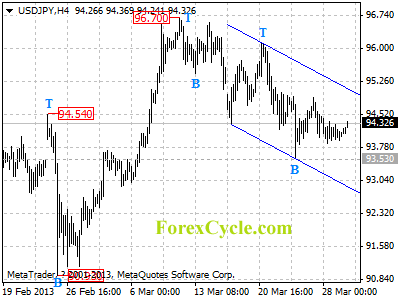
USDJPY stays within a downward price channel

USDJPY stays within a downward price channel on 4-hour chart, and remains in downtrend from 96.70. Key resistance is located at the upper line of the channel. As long as the channel resistance holds, the rise from 93.53 could be treated as consolidation of the downtrend, and one more fall to 92.00 – 93.00 area is still possible after consolidation. On the upside, a clear break above the channel resistance will indicate that the downtrend from 96.70 had completed at 93.53 already, then the following upward movement could bring price to 100.00 zone.

usdjpy

Forex Signals

On Gold — Billionaire Investor Eric Sprott Says : ‘I’m in Alex Cowie’s Camp’

By MoneyMorning.com.au

Dear Reader,

The ‘Masters of the Market’ are a tricky bunch.

I’m talking about the tiny club of professional billionaire investors who tend to be a few steps ahead of everyone else.

Most Masters keep their motives and intentions well and truly hidden. Or they only share what they think is about to happen in the markets long AFTER they’ve taken positions.

Which is why I’m thrilled to announce that a bit of a coup was pulled off for Money Morning readers in Hong Kong last week.

We had our resources expert Dr Alex Cowie on the ground for the conference. Alex somehow managed to land a meeting with one of our favourite Market Masters, Eric Sprott.

Away from the media and the 3,500 attendees. One-on-one.

In that meeting Sprott shared his best investment idea of 2013 with Alex. And today, as a special Easter Monday treat, we share the full transcript of this private interview below.

Sprott is one of the few ‘Masters’ who likes gold. (He holds 90% of his assets outside of Sprott Inc. shares in precious metals).

But this Merrill Lynch analyst-turned-fund-manager is one of the few ‘Masters’ who is vocal about the mess central bankers are making of the global financial system.

Sprott recently told King World News that the Fed and other central banks have simply lost control: ‘…there is no exit plan. There never was an exit plan, and there is no exit.’

This transcript is a little long. Alex was amazed by how candid Eric was. But I urge you to read the whole thing, because Eric’s take on where the market is going and how to invest for it is fascinating. (I also urge you to look at the five local stock recommendations Alex has that are 100% in line with Eric’s view. To do so, click here.)

Enjoy… (The bolding is our take on the particularly important bits.)

Alex: We’re very lucky to be joined by Eric Sprott today for the latest Strategy Session. Eric spoke as the keynote speaker for Hong Kong Mines and Money 2013, and gave a very rousing speech on the precious metals market. As editor of Diggers and Drillers I’ve been focusing very squarely on the gold market recently. So, thrilled to be joined by Eric today, and looking forward very much to hearing Eric’s thoughts on the gold market.

Eric: Alex I’m happy to be here; anyone who spreads the word on precious metals is in my camp. We need more people to realise that that’s where they should be investing their money, so I’m happy to partake in this.

Alex: I’ve been speaking a great deal recently about the possibility of an inflection point in gold, rallying strongly from here. We’ve seen quite a few technical and fundamental signs that suggest that we could have a serious move from here. Not just in gold but in gold equities too. How are you seeing the gold market from here, what do you anticipate for the rest of the year?

Eric: Well Alex we’ve done a lot of work on gold supply and demand and I’ve written a number of articles, all of which are available at our website sprott.com. And I think the most important one is one we wrote about six months ago, and it basically questioned whether the western central banks had any gold left. And we like to do an analysis of the physical market for gold, not the paper market where seemingly the prices are determined. And our own analysis suggests that the demand for gold is 2400 tons more than the annual supply – which is approximately 4000 tons – which is a very great disparity between supply and demand.

Alex: Yes.

Eric: And then we get there by adding up the Chinese demand the Indian demand, the mint sales. The central banks used to be sellers of gold, now they’re buyers of gold. How do all these people come into the market when supply of gold hasn’t changed in the last 12 years? It’s still 4000 tons a year. And there’s only one answer to the question: that is that the western central banks must be selling their gold.

It’s been analysed by a number of people. The way they do it is on central banks balance sheets they have one line on the financial statement and it’s called gold and gold receivables. So a receivable is gold they don’t have that’s been leased out into the market. Whereas physical gold they have. But we see a combined number and we don’t know what percent of that is leased.

We’ve seen evidence for example the Austrian finance minister when he was challenged, ‘well where’s our gold’, he foolishly made the comment, ‘Well we’ve only got 13% in the country but the rest of it’s either in New York or London, but we made 300 million of interest on it.’ Well you only make interest because you’ve leased the gold out, right? And then that gold of course is gone to satisfy physical demand and when the central bank goes back to the counterparty and says, we want our gold back, it’s not going to be there. Because there’s a shortage.

So I’m with you that there’s going to be an inflection point.

Here we are with these financial events firing up; of course the latest one is in Cyprus, and it looks like there’ll be one in Slovenia, and in my mind it never stops. It just keeps carrying on here.

And of course it’s brought people back to realise that when you can lose money in your bank account, you are way better off owning gold than having a deposit in the bank.

When Venezuela devalued by 40%, if the citizens had owned gold they would have lost nothing. When Iceland devalued, if the residents had owned gold they wouldn’t have lost 60% of their money. I don’t know how many more countries it takes to have these events happen until the world finally clicks in to realising it’s better to own gold than it is to have a bank deposit.

Alex: What about Chinese accumulation of gold? We know from official data that they’re the biggest consumer in terms of importing.

Eric: And manufacturing.

Alex: And manufacturing as well.

Eric: There’s a voracious Chinese appetite for gold. And I don’t believe it’s just the citizens of China. I think it’s the People’s Republic Bank of China that’s actually buying the gold. If I was in China, and you see what’s going on in some of these countries and the printing of money, they should be taking all their bonds and owning gold. But they’re smart enough to know that they can’t buy so much that everyone gets tipped off to the fact that there’s no gold left. So they’re going to just slowly bleed these western central banks dry of their gold.

Alex: Well we heard from People’s Bank of China last week suggesting that they hadn’t increased their holding over the last three years, from 1,054 tons. Let’s file that under ‘fairy tale’.

Eric: I don’t believe that for a second. It seems so obvious to me. They haven’t been buying US treasury bills or treasury bonds for the last 18 months. I think it doesn’t take a rocket scientist to realise that owning gold is probably the best thing you can do these days as a central bank.

Alex: Are you up for any sort of gold price targets?

Eric: You know that’s the toughest thing in the world to analyse Alex, because you know…you tell me how much they’re going to print in the future and I’ll tell you what the gold price should be, right?

I mean lots of people have done that analysis. With this much money in the world the price of gold should be $10,000 or $12,000. And of course the amount being printed is escalating, so it’s a moving target. It’s way beyond where we are today. It’s many times higher than where we are today, is what I would say. You know, we may look back in 2017 and now we’re printing 8 trillion a year, and the number could be $20,000. It’s just a moving target, but I know it’s a lot higher than today.

Alex: Well one of the reasons I’m suspicious of an inflection point happening sometime this year is the drop in physical supply.

Eric: I get the distinct feeling that they could very well be running on fumes. There’s lots of chatter about, you know, they went into Libya to get the gold, MF Global was closed down and nobody received their gold, and there’s some chatter about Cyprus has some gold. Maybe they’ll end up getting that gold out of this whole thing, and have a little amount to supply the market.

But it’s a game that they’re going to lose here. And I certainly know why they’re doing it. Because I think their explanation of some kind of economic recovery doesn’t hold true when it comes to the man in the street. Yes the stock market’s up, because the central banks are supporting it, but when it comes to looking at the fundamental economic strength, it’s just not there.

Alex: We’ve seen food stamp participants rising to 15% of the American population.

Eric: Yeah, well it’s gone up by at least 27 million people in the last five years. And over that same time period we lost 3.6 million jobs. So you think, well how can that group of the population be better off? They’ve got less money to spend. So there is no recovery going on.

Alex: Neither in Europe?

Eric: I don’t know if it’s a recession or a depression, quite frankly. But it could be defined as either. When you have 25% unemployment in Greece and Spain, and 50% youth unemployment, I mean that’s a depression.

And one of the theses that I have is that weakness begets weakness. So for example, if somebody announces a layoff, JP Morgan says they’re going to lose 19,000 employees, it doesn’t just affect the 19,000 employees, it affects the people whose services these 19,000 people would buy. And there’s only one way to stop weakness begetting weakness, and that is through some overt policy that comes in from the outside and changes the dynamic. And typically, under Keynesian analysis, that was fiscal policy or monetary policy.

We have no room on fiscal policy; we have austerity programs in most countries in Europe, we essentially are having austerity forced on the United States because of the whole fiscal cliff and the sequestration, and so fiscal policy is off the table.

And of course the deficits are at record highs already. And in terms of monetary policy, we already have the zero interest rate, and we have money printing. I don’t see any room for some outside influence to come along and cause this change in weakness.

Alex: Under those financial conditions, macro-economic conditions, we’d be expecting gold and silver to be the indicator of just how bad things are.

Eric: You would.

Alex: You can only suppose that there’s been a bit of discrete supply into the market to suppress that.

Eric: That’s totally what I think. I think when the world wakes up to the fact that having money in a bank is a risky situation because of leveraged financial counterparties…and when this financial system caves a little…all of a sudden the balance sheets of the banks can’t support the deposit liability. Which is what we’re already saw it in Greece. We’re seeing it in Cyrpus. We’re going to see it in other countries.

I think it’s a very risky thing having money in a bank, and that’s why I keep suggesting, whether it’s gold or silver or some other precious metal, something real is the preferred asset.

Alex: I’ve certainly been buying gold and silver, physical gold and silver, taking ownership of it, not just for myself but for my children as well. So I’m taking a five to ten year view, at least. Because we’re five or six years into this crisis and clearly nothing’s getting much better.

So there’s a good opportunity there in precious metals, physical precious metals, but also equities. If we could move to gold equities. They’re at record lows whichever way you want to slice and dice them, whichever metrics you want to look at. Do you see an inflection point happening there soon?

Eric: Well I’ve always said the stocks won’t go up until the metals go up, because everyone looks at the metal price and says, ‘Oh my god the price of the metal went down I don’t want to own the stocks.’ But typically when the metal goes up, the stocks outperform by at least two to three times. So if we can get a sustained move here – and we can’t just go to 1650 and give it up again, we’ve got to look like we’re going to a new high here – then of course the metal stocks have so much to get back again. And out of the 2009 bottom, the metal stocks put on a 200% gain in about nine months, because gold went up to $1920, obviously a new high.

Alex: And that’s just for the larger producers. Whereas the smaller developers and explorers rose even more.

Eric: The small companies always outperform the big companies, because they have more room to expand. I’d much rather buy a guy whose producing 100,000 ounces who can go to 200,000 ounces, ie who could double his income, than a major guy who’s at five million who thinks he might get to 5.5 million in three years, so there’s not the same growth element. So I always prefer the small to midcap guy, as providing by far the bigger return

Alex: I was hoping that you’d say that, because that’s what I’ve been doing a lot of recently, tipping those small to midcap guys. [To find out which guys, click here. -Ed]

So you think that from this level it’s quite realistic that, when we do see a sustained move for gold above 1650 or 1700, that gold stocks could rally hard?

Eric: I think that as it approaches 1700, people will realise it’s going to be a sustained rally. And it’s not as though the stocks haven’t started moving already.

I mean they have, we had a day recently where the gold price went up half a percent and the gold stocks went up 2.5%, because they are so oversold here.

Plus you’ve got short positions on them so there’s a bit of vulnerability from the guys that are short. And particularly as they realise that ‘hold one now maybe the mood towards precious metals has changed here’, and all of a sudden they think, ‘Gee, maybe it will go higher because of the developments in the financial system.’

Alex: It’s quite amazing how quickly and how extremely the sentiment can change. And that’s why you need to be set before the event.

Eric: Right, right.

Alex: Now Eric I’ve taken too much of your time already, so we better wrap it up there. Thank you very much.

Eric: Alex, a pleasure being with you.

Alex: Likewise, thank you.

***********************

Even as Alex was talking with Eric in Hong Kong, there were significant moves in the gold sector. A number of small cap gold explorers are starting to get major interest from brokers for the first time in what seems an age.

The ‘Gee, maybe it will go higher’ theory of Eric’s seems to be panning out already. Institutional money is once again on the lookout for cash-rich explorers ticking all the boxes on the road to production.

Alex has two such companies on his recommendation list right now.

One recently punched 20% in a single treading session in this month on takeover talk. It’s pulled back since then, which in Alex’s books makes it the most urgent buy on his share list.

And on the day Alex gave his own speech on gold stocks in Hong Kong, another of his gold mining recommendations announced a $52 million share placement.

What does it need the money for?

It’s just discovered a 4.2 million ounce ‘monster’ gold deposit in Mali. It needs the cash to fast-track the project.

In total Alex has five Australian gold explorers and producers that he believes are primed for huge gains if Sprott’s thesis on a supply shortage in the gold market proves correct in 2013.

To find out what these five gold stocks are, click here.

There you’ll be offered a trial subscription of Alex’s newsletter, Diggers and Drillers.

You’ll get Alex’s gold tips, plus secure access to the names of all the other resource and mining stocks on the Diggers and Drillers share list for the next 30 days. If – for whatever reason – you don’t want to remain a subscriber, simply cancel within that 30 days.

You will receive a 100% refund of the small subscription fee, no questions asked.

Alex had gainers in 2012 including 53%, 27% and 14.7%. His star performer ended 2012 up 175%. He also helped his readers avoid carnage by completely avoiding iron ore stocks that year.

Alex’s biggest prediction so far for 2013 is a major, major comeback in gold mining shares.

Ex-Fed Chairman Paul Volker admitted that in the 1970′s ‘the biggest mistake we made was not controlling the gold price’. Eric Sprott expects that the gold price is being similarly managed today to create the illusion of recovery…when nothing could be further from the truth. If, like Eric Sprott, you agree with Alex’s thesis that gold – and gold stocks – are about to take off again, you should take a look at Alex’s plan for profiting from it.

To do so, click here.

Regards,

Dan Denning,
Money Morning Australia

Related Articles

Diggers and Drillers:
Five Reasons Why Gold Stocks Are Set to Rebound

Large FX Specs trim USD longs to $24.8 billion plus Oil, Gold, VIX, 10-Year & SP500

By CountingPips.com


CotValues


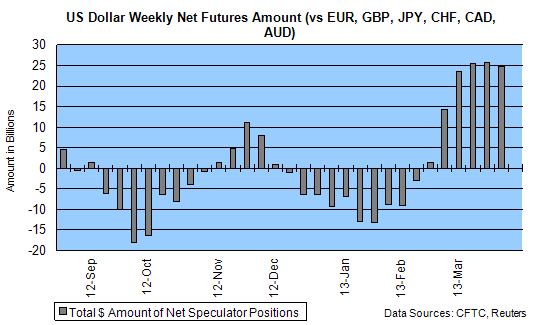
The latest weekly Commitments of Traders (COT) report, released on Friday by the Commodity Futures Trading Commission (CFTC), showed that large futures traders slightly decreased their total bullish bets of the US dollar last week following six consecutive weeks of increases in USD positions.

Non-commercial large futures traders, including hedge funds and large International Monetary Market speculators, registered an overall US dollar long position of $24.8 billion as of Tuesday March 26th. This was a decline from a total long position of $25.753 billion on March 19th, according to position calculations by Reuters (US dollar positions against the total positions of eurofx, British pound, Japanese yen, Australian dollar, Canadian dollar and the Swiss franc).

Individual Currencies Large Speculators Futures Positions:

The individual currency contracts quoted directly against the US dollar last week saw increases for the Australian dollar, New Zealand dollar, Mexican peso and the Canadian dollar while the euro, British pound sterling, Japanese yen and the Swiss franc all had a declining number of net contracts for the week.

Individual Currency Charts:

EuroFX:

eurofx

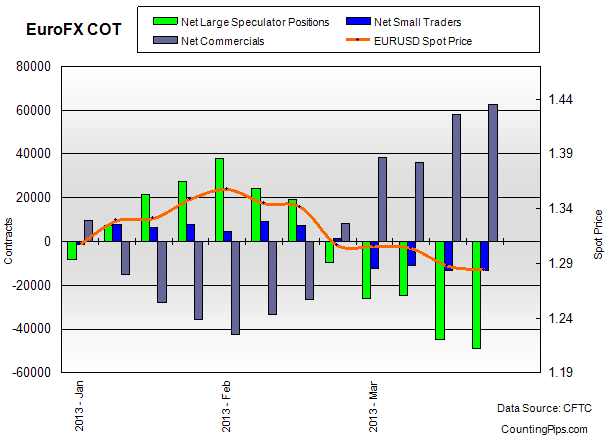
EuroFX: Large trader positions for the euro decreased last week for a second week in a row. Euro contracts declined to a total net position of -49,095 contracts in the data reported for March 26th following the previous week’s total of -44,884 net contracts on March 19th. This is a change of -4,211 contracts from the previous week.

Euro spec positions are at a new low level for 2013 and the lowest standing since November 27 2012 when positions stood at -66,693 contracts. EuroFx speculative contracts have now been in bearish territory for five weeks in a row.


BritishPound Sterling:

GBP

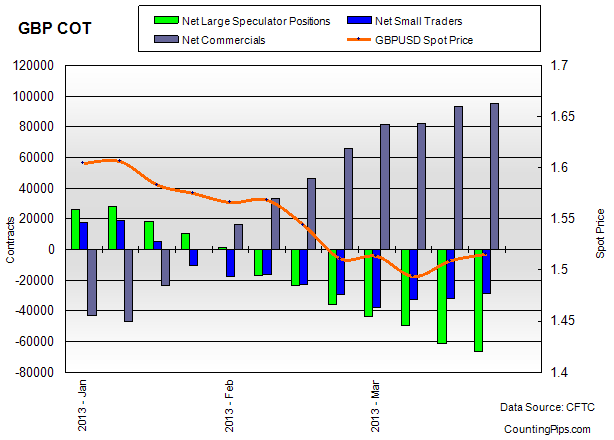
GBP: British pound sterling spec positions continued their decline last week for a tenth consecutive week and to the lowest standing since early of October 2011. British pound speculative positions fell last week to a total of -66,555 net contracts on March 26th following a total of -61,480 net contracts reported for March 19th. This was a weekly change of -5075 in large trader contracts.

Pound speculator positions have now been in a bearish position for seven consecutive weeks since crossing over on February 5th and are at the lowest level since October 4th 2011 when positions equaled -68,724 contracts.


Japanese Yen:

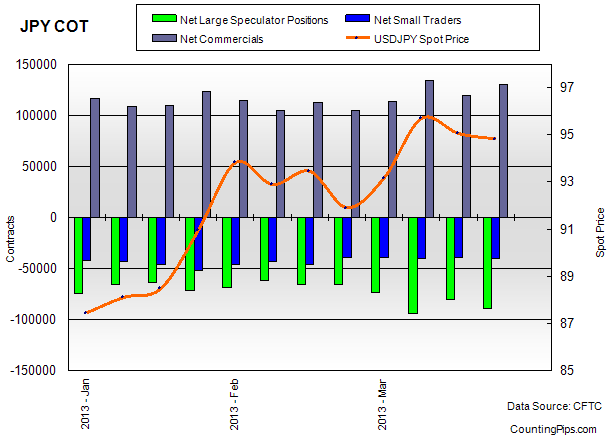
JPY

JPY: Japanese yen net speculative contracts fell last week after rebounding the previous week. Japanese yen positions declined to a total of -89,149 net contracts on March 26th following a total of -79,993 net short contracts on March 19th. This is a weekly change of -9156 positions.

Yen positions are at their third lowest point since December 11th 2012 when short positions equaled -94,401 contracts.


Swiss Franc:

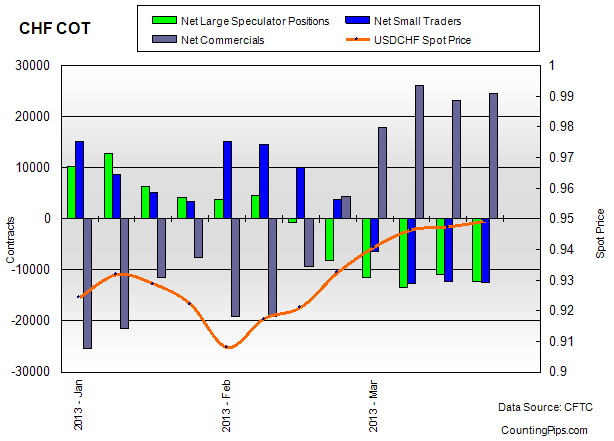
CHF

CHF: Swiss franc speculator positions decreased slightly last week to fall for the fifth out of last six weeks. Net positions for the Swiss currency futures fell to a total of -12,198 contracts on March 26th following a total of -10,996 net contracts reported for March 19th. This is a weekly change of -1,202 contracts.


Canadian Dollar:

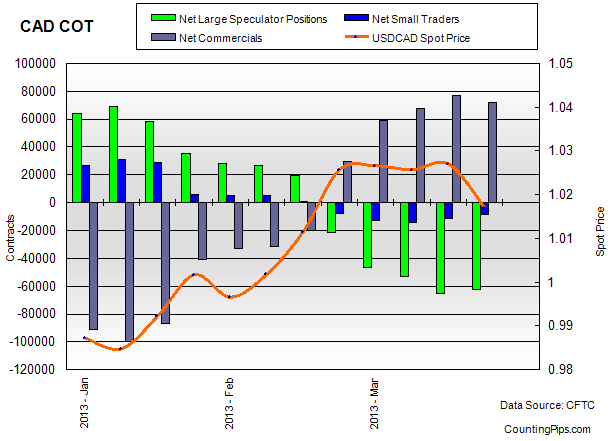
CAD

CAD: Canadian dollar positions increased slightly last week to end a streak of nine consecutive weeks of decline. Canadian dollar positions rose to a total of -62,645 contracts as of March 26th following a total of -65,331 net contracts that were reported for March 19th.

This is a weekly change of +2,686 net contracts following a weekly change of -11,934 the previous week.


Australian Dollar:

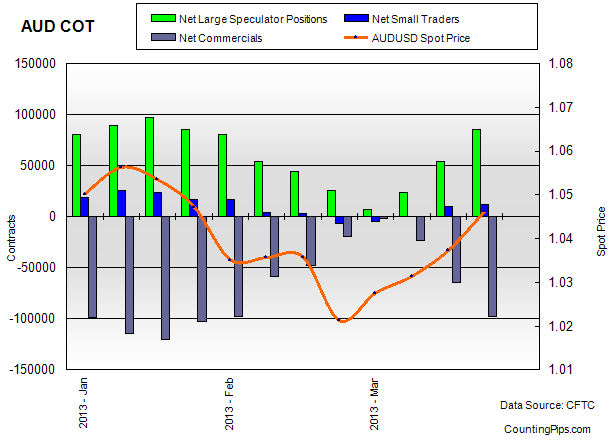
AUD

AUD: The Australian dollar jumped sharply again last week to rise for a third consecutive week. Aussie speculative futures positions increased to a total net amount of +85,515 contracts on March 26th after totaling +54,055 net contracts as of March 19th. This is a weekly change of +31,460 in net positions following the previous week’s +30,789 change.

Australian dollar contracts are at their highest level since January 22, 2013 when positions equaled +97,011 contracts.


New Zealand Dollar:

nzd

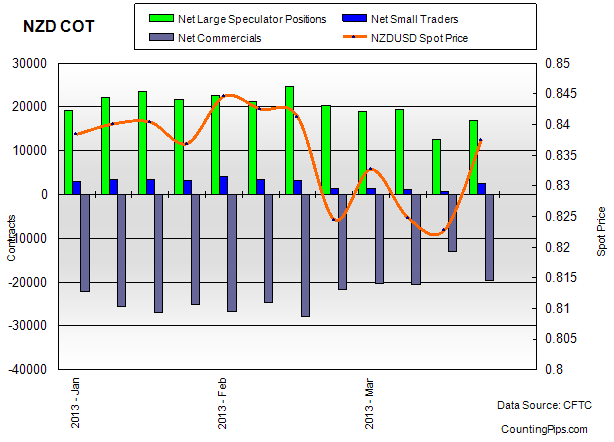
NZD: New Zealand dollar speculator positions rebounded last week after decreasing sharply the previous week. NZD contracts rose to a total of +16,916 net long contracts as of March 26th following a total of +12,477 net long contracts on March 19th. This constitutes a weekly change of +4,439 net contracts.

The New Zealand dollar positions had stayed above the +19,000 contracts level for ten consecutive weeks before the March 19th decline.


Mexican Peso:

mxn

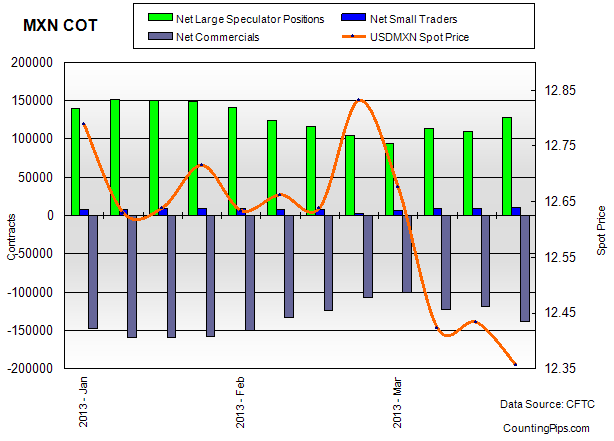
MXN: Mexican peso speculative contracts rose last week after a decline the previous week. Peso positions increased to a total of +128,162 net speculative positions as of March 26th following a total of +109,376 contracts that were reported for March 19th. This is a weekly change in net large peso speculator positions of +18,786 contracts.

Peso speculative positions have been over the +100,000 threshold for three straight weeks after falling under this level on March 5th for the first time since November 27th 2012.


Macro Financial Markets:

10 Year Treasuries:

10Year

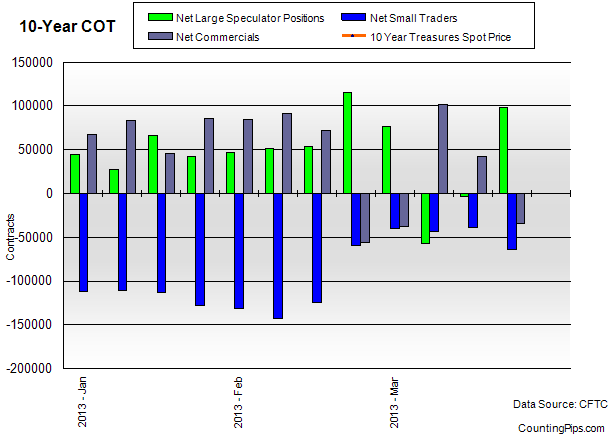
10 Year Notes: 10-Year Treasury Notes speculative contracts surged higher last week to increase for a second consecutive week. 10-Year positions rose to a total of +98,190 net speculative positions as of March 26th following a total of -3,295 contracts that were reported for March 19th. This is a weekly change in net large speculator positions of +101,485 contracts.

10-Year Treasury speculative positions, on March 12th at -57,346 contracts, had fallen to their lowest level since July 24, 2012 before turning around the past few weeks.


Crude Oil Light Sweet:

CrudeOil

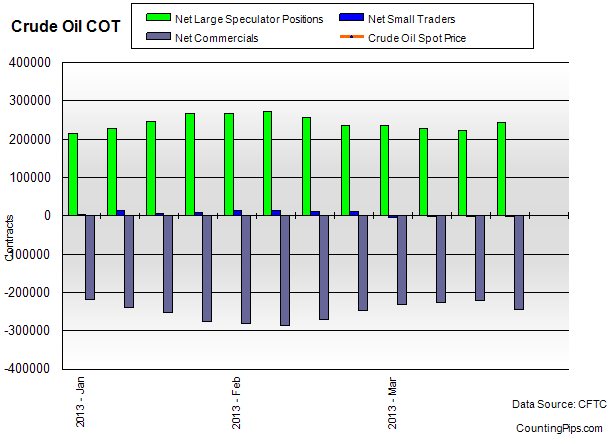
Crude Oil: Crude Oil speculative contracts rose higher last week following five straight weeks of decline. Crude positions rose to a total of +244,607 net speculative positions as of March 26th following a total of +223,721 contracts that were reported for March 19th. This is a weekly change in net large speculator positions of +20,886 contracts.

Crude Oil speculative positions had declined for five weeks after reaching a 52 week high on February 12th at +272,875 contracts.


Gold Futures CMX:

GoldCot

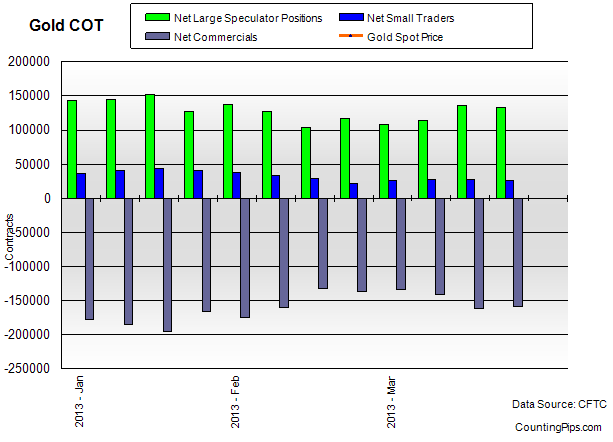
Gold: Gold speculative contracts decreased slightly last week following two straight weeks of incline. Gold futures positions declined to a total of +132,446 net speculative positions as of March 26th following a total of +135,610 contracts that were reported for March 19th. This is a weekly change in net large speculator positions of -3,164 contracts.

Gold speculative positions have been on a steady decline since reaching an apex on October 9th 2012 at +211,949 contracts.


S&P 500 Index Futures:

SP500

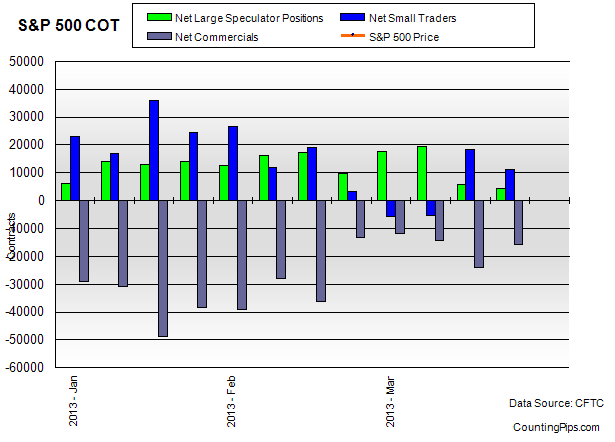
S&P 500: S&P 500 speculative contracts decreased last week for a second week in a row. S&P 500 futures positions declined to a total of +4,371 net speculative positions as of March 26th following a total of +5,695 contracts that were reported for March 19th. This is a weekly change in net large speculator positions of -1,324 contracts.


VIX Futures:

VIX

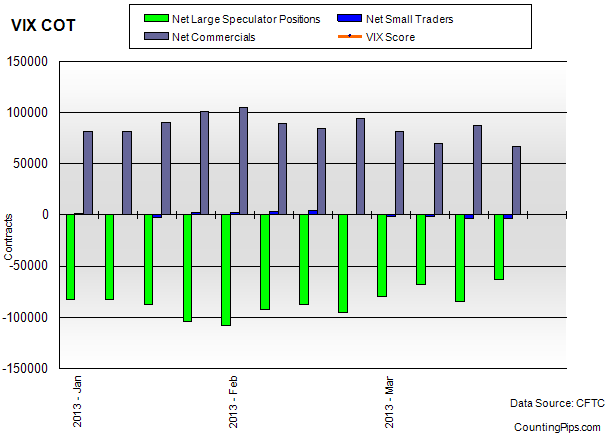
VIX: VIX speculative contracts increased last week to their highest level (or lowest short level) since August 2012. VIX futures positions rose to a total of -63,583 net speculative positions as of March 26th following a total of -84,400 contracts that were reported for March 19th. This is a weekly change in net large speculator positions of +20,817 contracts.


The Commitment of Traders report is published every Friday by the Commodity Futures Trading Commission (CFTC) and shows futures positions data that was reported as of the previous Tuesday (3 days behind).

Each currency contract is a quote for that currency directly against the U.S. dollar, a net short amount of contracts means that more speculators are betting that currency to fall against the dollar and a net long position expect that currency to rise versus the dollar.

(The graphs overlay the forex spot closing price of each Tuesday when COT trader positions are reported for each corresponding spot currency pair.)

See more information and explanation on the weekly COT report from the CFTC website.


Article by CountingPips.comForex News & Market Analysis


Monetary Policy Week in Review – Mar 30, 2013: Chance of global crises eases as 3 banks cut rates, 8 hold, 1 raises

By www.CentralBankNews.info

    Last week 12 central banks took policy decisions with three banks cutting rates (Vietnam, Hungary and Georgia), eight keeping rates on hold (Israel, Angola, Turkey, Morocco, Taiwan, Zambia, Czech Republic and Romania) and Tunisia becoming the fifth central bank to raise rates this year.
    The main message gleaned from central banks last week was that the global economy continues to recover, but every time it seems to pick up a little steam, confidence is undermined by developments in Europe, the only major risk to a sustained recovery. 
    But like a resilient boxer, the global economy dusts itself off and gets back on its feet, adjusting to the fact that large bank depositors in Europe may have to share the costs of future bank bailouts with tax payers, the main lesson from Cyprus.
    After the shock from this major but ultimately positive policy shift, there was a sense of relief that Europe had muddled through, once again, and financial markets had taken the events in stride.
     “It appears that there has been a decline in the probability of a crises occurring, a development which has reduced the high level of uncertainty that prevailed in the last year,” the Bank of Israel said in its statement.
    But as both Israel and the Reserve Bank of Australia (RBA) acknowledged, the global economic picture remains mixed and “it is too early to say whether the improved market sentiment over the past six months is the beginning of a sustained recovery, or merely a temporary upswing.”
    The challenges facing Europe’s policy makers is considerable. Not only do they have to restore financial health to governments and banks, they must also find ways to strengthen economic growth at a time of growing challenges from emerging markets.
    “The renewed market tension associated with the handling of the sovereign and banking crisis in Cyprus in recent weeks has provided a reminder of the political, economic and social challenges of resolving the pervasive fiscal and banking sector problems,” the RBA said in its financial review.
     In the latest manifestation of the structural shift in the global economy – illustrated by a stagnating Europe and growing emerging markets – the leaders of Brazil, Russia, India, and South Africa and China agreed to establish a New Development Bank.
    The leaders of these five countries, known as the BRICS countries, acknowledged that their infrastructure has to be improved but currently there is insufficient long-term and foreign investment in capital stock.
    Acknowledging their role and responsibility for global governance, the BRICS leaders said a bank, which now will be established, would use global financial resources more productively and thus make a positive contribution in boosting global demand.
    They also agreed to establish a $100 billion financial reserve arrangement that would “help BRICS countries forestall short-term liquidity pressures, provide mutual support and further strengthen financial stability,” the leaders said in their March 27 Durban declaration.
     The Contingent Reserve Arrangement (CRA) would help strengthen the global financial safety net during times of market turmoil.
         
    Through the first 13 weeks of the year, 77 percent of the 125 policy decisions taken by the 90 central banks followed by Central Bank News lead to unchanged rates, marginally down from 78 percent after the first 11 weeks.
    Globally, 19 percent of policy decisions this year have lead to rate cuts, largely by central banks in emerging economies, a ratio that was steady from last week.
    Of the 24 rate cuts worldwide so far this year, 42 percent have come from central banks in emerging markets and the remainder from frontier markets and other countries.
    No central banks in developed markets have cut rates this year, but this is largely because many of those central banks slashed rates to effectively zero five years ago and then switched to various forms of so-called quantitative easing to stimulate demand.
LAST WEEK’S (WEEK 13) MONETARY POLICY DECISIONS:

COUNTRYMSCI    NEW RATE          OLD RATE       1 YEAR AGO
ISRAELDM1.75%1.75%2.50%
VIETNAMFM8.00%9.00%14.00%
ANGOLA10.00%10.00%10.25%
TURKEYEM5.50%5.50%5.75%
MOROCCOEM3.00%3.00%3.00%
HUNGARYEM5.00%5.25%7.00%
GEORGIA4.50%4.75%6.50%
TAIWANEM1.88%1.88%1.88%
ZAMBIA9.25%9.25%9.00%
CZECH REPUBLICEM0.05%0.05%0.75%
TUNISIAFM4.00%3.75%3.50%
ROMANIAFM5.25%5.25%5.25%
Next week (week 14) features six central bank policy decisions, including Australia, Thailand, Uganda, Japan, United Kingdom and the euro area.

COUNTRYMSCI         MEETING              RATE       1 YEAR AGO
AUSTRALIADM1-Apr3.00%4.25%
THAILANDEM3-Apr2.75%3.00%
UGANDA3-Apr12.00%21.00%
JAPANDM4-Apr0.10%0.10%
UNITED KINGDOMDM4-Apr0.50%0.50%
EURO AREADM4-Apr0.75%1.00%