By www.CentralBankNews.info
Russia’s central bank held its benchmark refinancing rate steady at 8.25 percent, but trimmed some of its long-term liquidity provision rates and underlined its concern over slowing economic growth, a clear signal that it is getting ready to ease its policy stance.
The Bank of Russia, which raised its refi rate by 25 basis points in 2012 but is facing pressure to cut rates to boost growth, acknowledged that inflation remains above its target and this could fuel inflation expectations.
However, the central bank said it expects inflation, which has increased due to higher food prices and administered prices, to return to its target in the second half of this year.
“The dynamics of the key macroeconomic indicators in February 2013 point to a continuing deceleration of economic growth and increased risks of the economy slowing down,” the bank said.
The central bank’s reference to increased risks of economic slowdown is the latest sign that it is preparing to ease policy. Last month the central bank also noted the slowdown in economic growth but dropped its earlier phrase that the risk of a significant slowdown from were minor.
“In making monetary policy decisions, the Bank of Russia will be guided by the inflation goals and economic growth prospects,” the bank added after a meeting of its board.
It noted that investment in production capacity remained subdued and the decline in the growth rate of retail sales and industrial production continued.
“Against this background, economic confidence indicators are gradually deteriorating,” the bank said, a contrast to last month when it said economic confidence remained positive.
It added that labour market conditions and credit were still supporting domestic demand.
Russia’s Gross Domestic Product expanded by 0.6 percent in the third quarter from the second for annual growth of 2.9 percent, down from 4.0 percent in the second quarter.
Last month the government said GDP in February rose by an annual rate of 0.1 percent.
While the Bank of Russia held its refinancing rate steady, it cut its repo rate on 12-month standing facilities by 25 basis points to 7.75 percent and all loans secured by gold by 25 points. Some of the rates on open market operations were also cut by 25 basis points.
The bank said these cuts would not have any significant impact on money market rates but would bring the cost of obtaining liquidity from the Bank of Russia closer to its main liquidity provision rates, “which will contribute to strengthening the interest rate channel of the monetary policy transmission mechanism.”
Russia’s inflation rate rose to 7.3 percent in February, continuing its nine-month rising trend, but the bank said the annual inflation rate was projected at 7.2 percent as of March 25.
The central bank said last month that it expects inflation to exceed its 2013 target of 5-6 percent in the first half due to higher food prices and certain regulated prices.
In 2012 prices rose 5.1 percent and the central bank targets 4-5 percent inflation in 2014.
The Bank of Russia’s Chairman Sergey Ignatiev has lead a strong campaign against inflation which started accelerating in mid-2012 after easing in the second half of 2011. Ignatiev is retiring in June and is being replaced by Elvira Nabiullina, economic aide to Russian President Vladimir Putin.
Most economists had expected the central bank to keep rates steady this month though some had expected it could start cutting rates this month due to its forecast of lower inflation.
The Senior Strategist: Focus on central bank meetings and US job report
The central bank meetings in BoJ, ECB and BoE together with fridays US job figures are this weeks most important financial events.
Also Senior Strategist Ib Fredslund Madsen recaps Q1 on the equity market.
Video courtesy of en.jyskebank.tv
‘Gold Only Rises During the Bad Times’ and other Fairy Tales
When journalists start bagging out gold, you know it’s time to think about buying some.
Because they have an uncanny knack of getting gold’s next move 100% wrong.
When they are cheering gold on, you can bet your nugget that the price is topping out. And conversely when they are giving gold a tough time — like now — you can be sure the gold price is bottoming out.
Because let’s face it: if they could make accurate trading calls on gold, they wouldn’t be making their living writing newspapers…
So I was pleased as punch over the Easter weekend to see the Sunday Age lead its finance section with a story called, ‘Has gold had its time in the sun?’
Bring it on. More of that bearishness please!
The writer did, in fairness, include some quality research from our own Greg Canavan of Sound Money Sound Investments.
Then countering Greg’s argument he used some negative views from AMP Capital Investors Chief Economist, Shane Oliver.
To quote the story: ‘[Oliver] says the risk of a global meltdown or collapse has receded and the appetite for gold is less than it was…He cannot see much upside in the gold price from here, though that could change quickly if there is another major financial crisis or inflation spikes.’
Now I’m sure Shane’s a lovely guy, but he’s clearly not very good at gold.
Then again, which institutional economist is? While they may be able to talk about dividend payout ratios, and franking credits until dawn; gold (and gold stocks) make up just 1% of global assets, so doesn’t tend to preoccupy their thinking at 3am on a very regular basis.
The main problem here is Shane’s assuming gold can only rise if the world is going to pot.
Some Urban Myths About Gold
This is perhaps the most popular of gold’s urban myths. And I’m happy to say that it’s total nonsense.
Gold actually gained far more in the five ‘go-go’ years prior to the GFC than it has gained in the five crisis-riddled years since.
For example, between the start of 2003 and end of 2007, the average global GDP rate was a chunky 4.78%.
No ‘global meltdown or collapse’. And in this period gold gained a respectable 149%.
From the start of 2008 to the end of 2012, the global economy has been an ever-evolving ‘global meltdown’. The average global GDP rate has been just 2.86%, mostly thanks to China.
And gold gained less in this period — with a 95% rise.
So contrary to Oliver’s argument, gold can do just as well or even better during the good times than the bad.
The misconception is so common, I even hear it from smart analysts saying things like this: ‘I’d love to see gold at $2000, but I’d hate to live in a world that creates such a high price.’
So I ask them if a five-fold rise in the gold price since 2002 has translated into a world that’s five times worse (discounting the rise over that period of reality TV, drivers who text, and of course Justin Bieber).
The fact is that the state of the global economy is not a direct driver of the gold price.
Other factors, for example global money supply growth, are far more important.
And here’s the other two biggest of these golden fairy tales.
Firstly: that rising interest rates will stop gold from rising.
The idea is that investors will sell their gold when bonds start paying more yield. For example, if the US ten year bond starts paying 3–4% again, then gold will lose its appeal.
There may be a few gold owners that think that way, but they are in a tiny minority. But the real issue here is that history disagrees with the argument.
From 2003 to 2008, yields on a ten year US bond were around that 4% mark. And factoring in inflation, the real yield was around the 2% mark most of this time.
Did that slow the gold price down? Not exactly. It gained 149%.
Yields have a Long Way to Go Before They Stand a Chance of Denting Gold

Source: Bloomberg
So it has been amusing to hear people argue gold was going to fall because rates were creeping back up again. Because gold soared despite five years of real rates as high as 2%.
With today’s rates in negative territory, I’d say gold owners are pretty safe from this particular bogey-man.
The third bogey-man is the theory that mass sales from ETF’s could kill the gold price.
Back in February, the media was frothing at the bit that gold would crash because investors had liquidated 100 tonnes of gold (from a total of 2500) from ETFs during the month.
But let’s step back and put that in context.
Last year China imported 834 tonnes, with 114 tonnes in December alone.
India imported 860 tonnes in 2012, with another 100 in January.
As a whole, central banks purchased 534 tonnes in 2012.
These three buyers alone account for 2228 tonnes between them in 2012. In other words, they bought 100 tonnes every 16 days.
So I wouldn’t sweat it that ETF’s sold 100 tonnes in February. It wouldn’t even touch the sides of Asian demand.
In fact, global gold ETF holders could dump their entire remaining position of 2400 tonnes, and it still wouldn’t be enough to feed China, India and the central banks for thirteen months.
The Real Driver Behind Gold
Gold is an Asian story now. Western investors, and famous traders and hedge fund managers for that matter, need to wake up and smell the coffee if they still think that their trading is relevant to the big picture for gold.
I wrote to you yesterday with the transcript from my recent conversation with Eric Sprott about gold. I asked what he thought about the People’s Bank of China suggesting that they hadn’t increased their holding over the last three years, from 1,054 tons. Eric said:
‘I don’t believe that for a second. It seems so obvious to me. They haven’t been buying US treasury bills or treasury bonds for the last 18 months. I think it doesn’t take a rocket scientist to realise that owning gold is probably the best thing you can do these days as a central bank.’
|
It was a good chat we had. And if you haven’t seen it yet, I’d recommend a quick read, as Eric made some very interesting observations.
That’s the thing. Just as you should be selective about the food you consume, you should be careful about the ideas you consume.
It’s your choice. Will those ideas come from a fund manager that runs $11 billion in the precious metals space — or will you prefer to gobble up a journalist’s musings instead?
Dr Alex Cowie
Editor, Diggers & Drillers
Join me on Google+
From the Port Phillip Publishing Library
Special Report: Australia’s Energy Stock BLOWOUT
Daily Reckoning: Why a PlayStation and Mining Technology Have More In Common Than You Think
Money Morning: On Gold — Billionaire Investor Eric Sprott Says : ‘I’m in Alex Cowie’s Camp’
Pursuit of Happiness: Three Scams and One Opportunity to Escape Your Mortgage
Australian Small-Cap Investigator:
How to Make Money From Small-Cap Stocks
Welcome to the Modern Oil Age
Far offshore and deep beneath the seabed lies the future of the oil industry.
There’s a long, fascinating story here. But the short version is that in the past couple of decades, geologists have come to understand that there are large volumes of oil offshore. There’s a vast new hydrocarbon resource in the deep offshore waiting to be found.
In some areas of the deep offshore, the geology is such that you can actually ‘move the reserve needle’ with large finds. We’re talking about the possibility of finding hundreds of millions of barrels of oil in one place, or even billions of barrels. It’s quite a prize.
In fact, this new deep-offshore frontier makes for immense energy numbers, with strategic implications for an oil-constrained future.
But working offshore is quite unlike the olden days of finding large oil fields on land. Today, going far offshore and drilling deep down is a couple orders of magnitude more difficult than what we’ve experienced in the past. And the technical and operational effort is far beyond what most people, politicians, and policymakers realize.
It’s a huge effort to go far out, deep down, and work safely in the oceanic environment. The technology is extraordinary, as are the daily operational challenges. Indeed, it’s not just hard for most landlubbers to understand; it’s hard for many people who aren’t insiders to the offshore industry to appreciate as well.
I had the rare opportunity to go offshore and visit a working drilling ship positioned about 240 miles south of New Orleans, in the deep waters of the Gulf of Mexico. The water depth in the area is 6,750 feet to seabed, or the ‘mud line’, as the veterans call it. And the nearest dry land is 208 miles away, as the crow flies — a very tired crow, indeed.
‘Discoverer Inspiration’, Conducting Exploration
The vessel I visited is named the Discoverer Inspiration, owned by Transocean Ltd. This is a brand-new vessel, launched in 2009 and still fresh from the builder’s yards in South Korea. Inspiration is under a long-term contract with Chevron.
Chevron has a long list of deep-water oil prospects in the Gulf of Mexico, not to mention in many other parts of the world. Thus does Chevron require an ultra-modern ship like Inspiration to do the drilling.
To this end, Chevron is committing $1 million per day over the next five years — about $2 billion — for Inspiration to explore and test these deep-water prospects. And the effort will require all of Inspiration’s astonishing capabilities.
Let me emphasize that the well I saw under way is an EXPLORATION well. Chevron does not ‘know’ for sure that there’s oil there.
Certainly, Chevron’s geologists and management hope to find oil. But even the best of odds are that one of six-eight exploration wells is successful. Most often, the wells find ‘information’, which is a euphemism for, ‘We spent a hell of a lot of money but didn’t find commercial oil.’
In essence, Chevron is making a gigantic bet. It’s using a drill bit attached to a $700 million, state-of-the-art drilling vessel. Just this one well has a project budget in excess of $150 million. It’s not for the faint of heart.
Welcome to the Modern Oil Age
Also, IF this particular well finds oil — it’s a big ‘if’ — there is NO EXISTING TECHNOLOGY to extract it. So a successful exploration find will simply prompt the need for more research and development of new technology to develop a distant oil field, under a mile and a half of water, with no offshore logistical infrastructure for about 100 miles.
Under the best of circumstances, Chevron couldn’t lift any oil for perhaps six, eight or 10 years — maybe more. In this business, you have to think very long term.
Here’s a rough outline of the technical challenges that await the explorer in this new, deep-water realm.

On one hand, welcome to the modern oil age. On the other, I know that the circumstances are such as to make some people wonder why the folks at Chevron do it.
I believe I can answer that second question. It’s because the volumes of oil out there are so large as to make it worth the time, capital and effort of the likes of a company like Chevron. Also, if Chevron doesn’t do it, then who will?
There are only a few other firms in the world that have the capable people, innovative technology, world-class safety performance, capital strength and industry partnerships to undertake such challenges.
So Chevron and Transocean are committing immense amounts of capital and technical expertise to a long five-year mission — which is only the start of an effort that could last for much of the 21st century. Inspiration is, in a sense, the new starship of a real ‘trek’ into the unknown realm of deep-sea oil exploration and development. This is the future of oil.
Byron King
Contributing Editor, Money Morning
From the Archives…
Why Dividend Stocks May Not Stay This Cheap for Long
29-03-2013 – Kris Sayce
Respect the Market Trend, but Don’t Expect it to Last
28-03-2013 – Murray Dawes
Silver ‘$100 Within Two Years’
27-03-2013 – Dr. Alex Cowie
11 Billion Reasons to Expect a 200% Move in Gold Stocks Within Months
26-03-2013 – Dr. Alex Cowie
You Want Proof the Stock Market’s Heading Up? Try This…
25-03-2013 – Kris Sayce
My Platinum Chat With Rick Rule
I was chatting with Rick Rule last Friday. Rick is now part of Sprott Asset Management, one of the most respected natural resource investors around. Rick also had a ridiculously good long-term track record in managing money before joining Sprott.
Anyway, Rick has a new thesis he is hot on: platinum and palladium, or more broadly the platinum group metals (PGMs). I’ve learned when Rick gets hot on an idea, it is worth listening to him.
The thesis is simple, as most good ones tend to be…
The Law of Supply and Demand
‘What we discovered in about four weeks’ work,’ Rick told me, ‘is that the platinum and palladium mining industry as a whole does not earn its cost of capital. What that means is that either the price of platinum and palladium go up or there is less and less of it going forward.’
Another way to say it is that the platinum and palladium business, as is, doesn’t pay investors enough for the risks they take compared with alternatives. So it means people will not invest new dollars in the sector.
No new investment in mining means depletion of existing mines with no new sources of supply. Eventually, the price has to go up as rising demand (or flat demand) presses on a diminished supply.
What’s unique here is that platinum and palladium face particularly challenging supply constraints.
‘Gold and silver come from many countries and many geologies and as a byproduct with other metals,’ Rick says by way of analogy. ‘But about 90% of platinum and palladium supplies come from South Africa, Zimbabwe and Russia. And they are enormously constrained.’
How constrained? Well, South Africa is by far the most important producer. Let’s start there.
‘First, it doesn’t earn its cost of capital,’ Rick says. ‘And that has manifested itself in a few ways, but the most important is that the industry by its own estimate has deferred between $6–8 billion in capital investment.’
No surprise, then, that production has fallen 19% in six years. ‘We’re not talking about a set of circumstances that is going to affect production at some future date. We’re talking about a set of circumstances that is already driving higher production costs and lower production.’
Rick took me through the situation in South Africa in some detail. The mining industry there is labour-intensive for reasons both historical and geological. Workers are poorly paid. Labour conditions are truly awful. ‘Workers are crawling across broken rock on their hands and knees, often carrying 125–150 pounds of hand-operated drills with them,’ Rick says. ‘Worker mortality was always disgusting in South Africa, but it’s becoming frightful now.’
Workers have almost certainly seen a co-worker killed, if not maimed. ‘The point of all this,’ Rule says, ‘is that workers’ wages have to go up. But because the industry can’t earn its cost of capital, wages can’t go up.’
It’s a hard spot to be in — but it seems clear that something has to give. Once again, the price of the metals has to go up or production will continue to dwindle as rising costs put these miners out of business.
A New Bull Market Coming
Mining is, of course, energy intensive. And the power industry has a political mandate to provide cheap power for people who can’t afford it. So the mining industry pays more for power but is also the first one to be interrupted.
There have been no capacity upgrades in 12 years, Rick says. Meanwhile, demand keeps rising. Antiquated power plants struggle to keep up with demand.
Not a promising picture for the most important supplier of mine production of platinum and palladium in the world.
Then there is Zimbabwe. ‘Which I can dismiss very quickly,’ Rick said. ‘Zimbabwe had a viable platinum and palladium industry 10 years ago. Robert Mugabe took care of that.’
The industry ‘de-capitalized itself’, as Rick put. ‘It can’t be turned around in any reasonable amount of time with any reasonable amount of money.’ Moreover, when Mugabe dies, the struggle to succeed him could well paralyse the country for years.
‘I don’t see Zim affecting platinum or palladium supplies for at least a decade,’ Rick sums up.
The final alternative is Russia. ‘I believe it is getting better,’ Rick said, ‘but it is getting better from a low starting point. The problem there isn’t political, it’s geological. The ore bodies of Norilsk, which are the biggest PGM ore bodies in the world, are 80 years old. They are long in the tooth, started by Stalin. And as you get deeper and deeper, the concentration of palladium declines.’
Potentially, there is another deposit, but it is about 400 miles from Norilsk, which itself is in western Siberia and is fairly remote. Rick speculates that it will happen in 10 years and take billions of dollars. Short story: It’s not going to happen anytime soon.
As Rick says, this is not a resource story that’s going to take place in two–three years. It’s a story that’s already taken place over the last five–six years.
I asked about recycling. Rick told me that recycling makes up about 30% of supply. ‘It is the only source of supply that has been growing,’ he says. ‘It has increased as a percentage of total supply by 50% in the last 10 years.’
What about substitution? ‘Substitution doesn’t make sense at anything less than a 100% increase in price,’ he guesses.
And the demand scenario? Compelling. ‘Platinum and palladium go out a tailpipe, go up a smokestack or get turned into jewelry — that’s what happens to it,’ Rick says.
They are incredibly useful metals. ‘The social trade-off is really platinum versus smog,’ Rick says. ‘I mean that’s really what it’s about. The air quality we enjoy today in Western Europe and North America and Japan is a function of catalytic conversion. It takes only about $200 of PGMs at today’s prices to afford the air quality we all enjoy. And that’s $200 against a median sticker price of $27,400 for a new car in the US. If the price doubled, the demand implication would be de minimis.’
The emerging markets are a big potential source of demand. China eclipsed the US as the largest auto market last year. But its use of platinum and palladium remains a small fraction of North American consumption.
‘The price has to go up, and can go up,’ is the pithy summation Rick offers up.
‘It’s a thesis that is really, really difficult to poke holes in.’ Unless the Western world goes off an economic cliff and vehicle sales get cut in half, it is hard to imagine anything less than a 50–100% increase in price.
As you can see, this is a thesis worth investigating further.
Chris Mayer
Contributing Editor, Money Morning
From the Archives…
Why Dividend Stocks May Not Stay This Cheap for Long
29-03-2013 – Kris Sayce
Respect the Market Trend, but Don’t Expect it to Last
28-03-2013 – Murray Dawes
Silver ‘$100 Within Two Years’
27-03-2013 – Dr. Alex Cowie
11 Billion Reasons to Expect a 200% Move in Gold Stocks Within Months
26-03-2013 – Dr. Alex Cowie
You Want Proof the Stock Market’s Heading Up? Try This…
25-03-2013 – Kris Sayce
10 Startling Statistics About the S&P’s Record High (Part 2)
Yesterday, I set out on a mission to share a handful of startling statistics concerning the S&P 500 Index’s run-up to a new, all-time high.
If you’re still wondering why we should even care, consider that a heap of money tracks the S&P 500.
To be exact, there’s $2.7 trillion in open-end mutual funds and $187 billion in exchange-traded funds (ETFs) linked to the Index, according to Morningstar.
That compares to about $142 million in fund assets tracking the Dow.
I’m willing to bet that some of your hard-earned capital is included in those totals. In other words, you’ve got “skin in the game,” so to speak. And that’s a pretty good reason to take an interest in the topic at hand, if you ask me.
So let’s pick up where we left off yesterday…
~Stock Stat #6: Stay Away From Solar!
Yesterday I noted how we should be looking for momentum plays (i.e. – the best-performing stocks since the market hit bottom). After all, trends tend to persist in the market.
Well, the same holds true on the flipside, meaning we should avoid stocks that have shown lackluster performance since the market bottom. Because they’re likely to keep struggling.
And that brings us to First Solar (FSLR).
It’s the worst-performing stock, dropping 75% since March 2009. So much for the “sunny” prospects for solar stocks. (Let the record show, I did warn you here and here.)
~Stock Stat #7: One Bad Apple Can’t Spoil the Bunch
Since the Dow only tracks 30 companies, one or two stocks can heavily influence its performance.
In fact, the 155% run-up for International Business Machines (IBM), from $83 in March 2009 to $213 today, accounted for one-tenth of the Dow’s total gain, according to Standard & Poor’s Howard Silverblatt.
In contrast, the 500 companies in the S&P Index can’t exert such undue influence. Not even Apple (AAPL).
The stock has slumped a staggering 37.2% since September 2012. (By the way, I told you so.) Yet the S&P 500 still marched to a new record high.
Granted, if Apple’s stock didn’t head south, the S&P 500 would have set a new record on March 5, the same day as the Dow, according to Silverblatt.
~Stock Stat #8: A Golden Perspective
No surprise here, given all the money printing being done by Fed Chairman, Ben Bernanke. But if we priced the S&P 500 in grams of gold, we can see that it’s nowhere near a peak…

~Stock Stat #9: Don’t Underestimate the Power of Dividend Reinvesting
It’s official. The Dow and the S&P 500 have both recovered all of their losses since the Great Recession hit.
Who said buy-and-hold investing was dead?
And if you bought, held and reinvested dividends, your portfolio would be in even better shape.
A $10,000 investment in the S&P 500 on October 9, 2007 would be worth $11,270 today.
So instead of being back to breakeven, you would actually be up 12.7%.
Just something to keep in mind if you’re thinking of bailing on stocks altogether.
~Stock Stat #10: Far From a Rarity
For those of you who might be thinking it’s time to cash in and move out of stocks, just because the market hit a new record high, hold up!
All-time highs aren’t as rare as you might expect. Especially if we measure the total return of the S&P 500, including dividends (not just the price appreciation).
When we do, the S&P 500 has actually been hitting record highs since April 2, 2012.
More specifically, the Index hit a total of seven records last year and 26 so far this year, according to The Wall Street Journal’s Market Data Group.
I suspect the number is going to keep growing, too. So don’t miss out.
Ahead of the tape,
Louis Basenese
Article By WallStreetDaily.com
Original Article: 10 Startling Statistics About the S&P’s Record High (Part 2)
Central Bank News Link List – Apr 2, 2013: Abe says BOJ may miss price target if global economy changes
By www.CentralBankNews.info Here’s today’s Central Bank News link list, click through if you missed the previous link list. The list comprises news about central banks that is not covered by Central Bank News. The list is updated during the day with the latest developments so readers don’t miss any important news.
Australia holds rate, past cuts having expansionary effect
By www.CentralBankNews.info Australia’s central bank left its benchmark cash rate unchanged at 3.0 percent, as expected, and repeated that low inflation would allow it to reduce rates if necessary but private consumption is on the rise and there are “number of indications” that past rate cuts are “having an expansionary effect on the economy.”
The Reserve Bank of Australia (RBA), which embarked on an easing cycle in October 2011, said the impact of those rate cuts would continue to emerge over time but this stimulative effect is countered by a higher-than-expected exchange rate and demand for credit remains low as firms and households continue to pay down their debt.
The RBA, which cut rates by a total of 175 basis points between October 2011 and December 2012, appears slightly more confident about the prospects for Australia’s recovery compared with March when it only saw “signs” of the impact of recent rate cuts.
However, the RBA still sees economic growth below trend this year, and with inflation in line with its target, “an accommodative stance of monetary policy is appropriate,” the central bank said, adding:
“The inflation outlook, as assessed at present, would afford scope to ease policy further, should that be necessary to support demand,” the RBA said, quoting its governor, Glenn Stevens.
Australia’s inflation rate in the fourth quarter rose for the third quarter in a row to 2.2 percent and the RBA said labour costs remained contained while businesses are focused on improving efficiency, factors that should keep inflation low.
The central bank said it expects inflation to be consistent with its 2-3 percent target over the next one to two years. In its latest forecast, the RBA projects inflation of 3.0 percent in the year to June 30.
Australia’s Gross Domestic Product rose by 0.6 percent in the fourth quarter of 2012 from the third quarter for annual growth of 3.1 percent, the same rate as in the third quarter.
The RBA said last year’s growth was close to trend, led by the large increases in investments in capital resources and “looking ahead the peak in resource investment is drawing close.”
Although the near-term outlook for investment outside the resource sector is still relatively subdued, the RBA said a “modest increase is likely to begin over the next year.”
Echoing its March statement, the RBA said the downside risks to global growth appear to have lessened. However, growth worldwide is still forecast to be below average for a time and the task of putting private and public finances on sustainable paths is far from complete which leaves financial markets vulnerable to setbacks.
The RBA was widely expected to leave rates on hold, with labor market data in mid-March strengthening the view that is has finished its policy easing cycle. The unemployment rate in February remained steady at 5.4 percent, the same as in the last three months, despite expectations that it would rise, with the biggest gain in payrolls in almost 13 years.
www.CentralBankNews.info
AUDUSD may be forming a cycle bottom
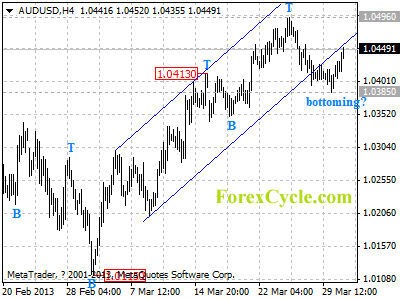
AUDUSD may be forming a cycle bottom at 1.0385 on 4-hour chart. However, the rise would possibly be correction of the downtrend from 1.0496, as long as 1.0496 key resistance holds, one more fall to 1.0200 – 1.0300 area to complete the downward movement is still possible. On the upside, a break above 1.0496 will suggest that the longer term uptrend from 1.0115 has resumed, then further rise to 1.0700 area could be seen.
When it comes to Forex Fraud, being Forewarned is being Forearmed
By ForexFraud.com
Investors beware! Summer is just around the corner, and the one thing that you can count on is that the criminal element in our society has polished up their best schemes to defraud and is preparing to launch their seasonal offensive to fleece a new round of unsuspecting fools. When there is money involved, especially in any investment field, you can be assured that fraudsters are on the sidelines ready to pounce. Awareness is the best defense, but it often helps to review where others have defrauded over time.
One of the most popular investment mediums over the past decade has become currency trading and all of its various forms, whether it pertains to an individual trader, using an account manager, or accessing many of the various products and services related to the craft. During the early years of retail forex following the millennium crossover, the industry was like the wild-wild west. Forex brokers were openly unscrupulous, manipulating accounts for their own gain or disappearing with customer deposits, never to be seen again.
The Commodity Futures Trading Commission (CFTC), the federal agency responsible for regulating currency trading, took action and has, over the past few years, rid the industry of its most blatant criminals. Their actions did not stop with cleaning up the broker community. They were also forceful in jailing crooks in all supporting arenas and in educating the consumer about the risks and what a potential fraud looks like.
Today there is a great deal more information on the record about various forex brokers, making the selection of your business partner behind the scenes a little less troublesome. There are ample review sites on the web. The CFTC publishes an annual listing of registered brokers and their capital and trading volumes. Due diligence is now a much easier task than it was years ago. (For more broker information, click here).
What are the various types of scams to be wary of in today’s market? Let us accept for the moment that there are many reputable domestic forex brokers available to support your access needs. Marketing claims from brokers located overseas may tempt you, but the CFTC cannot be active in these foreign jurisdictions. You must rely on other regulators, but risk and tax issues will be higher.
The first lesson to learn from past mistakes with brokers is to be wary of “marketing claims”. Every fraudster’s first objective is to sink the hook in really deeply, and he does this by relying on our inherent greed and the desire to get rich quick. Nearly all schemes depend on this shortcoming of human nature. Caution is the best path to take. Be skeptical at the outset.
This lesson applies especially to all forex related sales of services and products. The most notorious of these have to do with software trading systems and signal providers. Yes, there are legitimate products out there, but there are many hucksters promising outrageous returns and success rates that boggle the mind. In these cases, small amounts may be involved, but when you attempt to get a refund, all bets are off.
The largest frauds in foreign exchange, however, relate to Ponzi schemes and their many variations on the same theme. The most famous one in recent times involved Trevor Scott and two of his associates in Minnesota. Starting in 2005, Scott bilked over 700 investors out of $194 million, many from elderly retirees.
Scott used a Christian radio talk show host to assist him in rounding up his victims. He claimed to have over $4 billion under management and used early collections set up shop in the historic Van Dusen mansion, just south of downtown Minneapolis. Impressive computer screens and electronic equipment convinced unsuspecting investors that a sophisticated trading room was raking in the profits. It was all a façade. Scott and others are now serving jail sentences in excess of 20 years for their crimes.
“Beware the tipster” is the lesson with these “affinity” Ponzi schemes. There are several more cases where credibility was promoted through an ethnic community to gain access to easy marks. Notable cases have involved the Hispanic community in South Florida, as well as the Caribbean and the African-American communities of Brooklyn. In each case, fraudsters used phony trading credentials and bogus account statements to legitimize their fraud. (For more information, click here).
The moral is keep your greed in check. Be skeptical of outrageous marketing claims, and remember that being forewarned is being forearmed.
