Gold “Faces Headwinds if Economy Recovers”, Increased Risk Appetite Reflected in “Red Hot Stock Market”

London Gold Market Report
from Ben Traynor
BullionVault
Wednesday 3 April 2013, 08:00 EST

FOLLOWING a sharp drop yesterday, the gold price traded near one-month lows Wednesday
morning, hovering just above $1570 an ounce by lunchtime in London, as stock markets ticked
lower following gains yesterday.

Silver meantime climbed back above $27.30 an ounce, having fallen to an eight-month low below
$27, while broader commodities also ticked lower.

A day earlier, gold fell sharply at the start of Tuesday’s US trading, continuing to trade lower when
Asia opened on Wednesday, with analysts citing stock market gains and better-than-expected US
factory orders data as factors weighing on gold.

“The futures market is no doubt mainly to blame for the latest sudden sell-off,” says today’s
commodities note from Commerzbank.

“[Gold’s fall] worsened after the US stock market started to move higher [on Tuesday],” adds Ed
Meir, metals analyst at brokerage INTL FCStone.

“This was a clear signal that it was safe for more fund money to abandon commodities and head
into the red-hot equity markets.”

The S&P 500 index came within 0.2% of its 2007 intraday high during Tuesday’s trading.

“The US economy is one of the best-performing ones,” SAYS Patrick Moonen, senior strategist at
ING Investment Management.

“When it comes to the equities rally we’ve had this year, we think there is still more to come.”

“I’d be skeptical about continuing the stronger momentum that we saw in the first quarter,” counters
Tom Elliott, global strategist at JPMorgan Asset Management.

“It very rarely happens you get two such strong quarters in a row…I think what we’ll be seeing is
probably investors over the next three months looking for any slight excuse to take profits.”

“Gold prices are likely to face more headwinds, should equities continue to rally,” says a note from
HSBC.

“Furthermore, demand for safe-haven assets, which was a plank supporting bullion prices in late
March, [seems] to have eased.”

“Ascribing gold weakness to equity strength is shorthand for talking about risk appetite,” adds
David Jollie, strategic analyst at Mitsui Precious Metals.

“There is certainly a degree of optimism about the US economy, and that should lead to some
reductions in gold long positions…there is scope for gold to strengthen if economic data isn’t as

strong as people are hoping, but at the moment, there’s a lack of justification to buy in the short
term.”

The consensus forecast among analysts is that this Friday’s nonfarm payrolls report will show the
US economy added 200,000 jobs last month, while the unemployment rate is expected to hold
steady at 7.7%.

The world’s biggest gold exchange traded fund meantime continued to see outflows Tuesday, with
the volume of gold held to back SPDR Gold Trust (ticker: GLD) shares dropping eight tonnes to
1208.9 tonnes, its lowest level since July 2011.

Credit Suisse Wednesday cut its 2013 gold price forecast by 9.2% to $1580 an ounce, while its
silver price forecast was cut 11.5% to $28.50 an ounce.

“By long-term historical standards gold remains overvalued, both in real terms and relative to other
commodities and assets,” Credit Suisse said.

Over in Europe, Cyprus today agreed terms for a €1 billion loan from the International Monetary
Fund to add to the €9 billion bailout agreed with other Eurozone members. Cyprus’s central bank
meantime has unfrozen 10% of deposits over €100,000, the limit above which deposits are not
insured.

Looking ahead to Thursday, the Bank of Japan is due to announce its first policy decision since
Haruhiko Kuroda took over as governor. Kuroda said last month the BOJ “will do whatever we can
do” to end deflation in japan, while the country’s prime minister Shinzo Abe said this week that the
central bank should “display a strong commitment to create so-called inflationary expectations”.

Ben Traynor
BullionVault

Gold value calculator | Buy gold online at live prices

Editor of Gold News, the analysis and investment research site from world-leading gold ownership
service BullionVault, Ben Traynor was formerly editor of the Fleet Street Letter, the UK’s longest-
running investment letter. A Cambridge economics graduate, he is a professional writer and editor
with a specialist interest in monetary economics. Ben can be found on Google+

(c) BullionVault 2013

Please Note: This article is to inform your thinking, not lead it. Only you can decide the best
place for your money, and any decision you make will put your money at risk. Information or
data included here may have already been overtaken by events – and must be verified elsewhere –
should you choose to act on it.


Uganda holds rate, economy gaining, inflation on target

By www.CentralBankNews.info     Uganda’s central bank held its central bank rate (CBR) steady at 12.0 percent, saying it is maintaining a neutral policy stance as the economic recovery is gaining momentum and inflation is in line with its target.
    The Bank of Uganda (BOU), which slashed interest rates in 2012, said short-term economic prospects had improved compared to its outlook and “constraints to economic growth from deficient aggregate demand are now receding.”
    The BOU said inflationary pressures are largely subdued but annual core inflation is still forecast to remain 1-2 percentage points above the bank’s 5.0 percent target for the next few months.
    “Nevertheless, we expect core inflation to fall back towards 5 percent later in 2013,” the BOU said.
    Uganda’s headline inflation rate rose to 4.0 percent in March, slightly up from February’s 3.5 percent, with the underlying, or core, inflation rate rising to 6.8 percent from 5.6 percent.
    The rise in headline inflation was fueled by the first rise in food crop prices since November last year while core inflation rose due to the base effect of a drop in prices in March 2012.

    Last year the BOU cut rates by 1100 basis points after raising them sharply in 2011 to a high of 23.0 percent to curtail inflation that soared to an all-time high of 30.48 percent in October 2011. Inflation then plunged over the next 12 months to 4.5 percent in October 2012.
    Since then, inflation has stabilized and even declined to a two-year low of 3.5 percent in February.
    “There are signs of increased buoyancy in the economy,” the BOU said, adding that preliminary GDP data for the first half of 2012/13 indicate accelerating growth, driven by strong growth in services, construction and manufacturing.
    Recent trends also indicate that the recovery continued in the third quarter of the current financial year that ends June 30, the BOU said.
     “As such, it is possible that the negative output gap that characterised the economy in 2011/12 has narrowed significantly,” the BOU said, adding that private sector credit had risen in line with overall growth although shilling-denomicated loans remain subdued.
    Uganda’s Gross Domestic Product expanded by 1.8 percent in the third calendar quarter from the second quarter for annual growth of 2.8 percent, down from 3.2 percent rate in the second quarter.
    The central bank’s statement is considerably more confident about the economic outlook than last month when it said economic growth was below potential and upside inflationary risks had risen.

    www.CentralBankNews.info

Thailand holds rate steady, inflation warrants monitoring

By www.CentralBankNews.info    Thailand’s central bank held its policy rate steady at 2.75 percent, as expected, saying an accommodative stance is still appropriate given the fragile global economy, but inflationary pressures warrant monitoring and a volatile exchange rate and capital flows could pose risks to financial stability.
    The Bank of Thailand (BOT), which cut rates by 50 basis points last year, said the country’s economic growth is expected to moderate toward a normal trend in the first quarter of 2013 with domestic demand remaining a key engine, supported by favourable household income, high employment and accommodative monetary and credit conditions.
    Thailand’s economy surged in the fourth quarter, with Gross Domestic Product expanding by 3.6 percent in from the third quarter for an impressive annual growth rate of 18.9 percent, sharply above the third quarter’s growth rate of 3.1 percent, as it continues to rebound from devastating floods in 2011.
    Growth was boosted by fiscal stimulus measures and the BOT said it expects this to pick up pace in the second half of this year as flood management and large-scale infrastructure projects begin.
    Exports from Thailand are expected to expand slowly, in line with the global economy.
    Thailand’s inflation rate remains in line with the BOT’s target, but it warned that “potential upward pressure from supply constraints and higher labour costs warrants monitoring.”
    Thailand’s headline inflation rate eased to 2.69 percent in March, down from 3.23 percent, while core inflation was 1.23 percent, down from 1.57 percent, and well within the central bank’s target of 0.5-3.0 percent.
    The core inflation was 2.1 percent in 2012 and headline inflation was 3.0 percent. For 2013 the BOT forecasts core inflation of 1.7 percent and 2.8 percent headline inflation.
    The global economy continues to recover, but the central bank said tail risks had edged up over the last month from events in the euro zone, which “could exacerbate the economic contraction.”
    “The MPC judges that, given the fragile state of the global economy, a continuation of accommodative monetary policy stance remains appropriate. However, risks to financial stability, including volatile exchange rate and capital flows, are a concern,” the BOT said.
    In February, the BOT warned of risks to financial stability from rising asset prices but this reference was dropped in today’s statement.
    Thailand’s strong economic growth has attracted capital inflows and this has also put upward pressure on the baht currency. Last month the Thai finance minister asked the BOT to cut rates to help ease the upward pressure on the exchange rate but the central bank shrugged off this pressure, saying interest rates are not the main drive in inflows and further cut to rates would only help fuel an unsustainable rise in asset prices.
    The BOT’s monetary policy committee voted by 5-1 to hold the rate steady while one member voted to cut the rate by 25 basis points. One committee member was absent.
    In 2012, Thailand’s economy expanded by an estimated 5.9 percent compared with 2011’s 0.1 percent and is forecast to grow by 4.9 percent this year and 4.8 percent in 2014.

    www.CentralBankNews.info

Central Bank News Link List – Apr 3, 2013: RBA’s Glenn Stevens reappointed as governor for further 3 years

By www.CentralBankNews.info

Here’s today’s Central Bank News link list, click through if you missed the previous link list. The list comprises news about central banks that is not covered by Central Bank News. The list is updated during the day with the latest developments so readers don’t miss any important news.

Don’t Fall into These 10 Buyback Traps

By WallStreetDaily.com

This data is hot off the presses…

In the fourth quarter, S&P 500 companies repurchased a staggering $99.1 billion of their own stock. That’s a 13.2% increase over the $87.6 billion spent in the fourth quarter of 2011.

Talk about bullish news, right?

After all, stock buybacks are supposed to imply that management believes the stock is cheap. And the additional buying activity serves as a catalyst for a rally.

At least, that’s what conventional wisdom dictates. And the financial media is certainly buying into that theory…

Take the well-known industry rag, InvestmentNews, for instance. It’s out trumpeting the companies with the biggest buyback programs as “Buyback Kings.”

The implication is that these companies are also compelling “Buys” for investors.

My take? Not so fast!

In fact, treat this news as if it were an April Fools’ prank.

As I revealed in late January, stock buybacks aren’t always bullish.

Before we can make that determination, we need to ensure that management is actually reducing the share count – and, in turn, increasing earnings per share.

So let’s do that today. Because the last thing I want is for you to unknowingly fall into any of the buyback traps lurking in the market.

Not As Bullish As You Think

In the fourth quarter, a total of 317 companies in the S&P 500 repurchased shares on the open market. That works out to more than 60% of the Index, which sounds impressive and extremely bullish.

Until we dig into the data, that is…

As S&P’s Howard Silverblatt reveals, “Most of the companies have shied away from share count reduction.”

Specifically, only 98 of the 317 companies actually reduced the number of shares outstanding. And only 36 did so by a meaningful amount (more than 1%).

Which means a total of 219 companies that repurchased stock during the quarter actually saw their share counts remain the same – or even rise.

Or, more simply, 219 companies flashed false “Buy” signals.

Now do you understand why we can’t blindly treat buybacks as bullish?

In this case, the headlines suggest that a majority of companies reduced their share count, which would be a wildly bullish indicator.

But only a minority actually did (19.6%), which is only a moderately bullish indicator.

Bigger Isn’t Always Better

If we focus simply on the 10 biggest buyers of their own stock, the bullish readings come up short, too.

As you can see, every company spent more than $1.5 billion on repurchases.

Apple (AAPL) surprisingly made the list, too. I say “surprisingly” because it seldom repurchases its own stock. (The last time was in the second quarter of 2006.)

Despite its $1.95 billion in repurchases in the fourth quarter, though, the total number of shares outstanding increased. So if people say you should buy Apple because management is purchasing the stock, tell them to get a clue!

In truth, only one company in the top 10 purchased enough stock to reduce shares outstanding by a percentage that I’d consider extremely bullish. And that’s AT&T (T). It spent over $4 billion on buybacks and reduced its share count by more than 3%.

While that’s bullish, you’ll recall that legitimate buyback activity – accompanied by insider buying – is even more bullish. After all, if management thinks shares are truly undervalued, they should be buying them in their personal accounts, too.

And go figure – such stocks outperform the market by as much as 29 percentage points.

So if we also take insider buying into consideration, AT&T is (once again) the only company that comes close to being a compelling investment.

Add it all up – tacking on an attractive yield, to boot – and it seems like AT&T is currently a strong “Buy” right?

Not so much!

I say that simply because the stock is getting expensive. The current P/E ratio of 30 represents an 85% premium to the average stock in the S&P 500 and a 38% premium to AT&T’s five-year average P/E ratio.

Bottom line: None of the “Buyback Kings” represent irresistible opportunities. Sorry to disappoint. But investing isn’t as easy as looking at a top 10 list and buying blindly. No matter how bullish an indicator is supposed to be.

Ahead of the tape,

Louis Basenese

Article By WallStreetDaily.com

Original Article: Don’t Fall into These 10 Buyback Traps

Good News in China’s Economy? Put This Date in Your Diary…

By MoneyMorning.com.au

Here’s a date for resource investors’ calendars: 1pm on the 15th of April.

That’s when we hear the rate at which China’s economy grew during the first three months of this year.

This will be one of the most important data points out this month. You see, Chinese growth fell steadily through 2011 and 2012. And this saw resource stock prices follow the Chinese numbers down.

But then…the last reading of 2012 showed a sudden increase in growth.

The trillion-dollar question is this: was this a one off, or could it be the start of a Chinese recovery?

We find out soon. Until then the depressed resource sector hangs in the balance…

We saw a pretty decent jump when Chinese growth increased in the last quarter of 2012. It bounced from 7.4%, to 7.9%, almost making up for the falls of the previous two quarters.

Chinese Growth — Accelerating Again?

Chinese Growth

Source: trading economics

So, What’s in Store Next?

Well, I’m starting to think we’ll get a solid result, as in higher than 7.9%. This would be a bad look for the China bears. One big reason to expect a solid result is some of the data we’ve seen.

The PMI (purchasing manager’s index) is a good up-to-the-minute ‘leading indicator’ on how much activity is going on at business level. It’s been a pretty reliable heads up on what to expect from the quarterly growth rate.

Of course, it means trusting government statistics, which can be a leap of faith. Fortunately we have an alternative. Markit Economics compiles a non-government measure of China’s PMI, on behalf of HSBC. This gets announced as the ‘HSBC’ PMI.

The good news is that the numbers are looking much better here. To put it in context, above 50 is positive, 52-53 was typical prior to the GFC, and 57 is about as high as it ever gets.

This January we saw it at 52.3, in February it came in at 50.4 (lower due to the Chinese New Year), and March’s just came in at 51.6. The numbers have been above 50 now for five months.

China PMI Numbers — Looking the Best in Two Years

China PMI Numbers

Source: forexfactory

In the last quarter of 2012, the numbers were 49.5, 50.5, and 51.5. On average they were just 50.5. Yet this saw the GDP growth turn back up for the first time in two years from 7.4% to 7.9%.

The average read for the PMI this quarter is 51.4. This is great news. I’d say that’s good enough to expect the GDP figure to come in above the last rate of 7.9%.

And in turn, that should help mining stocks break out of their current funk, and head on a bearing of North-North-East once more.

Two weeks ago I attended the Mines and Money conference in Hong Kong. There was quite a bit of talk on Chinese growth. Here’s a snippet from the notes I sent to Diggers and Drillers subscribers on it last week:


‘One of the speakers was Amy Cheng, the MD of investment banking for Bank of China International. And speak she did … in machine-gun Cantonese! I listened via headset, and the translator was even having a hard time keeping up.

‘Cheng’s talk went on to some macro stuff, and it was good to hear her forecast of 8.3% Chinese growth for this year.

‘We get the first quarterly GDP figure for the year on the 15th April at 1pm, along with FAI and IP. So we will get our first taste of growth for the year then. Given the steep jump in Chinese lending (as per the Social Financing Aggregate) at the start of the year, and positive PMI figures (above 50 at any rate) I think we may be in for an increase on the 7.9% of the December 2012 quarter.

‘Not that resource investors really need a big jump. Anything above the 7.5% mark is more than enough to be bullish on commodities and resources — given the Chinese economy is as much as half the size of the US now. Really investors just want to be reassured that the intentional deceleration in Chinese growth of 2011–2012 was in fact intentional, and has finished.

‘Cheng didn’t sugar-coat things in her talk though.

‘She made a surprisingly big point, for a Chinese bank, on the fact that government spending is bloated at 50% of GDP. And that China’s big challenge is to convert this into consumer demand, so that money and activity is circulated at the private level more.

‘Though she said the big issue here is that most of the wealth generated in the last few decades has been amassed by just 10% of the population (around 130 million people). So it is a very dysfunctional financial ecosystem.

‘You can measure how fairly wealth is distributed in an economy with the ‘Gini coefficient’. I read in the Chinese newspaper, Caixin, recently that the China’s Gini is now 0.61, which I’m pretty sure is the highest in the world. This means that the spread between poor and rich in China is the most extreme on the planet.

‘Cheng’s concern was this: how is China supposed to migrate to a stable consumer society over the next decade or two, when this degree of wealth disparity exists?

‘It’s a good question, and one that much longer-term future commodity demand probably depends on, as China’s government can’t drive the economy indefinitely, and is a story I’ll need to follow.’

The Long History of Capitalism in China

With a bit of luck I may be heading over to Beijing in June to attend, and possibly speak at, another resources conference. I like to do site visits for mining companies I’m looking at, and likewise I want to get my feet on the ground in China if I’m writing about China! I’ll keep you posted.

To finish off, here’s an interesting chart to put the recent Chinese growth in a much wider historical context.

The light blue line shows China’s share of the global economy over the last 2,000 years, with a forecast for the next ten years for good measure. Europe is dark blue, and the US is light grey:

China — Historically the Biggest Global Economy

China’s share of the global economy

Source: Barclays

It’s a cool chart. It shows that from the 1st century to the 19th century, China was bigger than Europe, and bigger than the US right up to the start of the 20th century.

In this context, the last few decades of freakish growth in China are more of a ‘return to previous form’ than an incredible rags-to-riches story.

And considering China was the biggest economy in the world for most of the last two millennia — is it so hard to imagine China getting back on top again?

Dr Alex Cowie
Editor, Diggers & Drillers

Join me on Google+

From the Port Phillip Publishing Library

Special Report: Australia’s Energy Stock BLOWOUT

Daily Reckoning: Sideline Casualties in the Currency War

Money Morning: ‘Gold Only Rises During the Bad Times’ and other Fairy Tales

Pursuit of Happiness: Three Scams and One Opportunity to Escape Your Mortgage

Diggers and Drillers:
Why You Should Invest in Junior Mining Stocks

The Fuel of the Future isn’t Oil — It’s Natural Gas

By MoneyMorning.com.au

The panic over Cyprus has kept all eyes on the Mediterranean in recent weeks. The snatching of bank deposits may have marked another major turning point in the saga of the eurozone.

But this weekend, the Med played host to another major development — a far more positive one — that hasn’t drawn quite as much attention.

Israel started gas production at the Tamar field in the eastern Mediterranean Sea. According to Bloomberg, there’s enough gas under the Med ‘to supply the country for 150 years’.

The country could even become an energy exporter in the future, selling liquefied natural gas (LNG) around the world.

It’s all part of the energy market revolution — and it’s a trend you should be looking to profit from.

Remember When Oil Was Cheap?

It’s hard to remember now, but at the end of the 1990s, oil was dirt cheap. The notion that the price would ever rise to the lofty levels of $50 a barrel was seen as nothing short of ludicrous. $100 a barrel wasn’t even on the radar.

Most people hadn’t even heard of ‘peak oil’ theory, which at the time covered almost any concern that oil might just run out at some point. Those who peddled the idea were dismissed as nothing more than gibbering conspiracy theorists.

As so often happens, conventional wisdom proved to be entirely wrong. The trouble with a commodity being cheap is that there’s not much incentive to find more of it. And you can’t just turn the tap on and off. Even when prices begin to tick higher, ramping up production takes time.

So oil prices boomed. China’s rampant growth was one big factor. And all the cheap money being pumped around global markets didn’t help. Even in the big oil crash of 2008, prices only dipped below the $40 mark for the briefest period of time, before rebounding sharply.

The financial crisis put an end to oil’s rampant bull market. The 2008 high of around $140 a barrel of Brent crude is intact. But the price remains very high by historical standards.

And these days, ‘peak oil’ is practically accepted wisdom. You’ll hear it spouted in its most watered-down form by talking heads on CNBC. In essence, this boils down to: ‘all the cheap oil has been found’.

It’s an interesting point. It may even be true.

But it ignores one key fact about markets and human nature. If something gets expensive, two things happen. Firstly, producers try to produce more of it. Secondly, users try to find substitutes.

In short, supply increases and demand drops.

In some markets, this happens faster than others. It takes longer to establish a new copper mine, or to develop affordable deep-sea drilling technology, than to grow an extra field of corn, for example. But it does happen.

And this is why we suspect that oil’s best days are behind it. Investors should instead focus on the commodity that will increasingly act as a substitute for oil — natural gas.

More Industries are Increasing Their Natural Gas Usage

There’s an interesting column in the Financial Times from Seth Kleinman, Citigroup’s global head of energy strategy. He notes that cars accounted for about 22 million of the 87 million barrels of oil used each day in 2010.

That’s a big chunk of oil demand. And it may continue to increase as emerging market consumers become wealthier, and drive more cars. This in turn tends to be the key argument of the oil bulls. ‘More money, more drivers,’ goes the logic.

However, what the bulls miss is that the sectors that use up the rest of that oil are ‘using more and more natural gas’. In fact, ‘the prospect of oil demand hitting a plateau this decade is much more feasible than the market seems to think’.

Logistics companies are converting fleets to run on natural gas. Oil explorers are doing the same with drilling rigs. Meanwhile, car manufacturers are under pressure to make cars ever more economical. ‘New vehicles’ fuel economy is increasing by about 2.5% a year,’ enough to ‘significantly cut the expected growth in global oil demand — and, of course, oil prices.’

Barring geopolitical disasters — which tend to be short-term events in any case — the oil price is unlikely to embark on another bull run of the type we saw in the run-up to 2008. Instead, it’ll either be broadly static, or it will decline.

John Stepek
Contributing Editor, Money Morning

Join Money Morning on Google+

Publisher’s Note: This article originally appeared in MoneyWeek

From the Archives…

Why Dividend Stocks May Not Stay This Cheap for Long
29-03-2013 – Kris Sayce

Respect the Market Trend, but Don’t Expect it to Last
28-03-2013 – Murray Dawes

Silver ‘$100 Within Two Years’
27-03-2013 – Dr. Alex Cowie

11 Billion Reasons to Expect a 200% Move in Gold Stocks Within Months
26-03-2013 – Dr. Alex Cowie

You Want Proof the Stock Market’s Heading Up? Try This…
25-03-2013 – Kris Sayce

Coming Soon: The Next Breakout For Gold

By MoneyMorning.com.au

For years, the Federal Reserve has herded investors away from cash and bonds. It wants to keep investors bullish on stocks, hoping higher stock prices will create a wealth effect.

Along with stories of new highs in the Dow, newspapers are running stories on the Federal Reserve’s role in pushing up prices. The Fed’s support for the stock market, freshly baked in early 2010, is now a stale theme.

By the time a theme is constantly in the front page of the newspaper, it’s already played out. Newspapers reflect investors’ existing investment stance; front-page stories don’t feature investments that are ignored or cheap.

If you look beyond the sound bites and groupthink, you’ll find few investors that really believe in this market. Many fully invested stockholders plan to sell on the first sign the run is over.

Meanwhile, the buying pressure needed to push the market even higher from here must come from retail investors who’ve sworn off stocks after two crashes since the year 2000. It’s possible, but not likely. And even if possible, ‘greater fools’ rushing into the market at the top would hardly lead to a wealth effect.

The US Fed Creating a Disaster

Investors’ psychology of noncommitment — ‘I don’t really believe in the sustainability of this bull market, but I’ll hold stocks because there is no alternative’ — sets the market up for a steady drift higher, punctuated by sharp crashes. If the Federal Reserve wants to sustain the artificial stimulus gains in the market, it must respond to each crash with promises of more easy money.

History shows the Fed excels at creating bubbles, yet is completely inept at controlling conditions when bubbles pop. At the end of this mission to create a wealth effect, stocks may be a little higher, but the economy won’t be healthy, and faith in the dollar’s integrity will be shattered.

Investors have yet to flock to gold and silver as safe havens from currency chaos. But with central banks stuck in a permanent cycle of quantitative easing, investors will eventually think through the implications and position themselves accordingly.

George Topping, a gold mining analyst from Stifel Nicolaus, published a chart showing the US adjusted monetary base and the gold price. In the first two shaded areas of the chart, the Federal Reserve’s QE programs inflated the monetary base, and gold rose in lock step:

The third shaded area is the latest round of QE. The monetary base is rising as fast as ever, yet gold prices have fallen. This phenomenon is unlikely to last. The monetary base will keep growing, which will continue increasing the value of gold versus paper.

Gold and Silver Will Go Higher

It’s only a matter of time before the market recognizes that there will be no exit from quantitative easing and there will be no shrinkage of the monetary base. When that happens, gold and silver will break out of their long consolidations.

In its note, Stifel mentions that savers in Argentina, where confidence in the currency is collapsing, are rushing to buy up physical supplies of gold:

‘Argentine citizens are reported to have increased gold purchases in order to protect their savings (versus current inflation of 26%). The only gold trader in Argentina, Banco de la Ciudad de Buenos Aires, is apparently in talks to buy gold directly from miners as scrap supplies diminish.’

Buying directly from miners? If that is the case, it shows how quickly physical gold can disappear from the open market once a bankrupt government uses its central bank to finance its budget. In the USA, based on the status quo policies and political math, we are heading in that direction.

Dan Amoss
Contributing Editor, Money Morning

Join Money Morning on Google+

From the Archives…

Why Dividend Stocks May Not Stay This Cheap for Long
29-03-2013 – Kris Sayce

Respect the Market Trend, but Don’t Expect it to Last
28-03-2013 – Murray Dawes

Silver ‘$100 Within Two Years’
27-03-2013 – Dr. Alex Cowie

11 Billion Reasons to Expect a 200% Move in Gold Stocks Within Months
26-03-2013 – Dr. Alex Cowie

You Want Proof the Stock Market’s Heading Up? Try This…
25-03-2013 – Kris Sayce

The U.S. Dollar Retreats

The U.S. Dollar Retreats

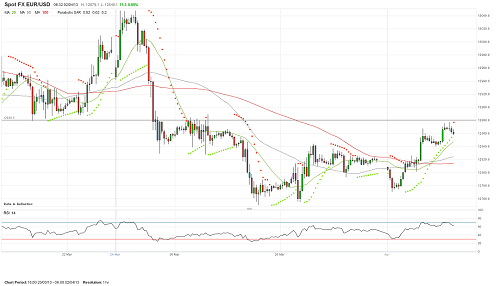
EURUSD

eurusd02.04.2013

Yesterday, despite the days-off in a number of the EU countries, the EURUSD was gradually increasing and managed to gain about 100 points. During the day, the pair have managed to reach the level of 1.2867, and during the Asian session on Tuesday — tested the resistance at 1.2880. Given the low liquidity of trading, this increase can be considered as the corrective one allowing the pair to sell at the best price. It is wise to take into account the pair’s increase to 1.2920-1.2980, which will not likely change the current bearish trend.

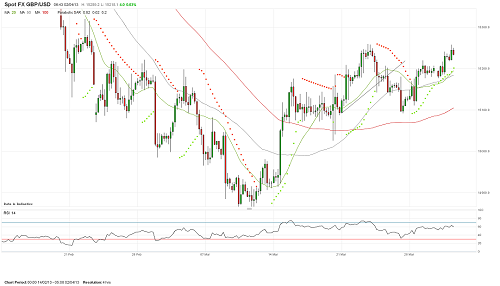
GBPUSD

gbpusd02.04.2013

The GBPUSD rebounded from the 1.5180 support, overcome the resistance of 1.5200-1.5220 and tested the 1.5258 level. It is wise not to rely on this pair’s increase, given low market liquidity yesterday, thus it is advisable to wait until the bulls’ seriousness has been approved – then, the pair will manage to consolidate above the 1.5220-1.5200 proximity (support, this time). In this case, the pound will continue increasing towards the 53rd figure, otherwise — the bears will test the support of 1.5180 again.

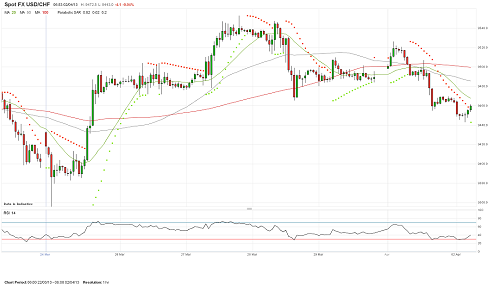
USDCHF

usdchf02.04.2013

The USDCHF attempted to develop an upward trend above the 95th figure. But it was not supported by the market participants, thus it decreased below this level again. This time, its rate dropped to 0.9443. The dollar risks at decreasing even further towards the support near the 0.9400-0.9360 proximity, the loss of which would worsen prospects for the American dollar. But if the dollar continues to saty above the support, the pair will have chances to increase.

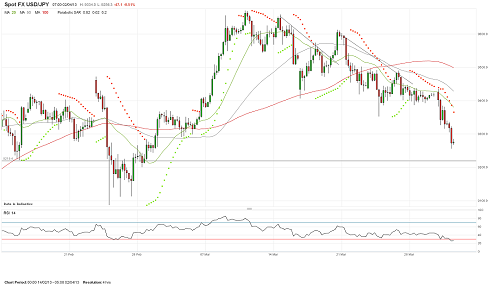
USDJPY

usdjpy02.04.2013

The pair bears were happy that the USDJPY managed to pass the support at the 93.90-93.50 proximity, which became the catalyst for the pair’s further reduction – the pair dropped to 92.56, due to yesterday’s decrease. Thus, the USDJPY has approached its more important support of 92.20. The RSI has entered the oversold zone on the 4-hour chart, thus it will likely have a pullback from this support. But is is wise not to take this fact at your face value, since the immediate bears’ target can become the 90.87 low in February. Nevertheless, the increase towards the broken support of 93.50-93.90, which now acts as the resistance one is more logical to use it for the pair’s sales at this stage.

provided by IAFT


Interest in Gold “Disappears” as North Korea Tensions Rise, Silver “Acting More Like Base Metal than Store of Value”

London Gold Market Report
from Ben Traynor
BullionVault
Tuesday 2 April 2013, 07:00 EST

U.S. DOLLAR prices to buy gold dipped back below $1600 an ounce Tuesday morning, though they remained close to that level by lunchtime in London, as the physical bullion market re-opened following the Easter break.

Stock markets edged higher in Europe despite news of record high unemployment and contracting manufacturing sectors, while major government bond prices dipped.

“Looking at gold for six months shows the metal making successively lower lows and lower highs,” says the latest technical analysis from Scotia Mocatta.

“The last major lower high was $1620…We feel that while this $1620 level holds, the risk is for another drop to $1555 and possibly the one year low of $1528.”

“We saw buying interest from the general public on TOCOM this morning,” says one dealer in Tokyo, referring to the Tokyo Commodity Exchange.

“But then it disappeared. [People] don’t want to buy or sell because of the matters concerning North Korea.”

North Korea said over the weekend that it is in a ‘state of war’ with South Korea, technically true since the 1950-53 Korean War ended with an armistice rather than a peace treaty. Pyongyang, which conducted a third nuclear test in February, has also said it will restart all facilities at its Yongbyon nuclear complex.

In the south, “people do seem a bit more concerned than before,” says one BullionVault contact based in Seoul, adding that a colleague of his has “bought lots of noodles and canned food ‘just in case'”.

“People’s fear is more based on the fact that the North has done small attacks in recent years to force a return to the negotiating table, and that if they do the same again, it could escalate this time because the South’s new president will need to show a reaction.”

BullionVault’s Gold Investor Index fell for the third month running in March, figures published Tuesday show, despite the online precious metals exchange seeing its busiest week since mid-

October following the Cyprus bailout news.

The world’s biggest gold exchange traded fund meantime continued to see outflows Monday. The volume of gold backing shares in the SPDR Gold Trust (ticker: GLD) fell to its lowest level since July 2011 at just over 1217 tonnes.

On the Comex exchange, the so-called speculative net long position of gold futures and options traders, calculated as the difference between the number of bullish and bearish contracts held by hedge funds and other money managers, fell by 0.2% to the equivalent of 397.3 tonnes in the week ended last Tuesday, weekly data published by the Commodity Futures Trading Commission show.

Silver meantime fell below $28 an ounce Tuesday, trading near seven-month lows, while other commodities were broadly flat on the day.

“In the past two weeks silver has been performing more like a base metal and less like a store of value,” says today’s commodities note from Commerzbank.

“Silver’s underlying demand/supply fundamentals remain weak…inventory is abundant,” says Standard Bank’s monthly Precious Metals Definer, estimating that China’s surplus is equivalent to 18 months’ of fabrication demand.

“The situation within China implies that one of two scenarios should happen before silver can rise substantially higher on a sustainable basis: (1) internal demand (fabrication and investment demand) must grow faster to decrease the stockpiles, or (2) China must become a net exporter of silver again.”

Standard’s analysts add that the second scenario “would only imply that the metal has shifted location and not been consumed — the result of which would be price neutral at best.”

Although the Dollar silver price ended the first quarter down more than 4%, the US Mint recorded its strongest quarter for silver coins sales since it began keeping records in 1986.

Over in Europe, the Eurozone unemployment rate hit a record 12% in January, according to revised figures published this morning, maintaining that level in February.

Eurozone manufacturing meantime continued to contract last month and a faster rate than a month earlier, according to purchasing managers index data published Tuesday. Germany’s manufacturing PMI fell back below 50, also indicating contraction, while Britain’s PMI fell further below 50.

India is unlikely to raise gold import duties again, having raised them to 6% in January, according to the country’s finance minister.

“There are limits to which tariffs can be raised on gold,” P. Chidambaram told Reuters Tuesday, “because if you raise tariffs prohibitively, gold smuggling will increase.”

Turkey imported 18.26 tonnes of gold last month, up from 17.34 tonnes a month earlier, according to data from the Istanbul Gold Exchange. Turkish gold imports in 2012 were up 51% from a year earlier at 120.78 tonnes. Turkey’s gold exports also jumped last year, with reports suggesting it was using gold in trade with sanctions-hit Iran.

Ben Traynor

BullionVault

Gold value calculator   |   Buy gold online at live prices

Editor of Gold News, the analysis and investment research site from world-leading gold ownership service BullionVault, Ben Traynor was formerly editor of the Fleet Street Letter, the UK’s longest-running investment letter. A Cambridge economics graduate, he is a professional writer and editor with a specialist interest in monetary economics. Ben can be found on Google+


(c) BullionVault 2013

Please Note: This article is to inform your thinking, not lead it. Only you can decide the best place for your money, and any decision you make will put your money at risk. Information or data included here may have already been overtaken by events – and must be verified elsewhere – should you choose to act on it.