Sizemore on Fox: Cashing in on the Echo Boomers

By The Sizemore Letter

Watch me give my thoughts on investing in the rise of the Echo Boomer generation on Fox Business:

Watch the latest video at video.foxbusiness.com

SUBSCRIBE to Sizemore Insights via e-mail today.

The post Sizemore on Fox: Cashing in on the Echo Boomers appeared first on Sizemore Insights.

Money Weekend Market Digest: 30 March 2013

By MoneyMorning.com.au

Health: The $1,000 Genome Challenge

Personalised Medicine. Get used to that phrase; you’ll hear it more often in the years ahead. Imagine knowing what disease you’re going to get, before you get it, and then putting a treatment regime in place to prevent you from getting sick.

It’s possible, and it’s so close it’s getting us nerd types very excited.

This all hinges around the ability to sequence DNA. You may have heard of the Human Genome Project, which began in October, 1990. It involved sequencing human DNA and then mapping out about 30,000 genes. So on April 14th 2003, about $2.7 billion later, the first Human Genome was completed. Since then it’s like the DNA sequencing industry has been in overdrive.

To see the speed at which this is all happening we have to briefly turn to computing for a moment and look at Moore’s Law.

Moore’s Law says the number of transistors on a computer chip roughly doubles every 2 years. For any industry, to keep pace with Moore’s law is as an exceptional rate of progression.

So when the cost per genome is imposed over Moore’s law you can see the amazing speed which genome sequencing has progressed in the last few years.

Human Genome Project, cost per genome Source: National Human Genome Research Institute

There are two parts to this story that have really got us in a bubble of excitement. First, this year marks the 10th anniversary of the completion of the Human Genome Project. And second, this September there’s a competition on called the Archon Genomics X Prize.

Up for grabs, a cool $10 million. This competition requires the winning team to sequence 100 human genomes in 30 days, with best-in-class accuracy and, here’s the best bit, at a cost of under $1,000 per sequence.

What this means is genome sequencing will go from being ‘research’ to a legitimate form of diagnosis and treatment for patients worldwide. It’s the dawn of real Personalised Medicine.

Energy: Is This (Finally) the Answer to Electric Cars?

It’s not just the human genome that’s got us super excited this week either. We’re excited about energy too. There’s a fair amount of talk about declining resources and an energy crisis the likes we’ve never seen before. It’s something we should all be aware of. But obviously that’s not why we’re excited about energy.

What gets our synapses firing like Bill Duke in Predator is innovation and the new discoveries in energy that are happening almost on a daily basis.

Take for example the electric car movement. It’s an energy discussion that’s been hanging around for some time. Yet no one quite believes it’s viable, and rightly so. Who really wants to drive 120km and then wait 12 hours to recharge for the next 120km? Not us. Admittedly some electric car manufacturers like Tesla have got a range of in excess of 300km now. But still, that’s three recharges on the way to Sydney.

Thankfully, innovation never sleeps, and a company called Phinergy based out of Israel thinks they’ve got the solution to our electric car problems. And it’s a pretty good solution we must say.

Phinergy have implemented their new Aluminium-Air battery technology into a car (you can see the video on their homepage). The technology uses Aluminium, Water and Air to create the energy that powers the vehicle. Not only that, Phinergy claim that it’s possible the range of their Aluminium-Air vehicle could be over 3 times that of existing Electric cars, possibly up to and over 1,000 miles.

So when the charged battery gets low, instead of spending 12 hours charging, top your car up with water (yes, plain drinking water). The reaction with the Aluminium-Air battery recharges the battery instantly and away you go.

The technology Phinergy has impressed some of the big auto makers. They’ve recently signed on with the Renault-Nissan Alliance, a partnership between Renault AG and the Nissan Motor Group.

Mercedes Benz is another major automaker that’s investing heavily in electric vehicles. They’re looking to release a full electric version of their B-Class in 2014. In September 2012 Mercedes also released a full electric version of their SLS AMG, AMG’s most powerful, and the world’s fastest, electric car.

So the electric car is once again getting some traction with the big car manufacturers, because they’ve finally cottoned on that you don’t have to compromise performance or style for ‘eco-friendliness’.

With new technologies the electric car won’t be an ‘alternative’ much longer, but could perhaps become the norm.

Technology: Why Hollywood Shouldn’t Remake Top Gun

We suspect that the movie Top Gun probably wouldn’t have done as well at the box office if it didn’t have Tom Cruise, Val Kilmer and Anthony Edwards in the cockpit of those Grumman F-14 Tomcats.

Imagine if it was a computer program playing an MP3 of ‘You’ve lost that loving feeling’ then autonomously sending off planes thousands of kilometres away. Probably wouldn’t have grossed over $353 million worldwide or inspired a generation of fighter pilots.

You see, if they remade Top Gun today, to be true to modern technology, it would be a pretty boring film. Because it wouldn’t need a cast.

The days of piloted strike fighter aircraft are almost over. And when we say unmanned, we mean no one. No pilot. No controller. Just a preprogramed drone strike fighter doing its thing.

Of course the US Military is the one pioneering unmanned strike fighters. As you would expect, with a defence spending budget in the realm of $670 billion they’ve got the money to pull this off. That’s why they’ve contracted Northrop Grumman to build and test the X-47B.

The Northrop Grumman fact sheet explains it best;

X-47B is a computer-controlled unmanned aircraft system that takes off, flies a preprogramed mission, then returns to base in response to mouse clicks from its mission operator. The mission operator monitors the X-47B air vehicle’s operation, but does not actively “fly” it via remote control as is the case for other unmanned systems currently in operation.

The real breakthrough here is the fighter can take off and land on an aircraft carrier. But we’re still dazzled by the ‘mouse clicks from its mission operator’ part!

Source: Northrop Grumman

Looking like a squished version of Northrop’s B-2 Bomber, the X-47B is fully compatible with the US Navy’s existing aircraft carriers and can carry a 4,500 lb payload. That’s a lot of weaponry.

Honestly, it scares the living daylights out of us. The whole military system seems to be going more and more down the track of automation. When it gets an injection of Artificial Intelligence, well, let’s just hope we can escape by flying to Mars by then.

Sam Volkering
Technology Analyst, Money Weekend

Join Money Morning on Google+
From the Archives…

Why You Should Buy This Falling Stock Market
22-03-2013 – Kris Sayce

Stock Market Warning: Part II
21-03-2013 – Murray Dawes

New Developments on Whether You Can Get Your Mortgage Cancelled
20-03-2013 – Nick Hubble

Your Retirement or Your Mortgage?
19-03-2013 – Nick Hubble

Get Used to This Stock Market Action, It’s Set to Last…
18-03-2013 – Kris Sayce

Australian Stock Market to Make an All-Time High? This Analyst Thinks So…

By MoneyMorning.com.au

What’s the best way to encourage a depositor to take his money out of a bank?

This question went around the office this week.

Answer: Tell him he’s not really a depositor. He’s a creditor to the bank. And from now on, he’s responsible for all the bank’s bad lending decisions!

That’s the pickle Dutch politician Jeroen Dijsselbloem got himself into this week. He said the bank restructuring in Cyprus would be a template for future problems elsewhere in Europe. A hasty retraction followed not long after as the implication became clear for European depositors: get your money out of iffy banks as quick as you can before they take it!

In the movie Margin Call there’s a quote from the head honcho of an investment bank that goes like this: ‘There’s three ways to make a living from this business. Be first, be smarter, or cheat.’ We’re not smart enough to know what will happen to the euro. But we do know we’d be first out the door if we had an account in southern Europe!

Cash Just Ain’t What it Used to Be

When you destroy trust in fractional reserve banking, you destroy the very thing that makes it work. Then you’re left with the naked truth that most banks borrow short and lend long.

On the face it, the situation in Cyprus is another bearish example of why the euro can’t survive as it is. But the bulls argue that the Cypriot case has shown once again that the political elites will stop at nothing to preserve the currency. No option is off the table. Perhaps the euro bearishness is a signal for contrarians to step in. Hmm.

Mind you, when the ‘safety’ of cash is called into question like that, shares suddenly look much more attractive as an asset class. At least they’re a claim on real assets.

That’s also a major reason editor Kris Sayce over at Australian Small Cap Investigator thinks the inflationary policies of the world’s central banks will continue to show up in stock prices. He sees the stage being set for a boom in the ASX that will take it over 7,000 points within two years.

‘Money doesn’t sit still in the financial world,’ Kris wrote in his latest report. ‘It moves constantly as the big banks and traders look to profit by investing in and betting on the next bull market. So here’s the important question for punters: where is the money heading next? Based on my experience, growth stocks are the next in line.’

Why You Want to Own Small Cap Stocks

This isn’t limited to a bit of market commentary, either. Kris has more open positions on the Australian Small-Cap Investigator buy list than at any time since 2010. If the rally comes, those positions should benefit. He’s got his subscribers in plays that range from high, medium and lower risk. And credit where credit is due. Mr Sayce called the rally since last year when a lot of others were wary of the market falling over.

This isn’t the first time the potential in small cap stocks has been discussed in Money Weekend. But we are not alone this week. The Australian Financial Review ran an article on Wednesday highlighting the opportunity in small-cap (and medium) sized stocks.

It noted the rally in the Australian share market up to 31 January had really only been in the top 50 stocks. If you take them out of the equation, the share market would only have been up 2.62%. It’s the major dividend payers like the banks that have rallied hard. But prices can only move so high before investors will start looking elsewhere for value.

To us, that means the best place to start hunting is the small to medium sized stocks that haven’t rallied. But that’s probably almost always true, anyway. Your best chance of finding mispriced companies will be in areas that don’t get as much attention from analysts. There’s less competition.

One strategy to use is classic value investing. That’s where you try to put a price on the company’s assets and overall position and buy under that price with a ‘margin of safety’.

Kris’ approach is slightly different. He’s looking for shares where the market may have mispriced the growth prospects of different companies. It’s always a subjective opinion, and certainly not without risk, but also why small cap stocks can often deliver gains of 100%, 200% or 500% if you get your homework right.

Callum Newman
Editor, Money Weekend

Join me on Google+

From the Port Phillip Publishing Library

Special Report: Australia’s Energy Stock BLOWOUT

Daily Reckoning: Trade the Market Like a Stoic Philosopher

Money Morning: Silver ‘$100 Within Two Years’

Pursuit of Happiness: Spreading the Idea of Liberty

Australian Small-Cap Investigator:
How to Make Money From Small-Cap Stocks

Language Barriers

By Bill Bonner, billbonnersdiary.com

Came the news yesterday that the governor of Cyprus’ central bank is a fellow named Panicos Demetriades.

No kidding.

But even though the Central Bank of Cyprus is showing the world – in
stark naked detail – how governments will deal with their debt problems,
there is no general panic.

Panicos goes about his business… like Ben and Mario… ripping off
savers to protect the feds’ access to easy cash. In Cyprus, they even
stab their major industry – banking – in the back to… what?

Protect their economy? Nope.

They do it to protect the power of the government. The economy can go to hell, which is what will happen in Cyprus. Who will want to keep money in a Cyprus bank now? Only a fool. Or someone who reads the newspapers.

Read the papers, take them seriously, and you are ready to believe
anything. The problem is partly a language barrier. The newspapers will
tell you that that the authorities “saved” Cyprus… and the entire
European financial system.

That is the trouble with the language of public information. The
words mean little or nothing. It is just noise. Events are often exactly
opposite in meaning to the description given them in the press.

Mots Justes

Someone cuts you off in traffic, and you know just what to say. You have the mot juste on the tip of your tongue even faster than you can raise your middle finger.

But what do you say to ZIRP (zero interest rate policy), which cuts
off the earnings from your savings? What do you call QE3, which
potentially undermines the value of your savings and your earnings by
adding billions to the money supply?

We barely have words for the kind of premeditated larceny done by
central banks and central governments. The meaning of them is hidden
behind gobbledygook descriptions and noisy public information.

As an aside, the same is true in geopolitical and military matters.
One generation learns that attacking one’s neighbors is bad business.
The next forgets… and begins to invent nice new words to describe bad
old habits. We have “surgical drone strikes” now, not assassinations!
And we have “enhanced interrogation techniques,” not torture.

But it’s as hard to come up with something new in military affairs as
it is in literature and economics. “Enhanced interrogation techniques”
is a direct translation of the Nazis’ Verschärfte Vernehmung, right out of the Gestapo handbook.

Cross-Cultural Misunderstandings

Even in simple everyday matters, language is a barrier to
understanding. When you talk to people you know, who speak the same
language, and come from the same area, you can usually tell what they
are talking about. The words give you some of the meaning. The rest of
it is supplied by tone, emphasis, facial expression and body language.

We spent the week with friends from France. We speak the language
reasonably well. Even so, there are subtle meanings we never understand.
It’s not enough to know the words. You have to know the context… and
the nuances… to get the full meaning of them.

That’s what makes cross-cultural marriages and multinational
businesses so treacherous: You never know what the other side is really
saying! Sometimes it’s better that way. Sometimes, worse…

The French are very proud of their language. They despise people who
use it badly. Speak French badly to a Parisian waiter, and he will make
fun of you… usually in ways you won’t understand. Make a mistake in
front of a person from the 16th arrondissement, and he will say nothing… but his mouth will betray a slight smile of superiority.

The Argentines – at least in this part of the country – are more
generous with their language. We say something to the field hands. They
get a quizzical look on their faces. They don’t understand what we are
saying because the local dialect is different and because we don’t speak
Spanish very well. But unlike the French, the local people act
embarrassed and pained – as if it were their fault that they didn’t
understand you.

“How many calves did we get this year,” we intend to ask Jorge, our
farm manager. He looks at us intently, as one looks at a mental
defective, struggling to make sense of what he saying.

“Yes, I’ll be here on Friday,” he replies.

“How many?”

“All day long,” he responds.

Regards,

Bill Bonner

Bill


(Complimentary video) One simple insight that will change the way you invest forever

Dear Investor,

Some of the greatest problem solvers in history — Albert Einstein, for example — know that the secret to solving complex problems requires simplicity.

Einstein’s simple equation (E = mc²) revolutionized math and science because it offered a single simple solution to so many of the world’s mysteries.

New research from the desk of market technician Robert Prechter reveals that a relatively small (yet growing) group of investors has discovered a universal truth about investing that stands to revolutionize the fields of finance and economics.

Prechter’s insight is simple yet counterintuitive. And in a new 23-minute video presentation called “How Market Losers Think — and How to Stop Doing It,” Prechter shares his one simple insight that will change the way you invest forever.

Prechter’s new video is free for a limited time.

Follow this link now to get Prechter’s jaw-dropping charts, figures and commentary (before this free offer ends) >>


About the Publisher, Elliott Wave International
Founded in 1979 by Robert R. Prechter Jr., Elliott Wave International (EWI) is the world’s largest market forecasting firm. Its staff of full-time analysts provides 24-hour-a-day market analysis to institutional and private investors around the world.


The Single Most Important Secret to Building Lasting Wealth

By Aaron Gentzler

Lewis Schiff of Inc. magazine has a new book out called Business Brilliant: Surprising Lessons From the Greatest Self-Made Business Icons.

After a dozen years of work, he has distilled seven core behaviors that explain how self-made millionaires became wealthy.

What’s struck me most about the book is the stark difference between
what wealthy people think and what “middle class” people think.

For example, Schiff reports 80% of wealthy people have equity in the businesses they are involved in.

In my wealth-building advisory service, Unconventional Wealth, I call this the principal of ownership. And I believe it’s the single most important secret to building lasting wealth. When you own a stake in what you do, you benefit more than your 9-to-5 neighbor.

That’s why it’s the mission of Unconventional Wealth to show you how to build ownership in income-producing assets.

According to Schiff just 10% of “middle class” people have equity in
what they do. And 70% said they’re not even trying to build any
equity.

Eighty percent of millionaires own what they do. Seventy percent of
middle class people aren’t even trying to own what they do. Think about
that.

Schiff also found that 71% of wealthy people have no problem walking
away from business deals that look suspect. But only 22% of middle
class people said the same thing. The middle class seems to think
there’s a point of no return after which you must follow through.

This shouldn’t come as a surprise. Another quality of the wealthy is that they cultivate and protect capital. They don’t toss it away on bad deals.

Don’t fall into that trap. Capital is precious. The most important
step to accumulating lasting wealth is ownership. You can’t own
something unless you first have enough capital to acquire it.

I don’t care what you own. Own a car wash. Own a liquor store. Own a
tractor you rent out to people in your area who want to plant a
garden. Own real estate and rent it out.

As I tell my Unconventional Wealth readers, you build wealth by owning something tangible that returns capital to you.

Put another way, the big difference between the truly wealthy and
the middle class is that wealthy people produce, and the middle class
consume.

I don’t mean that as a reverse class-warfare claim. This is not a
political statement. I simply mean that wealthy people find a way to
break the cycle of working for a paycheck and that they find themselves
in a very different financial situation than those you might call
“working stiffs.”

So how do you follow the path laid out by the truly wealthy? You
break the model of debt reliance by finding a way to “work for
yourself.”

The rich aren’t brilliant. They put their pants on just like you.
The difference between the rich and everyone else is that they own what
delivers them their capital. Everything else flows from that point.

One way to own what delivers you capital is to buy a second home and
rent it out. As I’ve written many times, 30-year fixed-rate mortgages
are cheap right now. Bankrate.com reports the nationwide average is
still just 3.75%. Historically speaking, this is a steal.

Visit www.trulia.com or visit www.zillow.com and search for existing homes in your area that are in your price range. Then contact a real estate agent and go tour them.

Schiff’s book might be called Business Brilliant, but you don’t have to be brilliant to become wealthy. Simply commit yourself to ownership and you control your future.

Best regards,

Aaron

P.S. I’ve found a way you can make up to 12% a year owning a unique,
time-tested asset most people don’t think of as a capital producer. Click here for my full report.


Disclaimer

Article brought to you by Inside Investing Daily. Republish
without charge. Required: Author attribution, links back to original
content or www.insideinvestingdaily.com. Any investment contains risk. Please see our disclaimer.


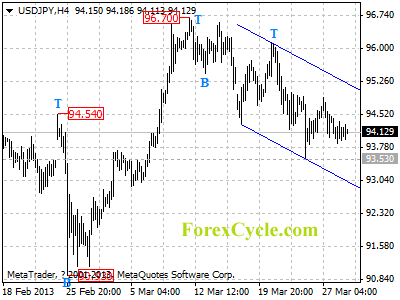
USDJPY remains in downtrend from 96.70

USDJPY remains in downtrend from 96.70, the price action from 93.53 is likely consolidation of the downtrend. Key resistance is at the upper line of the price channel on 4-hour chart, as long as the channel resistance holds, the downtrend could be expected to resume, and another fall to 92.00 – 93.00 area to complete the downward movement is possible. However, a clear break above the channel resistance will indicate that the downtrend from 96.70 had completed at 93.53 already, then further rise towards 100.00 could be seen.

usdjpy

Daily Forex Forecast

Why Dividend Stocks May Not Stay This Cheap for Long

By MoneyMorning.com.au

Phew! What a punishing second half of March.

There’s blood on the streets everywhere.

Investors are crying into their cheap beer.

And many are wondering if the stock market will ever go up again.

Oh, hang on a minute, it wasn’t that bad. Yes, the Australian market is 3% below the recent peak reached on 12 March. But seeing as the market is still 25% higher than it was last June, we’ll take that any day of the week.

The question is: are you still in the market or have you been spooked out of it?

Either way, here’s what to do now…

We’ll admit something. We told Pursuit of Happiness readers earlier this week that the Cyprus savings grab had spooked us.

It made us reassess our cash savings and whether we’re better off switching some of that into gold. We figured out that yes, we would be better off with more gold, so that’s what we’ll do.

But the one thing we didn’t do during the height of the Cyprus crisis was to change our view on the stock market.

Safer Than Cash?

That may seem strange. After all, in the event of a crisis isn’t it natural to sell risky assets and buy less risky assets? Well, yes, that’s true.

But the way we’ve come to think about it (and we don’t think we’re the only ones to come to this conclusion), we’ve got more faith in the ability of Australian companies to weather a financial storm than we have in the banking sector to weather a bank run.

That’s especially so when, as we also pointed out to Pursuit of Happiness readers, a bank like Australia & New Zealand Bank [ASX: ANZ] only has $75 in cash and coins in reserve for every $10,000 of deposits (that’s less than 1% by the way).

How do you think you’ll go getting your cash out if there’s a run on Australian banks? Enough said.

So, we’ll take the stock market any day of the week. That doesn’t mean you should ditch all your cash. But you should know the risks. We know the risks in shares, but just as importantly, we know the rewards.

And as the chart shows, a 3% drop…big deal:

Source: Google Finance

You know our style. We’re not a shill or a spruiker for the stock market. If we thought things were bad – really bad – we’d tell you to sell.

But right now we figure the Aussie market has settled in for an extended period of volatile, but ultimately, sideways action. In fact, we doubt if you’ll start to see the market challenge the March high again until the last three months of the year.

For what it’s worth, just remember we tipped the market to end the year at 5,004 points. It hit that mark in February, and who knows, with the volatility, it’s still looking like a good bet to end the year at that level.

But this is exactly why we’re buying stocks, and it’s why you should too…

Big Investors ‘Game-Hunting’ for Yield

We’ve laid out our stall to say that it’s a great time to buy growth stocks. We said that a few weeks ago as stocks hit the peak. To us, dividend stocks looked overvalued at worst and fairly valued at best.

But as we showed you in last Friday’s Money Morning, the recent sell-off has presented an opportunity to fill up on a few dividend stocks. We used AMP Ltd [ASX: AMP] as an example. And what do you know? It rallied 4.6% on Wednesday, recovering about half of what it had lost since February.

This isn’t, and won’t be, an isolated case. Investors will scan the market for yields. They’ll look to pick up any unfairly sold off stock. That should see dividend stocks gain over the next few weeks.

So although the best opportunities for gains this year will come from growth stocks (especially the ones we focus on in the small-cap market), you’d be a mug not to take advantage of the opportunity to use incoming cash flows to top-up on your dividend stocks.

You shouldn’t expect to see the kind of capital growth gains you saw in the previous six months. But if you can get 4-5% gains, plus a 4-5% dividend yield, well, that isn’t a bad return on what most still think of as a super high-risk market.

Cheers,
Kris

Join me on Google+

From the Port Phillip Publishing Library

Special Report: Australia’s Energy Stock BLOWOUT

Daily Reckoning: In Gold, Not Cyprus, We Trust

Money Morning: Silver ‘$100 Within Two Years’

Pursuit of Happiness: Safer Than Cash – Gold Regains Its Rightful Place

Australian Small-Cap Investigator:
How to Make Money From Small-Cap Stocks

The Most Futuristic 3-D Printer, Based on the Original Factory

By MoneyMorning.com.au

As you know, 2-D printing with ink on paper is being one-upped by 3- D printing with plastics and metals to create objects. But it doesn’t end there…

It’s one thing to print inanimate objects. That is, objects where the machine assembling them does all the work…whether it’s heating up or hardening materials in order to construct whatever your computer aided design (CAD) says.

But it’s quite another thing to print with self-assembling materials. Materials that aren’t just being moved around by the printer, but actually ‘help’ the machine make the product.

Chris Anderson, in his book Makers, explains the concept of ‘intelligent materials’ with the example of Lego blocks:


‘When a child plays with Lego, the blocks correct the child’s mistakes – they fit together only if they’re lined up right. The larger Duplo blocks guide the child to the correct orientation with bevelled edges that exert a force to rotate the parts in the right direction to fit when they’re pushed together.

‘The blocks themselves provide a coordinate system – the Lego grid. And when you’re done with the blocks, you don’t throw them away. You disassemble them and use them to build something else, making them the ultimate recyclable material.’

So How Can a 3-D Printer’s ‘Ink’ be Intelligent?

I’ll give you a hint: it won’t lay down Legos.

But the concept of materials that are inclined to rely on preconceived components is the same...A 3-D printer’s ‘ink’ can be intelligent in the same way that cells in your body are intelligent.

In other words, 3-D printing’s natural next step will be based on biology, the original factory. It will use ‘ink’ that follows instructions from your DNA, the very building blocks of life.

The next step in the 3-D printing revolution is the introduction of bioprinters into labs.

Bioprinters can print layers of living cells in order to create human or other animal tissues. And, in time, even entire organs. The printers build the relevant cells in a certain pattern, a framework, enough so that – amazingly – nature can fill in the rest of the work and complete the job.

Dissolvable gel keeps the cells from dying, which usually isn’t a problem when it happens naturally in a human blood network. The process uses ‘bioink spheroids’ and ‘biopaper gel’.

Incredibly, cells within the bioink spheroid actually rearrange themselves after printing, ‘correcting’ their positions and then turning into tissue.

How they effortlessly do this is all in the memory of their DNA.

Professor Makoto Nakamura at the University of Toyama was one of the first people in the world to use inkjet technology with real living cells to build a 3-D structure. He hopes to print a heart.

The idea first occurred to him in 2002 when he realized that droplets of ink from a standard ink jet printer are about the same size as human cells…one-hundredth of a millimetre.

He had bought a regular old Seiko Epson printer, loaded it with cells and…clogged the nozzle.

Woops.

He could have called it quits, and written it off as a crazy idea. But instead, he called the operator at customer service and explained that he wanted to print human cells, an idea she politely shut down.

Eventually, he reached an official who showed an interest and gave him technical support.

A year later, his experiments confirmed that cells could survive after the printing process if they were put in what we’ve affectionately been referring to as ‘biopaper gel’. So he became one of the first researchers in the world to print a 3-D structure with real living cells using inkjet technology.

His motivation is simple: His background as a paediatrician put him face to face treating children with heart problems. In a discussion he had with a journalist from iAfrica.com, he said:

‘I just had to watch them die. Clinical doctors can’t give them treatment that isn’t in textbooks. I clung to the hope that medicine will make progress and save more lives in the future.

‘I’m not envisioning making superhuman cyborgs. There are simply lives that could be saved if there are organs.’

Nakamura’s represents only one person with the desire to make organs readily available for transplants, but it’s an ambition shared by many. According to the National Network of Organ Donors:


‘More than 111,000 people are currently on the UNOS’ transplant waiting list…the number of people who die waiting for a transplant continues to grow: from 10 people each day in 1990, to 14 a day in 1996, to 19 today. That number will be even higher by 2020…’

That’s just in the United States.

3-D Printing: A New Hope for Patients

When this new technology comes to fruition, there may not even be a need to ask for organ donations. It will most likely be one of the many future technologies that converge in what our in-house expert calls ‘the Phoenix Event’.

Induced pluripotent stem cells, for example, can be used as the raw materials for this kind of technology. Using the DNA from your own stem cells limits any chance of immune system rejection. And all this can happen without the potentially controversial use of embryonic stem cells.

Organovo already has proprietary technology that boasts itself as the world’s first commercial 3-D bioprinter.

In the words of CEO Keith Murphy, ‘Scientists and engineers can use the 3-D bioprinters to enable placing cells of almost any type into a desired pattern in 3-D.’ He continues, ‘Ultimately, the idea would be for surgeons to have tissue on demand for various uses, and the best way to do that is get a number of bioprinters into the hands of researchers…’

Think of the demand from well-endowed medical schools and hospitals.

In December 2010, Organovo successfully created the first bioprinted blood vessels from a single person, and they plan to go through with human trials of bioprinted tissues by 2015.

They also anticipate their first artificial human organ will be a kidney, which is the most straightforward part in your body. In time, any organ might be bioprinted.

But Organovo is just one exciting company harnessing the power of breakthrough technologies.

Stay tuned for more!

Josh Grasmick
Contributing Editor, Money Morning

Join Money Morning on Google+

From the Archives…

Why You Should Buy This Falling Stock Market
22-03-2013 – Kris Sayce

Stock Market Warning: Part II
21-03-2013 – Murray Dawes

New Developments on Whether You Can Get Your Mortgage Cancelled
20-03-2013 – Nick Hubble

Your Retirement or Your Mortgage?
19-03-2013 – Nick Hubble

Get Used to This Stock Market Action, It’s Set to Last…
18-03-2013 – Kris Sayce

Gold vs. S&P 500 – Where is the Value?

By J.W. Jones – OptionsTradingSignals.com

This past week we received the final 4th Quarter GDP number which came in at 0.39%. The total 4th Quarter growth was terrible, plain and simple. Based on the performance in the equity markets that we have seen thus far in the 1st Quarter of 2013 investors would expect strong GDP growth. However, the only thing spurring stock market growth is the constant humming of Ben Bernanke’s printing press.

The real economy and the stock market are no longer strongly correlated. Essentially, they are meaningless. How do you evaluate risk when Treasury linked interest rates are artificially being held down by the Federal Reserve? How do you evaluate earnings growth estimates when most government based statistics are manipulated or “smoothed” to perfection?

My final argument to anyone who is a true believer that the stock market is representative of the economy is a very simple premise. If the stock market is the economy, how does the stock market evaluate small business earnings growth when most small businesses are not publicly traded? It is a simple question, but I have yet to find a sell side analyst that can work around it with facts.

To back up this information, here is a chart courtesy of www.zerohedge.com that demonstrates the S&P 500’s price action compared to economic data and overall macro risk.

Chart1

The chart above clearly depicts the divergence between the macroeconomic data and the performance of the S&P 500 Index. Yet the sell side continues to scream that stocks are cheap, earnings are going to ramp up later this year on insane S&P 500 earnings growth expectations, and the consumer is going to remain strong even though payroll taxes have increased and the “wealthy” are paying more in taxes.

Even amid those concerns, no one knows for sure what the impact that Obamacare and the various new taxes associated with it will have on the business community. Again, the only thing driving growth is directly linked to the Federal Reserve’s balance sheet expansion. The chart below is courtesy of the Federal Reserve’s website.

Chart2

On August 8, 2007 the Federal Reserve’s total assets were $869 billion dollars. As can clearly be seen today, according to the Federal Reserve the central bank’s total balance sheet has grown to over $3.2 trillion dollars. The increase is on the verge of rising exponentially. With QE, QE2, QE3, Operation Twist, Extended Operation Twist, and now with QE 4 in Perpetuity this trend is certainly unlikely to shift.

At this point in time the Federal Reserve is printing roughly $85 billion dollars each month to purchase Treasury securities with a focus on the long end of the maturity curve. As primary dealers of Treasury securities process these flows the money eventually finds its way into riskier assets that offer higher rates of returns through balance sheet machinations at large money center banks.

It has proven that the flow of the Federal Reserve’s printed monies are more important than the total money stock for a variety of reasons and inflation according to the government’s data is under control ex food and energy.

However, how are people supposed to survive without food and energy in today’s world? The last time I went to fill up my gas tank or to purchase food prices have gone up significantly. According to the 1990 version of consumer price reporting, real consumer inflation is running around 6% currently and shadowstats.com has the following comparison.

Chart3

Unfortunately the 1980 based inflation numbers are even uglier, which based on Shadowstats’ data chart would place consumer inflation at nearly 10%. The calculations being used by Shadowstats.com are based on the government’s OLD ways of calculating inflation. The calculations were adjusted over time and today the data is completely manipulated by not including items that typically experience the largest levels of inflation.

Normally I talk about price action, probability based option trading, and technical information. However, before investors consider buying stocks near the all-time NOMINAL (non-inflation adjusted) highs, why not simply consider the backdrop of the total economic situation.

Central banks around the world are printing money at an alarming rate and their balance sheets are growing to levels not seen in human history. Interest rates are being manipulated to levels that are historically at record lows or near record lows based on real inflation data.

Macroeconomic indicators are issuing a cautionary tone with significant divergences showing up in many areas. Earnings expectations for the S&P 500 in the 3rd and 4th Quarter of 2013 are extreme and borderline ridiculous.

So before jumping headlong into equities based on some sell side analysts recommendation or even worse, a financial advisor who is more interested in his/her commission than they are about producing gains consider the following comparisons.


S&P 500 Index (SPX) Price Chart – 1 Year Price History

Chart4

Gold Futures Spot Price Chart – 1 Year Price History

Chart5

Clearly paper gold represented by gold futures is no substitute for physical ownership, but when one considers the fundamental backdrop for gold versus the S&P 500 Index, it should be clear which asset is offering the most value at current price levels. It does not require any inserted trendlines or oscillators, it should be clear which asset is expensive and which asset is cheap based on the real long-term economic fundamentals.

I will give you a hint regarding which asset is offering the most value. It can’t be printed, it has represented the store of value since the advent of modern civilization, and it is senior to all paper currencies.

Simple ONE Trade Per Week Trading Strategy?

EASTER 30% OFF SPECIAL

COUPON: EASTER30

Join www.OptionsTradingSignals.com today

JW Jones


This material should not be considered investment advice. J.W. Jones is not a registered investment advisor. Under no circumstances should any content from this article or the OptionsTradingSignals.com website be used or interpreted as a recommendation to buy or sell any type of security or commodity contract. This material is not a solicitation for a trading approach to financial markets. Any investment decisions must in all cases be made by the reader or by his or her registered investment advisor. This information is for educational purposes only.