Central Bank News Link List – Apr 11, 2013: IMF chief says easy monetary policy should stay for now

By www.CentralBankNews.info Here’s today’s Central Bank News link list, click through if you missed the previous link list. The list comprises news about central banks that is not covered by Central Bank News. The list is updated during the day with the latest developments so readers don’t miss any important news.

Indonesia holds rate steady but wary of risks to inflation

By www.CentralBankNews.info     Indonesia’s central bank held its BI rate steady at 5.75 percent, but said it was “wary of a number of risks to inflation and would adjust its monetary policy response as needed,” including absorbing excess liquidity and strengthen its coordination with the government to reduce the current account deficit and minimize inflationary pressures from volatile food prices through changes to import policy.
    Bank Indonesia (BI), which cut rates by 25 basis points in 2012, trimmed its forecast for economic growth in 2013 to a range of 6.2-6.6 percent from a previous forecast of 6.3-6.8 percent and said second quarter growth this year is forecast to be steady from an estimated 6.2 percent in the first quarter.
    Domestic demand is continuing to grow quite strongly, the BI said, with robust private consumption supported by improved purchasing power and consumer confidence.
   Non-construction investment has slowed but “export volume has increased in line with the economic recovery in some major trading partners, particularly China,” the BI said, adding growth is also supported by high growth throughout the region.
    For 2014, economic growth is expected to rise to 6.6-7.0 percent, slightly down from an earlier forecast 6.7-7.2 percent, as domestic demand remains strong and global growth strengthens, the BI said.
    Indonesia’s Gross Domestic Product contracted by 1.45 percent in the fourth quarter from the third for annual growth of 6.1 percent, slightly down from the third quarter rate of 6.17 percent.
     The inflation rate jumped to 5.9 percent in March from 5.3 percent in February, the highest in 22 months,  and above the BI’s target of 4.5 percent, plus/minus one percentage point.
    But core inflation was stable at 4.2 percent and and the BI expects inflationary pressures to ease due to government measures to address food supply problems and the upcoming harvest season.
    There is still downward pressure on Indonesia’s rupiah, though it has been more moderate as the BI has strengthened its foreign exchange intervention, used term deposits and deepened the FX market.
    In the first quarter, the rupiah weakened by 0.7 percent against the U.S. dollar to an average rate of 9.68 per dollar and the bank expects moderate depreciation pressure in the second quarter.
    Last week the BI’s outgoing governor Darmin Nasution told reporters that an increase in the policy rate would be inevitable if inflationary pressures continued.
    Nasution’s term ends May 23 and he will be replaced by Finance Minister Agus Martowardojo.
   
    www.CentralBankNews.info

S.Korea trims 2013 growth forecast to 2.6%, 2014 at 3.8%

By www.CentralBankNews.info     The Bank of Korea (BOK), which earlier today left its policy rate steady at 2.75 percent, trimmed its forecast for growth this year to 2.6 percent from a previous forecast of 2.8 percent due to lower-than-expected growth in the third and fourth quarters of last year and slightly lower assumptions for world economic growth and trade.
    Growth in South Korea’s Gross Domestic Product this year is forecast at 1.8 percent in the first half, with investments in facilities contracting, but growth then rising in the second half to 3.3 percent as facilities investment picks up speed along with exports and consumption.
    For 2014 the economy is forecast to expand by 3.8 percent, the same rate as South Korea’s central bank forecast in its January forecast.
    In 2012 the economy grew by 2.0 percent, down from 3.6 percent in 2011.
    The 2013 growth forecast is growth is higher than South Korea’s finance ministry which recently cut its forecast to 2.3 percent from a previous forecast of 3.0 percent.
    “In terms of the future growth path, there are both upside risks – due to stronger growth in major economies including the U.S. and Japan and a possible acceleration of economic recovery driven by the supplementary budget – and downside risks – from the delayed recovery in the eurozone and the growing uncertainties concerning the value of the yen – but the risks are appraised as neutral overall,” the BOK’s staff said.

    The risks to inflation are also balanced, with upside risks from sluggish agricultural production from bad weather and downside risks from lower oil prices, the bank said.
     The central bank forecast a headline inflation rate of 2.3 percent this year, down from a previous forecast of 2.5 percent due to lower agricultural prices, and an unchanged 2.8 percent in 2014. at an unchanged 3.8 percent.
     The BOK targets inflation in a range of between 2.5 and 3.5 percent.

    www.CentralBankNews.info

Korea holds rate, keeps eye on impact of geopolitical risks

By www.CentralBankNews.info     South Korea’s central bank held its base rate steady at 2.75 percent, saying the domestic economy is  continuing to expand on the back of a recovery in exports and investments but the pace is weak and consumption has declined further, keeping inflation low.
    But the Bank of Korea (BOK), which cut rates twice in 2012 by a total of 50 basis points, said it would “closely monitor external risk factors and Korea’s geopolitical risk and any consequent changes in financial and economic conditions.”
    Financial markets were split in their expectations to the BOK’s decision, with a growing number of economists expecting a cut to boost confidence in light of the recent threats from North Korea, the growing competition from Japan and its weaker yen, and the Korean government’s pressure for the central bank to stimulate the economy to avoid a slowdown in the second half of the year.
    The BOK’s assessment of the economic outlook is largely steady from last month, when it also said it expected the economy to operate below its potential “for a considerable time, due mostly to the slow recovery of the global economy.” This month, however, it added that the influence of the weak yen would also contribute to the negative output gap.
     Nevertheless, the BOK expects the global economy to sustain its modest recovery, based on continued growth in the U.S. and an improvement in China and emerging markets. 


    There are still downside risks to the global economy, the BOK said, referring to a delay in the economic recovery in the euro area, which remains sluggish, and the impact of fiscal consolidation in the United States.
    The BOK added that stock prices had fallen substantially and the Korean won had “depreciated significantly” against the U.S. dollar as foreigners had withdrawn some investment funds in connection with “the reemergence of euro area risk and with the increase in geopolitical risk in Korea.”
    South Korea’s headline inflation rate has been easing recently and dropped to 1.3 percent in March from 1.4 percent in February and January’s 1.5 percent, well below the BOK’s 2.5-3.5 percent range for the 2013-2015 period. Core inflation rose slightly to 1.5 percent in March from 1.3 percent.
    Although inflation remains low due to weak demand, the BOK said it expects inflation to rise as downward pressure from “institutional factors” disappear.
    South Korea’s economy expanded by 2.0 percent in 2012, down from 2011’s 3.6 percent, with Gross Domestic Product in the fourth quarter up by 0.3 percent from the third quarter for annual growth rate of 1.5 percent.

   The government recently cut its 2013 growth forecast to 2.3 percent, below the BOK’s forecast of 2.8 percent from January, and is now planning an additional budget, not only to make up for the expected revenue shortfall but also to add stimulus.


        www.CentralBankNews.info

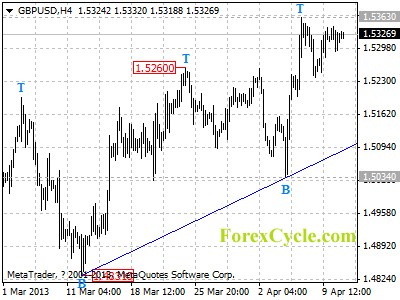
GBPUSD had formed a cycle top at 1.5363

GBPUSD had formed a cycle top at 1.5363 on 4-hour chart. Key support is at the upward trend line, as long as the trend line support holds, the price action from 1.5363 could be treated as consolidation of the uptrend from 1.4831, and another rise towards 1.6000 is still possible. On the downside, a clear break below the trend line support will indicate that the uptrend from 1.4831 had completed at 1.5363 already, then the following downward movement could bring price to 1.4000 zone.

gbpusd

Daily Forex Forecast

Investors: Ignore Japan’s Yen Devaluation Game

By MoneyMorning.com.au

All the talking heads are frothing at the mouth with the huge news out of Japan last week. I’ve read and watched countless articles and interviews trying to decipher what the outcome will be from this huge monetary experiment, and the great bulk of it has not been good.

I now check the Japanese Government Bond (JGB) yields a few times a day after the massively volatile moves that occurred at the end of last week. I think it’s very interesting that volatility circuit breakers were triggered twice in the Japanese Government Bond’s over the last week.

What that means is that the second largest bond market in the world was closed due to the immense volatility that was unleashed by the news that the Bank of Japan (BOJ) will double its monetary base over the next couple of years.

The BOJ Governor is playing with fire, but it will be investors that get burnt if they don’t sit up and take notice. Make sure you’re not one of them…

After the announcement yields on ten year JGB’s fell from around 50 bps to 33bps and then catapulted higher, to around 66bps before the circuit breakers kicked in.

I noticed on Tuesday that the BOJ bought a huge amount of bonds, which caused a quick fall in yields to around 44 bps, but then yields began climbing again and are currently sitting on 63bps as I write. If anything I see that as a bearish sign for the JGBs, and I would expect to see further rises in their yields in the future.

US Dollar/Yen Monthly Chart

I think this monthly chart of the US/Yen (USD/JPY) says it all. The last couple of years trading has seen a false break of the 1995 low at around 80 Yen and now the US dollar is shooting higher (Yen collapsing).

When you look at the monthly chart and compare the price action to the move we saw between 1995-1998, it doesn’t seem so outrageous to say that the Yen could head towards the 1998 level of 147 over the next few years, and maybe even sooner if the exodus from the Yen gathers steam.

A collapsing Yen is huge news, and it’s necessary to step back when big news like this occurs and think about the repercussions.

The weak Yen has been a boon for the carry traders over the last six months. I’m sure you’re aware of the correlation between the Euro/JPY, Aussie/JPY and our stock market.

Euro/JPY and AUD/JPY vs ASX 200

When you look at a chart like the one above the strong rally in stocks over the past nine months makes a lot of sense. Investors’ confidence that the BOJ would start printing madly has seen them borrowing in Yen and investing offshore.

Since the announcement by the BOJ last week, the collapse in the Yen has gathered steam and both the AUD/JPY and the Euro/JPY have leapt higher.

But our stock market has not kept pace. It appears that the correlation has weakened somewhat. But the fact remains that while these two currencies are shooting higher it will be very difficult for our market to sell-off very far.

Large Japanese investors are now looking for the exits out of the Yen and are parking their cash wherever they think is safe. That means US Treasuries and even European bonds (Spanish and Italian yields actually plummeted after the announcement by the BOJ) could be bought in size.

Australia won’t be left out because we have a stable currency and high yields relative to the rest of the world. Therefore we could see the Aussie dollar trading stronger for longer even though commodities have been under pressure. Yields on our government bonds could also come under pressure and that would also create buying in our banks and other high yielding stocks.

Don’t Forget This

Last but not least I would definitely expect gold to catch a strong bid after this news. Greg Canavan of Sound Money Sound Investments pointed out an article that shows that gold inventories at Comex have plummeted recently.

According to the article ‘stocks of gold held at Comex warehouses plunged by the largest figure ever on record during a single quarter since record keeping began in 2001.’

The article finishes with the ominous comment that:

While mainstream voices question whether or not gold is still in a bull market, smart money appears to be questioning something else. They appear to be asking themselves, “Do we want to continue storing our physical metal within the Comex system? How can we best whisk it away from fraud, theft, or bankruptcy (including our own)?”

The timing of this trend change is also quite shocking, as it’s happening during a time in which public sentiment towards the metals are at their worse levels in years.

The boy who cried wolf has certainly cried many times over the years with regard to the Comex, but if there was ever a time to be concerned of a major market event or default—now might be it.

Gold was in all sorts of trouble last week, with prices nudging below multi-year lows. But since the ‘print until things get better’ announcement we have seen a sharp turnaround in prices. Gold stocks are also starting to attract buying interest at extremely oversold levels.

My view is that the Japanese Yen will come under far more pressure than most people expect. I also think their bonds are an immense accident waiting to happen. How Kuroda could think that gunning for 2% inflation and holding down bond yields was even remotely possible is beyond me.

The arrogance of the central planners knows no bounds. I really hope Mr Market has the guts to stand up to him and give him a big kick in the pants.

Murray Dawes
Editor, Slipstream Trader

Join me on Google Plus

From the Port Phillip Publishing Library

Special Report: TORRENT SIGNAL 3

Daily Reckoning: When Government Bonds Go Bad

Money Morning: What Japan’s Economic Disaster Means for Australia

Pursuit of Happiness: Why the NBN is Dead Before it’s Begun

The First True Fitness Breakthrough in 25 Centuries, Part I

By MoneyMorning.com.au

I’m going to tell you today about the first real breakthrough in fitness technologies since the basics of physical training were established in ancient Greece.

When I first talked to the two scientists who discovered and exploited the principles behind this technology, the word that came to mind was ‘unbelievable’. Since then, I’ve told a number of friends how much it can improve strength and endurance. Inevitably, the word used in response is, in fact, ‘unbelievable’.

This technology is remarkably simple. Though it currently utilizes a simple microchip, its power comes from its ability to modify an incredibly elegant and complex biological system.

A New Life ‘Hack’

The brilliance of this technology is not in the rudimentary electronics contained in the machine; it is in the DNA found in our bodies and the minds of the scientists who realized that they could ‘hack’ our bodies’ temperature control systems to increase the benefits of exercise.

Despite the simplicity of the technology I’m going to tell you about, its discovery was facilitated by biotech tools that have arrived via accelerating technological progress — Moore’s law.

Moreover, this discovery will have far-ranging impacts. The sports and fitness industries, as well as physical therapy, surgical procedures, veterinary medicine, the treatment of numerous human diseases and military tactics, will see major disruptions as this technology works its way past understandable scepticism into widespread use.

The benefits of exercise are extensive and well-known. Physical fitness is not the entire health story. Dr. Craig Heller, one of the world-renowned sleep researchers who made this breakthrough, says there are three elements to a healthy life: nutrition, fitness and sleep. Fitness has an impact on virtually every aspect of our lives.

People tend to fail at fitness regimens because of the many physical discomforts associated with exercise. If you’ve ever worked out regularly, you know what I mean. Exercise, whether it involves aerobic or resistance training, necessarily involves discomfort, if not actual pain.

To get optimal benefits from exercise, we know we have to significantly exert ourselves. This entails, typically, getting hot and tired. Then, following exercise, there is often muscle and joint soreness.

Harvard behaviourist B.F. Skinner was right when he observed that an animal that experiences pain when it performs a certain action will tend not to perform that action over time.

Humans, of course, are subject to the same rules that Skinner labelled ‘operative conditioning.’ We tend, therefore, not to exercise as much as we should, despite the known benefits.

The enormous fitness industry prospers despite this fact. If there were a solution — some fitness technology that actually reduced the pain and negative stimuli while increasing positive stimuli, such as weight loss and increased strength — I believe that the market would be much bigger.

In fact, that solution exists.

An Amazing Breakthrough

First, let’s discuss the retia venosa. These are densely packed masses of specialized veins capable of expanding many times. They are mammals’ means of quickly venting heat. In response to high core body temperature, they expand near the surface of the skin to act as radiators.

Normally, blood flows through the capillaries, instead of the retia venosa systems. When thermoregulation is required, however, the arteriovenous anastomoses (AVA) kick in. This is an alternate circulatory system that reroutes arterial blood flow directly to the retia venosa and back to the heart, bypassing the normal nutritive capillary system.

This conclusion was verified using various methods, including heat-revealing infrared photography. In hairy animals such as bears, infrared imaging revealed large amounts of heat being shed in five areas containing retia venosa radiator veins. They are the pads of the limbs and the nose, the only areas on hairy animals where heat exchange is practical.

Though humans are not furred, our cooling systems function as if we were. Animals with glabrous or nonfurry faces, like humans, have retia venosa located in cheeks and forehead instead of the large noses typical of bears, dogs and other mammals. Exactly like furred animals, however, humans have heat exchange systems in the palms of the hands and the soles of the feet.

As a biological cooling system, this specialized blood flow is elegant and effective… but it has limitations. If the ambient temperature is too hot, there’s little heat exchange with the surrounding air.

If air is hotter than the body’s core temperature, the system has very little effect. If the air temperature is too cold, the arteriolles in these heat exchange areas vasoconstrict, preventing blood flow and heat exchange.

Heller and Dr. Dennis Grahn reasoned that they could fix these problems by exposing the AVA-fed retia venosa in one or more locations to optimal temperatures. Because air has very low heat-carrying capacity, they used cooled water in a medical perfusion pad.

This is a soft device through which water is circulated at a desired temperature. Because water is a very efficient heat-carrying substance, the rate of heat exchange is significantly faster.

Grahn and Heller, however, determined the precise range of temperatures that accomplished maximum cooling and warming. Then, they experimented until they found the optimal reduction in atmospheric pressure, or vacuum.

Depending on various factors, this reduced pressure expands blood vessels and is capable of accelerating heat exchange. This is because an increase in diameter of vessels increases flow by a factor of four. See Poiseuille’s law.

At that point, Stanford licensed the rights to use the Grahn/Heller technology to reheat patients suffering from hypothermia.

The company that acquired the license failed to perform, however. The two scientist inventors concentrated, instead, on the ability of their technology to cool subjects suffering from hyperthermia.

More on that topic, and how you stand to benefit the most from it, in tomorrow’s Money Morning. Stay tuned…

Patrick Cox
Contributing Editor, Money Morning

Join Money Morning on Google+

From the Archives…

Only Lunatics Need Apply for This Stock Market Rally
5-04-2013 – Kris Sayce

The Run-on Effect of Aussie Housing on the Australian Stock Market
4-04-2013 – Murray Dawes

Good News in China’s Economy? Put This Date in Your Diary…
3-04-2013 – Dr Alex Cowie

‘Gold Only Rises During the Bad Times’ and other Fairy Tales
2-04-2013 – Dr Alex Cowie 

On Gold — Billionaire Investor Eric Sprott Says : ‘I’m in Alex Cowie’s Camp’
1-04-2013 – Dr. Alex Cowie

Bernanke Gets Skewered by Stockman

By MoneyMorning.com.au

Did you see the Sunday Times on March 31? The Sunday Review section — the part with opinion-forming editorials and columns, etc. — had a banner headline declaring ‘Sundown in America’. This was the intro to a 2,600-word article by David Stockman, former budget director for US President Ronald Reagan.

If you didn’t see the Stockman article, perhaps you saw summaries in other media. That is, we now have an economic ‘boom, bust, doom & gloom’ story with legs — and of course it drips with the holy water of top billing in the Old Gray Lady. The subject is now legitimate.

It’s respectable. Hey, I read about it in The New York Times!

Stockman Carpet Bombs the ‘State-Wrecked’ System

Basically, in his Times article (a summary of his new book, The Great Deformation: The Corruption of Capitalism in America), Stockman carpet-bombs the structure of American monetary and fiscal management (mismanagement, actually), using the term state-wrecked — an obvious play on the word shipwrecked.

True to his name, Stockman enters the corral like an angry sheriff, shooting at bad guys with blazing guns. ‘The United States is broke — fiscally, morally, intellectually,’ he writes. ‘The Fed has incited a global currency war…that will soon overwhelm it. When the latest bubble pops, there will be nothing to stop the collapse.’

No sugar and spice from Stockman. Indeed, his article reads like the past 12 years of Daily Reckoning emails from Agora Financial. There are 50 shades of Bill Bonner’s gray musings about kinky abuse of the economy, by all manner of politicians and world-improvers.

Plus, Stockman channels other AF writing, concerning how screwed up is the US Federal Reserve (Fed) and how our government has wrecked the almighty US dollar.

One of Stockman’s key targets is the modern Fed. He skewers current Fed Chairman Ben Bernanke and previous Chairman Alan Greenspan (a ‘lapsed hero’), while allowing for the good — tight money — work of former chairmen William Martin and Paul Volker.

While I’m thinking about it, Stockman missed an easy layup by failing to mention the mess aided and abetted by Arthur Burns.

The 1998 bailout of Long-Term Capital Management by the Fed was ‘unforgiveable’, states Stockman. A decade later, the 2008 Wall Street bailout was ‘the single most shameful chapter in American financial history’.

On this last point, according to Stockman, ‘the White House, Congress and the Fed, under Mr. Bush and then President Obama, made a series of desperate, reckless maneuvers that were not only unnecessary but ruinous.

‘Graver Than Watergate’

Stockman plumbs the depths of history. He gets political, starting in 1933, and rips President Franklin Roosevelt for seizing the nation’s gold. It’s a sentence that ought to be a book.

Then Stockman jumps four decades, to ‘one perfidious weekend at Camp David, Md., in 1971,’ when then-President Richard Nixon ‘essentially defaulted on the nation’s debt obligations by finally ending the convertibility of gold to the dollar.’

When Nixon closed the gold window of the US Treasury, it was ‘arguably a sin graver than Watergate.’

Stop the presses! When someone indicates that something was worse than Watergate — and does so in the pages of the Times, no less — we are approaching the orbit of a forbidden planet. So what was Nixon’s even higher crime?

Per Stockman, Nixon’s move, with the country’s gold, ‘meant the end of national financial discipline and the start of a four-decade spree during which we have lived high on the hog’. In essence, lacking the discipline of a gold-backed dollar, the US has undergone ‘an internal leveraged buyout.’

Stockman’s points make eminent good sense to anyone who’s been reading Agora Financial pubs for more than, say, a few months. After all, once you’ve been infected by a true case of gold fever, you carry the bug forever. Proudly. Gold Pride!

Still, to the liberal masses and hard-core Keynesian disciples out there — especially to that execrable, formulaic, one-size-fits-all political shill Paul Krugman — the Stockman message soars past like a stealth bomber in the night. Whoosh!

Stockman’s Gallery of Rogue Presidents

By my count, Stockman pillories FDR, as well as presidents Kennedy, Johnson, Nixon, Carter, Reagan (for whom Stockman worked), Bush I, Clinton, Bush II and Obama. On the other hand, Stockman offers a kind reference to the ‘balanced-budget policies’ of President Calvin Coolidge and more kind words about Eisenhower.

Stockman manages to avoid direct discussion of presidents Truman, Ford and Carter — although with respect to the last two chief executives, he distinctly recalls the bad days of the late 1970s. (As do I, by the way.)

The result of decades’ worth of loose money and undisciplined spending, according to Stockman, is that ‘Americans stopped saving and consumed everything they earned and all they could borrow.’

Meanwhile, states Stockman, China and Japan have ‘accumulated huge dollar reserves, transforming their central banks into a string of monetary roach motels where sovereign debt goes in but never comes out. We’ve been living on borrowed time — and spending Asians’ borrowed dimes.

In a sidebar that should be familiar to energy investors, Stockman slams the so-called ‘green energy’ movement. He summarizes the recent green efforts by the Obama administration as ‘mainly a nearly $1 billion giveaway to crony capitalists, like the venture capitalist John Doerr and the self-proclaimed outer-space visionary Elon Musk, to make new toys for the affluent.’ Bingo!

Where Does This Go?

Stockman paints a dire picture. He indicts the current US political system, declaring that the US ‘Main Street economy is failing while Washington is piling a soaring debt burden on our descendants, unable to rein in either the warfare state or the welfare state or raise the taxes needed to pay the nation’s bills.

Betraying utter pessimism, Stockman offers a selection of all-but-unattainable solutions that could, possibly, surprise even the most libertarian of readers.

For example, per Stockman, the US needs a ‘drastic deflation of the realm of politics and the abolition of incumbency itself,’ including ‘sweeping constitutional surgery: amendments to give the president and members of Congress a single six-year term, with no re-election; providing 100% public financing for candidates; strictly limiting the duration of campaigns (say, to eight weeks); and prohibiting, for life, lobbying by anyone who has been on a legislative or executive payroll.’

Of course, US governance could revert to colouring within the lines of that old Constitution, too — with those enumerated powers and such. Fat chance, right?

Will any of this happen? No way. Not when the captain, crew and most of the passengers on this ship are partying hard while the iceberg tears a hole in the bottom of the hull.

Of course, The New York Times has run many an article, over many years, about government overspending, national debt, gold and much more. The Times is a big, important newspaper for a reason. It influences people and moves markets.

But with this recent feature article in the Times, Stockman has now brought to the surface a set of formerly ‘unspeakable’ — at least amongst that crowd — monetary, fiscal and political points.

The dollar is dying, spending is out of control, debt is unmanageable and the economy is rotten through and through. (So other than the incident with the man and the gun, Mrs. Lincoln, how did you and the president enjoy the play?)

Editorialists of the world — and even the less-dense politicians — will now have to address the issues that Stockman has raised. Doubtless, they’ll move mountains to obfuscate the issues. But the door has opened to thinking about the unthinkable.

In terms of investment — certainly for our purposes here — Stockman is waving bright signal flags for a revival in the fortunes of gold, silver and other hard assets. His description of the decline of the dollar is a ringing endorsement for real stuff, like platinum, copper, oil and other things on which the world runs.

Plus, it’s fun to watch Krugman get all apoplectic as his entire worldview takes a hit.

Byron King
Contributing Editor, Money Morning

Join Money Morning on Google+

From the Archives…

Only Lunatics Need Apply for This Stock Market Rally
5-04-2013 – Kris Sayce

The Run-on Effect of Aussie Housing on the Australian Stock Market
4-04-2013 – Murray Dawes

Good News in China’s Economy? Put This Date in Your Diary…
3-04-2013 – Dr Alex Cowie

‘Gold Only Rises During the Bad Times’ and other Fairy Tales
2-04-2013 – Dr Alex Cowie 

On Gold — Billionaire Investor Eric Sprott Says : ‘I’m in Alex Cowie’s Camp’
1-04-2013 – Dr. Alex Cowie

The End of Money

By Justice Litle

The world’s monetary system stands on a precipice…

It may not feel like it. But we are fast approaching what I call “the end of money.”

The process that will lead to the end of money has already begun.
That’s why central bankers and governments are terrified of the booming
“digital currency” bitcoin… and the implications it has for outdated
fiat regimes.

Maybe that’s why a government-sponsored cyber-terror agency tried to shut the bitcoin down.

Instawallet is – or, rather, was – a service that made it
easy to store and spend bitcoins. Instawallet was just hacked
anonymously – leading it to shut down until it can develop a new
hacker-safe architecture.

Of course, we can’t say for sure that the bitcoin cyberattacks are
the work of a worried government (or governments). But this is a logical
assumption… and, at minimum, a strong possibility.

Bitcoin is such a threat to the standing fiat money regimes that it would be crazy for them NOT to try to torpedo the bitcoin under cover of darkness.

Bitcoin is a “decentralized digital currency.” It was launched in
2009 by a developer known only by the pseudonym Satoshi Nakamoto.

You can buy bitcoins through a range of online exchanges. (This is the largest bitcoin exchange.)
Once you’ve bought them, you store them in an online “wallet,” a small,
unobtrusive program that runs on your computer or phone) and exchange
them anonymously… locally or internationally.

This all take places without any bank, government or other middleman taking a cut.

The supply of bitcoins is finite. There is no bitcoin central bank.
And there is no backing by “fiat” from any government. There is a hard
limit of 21 million bitcoins. The rate of new bitcoin issuance is
automated. Based on the rate of issuance, the 21 million hard limit will
be reached by 2140.

Currently, the total outstanding supply of bitcoins is worth over $1 billion.

There are two important reasons why bitcoins have value:

1. Their supply is strictly limited (much like the supply of gold)

2. They’re nearly impossible to counterfeit.

Gold has been desirable as a currency for millennia because it is
portable, divisible and in limited supply (unlike the paper stuff, which
can be cranked out at will). The bitcoin has exactly the same
characteristics.

And all bitcoins are verified by a “transaction chain.” This means,
to counterfeit bitcoins, the counterfeiter would have to spoof a
miles-long transaction record and fool thousands of independent servers
instantaneously (a feat orders of magnitude tougher than counterfeiting
paper banknotes).

Bitcoin is ushering in a sea change. It is teaching the users of
fiat-backed currency to think and imagine… and what they are thinking
about is a monetary future without central bankers.

The key point here is that the bitcoin is a viable
alternative to a system in which the government issues currency… and
declares “by fiat” that it is worth something while it prints unlimited
amounts of the same currency.

The mainstream media’s scoffs and guffaws… and the shadowy hacker attacks… do not diminish that reality.

Are bitcoins a good investment right now, as they enjoy the spotlight
of a tulip-like mania? Probably not. Wait for price volatility to
create better buying opportunities.

While you’re waiting, remember that bitcoins are the harbingers of brand-new realities… and the “end of money” as we know it.

There will come a time – perhaps soon – when you can denominate the
majority of your liquid assets in a stable, private currency of your own
choosing…

One issued by no government. And manipulated by no central bank.

Carpe Divitiae,

Justice


Disclaimer

Article brought to you by Inside Investing Daily. Republish
without charge. Required: Author attribution, links back to original
content or www.insideinvestingdaily.com. Any investment contains risk. Please see our disclaimer.


Why Money Printing Makes You Poorer

By Bill Bonner

We can barely catch our breath. We can’t stop laughing.

Last week, Japan announced that it would undertake a bold and
radical experiment. After 23 years of on-again, off-again deflation,
the new government decided it had had enough of things getting cheaper.

The Bank of Japan will now obediently monetize debt until inflation
reaches 2%. This, the country’s central bankers believe, will encourage
people to spend. The economy will take off.

Why is it better for people to spend more tomorrow than they want to
spend today? Why is it better for prices to go up 2% than to go down
2%? Why is an economy that “takes off” better than one that sits calmly
on the runway?

Those questions will have to wait for another day; no one bothers to
ask today. Economists say the secret to prosperity is to stimulate
demand. Anything that stimulates demand is thought to be a good thing.

It doesn’t seem to matter that this proposition is transparent
poppycock. People always want stuff. Demand is infinite. Government
doesn’t have to stimulate it.

What really matters is buying power. And buying power is limited. The authorities try to get around this problem by printing money. Then, with this new money in hand, it is almost as though people had real demand!

The Demand Delusion

But that’s what is so breathtaking and so funny about this time we
live in. Who really believes you can increase demand… and make people
wealthier… by just printing up money? Who really believes you can
give people more buying power by giving them more pieces of paper?

Apparently, just about everybody! Ha ha ha!

Real demand depends on real earnings, not more currency. People buy
things by producing things. That’s “Say’s Law,” named after
Jean-Baptiste Say. Buying power — or demand — comes from production,
not pieces of paper.

Economists and central bankers cannot increase real demand. But they can sure move it around!

Giving money to poor nations — foreign aid — does not make them
richer; it undermines local industries and makes them poorer. But some
people get richer. Mercedes-Benz dealers in Africa noticed that
whenever a new foreign aid program was announced, sales of their
high-end models shot up. The insiders knew they could skim millions
from the aid programs.

Now, when new QE programs are announced in Japan, Ferrari sales shoot up. From Bloomberg:

Registrations of Fiat SpA (F)’s
ultra-luxury brand surged 40%, to 144 vehicles, in Japan last quarter,
according to the Japan Automobile Importers Association yesterday.
That’s more than twice the pace in the larger U.S. market, while demand
is slumping in China, at home and across Europe.

The surge in demand for luxury cars
adds to signs that Prime Minister Shinzo Abe and Bank of Japan Governor
Haruhiko Kuroda are succeeding in reviving spending in the country.
Stock prices are climbing back to levels before the September 2008
collapse of Lehman Brothers Holdings Inc., and households have become
more confident about the economic outlook.

“The growth is very promising, and I
think we can expect these super luxury brands to introduce more models
that they hadn’t introduced to Japan before and to strengthen their
dealership networks,” said Yoshiaki Kawano, a Tokyo-based auto analyst
at industry researcher IHS Automotive. “The optimism for an economic
recovery is spreading.”

To sustain growth, Ferrari opened a
new after-service facility in Japan this month, said Herbert Appleroth,
head of the company’s operations in the country.

Getting Poorer

When you print money,
it’s like issuing new shares in a public company. The existing shares
become worth less than they were before… because each one represents
less of the total company.

Likewise, the currency of a nation represents the goods and services
that the nation produces. Print more currency and each unit will have
fewer goods and services behind it.

But some people get the new shares… or new money… and are
richer. Everyone else may be poorer, but the people first in line for
the free cash come out ahead. Economists and other dim observers look
at the increase in Ferrari sales with approval. Again, from Bloomberg:

“It seems like demand is coming
back,” said Michiaki Ishida, a spokesman for the auto importers
association. “Some people are reacting to Abenomics, so the trend may
continue.”

What the mainstream press doesn’t realize is that, although high-end
demand goes up as insiders make wins from speculating on asset prices,
real demand goes down.

That’s because new money reduces the buying power of the old money.
Except for the few insiders, speculators and sharpies who are first in
line to get the EZ money, everyone else gets poorer.

Is that funny… or what?

Regards,

Bill Bonner

Bill

http://www.billbonnersdiary.com/articles/bonner-money-printing.html