By www.CentralBankNews.info Poland’s central bank said decisions about interest rates in coming months will depend on how far inflation will fall below the bank’s target and the level of economic activity in the country.
The National Bank of Poland (NBP), which earlier today left its policy rate steady at 3.25 percent, said economic activity may gradually improve in coming months but it “will probably remain moderate, which will continue to contain inflationary pressure.”
Last month the NBP signaled that it was likely to have concluded its five-month-old rate cutting campaign, but today’s statement indicates the bank is now much more uncertain about its next move and leaning toward further rate cuts if inflation remains below the bank’s target.
In February, Poland’s inflation rate tumbled to 1.3 percent in February from 1.7 percent in January, the lowest rate since early 2006, and well below the NBP’s inflation target of 2.5 percent target, plus/minus one percentage point.
“There was also a decline in core inflation measures, which confirms weak demand pressure prevailing in the economy,” the central bank said, adding inflationary expectations among households and businesses also declined further.
Economic activity in Poland in the first quarter of this year was low, the NBP said, with lending to the corporate sector and households also low.
The unemployment rate rose to a six-year high of 14.4 percent in February and this is constraining wage growth, the bank said.
Polish retail sales rose marginally in February from January, but on an annual basis they were down 0.8 percent.
In the fourth quarter of 2012, Gross Domestic Product grew by 0.2 percent from the third quarter for annual growth of 1.1 percent.
Global economic activity also remains low, despite a gradual improvement, the central bank said, adding that activity in Germany – a key trading partner – rebounded at the start of the year but corporate sentiment had deteriorated more recently.
The central bank started cutting rates in November and since then it has cut by a total of 150 basis points, most recently by 50 basis points in March.
“The Council’s decisions in the following months will depend on the assessment of the incoming data with regard to the probability of inflation remaining markedly below the NBP inflation target and regarding economic activity,” the NBP said.
www.CentralBankNews.info
This “Golden Income” Secret Is Currently Paying 12% per Year
By Jim Nelson
I am not going to try to tell you why you should own some gold…
You either understand why gold should be part of a well-diversified portfolio… or you don’t.
You either see that the world’s most powerful central banks are all
deliberately debasing fiat currencies to stimulate “growth”… or you
don’t.
Gold prices have been getting clobbered recently. That’s bad news if
you are a short-term investor. But it’s good news if you have a
longer-term view. That’s because, if you understand the effects
concerted central bank money printing will have on the values of fiat
currencies, the recent correction in prices is a great opportunity to buy gold on the dips.
But I don’t recommend you rush out and buy gold bars… or even gold-backed ETFs.
Sure, those are great ways to track the price of gold. But I never make a recommendation to buy anything unless I know that investment will pay over time. I look for income.
That’s why I recommend you get exposure to the gold market… and pick up some solid income… by buying shares in Gamco Global Gold, Natural Resources & Income Trust (NYSE:GGN).
Gamco is a closed-end fund that holds positions in 48 different gold
mining companies and 37 energy companies. And it has been paying out a
10%-plus dividend yield for the last eight years.
Today, it pays a 12% annual dividend yield. Better still, it pays out
monthly. So you can grab a healthy 1% per month if you buy now.
(Compare that to the measly returns on your CD or bond market.)
The “golden income” Gamco pays out to shareholders comes from an
unusual source: the premiums the company collects from writing covered
calls on the stocks it owns in its portfolio.
A covered call is an options strategy in which an investor writes
(sells) call options on a long position he holds a position in to
generate increased income from the asset.
When you write a call and sell it, the buyer pays you a “premium”
upfront.
Gamco keeps this premium no matter what happens. And because this is a
covered call options strategy, if the shares Gamco writes covered calls
on rise sharply, Gamco is forced to sell them… but at a profit.
Gamco sells a bit of upside, in other words, in exchange for a lot of safety in the form of its options premiums.
This “golden income” stream is perfect for today’s environment.
You see, there’s no limit to how many times Gamco can write covered
calls on the stocks it owns. And since shares aren’t jumping right now,
the company is able to continue to write one contract after another
without seeing its shares called away.
And guess who benefits from the “golden income”? You. Gamco passes all that income onto shareholders.
So don’t worry about short-term movements in the gold market.
Instead, seize the opportunity and start picking up “golden income” of
12% per year.
I recommend you get in today.
Sincerely,
Jim Nelson
Disclaimer
Article brought to you by Inside Investing Daily. Republish
without charge. Required: Author attribution, links back to original
content or www.insideinvestingdaily.com. Any investment contains risk. Please see our disclaimer.
List of Central Bank Governors
By www.CentralBankNews.info Russia’s parliament has confirmed that Elvira Nabiullina will succeed Sergei Ignatyev as governor of the Bank of Russia. Nabiullina, economic adviser to Russian President Vladimir Putin, will take up her new post at Russia’s central bank on June 24.
Following is Central Bank News’ list of the chief executives of central banks worldwide. In most cases, central banks have governors as their top executive but in some countries the central bank’s main executive is a president or chairman of the board.
Central Bank News will update the list, found in the website’s Central Bank Information section, when new governors take up their positions.
CENTRAL BANK GOVERNORS:
| COUNTRY | CENTRAL BANK NAME | GOVERNOR/PRESIDENT/CHAIRMAN |
| AFGHANISTAN | Bank of Afghanistan | Noorullah Delawari |
| ALBANIA | Bank of Albania | Ardian Fullani |
| ALGERIA | Bank of Algeria | Mohammed Laksaci |
| ANGOLA | National Bank of Angola | Jose de Lima Massano |
| ARGENTINA | Central Bank of Argentina | Mercedes Marco del Pont |
| ARMENIA | Central Bank of Armenia | Arthur Javadyan |
| ARUBA | Central Bank of Aruba | Jeanette R. Semeleer |
| AUSTRALIA | Reserve Bank of Australia | Glenn Stevens |
| AUSTRIA | Austrian National Bank | Ewald Nowotny |
| AZERBAIJAN | Central Bank of the Rep. of Azerbaijan | Ellman Siraj oglu Rustamov |
| BAHAMAS | Central Bank of the Bahamas | Wendy Craigg |
| BAHRAIN | Central Bank of Bahrain | Rasheed Mohammed Al-Maraj |
| BANGLADESH | Bangladesh Bank | Atiur Rahman |
| BARBADOS | Central Bank of Barbados | DeLisle Worrell |
| BELARUS | National Bank of the Rep. of Belarus | Nadezhda Ermakova |
| BELGIUM | National Bank of Belgium | Luc Coene |
| BELIZE | Central Bank of Belize | Glenford Ysaguirre |
| BENIN | Central Bank of West African States | Tiemoko Meyliet Kone |
| BERMUDA | Bermuda Monetary Authority | Jeremy Cox (chief executive) |
| BHUTAN | Royal Monetary Authority of Bhutan | Daw Tenzin |
| BOLIVIA | Central Bank of Bolivia | Marcelo Zabalaga |
| BOSNIA & HERZEGOVINA | Central Bank of Bosnia & Herzegovina | Kemal Kozaric |
| BOTSWANA | Bank of Botswana | Linah Mohohlo |
| BRAZIL | Central Bank of Brazil | Alexandre Tombini |
| BULGARIA | Bulgarian National Bank | Ivan Kskrov |
| BURKINA FASO | Central Bank of West African States | Tiemoko Meyliet Kone |
| BURUNDI | Bank of the Republic of Burundi | Jean Ciza |
| CAMBODIA | National Bank of Cambodia | Chea Chanto |
| CAMEROON | Bank of Central African States | Lucas Abaga Nchama |
| CANADA | Bank of Canada | Mark Carney (leaves June 1) |
| CAPE VERDE | Bank of Cape Verde | Carlos Burgo |
| CEN. AFRICAN REPUBLIC | Bank of Central African States | Lucas Abaga Nchama |
| CHAD | Bank of Central African States | Lucas Abaga Nchama |
| CHILE | Central Bank of Chile | Rodrigo Vergara |
| CHINA | People’s Bank of China | Zhou Xiaochuan |
| COLOMBIA | Central Bank of Colombia | Jose Dario Uribe |
| CONGO | Bank of Central African States | Lucas Abaga Nchama |
| CONGO DEM. REP. | Central Bank of Congo | Jean-Claude Masangu Mulongo |
| COSTA RICA | Central Bank of Costa Rica | Rodrigo Bolanos Zamora |
| CROATIA | Croatian National Bank | Boris Vujcic |
| CUBA | Central Bank of Cuba | Ernesto Medina Villaveiran |
| CURACAO | Central Bank of Curacao and St. Maarten | Emsley Tromp |
| CYPRUS | Central Bank of Cyprus | Panicos Demetriades |
| CZECH REPUBLIC | Czech National Bank | Miroslav Singer |
| DENMARK | National Bank of Denmark | Lars Rohde |
| DOMINICAN REPL. | Central Bank of the Dominican Rep. | Hector Valdez Albizu |
| ECUADOR | Central Bank of Ecuador | Pedro Delgado |
| EGYPT | Central Bank of Egypt | Hisham Ramez Abdel Hafez |
| ESTONIA | Bank of Estonia | Ardo Hansson |
| EL SALVADOR | Central Reserve Bank of El Salvador | Carlos Acevedo |
| ETHIOPIA | National Bank of Ethiopia | Teklewold Atnafu |
| EURO AREA | European Central Bank | Mario Draghi |
| FIJI | Reserve Bank of Fiji | Barry Whiteside |
| FINLAND | Bank of Finland | Erkki Liikanen |
| FRANCE | Bank of France | Christian Noyer |
| GABON | Bank of Central African States | Lucas Abaga Nchama |
| GAMBIA | Central Bank of The Gambia | Amadou Colley |
| GEORGIA | National Bank of Georgia | Giorgi Kadagidze |
| GERMANY | Deutsche Bundesbank | Jens Weidmann |
| GHANA | Bank of Ghana | Henry A. Kofi Wampah |
| GREECE | Bank of Greece | George Provopoulos |
| GUATEMALA | Bank of Guatemala | Edgar Barquin |
| GUINEA | Central Bank of the Rep. of Guinea | Lounceny Nabe |
| GUINEA-BISSEAU | Central Bank of West African States | Tiemoko Meyliet Kone |
| GUYANA | Bank of Guyana | Lawrence Williams |
| HAITI | Bank of the Republic of Haiti | Charles Castel |
| HONDURAS | Central Bank of Honduras | Maria Elena Mondragon |
| HONG KONG | Hong Kong Monetary Authority | Norman Chan |
| HUNGARY | Central Bank of Hungary | Gyorgy Matolscy |
| ICELAND | Central Bank of Iceland | Mar Gusmundsson |
| INDIA | Reserve Bank of India | Duvvuri Subbarao |
| INDONESIA | Bank Indonesia | Agus Martowardojo |
| IRAN | Central Bank of Islamic Rep. of Iran | Mahmud Bahmani |
| IRAQ | Central Bank of Iraq | Abdul Basit Turki |
| IRELAND | Central Bank of Ireland | Patrick Honohan |
| ISRAEL | Bank of Israel | Stanley Fischer |
| ITALY | Bank of Italy | Ignazio Visco |
| JAMAICA | Bank of Jamaica | Brian Wynter |
| JAPAN | Bank of Japan | Haruhiko Kuroda |
| JORDAN | Central Bank of Jordan | Ziad Fariz |
| KAZAKHSTAN | National Bank of Kazakhstan | Grigori Marchenko |
| KENYA | Central Bank of Kenya | Njuguna Ndung’u |
| KOREA, REPUBLIC OF | Bank of Korea | Kim Choongsoo |
| KOSOVO | Central Bank of the Republic of Kozovo | Gani Gerguri |
| KUWAIT | Central Bank of Kuwait | Mohammad Yusef Al-Hashel |
| KYRGYZSTAN | National Bank of the Kyrgyz Rep. | Asankojoeva Zina |
| LATVIA | Bank of Latvia | Ilmars Rimsevics |
| LEBANON | Central Bank of Lebanon | Raid Salameh |
| LESOTHO | Central Bank of Lesotho | Retselisitsoe Matlanyane |
| LIBERIA | Central Bank of Liberia | Joseph Mills Jones |
| LIBYA | Central Bank of Libya | Saddek Omar Elkaber |
| LITHUANIA | Bank of Lithuania | Vitas Vasiliauskas |
| LUXEMBOURG | Central Bank of Luxembourg | Gaston Reinesch |
| MACEDONIA | National Bank of the Rep. of Macedonia | Dimitar Bogov |
| MADAGASCAR | Central Bank of Madagascar | Guy Ratovondrahona |
| MALAWI | Reserve Bank of Malawi | Charles Chuka |
| MALAYSIA | Central Bank of Malaysia | Zeti Akhtar Aziz |
| MALTA | Central Bank of Malta | Josef Bonnici |
| MAURITANIA | Central Bank of Mauritania | Sid’Ahmed Ould Raiss |
| MAURITIUS | Central Bank of Mauritius | Rundheersing Bheenick |
| MEXICO | Bank of Mexico | Agustin Carstens |
| MOLDOVA | National Bank of Moldova | Dorin Dragutanu |
| MONGOLIA | Bank of Mongolia | Naidansuren Zoljargal |
| MOROCCO | Bank of Morocco | Abdellatif Jouahri |
| MOZAMBIQUE | Bank of Mozambique | Ernesto Gove |
| NAMIBIA | Bank of Namibia | Ipumbu Shiimi |
| NETHERLANDS | De Nederlandsche Bank | Klaas Knot |
| NEW ZEALAND | Reserve Bank of New Zealand | Graeme Wheeler |
| NIGERIA | Central Bank of Nigeria | Sanusi Lamido Sanusi |
| NORWAY | Norges Bank | Oestein Olsen |
| PAKISTAN | State Bank of Pakistan | Yaseen Anwar |
| PERU | Central Reserve Bank of Peru | Julio Velarde |
| PHILIPPINES | Central Bank of Philippines | Armando Tetangco |
| POLAND | National Bank of Poland | Marek Belka |
| PORTUGAL | Bank of Portugal | Carlos Costa |
| QATAR | Qatar Central Bank | Saud Al-Thani |
| ROMANIA | National Bank of Romania | Mugur Isarescu |
| RUSSIA | Bank of Russia | Sergei Ignatyev |
| RWANDA | National Bank of Rwanda | Rwangombwa John |
| SAMOA | Central Bank of Samoa | Atalina Ainuu Enari |
| SAUDI ARABIA | Saudi Arabian Monetary Authority | Muhammad Al-Jasser |
| SERBIA | National Bank of Serbia | Nebojsa Savic |
| SEYCHELLES | Central Bank of Seychelles | Pierre Laporte |
| SIERRA LEONE | Bank of Sierra Leone | Sheku Sesay |
| SINGAPORE | Monetary Authority of Singapore | Ravi Menon |
| SLOVAKIA | National Bank of Slovakia | Jozef Makuch |
| SLOVENIA | Bank of Slovenia | Marko Kranjec |
| SOMALIA | Central Bank of Somalia | Abdusalam Omer |
| SOUTH AFRICA | South African Reserve Bank | Gill Marcus |
| SOUTH KOREA | Bank of Korea | Kim Choong Soo |
| SPAIN | Bank of Spain | Luis Maria Linde |
| SRI LANKA | Central Bank of Sri Lanka | Ajith Nivard Cabraal |
| SUDAN | Central Bank of Sudan | Mohamed Khair Elzubair |
| SWAZILAND | Central Bank of Swaziland | Margin Diamini |
| SWEDEN | The Riksbank | Stefan Ingves |
| SWITZERLAND | Swiss National Bank | Thomas Jordan |
| TANZANIA | Bank of Tanzania | Benno Ndulu |
| TAIWAN | Central Bank of the Rep. of China (Taiwan) | Fai-Nan Perng |
| TAJIKISTAN | National Bank of Tajikistan | Shirinov Abdujabbor |
| THAILAND | Bank of Thailand | Prasern Trairatvorakul |
| TRINIDAD & TOBAGO | Central Bank of Trinidad and Tobago | Jwala Rambarran |
| TUNISIA | Central Bank of Tunisia | Chedly Ayari |
| TURKEY | Central Bank of Republic of Turkey | Erdem Basci |
| UAE | Central Bank of United Arab Emirates | Sultan Nasser Al-Suweidi |
| UGANDA | Bank of Uganda | Emmanuel Tumusiime Mutebile |
| UKRAINE | National Bank of Ukraine | Serhiy Abruzov |
| UNITED KINGDOM | Bank of England | Mervyn King |
| URUGUAY | Central Bank of Uruguay | Mario Bergara Eq |
| USA | Federal Reserve | Ben Bernanke |
| UZBEKISTAN | Central Bank of the Rep. of Uzbekistan | Fayzulla Mullajanov |
| VIETNAM | State Bank of Vietnam | Nguyen Van Binh |
| ZAMBIA | Bank of Zambia | Michael Gondwe |
| ZIMBABWE | Reserve Bank of Zimbabwe | Gideon Gono |
Central Bank News makes every effort to ensure the accuracy of the information in the above table. However, if you have any corrections to make please contact us. You may replicate the table above in full but under the strict condition that you cite CentralBankNews.info as the source, and if online, provide a link back to www.centralbanknews.info
Poland holds rate at 3.25%, press conference later today
By www.CentralBankNews.info Poland’s central bank held its policy rate steady at 3.25 percent, as expected by most economists, and said it would explain its decision at a press conference later today.
The National Bank of Poland (NBP), which has cut rates by 100 basis points this year following a reduction of 50 basis points in 2012, signaled last month that it was getting close to ending its rate easing cycle as moderate economic growth would help contain inflation.
In February, Poland’s inflation rate tumbled to 1.3 percent in February from 1.7 percent in January, the lowest rate since early 2006. The NBP targets inflation of 2.5 percent target, plus/minus one percentage point.
Financial markets are expecting the NBP to cut rates further in the next few months as economic data continue to weaken.
Retail sales rose in February from January but on an annual basis they were down 0.8 percent while the February unemployment rate rose to six-year high of 14.4 percent.
Poland’s Gross Domestic Product grew by 0.2 percent in the fourth quarter from the third quarter for annual growth of 1.1 percent
Sentiment “Less Bullish” Towards Gold as Goldman Sachs Says “Go Short Gold”
London Gold Market Report
from Ben Traynor
BullionVault
Wednesday 10 April 2013, 07:30 EST
AFTER touching a one-week high yesterday, gold drifted lower Wednesday, ending London’s
morning trading around $1580 an ounce, more-or-less where it started the week, while stocks
gained and government bond prices fell.
Gold in Sterling was also trading in line with last week’s close at around £1032 an ounce, while
gold in Euros fell to €1206 an ounce, just under 1% down on the week so far, as the Euro touched a
one-month high against the Dollar following news that Ireland and Portugal may get more time to
repay bailout funds.
Dealers in India meantime reported slow buying Wednesday, while the world’s biggest gold
exchange traded fund, SPDR Gold Trust (ticker: GLD), continued to see outflows Tuesday. The
volume of gold bullion backing GLD shares ended yesterday at a new 21-month low of just over
1200 tonnes.
“Sentiment amongst some investors has become less bullish for gold,” says this month’s Metal
Matters from bullion bank Scotia Mocatta.
“Rising equity prices to new record highs have increased the opportunity cost of holding gold as an
investment and that has caused some rotation out of bullion and into other asset classes. With some
financial institutions also seeing the gold price as in a bubble and marking down their forecasts, it is
not surprising that sentiment amongst some investors has turned less bullish.”
Analysts at US investment bank Goldman Sachs today cut their 12-month gold price forecast from
$1550 to $1390 per ounce, and advised clients to sell gold short using futures contracts.
Deutsche Bank and UBS both cut their average gold price forecasts yesterday, to $1637 and
$1740 respectively. So far this year gold has averaged just over $1626 per ounce, based on
afternoon London Fix prices.
President Obama is due to unveil his 2014 budget later today, with the White House saying he has
come “more than halfway towards the Republicans” in an effort to secure a deal.
Obama’s budget is expected to ask for $580 billion of new tax revenues over the coming decade,
including a minimum tax on those earning more than $1 million a year – the so-called Buffett Rule
– which is opposed by Republicans.
Obama is also expected to announce a change in the way inflation is measured when calculating
payments under programs such as Social Security, adopting the so-called chain-weighted consumer
price index, which has tended to be slightly lower than the standard CPI.
Whereas the standard CPI measures the changes in prices of a predetermined basket of goods and
services, the chain-weighted measure allows the basket to change to reflect changes in consumer
buying habits, in particular substitution out of goods and services that have risen in price.
The Federal Open Market Committee meantime is due to publish the minutes of its latest policy
meeting later today.
Over in Europe, Ireland and Portugal could get an extra seven years to repay their bailout loans,
according to draft proposals drawn up by the so-called troika of the European Commission,
European Central Bank and International Monetary Fund, Reuters reports.
Support for granting Portugal more time however is likely to depend on its government plugging a
€1.3 billion budget gap that arose after earlier proposed savings were deemed illegal, the newswire
adds.
China, the world’s second-biggest gold buying nation last year, recorded an $884 million trade
deficit in March, official figures published Wednesday show. Year-on-year export growth fell to
10%, down from nearly 22% a month earlier, while imports rose by 14% from a year earlier.
“A depreciating Yen has weakened the competitiveness of Chinese products in Japan,” says Zheng
Yuesheng, spokesman for China’s customs administration.
The Yen traded close to four-year highs against the Dollar Wednesday, just below the ¥100 mark,
while gold in Yen was also near its highest level in over 30 years.
The Bank of Japan last week promised to aggressively boost its monetary stimulus program as part
of an effort to raise the rate of inflation in Japan.
Elsewhere in Asia, South Korea has raised its alert level to “vital threat” following signs that North
Korea is preparing for a missile test.
Gold value calculator | Buy gold online at live prices
Editor of Gold News, the analysis and investment research site from world-leading gold ownership
service BullionVault, Ben Traynor was formerly editor of the Fleet Street Letter, the UK’s longest-
running investment letter. A Cambridge economics graduate, he is a professional writer and editor
with a specialist interest in monetary economics. Ben can be found on Google+
(c) BullionVault 2013
Please Note: This article is to inform your thinking, not lead it. Only you can decide the best
place for your money, and any decision you make will put your money at risk. Information or
data included here may have already been overtaken by events – and must be verified elsewhere –
should you choose to act on it.
Real-Forex Market News 10.4.2013
Forex Daily review brought to you by REAL FOREX | www.Real-forex.com
Forex market EUR/USD
Date: 09/04/2013 Time: 19:45 Price: 1.3092
Strategy: Long
Graph 4 hours
Quote previous review:
The price broke the level of 1.2880, topranging level. Indeed, as written in the last market forecast, the price has achieved the level of 1.3000, which makes it a ranging balance level. A continuation of the upward movement will most certainly lead to price level of 1.3114, used also as a Fibonacci correction level of 38.2% on the last downwards move described by black broken line. On the other hand, blocking the upward movement in the current levels, will take the price to correct this process between one third and two thirds on the Fibonacci bar, meaning, that it is moving towards the average area of the Bollinger bands.
Current Review today:
The pair is being close to the level of 1.3114, which is a Fibonacci correction level of 38.2% on thedownwards move described by the black broken line. A proven outbreak of this level will lead the pair to the next Fibonacci level, the level of 1.3228. On the other hand, blocking the upward movement at the current stage area is likely to take the price tocorrect this process between one third and two thirds by the Fibonacci bar, meaning, a decrease towards the moving average of the Bollinger bands.
You can see the graph here:

Forex market GBP/USD
Date: 09/04/2013 Time: 19:49 Price: 1.5324
Strategy: Long
Graph 4 hours
Quote previous review:
The pair broke the high ranging level of 1.5261 and now is going down to check whether this level can switch roles from a resistance level to a support. If so, it`s likely, to be destined towards the nearest price level of 1.5422, which is a Fibonacci correction level of 38.2% on the downwards move described by crushed red line. When an outbreak of this will appear, it reasonable to assume, that the price will climb back to the level of 1.5600, a Fibonacci correction level which is I. 50% of the downward movement above. On the other hand, only a drop of the price below two-thirds might correct the recent upward movement (described by the blue broken line) and return the pair to a bearish movement at this time resolution.
Current Review today:
The level of 1.5261 indeed proves its ability to be used as a support level that’s being reviewed by the price and now the pair is on its way to the level of 1.5422, which is also a Fibonacci correction level of 38.2% on thedownwards move described by the crushed red line, whilean outbreak of this it is reasonable to assume will take the priceto climb towards the level of 1.5600, a Fibonacci correction level that is 50% on the downward movement of the above. On the other hand, only a drop of the price below two-thirds might repair the recent upward movement (described by the blue broken line) and will return the pair to a bearish movement at this time resolution.
You can see the graph here:


Central Bank News Link List – Apr 10, 2013: ECB’s Bonnici: Rate cut could have positive impact
By www.CentralBankNews.info Here’s today’s Central Bank News link list, click through if you missed the previous link list. The list comprises news about central banks that is not covered by Central Bank News. The list is updated during the day with the latest developments so readers don’t miss any important news.
- ECB’s Bonnici: Rate cut could have positive impact (MarketWatch)
- Japan PM Abe aide: BOJ has further easing options (Reuters)
- Russian parliament approves Nabiullina to head central bank (dow jones)
- Swan backs Japan-to-U.S. stimulus as G-20 meets (Bloomberg)
- Australia central bank optimistic on business investment (Reuters)
- N.Korea threats boost first BOK rate cut odds since October (Bloomberg)
- BOE’s Haldane: Simplify bank rules to strengthen them (WSJ)
- Deputy post at (Cyprus) central bank axed (cyprus mail)
- (Kuwait) interest rates to remain unchanged (Arab Times)
- ICAP probed by US regulators over rate fix (telegraph)
- Sri Lanka misses 2012 growth, deficit targets (dailymirror)
- www.CentralBankNews.info
What Japan’s Economic Disaster Means for Australia
On the 11th of March 2011, Japan experienced a nuclear disaster at the Fukushima power plant.
Then just over two years later, on the 4th of April 2013, Japan experienced its second ‘nuclear disaster’.
But this time, the nuclear disaster was in its financial system. And rather than an act of god, it was an act of madness by a central bank: the Bank of Japan nuked its own currency.
This will have massive implications for the Japanese…but just what does it mean for you?
In case you missed it, the Bank of Japan’s (BoJ) Governor, Haruhiko Kuroda, announced last week plans to DOUBLE the size of the BoJ’s balance sheet by the end of next year…
To do this it will buy the equivalent of $75 billion of securities each month.
That may not sound so shocking, given the US Fed is buying $85 billion a month. It seems we’ve become desensitised to these big numbers anyway: a hundred billion here, a few trillion there.
But please let me put Japan’s $75 billion in context.
Their economy may be the third largest globally, but its GDP is currently just $5.8 trillion. Compare that to the US economy with a GDP of $15.1 trillion.
So Japan is almost matching the US’s asset purchases, but has an economy almost three times smaller.
In other words — Japan’s purchases would be the equivalent to the Fed buying $195 billion of assets a month.
Give it a few years before the Fed does that…for now, that kind of number would still stun the market.
So what’s happening over in Japan so far? Well the main index, the Nikkei 225, has taken off like a rocket, jumping 8.6% in the last few days.
This is where things could get interesting for Aussie investors. You may not think of the Japanese stock market being that important to us, but the two are linked in a tango.
Aussie Investors Take Note
After all, Japan is the second biggest economy in the region, after China. Japan is also one of the biggest importers of Australian resources. And Japan’s currency has been a favourite of the ‘carry trade’, where low interest Yen is used to invest in higher yielding assets, like Aussie stocks.
Through these links, and others, Japan has a major influence on our market. You can see just how tight the All Ords (red) and the Nikkei (black) are in the chart below.
Japanese and Australian Markets Dance the Tango

Now take another look at the chart. See how the Aussie market has tracked Japan’s every move for years — but is yet to follow Japan’s recent massive spike?
If the long term relationship continues, either Japan’s market pulls back, which is very unlikely given the immense scale of the BoJ’s new plan…or alternatively, the Aussie market follows Japan’s lead up.
This has the makings of a turning point for our market, after it spent most of March falling. Even the smoking crater called the Australian resource sector has bounced 4.4% since the surprise announcement from Japan.
And that’s the key in this. It has been a genuine surprise. Of course, everyone knew an announcement was coming, and that it was supposed to be a big one.
Even so, after many years of piecemeal Japanese policy, no-one anticipated that the BoJ would come out with the biggest ‘bazooka’ the world of Quantitative Easing has ever seen.
In Money Morning yesterday, I explained how Japan’s decision could contribute to a 40% move in gold. But what of other assets? How about silver? It’s already seen a 5.5% jump since the announcement.
A Bullish Signal
Is it a coincidence that leading into the BoJ decision, the set up on the silver futures market has been just about as bullish as it gets? Take a look at this chart below. The managed money (ie: traders, not the big banks) have recently taken a short position between them.
Traders Shorting Silver — Time for You to Buy

Like in the chart for gold I showed you yesterday, when these guys get bearish they are usually wrong — and it precedes a rally in silver.
But it’s been 5.5 years since they were so short that the net position was actually negative. Last time this happened, silver jumped 65% in six months. This is a clear warning to expect the well overdue move in silver. And Japan’s red-hot printing presses will be the perfect catalyst.
This could well mark the moment that the devastated gold and silver juniors turn around. Where else will helicopter Haruhiko’s money show up in global markets?
It’s hard to anticipate how bubbles will express themselves. The biggest question is how this affects the Japanese bond market.
The jury is still out, but trading has been wild so far. Nearly all of Japans grossly inflated bond market is held domestically by banks, pension funds and the like. They have been ridiculously loyal in recent years, but will they be able to hang on in the face of a doubling in the balance sheet?
We just don’t know. So while it is easy to imagine the price of precious metals, and stocks rising in over the next few years in response to the BoJ’s big
bazooka , be warned there are more important questions over the longer term.
What will be the unintended consequences of this grand experiment?
How will this affect the Japanese bond market, only slightly smaller than that of the US?
And how will this play out in Japan and Australia’s economies?
It’s just far too early to say, but it’s very hard to imagine this will go without a hitch!
Dr Alex Cowie
Editor, Diggers & Drillers
Join me on Google+
From the Port Phillip Publishing Library
Special Report: TORRENT SIGNAL 3
Daily Reckoning: Will Japan Provoke the Chinese Dragon?
Money Morning: Gold Bulls About to Win the War
Pursuit of Happiness: Why the NBN is Dead Before it’s Begun
Australian Small-Cap Investigator:
How to Make Money From Small-Cap Stocks
Why it’s Time to Buy Back into Nuclear Power
Of all the alternative energies in the world, nuclear power is both the most promising and the most reviled.
Many environmental activists now see nuclear as the ‘least-worst’ option for dealing with climate change. Compared to coal and even natural gas, nuclear is clean energy.
On the other hand, the 2011 Fukushima disaster in Japan illustrated all anyone needs to know about why nuclear power is held with such suspicion by the voting public. And where the voters go, politicians follow.
As a result, the price of uranium — the fuel for nuclear reactors — is hovering very near to its post-financial crisis lows.
And that’s why now could be the perfect time to add some nuclear industry exposure to your portfolio…
Supply of Uranium Looks Set to Tighten
In 2007, the price of uranium spiked above US$130 per pound. The financial crisis saw it crash to around $40 per pound. It then clawed its way back above $100 as recently as early 2011. The Fukushima disaster drove it back below $50, and it has been in a slow decline since.
Right now, the price is sitting at just over $42 per pound. What’s to stop it from going even lower?
There are tentative signs that the price might be bottoming out. Uranium industry group Ux Consulting notes that the uranium price has remained stable at $42.25 per pound for five weeks in a row. That’s the longest period of unchanged prices since the summer of 2008, according to Platts.
As Melissa Pistilli notes on uraniuminvestingnews.com, the stable price may ‘lure utilities back into the market this month despite the fact that April is seasonally slow.’
They might be wise to do so. We all know what happens when prices of commodities fall. Production tends to fall too. Various plans for new mines and production expansions have been shelved.
Meanwhile, global uranium consumption looks set to outstrip production this year. The shortfall is met by stockpiles from Russia, from decommissioned nuclear weapons. This has provided around 25 million pounds of uranium a year since 1993, according to Halkin Services.
However, the deal between the US and Russia on the stockpiles expires this year. While it might be renegotiated, the Russians may well look for better terms.
What About the Demand Side?
Worldwide, there are around 435 nuclear reactors in operation, with more than 60 being built. Nearly half of the new reactors are in China. One of China’s biggest problems right now is pollution. Between the smog and the dead animal-clogged rivers, the state of the environment and living conditions are a serious social issue.
This is where nuclear power has a real benefit. China only gets around 2% of its electricity from nuclear just now. The majority comes from coal, which is dirty and accounts for a lot of the pollution problem.
So if China wants to be more ‘green’, then nuclear makes a lot of sense — there are plenty of problems associated with nuclear, but greenhouse gas emissions are not one of them.
The other area to keep an eye on is Japan itself. Before the disaster in 2011, nearly a third of Japan’s electricity came from nuclear power. Yet now almost all of its reactors have been shut down.
That means the country is relying on expensive imported natural gas. Japan’s Ministry of Economy, Trade and Industry thinks the nuclear shutdown is costing the utility companies around $13bn a year.
Unsurprisingly, Japanese voters don’t like the idea of nuclear power. But given the huge costs involved, you can see that politicians might be tempted to push through the reopening of as many reactors as possible.
Prime Minister Shinzo Abe is certainly keen — the last thing he wants after making such an effort to reflate the economy is for his hard work to be undone by an energy crisis.
New safety standards are being revealed in July, notes Pistilli, and some reactors look set to be restarted in the autumn. If Japan switches on more reactors than expected, that could give a surprise boost to demand.
The reality is that despite Fukushima, nuclear power isn’t going to go away. Yes, it’s likely to remain a marginal source of energy because it will never be politically popular. But given how far the uranium price has fallen, now looks a promising time to add a bit of exposure to the sector to your energy portfolio.
Don’t expect the price to come rocketing back — there are plenty of potential disappointments and tripwires on the road to a nuclear renaissance.
But given the current lack of interest in the sector, and the low price of uranium, it wouldn’t take much positive news to start turning things around.
John Stepek
Contributing Editor, Money Morning
From the Archives…
Only Lunatics Need Apply for This Stock Market Rally
5-04-2013 – Kris Sayce
The Run-on Effect of Aussie Housing on the Australian Stock Market
4-04-2013 – Murray Dawes
Good News in China’s Economy? Put This Date in Your Diary…
3-04-2013 – Dr Alex Cowie
‘Gold Only Rises During the Bad Times’ and other Fairy Tales
2-04-2013 – Dr Alex Cowie
On Gold — Billionaire Investor Eric Sprott Says : ‘I’m in Alex Cowie’s Camp’
1-04-2013 – Dr. Alex Cowie
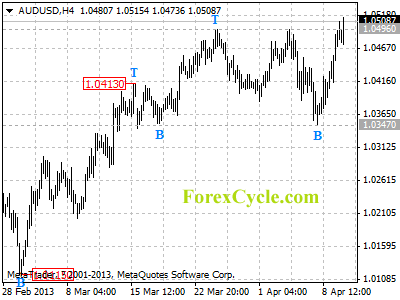
AUDUSD breaks above 1.0496 resistance
AUDUSD breaks above 1.0496 resistance and reaches as high as 1.0508, suggesting that the uptrend from 1.0115 has resumed. Further rise is still possible, and next target would be at 1.0600 area. Support is at 1.0435, only break below this level will indicate that lengthier consolidation of the uptrend is underway, then another fall towards 1.0300 could be seen.