Australia: The Home of World Beating Divdend Stocks

By MoneyMorning.com.au

Watching the markets is more like a geography lesson these days.

Last week it was Cyprus. This week it’s Japan.

What’s next? If the press is right, it’s Luxembourg.

Apparently the country’s financial system is too big relative to the size of the economy.

What should you do to prepare for the coming ‘Luxembourg-ageddon’?

We’re surprised you asked. Do what we are. Buy stocks before this rally really takes off…

If you wonder how we can back stocks with the world in never-ending turmoil, give us a moment to explain.

On Wednesday we went to the Bloomberg Australia Economic Summit in Sydney. Keynote speakers were Treasurer Wayne Swan, Shadow Treasurer Joe Hockey, and New South Wales Premier Barry O’Farrell.

Other speakers included Coca-Cola Amatil CEO Terry Davis, former Reserve Bank of Australia board member Warwick McKibbin, and housing bear Professor Steve Keen.

The big message I took away was that for all the talk about letting ‘free markets’ work, the reality is they’ve got no intention of letting that happen.

Every time someone said they believed in free markets, they quickly followed it with a ‘but’.

That tells us there’s not a chance in heck of an end to the meddling and money printing.

More Proof Money Printing Boosts Stocks

And while speakers at the Bloomberg summit didn’t commit Australia down the same path, they certainly didn’t object to it going on elsewhere.

In short, if the Australian economy doesn’t get into shape soon, the money printing you’ve seen overseas will happen here.

But even if it doesn’t, the international flow of new money has already hit the Australian share market. That will only increase as foreign central banks churn out more printed money.

And if you believe that money printing is only good for gold, not stocks, think again. The next chart proves a point we’ve made for some time:


Source: Business Insider

This chart only goes until the end of 2012. It doesn’t include the recent reaction to Japan’s money printing plans.

This has helped spur the US S&P 500 to an all-time record high:

It has even helped push the Australian stock market back above 5,000 points after more than a month of painful falls.

But even so, for most stocks the falls weren’t that bad. The benchmark index only fell 4.9% from the early March peak to the early April trough. That’s hardly what you’d call ‘crash’ territory.

As we said all along, it was and still is the time to buy stocks. We’ll show you another chart that explains our point further…

Still Something Left for Yield Hunters

The Reserve Bank of Australia recently released its latest chart pack showing key data on the Aussie and world stock markets. The chart that interested us the most was this one:


Source: Reserve Bank of Australia

The chart shows you the dividend yield for Aussie stocks compared to world stocks. As you can see, despite the recent Aussie stock rally, dividend yields are still much higher than non-Australian stock dividend yields.

Foreign investors can get nearly twice as good a yield in Australian dividend stocks as they can in stocks anywhere else.

This is a key point for big institutional investors. It won’t mean that they’ll invest every cent in Australia, but they will invest more than they have in the past.

The relatively stable Australian dollar helps the case for Aussie stocks. Since late 2010, the Aussie dollar has traded in a fairly tight range. The range has consolidated further since mid-2012.

Seeing as currency movements can have a big impact on stock returns, it’s important for foreign investors to know they’re dealing with a stable currency.

Don’t Miss the Money ‘Torrent’

But make no mistake, this stability won’t last forever. As long as central banks hold interest rates at record lows, and print money at a non-stop rate, investors here and overseas should take advantage of market dips in order to buy good dividend stocks.

You could wait and hope stocks will fall so you can bag an even bigger yield. But that’s a big risk. You risk missing out on a decent yield and capital growth if the central bank money ‘torrent’ pushes stocks higher.

You shouldn’t bet your house on the market (it’s still risky), but you could miss out on the best stock rally  in years if you stay on the sidelines.

Cheers,
Kris

Join me on Google+

From the Port Phillip Publishing Library

Special Report: TORRENT SIGNAL 3

Daily Reckoning: The Market Is High

Money Morning: Investors: Ignore Japan’s Yen Devaluation Game

Pursuit of Happiness: Why the NBN is Dead Before it’s Begun

Australian Small-Cap Investigator:
How to Make Money From Small-Cap Stocks

An Anarchist Squint at the US Jobs Report

By MoneyMorning.com.au

So the jobs report came out and rattled the market a bit. But there is a different perspective to this whole thing that I think is far more important. It also fingers a much more sinister trend afoot.

First, the conventional view: The unemployment rate fell to a new four-year low of 7.6%. Everybody knew that was bogus. It fell because half a million Americans left the job market. The unemployment figure the government publishes is a fiction anyway. It’s a government-manufactured number. I never really pay any attention to it, except to make fun of it, like I am now.

A somewhat less conventional view is to focus on job participation. This number is harder to fudge than the unemployment figure. It just shows you how many people are working or seeking work as a percentage of the civilian population (minus some adjustments for kids under 16, people in prisons, etc.).

Some people like this better and cite this chart as troubling:

I still don’t like this number.

The reason is that both figures are based on implicit assumptions that I find repulsive and evil. The idea is that the government should manage the economy to maximize employment. The idea is that higher is better. I don’t think any of these ideas are good ideas.

The Problem with the Economy (and Society)

Employment should be a residual, the end result of a free people making their own choices about how much or how little they want to work. Counting jobs misses the point entirely. It’s like people who say the economy needs to ‘grow faster’. Why? The growth rate should be a residual, the end result of many choices consumers make. It should not be something managed to hit a target.

People forget that the economy does not exist to create numbers for economists and taxes for governments. It exists as a result of people cooperating with each other and making trades to satisfy needs and wants.

The problem is that we live in a society riddled with government intervention at every level. What these interventions do is discourage people from working. Most commentators focus on the number of Americans on some kind of federal assistance. That’s only part of it.

The other part of it is that government regulations (created in partnership with big business) keep a lot of people from creating their own work. You can’t open a restaurant in your own kitchen, for instance, without a lot of hassle — if you can do so at all.

In fact, you could get in big trouble if you started serving meals to the public out of your house or back porch on a commercial basis. The government would shut you down and fine you at a minimum. It would do so under the guise of guarding the public’s health. (As if your incentive were to poison your neighbours.)

And if you believe that, you are a fool. What it is really doing is protecting the establishment. This is just one tiny example, but I could on for pages about how government discourages people from making their own living.

I’ve always liked this passage from Professor Roderick Long, from a piece back in 2008:

‘In the absence of licensure, zoning and other regulations, how many people would start a restaurant today if all they needed was their living room and their kitchen? How many people would start a beauty salon today if all they needed was a chair and some scissors, combs, gels and so on? How many people would start a taxi service today if all they needed was a car and a cellphone?

‘How many people would start a day care service today if a bunch of working parents could simply get together and pool their resources to pay a few of their number to take care of the children of the rest?

‘These are not the sorts of small businesses that receive SBIR awards; they are the sorts of small businesses that get hammered down by the full strength of the state whenever they dare to make an appearance without threading the lengthy and costly maze of the state’s permission process.

The assistance that small firms receive comes largely at the expense, not of larger firms, but of still smaller firms — or of those who would start such smaller firms if they could.’

But the government is opposed to such anarchic job creation. It always has been. The work of Professor James C. Scott is a particularly valuable aid in seeing why this is so. Scott is no scholar stuck in his ivory tower.

He lives in an 1826 Connecticut farmhouse. The 76-year-old raises chickens, shears sheep and keeps bees. He lived for two years in a Malaysian village and hiked all over the hills of northern Burma (Myanmar). He also writes terrific books. I highly recommend his Two Cheers for Anarchism.

Anyway, his work makes plain that the state from the beginning wants people organized in ways that make them easier to tax, keep track of and subdue. You can’t have a free people running unlicensed businesses out of their homes!

What the government wants is for people to take jobs with big companies. The government wants cows to milk. And it’s easier to milk them when they all hang out in the same spots. Federal assistance programs are there to quell rebellion and create dependency.

Too many unemployed people means a lot of time for meeting in coffeehouses plotting revolution. Better to give the sops something to keep them quiet, government thinks, while we dream up ways to create more tax-paying jobs that we approve of.

I recall a classic and much quoted passage from the anarchist Pierre-Joseph Proudhon (1809–1865):

‘To be governed is to be watched over, inspected, spied on, directed, legislated at, regulated, docketed, indoctrinated, preached at, controlled, assessed, weighed, censored, ordered about, by men who have neither the right, nor the knowledge, nor the virtue…

‘To be governed is to be at every operation, at every transaction, noted, registered, enrolled, taxed, stamped, measured, numbered, assessed, licensed, authorized, admonished, forbidden, reformed, corrected, punished.

‘It is, under the pretext of public utility, and in the name of the general interest, to be placed under contribution, trained, ransomed, exploited, monopolized, extorted, squeezed, mystified, robbed; then, at the slightest resistance, the first word of complaint, to be repressed, fined, despised, harassed, tracked, abused, clubbed, disarmed, choked, imprisoned, judged, condemned, shot, deported, sacrificed, sold, betrayed; and, to crown all, mocked, ridiculed, outraged, dishonored. That is government; that is its justice; that is its morality.’

Government will always fail in its efforts to make society into some kind of abstract image, to fit it into some preconceived plan of what it should look like. That’s why the economy reels from one crisis to the next. And that’s why there is so much unhappiness and angst in the employment market today.

Chris Mayer
Contributing Editor, Money Morning

Join Money Morning on Google+

From the Archives…

Only Lunatics Need Apply for This Stock Market Rally
5-04-2013 – Kris Sayce

The Run-on Effect of Aussie Housing on the Australian Stock Market
4-04-2013 – Murray Dawes

Good News in China’s Economy? Put This Date in Your Diary…
3-04-2013 – Dr Alex Cowie

‘Gold Only Rises During the Bad Times’ and other Fairy Tales
2-04-2013 – Dr Alex Cowie 

On Gold — Billionaire Investor Eric Sprott Says : ‘I’m in Alex Cowie’s Camp’
1-04-2013 – Dr. Alex Cowie

Peru holds rate steady, inflation still in target range

By www.CentralBankNews.info     Peru’s central bank maintained its policy rate at 4.25 percent, as expected, saying inflation is still in its target range and the economy is growing at a pace that is close to its potential.
   The Central Reserve Bank of Peru (BCRP), which has held rates steady for two years since April 2011, said economic growth has stabilized around its long-term sustainable level even though the sectors that are linked to markets abroad show weak performance.
    “Inflation is expected to coverage to the 2 percent target in the next months due to the improvement observed in the food supply conditions, due to a pace of growth of economic activity close to the economy’s level of potential output, and due to inflation expectations anchored to the target range in a context in which weak production indicators persist in the global economy,” the board of BCRP said.
    Peru’s inflation rate was 2.59 percent in March, slightly up from February’s 2.45 percent but down from January’s 2.87 percent, and within the central bank’s target range of 1.0-3.0 percent.
    Peru’s economy expanded by 6.3 percent in 2012 and in the fourth quarter Gross Domestic Product was up by 0.6 percent from the third quarter for annual growth of 5.9 percent, down from the third quarter’s rate of 6.8 percent.

  www.CentralBankNews.info

The First True Fitness Breakthrough in 25 Centuries, Part II

By MoneyMorning.com.au

I want to concentrate now on the impact of core cooling on sports and fitness.

The focus of Stanford scientists’ early cooling research was centred on recovery from hyperthermia. To get data about cooling, it was, of course, necessary to study subjects with high core temperatures.

The obvious, logical way to get those temperatures is through exercise. At the time, almost a decade ago, they had no idea that cooling would dramatically increase the efficiency of exercise.

Since the initial discoveries, multiple third-party researchers have validated the results in controlled studies. From endurance training to bench-pressing, studies show that core cooling enables gains comparable, or superior, to steroids.

Rather than spend time on the details of those studies, I will direct you to the AVAcore Technologies website, where a number of important papers are available for study. Go to the ‘How It Works’ link in the Technology section for downloadable papers.

Most of the studies and papers about the Grahn/Heller model, however, simply present evidence that their device works. I’d like to talk a little about why it works.

Breaking the Wall

So let’s start with heat. Our bodies can generate an enormous amount of heat. Under normal conditions, this heat is easily removed. When excess heat is not dissipated, however, the consequences can be lethal. Our brains and other organs are, essentially, cooked. Long before hyperthermia kills, however, excess heat can do serious damage on a cellular level.

Our biological systems, our bodies, have four primary protective mechanisms designed to prevent such damage. When you are doing hard physical labour or are exercising, you encounter all four. Together, they are what athletes metaphorically refer to as ‘the wall’.

I suspect we’ve all hit the wall. We are trying to work out but find that we are overcome by a kind of lethargic exhaustion that saps the will and makes it difficult even to move our limbs. If you’ve ever spent time in a gym, you’ve heard personal trainers and workout partners exhorting people, often at high volume, to push through that wall.

In fact, this is probably not particularly good advice, because the wall is your own safety mechanism for avoiding cellular heat damage. So how is the wall activated? What follows is my understanding.

When we are doing physical work, muscle cells create heat. That heat is moved via the circulatory system throughout your body, including your core organs. The AVA system responds by shunting blood to your radiator system. It’s not that hard to overwhelm this heat-removal system, though.

The body responds by increasing blood flow to the heat loss structures so that it can protect the most important and heat- sensitive locations, such as the brain and other organs. This is a kind of personal organ triage.

This results in a reduction of blood flow to the muscles in the extremities. Heat builds up in the muscles because the body is protecting the organs, and, in fact, damage is done to muscle and connective tissues that are no longer being cooled.

At this point, safety mechanism No. 1 is activated – sweating, which has limited impact. Then, the brain stops obeying your efforts to work muscles at maximum force. The muscle cells themselves remain capable of maximum contraction, but the brain refuses to send the signal.

When you’re overheated, you’re still capable of activating muscle cells. This is required to escape dangerous situations, but your ability to do work in the biological sense is severely reduced by the brain. This reduces the amount of heat being generated. Every instinct then tells you to stop what you’re doing and rest.

Sometimes, people ignore instincts, though. So there are other, more important safety mechanisms. One is activated at the DNA level in the chromosomes of the overheated muscle cells. Sensing excess heat, the heat shock family of genes begins transcribing or synthesizing proteins that do two things.

One, they act as chaperones to protect existing proteins because the folding or degradation of those proteins can cause all kinds of damage. Two, they shut down further gene transcription. The computer mechanism that runs your cells simply stops working until cell temperature returns to the safety zone. Personal computers do the same thing when their sensors detect dangerously high temperatures.

Also on the cellular level, your mitochondria, which produce usable biological energy (adenosine triphosphate, or ATP) from food energy, shut down. Specifically, the pyruvate kinase necessary for ATP production stops functioning outside of a very narrow temperature range.

Changing the Rules on Fitness

This also is a good thing. If these safety mechanisms did not work, excess physical activity would cook our muscles and connective tissues. Nevertheless, overheating of muscle cells during exercise seems to slow recovery and adaptation to progressive training.

The discoveries of Heller and Grahn have not just enabled an important training and potential new medical device, but they rewrite what we thought we knew about exercise and muscle growth. We now know that you can stop that cell cooking by restoring core body temperature to normal.

This means that recovery times after workout will also be dramatically shortened. In turn, this means that, with core cooling, we can work out more often and harder, increasing fitness levels much faster.

Patrick Cox
Contributing Editor, Money Morning

From the Archives…

Only Lunatics Need Apply for This Stock Market Rally
5-04-2013 – Kris Sayce

The Run-on Effect of Aussie Housing on the Australian Stock Market
4-04-2013 – Murray Dawes

Good News in China’s Economy? Put This Date in Your Diary…
3-04-2013 – Dr Alex Cowie

‘Gold Only Rises During the Bad Times’ and other Fairy Tales
2-04-2013 – Dr Alex Cowie 

On Gold — Billionaire Investor Eric Sprott Says : ‘I’m in Alex Cowie’s Camp’
1-04-2013 – Dr. Alex Cowie

Chile holds rate steady, inflation in line with target

By www.CentralBankNews.info    Chile’s central bank held its policy rate steady at 5.0 percent, as widely expected, with inflation expectations in line with the central bank’s target but economic activity in February below market expectations.
    The Central Bank of Chile, which last cut rates by 25 basis points in January 2012, said prices of raw materials had receded in recent weeks, including copper. Chile is the world’s largest copper exporter.
    International financial conditions remain stable but economic indicators have been mixed in the United States while recession continues in the euro zone and the Bank of Japan has announced a “major program of quantitative easing, which is reflected in a deprecation of the yen,” the bank said.
    “The labor market remains tight and domestic demand remains buoyant,” the bank said, adding that credit conditions were more restrictive.
    Chile’s inflation rate rose slightly to 1.5 percent in March from February’s 1.3 percent but was down from January’s 1.6 percent. The central bank targets inflation in a range of 2.0-4.0 percent.
    Chile’s Gross Domestic Product rose by 1.5 percent in the fourth quarter from the third quarter for annual growth of 5.7 percent, steady from the third and second quarter’s growth rates of 5.8 percent and 5.7 percent, respectively.

    The central bank’s latest poll of economists showed that interest rates were expected to remain unchanged at today’s meeting and for the rest of this year before rising by 25 basis points to 5.25 percent in two years. This forecast is slightly down from February’s poll which showed interest rates rising to 5.50 percent by March 2015.

    www.CentralBankNews.info

Serbia holds rate for 2nd month, sees inflation on target

By www.CentralBankNews.info     Serbia’s central bank held its benchmark interest rate unchanged at 11.75 percent for the second month in a row, saying its current restrictive stance would help ensure that inflation continues to decline and returns to the central bank’s target range in the second half of the year.
    The National Bank of Serbia paused last month after eight interest rate hikes since last June, but warned that the restrictiveness of its policy stance would be affected by consistent fiscal consolidation, financial market developments and the growth prospects of foreign trading partners. 
    Serbia’s inflation rate eased to 12.4 percent in February, down from 12.8 percent in January, but up from December’s 12.4 percent, and well above the central bank’s target range of 4.0 percent, plus/minus 1.5 percentage points.
    Although the economy continued to shrink in the fourth quarter of 2012, the national bank said exports were rising, supporting a “nascent economic recovery.”
    Serbia’s Gross Domestic Product shrunk by 0.3 percent in the fourth quarter from the third, the second quarterly contraction in a row, for an annual fall of 2.0 percent, the fourth quarter in a row where the economy has been contracting on an annual basis.

    Serbia’s inflation rate started accelerating in April last year after hitting a 30-year low of 2.7 percent and peaked at 12.9 percent in October due to higher agricultural prices and administered prices.
    The central bank estimates that Serbia’s economy contracted by 1.7 in 2012 and forecast an expansion of 2.5 percent in 2013.

    In March the central bank also said it expects inflation to return to its target but it did not say when.

   
    www.CentralBankNews.info

Charles Sizemore and Jeff Reeves Discuss the Microsoft Drubbing

By The Sizemore Letter

From Jeff Reeves at The Slant:

It was a rough Thursday for PC stocks Microsoft (NASDAQ:MSFT), Intel(NASDAQ:INTC), Hewlett-Packard (NYSE:HPQ) and the like.

That’s because late Wednesday, IDC reported PC sales slid nearly 14% in the first quarter, well below the 7.7% decline that was expected and the worst drop since the firm began tracking the sector in 1994.

Ouch.

To add insult to injury, Microsoft was downgraded Thursday by Goldman Sachs(NYSE:GS), Normura and Hilliard Lyons. All  cited the ugly IDC numbers.

So what’s going on? Can these companies — particularly Microsoft — evolve?

Charles Sizemore thinks so, based on hopes of getting Microsoft Office software on Apple and Android devices.

The tug-of-war between hardware and software always favored keeping Office native to the Microsoft Surface tablet. But that may be changing.

“It’s a bit of a game in that does Microsoft … minimize their plans to grow their tablet business by pushing Office onto their competitors, or do they hold out and see if they can generate margins?”

Charles thinks the rumor mill is strongly favoring a push onto Apple (NASDAQ:AAPL) devices powered by iOS or mobile gadgets running Android from Google(NASDAQ:GOOG).

There’s also hope for the xBox business with innovative in-home entertainment options, Charles says.


SUBSCRIBE to Sizemore Insights via e-mail today.

The post Charles Sizemore and Jeff Reeves Discuss the Microsoft Drubbing appeared first on Sizemore Insights.

With Cyprus in the news, Windsor shares its views.

By Windsor Brokers

Cyprus, April 10th, 2013 – Mr. Johny Abuaitah, Managing Director of Windsor Brokers Ltd. shares his views on the Cyprus situation.

“Before we talk about Cyprus, it is important to bear in mind that banks worldwide became involved in two successive global crises, starting with the derivative-mortgage crisis that originated from the USA in 2008 and Europe’s sovereign bonds crisis. The financial markets went into panic as many banks worldwide were stuck with bad investments and over 4 trillion dollars went into stabilization of banks and stimulus initiatives.

As a consequence of Europe’s bonds crisis, two local banks in Cyprus were stuck with bad investments and required financial assistance. These were not the first two banks and will not be the last to do so worldwide. We saw similar bailouts to major banks in the USA and Europe in the past 4 to 5 years.

Obviously, depositors and shareholders of the two local Cypriot banks suffered the consequences. However, investors who held funds below the amount of 100,000 Euros were protected in accordance with EU regulations.

As an EU member state with a significant geographic location, a favourable tax/legal system and advanced communication channels and infrastructure, Cyprus has been a high caliber services and business friendly center for many years.

There are two types of businesses in Cyprus; businesses that focus on the local market and international businesses that focus on foreign markets. International companies located in Cyprus mainly provide banking, shipping, insurance and investment services. These companies have continued their operations normally and were not directly affected as they were not linked to the local market but to many countries worldwide.

Windsor Brokers Ltd. is a licensed and regulated international investment firm. We were one of the first brokers to have been established and officially regulated in the Republic of Cyprus and have been active in the financial markets for the past 25 years. Windsor was also recently ranked by CySec as the number one broker with the
highest capital reserves among all regulated FX brokers in Cyprus.

Our real strength however as a company lies in our structured internal risk management policies. Thanks to many pre-established risk management policies, Windsor was not affected by the Cyprus bailout or the collapse of several important banks over the past decade. The optimal aim of our risk management policies is to ensure safety of client funds and that our operations can continue running normally under different circumstances, without compromising the quality and efficiency of our products, services and customer support.

As part of our risk management policies, client and company funds are held in segregated accounts in 11 first class banks over a geographically widespread area. Windsor did not hold any funds with the two banks in question in Cyprus. This policy allowed us to conduct our business as normal, even on Sunday the 17th of March – a day after
they announced that banks would close for a certain period of time. At Windsor, clients were able to trade and make transfers whether deposits or withdrawals to and from their trading accounts as usual, without any delays or limitations.

The main concern should therefore not only be based on a country and/or its banks as such. The real question that investors should ask themselves is not whether Cyprus and its banks are safe, but rather if the firm they are dealing with actually has a solid pre-established risk management framework.

That is a company’s safety net during tough times. After all, even if a broker located outside of Cyprus held funds in one of the two banks in question, they would have still been affected by the bailout.

At Windsor, thanks to our risk management policies and procedures, we are in a position to provide our clients and business introducers with a safe, ethical and reliable trading environment. Moreover, we are constantly taking up challenges to launch new products and services as well as innovative ways of trading that will best meet the
expectations of our valued customers.”

About Windsor Brokers Ltd

Windsor Brokers Ltd is licensed/regulated by CySec (Cyprus), EEA authorized by the FSA (UK), registered with the AMF (France) and BaFin (Germany) and complies with MiFID.

More information is available @ www.windsorbrokers.com


Gold & Silver “Take a Beating” from Goldman Sachs, the Fed & Cyprus Sales Plan – Now Denied

London Gold Market Report
from Adrian Ash
BullionVault
Thurs 11 Apr, 08:20 EST

The WHOLESALE PRICE of gold rallied from 1-week lows against the Dollar on
Thursday morning, but continued to fall for UK and Euro investors, hitting 4- and 2-month
lows respectively.

World stock markets continued to rise, while major government bonds slipped, commodities
held flat, and silver bullion rose back above $27.50 per ounce.

“Precious metals took a beating [on Wednesday],” notes Germany’s Commerzbank, with
gold “leading the way” by falling more than1.5%.

“Goldman Sachs came out with a top trade recommendation to sell Comex gold [futures],
which started the move down.”

That tip was followed by minutes from the US Federal Reserve’s latest policy meeting,
released at 9am after being mistakenly shared with lobbyists and lawmakers.

A leaked paper from the European Commission then included a proposal for Cyprus to sell
10 of its 13.9 tonnes in central-bank gold as part of the bankrupt island’s €10 billion bail-out
program.

“The Cypriot authorities have committed to sell the excess amount of gold reserves owned by
the Republic,” says the ‘template’ detailed in the paper.

“This is estimated to generate one-off revenues to the state of €0.4bn via an extraordinary
pay-out of central bank profits.”

Under the currency union’s political treaty, however, central banks must be
independent “from Community institutions or bodies, from any government of a Member
State or…any other body.”

That independence specifically includes not financing state deficits through the sale of
central-bank assets – a point stressed by the European Central Bank when it rebuked a 2009
attempt by Silvio Berlusconi’s administration to levy a 6% tax on the Banca d’Italia’s 2,450-
tonne gold bullion reserves.

“No such thing has been discussed or is in the process of being discussed,” said Aliki
Stylianou, a spokesperson at the Central Bank of Cyprus, to CNBC today.

“There are so many rumors flying about and this is just one of them.”

“Ten tonnes of gold [is] not enough to significantly affect the market,” adds Swiss refinery
and finance group MKS in a note.

But even so, the leaked plan “has been a psychological blow to the market,” counters James
Steel at London market-maker HSBC, quoted by the Financial Times.

“The gold price has taken a pretty hard tumble.”

Yesterday’s minutes from the US Fed’s mid-March policy meeting – where both interest rates
and bond-buying levels were left unchanged – meantime revealed that “a few participants”
would like to end its asset-purchase scheme “relatively soon.”

Other attendees – again un-named, with their voting status left unclear – felt that “economic
conditions would likely justify continuing the [quantitative easing] program at its current
pace at least until late in the year.”

“Many participants [however] emphasized” the need to see strong, sustainable improvement
in the US labor market before the current $85 billion-per-month is reduced.

Today in Tokyo, new Bank of Japan governor Haruhiko Kuroda – who last week launched
$1.4 trillion in QE over the next 2 years – tempered his previous comments by saying the
central bank will treat its 2% annual inflation target “flexibly”.

“If there is any serious asset market bubble appearing or approaching, of course we will take
necessary measures,” Kuroda told the FT in an interview.

The People’s Bank of China meanwhile said this morning that its foreign exchange reserves
grew 3.8% in the first 3 months of this year – the fastest pace in nearly 2 years – to hit fresh
all-time records above $3.4 trillion.

“[We’re seeing] an even greater demand for gold by China during price pullbacks, aside from
the general uptrend,” says a note from Mike Dragosits at TD Securities in Toronto,
commenting on Wednesday’s new gold import figures.

“China’s demand for gold has not wavered in the face of all the negativity in the market
surrounding the end to the gold bull run.”

Adrian Ash
BullionVault

Gold price chart, no delay | Buy gold online

Adrian Ash is head of research at BullionVault, the secure, low-cost gold and silver market
for private investors online, where you can buy gold and silver in Zurich, Switzerland for just
0.5% commission.

(c) BullionVault 2013

Please Note: This article is to inform your thinking, not lead it. Only you can decide the best
place for your money, and any decision you make will put your money at risk. Information
or data included here may have already been overtaken by events – and must be verified
elsewhere – should you choose to act on it.


Train Yourself to be a better Forex Trader with Forex Tester Software

Test Strategies & Train Yourself to be a better Forex Trader with a FREE TRIAL of this popular Simulator Software

Reduce your learning time by testing years worth of data in minutes!

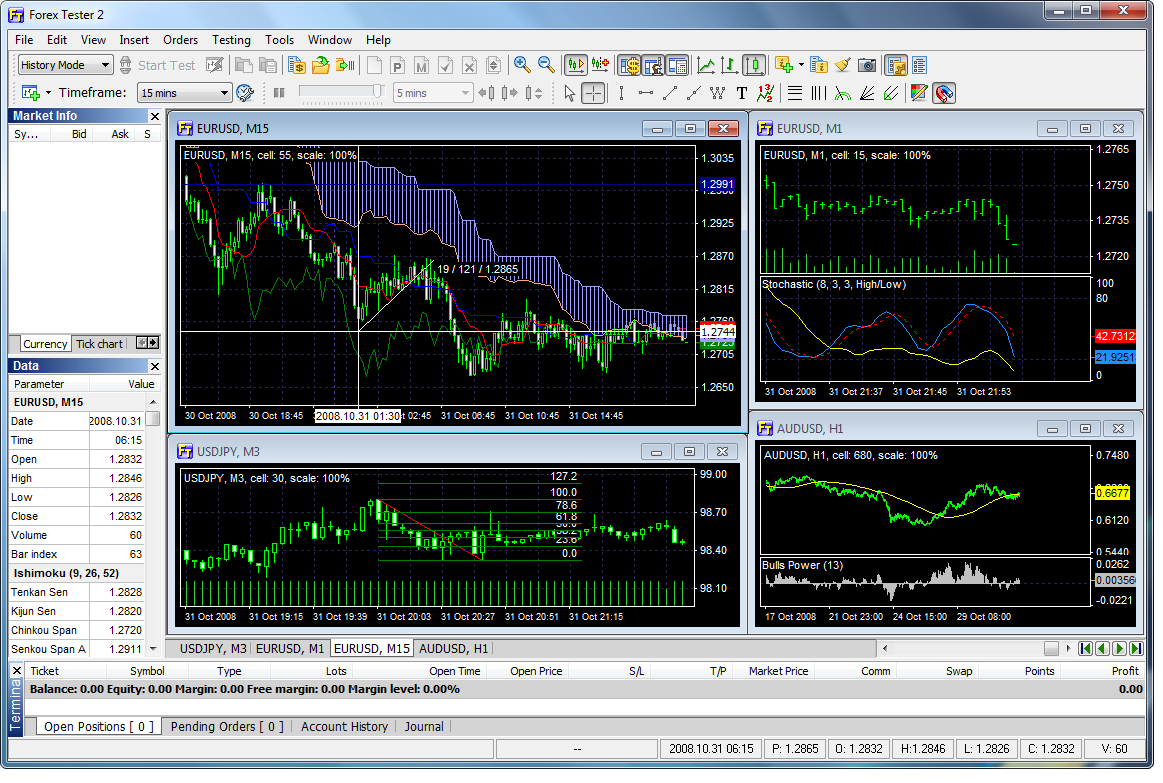
Forex Tester is a computer software simulator for the FOREX market that allows the user to practice trading and test out different trading strategies against real historical market data, rather than risk real money. The simulator gives the user total control over the testing process and testing speed.

Forex Tester is designed for all traders, including beginners who are just taking the first steps into the world of FOREX as well as professionals who want to hone their trading skills and further develop trading strategies.

Why it is better than a demo account:

While a live FOREX demo account can help in this process, practicing in real time can be too long and complex. For example, if your trading system only allows trading every day only at certain hours, the user will have to sit at the computer every day for weeks or months on end before you see how your doing. In other words, demo trading can take a long time to get meaningful results.

Forex Tester reduces learning from weeks to minutes and allows the trader to test strategies uninterruptedly.

Just some of Forex Tester 2 Features:

  • Multi-window interface
  • Any operation is a mouse click away
  • No need to learn or to write complex formulas
  • Test your strategies with popular indicators, including Moving Averages, Bollinger Bands, MACDs, Pivot Points, Parabolic-SAR, RSI, Stochastic, Keltner Channels, Heiken Ashi candles, and many more
  • Import historical data from any text format, including Metastock *.csv format and from MetaTrader 4 history format (*.hst)
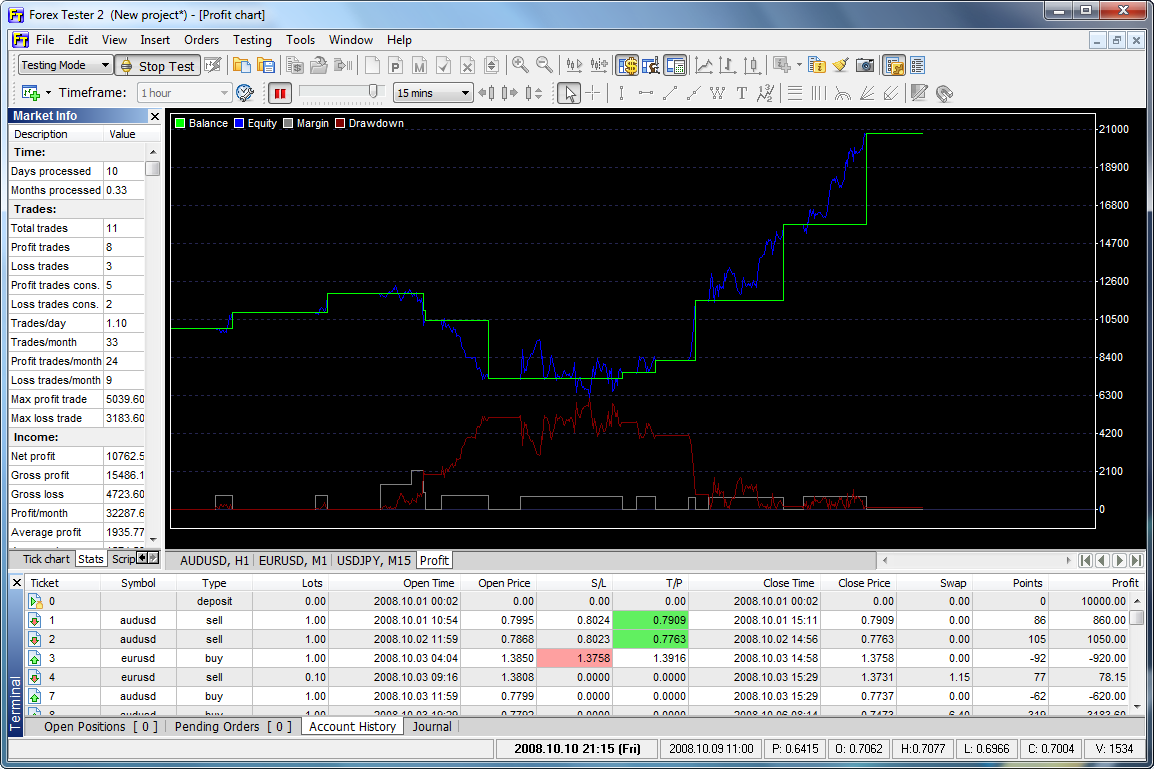
  • Customizable profit diagram that shows balance, equity, margin and drawdown
  • Test unlimited number of currencies together
  • Test unlimited number of strategies together (portfolio testing)
  • Unlimited history size

Try out the Forex Tester 2 Software for FREE before purchasing

Screenshots:


See Forex Tester 2 Trading Software